Enjoy some stuff I saved up to bring here today. Look/listen to whatever you care to, whenever you want. A few are shorts; 1 is a comic. The longer ones are worthy when you have a few minutes or can listen while you’re doing another thing. Relax and laugh! Open comments thread.
Note on 1/3: My apologies-this video has been taken down. Here is the link to Josh Johnson’s YouTube page; look around there. You’ll enjoy anything you choose! Again, I’m so sorry. It was there yesterday! 💐 Ali
and may the upcoming year be kind to us all. I think Barry already has some 2026 experience, even, so we do know it’s coming! 😀 I second Frazz’s Motion, and hope to see everyone around!
The United States is offering Ukraine security guarantees for a period of 15 years as part of a proposed peace plan, Ukrainian President Volodymyr Zelenskyy said Monday, though he said he would prefer an American commitment of up to 50 years to deter Russia from further attempts to seize its neighbor’s land by force.
U.S. President Donald Trump hosted Zelenskyy at his Florida resort on Sunday and insisted that Ukraine and Russia are “closer than ever before” to a peace settlement.
Negotiators are still searching for a breakthrough on key issues, however, including whose forces withdraw from where in Ukraine and the fate of Ukraine’s Russian-occupied Zaporizhzhia nuclear power plant, one of the 10 biggest in the world. Trump noted that the months long U.S.-led negotiations could still collapse.
“Without security guarantees, realistically, this war will not end,” Zelenskyy told reporters in voice messages responding to questions sent via a WhatsApp chat.
Ukraine has been fighting Russia since 2014, when it illegally annexed Crimea and Moscow-backed separatists took up arms in the Donbas, a vital industrial region in eastern Ukraine.
Details of the security guarantees have not become public, but Zelenskyy said Monday they include how a peace deal would be monitored as well as the “presence” of partners. He didn’t elaborate, but Russia has said it won’t accept the deployment in Ukraine of troops from NATO countries.
Trump and Putin discuss peace efforts by phone
Trump on Monday had “a positive call” with Russian President Vladimir Putin about the war, White House press secretary Karoline Leavitt said in a post on X. The two leaders had also spoken shortly before Trump’s talks with Zelenskyy on Sunday as the American president tries to steer the countries toward a settlement.
Later, to reporters, the U.S. president similarly characterized the call as “a very good talk” and said “we have a few very thorny issues, as you can imagine” in the negotiations to end the war.
“If we get them resolved, you’re going to have peace,” he added.
Putin’s foreign affairs adviser Yuri Ushakov said Trump is pushing Ukraine to seek a comprehensive peace agreement and not demand a temporary respite for its military through a ceasefire. Putin has insisted on a full settlement before any truce.
In Monday’s call, Putin told Trump that Ukraine attempted to attack the Russian leader’s residence in northwestern Russia with long-range drones almost immediately after Trump’s Sunday talks with Zelenskyy.
The attack “certainly will not be left without a serious response,” Ushakov said, adding that Moscow will now review its negotiating position.
Zelenskyy denied the Russian claim of an attack, describing it as an attempt to manipulate the peace process. He said it was “another lie” and came about because Moscow is unnerved by progress in peace efforts.
Russian Foreign Minister Sergey Lavrov said Ukraine launched an attack on Putin’s residence in the Novgorod region overnight from Sunday to Monday using 91 long-range drones.
“I don’t like it. It’s not good,” Trump said of the alleged attack on Putin’s home, confirming the Russian leader informed him of it during their call Monday morning.
Russia claims its forces are advancing
As indications suggest negotiations could come to a head in January, before the fourth anniversary of Russia’s full-blown invasion of Ukraine on Feb. 24, 2022, Putin on Monday claimed that Russian troops are advancing in the eastern Donetsk region of Ukraine and are also pressing their offensive in the southern Zaporizhzhia region.
Putin has sought to portray himself as negotiating from a position of strength as Ukrainian forces strain to keep back the bigger Russian army.
He emphasized at a meeting with senior military officers the need to create military buffer zones along the Russian border. “This is a very important task as it ensures the security of Russia’s border regions,” Putin said.
French President Emmanuel Macron said Kyiv’s allies will meet in Paris in early January to “finalize each country’s concrete contributions” to the security guarantees.
Trump said he would consider extending U.S. security guarantees for Ukraine beyond 15 years, according to Zelenskyy. The guarantees would be approved by the U.S. Congress as well as by parliaments in other countries involved in overseeing any settlement, he said.
Zelenskyy said he wants the 20-point peace plan under discussion to be approved by Ukrainians in a national referendum.
However, holding a ballot requires a ceasefire of at least 60 days, and Moscow has shown no willingness for a truce without a full settlement.
Ukrainians doubt Putin’s sincerity
On the snowy streets of Kyiv, the Ukrainian capital, people were skeptical about the chances of peace.
One military veteran who uses the call sign Sensei, in keeping with the rules of the Ukrainian military, said Putin’s record in power shows he can’t be trusted. Sensei joined the military in 2022 and was wounded that year during the battle for the Ukrainian city of Bakhmut. Now, he said, almost nobody from his company is still alive.
“But all these sacrifices, they are not in vain, because we need to prove … that we exist, that we are, that we have the right to our existence, to our territory, to our culture, to our language,” the 65-year-old veteran told The Associated Press.
Denys Shpylovyi, a 20-year-old student who was home for the holidays, said Trump’s willingness to accept Putin’s arguments has put Zelenskyy in a difficult situation.
“But I’m thankful for some progress. They are speaking, and maybe someday there will be hope,” he said.
Oleh Saakian, a Ukrainian political scientist, said it was a good sign that Zelenskyy is managing to build a relationship with Trump, although he noted that “nothing has been adopted yet, nothing has been signed yet.”
“I don’t see these negotiations bringing us closer to real peace, because they are based on equality between the aggressor and the victim, they are based on complete disregard for international law, and … disregard for European security,” he said.
___
Associated Press journalists Seung Min Kim in Washington, and Vasilisa Stepanenko and Volodymr Yurchuk in Kyiv, Ukraine, contributed to this report.
Considered sacred by several Mesoamerican civilizations, the Resplendent Quetzal remains culturally significant to this day. The Resplendent Quetzal likely inspired Quetzalcoatl, the “plumed serpent” god of Mesoamerica. Legend has it that Quetzalcoatl helped create Earth. Rulers and nobility wore headdresses made from this quetzal’s shining green feathers, which symbolically connected them to the god.
In some Mesoamerican cultures, it was considered a crime to kill a quetzal, so the plumes were procured by capturing the bird, plucking its long tail feathers, and setting it free. In several Mesoamerican languages, the term for quetzal can also mean “precious” or “sacred.”
These iridescent green tail feathers also symbolized spring plant growth to the Aztecs and Maya, who viewed the quetzal as the “god of the air” and as a symbol of goodness and light. The Maya also viewed the quetzal as a symbol of freedom (due to the difficulty of keeping them in captivity) and wealth and status, as its feathers were used as money. Even today, the currency of Guatemala is called the quetzal.
The Resplendent Quetzal is also the national bird of Guatemala, pictured on the country’s flag and coat of arms. It was thought to be the spirit guide of a Maya ruler and hero, Tecún Umán, who fought against the Spanish conquest. According to legend, Tecún Umán was killed as he fought the conquistador Pedro de Alvarado. As Tecún Umán lay dying, a quetzal flew down and landed on his chest, dipping its feathers in the hero’s blood. This is supposedly how the bird acquired its red breast and belly feathers.
This spectacular species belongs to the trogon family, a group of colorful, fruit-eating birds found in the Americas, Asia, and Africa. Other family members found in the Americas include the Golden-headed Quetzal, the Elegant Trogon, and Haiti’s national bird, the Hispaniolan Trogon.
Threats
Birds around the world are declining, and many of them, like the Resplendent Quetzal, are facing ever-increasing threats. Partners in Flight includes the Resplendent Quetzal on its Red Watch List as a species of high conservation concern, and also classifies it as a “Tipping Point” species — one that has lost more than 50 percent of its population within the past 50 years. (snip-so much more!)
December 27, 1914 The International Fellowship of Reconciliation (IFOR), an inter-religious peace group, was founded in Cambridge, England. “The International Fellowship of Reconciliation (IFOR) is an international spiritually based movement composed of people who commit themselves to active nonviolence as a way of life and as a means of transformation – personal, social, economic and political.” “Your goal is, in my opinion, the only reasonable one and to make it prevail is of vital importance.” –Albert Einstein, in a letter to the FOR Read more
December 27, 1971 Vietnam Veterans Against the War staged a peace protest at historic Betsy Ross House, Philadelphia.
December 27, 2002 North Korea ordered U.N. nuclear inspectors to leave the country and said it would restart the Yongbyon plutonium Plant to meet the fuel needs of its nuclear power reactor. The plant had been shut down and sealed by the U.N. in 1994 in exchange for shipments of fuel oil. When it was discovered that the North Korean had been pursuing a uranium-based weapons program, the U.S. and Japan, South Korea and the European Union suspended the fuel shipments.
December 27, 2002 1500 people gathered in Tel Aviv, Israel, the protest the Israeli military occupation of land beyond the 1948 borders of the country. With the slogans “End the Occupation” and “No to Racism,” and dressed mostly in black, they used a variety of means – drumming, singing, art installations, giving away olives and olive oil – to express their frustration and anger over the ongoing occupation. Alternative Ten commandments at demonstration in Tel Aviv, Israel The Coalition of Women for Peace also showed a movie, Jenin, Jenin, which had been banned for public showing, in defiance of police orders to stop the projector. Shown on a large outdoor screen, it was a narrative about the actions of the Israeli army the previous Spring in the occupied West Bank town of Jenin.
tRump’s illegal military war crime actions / tRump’s gift to the oil companies that paid him prior / This is a war crime and illegal / tRump trying to get other countries resources for his own profits / tRump grifts and seeking bribes
It has nothing to do with US national security and all the minerals / traffic rights to make ships pay / and the “rare earth” metals that tRump wants a piece of. It is about profit. Hugs
The paying tribute and bribes to tRump and his slush funds is so anti what the US should and used to stand for. It is the very thing the founding fathers were most against. The courts have gutted the holding of tRump to account but the emoluments cause is what this was designed to stop. Ask yourself if Biden / Obama / Clinton had been so blatant in demanding bribes would you tRump cult supporters be OK with it still? Hugs
The appeals court told her to have it completely wrapped up by the first week of January and this is not doing that. I expect more to happen fast with this. She ignored the appeals court order to please tRump.
“There was blood everywhere, screams, people crying, people who couldn’t take it and were urinating and vomiting on themselves,” the college student from Venezuela who sought U.S. asylum, said. “Four guards grabbed me, and they beat me until I bled until the point of agony. They knocked our faces against the wall. That was when they broke one of my teeth.”
Mr. Miller’s belief that seven decades of immigration has produced millions of people who take more than they give — an assertion that has been refuted by years of economic data — is at the heart of the Trump administration’s campaign to restrict immigration and deport immigrants already in the country.
tRump trying to hold on to power illegally / Jan 6th insurrectionists / trying to change the history everyone seen live / Scamming / Using the US treasury & taxpayer funds to pay off tRump cult members.
The U.S. Air Force will provide Jan. 6 rioter Ashli Babbitt with military funeral honors, reversing a Biden-era decision that denied her family’s request, according to a legal group that has represented her family.
In June 2025, the Pentagon agreed to pay the Babbitt family a $5 million “wrongful death” settlement. Below, see the latest from Proud Boys leader Enrique Tarrio, who is himself reportedly suing the DOJ for $100 million.
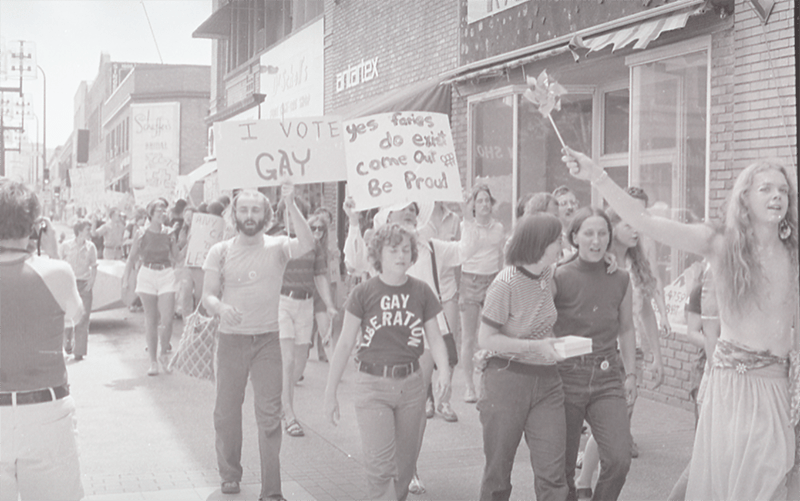
Gay Pride Day on June 28, 1975 in downtown Minneapolis. Credit: Minnesota Historical Society/John Hustad Papers/Tretter Collection in GLBT Studies/University of Minnesota
It was likely one of the last pieces of city policy passed that winter, just before the New Year, a parting gift from a progressive city council.
On December 30, 1975, Minneapolis became the first city to adopt a trans-inclusive LGBTQ+ non-discrimination ordinance. Fifty years later, the United States still lacks similar protections on a federal level.
Minneapolis was special in that the right people were there at the right time, said Seth Goodspeed, director of development and communications at OutFront Minnesota, the state’s largest LGBTQ+ rights organization.
“Minneapolis, since the early ’70s, has really been a leader in the gay rights movement,” he said. “That comes out of a lot of the student organizing at the University of Minnesota in the late ’60s.”
It was home to Jack Baker and Michael McConnell, two men who, in 1971, figured out how to legally marry, the first recorded same-sex marriage in history. It was also the stomping ground of Steve Endean, who founded the nation’s largest LGBTQ+ rights organization, the Human Rights Campaign.
Endean started lobbying a city alderman, Earl Netwal, in 1973 to pass a gay rights ordinance. His timing was just right. In 1974 progressives won the mayoral race and the city council. That year they voted 10-0 to ban discrimination on the basis of “sexual preference.”
The next year, Tim Campbell, a local activist and publisher of the GLC Voice in Minneapolis, penned a trans-inclusive policy.
“I think it was a pendulum,” Goodspeed said. “The pendulum was sort of swinging back toward a more conservative mayor and a conservative city council.” (snip)
…
“You’re able to say, ‘We passed this two years ago, last year, in the past five years, and nothing’s really changed, there is no boogeyman under the bed,’” he said. “We’ve had these protections since the 1970s and all these fears that they might have … just never came to fruition.”
The public spaces in Nantes, a city along the Loire River in the west of France, might at first glance seem just like those in any other part of Europe. Across the city, there are numerous bike lanes, bustling fresh produce markets and pretty, historic squares.
But on closer inspection, there are signs of a profound attempt to make the city, its facilities and its built environment a more equitable place for women.
Hundreds of streets now bear the names of women, including Joséphine Baker, Frida Kahlo and Clémence Lefeuvre — the little-known creator of local specialty beurre blanc sauce. School yards, once dominated by soccer pitches, have been remodeled to incorporate spaces for calm and creativity. Stations for breastfeeding have been built in the city center to improve maternal comfort and visibly counter stigma. Free tampon dispensers have been installed in libraries, gyms and all kinds of other municipal buildings.
The new Boulevard Gisèle Halimi, named after the feminist lawyer (1927-2020), is located in the Prairie-au-Duc district on the Île de Nantes. Credit: Patrick Garcon / Nantes Métropole.
These initiatives form part of mayor Johanna Rolland’s bold plan to make Nantes, which is home to around 700,000 people and is the sixth largest city in France, a ville non-sexiste, or non-sexist city. From redesigning public areas to reallocating spending and inaugurating France’s leading center to counter gender-based violence, Nantes is trailblazing the way to safer, less discriminatory urban life.
“We couldn’t wait for change anymore, we had to take action,” says Mahaut Bertu, the deputy mayor of Nantes in charge of equality, the fight against discrimination and the non-sexist city project. “Femicides continue every year. Women suffer harassment every day. [To make change], we had to take a hold of the problem ourselves.”
Shortly after taking power in 2014, Rolland and her team set about carrying out research and compiling statistics on the extent of inequality in Nantes, since at that point limited information existed.
The findings of the research, which included income, violence and public spaces, were striking. Analysis found, for example, that of the 3,000 streets in Nantes, fewer than four percent of them were named after women compared with more than 36 percent bearing men’s names. More broadly, it found that, in 2014, 58 percent of women aged 15 to 64 were employed, compared to 63 percent of men. And women represented 70 percent of the so-called “working poor” — those in employment but below the poverty line.
From that understanding, city authorities went about introducing women-centered policy and ramping up investment. One of the most pressing issues was responding to gender-based violence.
In France, 99 percent of women have been victims of a sexist comment or act at least once in their lives, according to the French High Council for Equality, an independent advisory body. “Far from declining, sexism is becoming entrenched, even increasing,” its 2024 report concluded.
In November 2019, following years of consultation with residents, women’s rights groups and nonprofits, the city opened Citad’elles, a shelter for women victims of violence that provides free, centralized support 24/7 — something that to this day does not exist anywhere else in France. (snip)
…
This year, a pilot study is taking place in four of the schools to assess the impact of the new playgrounds. Fischer’s team is also working with school employees to help promote fairer use of the spaces.
At the same time, Nantes has an initiative to fight “period poverty” and to help reduce the costly burden of women’s sanitary products.











 Scottie's Playtime