LGBTQ+ people are significantly more likely to stopped, harassed, and even falsely accused by the police than non-LGBTQ+ people, according to a new study released by the Williams Institute. As a result, LGBTQ+ people are less likely to contact the police when they need support, the study notes.
“Participants in these studies have described being stopped for no reason, encountering hostile treatment when police discovered they were transgender, and having officers assume they were engaging in sex work or other illegal activities,” the report explains, detailing some of its qualitative research. “Participants in several studies shared that they have concerns related to their LGBTQ identity about contacting the police or that they avoid police in order to avoid negative interactions.”
The Williams Institute study analyzed 25 years of research on interactions between the LGBTQ+ community and police. The data came from surveys, incident reports, government investigations, qualitative research, court cases, and anecdotal reports.
The findings might not be astonishing to those familiar with LGBTQ+ history, most notably the police raids that led to the Stonewall Riots. While decades have passed since crimes explicitly targeted LGBTQ+ social behaviors, the report suggests that changes only run so deep and notes that it was only 2003 when the Supreme Court ruled sodomy laws as unconstitutional.
The Williams Institute study analyzed 25 years of research on interactions between the LGBTQ+ community and police. The data came from surveys, incident reports, government investigations, qualitative research, court cases, and anecdotal reports.
The findings might not be astonishing to those familiar with LGBTQ+ history, most notably the police raids that led to the Stonewall Riots. While decades have passed since crimes explicitly targeted LGBTQ+ social behaviors, the report suggests that changes only run so deep and notes that it was only 2003 when the Supreme Court ruled sodomy laws as unconstitutional.
Just as the censorious Hays Code from the 1930s to ’60s still defines aspects of modern media, past criminalization of LGBTQ+ identities has created an environment where discrimination and harassment are common.
“The history of criminalization and related tensions between law enforcement and LGBTQ communities have legacies that extend to the present day,” the report acknowledges. The authors also note the new waves of anti-trans laws, pointing to the fact that “Recent years have seen a rise in anti-LGBTQ legislation, with many of these new laws imposing criminal penalties.”
The analysis of survey data revealed that as well as being more likely to be stopped, searched, arrested, and held in custody, LGBTQ+ people were also more likely to report verbal, physical, and sexual harassment and assault at the hands of law enforcement.
The study’s lead author, Joshua Arrayales, a law fellow at the Williams Institute, released a statement noting that all of this meant that LGBTQ+ people were less likely to report crimes, and that affects future data.
“Reporting crimes is essential for accurate crime statistics, proper allocation of crime prevention resources, and support services that address the unique needs of LGBTQ survivors,” Arrayales said.
As previous data already suggested that LGBTQ+ people are more likely to be crime victims, this research supports the idea that many crimes against queer people go unreported.
While LGBTQ+ people are more likely to be stopped by police, face harassment, and avoid contacting law enforcement as a result, the statistical differences grow for specific groups. People who are part of other marginalized groups reported higher incidence rates; one study showed that 46% of trans people said they’d avoid contacting the police if they were the victim of a crime.
The study also found that these interactions often had a lasting impact. A “growing body of research” suggests that there are “associations between police violence and harassment and binge drinking, stress, depression, and other negative health outcomes.”
The Williams Institute study also provides action items for improving the current situation: “(1) legal and policy reform, (2) enhanced accountability and representation within law enforcement agencies, (3) community engagement and support, and (4) continuous data collection and evaluation of these initiatives.”
Subscribe to the LGBTQ Nation newsletter and be the first to know about the latest headlines shaping LGBTQ+ communities worldwide.
Acting on Donald Trump’s orders, the FBI has reportedly begun showing up at the homes of peaceful protesters — a chilling escalation against Americans exercising their rights.
Sign up forThe Agenda, Them’s news and politics newsletter, delivered Thursdays.
Since June, Amtrak Police officers have arrested dozens of people for alleged “public lewdness” at New York City’s Penn Station, a sting operation that sent at least one person to an ICE detention facility — and which one university professor says was conducted, in part, through popular cruising apps like Sniffies.
The most important LGBTQ+ news and politics stories delivered straight to your inbox
As reported by NYC news outlet The City on Wednesday, Amtrak Police arrested 23 people for public lewdness in June — LGBTQ+ Pride Month — after making only eight such arrests in the five months prior. “Lewdness” arrest numbers have remained high since then, according to the NYC-based Legal Aid Society, which told The City that 20 people were arrested for lewdness at Penn Station in a single day in September.
One of the people arrested in June was David, a 31-year-old gay man and healthcare worker who said he was arrested while trying to use a Penn Station urinal on his way home from visiting a friend. He was wearing a rainbow bracelet. David told The City that he was taken to a cell inside the station and handcuffed to a wall, at which point he heard one officer tell others “we got three more fag pervs.” The lewdness charge against him was eventually dropped, but David said he was “traumatized” by the experience.
Immigration attorney Danney Salvatierra also told The City that one of her clients, an asylum seeker from Mexico, was arrested by Amtrak Police while using the bathroom at Penn in July and immediately handed off to ICE agents. Salvatierra said the arrest documents did not contain a charge against her client, who spent over a month in a detention facility before being released by a judge.
Last week, City University of New York (CUNY) law professor Jared Trujillo posted a TikTok video warning others about sting operations in Penn Station bathrooms. Trujillo claims that police have been using Sniffies to lure potential cruisers to a bathroom near a police booth, then arrest them. The arrests come during a marked increase in visibility for Sniffies through print media like The New Yorker and New York Magazine, though Trujillo pointed out that the platform wasn’t the only way police have targeted travelers.
Be safe!! Amtrak officers are using Sniffies and otherwise approaching people in the men’s Amtrak bathroom at Penn Statuon and charging them with lewdness #sniffies#NYC#civilrightawyer#amtrak#pennstation
“There are other instances where officers will approach someone who’s at a urinal, the officer will touch himself or will just peer at the person, and if the person — who is there just trying to pee — responds in any way, that person is then arrested or at least charged with lewdness,” Trujillo said in his video. (In his comments to The City, David said he felt “watched” by a nearby man shortly before his arrest.) Trujillo further noted that such stings closely resemble tactics used in the past decade by Port Authority police, who settled a class action lawsuit over similar arrests in 2022, promising to end plainclothes bathroom patrols and step up sensitivity training.
“Police have long weaponized constitutionally dubious tactics to target men they perceive as gay. Officers sometimes expose or touch themselves, or leer at men, only to arrest the man — even when he has done nothing wrong,” Trujillo told Them in a statement Wednesday. “These arrests are about padding numbers, not public safety. They waste resources and inflict trauma, and the charges can carry devastating immigration and employment consequences. The Port Authority police engaged in the same conduct until Legal Aid sued and forced a settlement in 2022.”
Trujillo urged LGBTQ+ people to exercise caution when dealing with the police to reduce the chance of harm. “If you are arrested, invoke your right to remain silent and ask for an attorney,” he told Them. “Do not consent to police searching your phone.”
The arrests come during a marked increase in visibility for Sniffies through print media like The New Yorker and New York Magazine.
Dashcam footage of a 22-year-old driver pulled over in a Jacksonville, Fla. traffic stop has left lots of viewers with questions about police and excessive force.
Video of a traffic stop in Jacksonville, Fla., has gone viral. And although the incident occurred nearly six months ago, thousands of outraged viewers are now raising questions about what they believe to be excessive force used on a young Black man.
According to an arrest report obtained by News4JAX, Will McNeil Jr. was pulled over just after 4:00 pm on February 19 because his car “did not have its headlights or tail lights illuminated in inclement weather.” The report reads that McNeil Jr. was not wearing his seat belt and became “verbally combative” with the officer when he was asked to show his identification.
But recently released dash cam video paints a different picture and has many on the internet seeking justice for the 22-year-old driver. The footage shows McNeil Jr. was wearing his seat belt at the time he was pulled over and asked officers to call their supervisor to explain why he was being held when there was no rain or fog at the time he was stopped.
According to First Coast News, officers reported giving McNeil Jr. several warnings that they would break his window if he did not step out of his car. Although those warnings cannot be heard in the video, officers can be seen breaking the driver’s side window and striking McNeil Jr. in the head several times before he was forcibly removed from his car and forced to the ground.
McNeil Jr. told News4JAX that the incident left him with several injuries, including a concussion.
“I suffered a chipped tooth; my tooth went through my lip, and they slammed me on the ground and on the concrete. I had to get nine stitches. I also had a concussion and now I suffer from short-term memory loss,” he said.
In a statement on X, the Jacksonville Sheriff’s Office acknowledged the incident and said they are conducting their own investigation into the events leading up to the young man’s arrest.
“We are aware of a video circulating on social media showing a traffic stop represented to be from February 19, 2025. We have launched an internal investigation into it and the circumstances surrounding this incident. We hold our officers to the highest standards and are committed to thoroughly determining exactly what occurred,” it reads.
But social media has been flooded with comments from people who believe the proof that the police department is in the wrong is in the video.
“You saw exactly what happened because it was completely recorded. Your own officers stated the reason for his arrest in the video, and he was not resisting. The force used was completely unnecessary. This was a blatant abuse of power. The City of Jacksonville should be ashamed,” wrote someone on X.
Attorney Ben Crump, who will be representing McNeil, told News4JAX that the video evidence is clear that the police were out of line, “It should be obvious to anyone watching this video that William McNeil wasn’t a threat to anyone. He was calmly exercising his constitutional rights, and they beat him for it.”
Mario Guevara reports from a local police traffic enforcement area in Stone Mountain, Georgia, on 29 April 2025. Photograph: Erik S Lesser/EPA
‘No Kings Day’ protests have swept the US as over 100,000 rally in New York City against the Trump administration’s policies on 14 June 2025.
Photograph: Carlos Chiossone/ZUMA Press Wire/Shutterstock
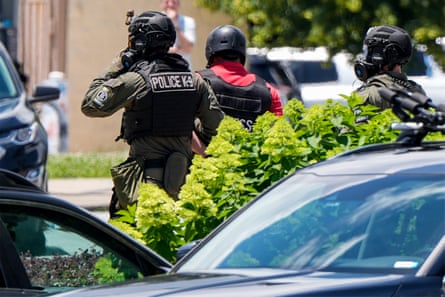
Law enforcement officers patrol as a ‘No Kings Day’ protest takes place in Dekalb county, Georgia, on 14 June 2025.
Photograph: Mike Stewart/AP
A Salvadorian reporter with an audience of millions, Mario Guevara was arrested while livestreaming a protest against Trump in June – and is still struggling for freedom
Prosecutors dropped the last remaining charges against Atlanta-area journalist Mario Guevara last week after he was arrested while livestreaming a protest in June. But the influential Salvadorian reporter remains penned up in a south Georgia detention center, fending off a deportation case, jail house extortionists and despair, people familiar with his situation told the Guardian.
Donald Trump’s administration has been extreme in unprecedented waysto undocumented immigrants. But Guevara’s treatment is a special case. Shuttled between five jail cells in Georgia since his arrest while covering the “No Kings Day” protests, the 20-plus-years veteran journalist’s sin was to document the undocumented and the way Trump’s agents have been hunting them down.
Today, according to the Committee to Protect Journalists,he’s the only reporter in the United States sleeping in a prison cell for doing his job.
‘No Kings Day’ protests have swept the US as over 100,000 rally in New York City against the Trump administration’s policies on 14 June 2025. Photograph: Carlos Chiossone/ZUMA Press Wire/Shutterstock
“For the first time in my life, I’m seeing what absolute power can do,” said Guevara’s attorney, Giovanni Díaz. “Power that doesn’t care about optics. Power that doesn’t care about the damage to human lives to achieve a result I’ve only heard about as some abstract thing that we heard about in the past, usually talking about other governments in the way that they persecute individuals. This is powerful.”
Around Atlanta, Guevara has been the person that immigrants call when they see an Immigrations and Customs Enforcement (Ice) raid going down in their neighborhood.
Guevara had been working for La Prensa Gráfica, one of El Salvador’s main newspapers, when he was attacked at a protest rally held by the leftwing group Farabundo Martí National Liberation Front (FMLN) in2003. The former paramilitary organization viewed reporters from his paper as aligned with the rightwing government, and threatened his life. He fled to the United States in 2004, seeking asylum with his wife and daughter, entering legally on a tourist visa.
He has been reporting for Spanish-language media in the United States ever since, riding a wave of Latino immigration to the Atlanta suburbs to career success and community accolades. He began reporting on immigration crackdowns under the Obama administration, one of the few reporters to note a tripling of noncriminal immigration arrests in the Atlanta area, as noted in a 2019 New York Times video profile of his work.. He meticulously documented cases and interviewed the families of arrestees. People around Atlanta began to recognize him on the street as the journalist chasing la migra.
His work continued through the Trump administration, drawing an audience of millions that followed him from Mundo Hispánico to the startup news operation he founded last year: MGNews or Noticias MG.
“It’s a unique niche that was met by Mario’s innovation and entrepreneurialism, if you will,” said Jerry Gonzalez, executive director of the Georgia Association of Latino Elected Officials and GALEO Latino Community Development Fund. “He developed a really strong relationship with the community. He developed significant trust with much of that community. And because of that, his eyeballs started increasing.”
An immigration court judge denied Guevara’s asylum claim in 2012 and issued a deportation order. Guevara’s lawyers appealed, and the court granted administrative closure of the case. He wasn’t being deported. But he wasn’t given legal residency either. Instead, the government issued him a work permit, his lawyer said. With a shrug, he went back to work.
Guevara is arguably the most-watched journalist covering Ice operations in the United States, a story that the English-language media had largely been missing, Gonzalez said. And local police were well aware of his work. He has been negotiating with them for access to immigration enforcement scenes for more than a decade.
“Mario Guevara is well known – sometimes liked sometimes not – but definitely well known by law enforcement agencies, particularly in DeKalb county and Gwinnett county, and also with federal agents, and particularly immigration agents,” Gonzalez said.
Gonzalez, among others, believes this put a target on his back in the current administration.
“It seems like law enforcement coordinated and colluded with the federal agents,” Gonzalez said. Gonzalez points to the misdemeanor traffic charges laid by the Gwinnett county sheriff’s office shortly after Guevara’s arrest in DeKalb county by the Doraville police department as evidence.
“The facts and the timeline indicate that pretty clearly to anybody that’s been following this,” he claimed. “In this regard it’s particularly troubling, given that he is a journalist and his situation. He had no reason to have been targeted for his arrest.”
The Department of Homeland Security has not responded to a request for comment about their relationship with local law enforcement. The Gwinnett county sheriff’s office said in a response to a lawmaker’s inquiry that it cooperates with Ice when deemed “mutually beneficial” but has not responded to requests for additional comment.
Doraville’s police chief, Chuck Atkinson, has not replied to an email seeking answers and fled from questions about the case at a city hearing. But Doraville’s mayor, Joseph Geierman, denied a connection between Ice and Doraville’s arrest of Guevara.
On 14 June, the day of his arrest, in Atlanta’s DeKalb county, Guevara darted around a Doraville police truck. A group of riot cops nearby took note. One shouted “last warning, sir! Get out of the road!”
Guevara was helmeted and wearing a black vest over his red shirt with the word “PRESS” in white letters. James Talley, an officer with the Doraville police department, was wearing an olive drab Swat jumpsuit with a helmet and gas mask.
A masked demonstrator set off a smoke bomb near the cops. Guevara ran into the street with a stabilized camera in hand to capture the police reaction and the crowd scampering out of the way, as was shown on a police body camera video.
Police had issued a dispersal order and were kettling protesters out of Chamblee-Tucker Road. They chased the suspected bomb thrower into the crowd, to no avail. But Guevara was in front of them on a grassy slope.
Police from DeKalb county managing the raucous protest had been taking verbal abuse from demonstrators for a while – a sharp contrast from other protests around Atlanta held that day. The protest was winding down. Body camera video from the event suggests Talley was in an arresting mood.
“Keep your eye on the guy in the red shirt,” Talley said to another Swat officer from Doraville. “If he gets to the road, lock his ass up.”
Talley pulled another police officer aside. “If he gets in the road, he’s gone,” Talley said. “He’s been warned multiple times.”
The other officer drew a finger across his chest. “The press?” Yep, Talley replied.
The three of them waited about 50ft away as a DeKalb county police officer approached Guevara on the hill, ordering him to get on the sidewalk. Guevara backed away from the officer, his attention focused on the recording, took two steps into the street, and the Doraville police pounced.
Guevara pleaded for the police to be reasonable.
“I’m with the media, officer!” Guevara said. “Let me finish!”
People shouted at the officers “That’s the press!” as they walked him handcuffed to a vehicle. “Why are you all taking him! He didn’t do nothing.”
More than one million people were watching Guevara’s livestream when he was arrested.
Trump has stepped up his rhetorical attacks on journalists since his inauguration. Last week, he described a reporter asking about warnings and emergency response in the Texas flooding disaster as “an evil person”, an epithet he has turned to with increasing frequency.
The Guevara case is a sign of increasing hostility toward a free press, said Katherine Jacobsen, a program coordinator for the Committee to Protect Journalists. She traced a through line from the Associated Press being barred from government briefings after it refused to accept the renaming of the Gulf of Mexico to the “Gulf of America”, then lawsuits and investigations reopened against media companies, then attacks on journalists covering protests in Los Angeles, then Australian writer Alistair Kitchen’s deportation seemingly in relation to his reporting on student protests.
“Next thing you know, we have Mario Guevara, a long time Spanish-language reporter in the Atlanta metro area, who is in Ice detention,” she said. “It’s growing increasingly concerning by the day.”
Guevara’s audience views it as more than an attack on press freedom, though. They view it as an attack on themselves.
“He’s a test case to push the envelope for legal immigrants that have committed no crime, to trump up charges against them,” GALEO’s Gonzalez said. “And the second piece is how to target journalists.”
Guevara’s arrest set off an immigration nightmare akin to the kind he has spent the last decade documenting.
His arrest on a Saturday led to a weekend in DeKalb county’s decaying jail and a bond hearing that Monday. A magistrate court judge granted Guevara a no-dollar bond, but by then Ice had become aware of the arrest and placed Guevara on a hold. The jail released him into Ice custody, and held him briefly in a metro Atlanta facility.
The next day, Gwinnett county charged Guevara with three misdemeanor traffic offenses, claiming that they were related to Guevara livestreaming a law enforcement operation a month earlier. The charges would be sufficient to keep him in jail and provide Ice an argument for his deportation at a federal bond hearing. The Gwinnett county sheriff’s office said Guevara’s livestreaming “compromised” investigations.
Guevara’s attorneys tried to work quickly, Diaz said. “The detained dockets are so backed up, and the immigration detention centers are so overwhelmed that what used to take us two or three days to get a bond hearing now is taking about a week,” he said.
Attorneys working for immigration enforcement argued in court that Guevara’s reporting constituted a “threat” to immigration operations.
Jacobsen with CPJ was listening to the hearing when the government made that argument.
“We felt a sense of alarm,” she said. “Alarm bells were raised by the government’s argument, as well as the judge not necessarily pushing back against the government’s argument that live streaming poses a danger to threaten law enforcement actions.”
Law enforcement officers patrol as a ‘No Kings Day’ protest takes place in Dekalb county, Georgia, on 14 June 2025. Photograph: Mike Stewart/AP
The immigration judge granted Guevara a $7,500 bond for the immigration case. But Guevara’s family was not allowed to pay it because government attorneys appealed the bond order to the board of immigration appeals. But it took seven days for the court to issue a stay to the government’s appeal. Meanwhile, Ice began playing musical jail cells with Guevara.
Over the course of the next three weeks, Ice shuttled Guevara between three different counties around Atlanta and eventually to the massive private prison Ice uses in Folkston, Georgia, 240 miles south-east of Atlanta on the Florida line.
“We weren’t surprised that they appealed, because the government’s reserving and in most cases appealing everything, even stuff where they shouldn’t appeal because they’re wasting everybody’s time,” Diaz said. “But we didn’t really know the breadth of what they were trying to do to him.”
Earlier this week, Todd Lyons, Ice’s acting director, issued a memo changing its policy on bond hearings, arguing that detainees are not entitled to those hearings before their deportation case is heard in court. Immigration advocates expect to challenge the move in court.
But Guevara is not facing a criminal charge. The Gwinnett county solicitor’s office dropped the traffic charges last week, noting that two of them could not be prosecuted because they occurred on private property – the apartment complex – and the third lacked sufficient evidence for a conviction.
For now, Ice has mostly kept Guevara in medical wards in jails even though he is healthy, Diaz said. “From the beginning, they’ve been keeping Mario under a special segregation because they’re claiming he’s a public figure. They want to make sure nothing happened to him.”
Doraville is a municipality of about 10,800 in DeKalb county with a separate police force, and had been asked to assist managing the protest in the immigrant-heavy Embry Hills neighborhood nearby. Protests have become a regular occurrence in DeKalb county since the Trump administration’s immigration raids began.
Doraville’s cops have displayed a more cooperative relationship with immigration law enforcement than many other metro Atlanta departments, and observers have raised questions about whether its police department arrested Guevara to facilitate an Ice detainer.
Geierman, the mayor, denied those accusations.
“The Doraville police department was not operating under the direction of, or in coordination with, US Immigration and Customs Enforcement (Ice) during the June 14th protest,” he said in a statement. “To the department’s knowledge, no Ice personnel were present at the event. Doraville officers were on site to support the DeKalb county sheriff’s office as part of a coordinated public safety effort.”
Observers have also questioned Guevara’s charges from Gwinnett county – ignoring traffic signs, using a communication device while driving, and reckless driving – that stemmed from an incident that occurred in May, a month before his arrest.
“Mario Guevara compromised operational integrity and jeopardized the safety of victims of the case, investigators, and Gwinnett county residents,” the department said in a statement.
But Gwinnett’s belated prosecution left his attorneys gobsmacked.
“In the narrative that they put out, they say he was livestreaming a police operation, and he was interfering,” Diaz said. “But when they went to a judge to get warrants, the only warrants the magistrate was able to sign for them was for traffic violations. I mean, that’s kind of telling.”
“I think the whole thing is suspicious,” he added. “From the beginning, just everything seemed they were really making efforts to make it difficult for him to go free.”
Marvin Lim, a Filipino American state representative whose district contains the apartment complex in Gwinnett in Guevara’s citation, has asked the sheriff’s office a detailed set of questions about the department’s relationship with federal immigration enforcement. He has not received an adequate response, he said in an open letter to the sheriff.
An array of six advocacy organizations challenged Gwinnett’s sheriff, Keybo Taylor, in a letter Tuesday over Guevara’s arrest and the sheriff’s posture toward immigration enforcement, demanding details about the relationship. GALEO, among them, also issued a separate letter Wednesday calling on Taylor to be transparent about the Guevara arrest.
Ice ‘politically targeted’ farm worker activist Juarez Zeferino, colleagues say
Read more
Guevara “was arrested while doing the vital work that journalists in a democracy do”, GALEO’s letter states. “Not only do the circumstances surrounding his incarceration and subsequent immigration detainment stir serious civil rights concerns, but they also build upon an expanding sense of fear and confusion in Georgia’s most diverse county.”
“I am being persecuted,” Guevara wrote in a 7 July letter seeking humanitarian intercession from, of all people, Nayib Bukele, El Salvador’s rightwing president.
“I am about to complete a month in jail, and I need to get out in order to continue with my life, return to my work, and support my family,” Guevara wrote. “I have lived in the United States for nearly 22 years. I had never been arrested before. In these past three weeks, I have been held in five different jails, and I believe the government is trying to tarnish my record in order to deport me as if I were a criminal.”
Guevara’s American-born son turned 21 this year, permitting him to sponsor Guevara’s green card and eventual citizenship. His application is pending, Diaz said. It may not matter.
“This is the first time I’ve ever seen a stay filed for someone who has no convictions, has almost no criminal history in 20 years, and only had pending traffic violations,” Diaz said.
“It’s clear that everybody’s working really hard to keep him detained.”
Allendale United Methodist Church in St. Petersburg, Florida. | Screenshot: Google Maps
A church in Florida has sent the local sheriff’s office an invoice after law enforcement officials parked their vehicles in its parking lot against the pastor’s wishes as they sought to carry out an unspecified investigation.
Allendale United Methodist Church in St. Petersburg, Florida, posted a photograph to Facebook on June 17 showing an invoice addressed to the Pinellas County Sheriff’s Office. The invoice requests a payment of $10,000 for “unauthorized use of [the] private church parking lot beginning at 6:00 AM.”
The invoice maintained that the presence of “13 vehicles occupying 17 parking spots” resulted in a “disruption to community access, operations, and congregational use of property.”
The document stressed that “continued use without coordination or consent may result in legal action or additional penalties,” vowing that the church will use payment received from the law enforcement agency to pay for “legal services for immigrants.”
Andy Oliver, the pastor of Allendale, who has been outspoken in his advocacy against U.S. Immigration and Customs Enforcement, posted a video to Facebook on June 17 documenting the presence of law enforcement vehicles in the church parking lot.
The video shows Oliver asking law enforcement officials if he could help them. One of them responded by telling Oliver, “We’re just waiting for an operation.”
“Is this involving ICE?” Oliver asked. Multiple law enforcement officials denied that the operation in question involved ICE but declined to provide further details other than stating, “It’s a Sheriff’s Office investigation.” After the official informed Oliver that the investigation did not involve anything on his property, the pastor asked the law enforcement officials to leave: “I don’t want policing to be staged here. Definitely, ICE is not welcome here.”
The officers agreed to leave, and a subsequent video posted to Facebook shows a dozen vehicles, both marked and unmarked, exiting the property.
Oliver’s Facebook page makes the dislike of ICE at his church clear. The cover photo features an image of the church taken at night with the words “Abolish ICE” displayed on the side of the building.
The most recent public post on Oliver’s Facebook page links to a TikTok video showing the pastor speaking at an anti-ICE protest outside the Pinellas County Jail while wearing an “Abolish ICE” shirt on June 14, three days before law enforcement officials showed up on his property.
During his remarks, Oliver denounced ICE as a “weapon” that is “soaked in white supremacy.”
“It is the child of manifest destiny and Jim Crow, the bastard cousin of slave patrols and Indian removal,” he added. “ICE is the cold breath of empire whispering ‘You don’t belong.'”
Oliver referred to the Bible as he attempted to make the case against ICE.
“Jesus fled to Egypt as a refugee. Jesus knew what it meant to hear soldiers marching with orders signed in the blood of empire and Jesus, he was executed by the state, hung between thieves as a warning to the masses. His death was legal.”
“So, don’t you dare tell me that the Gospel is neutral. Don’t you dare sanitize the cross while ICE cages children under fluorescent lights. I believe in resurrection, but too many are still hanging on crosses of barbed wire borders, prison buses, ankle monitors and courtroom numbers that decide who gets to stay and who gets disappeared. ICE disappears people. And if your theology doesn’t scream for abolition, then your theology is frozen,” he proclaimed.
Oliver shared his belief that “this nation has built its wealth on stolen land and stolen labor, and ICE is just the newest name for the oldest sin.” He described ICE as “white supremacy in a windbreaker, colonialism with a clipboard” and “hatred with a hollowed-out smile.”
“Our God does not deport, our God delivers,” he said. “Our God does not separate families, our God sets captives free.”
“ICE is sin, borders are a lie, cages are the devil’s architecture and silence is complicity. We won’t be silent. We won’t be complicit. We won’t stop until every child is reunited, every detainee is released and every system built on hate melts into history,” he vowed.
Oliver’s advocacy against ICE is not the only example of the pastor’s progressive activism.
In 2023, after the Florida Department of Education rejected an Advanced Placement African-American Studies course over concerns it promoted critical theory, Oliver offered the class at his church.
Since returning to the White House in January, President Donald Trump and his administration have ramped up enforcement of immigration law, which has seen waves of ICE raids seeking to detain immigrants who are in the U.S illegally.
While some have defended the measure as a bid to enforce the country’s immigration laws, as millions of immigrants are in the country illegally, some Christian leaders have voiced their displeasure with church properties being used in immigration raids.
In a January directive, the Trump administration rescinded the U.S. Department of Homeland Security’s policy limiting the deportation of illegal immigrants in so-called “sensitive areas.”
The Roman Catholic Diocese of San Bernardino in San Bernardino, California, issued a statement this week criticizing the “change and increase in immigration enforcement in our region and specifically our diocese.”
“We have experienced at least one case of [Immigration and Customs Enforcement] agents entering a parish property and seizing several people,” Bishop Alberto Rojas wrote.
“While we surely respect and appreciate the right of law enforcement to keep our communities safe from violent criminals, we are now seeing agents detain people as they leave their homes, in their places of work and other randomly chosen public settings.”
The Allendale United Methodist Church of St. Petersburg just ran a full page ad in the Tampa Bay Times in which it apologized to the LGBTQIA community for the harm that was done to it by the UMC. The add is a wonderful expression of love for all. Please find it and read it.
LGBTQ+ affirming Allendale United Methodist Church, located in St. Petersburg, FL, hosts drag queen-led worship services. In one service, drag queens perform and lip-sync to Dolly Parton’s version of “Go Tell It on the Mountain.” Allendale’s most recent Instagram post reads,… pic.twitter.com/h9omwmnhSE
Rev. Andy Oliver (he/him/his), pastor of Allendale United Methodist Church in St Petersburg, Florida, lights a candle wrapped in barbed wire in honor of alleged wife beater Kilmar Abrego Garcia—during his EASTER church service.

 Faefyx Collington (They/Them)November 18, 2025, 1:00 pm EST
Shutterstock
 Bloomberg/Getty Images


Mario Guevara reports from a local police traffic enforcement area in Stone Mountain, Georgia, on 29 April 2025. Photograph: Erik S Lesser/EPA
‘No Kings Day’ protests have swept the US as over 100,000 rally in New York City against the Trump administration’s policies on 14 June 2025.
Photograph: Carlos Chiossone/ZUMA Press Wire/ShutterstockLaw enforcement officers patrol as a ‘No Kings Day’ protest takes place in Dekalb county, Georgia, on 14 June 2025.
Photograph: Mike Stewart/AP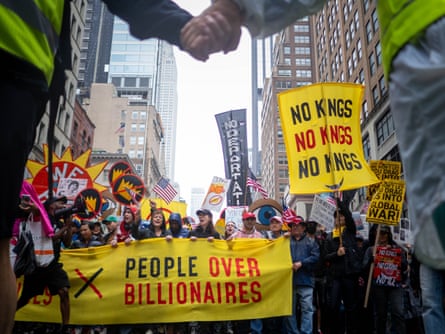

Allendale United Methodist Church in St. Petersburg, Florida. | Screenshot: Google Maps
 Scottie's Playtime