A.I. Does STEAM-

(Well, the Science and Art parts, anyway! This is originally a year-old story, republished by Cosmos today. I scouted around for some sort of an update, but didn’t find one. I still thought this is interesting, and at least now we know another area in which A.I. might be applied. I think that’s good to know, since A.I. does make mistakes, as noted below.)

The artificial intelligence program AlphaFold is proving to be a gamechanger for biological research, Imma Perfetto reports. This article was originally published in the Cosmos Print Magazine, September 2024.

October 11, 2025 Imma Perfetto
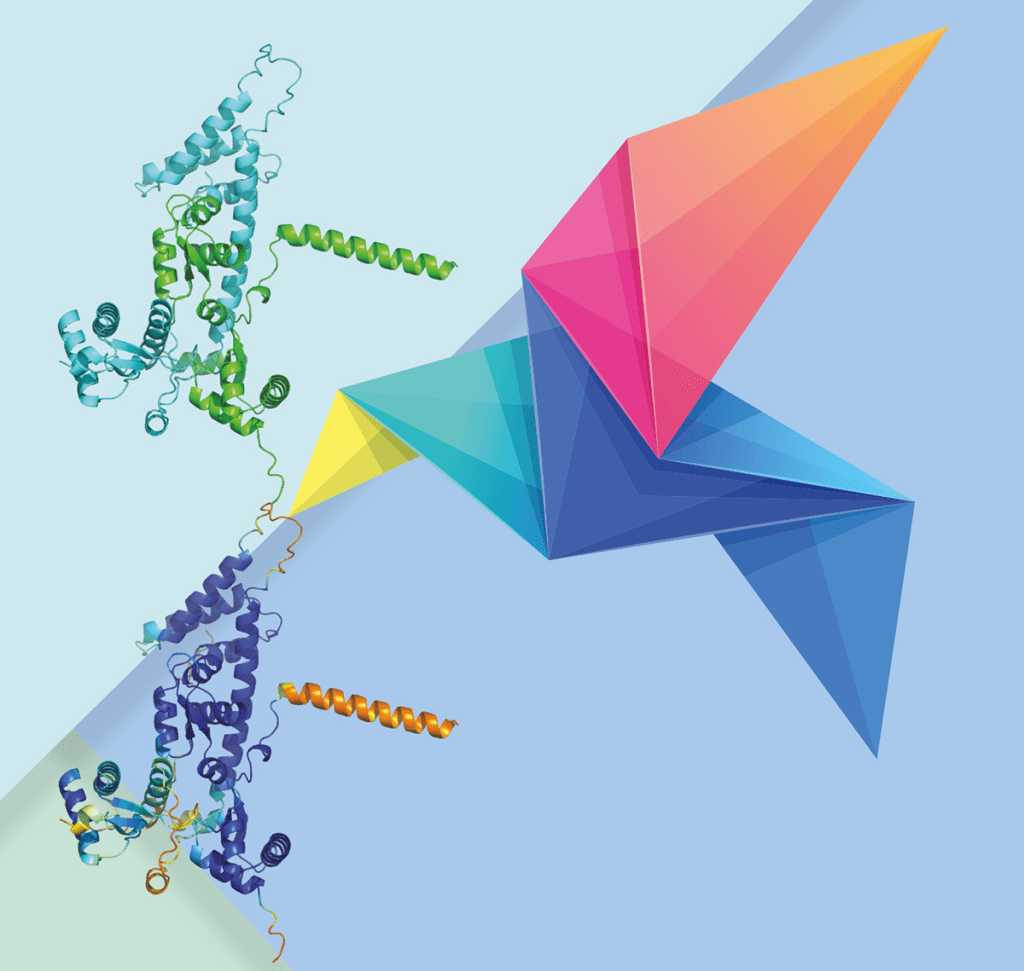
This artwork of an origami bird holds AlphaFold 3 predictions of a complex of two proteins (ScpA and ScpB) in its beak. The protein complex is important during cell division in bacteria. Top: ScpA is cyan and ScpB is green. Bottom: Confidence measures, where dark blue is very high confidence, light blue is confident, yellow is low confidence, and orange is very low confidence in the structural prediction. Credit: AlphaFold 3, Katie Michie.

A protein is made from of a chain of amino acids strung together like beads on a necklace. This chain spontaneously folds, like origami, into intricate pleats, folds, and loops through interactions between its amino acids. The resulting unique 3D structure largely determines its vital function within the lifeform. Solving the structure allows biologists to better understand how the protein works and design experiments to affect and modify it.

The smallest known protein, TAL, influences development of the fruit fly Drosophila melanogaster and has just 11 amino acids. The largest, Titin, is found in human muscle cells and is made up of roughly 35,000.

Proteins are far too tiny to inspect under a regular microscope. For decades researchers used complex experimental techniques, such as X-ray crystallography, nuclear magnetic resonance (NMR) spectroscopy, and cryogenic electron microscopy (cryo-EM) to solve their structures. It’s painstaking, time-consuming work that takes specialised skill and sometimes hundreds of thousands of dollars. And, as Kate Michie can attest, success is not always guaranteed.

“I spent four years trying to solve the crystal structure of a complex of two human proteins and got scooped. You know, I got nothing out of four years. I worked really hard at it, and it was a really difficult project. AlphaFold can calculate those in a few hours,” says Michie, who is chief scientist of the Structural Biology Facility at the Mark Wainwright Analytical Centre, of the University of New South Wales Sydney.

On 8 May 2024 Nature dropped a paper introducing the third and latest iteration of the artificial intelligence (AI) system AlphaFold, which predicts the 3D structure of proteins from their amino acid sequences. Google DeepMind and Isomorphic Labs, both subsidiaries of Alphabet, co-developed the new model. They say AlphaFold 3 (AF3) is “a revolutionary model that can predict the structure and interactions of all life’s molecules with unprecedented accuracy”. But, while AF3 has generated significant interest since its release, it has simultaneously sparked criticism among those in the scientific community.

Let’s take a closer look at how AI is changing the world of structural biology.

A revolution in protein structure

AF3’s predecessor, AlphaFold 2, was released as open source code in July 2021 and immediately changed the game in structural biology.

“I contacted the high-performance computation people and said, ‘we really need to get this piece of code running’. And then I asked my colleague, ‘Do you have any structures that you never submitted to the Protein Data Bank?’” says Michie.

The Protein Data Bank (PDB) is the global archive of all the experimentally solved structures for large biological molecules. As of June 2024, its estimated to include more than 220,000 proteins, which sounds like a lot until you consider the number of proteins we know of exceeds 200 million.

“My colleague sent me a sequence of a small protein he never submitted to the PDB, I ran it, and I just sent him the result. His email response to me was: ‘My mind is blown!’ And he said, ‘I immediately thought someone else must have solved the structure.’”

But they hadn’t, AF2 had accurately predicted the 3D structure of the protein from its amino acid sequence alone. What had taken years to describe experimentally had been done in just a few hours.

AF2 is a deep learning algorithm. In the world of AI that means it simulates the neural networks found in human brains. First, it takes the protein sequence of interest and searches several databases for similar proteins. By comparing these sequences, it can identify areas of similarity and difference to understand how the protein has changed across evolution.

For instance, if two amino acids are in close contact in 3D space then a mutation in one will usually be accompanied by a mutation in the other (to conserve the structure of the protein). But if they are far apart then they tend to evolve independently from each other. Using this to work out the relative positions of the amino acids, AF2 then takes its training on PDB structural data and iteratively constructs a 3D model of the protein’s structure with relatively high accuracy.

Scientists can take advantage of that predicted structure to accelerate their science by doing smarter, more strategic experiments in the laboratory right off the bat. “I’ve done work with some scientists working with immune complexes, and the models coming out of AlphaFold enable them to really trim down the number of animal experiments they do,” says Michie. “So instead of making say 20 CRISPR mice, they only might make two.”

Fos and jun transcription factors coloured in blues, yellow and orange depending on their confidence. A green box in the right is shaded to indicate binding confidence.
As seen in AlphaFold 3, a structural prediction of Fos and Jun transcription factors with the DNA sequence they bind. The top panel shows the model and confidence data, and the green chart shows the high confidence of them binding to each other. Credit: AlphaFold 3, Katie Michie.

Crystal clues

An accurate AlphaFold structure can also be the crucial missing piece of the puzzle that allows researchers to experimentally solve the structure using X-ray crystallography.

“One of my other colleagues is virologist and he’d been working on a protein that had eluded structural elucidation for 20–30 years. It was from the world’s first known retrovirus,” says Michie.

“The trick of crystallography is you need to know two components of the maths to solve them,” she continues. The diffraction data provided by X-ray crystallography gives you one of those components, but you don’t have the other: the phase.

Traditional methods of obtaining phase information had proved unsuccessful, until Michie suggested using AlphaFold instead.

“Immediately the structure came out. AlphaFold helped him get the crystals but then actually enabled him to phase the structure. It told us that the Alpha Fold model was very good, but it also fixed up this problem in structural biology.”

To Michie, AlphaFold represents a massive step forward: “it’s genuinely the biggest scientific advance in my career”.

“The Alpha Fold model was very good, but it also fixed up this problem in structural biology.”

Predicting the structures of life’s molecules

Proteins don’t exist in a vacuum. They move around, bind to and modify each other, and even form large, complicated complexes.

Peter Czabotar, joint head of the Structural Biology Division at WEHI, the oldest medical research institute in Australia, says one of the early limitations of AF2 was you could only ever get structural predictions of one protein, alone. “Often what you’re interested in is how different proteins will interact with each other. For example, we work on proteins that are involved with cell death and the interactions between those proteins will dictate whether a cell will live or die.”

The gap has since been bridged by other research groups adapting and building upon AF2’s open source code, and with the AlphaFold-Multimer extension in October 2021.

The newest version, AF3, extends upon this capability by predicting interactions of multiple proteins, and nucleic acids (DNA and RNA). It can predict the impact of ions and post-translational modifications – the addition of chemical groups to amino acids – on these molecular systems too. AF3 can also be used to predict how a selection of small molecules called ligands bind to proteins, though this is restricted to ligands that have high-quality experimental data available in the PDB.

“But where the real power is, something that we do a lot of, is in the drug discovery world,” says Czabotar. “And it is extremely powerful for that, potentially, but they haven’t enabled that in the way that it’s released. We’ve done drug discovery against cell death proteins, for example. I can’t take one of the drugs that we’ve worked with and see how it interacts with my target protein, I can only use the [ligands] that they’ve enabled us to use.”

That capability to predict the structure of novel drug molecules interacting with target proteins seems to be restricted to Isomorphic Labs, which was launched in 2021 to pursue commercial drug discovery.

AF3 uses a very different approach for this new suit of predictions: generative AI. After processing the sequence inputs, it assembles its predictions using a diffusion network, the likes of which power AI image generators. According to Isomorphic Labs’ website: “the diffusion process starts with a cloud of atoms, and over many steps converges on its final, most accurate molecular structure”. Diffusion has been applied to protein structure prediction before, for example, in the seminal RoseTTAFold diffusion (RFdiffusion) by the Baker Laboratory at the Institute for Protein Design, the University of Washington.

But generative AI is not without its limitations. AF3 will occasionally produce structures with overlapping atoms (this is physically impossible) or replace a detail of the structure with its mirror image (chemically impossible). As a generative model, it is also prone to hallucinations in which it invents plausible-looking structures – particularly in disordered regions of the protein that lack a stable 3D structure – similarly to how a text to image AI struggles to create realistic-looking hands. In-built confidence measures help to identify when AF3 isn’t so sure about its structural prediction, but ultimately it takes a scientist with understanding of the underlying structural biology to come along and identify what’s gone wrong, and why.

“It’s very, very powerful. But it doesn’t exclude the need to necessarily confirm things experimentally. Whether that is by solving structures themselves or by, for example, testing the structures in some way in an experiment,” says Czabotar.

Concerns about code

In a major departure from AF2, access to the newest iteration of AlphaFold is limited to a web server and for non-commercial research only. “We have various structure-based drug discovery projects and some of them are purely academic, as students, PhDs and honours projects. But we also have had commercial partnerships, because that’s a way to push your discoveries into a clinical setting,” says Czabotar. “So generally, anything that is going to make an impact is done by an academic lab in a commercial partnership. Now, I guess it puts us in a bit of an awkward situation. Even if we could look at our compounds bound to the target [protein], there’s some projects where we won’t be able to do it because, you know, we’ve ticked a box.”

AF3’s accompanying Nature paper was also published without the source code, but with a ‘pseudocode’ instead – a detailed description of what the code can do and how it works. This prompted an open letter to the Editors of Nature, published 16 May and endorsed by more than 1,000 scientists as of June.

The letter raised concerns that “the absence of available code compromises peer review” and that the pseudocode released would “require months of effort to turn into workable code that approximates the performance, wasting valuable time and resources”. Access to the web server was also initially capped at 10 predictions per day, which the letter stated, “restricts the scientific community’s capacity to verify the broad claims of the findings or apply the predictions on a large scale”.

The sentiments appear to have hit home. Shortly after the letter’s release, DeepMind’s Vice President of research, Pushmeet Kohli announced via X that they would double the daily job limit to 20 and are “working on releasing the AF3 model (incl weights) for academic use … within 6 months”.

On 22 May Nature responded in an editorial, stating its reasoning for publishing the paper without code: “the private sector funds most global research and development, and many of the results of such work are not published in peer-reviewed journals. We at Nature think it’s important that journals engage with the private sector and work with its scientists so they can submit their research for peer review and publication.”

In the meantime, other researchers won’t be sitting idly by until the code release at the end of 2024. Already, multiple teams are racing to develop their own open source versions of AlphaFold 3, without any strings attached.
“Rarest of Its Kind”

Now Here’s A Thing We Can Use, From Carl Sagan, Bless Him!

Reblogging This, Because Likely We Can All Use A Pointer About Mindful Breathing, Especially Before Sleep

I can do box breathing, but it takes more effort to do properly than I want to expend if I want to settle to sleep. This idea is the very thing, though! A person can do it any time; I did it for the little bit of time it takes to read MM’s post, and lowered my heart rate 3 BPM. It’s great!

Now Here’s A Thing We Can Use, From Carl Sagan, Bless Him!

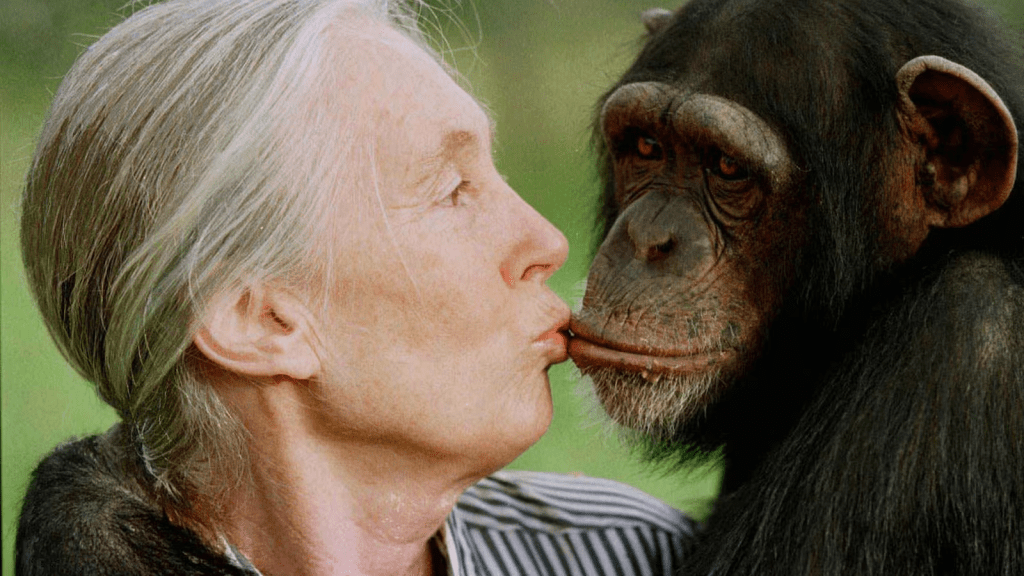
Jane Goodall, the celebrated primatologist and conservationist, has died

(I’m very sorry to read this. -A)

Jane Goodall, the conservationist renowned for her groundbreaking chimpanzee field research and globe-spanning environmental advocacy, has died

By HALLIE GOLDEN – Associated Press Updated 37 minutes ago

Jane Goodall, the conservationist renowned for her groundbreaking chimpanzee field research and globe-spanning environmental advocacy, has died. She was 91.

The Jane Goodall Institute announced the primatologist’s death Wednesday in an Instagram post. According to the Washington, D.C.-based institute, Goodall died of natural causes while in California on a U.S. speaking tour.

Her discoveries “revolutionized science, and she was a tireless advocate for the protection and restoration of our natural world,” it said. (snip-MORE on the page)

https://www.springfieldnewssun.com/news/nation-world/jane-goodall-conservationist-renowned-for-chimpanzee-research-and-environmental-advocacy-has-died/2BQI7LDKS5L3NHS3GEH6X5M624/#

For Science!

Debris from World Wars now home to thriving wildlife communities

September 29, 2025 Velentina Boulter Velentina Boulter is science journalist based in Melbourne.

Composite image, or orthomosaic, of the wreck of Benzonia lying partially on top of the wreck of Caribou, in the “Ghost Fleet” of World War 1 shipwrecks in Mallows Bay, USA. Credit: Duke Marine Robotics and Remote Sensing Lab

Two recently published studies showcase how underwater human structures can become essential habitats for marine life, with discarded munitions and ships from the World Wars now home to vibrant ecological communities.

The first study found that more marine life lives on World War II munitions on the Baltic Sea floor than on the surrounding sediment. Some of the marine organisms can tolerate the high levels of toxic compounds leaking from the unexploded bombs, as long as there is a hard surface for them to live on.

In a separate study, published in Scientific Data, researchers from Duke University’s Marine Robotics and Remote Sensing lab mapped a “Ghost Fleet” of World War I shipwrecks which have become habitat for a variety of wildlife, such as ospreys.  

“For the first time, the composition and structure of epifauna on the surface of marine munitions are described,” write the authors of the first study, which has recently been published in Communications Earth & Environment. Epifauna refers to sea creatures that live on the seafloor.

Unused explosive munitions were often disposed of by dumping them at sea prior to the signing of the 1972 London Convention on the Prevention of Marine Pollution. The team used a remotely controlled submersible to examine a dumpsite in Lübeck Bay in the Baltic Sea to investigate the impact the munitions have had on marine environments.

A remote controlled submersible robot with visible cameras and sensing equipment sits on the deck of a boat
The remotely controlled submersible Käpt’n Blaubär being inspected on the deck of RV Alkor during the research cruise AL628, March 2025. Credit: Ilka Thomsen, GEOMAR

Only 2 of the 9 objects examined were intact. The other 7 were in varying stages of degradation, which meant the explosive chemicals were exposed.

They identified the munitions as being from discarded warheads from V-1 flying bombs which were used by Nazi Germany in the late stages of World War II. Concentrations of the explosive compounds, mainly TNT and RDX, were found to vary between 30 nanograms and 2.7 milligrams per litre in the surrounding water.

Despite this, an average of about 43,000 organisms per square metre (m2) were found living on the munitions, with only 8,200 organisms per m2 on natural sediment nearby.

“On the individual objects,” write the authors, “the majority of epifauna was found on metal carcasses, while the exposed explosive was usually free of visible overgrowth.”

These results suggest the advantages of living on the surfaces of munitions outweigh the potential exposure to explosive and toxic chemicals for many marine organisms.

“This suggests that the high measured explosive chemical concentrations are not sustained long-term, or that they, in fact, do not have a major negative effect on nearby organisms,” the authors write.

“Overall, the epifaunal community on the dumped munition in the study area reaches a high density, with the elevated metal structures providing a suitable habitat for benthic organisms.”

While the munitions seem to be an important habitat for this local ecosystem, the researchers suggest replacing them with a safer artificial surface that does not contain explosives to further benefit marine life.

Composite image of the ghost fleet of mallows bay with individual wrecks labelled. Credit duke marine robotics and robotics sensing lab 850

Composite image of the entire “Ghost Fleet” of Mallows Bay, with individual wrecks labelled. Credit: Duke Marine Robotics and Remote Sensing Lab

In the second study, a team of researchers conducted aerial surveys to capture images of 147 abandoned World War I steamships at Mallows Bay on the Potomac River in Maryland, USA. It is the largest known shipwreck in the Western Hemisphere.

“Since their arrival, the ships have become an integral part of the ecology at Mallows Bay,” write the authors.

“However, sea level rise, sediment infill, plant colonisation, and physical deterioration are changing the nature of these shipwrecks over time.”

Like the previous study, the researchers found a variety of creatures have made the shipwreck their home. One of the species includes the endangered Atlantic sturgeon, which uses the ship as its nursery. 

A photograph of a coastal environment where submerged ships can be seen covered in vegetation as they form artificial islands
As the “Ghost Fleet” shipwrecks become islands, they are shaping both the coastal and aquatic habitats of Mallows Bay. The “Three Sisters” are pictured in the bottom right. Credit: Duke Marine Robotics and Remote Sensing Lab

The authors are hopeful their map will be an insightful resource for future ecological and archaeological research into the area.

“These data and products will enable researchers to monitor and study the changing terrestrial and aquatic ecosystems,” write the authors.

“The use of unoccupied aircraft systems allows for the creation of detailed orthomosaics and digital surface models, which provide valuable baseline data for archaeological, geological, and ecological assessments.”

Originally published by Cosmos as Debris from World Wars now home to thriving wildlife communities

What Think You?

Keynote Address: Unscripted — Introducing Intergender Dynamics and Reframing Gender-Type Prejudice by Richard Hogan, MD, PhD(2), DBA

Read on Substack


🇨🇦 Richard Hogan PhD (Mathematics) · MD (Neuroscience) · PhD (Ethics) · DBA (HRD) Architect of IGD & IBT | Rewriting the language of gender justice Essays, theory, and verse from the post-binary frontier


Keynote Address: Unscripted—Introducing Intergender Dynamics and and Reframing Gender-Type Prejudice


Good morning.

It is an honor to stand before you today—not to echo what has already been said, but to challenge what we’ve long accepted. To offer not just a critique, but a new vocabulary. A new lens. A new way forward. I hope you are ‘not toned deaf’.

For decades, we have used the term misogyny to name and confront systemic prejudice against women. It has served us well in many ways. But today, I ask you—academics, legal scholars, educators, and clinicians—to consider this: What if the language we use to fight injustice is now limiting our ability to understand it?

We are living in a post-binary world. Gender is no longer a fixed category—it is a spectrum, a performance, a negotiation. And yet, our frameworks remain tethered to binary logic. Misogyny is one such tether. It is gender-specific. Directionally fixed. It presumes a hierarchy that no longer reflects the lived realities of our students, our patients, our communities.

So today, I introduce a new term: Intergender Dynamics , or IGD .

IGD refers to the patterned, reciprocal, and often asymmetrical interactions between individuals and groups across the gender spectrum. It is not just about identity—it is about relationship . It is about how we perform, police, and punish gender roles in our daily lives. It is about the emotional labor we assign, the authority we grant, the empathy we withhold.

And this is not just a sociological insight—it is a medical one.

Recent research in gender-affirming care has shown that transgender and gender-diverse individuals face significant barriers in accessing health services, often due to systemic bias and relational discomfort within clinical settings. Studies have also revealed that patients with dynamic or evolving gender identities experience distress not only from institutional exclusion, but from interpersonal dynamics—how they are spoken to, validated, or dismissed by providers.

In pediatric and adolescent medicine, clinicians are now trained to recognize how gender-role expectations affect mental health, emotional development, and access to care. The World Professional Association for Transgender Health and The Endocrine Society have emphasized the importance of relational sensitivity—not just diagnostic accuracy—in improving outcomes.

What does this tell us?

It tells us that IGD is not just a theoretical tool—it is a clinical imperative . If we want to reduce disparities, improve mental health, and foster trust in care, we must understand how gender prejudice operates not only in policy, but in conversation. In tone. In silence.

To complement IGD, I also propose Intergender Bias Theory (IBT) —a framework for analyzing the structural architecture of gender-type prejudice. IBT examines how laws, curricula, and institutional norms enforce rigid roles and marginalize deviation. Together, IGD and IBT offer a dual lens: one that captures both the macro-level scaffolding of bias and the micro-level choreography of interaction.

Let me be clear: retiring the term misogyny is not an act of denial. It is an act of evolution. It is a recognition that our language must grow with our understanding. That our frameworks must reflect the complexity of the world we now inhabit.

So I call on you:

  • Academics , to revise your syllabi, your research, your theories.
  • Legal scholars , to expand your statutes, your protections, your definitions.
  • Educators , to teach emotional literacy, role deconstruction, and relational justice.
  • Clinicians , to recognize IGD in patient care and to train for relational sensitivity.

Let us move from naming contempt to understanding connection. Let us shift from binary blame to systemic insight. Let us unscript ourselves—and write a new language of liberation.

This is not the end of a conversation. It is the beginning of a movement.

Thank you.

(snip-To read in Latin, French, Spanish, or Arab, click through to the Substack)

Two more clips from The Majority Report. One on RFK destroying the CDC and the other on the how bad Chuck Schumer is as an opposition party leader.


Sunday AM Art & Science

Drawing is learning: the birds of the subantarctic

September 12, 2025 Bonnie Koopmans

(Some) Penguins of the Subantarctic. Watercolour and gouache on toned paper, 30 x 23cm. Credit: Bonnie Koopmans.

Visit the remote, windswept islands of the subantarctic with scientific illustrator Bonnie Koopmans. Here she shares her artworks of a few of the extraordinary birds that call this harsh yet majestic environment home. This article originally appeared in the Cosmos Print Magazine in December 2024.

Between Tasmania and Antarctica, there are a series of tiny, isolated islands on the cusp of the Southern Ocean. Many people don’t even realise they exist, but these frigid and windswept islands host a surprising diversity of seabirds.

Last summer, I was awarded a Heritage Expeditions True Young Explorer Scholarship to visit this remarkable region. My time in the subantarctic included visiting 4 of the island groups in the region: The Snares, the Auckland Islands, and Campbell Island (belonging to New Zealand) and Macquarie Island (belonging to Australia).

As a keen naturalist and natural history illustrator, I jumped at the chance to experience an area so remote, expensive and difficult to access. Additionally, as a keen birder, the subantarctic represented an opportunity to see some stunning birds in the most beautiful, harsh and unique environment.

Mother and chick king penguins.
FEED ME. King penguin (Aptenodytes patagonicus) in gouache on toned paper, 23 x 30cm. Credit: Bonnie Koopmans.

As an illustrator and visual learner, drawing is one of my methods of learning about something, whether it’s internalising technical species differences or figuring out the general shape and character of an animal.

Field studies and drawing from life, especially, allow an artist to deeply observe and capture behaviour and colours in a way that is otherwise very difficult to achieve. The illustrations featured in this article are a mixture of studies done in the field, and finished paintings I completed once I was back home.

Flipping through a bird field guide, the seabird section often seems remarkably… grey. For me, it was finally seeing these birds in the flesh that made me realise how special they are.

While seabird identification can be complicated (groups such as prions are notoriously difficult to identify), observing them in person can provide other avenues to assist the process, as even aspects such as manner of flight can help with distinguishing species.

Albatross with their immense unflapping wingspan, and their endearing rambling stride on land. Petrels following the ship almost the entire journey, arcing left and right past the stern. Penguins effortlessly rocketing through the water, only to reach land and be slowed to a shuffle by their own tiny legs.

Certainly, the highlight of the trip were the penguins, with 6 species seen on the trip, each absolutely bursting with personality and charm. To see a breeding colony of penguins is an unforgettable sight (and sound!) and, if anything, it’s a wonder to see immense congregations of penguins at all considering the history of whaling and sealing in the subantarctic.

Various kin penguin and chick illustrations and colour tests.
King Penguin Studies. King penguin (Aptenodytes patagonicus) in watercolour and ink, 20 x 20cm. Credit: Bonnie Koopmans.

A devastating history

During the 1800s and into the early 1900s, whaling and the subsequent products of oil and baleen were critically important to the newly industrial world. Whale oil – and later seal and penguin oil – provided crucial lubricants for machinery, and fuel for lighting. The subantarctic was heavily targeted.

Besides the obvious and huge impact these activities had on whale, seal and penguin numbers, another long-term conservation issue was the introduction of livestock and establishment of stowaway predators. These affected the local populations of seabirds, especially.

Once the whale and seal populations were low enough that it was no longer financially viable for whalers to remain on the islands, they turned their livestock loose, and pigs, cows, cats, and stowaways such as rats were left to run rampant.

As many of the seabirds breeding on these islands had never had to contend with land-based predators, the introduction of cats and rats devastated their populations. Surprisingly voracious predators which were, similarly, introduced as a food source were weka – flightless rails endemic to New Zealand.

As ground dwellers, the rails could easily eat chicks of ground burrowing seabirds such as common diving petrels and blue petrels. Additionally, livestock such as pigs and cows caused environmental damage and drastically changed the composition of habitat through grazing and trampling.

Various shag illustrations and colour tests.
Shag Studies. Watercolour and ink on cotton rag, 35 x 28cm. Credit: Bonnie Koopmans.

Today’s birdlife

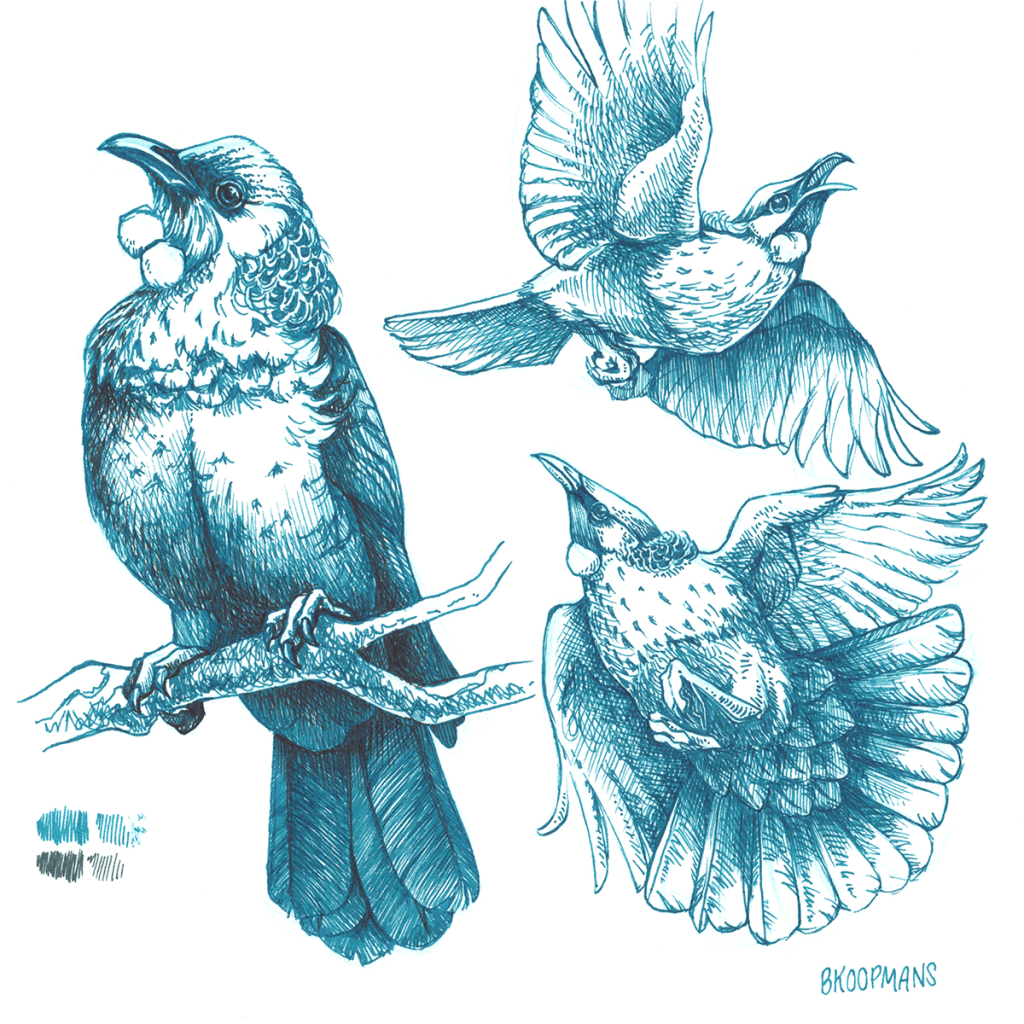
Beyond the obvious seabird residents, these islands are home to a wide variety of other bird species, from red-crowned parakeet and New Zealand falcon, to several species of passerines (‘perching birds’) such as tomtit, New Zealand bellbird and tūī.

Being so isolated, the islands tend to have a high level of endemism, meaning they are unique to the location. Several species of shags, ducks and snipe have diverged evolutionarily between the islands over time.

Campbell teal (Anas nesiotis) represent the impact introduced predators can have, but are also an incredible success story. This charismatic flightless duck was presumed extinct following the introduction of brown rats to Campbell Island during the period of whaling. A precariously small population was discovered on Dent Island, which rats hadn’t managed to reach, and in 1987 some of the teal were removed from the wild to establish a captive breeding program and ensure the preservation of the species.

Various campbell teal illustrations and colour tests.
Campbell Teal Studies. Campbell Teal (Anas nesiotis) in graphite and watercolour, 20 x 20cm. Credit: Bonnie Koopmans.

Due to the significance of the New Zealand and Australian subantarctic islands in terms of unique habitat, flora and importance for the fauna that eke out an existence in the region, there have been some incredibly successful efforts to remove predator species and rehabilitate these islands.

Macquarie, Enderby, and Campbell Islands are now free of introduced pests, with New Zealand’s Department of Conservation aiming to embark on their most ambitious pest eradication yet, targeting Auckland Island at 46,000ha.

Campbell teal have been reintroduced to Campbell Island as of 2004, and bird populations generally have been improving with lessened pressure from predation.

The precariousness of life on these tiny specks of land in the middle of a vast ocean makes them so unique and important to the creatures that thrive there.

All 4 of these island groups are now protected as UNESCO World Heritage Sites for outstanding universal value.

True Young Explorer scholarship applications open each year in spring for summer voyages. You must be aged 18–30 and share your experience of the subantarctic.

Southern royal albatross in environment (cliffs, ocean, purple flowers).
A Room with a View. Southern royal albatross (Diomedea epomophora) in watercolour and ink on cotton rag, 35 x 28cm. Credit: Bonnie Koopmans.

Originally published by Cosmos as Drawing is learning: the birds of the subantarctic