Lawrence v TX and More, in Peace & Justice History For 6/26

June 26, 1894

Mohandas Gandhi (center) as a young lawyer in Durban, South Africa in 1894
Mohandas Gandhi, a young Indian lawyer from Porbandar in Gujarat province, urged the Natal (a province in South Africa) India Congress to run a campaign of education and peaceful noncooperation to assert and protect their rights as ethnic Indians in South Africa. Within days of Gandhi’s arrival in South Africa the previous year, though he was a British subject and South Africa was under British rule, he had been thrown off a train, assaulted by a white coachman, denied hotel rooms, and pushed off a sidewalk because his skin color defined his status and limited his rights.
“Truly speaking, it was after I went to South Africa that I became what I am now.
My love for South Africa and my concern for her problems are no less than for India….”

– Mohandas Gandhi, 1949

“Gandhiji was a South African and his memory deserves to be cherished now and in post-apartheid South Africa. The Gandhian philosophy of peace, tolerance and non-violence began in South Africa as a powerful instrument of social change . . . This weapon was effectively used by India to liberate her people.”
– The Rev. Martin Luther King, Jr. [King used the same techniques to combat racism in the U.S.]

“We must never lose sight of the fact that the Gandhian philosophy may be a key to human survival in the twenty-first century.”
– Nelson Mandela, in his speech opening the Gandhi Hall in Lenasia, South Africa, September 1992 [source: anc.org.za] Mohandas Gandhi, 1949]

Also known as Mohandas Karamchand Gandhi was born on October 2, 1869, in Porbandar, India. He was known to the Indian people as Mahatma, meaning great-souled, a person revered for high-mindedness, wisdom and selflessness. Ghandiji adds a suffix to the last name to show respect.
He was also known as Bapu which means great father.
June 26, 1918
Pacifist and socialist organizer Eugene V. Debs was arrested for having given an anti-war speech in Canton, Ohio, ten days earlier. He was charged with “uttering words intended to cause insubordination and disloyalty within the American forces of the United States, to incite resistance to the war, and to promote the cause of Germany,” This last was despite his repeated and vehement criticism in the speech of Germany and its landed aristocracy, known as the Junkers.
“And that is war in a nutshell. The master class has always declared the wars; the subject class has always fought the battles.The master class has had all to gain and nothing to lose, while the subject class has had nothing to gain and all to lose — especially their lives.”
June 26, 1945
On the stage of San Francisco’s Veterans Auditorium (now known as the Herbst Theatre in the center of the War Memorial Veterans Building), delegates from 50 nations signed the United Nations Charter, establishing the world body as a means of saving “succeeding generations from the scourge of war.”

The U.S. Post Office issues a commemorative envelope.
The Germans had just surrendered to the Allied forces in April; the war in the Pacific continued.
Read the Preamble (included is full text of the Charter) 
Collection of photos from Founding of the UN – San Francisco Conference  (I love looking at these photos! -A.)
June 26, 1955

Flyer used to promote the Freedom Charter
The South African Freedom Charter was adopted at the Congress of the People at Kliptown near Johannesburg.
“We, the People of South Africa, declare for all our country and the world to know that South Africa belongs to all who live in it, black and white, and that no government can justly claim authority unless it is based on the will of all the people . . . .”
The Congress of the People in Kliptown 
Text of the Charter: 
June 26, 1963
President John F. Kennedy addressed 120,000 West Berliners and concluded his speech, “All free men, wherever they may live, are citizens of Berlin, and, therefore, as a free man, I take pride in the words: “Ich bin ein Berliner!” The East German government had stopped all travel and commerce between the Soviet-controlled and the American/British/French-controlled parts of the city in 1961. west.

John F. Kennedy, West Berlin, June 26, 1963
They then built a 166 km-long (103 miles) wall to separate the two Berlins and to stop emigration from east to west.
Watch the speech 
June 26, 2003
The U.S. Supreme Court found a Texas “anti-sodomy” law unconstitutional, overruling, and apologizing for, the 1986 Bowers v. Hardwick decision. The 6-3 decision in Lawrence v. Texas said that citizens have the “right to liberty under the Due Process Clause gives them the full right to engage in private conduct without government intervention.”
Text of the decision 

Bill White: In Trump’s world facts are inconvenient, irrelevant

Bill White: In Trump’s world facts are inconvenient, irrelevant

My wife and I recently returned from a Danube River cruise — no, it’s not blue, the waltz notwithstanding — and we had a wonderful time.

One of the many pleasures of these relatively small river cruises is all the interesting people you get to meet from around the world. This time around, we spent most of our time with Canadians and Australians, who seemed to enjoy our company once they determined we shared their low opinion of our president.

When one of the Canadians we dined with several times learned that we had signed on for a “Sound of Music” tour of Salzburg, Austria — featuring fountains, mountains, cityscapes, trees, a church and other locations from the movie — he told a nice story about an Austrian who emotionally described to him his love for their traditional folk song, “Edelweiss.”

I had read that the song actually was written just for the movie and had no significance for Austrians, which our guide confirmed the next day. So when our new friend repeated his story at dinner that evening, I politely corrected him, explaining that although some Austrians may have embraced the song — the Edelweiss is their national flower — it was a Rodgers and Hammerstein creation.

I won’t say our friend was crestfallen, but he did seem disappointed. I should add that I have a long tradition of spoiling people’s favorite stories, in part through the urban legend columns I used to write semiregularly.

So here’s the question. Is the truth really that important, if it spoils a good narrative?

After all, we’re in what some people have characterized as the Post-Truth Era, ushered in most recently by Donald Trump, his congressional lapdogs and Fox News but immortalized much earlier by Adolf Hitler and his Nazi regime. Falsehoods abound, not just in the White House but all over social media.

Here’s how the European Center for Populism Studies explained the Big Lie technique.

The big lie is the name of a propaganda technique, originally coined by Adolf Hitler in “Mein Kampf,” who says “The great masses of the people … will more easily fall victim to a big lie than to a small one,” and denotes where a known falsehood is stated and repeated and treated as if it is self-evidently true, in hopes of swaying the course of an argument in a direction that takes the big lie for granted rather than critically questioning it or ignoring it.

Pssst. If that doesn’t sound familiar, wake up.

Hitler used it to blame his country’s problems on his best available scapegoat, Jewish people. Trump and company have broadened this approach to encompass multiple scapegoats — immigrants, foreigners, transgender people, people who are “woke” because they encourage social justice and care about the future health of our planet — and to big lies involving the 2020 election and so many other subjects that we’re numb to it. He lies about everything, and his supporters don’t seem to know or care.

I remember when the idea of act checking first emerged in political coverage. Instead of just quoting politicians who were fudging the truth, the fact-checkers would point out when they were lying or exaggerating, in the case of The Washington Post by assigning up to four Pinocchios for the most egregious falsehoods.

Some politicians would correct themselves in future pronouncements. Others wouldn’t bother.

Trump, the ultimate Pinocchio, is oblivious to Fact Checking. He just plows ahead — “They’re eating the dogs, they’re eating the cats!” — repeating the same misinformation over and over at rallies, news conferences, debates. Facts are irrelevant.

Perhaps most amazingly, his long-since-debunked fraud allegations regarding the 2020 election are being incorporated into Oklahoma’s public-school curriculum. Elsewhere, facts about racial injustice, climate change and our nation’s history have been altered or eliminated from public school curricula to suit the MAGA agenda. Kinglike, Trump even is punishing colleges, states and others who won’t go along with his determination to impose “1984”-style Newspeak.

I think at least some Trump followers — particularly Republican elected leaders — know he is lying. But because it suits their preferred narrative, they go along. That’s frightening enough. Even scarier, though, are the people who are too dim, lazy or Foxcentric to figure out that we’re not being overrun by bloodthirsty killer immigrants or that non-straight men and women aren’t a threat to our military, our children or anything else, not to mention that Trump really lost the 2020 election, that the rioters storming the Capitol weren’t the true victims of Jan. 6, that indiscriminate ICE goon squads aren’t the best solution to illegal immigration and that vaccinating our children continues to be a very good idea.

They don’t just accept the lies. They spread them. That’s why we must be advocates for the truth, correcting and even confronting falsehoods, at rallies, on social media, in conversations. Ignorance is not bliss. It’s fueling our country’s descent into unrecognizable autocratic chaos.

“Eidelweiss” may be trivial. But innocent people being demonized? Trust in our elections destroyed? Our constitutional guarantees shredded? Our planet’s climate threatened? Long-dead diseases given new life?History rewritten?

Speak up. The truth is worth defending.

This is a contributed opinion column. Bill White can be reached at whitebil1974@gmail.com. His Threads handle is whitebil2000. The views expressed in this piece are those of its individual author and should not be interpreted as reflecting the views of this publication. For more details on commentaries, read our guide to guest opinions at themorningcall.com/opinions.

Peace & Justice History for 6/21

June 21, 1877
 
The Molly Maguires
Four members of the Molly Maguires were hung for murder in what was then Mauch Chunk, and in Pottsville, towns in Pennsylvania’s Carbon County. The Molly Maguires was a secret and violent Irish-Catholic organization of coal miners formed to combat the oppressive working and living conditions in the anthracite coal region of the state.
Read more (2 links)
June 21, 1908
A Women’s Sunday Suffrage rally, supporting the right of women to vote, drew several hundred thousand to London’s Hyde Park from all over the country.

Women were encouraged to wear “the colours” – white (for purity), green (hope) and purple (dignity) – and in “as fetching, charming and ladylike a manner as possible.” As the Yorkshire Daily Post put it: “At least one half of the crowd was composed of the sort of people you would expect to see at a suburban garden party.”
The women’s suffrage movement 
June 21, 1964
James Chaney, Andrew Goodman and Michael Schwerner, three young Freedom Summer workers, disappeared in Philadelphia, Mississippi, while registering negroes to vote. Their bodies were found six weeks later, having been shot and then buried in an earthen dam.

James Chaney, Andrew Goodman and Michael Schwerner
Eight members of the Ku Klux Klan eventually went to prison on federal conspiracy charges related to the disappearance; none served more than six years.
Schwerner and Goodman, both white New Yorkers, had traveled to heavily segregated Mississippi to help organize civil rights efforts on behalf of the Congress of Racial Equality (CORE). Chaney was a local African-American man who had joined CORE in 1963.

Read more and hear versions of Pete Seeger’s song,  “Those Three are On My Mind”

More on Chaney 
Read about the movie
June 21, 1997
100,000 marched in solidarity with striking newspaper workers in Detroit after nearly two years on the picket line.

support rally march 1, 1997  photo: Paul Felton
The Detroit Newspaper Agency (DNA) had refused to bargain in good faith (later confirmed by a ruling of the National Labor Relations Board), even after the union members had worked for months without a contract, and the DNA, which ran both the Detroit Free Press and the Detroit News, had begun to impose the changes they had been insisting on at the bargaining table.

https://www.peacebuttons.info/E-News/peacehistoryjune.htm#june21

It’s Still PRIDE Month! Here’s Peace & Justice History for 6/18. Now Have Some Big Fun!

June 18, 1571
King Sebastian of Portugal enacted penalties for violation of censorship legislation. The fines could be as much as a quarter or half of the violator’s legal possessions, plus the threat of exile to Brazil or an African colony. Death sentences were also not uncommon. Seized books were burned and burnings were supervised by Roman Catholic priests.
June 18, 1840
The Oberlin Non-Resistance Society was formed at the Ohio college by students who believed “that the Gospel of Jesus Christ inculcates the duty of peace and good-will.” They were inspired by abolitionist William Lloyd Garrison’s New England group of similar name.
They rejected all use of violence even in the name of duty to country. “We must submit to the ‘powers that be,’ and ‘obey magistrates,’ except when their requirements conflict with God’s laws; when we are meekly to endure the penalty of disobedience ‘threatening them not.’ ”
Though denounced by the faculty and ignored by the student newspaper, the group was among the first in a succession of peace- and justice-oriented organizations begun at Oberlin.

Oberlin’s peaceful tradition 
June 18, 1941
Less than two weeks before a scheduled march on Washington, its chief organizer, (Asa) A. Philip Randolph, was invited to the White House by President Franklin Roosevelt. Randolph was the president of the Brotherhood of Sleeping Car Porters, the first successful black trade union. He, along with activist and singer Bayard Rustin, had issued a “Call to Negro America to March on Washington for Jobs and Equal Participation in National Defense on July 1, 1941.”

Roosevelt was wary of the prospect of such a demonstration and desirous of developing support for a war effort. Randolph told Roosevelt he would abandon the march plans only if the president would stop job discrimination in both the defense industry and the government. Before the end of the month, Roosevelt signed Executive Order 8802, which barred government contractors from discriminating in hiring on the basis of race, color, creed or national origin.

A. Philip Randolph and Eleanor Roosevelt
The order, sometimes called a second emancipation proclamation, was the federal government’s most significant action on behalf of the rights of African Americans since post-Civil War reconstruction of the 1870s.
June 18, 1948
A United Nations commission approved and recommended to the General Assembly an International Declaration of Human Rights, recognizing that “the inherent dignity and . . . the equal and inalienable rights of all members of the human family is the foundation of freedom, justice and peace in the world . . . .”
Text of the Declaration:  . . .
June 18, 1970
The U.S. Congress passed the 26th amendment to the constitution, lowering the voting age to 18 for all elections—federal, state and local. The amendment went into effect just 100 days later after 38 state legislatures had ratified the amendment.
June 18, 1979
SALT II (Strategic Arms Limitation Treaty), an agreement to put limits on both America’s and the Soviet Union’s long-range missiles and bombers, was signed by Presidents Jimmy Carter and Leonid Brezhnev. This was the first arms-reduction treaty between the two superpowers. It was signed despite the Soviet invasion of Afghanistan the previous year.

Read more on SALT II’s control of weapons of mass destruction 

https://www.peacebuttons.info/E-News/peacehistoryjune.htm#june18

KS Troopers On Standby While A Democracy Demonstrates Democracy

(what? Also KS’s gubernatorial race already sucks. On ice.)

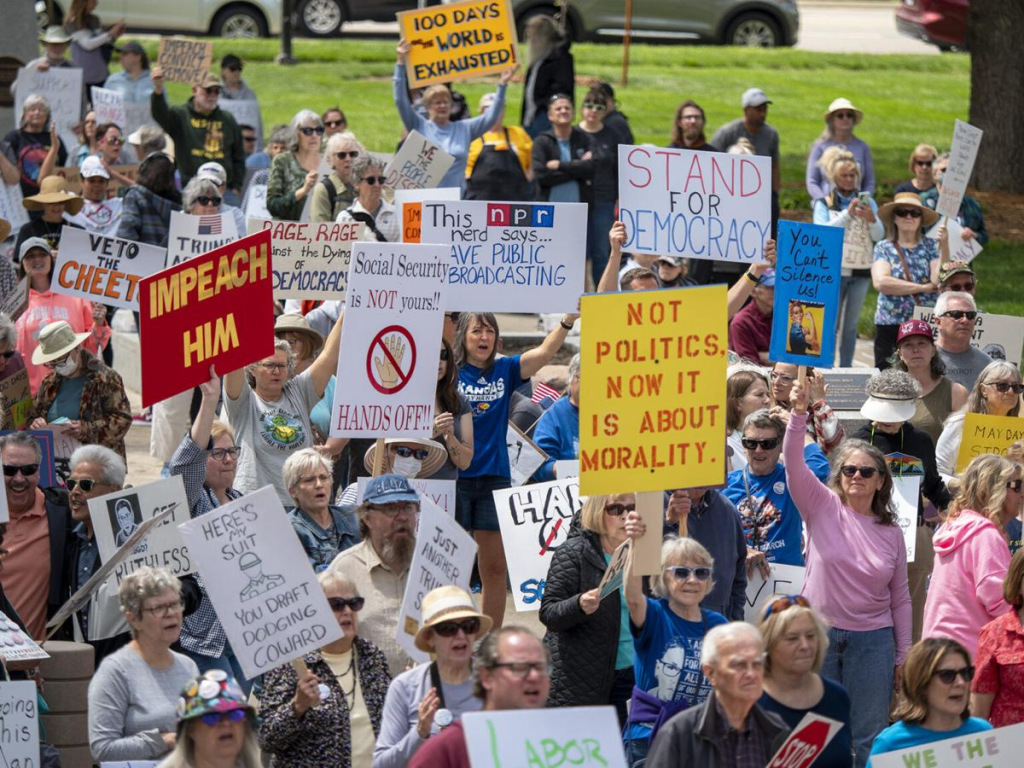
Kansas troopers on standby for protests, ahead of nationwide anti-Trump demonstrations

  • Kansas Reflector
  • Jun 11, 2025 Updated Jun 11, 2025

TOPEKA — State troopers are on standby in Kansas as demonstrations against federal immigration raids crop up around the country following an increased military presence in response to protests in Los Angeles.

The Kansas Highway Patrol is aware of Kansas City-area protests this week, said April McCollum, a spokeswoman for the agency.

Also read: ‘No Kings Day’ protests sweep U.S. as Wichita joins national pushback against Trump administration 

Protests in LA began Friday, mostly in downtown and central parts of the city, in opposition to targeted, sweeping raids from federal immigration officials that result in the arrest and detention of immigrants lacking permanent legal status. The demonstrations escalated once President Donald Trump ordered thousands of members of the California National Guard to the city’s streets, against the wishes of state leaders. Protesters in dozens of other cities joined their LA counterparts Tuesday.

Col. Erik Smith, superintendent of the state highway patrol, told legislators Tuesday that a protest similar to those in LA was planned in the Johnson County area, but the agency did not disclose specifics when asked. The only report of a protest in the area Tuesday occurred in Kansas City, Missouri’s downtown and Westside, drawing hundreds of attendees, according to reporting from The Kansas City Star.

A slate of more than 1,800 protests are scheduled across the nation for Saturday. More than a dozen of them are set to occur in Kansas cities, from Garden City to Hiawatha to Arkansas City to the Kansas City area.

“We encourage those involved to maintain civility while exercising their First Amendment rights,” McCollum said. (snip-MORE that diverts into interesting conversation about immigration sweeps and our gubernatorial race later on.)

Letters From An American video feed with Sec. Buttigieg

Conversation with Secretary Buttigieg by Heather Cox Richardson

A recording from Heather Cox Richardson’s live video Read on Substack

(There is also a transcript, available on the page.)

Peace & Justice History for 6/7

June 7, 1712
The Pennsylvania Assembly banned the importation of slaves into the colony.
June 7, 1892
Homer Plessy, a Creole of European and African descent, was arrested and jailed for sitting in a Louisiana railroad car designated for white people only. Plessy had violated an 1890 state law, the Louisiana Separate Car Act, that called for racially segregated rail facilities. He then went to court, claiming the law violated the 13th and 14th amendments, but Judge John Howard Ferguson found him guilty anyhow.
The U.S. Supreme Court allowed Plessy’s guilty verdict to stand by an 8-1 majority. The decision, Plessy v. Ferguson, established the doctrine of “separate but equal” [separate facilities for white and black people,] institutionalizing and legalizing segregation in the United States public transportation until 1946 in Morgan v. Virginia [see June 3, 1946].
More about Homer Plessy  
Read the decision 
June 7, 1893

a young Gandhi
 In his first act of civil disobedience, Mohandas Gandhi refused to comply with racial segregation rules on a South African train and was forcibly ejected at Pietermaritzburg.
“Pietermaritzburg: The Beginning of Gandhi’s Odyssey” 
The birthplace of Gandhi’s peaceful protest
June 7, 1997
Seven activists are arrested for distributing copies of the Bill of Rights outside the Bradbury Science Museum, part of Los Alamos National Laboratory in New Mexico, the primary nuclear research facility in the U.S.

https://www.peacebuttons.info/E-News/peacehistoryjune.htm#june7

Peace & Justice History For 6/2

June 2, 1783
At the urging of General George Washington, the United States Congress agreed to gradually disband the Revolutionary army following the end of the war. Subject only to the signing of a final peace treaty with Great Britain, all soldiers and non-commissioned officers were discharged; additionally, a full pardon was granted to privates and non-coms in confinement.
June 2, 1863
Abolitionist and former slave James Montgomery led 300 African-American troops of the Union Army’s 2nd South Carolina Volunteers on a raid of plantations along the Combahee River. Meanwhile, backed by three gunboats, Harriet Tubman’s forces set fire to the plantations and freed 750 slaves.

Harriet Tubman
More on General Tubman 
June 2, 1936
General Anastasio Somoza, head of the U.S. Marine-trained National Guard, forced the resignation of Nicaragua’s elected President, Juan Bautista Sacasa. This followed a seven-year U.S. occupation of the country and was followed by Somoza family control of the country for the next four decades.

More about Somoza and other U.S.-friendly Central American dictators
June 2, 1952
The U.S. Supreme court ruled illegal President Truman’s order two months earlier for the Army to seize the nation’s steel mills in order to avert a strike during the Korean war.
The decision 

Open Windows and Clay Jones

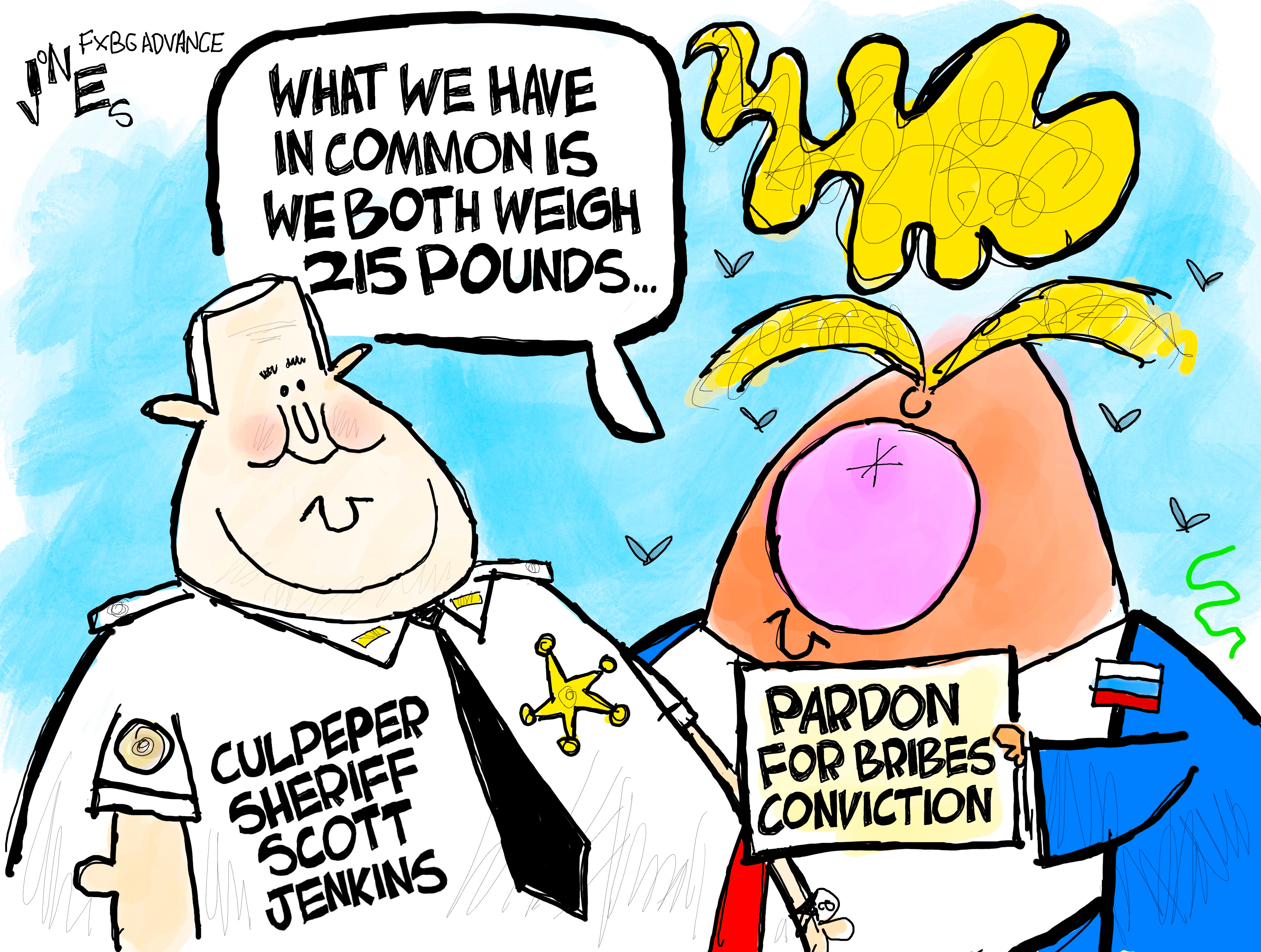
Bribe Bros by Clay Jones

Trump pardons a fellow briber Read on Substack

This cartoon was drawn for the FXBG Advance.

Last December, a Culpeper Jury (Trump country) found former Sheriff Scott Jenkins guilty of one count of conspiracy, four counts of honest services fraud, and seven counts of bribery. Fortunately for the corrupt sheriff, he’s a MAGAt.

In fact, Shurf Jenkins is a minor MAGAt celebrity, as he has pro-MAGA views that got him featured on Breitbart multiple times, was a guest on the Daily Signal podcast, and even got him an appearance on Fox & Friends after vowing to “deputize thousands of our law-abiding citizens to protect their constitutional right to own firearms.” This is kinda what got him into trouble.

By the way, nobody’s gun rights are in danger. Republicans use it as a fear tactic to win public office.

Jenkins accepted $75,000 worth of bribes. He took cash and campaign contributions from eight people, including two undercover FBI agents. In return, he gave them badges and made them auxiliary deputy sheriffs, despite not having any training for the position (it’s kind of an honorary position, but it gives them a lot of cop powers). He also pushed officials to restore one bribe-payer’s right to possess a gun as a convicted felon. He was also able to give some of his bribers the right to carry concealed weapons without permits.

What’s fucked up about that last part is it’s extremely easy to get a concealed-carry permit in Virginia. About the only thing that could stop a person from getting a concealed-carry permit in Virginia would be if they were a convicted felon or something. For example, Donald Trump would NOT be allowed to carry a concealed weapon in Virginia. (snip-click through to read on, it’s quite good!)

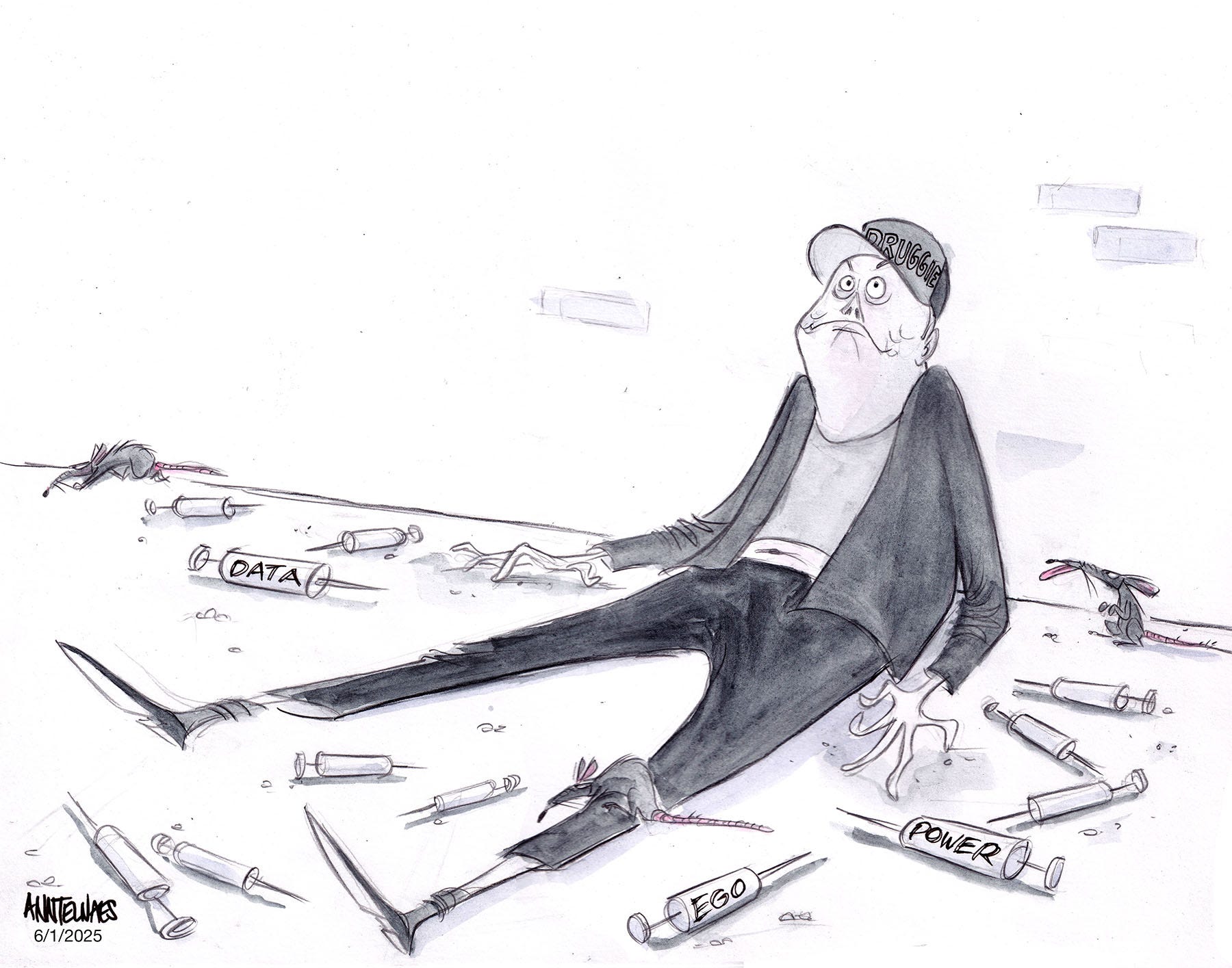
Elon Musk, drugged up by Ann Telnaes

The New York Times has an extensive piece on his drug use while campaigning for Trump Read on Substack

Trump, in his brilliant ability to read people (like Putin) gave Musk the power to indiscriminately cut federal programs and workers, destroying careers and affecting millions of Americans’ lives. Read the NYT article by investigative reporter Kirsten Grind and Megan Twohey, who was part of the team that broke the Harvey Weinstein story in 2017.

And Another Young Candidate

Presuming we have elections, we’re gonna be rich in good people to elect. Here’s another one I’ve been watching and donating to for a couple of months. I may have posted about her here before, but I’m not certain.