Peace & Justice History for 1/9

January 9, 1964
Anti-U.S. rioting broke out in the Panama Canal Zone, resulting in the deaths of 21 Panamanians and three U.S. soldiers. The immediate issue was whether both the U.S. and Panamanian flags would fly at Canal Zone facilities, as ordered by President John F. Kennedy. 
James Jenkins, a 17-year-old senior at Balboa High School in the Canal Zone:
“I guess you could say I’m the guy that started this whole thing. I’m sort of the ringleader. I circulated the petition to keep our flag flying. Then me and the others raised the flag. The school authorities left it up because they knew we’d walk out.”
On the third day, demonstrating Panamanian students entered the school grounds and sang their national anthem, but the Balboa students blocked them from raising their flag. there was a scuffle — and the Panamanians retreated in outrage, claiming that their flag had been ripped by the Zonians.
January 9, 1967
Julian Bond, elected more than a year before, was finally sworn in as a member of the Georgia House of Representatives.The legislature had refused to allow him to take his seat because of his opposition to the Vietnam War and specifically his endorsement of a Student Nonviolent Coordinating Committee (SNCC) statement accusing the United States of violating international law in Vietnam. Bond had been the director of SNCC.
Following his election in 1965, the Georgia House refused to seat him. He was re-elected to his “vacant seat” and the House refused again. He was then elected to the same office for a third time. But not until the U.S. Supreme Court ruled unanimously in his favor was the legislature forced to relent.


Julian Bond in 1966 waiting to be seated in the General Assembly
January 9, 1987
The White House released the presidential finding – signed by President Ronald Reagan on January 17, 1986 – which authorized the sale of arms to Iran (to encourage the release of hostages) and ordered the CIA not to tell Congress. This was done retroactively after several shipments, including 18 HAWK (Homing-All-the-Way-Killer) surface-to-air missiles, had already been transferred to the Iranians, then at war with Saddam Hussein’s Iraq.
Read the actual document authorizing the arms sales 
More 
Outline, key players and selected Iran-Contra documents from the National Security Archive 
January 9, 1991

 Sam Day
The day after the start of the U.S. bombing of Iraq, ten peace activists were arrested at Fort McCoy, Wisconsin, for handing out written warnings to military reservists about participation in war crimes. Long-time peace activist Sam Day was sentenced to four months for his participation.
Remembering Sam Day

https://www.peacebuttons.info/E-News/peacehistoryjanuary.htm#january9

Yesterday’s asshat news headlines.

Hi Everyone.  I woke at 12:22 last night.  But I got up at 1 am and started making posts and doing things.   So I just finished the asshat yesterday news posts.  So now before I answer the comments … and I love comments everyone sends to me, I have to make a red sauce.   Ron promised to make me a grand lasagna if I make the sauce.   So with ear buds in, off I go to make the sauce.   Hugs and loves to everyone.  Remember that I really care for everyone.  Add any questions or comments in the comments and I will reply there.   Hugs.  


JoeMyGod
Moda day ago

Two months ago Fat Hitler vowed to imprison Zuckerberg.

This is the result.

If you criticize the dear leader of the maga cult then you are forever an enemy.  Death to the nonbelievers.   This is why the current republicans and maga is very much a cult.  Hugs. 

This is great.  The tRump world crowed about this citizen of Greenland who praised tRump’s plan to take over Greenland.  Yet the truth did come out … He was a tRump  loving fanboy violent felon drug dealer prison escapee.   Hugs.

Happy New Year?? | Christopher Titus Armageddon Update

Voter ID News

Yes, we lived through this. We do not advise it. If your state legislature starts in this direction, show them this.

Kansas once required voters to prove citizenship. That didn’t work out so well

By  JOHN HANNAUpdated 10:44 AM CST, December 29, 2024Share

TOPEKA, Kan. (AP) — Republicans made claims about illegal voting by noncitizens a centerpiece of their 2024 campaign messaging and plan to push legislation in the new Congress requiring voters to provide proof of U.S. citizenship. Yet there’s one place with a GOP supermajority where linking voting to citizenship appears to be a nonstarter: Kansas.

That’s because the state has been there, done that, and all but a few Republicans would prefer not to go there again. Kansas imposed a proof-of-citizenship requirement over a decade ago that grew into one of the biggest political fiascos in the state in recent memory.

The law, passed by the state Legislature in 2011 and implemented two years later, ended up blocking the voter registrations of more than 31,000 U.S. citizens who were otherwise eligible to vote. That was 12% of everyone seeking to register in Kansas for the first time. Federal courts ultimately declared the law an unconstitutional burden on voting rights, and it hasn’t been enforced since 2018.

Kansas provides a cautionary tale about how pursuing an election concern that in fact is extremely rare risks disenfranchising a far greater number of people who are legally entitled to vote. The state’s top elections official, Secretary of State Scott Schwab, championed the idea as a legislator and now says states and the federal government shouldn’t touch it.

“Kansas did that 10 years ago,” said Schwab, a Republican. “It didn’t work out so well.”

Steven Fish, a 45-year-old warehouse worker in eastern Kansas, said he understands the motivation behind the law. In his thinking, the state was like a store owner who fears getting robbed and installs locks. But in 2014, after the birth of his now 11-year-old son inspired him to be “a little more responsible” and follow politics, he didn’t have an acceptable copy of his birth certificate to get registered to vote in Kansas.

“The locks didn’t work,” said Fish, one of nine Kansas residents who sued the state over the law. “You caught a bunch of people who didn’t do anything wrong.”

A small problem, but wide support for a fix

Kansas’ experience appeared to receive little if any attention outside the state as Republicans elsewhere pursued proof-of-citizenship requirements this year.

Arizona enacted a requirement this year, applying it to voting for state and local elections but not for Congress or president. The Republican-led U.S. House passed a proof-of-citizenship requirement in the summer and plans to bring back similar legislation after the GOP won control of the Senate in November.

In Ohio, the Republican secretary of state revised the form that poll workers use for voter eligibility challenges to require those not born in the U.S. to show naturalization papers to cast a regular ballot. A federal judge declined to block the practice days before the election.

Also, sizable majorities of voters in Iowa, Kentucky, Missouri, Oklahoma, South Carolina and the presidential swing states of North Carolina and Wisconsin were inspired to amend their state constitutions’ provisions on voting even though the changes were only symbolic. Provisions that previously declared that all U.S. citizens could vote now say that only U.S. citizens can vote — a meaningless distinction with no practical effect on who is eligible.

To be clear, voters already must attest to being U.S. citizens when they register to vote and noncitizens can face fines, prison and deportation if they lie and are caught.

“There is nothing unconstitutional about ensuring that only American citizens can vote in American elections,” U.S. Rep. Chip Roy, of Texas, the leading sponsor of the congressional proposal, said in an email statement to The Associated Press.

Why the courts rejected the Kansas citizenship rule

After Kansas residents challenged their state’s law, both a federal judge and federal appeals court concluded that it violated a law limiting states to collecting only the minimum information needed to determine whether someone is eligible to vote. That’s an issue Congress could resolve.

The courts ruled that with “scant” evidence of an actual problem, Kansas couldn’t justify a law that kept hundreds of eligible citizens from registering for every noncitizen who was improperly registered. A federal judge concluded that the state’s evidence showed that only 39 noncitizens had registered to vote from 1999 through 2012 — an average of just three a year.

In 2013, then-Kansas Secretary of State Kris Kobach, a Republican who had built a national reputation advocating tough immigration laws, described the possibility of voting by immigrants living in the U.S. illegally as a serious threat. He was elected attorney general in 2022 and still strongly backs the idea, arguing that federal court rulings in the Kansas case “almost certainly got it wrong.”

Kobach also said a key issue in the legal challenge — people being unable to fix problems with their registrations within a 90-day window — has probably been solved.

“The technological challenge of how quickly can you verify someone’s citizenship is getting easier,” Kobach said. “As time goes on, it will get even easier.”

Would the Kansas law stand today?

The U.S. Supreme Court refused to hear the Kansas case in 2020. But in August, it split 5-4 in allowing Arizona to continue enforcing its law for voting in state and local elections while a legal challenge goes forward.

Seeing the possibility of a different Supreme Court decision in the future, U.S. Rep.-elect Derek Schmidt says states and Congress should pursue proof-of-citizenship requirements. Schmidt was the Kansas attorney general when his state’s law was challenged.

“If the same matter arose now and was litigated, the facts would be different,” he said in an interview.

But voting rights advocates dismiss the idea that a legal challenge would turn out differently. Mark Johnson, one of the attorneys who fought the Kansas law, said opponents now have a template for a successful court fight.

“We know the people we can call,” Johnson said. “We know that we’ve got the expert witnesses. We know how to try things like this.” He predicted “a flurry — a landslide — of litigation against this.”

Born in Illinois but unable to register in Kansas

Initially, the Kansas requirement’s impacts seemed to fall most heavily on politically unaffiliated and young voters. As of fall 2013, 57% of the voters blocked from registering were unaffiliated and 40% were under 30.

But Fish was in his mid-30s, and six of the nine residents who sued over the Kansas law were 35 or older. Three even produced citizenship documents and still didn’t get registered, according to court documents.

“There wasn’t a single one of us that was actually an illegal or had misinterpreted or misrepresented any information or had done anything wrong,” Fish said.

He was supposed to produce his birth certificate when he sought to register in 2014 while renewing his Kansas driver’s license at an office in a strip mall in Lawrence. A clerk wouldn’t accept the copy Fish had of his birth certificate. He still doesn’t know where to find the original, having been born on an Air Force base in Illinois that closed in the 1990s.

Several of the people joining Fish in the lawsuit were veterans, all born in the U.S., and Fish said he was stunned that they could be prevented from registering.

Liz Azore, a senior adviser to the nonpartisan Voting Rights Lab, said millions of Americans haven’t traveled outside the U.S. and don’t have passports that might act as proof of citizenship, or don’t have ready access to their birth certificates.

She and other voting rights advocates are skeptical that there are administrative fixes that will make a proof-of-citizenship law run more smoothly today than it did in Kansas a decade ago.

“It’s going to cover a lot of people from all walks of life,” Avore said. “It’s going to be disenfranchising large swaths of the country.”

___

Associated Press writer Julie Carr Smyth in Columbus, Ohio, contributed to this report.

We Did Get Some Stuff Done

because we did the work.

It wasn’t all bad: Despite election defeat, progressives scored big wins in 2024

Organizers tell Salon how they pulled off major victories in a year marked by the rise of the far-right

By Tatyana Tandanpolie Staff Writer

Snippet:

For many on the political left, 2024 was disappointing.

Even as inflation ebbed, Americans still struggled with housing costs and necessary expenses. The U.S. role in enabling Israel’s war in Gaza sparked protests in the streets and on college campuses. The far-right continued to target marginalized groups, most notably immigrants, transgender people and women. To top it off, the mid-summer excitement at Vice President Kamala Harris’ entry into the presidential race following President Joe Biden’s eleventh-hour exit petered out with the election of President-elect Donald Trump — again. 

But even as the political landscape appeared to grow bleaker, Americans still fended off at least some of the efforts to encroach upon their rights. At times, they even helped pass policies that not only protected core freedoms but could genuinely improve quality of life.

As they reflected on 2024 and looked ahead to 2025, when the Trump administration’s ultraconservative agenda is poised to make their work harder, advocates behind wins in LGBTQ+labor and reproductive rights shared with Salon how they successfully organized against legislative efforts to roll their rights back and planted hope for a better future. 

Abortion rights enshrined in seven states

Ballot measures seeking to establish or protect abortion rights were on 10 states’ ballots this year as organizers fought to protect access and reverse bans enacted in the wake of the 2022 overturning of Roe v. Wade. Seven of those states — Arizona, Colorado, Maryland, Missouri, Montana, Nevada and New York — would indeed pass measures to enshrine a right to abortion access in their respective constitutions.

Proposition 139 in Arizona provided a legal means to upend the state’s 15-week abortion restriction and established state constitutional rights to abortion access until viability and afterward if a healthcare professional deems it necessary for the pregnant person’s physical or mental health. The proposition also barred the state from penalizing any individual or entity “for aiding or assisting a pregnant individual in exercising the individual’s right to abortion.” 

Arizona for Abortion Access, a seven-group coalition of reproductive health, rights and justice organizations, including Reproductive Freedom for All and Planned Parenthood Advocates of Arizona, led the campaign supporting the proposed amendment, which took effect almost immediately on Nov. 25.

“The passing of Proposition 139 speaks to the broad support — across the entire state, across all political parties, and across voters of all different backgrounds — for reproductive freedom,” Erika Mach, Planned Parenthood Arizona’s chief external affairs officer, told Salon. “People want the freedom to make medical decisions with their doctor and family, without government involvement.”

To place a constitutional amendment on the state’s ballot, the coalition had to obtain signatures from 15% of registered voters in the state — just under 384,000 signatures — and file the petition by early July, according to the Arizona Secretary of State’s website. (snip-MORE)

If Congress Passes Terrific Law For Kids In The Forest, Does Anybody Hear?

by Rebecca Schoenkopf

It’s bipartisan and it’s good and nobody fought over it. So the answer is ‘no.’ Read on Substack

Here to warm your heart a little bit is a fable about a magical land called the US Congress, where in the midst of last week’s huge stupid fight about whether to actually have a government anymore, and about whether unelected weirdo billionaires should be able to destroy said government, the Senate passed a little-noticed bill that will update American child welfare laws for the first time in 15 years and help out kids in foster care.

As Gabe Fleisher at Wake Up To Politics points out, there weren’t any big culture war provisions in the bill, and somehow the flaky billionaire with an online propaganda factory didn’t catch wind of it, so the Supporting America’s Children and Families Act passed and was signed into law without getting much attention at all. In fact, when Fleischer wrote about it over the weekend, he noted that “as far as I can tell, not a single other article has been written about this legislation by any news outlet, anywhere.”

Fleischer included a google link so people could check, and I did. Even after his post, nope, nothing much, apart from several social media posts linking to Fleisher, plus the expected press releases from members of Congress who helped pass the bill. The only exception we found was a Yahoo reprint of a brief story from Native News Online, based on a press release from the National Indian Child Welfare Association (NICWA), which advocated for the law because it

increases funding for tribal child welfare programs and courts, reduces administrative burdens, closes a gap in data collection for Native children and families who are in state child welfare systems, and requires the Department of Health and Human Services with the assistance of the Bureau of Indian Affairs to provide needed technical assistance to states and tribal nations to improve implementation of the Indian Child Welfare Act.

So there’s a second article, and now Yr Wonkette makes three. Maybe some bigger outlets should cover this, although that might run the risk of bringing it to the attention of some jerk who thinks kids in the system have it too easy and need to be working overnight shifts.

As Fleisher — who staunchly refuses to have a c in his name no matter how often I misspell it — points out, there are some excellent things in the bill beyond the increase of $75 million a year into the budget for “the federal program tasked with combatting child abuse/neglect and protecting children in the foster care system.”

Among other things, the bill allows states to pass on federal child welfare funds directly to families that have hit an economic rough patch, to “prevent children from being separated from parents solely on the basis of poverty-related circumstances” — instead of declaring the parents “neglectful” and taking their kids away.

Other measures in the law will

expand mental health services for children in foster care; ease the transition out of foster care by offering assistance to former foster children until they reach the age of 26; increase funding for the 2.5 million grandparents and relatives raising children who would otherwise go into foster care; create a new requirement that states consult with affected children and parents when crafting their child welfare policies; seek to improve the relationships between incarcerated parents and their children in foster care; and reduce the administrative burden of child welfare caseworkers by 15%, so they can focus more on children and less on paperwork.

That’s a hell of a lot of good that literally got zero mention in the mainstream press, mostly because the bill was written and passed without any drama or denunciations that it would promote witchcraft, turn children into communists, or force Americans to live under the tyranny of the Metric System. And that, Fleisher says, is a damn shame, because “coverage of the country’s legislative output should not be dictated by how much squabbling went into the passage of the bill.” A media focus on dysfunction might be entertaining, but leads to cynicism and to people never hearing about genuinely worthwhile, honest-to-Crom “bipartisan achievements like the Supporting America’s Children and Families Act.”

We think Fleisher is right, though we’d also add that it would sure help a hell of a lot if our politicians, especially those on one side of the aisle, would actually try to legislate instead of trying to get their scowling faces on Fox News. Oh dear, that wasn’t bipartisan of me at all.

(snip-comments on the page)

Peace & Justice History for 12/26

December 26, 1862
38 members of the Santee Sioux tribe were hanged in a public mass execution in Minnesota. 300 members of the band had been convicted of participating the the Minnesota Uprising and ordered to hang. However, all sentences except the 38 had been commuted by President Abraham Lincoln.
For decades white settlers had been encroaching on Santee Sioux territory, and they had been victimized by corrupt federal Indian agents on the reservations.In July agents and contractors had withheld food when their demands for kickbacks had been refused. The Indians eventually struck back, killing Anglo settlers and taking some hostages. In two battles with the U.S. Army, they killed or wounded dozens of soldiers, but ultimately lost and were put on trial.


America’s only legal mass execution
===========================================
December 26, 1966

The first Kwanzaa was celebrated in Los Angeles, California. It was conceived and organized in the wake of the Watts riots by Dr. Maulana (Ron) Karenga, a professor and chairman of Black Studies at California State University at Long Beach. Kwanzaa is a non-religious African-American holiday focusing on family, community, and culture.The name Kwanzaa is derived from the phrase “matunda ya kwanza,” which means “first fruits” in Swahili. The celebrations are expressed through song, dance, drumming, storytelling, poetry and the lighting of candles in a Kinara, all followed by a large traditional meal. The holiday is observed for seven days, each representing a different principle:

a Kwanzaa Kinara
• Umoja (oo-MO-jah) Unity
• Kujichagulia (koo-gee-cha-goo-LEE-yah) Self-Determination
• Ujima (oo-GEE-mah) Collective Work and Responsibility
• Ujamaa (oo-JAH-mah) Cooperative economics
• Nia (NEE-yah) Purpose
• Kuumba (koo-OOM-bah) Creativity
• Imani (ee-MAH-nee) Faith

Ron Karenga lighting the Kinara
History, Principles, and Symbols of Kwanzaa 
============================================
December 26, 1971


Two dozen members of Vietnam Veterans Against the War “liberated” the Statue of Liberty with a sit-in to protest resumed U.S. aerial bombings in Vietnam. They flew an inverted U.S. flag from the crown as a signal of distress.
more on this action 
=============================================
December 26, 1992

photo: Simran Sachdev Belgrade, 7.2009
Women In Black began campaign against rape during war, Belgrade, Serbia.
WIB website 
Women in Black is a world-wide network of women committed to peace with justice and actively opposed to injustice, war, militarism and
other forms of violence.

================================================
December 26, 1999

Alfonso Portillo Cabrera scored a resounding victory (nearly 70% of the vote in the second round) in Guatemala’s first peacetime presidential elections following a 36-year civil war.

Alfonso Portillo Cabrera after his election
Some perspective 

https://www.peacebuttons.info/E-News/peacehistorydecember.htm#december26

Well, just how about this:

Sunday, December 22, 2024

Ever Wonder Why Your Never Trump Allies Are So Friendly and Deferential…

…to the same legacy media institutions that have fucked us over so badly?

Well, perhaps it’s because outfits like The Bulwark are sponsored by outfits like Jeff Bezos’ Washington Post.

Yeah, that Washington Post.   From NPR:

Over 200,000 subscribers flee ‘Washington Post’ after Bezos blocks Harris endorsement

The Washington Post has been rocked by a tidal wave of cancellations from digital subscribers and a series of resignations from columnists, as the paper grapples with the fallout of owner Jeff Bezos’s decision to block an endorsement of Vice President Kamala Harris for president…

From the transcript of live ad read in the middle of the above-referenced podcast.

Tim Miller:  Hey guys, if you listen to this podcast you care about what’s going on in the world.  And you know we’re doing our best here at the Bulwark as we grow, to expand out, reporting, reported commentary no bullshit insight.   But, like all of this stuff is based on people doing shoe leather reporting.  People going out there and gathering sources and going around the world an… and educating us about what’s happening in the world.  And… and one of the places that’s out there still doing that is the Washington Post.  Uh, and this podcast is sp… sponsored by The Washington Post.  When you go to Washington Post.com slash The Bulwark, our listeners can get an exclusive deal to subscribe for just 50 cents per week for your first year.  Uh…if you listen to us you know the great work the Washington Post does on a bunch of topics…

It goes on.  And on. And on.  Bezos is definitely getting his money’s worth.  

Because, as we have discussed on this blog several hundred times before…

(snip)

“Thank You, Pramila Jayapal”

After Building Progressive Power Among House Democrats, Jayapal Passes the Torch

By Jessica Corbett — December 21, 2024

After six years at the helm of the Congressional Progressive Caucus, dedicated to “building the infrastructure” necessary to effectively fight for key policies on Capitol Hill, term-limited Rep. Pramila Jayapal is determined to ensure that the CPC’s incoming leaders “are as successful as possible.”

Jayapal (D-Wash.) spoke with Common Dreams on Wednesday about her time leading the caucus of nearly 100 lawmakers whose legislative priorities include “comprehensive immigration reform, good-paying jobs, fair trade, universal healthcare, debt-free college, climate action, and a just foreign policy.”

She was elected first vice chair of the CPC in June 2017, just months into her freshman term in Congress. Explaining her foray into leadership, Jayapal affectionately said, “I blamed it all on Keith Ellison,” a Minnesota Democrat who was then a congressman and caucus leader and is now his state’s attorney general.

“He was very encouraging,” she said of Ellison. “He knew that the whole reason I was running, because he had heard me talk about it on the campaign trail… was because I wanted to strengthen the power of the progressive movement inside Congress and figure out how we could be more effective working on the inside and the outside, which I was coming from.”

Jayapal, who was born in India and came to the United States as a teenager for college, founded the immigrant advocacy group Hate Free Zone—which later became OneAmerica—after the September 11, 2001 terrorist attacks. Residents of the Seattle area elected her to Congress in 2016, during her first term in the Washington State Senate.

In politics, Jayapal has shared stories from her own life with the world, publicly writing and speaking about her experiences as an immigrant woman of color, a woman who had an abortion, and a mother to her trans daughter. She has welcomed the mentorship of Rep. Barbara Lee (D-Calif.), the first woman of color to co-chair the CPC and, as Jayapal put it on Instagram earlier this week, “one of the most courageous and effective progressive leaders I have had the privilege to know.”
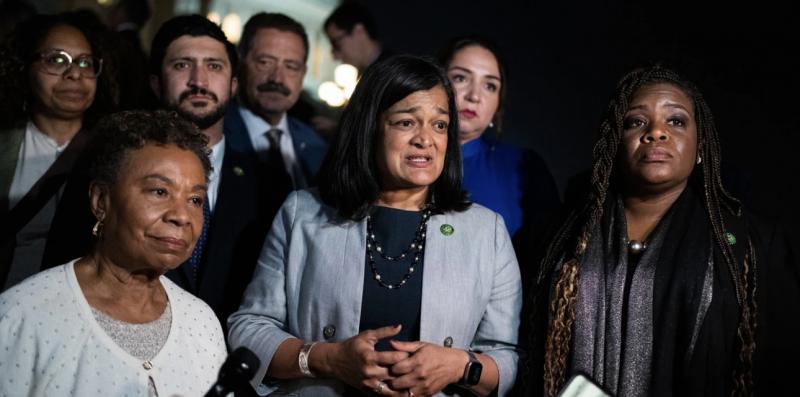
lee_jayapal_bush.jpgU.S. Reps. Barbara Lee (D-Calif.) Pramila Jayapal (D-Wash.), and Cori Bush (D-Mo.) talk with reporters in Washington, D.C. on May 31, 2023. (Photo: Tom Williams/CQ-Roll Call, Inc. via Getty Images)

Backed by leaders like Ellison and Lee—who is leaving Congress after this session—Jayapal jumped into the CPC hoping to transform it into “a caucus that could really have the power to stand up for working people and deliver.” In 2018, she was elected co-chair with Rep. Mark Pocan (D-Wis.), and following 2020 caucus rule changes, she became a solo chair.

“What I realized when I came in is that we didn’t really have the infrastructure we needed to support us to be powerful as a bloc of votes,” said Jayapal, who utilized the skills and connections she developed as an organizer in the role she is now preparing to leave.

“I was able to come in and not only think about how you build power on the inside, but also how you coordinate with the outside,” she said. “And that inside-outside strategy, and the trust I had, and the relationships I had, were really critical to my success in building the infrastructure here in Congress and sort of coalescing the movement around a set of priorities that we were then able to fight for and stand up for.”

Jayapal recognized the need to hire staff and reform CPC rules to boost meeting attendance and caucus cohesion. She explained that “I felt very strongly about leadership transition to build the bench, and so I put in term limits for the CPC chair as well.”

Thanks to that policy, she will pass the torch to Rep. Greg Casar (D-Texas) early next month. Jayapal, who will be chair emeritus, told Common Dreams, “I’m just really proud to have built an infrastructure that I can pass on to the next chair that just wasn’t there before and will continue to get better, of course, with new leadership.”

The 35-year-old incoming chair will be joined by Reps. Ilhan Omar (D-Minn.) as deputy chair and Jesús “Chuy” García (D-Ill.) as whip. They will face a Republican-controlled Congress and the second administration of President-elect Donald Trump.

“I’m honored to build on the legacy of Chair Jayapal,” Casar said after the caucus election earlier this month. “I’ve fought back against extremist, egocentric autocrats in Texas for my entire adult life. The Democratic Party must directly take on Trump, and it’ll be CPC members boldly leading the way and putting working people first.”

Trump won his first presidential contest the same day Jayapal was initially elected to Congress. On that night in November 2016, before the White House race was called, Jayapal described her victory as “a light in the darkness” and told supporters that “if our worst fears are realized, we will be on the defense as of tomorrow,” according toThe Seattle Times.

After four years of fighting the first Trump administration, CPC members kicked off 2021 with a fresh opportunity to advance progressive policies: Although the Senate was divided, Democrats controlled the House of Representatives and President Joe Biden was sworn in—despite Trump contesting his 2020 loss and inciting an insurrection.

During Biden’s term, which ends next month, the Jayapal-led caucus has successfully encouraged the Democratic president to pursue various executive actions promoting access to contraception, climate action, corporate accountability, higher wages, lower costs for essentials, and relief for immigrants from countries in crisis, among other priorities.

The caucus also played a significant role in enacting major pieces of Democrats’ Build Back Better agenda. In the summer of 2021, Jayapal made clear to Congress and the president that House progressives would withhold votes from what became the Bipartisan Infrastructure Law—also known as the Infrastructure Investment and Jobs Act—unless they also passed legislation on the climate emergency and social issues.

Biden signed the infrastructure bill in November 2021—followed by the Inflation Reduction Act in August 2022. The delay was largely due to obstructionist then-Democratic Sens. Joe Manchin (I-W.Va.) and Kyrsten Sinema (I-Ariz.), who ditched the party in the aftermath and are both leaving Congress at the end of this session.

Although Jayapal wishes the second bill would have passed sooner, and tackled the country’s childcare and housing crises, she said that she is still “particularly proud” of what the caucus was able to accomplish with that battle. As she told Common Dreams, “There would be no Inflation Reduction Act without Build Back Better, and there would’ve been no Build Back Better without the CPC.”
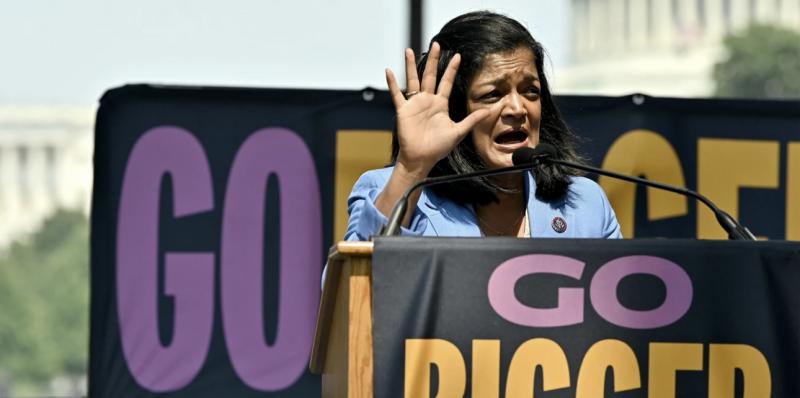
jayapal_rally.jpgRep. Pramila Jayapal (D-Wash.) speaks at a “Go Bigger on Climate, Care, and Justice” rally on July 20, 2021 in Washington, D.C. (Photo: Shannon Finney/Getty Images for Green New Deal Network)

Those two legislative packages were “about changing the way that we thought of government’s ability to fight for working people,” she continued. They “were about delivering results to people that would matter, whether it was in terms of great jobs, whether it was in terms of taking on climate change, whether it was in terms of driving down the cost of prescription drugs, [or] unrigging the tax system so that the wealthier began to pay their fair share.”

“All of those things were kind of fundamental and core to an economic agenda that worked for working people and poor people,” said Jayapal, who has personally championed legislation including the College for All ActDignity for Detained Immigrants ActHousing Is a Human Right ActMedicare for All ActTransgender Bill of Rights, and Ultra-Millionaire Tax Act—partnering with Senate progressives such as Sens. Elizabeth Warren (D-Mass.) and Bernie Sanders (I-Vt.), the founding chair of the CPC.

While the Congressional Progressive Caucus will have new leadership next year, Jayapal plans to remain engaged by providing advice and support as chair emeritus and by co-chairing the CPC Political Action Committee with Casar and Rep. Maxwell Frost (D-Fla.). Under the PAC’s current heads—Jayapal, Pocan, and Rep. Jamie Raskin (D-Md.)—it “has grown from a $300,000 budget in the 2016 election cycle to raising $12 million over the past three election cycles,” the group said Wednesday.

Jayapal told Common Dreams that she is “really proud of the fact that we’ve had an incredible record” for CPC PAC endorsements. Over the past decade, a majority of pre-primary backed candidates have won their general election races—often “pushing back on big money that came in, dark money that came in, sometimes in the millions,” she said, pointing to Reps. Summer Lee (D-Pa.) and Delia Ramirez (D-Ill.) as examples.

Lee, Ramirez, and Jayapal were all reelected last month, but overall it was a devastating cycle for Democrats, who failed to win control of the White House and both chambers of Congress. The outgoing CPC chair is among those who have responded to the results by urging the Democratic Party to reject super PACs and uplift working-class voters going forward.

In a memo earlier this month, Jayapal, Casar, Frost and fellow CPC member Rep. Chris Deluzio (D-Pa.) called on the next Democratic National Committee chair, whoever it is, to “create an authentic… brand that offers a clear alternative and inclusive vision for how we will make life better for the 90% who are struggling in this economy, take on the biggest corporations and wealthiest individuals who have rigged the system, expose Trump’s corporate favoritism, and create a clear contrast with Republicans.”

Noting Republicans’ aim to use their forthcoming federal trifecta to pass another round of tax cuts for the rich, Jayapal said that “when we fight against the tax cuts, the Trump tax scam 2.0, we should tie it to this: The Democratic Party is not beholden to corporate PACs and dark money. We are fighting for the people.”

“There’s a clear contrast between Trump and his billionaires… and Democrats who are fighting for the vast majority of Americans, the 99% of Americans who are out there struggling every day,” she added. “That’s the contrast we need to be able to draw.”

(snip-embedded tweet)

In her final days as CPC chair, Jayapal is highlighting that contrast by slamming Trump and the billionaires who have his ear, like Elon Musk, for risking a government shutdown—which could begin Saturday—by derailing a bipartisan spending bill this week.

“The past 24 hours is the clearest demonstration yet of what Trump 2.0 will entail: The president of the United States allowing his unelected billionaire friends to control the government and enrich themselves at the expense of working people,” she said in a Thursday statement. “We cannot succumb to a government by billionaires, for billionaires.”

Republished from Common Dreams under Creative Commons (CC BY-NC-ND 3.0).

Topics: House Progressive CaucusHouse ProgressivesPramilla

Another Cartoon

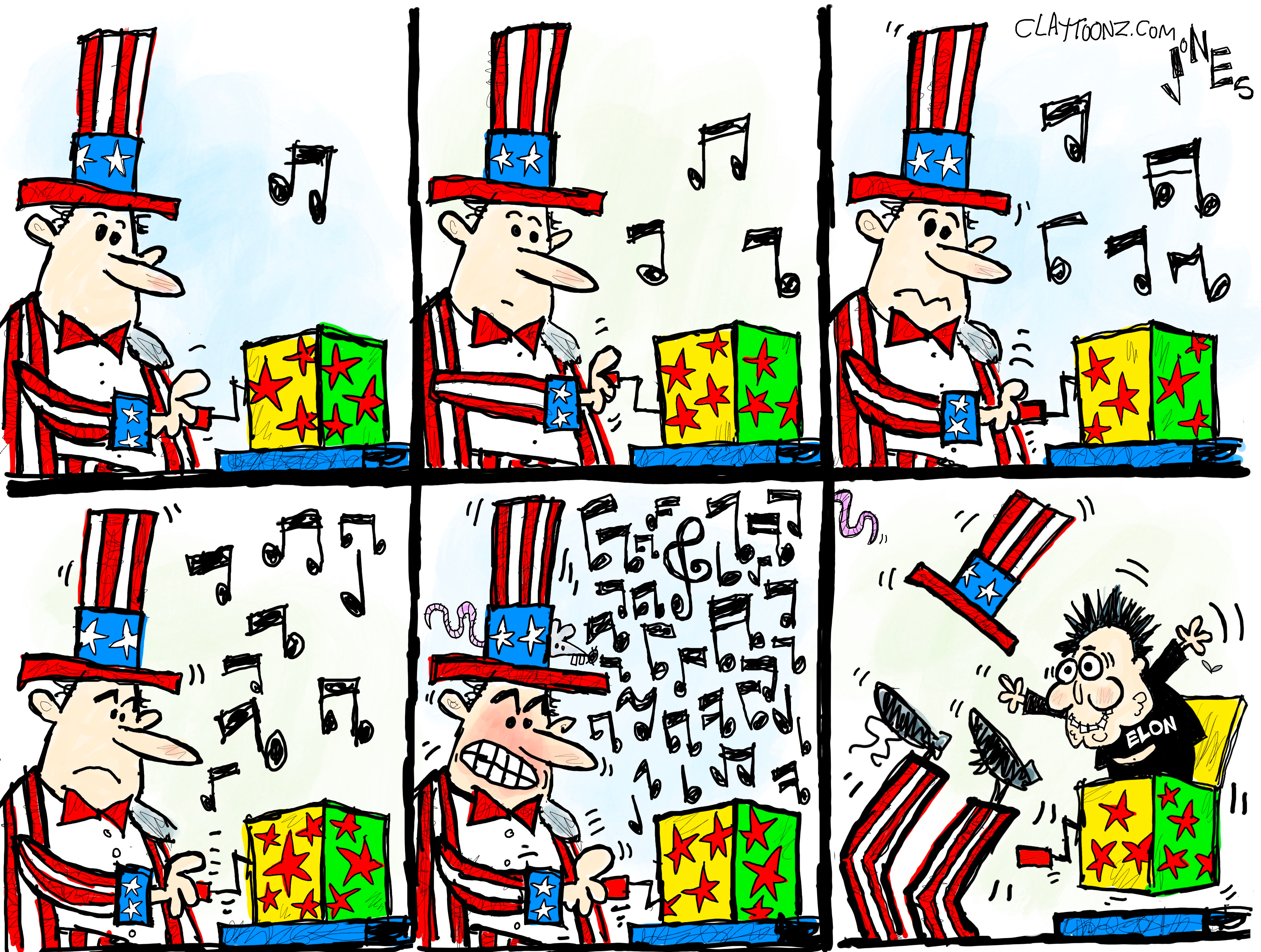
It’s been one heck of a week, both on the public front, and here on the home front. It’s Friday afternoon, though, so here’s a toon about the public front from Clay Jones.

Jerk In The Box by Clay Jones

Remember, MAGAts…you voted for this Read on Substack

I’m going to use a colleague’s cartoon to point something out. Right-wing gaslighting lying fucknut Steve Kelley has a cartoon of a reporter asking White House Spokesperson Karine Jean-Pierre to clarify who she’s talking about when she says “the president,” Joe Biden or Donald Trump. In Steve’s defense, it’s hard to write even adequate cartoons when you’re a lying racist MAGAt.

Steve might be a little slow on his civics but the answer is President Joe Biden. How do I know this? Because for one thing, Jean-Pierre works for President Joe Biden so you would have be a real idiot to believe she’s referencing the other guy. Second, President Joe Biden is the current president. The third thing is, Donald Trump is NOT president right now no matter how hard he’s trying to destroy the nation before he’s sworn into office.

Other fucknut cartoonists may also believe Trump is the leader of our government. Look at this bullshit from Idiot One Gary Varvel and copied days later by Idiot Two Dana Summers. I don’t see how Trump sitting his fat ass at MAGA-Lardo grifting his Trump Bibles as Christmas gifts while trying to destroy the government he’ll inherit on January 20 is leadership, but whatevs.

Trump is pushing for a government shutdown, saying he’s OK with it either way. If there’s a shutdown, he’ll blame Biden even though he’s the one shitposting on Truth Social that Republicans shouldn’t cooperate with Democrats, but they should raise the debt ceiling so that he can give asshole billionaires such as himself and Elon Musk tax cuts in 2025.

Remember, Republicans hate raising the debt ceiling. The debt ceiling is to cover expenses Congress has already legislated but Republicans think it’s authorizing future spending. Trump is looking at future spending and wants the ceiling raised or done away with altogether. For once, I agree with Trump and the debt ceiling should be scrapped. Republicans won’t go along with that because for them, it’s a tool to hold the nation hostage.

Elon wants a shutdown because he wants to destroy the government except for the parts of it that pay him billions of dollars in government contracts. But he’s howling for a shutdown and that’s when Trump changed his mind. Elon did invest $277 million to get Trump elected, so his stake in that orange fat ass may be higher than Putin’s. And how much does Elon expect to reap for his quarter-billion-dollar purchase?

House Speaker Mike Johnson filed a stopgap spending bill Tuesday night which went to shit after Elon went into a tweet(X) frenzy consisting of over 100 posts in one night against a deal negotiated with Democrats. The bill would have provided $100 billion in disaster aid funding, billions in farm assistance, and other assorted projects like fighting cancer in children and kept the government running.

Among Elon’s tweets were lies that the bill included a 40 percent increase in congressional pay, $3 billion for a new stadium for the Washington Commanders, funding for bioweapon labs, and protecting the Jan. 6 Committee from being investigated. Why didn’t he also tweet it would fund Critical Race Theory, Drag Queen Story Time, trans men in women’s sports and restrooms, and buffets of cats and dogs to be eaten by illegal Haitian immigrants in Springfield, Ohio?

Here’s the thing: If you have to lie your tiny South African balls off, you’re on the wrong side of the issue. The reason creepy goons and idiots like Elon and Trump have to lie is that the truth doesn’t help them. They also know they’re lying because Google’s search engine works for Republicans too.

As of this writing, there are only about eight hours left to pass a funding bill to prevent a shutdown. Trump says the shutdown will be Biden’s problem, but the idiot doesn’t realize he’s inheriting this problem in January. Or maybe, he thinks Elon will inherit it. Just go play golf, Tiny. Elon’s got this (sic).

During his last administration (sic), Trump told Chuck Schumer and Nancy Pelosi he’d be glad to take the blame for a shutdown. When that shutdown happened, he blamed Schumer and Pelosi and eventually negotiated a deal where he lost funding for his stupid racist wall.

Trump is as good of a negotiator as George Constanza who negotiated his and Jerry’s salary for their NBC TV pilot down from $13,000 to $8,000.

The leader of this nation until January 20, 2025, is President Joe Biden, but the leader of the Republican Party is not Donald Trump or even Mike Johnson. It’s unelected Elon Musk.

This is a preview of the next four years. Republicans are in a rush to destroy this nation and they’re starting early.

Music note: I listened to Audioslave.

Drawn in 30 seconds: (snip-click through to help him out, and watch him draw!)