October 23, 1915 33,000 women marched in New York City demanding the right to vote. Known as the “banner parade” because of the multitude of flags and banners carried, it began at 2 o’clock in the afternoon and continued until long after dark, attracting a record-breaking crowd of spectators. Motor cars brought up the rear decorated with Chinese lanterns; once darkness fell, Fifth Avenue was a mass of moving colored lights. The history of women’s suffrage in the U.S.
October 23, 1945 Jackie Robinson and pitcher John Wright were signed by Branch Rickey, president of the Brooklyn Dodgers Baseball Club, to play on a Dodger farm team, the Montreal Royals of the International League.Robinson became the first black baseball player to play on a major league team. Jackie Robinson
October 23, 1947 The NAACP filed formal charges with the United Nations accusing the United States of racial discrimination. “An Appeal to the World,” edited by W.E.B. DuBois, was a factual study of the denial of the right to vote, and grievances against educational discrimination and lack of other social rights. This appeal spurred President Truman to create a civil rights commission.
October 23, 1956 The Hungarian revolution began with tens of thousands of people taking to the streets to demand an end to Soviet rule. More than 250,000 people, including students, workers, and soldiers, demonstrated in Budapest in support of the insurrection in Poland, demanding reforms in Hungary. Hungarian students,1956 Hungarian revolution monument The day before, the students had produced a list of sixteen demands, including the removal of Soviet troops, the organization of multi-party democratic elections, and the restoration of freedom of speech. On the evening of the 23rd a large crowd pulled down the statue of Josef Stalin in Felvonulási Square. Hungary 1956 and the Political Revolution More
October 23, 1984 The Fact-Finding Board looking into the assassination of Filipino democratic leader Benigno Aquino confirmed that his death was the result of a military conspiracy, and indicted Chief-of-Staff General Fabian Ver, the first cousin of dictator Ferdinand Marcos. Marcos had blamed the chair of the Communist Party for the assassination, despite the fact that Aquino had been in the custody of the Aviation Security Command and surrounded by military personnel as he disembarked from the plane returning him to the Philippines. The chair of the Board, Corazon J. Agrava, was pressured into submitting a minority report clearing General Ver. He and the 25 other military officials charged were all acquitted.
Happy Monday from Atlanta! I just tried to convince thousands at a public health conference that it’s time to reimagine systems—not just defend the status quo. I’m happy to report that tomatoes weren’t thrown my way. This is my fourth state in five days, and the highlight is actually seeing the seasons change and meeting a lot of you in person. I couldn’t be more excited to see my girls (and survive another round of the KPop Demon Hunters soundtrack).
Top: Plenary stage with Mike Osterholm; From the bottom left: Met YLE reader Krisandra Allen at the conference. Fall leaves in Idaho. My daughter welcoming me home at the airport.
This week’s Dose runs the gamut: from what’s really going on with lead in protein powders (and whether you should be worried), to a refreshing burst of leadership as 15 governors join forces to strengthen public health collaboration, to falsehoods swirling around mammograms. We’ll wrap with an infectious disease weather report and a quick note for dog owners on an FDA recall.
Let’s go!
Consumer Reports found lead in protein powders. How bad is it?
Last week, Consumer Reports released an analysis revealing elevated lead levels in several popular protein powders and shakes. Google searches for “lead in protein powder” spiked 300%, and influencers lit up social media. Depending on which news source you read, it was either a five-alarm fire or no big deal.
So what’s actually going on? Lead is everywhere—soil, food, water, and air. Thankfully, overall exposure has dropped dramatically since the 1970s, and modern lab tests can now detect vanishingly small amounts (down to parts per billion). But detection does not necessarily equal danger.
How bad is bad?That’s where things get tricky because not everyone agrees:
California limit: 0.5 mcg/day. This number comes from a very conservative calculation: regulators took the “no observable effect” level for reproductive harm for inhaled lead exposure in workplaces and divided it by 1,000. Many experts argue that this threshold is unrealistic. It’s also not linked to adverse health outcomes.
FDA’s limit: 2.2 mcg/day for kids, 8.8 mcg/day during pregnancy, and 12.5 mcg/day for other adults based on blood lead levels, toxicology data, and a built-in 10x safety factor.
European Union limit: Allows up to 3 mg/kg (3 ppm) in food supplements—roughly 90 mcg per 30-gram scoop of protein powder. In this case, the FDA is far more cautious than Europe (and that’s not usually how things go).
Back to the report: of the 23 protein supplements they tested, two-thirds exceeded “Level of Concern.” One brand (Naked Nutrition Vegan Mass Gainer) hit nearly 16 times the limit. But because Consumer Reports used California’s exceptionally strict benchmark, those numbers sound scarier than they really are.
The average American already gets 5.3 mcg of lead daily from food and the environment. That’s another reason California’s cutoff doesn’t make much sense. Still, some products identified in the report could push intake close to the pregnancy (8.8 mcg) or adult (12.5 mcg) daily thresholds.
What this means for you: Don’t worry too much. While the FDA continues to reduce lead exposure through programs like Closer to Zero and the Total Diet Study (that is, if the funding continues), there are several things we can do in our own homes, especially for parents of kids and during pregnancy.
Check to see if your protein supplement (or any supplement, really) has third-party testing for heavy metals (like USP or Informed Sport).
Advocate for more pre-market regulatory oversight in the supplement industry (which has very little, if any at all) by writing to your local representative.
Eat a diet that includes a variety of nutrient-dense foods, which helps limit exposure to specific food sources and ensures we get an array of protective nutrients.
Prioritize getting your protein from whole food sources.
Big thanks to YLE’s Megan Maisano—Registered Dietitian Nutritionist— for writing this section.
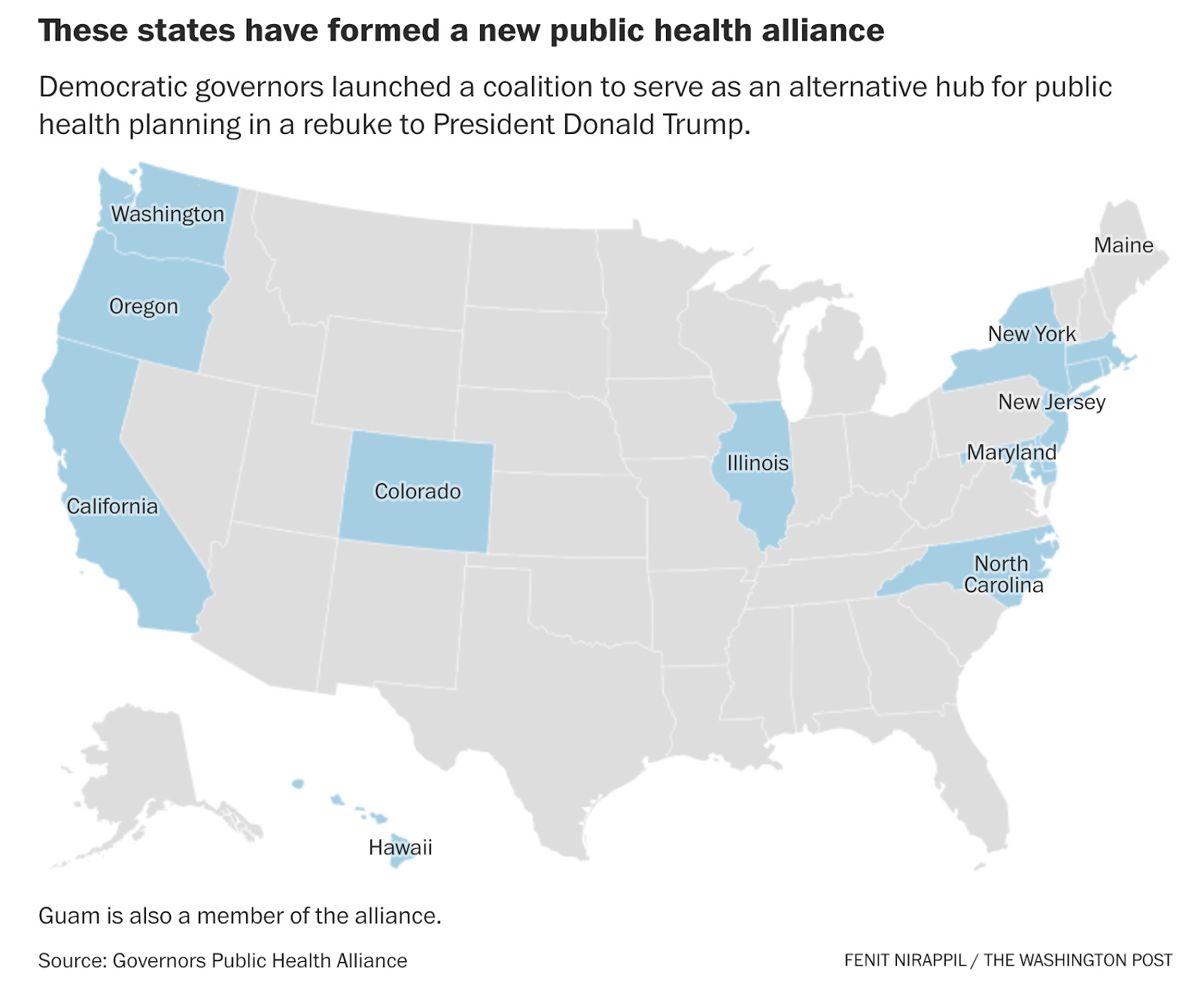
Fourteen states and Guam join forces to launch Governors’ Public Health Alliance
Governors from 14 states and Guam announced the creation of the bipartisan Governors’ Public Health Alliance, which is a new effort to strengthen coordination and collaboration across state lines.
Why do we need this? In the U.S., authority over health rests with the states, not the federal government. Health (encompassing both health care and public health) is not only the highest budget item for a state but also the primary reason for state bankruptcy. In other words, governors hold enormous power over your health.
Today, though, federal support is shifting fast, funding is drying up, and states are being forced to get creative. States must decide whether to maintain their public health departments (due to funding cuts), how to continue purchasing vaccines (if the federal government stops recommending them), whether to negotiate drug prices (like insulin), and more. We saw a similar challenge during the pandemic with bulk purchasing of PPE.
In general, the more coordinating, collaborating, and innovative thinking, the better.
However, I’m growing increasingly concerned about the partisan gaps in public health. Although some Republicans are on the advisory board and the initiative was framed as bipartisan, no Republican-led states have joined. This worries me for my friends in red states, like Texas, but it also has implications for everyone, as diseases don’t care about borders.
What this means for you: If your state is included, you can rest assured your governor is talking to others, which is a helpful step toward innovative solutions. You could argue it was needed before this moment, too. Public health has been siloed for far too long.
Mammograms save lives. They’ve been wrongly targeted.
Happy Breast Cancer Awareness month! Unfortunately, this month has driven some influencers to post false claims about the harms of mammograms. So let’s clear this up.
Breast cancer is the second leading cause of cancer death in women in the U.S., and accounts for 1 in 3 new cancers among women each year. (It affects men too, just at lower rates.) There is strong scientific consensus in support of routine mammograms to prevent breast cancer and detect it early:
Regular mammograms starting at age 40 are recommended for everyone, but may have even greater benefit for Black women, who are 40% more likely to die from breast cancer than white women and more likely to have aggressive cancers, younger.
There’s some critical nuance here:
With each mammogram, breast tissue is exposed to a small amount of ionizing radiation. But! We’re exposed to this type of radiation every day in our natural environment. At high doses, radiation exposure can change DNA and cause harm, but the amount of radiation exposure during a mammogram is about the same as flying from California to New York.
Organizations disagree on whether mammograms every year or every other year are optimal. Screening recommendations are based on evaluating science to maximize benefit (lives saved) while reducing patient worry, unnecessary costs, and diagnosing and treating cancers and pre-cancers that ultimately wouldn’t cause health problems—also called “overdiagnosis.” This is a balancing act.
Mammograms are just one tool for detecting cancer, and women with dense breasts or high risk for cancer (e.g., family history, known genetic predispositions, or other key risk factors) may benefit from additional screening, such as through an MRI.
For more, see YLE’s deep dive on breast cancer screening recommendations.
Infectious disease “weather report”
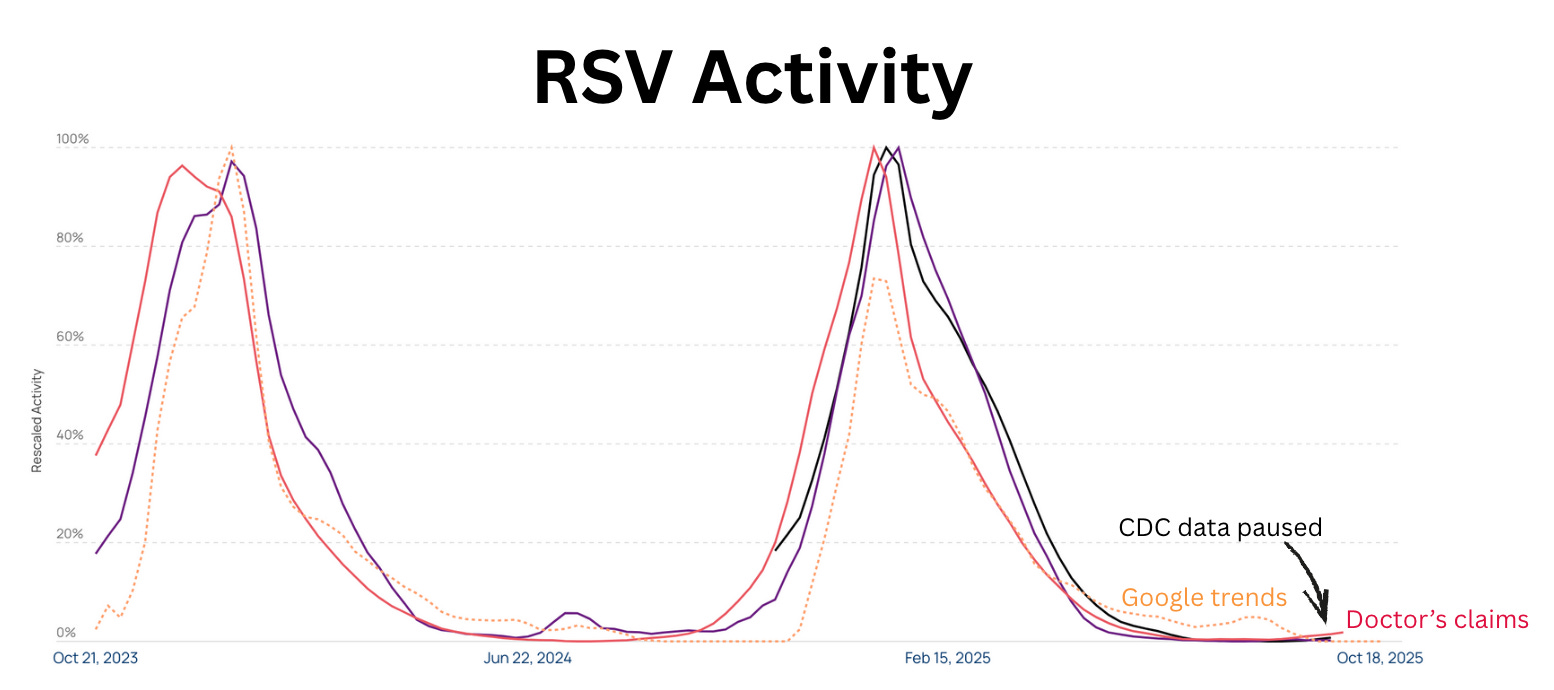
In the U.S., flu and RSV are still quiet. CDC data is still on pause because of the government shutdown, so we’re continuing to reference PopHive data. RSV activity is still low but growing in southern states, like Louisiana and Texas.
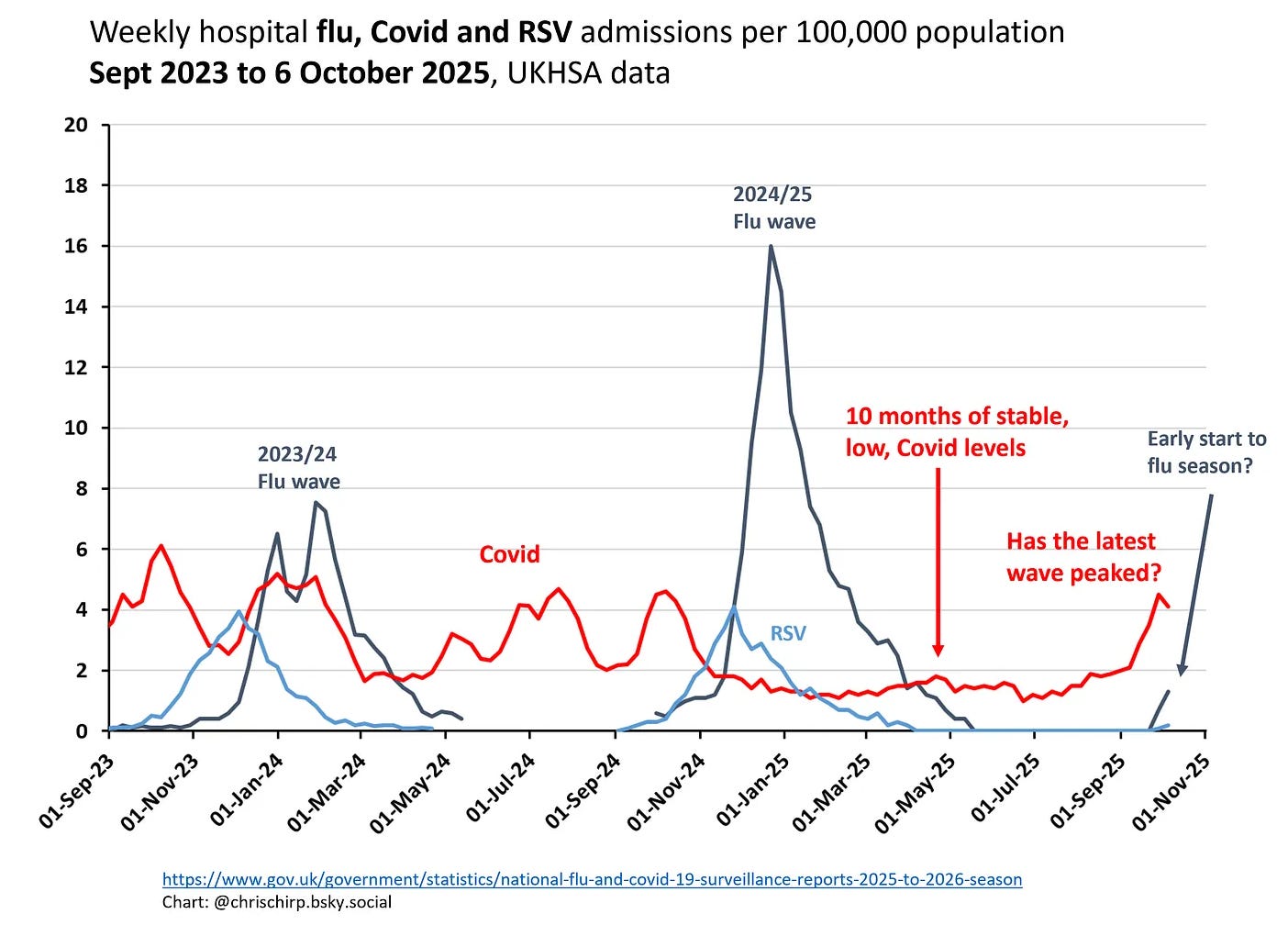
However, Covid-19 is having a moment in the U.K., with hospitalizations increasing exponentially after a 10-month lull. This isn’t driven by a dramatic variant, but rather by a lack of immunity building up over time. Flu might also be increasing, which suggests it’s coming soon (as expected) for the U.S.
The FDA recalled Raw Bistro frozen beef dog food for possible Salmonella contamination. The recalled products were sold directly to consumers and to select distributors between Sept. 1 and Sept. 17 in California, Colorado, Illinois, and Minnesota.
Salmonella can make dogs sick, just like humans. Contaminated food can cause illness days later in dogs. And dog owners can get sick from handling contaminated food or dog bowls.
What this means for you: Check the lot numbers on your dog’s food, and toss it if they are included in the FDA recall notice. Sanitize bowls if they held contaminated food, wash your hands, and watch for warning signs in your dog: lethargy, vomiting, diarrhea, and loss of appetite. If you notice these signs, take your pet to the vet.
That’s it for this week! Share your fall leave pics in the comments below so that I can continue to live vicariously through you.
Love, YLE
Your Local Epidemiologist (YLE) is founded and operated by Dr. Katelyn Jetelina, MPH PhD—an epidemiologist, wife, and mom of two little girls. YLE is a public health newsletter that reaches over 400,000 people in more than 132 countries, with one goal: to translate the ever-evolving public health science so that people are well-equipped to make evidence-based decisions. This newsletter is free to everyone, thanks to the generous support of fellow YLE community members. To support the effort, subscribe or upgrade below:
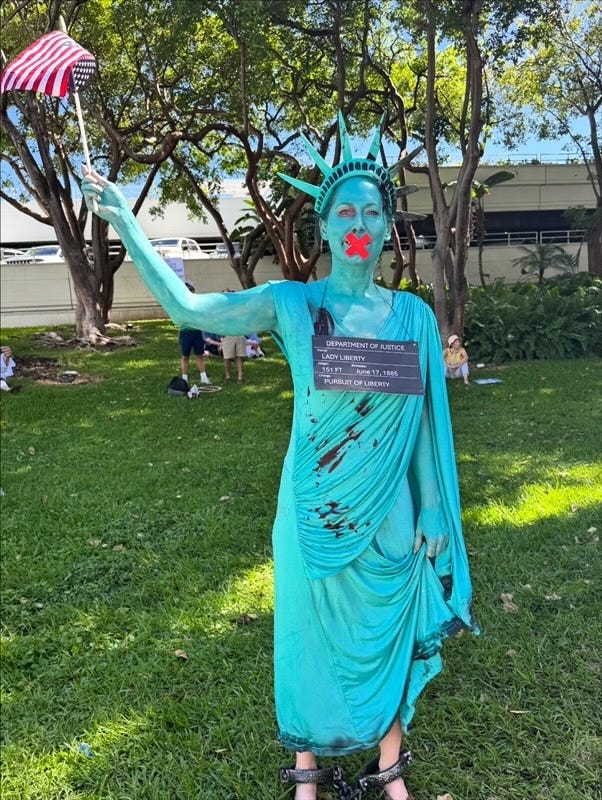
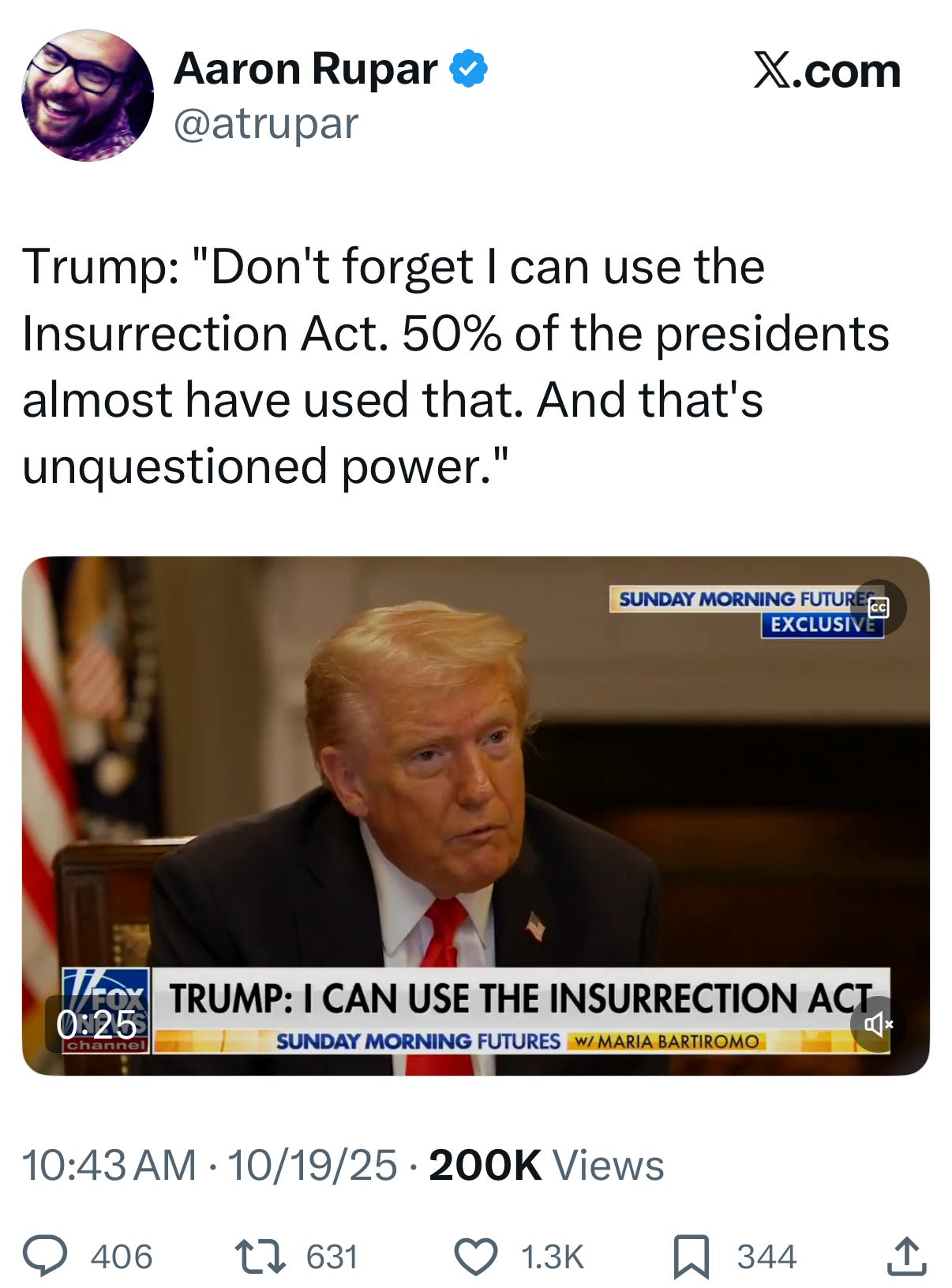
Apparently, Donald Trump felt threatened by a successful, peaceful protest and by seeing millions of us out in the streets protesting against him. Saturday night, he posted a childish, petulant video, portraying himself as the king of sh*t. Then, this morning, he resorted to a temper tantrum, insisting he would use his “absolute power” to invoke the Insurrection Act.
Of course, 50% of presidents have not invoked the Act. Wrong again.
Trump’s renewed focus on the Insurrection Act comes on the heels of a Seventh Circuit decision last week declining to permit Trump to deploy troops to Chicago. “Political opposition is not rebellion,” wrote a panel of the Seventh Circuit Court of Appeals, affirming District Judge April Perry. You can read the court’s order here. The panel consisted of appointees from the administrations of Presidents George H.W. Bush, Barack Obama, and Donald Trump.
That case is not about the Insurrection Act, however. Trump has, so far, stopped short of invoking it, instead using related authority that the administration maintains allows it to federalize National Guard troops, even over a governor’s objection.
The appellate judges in the Chicago case affirmed the portion of Judge Perry’s order that temporarily enjoined the administration from deploying the Guard within Illinois. They held that even affording Trump the substantial deference owed to a president’s decisions, Trump had failed to show he met the predicates for doing so. Under 10 U.S.C. § 12406, the administration had to establish that there was either (1) a rebellion or a danger of one or (2) that the situation on the ground made it impossible for the President to execute the laws of the United States with regular forces.
Among their justifications for that decision: “Despite President Trump’s federalization of Guard troops as necessary to enforce federal immigration law, DHS and ICE have touted the success of Operation Midway Blitz. In an October 3 press release, DHS stated that ICE and CBP have effected more than 1,000 immigration arrests since the start of the Operation. In a September 26 DHS press release, the Department declared that protests had not slowed ICE down, and, in fact, ICE has significantly increased its deportation and arrest numbers year over year.” The government contradicted its own case in its self-congratulatory press releases.
There is a technical legal point here. Because the plaintiffs had asked the court to prevent Trump both from federalizing the Guard and from deploying them, the panel looked at those two separately. To obtain an injunction, one of the elements plaintiffs have to establish is that they will be irreparably injured without it. The court held that “the administration’s likely violation of Illinois’s Tenth Amendment rights by deploying Guard troops in the state over the state’s objection ‘constitutes proof of an irreparable harm’” and enjoined their deployment. But it made a different finding when it came to Trump’s ability to federalize Guard troops, holding that it would not enjoin that action because the injury “appears to be relatively minimal.” This effectively gives the state the relief it sought, while interestingly, putting federalized state National Guard troops on the federal payroll during the shutdown, perhaps a topic for another day.
A key point we’ve been tracking in these cases reemerged in this one: Trump’s inexorable march towards obtaining more power for himself. The administration argued, as it has before, that a president’s decision to federalize National Guard troops under § 12406 cannot be reviewed by a judge. That really would make Trump a king. But the panel dismissed the argument, at least at this stage in the proceedings, rejecting the administration’s attempt to use an older case, Martin v. Mott, which we’ve discussed here and here, as going too far. That case involved an effort by militia men to override a presidential decision during a time of open war, and the panel said that did not suggest that the judicial branch of government could not review decisions by the executive branch. They concluded that nothing in the statute “makes the president the sole judge” of whether the reason for invoking it passes muster.
The Solicitor General filed an emergency appeal to the Supreme Court, which means we’ll spend at least part of the week ahead court watching.
All of that legal wrangling explains why Trump returns to threats to invoke the Insurrection Act whenever courts step in to check his authority. With the National Guard, there are clearly some limits on presidential power. Trump seems to believe none of them come into play when the Insurrection Act is involved. The first parts of the Act became law in 1792. It permits the president to deploy the military on domestic soil and use American soldiers against American citizens, making it the chief exception to the Posse Comitatus Act, which would otherwise prohibit that. There are exceptional circumstances where that sort of extreme action is necessary—the opening moments of the Civil War involved President Lincoln using it for just that purpose. But the law has been described by experts as “dangerously overbroad and ripe for abuse.”
Chief among its problems is language that could easily be interpreted as giving the president sole authority to determine when it should be invoked, without resort to the courts for constitutional review. This is why the Supreme Court’s decision about the reach of Martin v. Mott in Chicago and other cases will be so important. Whether the Court will finally take steps to curtail Trump’s attempt to consolidate all power in his own hands remains to be seen.
For the record, even Twitter AI Grok says that Trump got it wrong when it came to the number of presidents who’ve invoked the Insurrection Act: “15 U.S. presidents have invoked the Insurrection Act since its passage in 1807, including Thomas Jefferson, Abraham Lincoln, Dwight D. Eisenhower, and George H.W. Bush. It has been used about 30 times total for events like the Civil War, civil rights enforcement, and riots. That’s roughly a third of presidents, not half as claimed.” And a far better question is, how many times has it been invoked over the objection of the governor, which is a much smaller number.
The most recent use of the Act happened at the request of California’s governor, when sustained riots broke out following the April 29, 1992, acquittal of four Los Angeles police officers who were captured on videotape brutally beating Rodney King, a Black motorist. PresidentGeorge H.W. Bush deployed the National Guard and U.S. troops to restore order after both the governor and the mayor requested federal assistance to help stop the shootings, arson, looting, and other violence in the city that resulted in the deaths of more than 50 people, thousands of injuries and arrests, and property damage of more than $1 billion. That’s the sort of situation the Act is meant for. Not ones where a president trumps up baseless claims of out-of-control crime and violence to serve his own political purposes.
There is no good faith basis underlying Trump’s asserted justification for bringing in the Guard or potentially invoking the Insurrection Act. But that doesn’t matter if you’ve decided you’re a king.
So, when has the Insurrection Act been used absent a request for the governor and local officials? That happened during the Civil Rights Movement in a few extreme situations where the state was interfering with the enforcement of Supreme Court decisions. And in Alabama, George Wallace’s threatened stand in the schoolhouse door to prevent school integration faded away when President Kennedy sent in federal troops using a measure related to the Insurrection Act.
It’s important to understand that Trump is using a fictitious basis for invoking a statute designed for use in only the most serious of situations. There is no rampant crime that local law enforcement can’t handle as well without federal troops as they could with them, and certainly no rebellion. Trump has no plans to use federal forces to enforce Americans’ civil rights. Instead, it’s the same theme we’ve seen since he took office: An effort to seize more and more power and create a lopside executive branch that can rule over the rest of government—and the American people. (snip)
There is more going on this week, although that feels like enough.
The Courts. As the shutdown continues, the federal courts are preparing to run out of funding on Monday. They will maintain “limited operations necessary to perform the Judiciary’s constitutional functions” for as long as the shutdown continues. Constitutional litigation and criminal cases will continue to move forward, but staff will be furloughed and much of the courts’ civil work will slow down to a snail’s pace.
Abrego Garcia. A hearing on Abrego Garcia’s motions for selective and vindictive prosecution in the Tennessee-based criminal case the Justice Department charged him in after his return from deportation has been scheduled for November 4 and 5. In advance, we are learning some information about the evidence he plans to put on.
Abrego Garcia wants to call at least seven witnesses to testify. The government is apparently preparing to attempt to quash subpoenas for high-level officials at DHS and DOJ, and possibly someone from the White House. Abrego Garcia has also identified a series of emails between the U.S. Attorney’s Office and main Justice that he requests access to, to see if they shed any light on the decision to indict him for old crimes, which required obtaining the cooperation of a more culpable individual by promising to terminate his deportation proceedings. Abrego Garcia complains that he’s received very little information from the government in discovery because the local U.S. Attorney believes what he has requested is protected by a number of government privileges including deliberative process and attorney work product. This case, which has dropped off the radar screen in recent weeks, is about to return in a big way, setting the stage for similar motions in the Trump revenge cases as well.
Comey Motions. This case is still scheduled for trial on January 5, 2026, because the Eastern District of Virginia is the rocket docket. Comey’s first round of motions are due on Monday. The government will have two weeks to respond. It’s unclear which motions we will see, but there will likely be several to dismiss the case entirely, including ones arguing the U.S. Attorney was appointed improperly, rendering the indictment invalid, along with selective and vindictive prosecution motions.
Book tour. Also, this week I’m off on my book tour. Giving Up Is Unforgivable will officially be on sale on Tuesday. If you haven’t already, grab your copy here. If you’re in New York City, Preet Bharara and I will be at the 92nd Street Y, and they’ve moved us to a larger space, so there are more tickets available, if you weren’t able to get them earlier. I’d love to get to see you!
There may be lighter posting than usual this week and next while I’m traveling, but I’ll be here for all the important developments, and I’ll try to share pictures from the road with you too! Please make sure you say hi if you’re able to join me at one of our other tour locations.
October 20, 1947 The House Un-American Activities Committee (HUAC) opened public hearings into alleged Communist influence in Hollywood. To counter what they claimed were reckless attacks by HUAC, a group of motion picture industry luminaries, led by actor Humphrey Bogart and his wife, Lauren Bacall, John Huston, William Wyler, Gene Kelly and others, established the Committee for the First Amendment (CFA). Read more
October 20, 1962 A folk music album, “Peter, Paul and Mary,” hit No. 1 on U.S. record sales charts. The group’s music addressed real issues – war, civil rights, poverty – and became popular across the United States. The trio’s version of “If I Had A Hammer” (originally recorded by The Weavers, which included the song’s composers, Pete Seeger and Lee Hays) was not only a popular single, but was also embraced as an anthem by the civil rights movement. About Peter, Paul and Mary
October 20, 1967 The biggest demonstration to date against American involvement in the Vietnamese War took place in Oakland, California. An estimated 5,000-10,000 people poured onto the streets to demonstrate in a fifth day of massive protests against the conscription of soldiers to serve in the war. [see October 16, 1967] Read more
October 20, 1973 In what was immediately called the “Saturday Night Massacre,” President Richard Nixon’s Press Secretary, Ron Ziegler, announced that Special Watergate Prosecutor Archibald Cox had been dismissed. Cox had been investigating Nixon, his administration and re-election campaign. Nixon had demanded that he rescind his subpoena for White House recordings. Archibald Cox Richard Nixon Earlier in the day, Attorney General Elliot Richardson had resigned, and Deputy Attorney General William Ruckelshaus had been fired, both for refusing to dismiss Cox. Solicitor General Robert Bork, filling the vacuum left by the departure of his two Justice Department superiors, fired Cox at the president’s direction.








 Scottie's Playtime