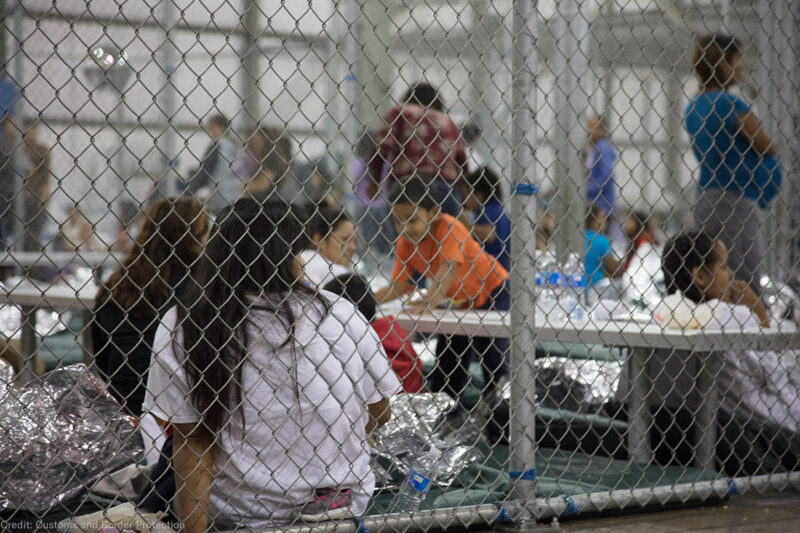
If you go to the link 3 /4 of the way through the article it will open a page that details some of the abuse. Sorry I can’t post it as I couldn’t finish reading it. I started to get triggered. Been there made to do that. Hugs
Victoria López, Advocacy and Legal Director, ACLU of Arizona
Sandra Park, Former Senior Staff Attorney, ACLU Women’s Rights Project
All 50 states, the District of Columbia, and the federal government impose criminal liability on correctional facility staff who have sexual contact with people in their custody. These laws recognize that any sexual activity between detainees and detention facility staff, with or without the use of force, is unlawful because of the inherent power imbalance when people are in custody. Yet, one immigration detention center is trying to avoid responsibility for sexual violence within its walls by arguing that the detainee “consented” to sexual abuse.
E.D., an asylum-seeker and domestic violence survivor from Honduras, was sexually assaulted by an employee while she was detained with her 3-year-old child at the Berks Family Residential Center in Pennsylvania. At the time of the assault, E.D. was 19 years old.
She filed suit against the detention center and its staff for their failure to protect her from sexual violence, even though they were aware of the risk. The record in the case, E.D. v. Sharkey, shows that her assailant coerced and threatened her, including with possible deportation, while the defendants stood by and made jokes.
Although the employee pled guilty to criminal institutional sexual assault under Pennsylvania law, the defendants contend that they should not be liable for any constitutional violations. Their argument rests in part on their assessment that the sexual abuse was “consensual” and that they should be held to a different standard because the Berks Family Residential Center is an immigration detention facility rather than a jail or prison.
The ACLU, ACLU of Pennsylvania, and partner organizations filed an amicus brief this week supporting E.D., explaining that officials wield such tremendous control over the lives of those in their custody, including through coercion and exploitation, that consent to sexual contact cannot be freely given in these circumstances. We also discuss how sexual violence in custodial settings is a serious and pervasive issue, including in immigration detention. For many years, the ACLU, various advocacy groups, and immigrants themselves have reported on the unsafe conditions in immigration detention, including sexual violence and the retaliation that detained immigrants face when they decide to come forward with these violations.
A recent investigation into sexual abuse in immigration detention found that there were 1,448 allegations of sexual abuse filed with ICE between 2012 and March 2018. In 2017 alone, there were 237 allegations of sexual abuse in immigration detention facilities.
Other reports include a 2014 complaint documenting widespread allegations of sexual harassment at the Karnes County Residential Center, where more than 500 women were detained with their children. In 2017, advocates filed a complaint on behalf of eight immigrants who recounted their experiences of sexual violence while detained in various ICE detention facilities across the country.
The Government Accountability Office reported in 2013 that officials at immigration prisons and jails failed to report 40 percent of sexual abuse allegations to the ICE headquarters. After looking at 10 different detention centers and analyzing over 70 cases of sexual abuse, researchers found that only 7 percent of 215 allegations of sexual assault in immigration detention facilities from 2009 to 2013 were substantiated, calling into question the thoroughness of investigations as well as reporting and oversight mechanisms.
Sexual violence impacts immigrants across federal agencies that are charged with immigrant detention. Most recently in Arizona, the state’s Department of Health Services, which licenses facilities that are used by the U.S. Department of Health and Human Service’s Office of Refugee Resettlement to detain migrant children, moved to revoke the license of Southwest Key, a nonprofit contractor that rakes in about a half a billion dollars to detain migrant children in facilities across the country. The state moved to revoke the group’s license because Southwest Key failed to comply with required employee background checks. At least three former employeeshave been arrested for sexually abusing migrant children. One was convicted, and one of the facilities was closed down following allegations of staff abusing children.
These are not isolated cases. They clearly show that officials are not doing enough to detect and respond to incidents of sexual abuse in immigration detention. The result is that immigrants are put at serious risk for sexual violence while they are detained.
The Prison Rape Elimination Act was passed by Congress in 2003 to protect against sexual assault in prisons and jails across the country. It took the Department of Homeland Security until 2014 to finalize regulations implementing PREA. Even with those regulations in place, DHS PREA standards do not protect immigrants in all detention facilities because the agency has taken the position that those requirements can only apply when the agency enters into new contracts or renews or modifies old ones.
Rather than meaningfully addressing these endemic problems in immigration detention, the Trump administration continues to aggressively target immigrants and asylum seekers by stripping away legal protections, ramping up enforcement, and expanding immigration detention. E.D.’s case highlights the real need for greater protections against sexual abuse and more robust oversight and accountability measures in immigration detention, not less.
Please understand the horrific conditions these children are being held in. Bug and dirt filled food, guards in these concentration camps they are held in tell the kids not to waste their oxygen by complaining or making the guard deny them. While physical abuse and verbal abuse is a given there is no doubt that some sexual abuse is happening. One boy had appendicitis and the guards refused him treatment until he was throwing up in a hallway that they even dealt with him and even then they kept him from medical attention for another 6 hours. The boy barely survived. First they don’t see these brown children as people and second the government has stopped paying for the medical care of the detained people in their care. Hugs
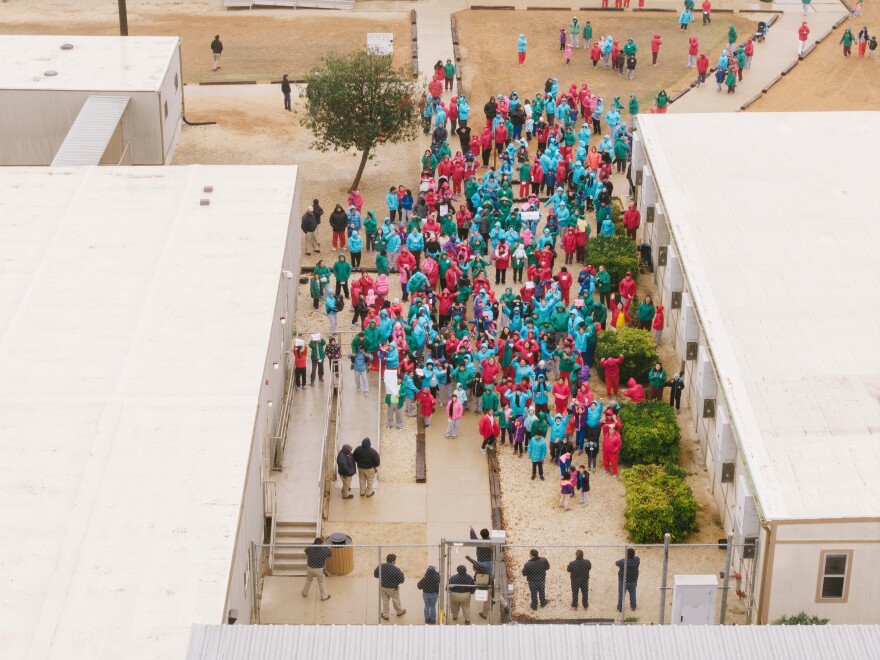
Detainees held at the South Texas Family Residential Center wave signs during a demonstration in Dilley, Texas, Saturday, Jan. 24, 2026.
A protest broke out Saturday at the South Texas family detention complex in Dilley, about 70 miles south of San Antonio, after guards abruptly ordered attorneys to leave while detainees — many of them children — poured into open areas of the facility chanting “Libertad,” or “Freedom,” according to an immigration attorney who witnessed the event.
Immigration attorney Eric Lee said he was at the Dilley facility for a confidential visit with clients — an immigrant family of six, including five children — when guards began shouting for everyone in the waiting area to leave, citing what they described as “an incident.”
As the Michigan-based attorney walked toward his car, he said he heard what sounded like “hundreds of children” shouting, with voices he described as “high-pitched” and “urgent.” He said he could see children streaming from dormitory areas behind a chain-link fence and chanting “Libertad.”
Lee said clients he later spoke with told him the protest was triggered by concerns over the treatment of Liam Conejo Ramos, a five-year-old who was taken into custody with his father in Minnesota earlier this week and transferred to the Dilley facility.
Lawmakers and advocates are calling for the child’s release, while the Department of Homeland Security disputes claims about how the boy was taken into custody and faces criticism over access to the facility.
School officials in Columbia Heights, Minnesota, have said federal agents took the child from a running car in the family’s driveway and directed him to knock on the door of the home — an action the superintendent described as “essentially using a 5-year-old as bait.”
The Department of Homeland Security has disputed that account, saying agents did not target the child, were focused on apprehending the child’s father—whom DHS said fled on foot—and attempted to have the child’s mother take custody of the boy.
Lee described Saturday’s action inside the facility as a peaceful demonstration, not a riot, and said the show of solidarity carried risk for detained families.
Lee said the protest unfolded against what he described as harsh day-to-day conditions inside the Dilley detention center. He characterized the facility as “a horrible, horrible place,” alleging that drinking water is “putrid” and often undrinkable, and that meals have contained “bugs,” dirt, and debris.
“The guards are just as tough as the guards at the adult facilities. This is not a place that you would want to have your child be for even 15 minutes,” Lee said.
Lee said the site does not operate as “civil detention,” arguing it functions like a punitive facility despite housing families.
CoreCivic, the private prison company that operates the site under federal contract, has previously said the facility is intended to provide an “open and safe environment” with access to services such as recreation, counseling, and legal resources.
Texas Public Radio reached out to Immigration and Customs Enforcement for comment on the disturbance and on Lee’s allegations regarding Liam Ramos’ treatment but had not received a response by Saturday evening.
The Dilley detention complex — known for years as the South Texas Family Residential Center — closed in 2024 and later reopened, as federal authorities expanded detention capacity for immigrant families, according to prior reporting and company statements.
Saturday’s episode comes amid heightened scrutiny of immigration enforcement nationally, including protests in Minneapolis following the January 7 killing of Renée Macklin Good during an ICE operation, and another fatal shooting involving federal immigration agents reported Saturday.
TPR was founded by and is supported by our community. If you value our commitment to the highest standards of responsible journalism and are able to do so, please consider making your gift of support today.
There are videos at the link that doesn’t appear to embed. In each of these ICE unwarranted shootings we see that the ICE gang thug shooter was putting their fellow gang thugs in danger from the bullets. Also the videos clearly shot that Pretti was shot in the back and the gang thug ICE people were overjoyed and counting the bullet wounds as they made sure to get their stories straight for the bosses who would applaud their courage of ganging up on, beating a man on the ground and then shooting him in the back. Really brave souls. Hugs
Kristi Noem made public statements about Alex Pretti and details surrounding his fatal shooting. But the videos tell a dramatically different — and tragic — story.
Statement #1: “An individual approached US Border Patrol officers with a 9 mm semi-automatic handgun” DHS Secretary Kristi Noem said in a news conference, adding that the suspect was “brandishing” a firearm.
Video shows Pretti had no visible firearm in his hands or on his body in the minutes before he interacted with immigration officers but was using a cell phone to record immigration raids in the area. This is allowable under the First Amendment, as long as it doesn’t interfere with law enforcement activity, such as an arrest.
The officers do not draw their firearms on Pretti, which would be standard training for how federal law enforcement should react if they see a suspect brandishing a gun.
The federal legal definition of “brandishing” is broad, stating that it doesn’t require the weapon to be directly visible, but that its presence is used to intimidate. There is no evidence from the video that Alex Pretti was using a gun for this purpose.
Statement #2:“This looks like a situation where an individual arrived at the scene to inflict maximum damage on individuals and kill law enforcement.”
One of the videos shows Pretti carrying a cell phone in his right hand and appearing to film immigration officers and agents in the area. It’s not yet known if he had had previous interactions with the officers or if this was the first encounter. The officers push him back by his chest to the curb; Pretti continues to keep his phone up, filming the interaction.
In another video, he is seen trying to help up a woman who is steps away and whom a masked officer has pushed down into the ice on a curb. Pretti immediately steps between the two, putting his left hand near the officer, who then pepper sprays him. Pretti raises his left arm and then lowers it as he turns around toward the woman who has been pushed down, the officer now behind him as he knocks Pretti to the ground, joined by several other agents.
Statement #3: “The officers attempted to disarm this individual, but the armed suspect reacted violently.”
Pretti is seen struggling at first when at least three officers knock him to the ground, eventually joined by four more, but appears to be largely held down with his stomach to the ground and his arms in front of his body. Several moments into the officers’ effort to detail and control Pretti, an officer can be heard on video calling out “gun,” apparently to make fellow officers aware. Within a second or two, an agent fires the first shot. Pretti’s body crumples onto the ground.
A source close to the DHS probe told MS NOW that Pretti had a firearm in his holster, which agents retrieved at some point in the interaction. Minneapolis’ police chief said Pretti was a legal owner of a weapon with a permit to carry it.
Statement #4: “Fearing for his life and the lives of his fellow officers around him, an agent fired defensive shots.”
Video shows Pretti’s hands pinned in front of him on the ground until he is shot, with no evidence he reached for a weapon. Some video clips appear to show another officer reaching towards Pretti’s waistband, retrieving something with his hand that looks like a gun, and stepping away. At roughly the same moment of the officer’s movement away from the suspect and has retrieved with his hand an object that appears to be a gun, someone can be heard saying “gun.”
The border patrol agent fires within a second or two of the officer retrieving this object. A total of ten shots were fired. In the aftermath of the shooting, however, video shows two officers desperately searching the dead man’s body and one yells emphatically, “Where’s the gun?” One officer over the body — and it’s not clear which — yells, “I need scissors. I need someone to cut this shit,” as he tugs at the dead man’s clothes.
Multiple seasoned law enforcement officers told MS NOW that they have been unable to see the justification for the shooting. Some said the video of the officers searching for a gun on Pretti’s dead body suggests to them that the agent who shot Pretti did so believing he had a weapon on his person that was an imminent threat when a fellow officer said “gun.”
If that is true, the officer may have wrongly believed Pretti posed an active threat to his life and the life of others. Earlier video of the fracas suggests instead that the firearm had been safely retrieved and the threat was removed.
Former FBI agent Rob D’Amico said that simply hearing the word “gun” does not authorize an officer in a scuffle to shoot to kill. “You have to see that gun be in a position for it to be used,” D’Amico said. “Many, many times I’ve been in situations like this, the gun has fallen on the ground and someone yelled ‘gun,’ and we didn’t just blindly shoot the person.”
Minneapolis Police Chief Brian O’Hara said in an interview on Face The Nation on Sunday that the videos make clear Pretti was simply engaging in his legal right to free speech, and did not start the confrontation with officers. He said the volume of shootings by “Operation Surge” officers makes plain that their protocols and methods are flawed and dangerous.
“The Minneapolis Police Department went the entire year last year recovering about 900 guns from the street, arresting hundreds and hundreds of violent offenders, and we didn’t shoot anyone,” O’Hara said. “And now this is the second American citizen that has been killed. It’s the third shooting within three weeks.”
Oh my the criminal gang thugs with all the weapons and beating up / killing people are the victims because people disrespect them while local government won’t help them hurt more nonwhite people. Cry me a few more tears. WTF reality are we living in! Everything Bovino the Nazi wannabee gets all the facts wrong, but that is the intent. There is no more truth, justice, and the American way. It is gang thugs trying to get their gang to the top of the heap and the public is just canon fodder for them. That a member of the public can be present and video their illegal activity must mean they are a US hating domestic terrorist who failed to instantly obey the lawless gang thugs. Notice the last paragraph, they moved the shooters out of the state just like they did with Jonathan Ross who shot Renee good. It is to protect the thugs from state laws charging them with the crimes they are doing. Hugs
Gregory Bovino applauded his agents’ actions in Minnesota, despite one citizen being killed by agents.
“We respect that Second Amendment right. But those rights don’t count when you riot and assault, delay, obstruct and impede law enforcement officers,” Gregory Bovino said. | Angelina Katsani/AP
Border Patrol commander Gregory Bovino on Sunday said his Customs and Border Patrol agents are “the victims” after they shot and killed 37-year-old Alex Pretti in Minnesota.
In an interview with CNN’s “State of the Union,” host Dana Bash pointed out that Bovino had repeatedly referred to Pretti as a “suspect” as he defended CBP’s training and de-escalation tactics.
“With respect, it feels as though in some ways you’re blaming the victim here,” Bash said.
Bovino replied, “The victim? The victims are the Border Patrol agents. I’m not blaming the Border Patrol agents. The suspect put himself in that situation.”
Bovino said that Pretti had “injected” himself into a federal law enforcement operation and was “more than likely” on the scene to assault officers.
The federal agents, Bovino added, “prevented any specific shootings of law enforcement. So good job for our law enforcement in taking him down before he was able to do that.”
Pretti was shot and killed Saturday morning as CBP agents continued to patrol Minneapolis streets as part of the Trump administration’s immigration crackdown. He is the second U.S. citizen in Minneapolis to be killed by immigration officers in recent weeks. Renee Good was killed by an Immigration and Customs Enforcement officer earlier this month in the city.
Bovino and Homeland Security Secretary Kristi Noem have questioned why Pretti was in an area where agents were on the scene to arrest a “violent” illegal immigrant and accused him of interfering with federal law enforcement operations.
“Let’s look at why he was there in the first place. Was he simply walking by and just happened to walk into a law enforcement situation and try to direct traffic and stand in the middle of the road, and then assault, delay and obstruct law enforcement? Or was he there for a reason?” Bovino said on Sunday.
Video footage of the moments leading up to the shooting and verified by several media outlets, including the New York Times, shows Pretti filming the scene with his phone. While federal officials assert Pretti was holding a gun, video of the incident does not appear to corroborate the allegations. The analysis from the New York Times concludes that agents did not identify Pretti had a gun until about eight seconds after they had wrestled him to the ground.
While Pretti did hold a concealed carry license, video footage of the shooting from multiple angles appears to show Pretti holding a phone, not a gun, as he approaches a woman who had been shoved to the ground by agents.
“Are you saying it’s not okay for him to exercise his Second Amendment right, not to mention his First Amendment right to be there in the first place, and if you do you can be shot by federal law enforcement?” Bash asked.
“No, I didn’t say that, Dana. I never said that,” Bovino replied. “What I’m saying is we respect that Second Amendment right. But those rights don’t count when you riot and assault, delay, obstruct and impede law enforcement officers.”
Bovino added he does not know if Pretti was unarmed at the time of the incident but said that agents believed he was in possession of one. “We heard the law enforcement officer say gun, gun, gun. So at some point they knew there was a gun,” he said.
Video footage does not appear to show Pretti holding a gun as he tried to help the woman stand. Still, agents surround Pretti and force him to the ground before opening fire.
Bovino said he doesn’t know how many agents opened fire, but that those involved “will more than likely be on administrative duty” and relocated out of Minneapolis.
What will it take to understand we are not the land of the free anymore. Government has been taken over by groups that don’t care about civil rights of the public. What is happening is fascism, an authoritarian take over of the government who have no concern of the rights of the people. They only care about their individual group’s goals. The wealthy want to rule, the white supremacists want a white only country where they judge everyone on how European white they think they are, the Christian nationalist want a theocracy want a country run by their own version of the religion, the maga cult simply wants to be rude crude 1950s thugs and not be called on it. Hugs
While I like the idea of people having integrity, it does seem like the government is being purged of people that want to do the right things, to be decent people. This government is corrupt and is run like a crime syndicate with a mob boss wannabee at the top. I think how fast these people took over the government and turned all the good that government can do upside down so that government has become the very engine of harm in our country. Hugs
The Trump administration is paving the way for mass deportations by building new prison camps and invoking the Alien Enemies Act, which was used to justify the internment of Japanese Americans during World War II. Motivated by nativism and white nationalism, Steven Miller and other officials are attempting to ethnically cleanse the United States, while tech and prison companies profit on lucrative government contracts and corporations continue to exploit immigrant labor. Knowing that mass deportations will inflict devastating costs, Trump has chiefly been concentrating his efforts in cities like Chicago and Denver that are governed by his political adversaries.
Nonetheless, people are getting organized. Communities across the US are mobilizing rapid response networks that can respond to raids and support those targeted by state violence. Students across the US are staging walkouts; people are holding mass demonstrations and fighting back against deportations.
If we fail to stand in solidarity with those targeted by Immigration and Customs Enforcement (ICE) today, the same infrastructure of repression will eventually be turned against others, as well. An injury to one is an injury to all!
Do your part to melt the ICE.
Eight Things You Can Do to Stop ICE
Click on the image to download the PDF. Please print these out and distribute them in your community!
Know Your Rights—Educate Your Community
Learn your rights in interactions with ICE and law enforcement. Trump officials have complained that people knowing their rights makes it “very difficult” to carry out raids. Asserting our rights can disrupt their plans, delay their efforts, and shift the power dynamics in encounters with law enforcement. Distribute “Know Your Rights” cards and fliers in your community. Organize teams to get them into schools and workplaces. Host a training at your local community center, church, or union hall. Publicizing this information is an chance to get people together to strategize about how to accomplish the other tasks on this list.
Vet Information—Stop Rumors
Disinformation spreads quickly when people are afraid. Set up hotlines, Signal loops, and social media accounts that can vet information, verify reports of ICE activity, and circulate reliable updates. If your area already has a hotline, volunteer to help keep it running. Don’t amplify rumors; when you see them spreading, debunk them. Reports about ICE activity should include the exact time, date, and location of the sighting, the number of agents, and a visual description of their uniforms, vehicles, and badges—or better still, photographic evidence.
Organize a rapid response network to mobilize against ICE raids by recording their activity, providing support to the targeted, and organizing an immediate response. Documenting ICE activity has proven useful for understanding how they behave; it has also helped people in court. Wherever possible, block or slow their actions. In the past, crowds mobilized by rapid response networks have blockaded ICE deportation vans and protested outside ICE facilities.
You can read about some rapid response networks here and here.
Organize Mutual Aid—Support Bail Funds
ICE raids disrupt lives and break families apart. Many people are afraid to attend school or go to work for fear of being kidnapped by ICE. Organize mutual aid programs to provide support to those in hiding and to families whose breadwinners have been abducted. Start a free grocery program. Deliver meals. Connect with existing support networks and organizations to expand their efforts. Support bail funds to get arrestees out of the system as soon as possible.
Fight Criminalization—Shut out the Police
Ordinary interactions with police are one of the chief risks to those targeted by ICE. A single false criminal charge could ruin a person’s life, even if it would never hold up in court. Encourage neighbors and coworkers not to call the police. Organize neighborhood networks, conflict resolution projects, and other ways to address community needs without involving the criminal “justice” industry. Debunk false narratives about rising crime rates—these are just excuses to increase the scope of repression and the profits of those who invest in it. Explain what everyone has to gain by standing in solidarity with those who are on the receiving end of criminalization. Publicly shame police officers and other mercenaries who sell their capacity to inflict harm to the highest bidder.
Stand In Solidarity with ICE Detainees—Fight to Abolish ICE
Stand in solidarity with those locked inside ICE facilities. Support their efforts to organize. Prisoners in many ICE facilities organize hunger strikes and labor stoppages demanding better food, better conditions, access to healthcare, and legal representation. Organize to prevent the construction of new ICE facilities. Mobilize against contractors that work with ICE or supply technology to ICE. Connect the struggle against ICE to other organizing within and against prisons.
Connect Communities
These tactics will be most effective if you pursue them in community with those who are immediately at risk. For example, if you maintain a platform sharing verified sightings of ICE in your community, this will do little good unless it reaches those who need that information most. Strengthen the ties between those who are targeted by ICE and the rest of your community.
Build a Culture of Resistance against ICE and State Repression
Build a culture of resistance in your neighborhood, school, or workplace. Make the walls of your community speak with stickers and posters. Encourage non-cooperation with ICE. Strategize with others in your community about how to support those facing repression and take the offensive against those who are scapegoating the undocumented.
Every time ICE wants to attack your community, they should know that their activity will be recorded and reported, that people will converge on them wherever they show up, that there will be consequences for their actions. Every operation should cost them more resources than the last. If all of us do what we can, the accumulation of our efforts will save lives and preserve communities.
DO NOT OPEN THE DOOR if an immigration agent is knocking on the door.
DO NOT ANSWER ANY QUESTIONS from an immigration agent if they try to talk to you. You have the right to remain silent.
DO NOT SIGN ANYTHING without speaking to a lawyer first. You have the right to speak with a lawyer.
If you are outside of your home, ask the agent if you are free to leave. If they say yes, leave.
GIVE THIS TEXT TO THE AGENT. If you are inside of your home, show the text through the window or slide a card with this text under the door:
I do not wish to speak with you, answer your questions, or sign or hand you any documents based on my 5th Amendment rights under the United States Constitution. I do not give you permission to enter my home based on my 4th Amendment rights under the United States Constitution unless you have a warrant to enter, signed by a judge or magistrate with my name on it that you slide under the door. I do not give you permission to search any of my belongings based on my 4th Amendment rights. I choose to exercise my constitutional rights.
ICE agents often carry administrative rather than judicial warrants. They would like you to think that these are the same, but they are not. If the agent does not have a judicial warrant with all the correct information for the specific person they are looking to detain, they do not have authority to enter private areas without consent, including private areas at a workplace. Talk with your coworkers so that everyone understands which areas are public and private; put up signs and keep doors closed. Create a policy on how to respond if ICE comes to your place of work. You can learn more about how to deal with workplace raids here.
















 Brenda Bazán