ADVOCATE: Man arrested under Russia’s ‘international LGBT extremism’ law dies in custody

Man arrested under Russia’s ‘international LGBT extremism’ law dies in custody
Andrei Kotov ran a travel agency that reportedly catered to gay men.

Read in Advocate: https://apple.news/AOMLdIA0qTDGxo3M84aG0lg

Shared from Apple News

Best Wishes and Hugs,Scottie

A Few Laughs for the Evening

Here, it’s gotten windy, and the wind was chilly, now cold. Enjoy some giggles and maybe eye candy, and have a nice evening!

Peace & Justice History for 12/30

(Their email program seems to be off for the holidays! I keep a link; here is today’s.)

December 30, 1901
The worst year in the 20th century for lynching in the U.S. ended with a total of 130 victims (105 blacks, 25 whites).
Ida Wells-Barnett had been a teacher and newspaper editor in Memphis, Tennessee, where she wrote against the evils of lynching in her columns in The Free Speech and Headlight. Forced from the South by threat of violence, she continued her efforts in Chicago.

From a letter to President William McKinley from Barnett, published in the Cleveland Gazette April 9, 1898:
Mr. President, the colored citizens of this country in general, and Chicago in particular, desire to respectfully urge that some action be taken by you as chief magistrate of this great nation, first for the apprehension and punishment of the lynchers of Postmaster Baker, of Lake City, S.C.; second, we ask indemnity for the widow and children, both for the murder of the husband and father, and for injuries sustained by themselves; third, we most earnestly desire that national legislation be enacted for the suppression of the national crime of lynching.
For nearly twenty years lynching crimes, which stand side by side with Armenian and Cuban outrages, have been committed and permitted by this Christian nation. Nowhere in the civilized world save the United States of America do men, possessing all civil and political power, go out in bands of 50 and 5,000 to hunt down, shoot, hang or burn to death a single individual, unarmed and absolutely powerless. Statistics show that nearly 10,000 American citizens have been lynched in the past 20 years. To our appeals for justice the stereotyped reply has been that the government could not interfere in a state matter. Postmaster Baker’s case was a federal matter, pure and simple. He died at his post of duty in defense of his country’s honor, as truly as did ever a soldier on the field of battle. We refuse to believe this country, so powerful to defend its citizens abroad, is unable to protect its citizens at home. Italy and China have been indemnified by this government for the lynching of their citizens. We ask that the government do as much for its own.
December 30, 1936

above: Workers sit down at GM

Supporters pass in food to sitdown strikers
Members of the United Automobile Workers sat down at a General Motors plant in Flint, Michigan. GM, the world’s largest corporation at the time, had refused to recognize or negotiate with the union, despite passage of the National Labor Relations Act (Wagner Act) in 1935 which promised unions the right to organize. The local’s membership adopted a tactic developed by French workers. Instead of picketing outside a factory only to be ignored or forcibly cleared away, the sit-down strike enabled workers to halt production and seize the plant “from the inside.” The strike began just days after the end of a successful sit-down at Ford supplier Kelsey-Hayes. 

“Master Hands,” a corporate documentary about the Flint plant shot shortly before the strike 
December 30, 1971
Daniel Ellsberg, a Defense Department analyst, and his colleague Anthony Russo were indicted by a federal grand jury for releasing the Pentagon Papers to the news media. The papers were part of a 7000-page, top-secret government history of the United States’ political and military involvement in the Vietnam War from 1945 to 1971, and described air strikes over Laos, raids along the coast of North Vietnam, and offensive actions taken by U.S. Marines well before the American public had been told that such actions had occurred.

The Most Dangerous Man in America: Daniel Ellsberg and the Pentagon Papers 
The Post – new movie (2017) watch trailer 
Why were they being prosecuted? 
December 30, 1972
President Richard Nixon ordered an end to U.S. bombing of North Vietnam. The most recent air strikes had been retaliation for North Vietnam’s walking out of the peace negotiations in Paris and pressure to force it to submit to U.S. terms. Bombing of strategic targets and Hanoi (the North’s capital) and Haiphong lasted for eight days with a 36-hour break for Christmas. The 20,000 tons (18.1 million kg) of bombs killed just over 1600 North Vietnamese, and a dozen B-52s were lost. North Vietnam agreed to return to the bargaining table.
December 30, 1993
The state of Israel and the Vatican under Pope John Paul II agreed to extend diplomatic recognition to one another.

https://www.peacebuttons.info/E-News/peacehistorydecember.htm#december30

THE HILL: Appeals court upholds verdict finding Trump liable for sexually abusing E. Jean Carroll

Appeals court upholds verdict finding Trump liable for sexually abusing E. Jean Carroll
A federal appeals court panel on Monday upheld a jury’s verdict finding President-elect Trump liable for sexually abusing advice columnist E. Jean Carroll and ordering him to pay $5 million.

Read in The Hill: https://apple.news/AAWezxXShRuCxD07YHQZo9Q

Shared from Apple News

Best Wishes and Hugs,Scottie

Israeli forces assault hospitals, sexually abuse women and girls

https://www.tehrantimes.com/news/508072/Israeli-forces-assault-hospitals-sexually-abuse-women-and-girls

Best Wishes and Hugs,
Scottie

Voter ID News

Yes, we lived through this. We do not advise it. If your state legislature starts in this direction, show them this.

Kansas once required voters to prove citizenship. That didn’t work out so well

By  JOHN HANNAUpdated 10:44 AM CST, December 29, 2024Share

TOPEKA, Kan. (AP) — Republicans made claims about illegal voting by noncitizens a centerpiece of their 2024 campaign messaging and plan to push legislation in the new Congress requiring voters to provide proof of U.S. citizenship. Yet there’s one place with a GOP supermajority where linking voting to citizenship appears to be a nonstarter: Kansas.

That’s because the state has been there, done that, and all but a few Republicans would prefer not to go there again. Kansas imposed a proof-of-citizenship requirement over a decade ago that grew into one of the biggest political fiascos in the state in recent memory.

The law, passed by the state Legislature in 2011 and implemented two years later, ended up blocking the voter registrations of more than 31,000 U.S. citizens who were otherwise eligible to vote. That was 12% of everyone seeking to register in Kansas for the first time. Federal courts ultimately declared the law an unconstitutional burden on voting rights, and it hasn’t been enforced since 2018.

Kansas provides a cautionary tale about how pursuing an election concern that in fact is extremely rare risks disenfranchising a far greater number of people who are legally entitled to vote. The state’s top elections official, Secretary of State Scott Schwab, championed the idea as a legislator and now says states and the federal government shouldn’t touch it.

“Kansas did that 10 years ago,” said Schwab, a Republican. “It didn’t work out so well.”

Steven Fish, a 45-year-old warehouse worker in eastern Kansas, said he understands the motivation behind the law. In his thinking, the state was like a store owner who fears getting robbed and installs locks. But in 2014, after the birth of his now 11-year-old son inspired him to be “a little more responsible” and follow politics, he didn’t have an acceptable copy of his birth certificate to get registered to vote in Kansas.

“The locks didn’t work,” said Fish, one of nine Kansas residents who sued the state over the law. “You caught a bunch of people who didn’t do anything wrong.”

A small problem, but wide support for a fix

Kansas’ experience appeared to receive little if any attention outside the state as Republicans elsewhere pursued proof-of-citizenship requirements this year.

Arizona enacted a requirement this year, applying it to voting for state and local elections but not for Congress or president. The Republican-led U.S. House passed a proof-of-citizenship requirement in the summer and plans to bring back similar legislation after the GOP won control of the Senate in November.

In Ohio, the Republican secretary of state revised the form that poll workers use for voter eligibility challenges to require those not born in the U.S. to show naturalization papers to cast a regular ballot. A federal judge declined to block the practice days before the election.

Also, sizable majorities of voters in Iowa, Kentucky, Missouri, Oklahoma, South Carolina and the presidential swing states of North Carolina and Wisconsin were inspired to amend their state constitutions’ provisions on voting even though the changes were only symbolic. Provisions that previously declared that all U.S. citizens could vote now say that only U.S. citizens can vote — a meaningless distinction with no practical effect on who is eligible.

To be clear, voters already must attest to being U.S. citizens when they register to vote and noncitizens can face fines, prison and deportation if they lie and are caught.

“There is nothing unconstitutional about ensuring that only American citizens can vote in American elections,” U.S. Rep. Chip Roy, of Texas, the leading sponsor of the congressional proposal, said in an email statement to The Associated Press.

Why the courts rejected the Kansas citizenship rule

After Kansas residents challenged their state’s law, both a federal judge and federal appeals court concluded that it violated a law limiting states to collecting only the minimum information needed to determine whether someone is eligible to vote. That’s an issue Congress could resolve.

The courts ruled that with “scant” evidence of an actual problem, Kansas couldn’t justify a law that kept hundreds of eligible citizens from registering for every noncitizen who was improperly registered. A federal judge concluded that the state’s evidence showed that only 39 noncitizens had registered to vote from 1999 through 2012 — an average of just three a year.

In 2013, then-Kansas Secretary of State Kris Kobach, a Republican who had built a national reputation advocating tough immigration laws, described the possibility of voting by immigrants living in the U.S. illegally as a serious threat. He was elected attorney general in 2022 and still strongly backs the idea, arguing that federal court rulings in the Kansas case “almost certainly got it wrong.”

Kobach also said a key issue in the legal challenge — people being unable to fix problems with their registrations within a 90-day window — has probably been solved.

“The technological challenge of how quickly can you verify someone’s citizenship is getting easier,” Kobach said. “As time goes on, it will get even easier.”

Would the Kansas law stand today?

The U.S. Supreme Court refused to hear the Kansas case in 2020. But in August, it split 5-4 in allowing Arizona to continue enforcing its law for voting in state and local elections while a legal challenge goes forward.

Seeing the possibility of a different Supreme Court decision in the future, U.S. Rep.-elect Derek Schmidt says states and Congress should pursue proof-of-citizenship requirements. Schmidt was the Kansas attorney general when his state’s law was challenged.

“If the same matter arose now and was litigated, the facts would be different,” he said in an interview.

But voting rights advocates dismiss the idea that a legal challenge would turn out differently. Mark Johnson, one of the attorneys who fought the Kansas law, said opponents now have a template for a successful court fight.

“We know the people we can call,” Johnson said. “We know that we’ve got the expert witnesses. We know how to try things like this.” He predicted “a flurry — a landslide — of litigation against this.”

Born in Illinois but unable to register in Kansas

Initially, the Kansas requirement’s impacts seemed to fall most heavily on politically unaffiliated and young voters. As of fall 2013, 57% of the voters blocked from registering were unaffiliated and 40% were under 30.

But Fish was in his mid-30s, and six of the nine residents who sued over the Kansas law were 35 or older. Three even produced citizenship documents and still didn’t get registered, according to court documents.

“There wasn’t a single one of us that was actually an illegal or had misinterpreted or misrepresented any information or had done anything wrong,” Fish said.

He was supposed to produce his birth certificate when he sought to register in 2014 while renewing his Kansas driver’s license at an office in a strip mall in Lawrence. A clerk wouldn’t accept the copy Fish had of his birth certificate. He still doesn’t know where to find the original, having been born on an Air Force base in Illinois that closed in the 1990s.

Several of the people joining Fish in the lawsuit were veterans, all born in the U.S., and Fish said he was stunned that they could be prevented from registering.

Liz Azore, a senior adviser to the nonpartisan Voting Rights Lab, said millions of Americans haven’t traveled outside the U.S. and don’t have passports that might act as proof of citizenship, or don’t have ready access to their birth certificates.

She and other voting rights advocates are skeptical that there are administrative fixes that will make a proof-of-citizenship law run more smoothly today than it did in Kansas a decade ago.

“It’s going to cover a lot of people from all walks of life,” Avore said. “It’s going to be disenfranchising large swaths of the country.”

___

Associated Press writer Julie Carr Smyth in Columbus, Ohio, contributed to this report.

Judge Denies State Superintendent’s Motion to Dismiss Defamation Lawsuit

(Trying to keep up with this guy & post that news was my 1st assignment when I started helping here. I just received this alert late last night. -A)

A Tulsa Judge denied a motion to dismiss a defamation lawsuit against Oklahoma Superintendent Ryan Walters on Tuesday.

Tuesday, December 24th 2024, 11:36 am Read at: News On 6

A Tulsa Judge denied a motion to dismiss a defamation lawsuit against Oklahoma Superintendent Ryan Walters on Tuesday.

Bixby Public Schools Superintendent Rob Miller filed a defamation lawsuit against State Superintendent Ryan Walters after Walters called Miller a liar and a clown in July in response to Miller’s concerns over Title I funding.

Walters had asked the judge to dismiss it, saying it would set a bad precedent going forward. However, the judge ruled that because of the claims Walters was making he needed to show evidence to support them. The case could still be dismissed at a later date if proper evidence is provided.

A date for further action on the case has not been set.

(snip-MORE with background on the page linked above)

In Regard to New Year’s:

I found this bit last night, and thought Scottie’s Playtime is a fine place for it to be, too.

(She’s my favorite pastor, though Rev. Trevors is right up there with her.)

‘Shocking’ bodycam video released of New York officers fatally beating prisoner

https://www.nbcnews.com/news/rcna185537

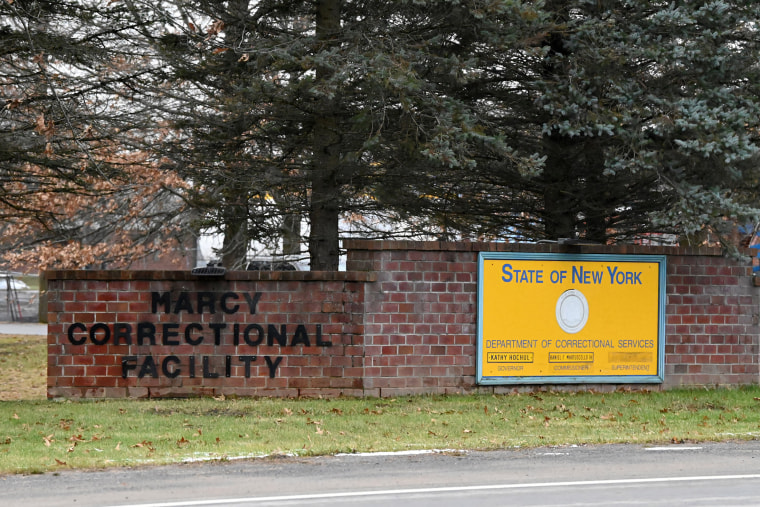
Robert Brooks, 43, died a day after being attacked by several correctional officers at the Marcy Correctional Facility on Dec. 9. His death has prompted a state investigation.
 
***  There is a video at the site linked above that is very informative and shows the man before the police killed him.  ***
 

The office of New York’s attorney general released body camera footage Friday showing the fatal beating of a state prisoner this month by correctional officers who punched and kicked him repeatedly while he was handcuffed on an infirmary bed.

The incident, which has drawn outrage from political leaders and was condemned by the officers’ union as “incomprehensible,” is being investigated by state Attorney General Letitia James. The inmate, Robert Brooks, 43, died in the hospital a day after the Dec. 9 attack.


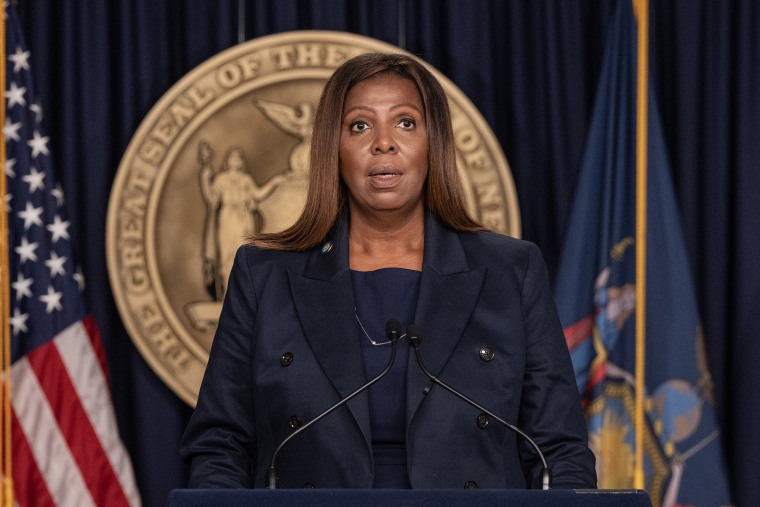
“I do not take lightly the release of this video, especially in the middle of the holiday season,” James said at a virtual news conference.

“These videos are shocking and disturbing,” she added.

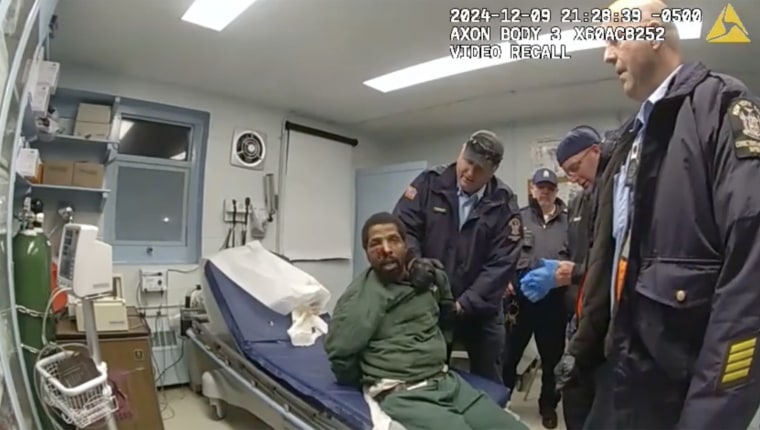
Brooks can be seen in the videos with his hands cuffed behind his back. In one video, he is sitting up as an officer presses his foot down on him. He is then punched by two officers.

At another point, he is forcefully yanked from the bed by his shirt collar and held up above the ground, his face visibly bloodied.

OSI is currently conducting an investigation into the death of Robert Brooks, who died on December 10, 2024 following an encounter with Department of Corrections and Community Supervision officers at Marcy Correctional Facility in Oneida County.
Robert Brooks as seen in body camera footage at the Marcy Correctional Facility in Oneida County, New York, on Dec. 9.Office of the New York State Attorney General

Last week, Gov. Kathy Hochul ordered the state Department of Corrections and Community Supervision to begin the process of firing 14 workers at the Marcy Correctional Facility in Oneida County, where the incident occurred. They include correctional officers, sergeants and a prison nurse. In the interim, all have been suspended without pay, except for one officer, who already resigned. In a statement following the release of the videos, Daniel Martuscello, the commissioner of the state corrections department, said his office has launched its own investigation in an effort to bring “institutional change.”

“Watching the video evidence of Robert Brooks’ life being taken left me feeling deeply repulsed and nauseated,” Martuscello said. “There is no excuse and no rationalization for a vulgar, inhumane act that senselessly took a life. This type of behavior cannot be normalized, and I will not allow it to be within DOCCS.”

Colorado Man Accused Of Attacking Reporter, Saying ‘This Is Trump’s America Now’

https://www.huffpost.com/entry/colorado-man-accused-attacking-tv-reporter-trump-america_n_676f8133e4b03f311afdc4bd

The Colorado TV reporter told police that he believed he had been followed by the man because he is Pacific Islander.
 

A Colorado man is facing possible bias-motivated charges for allegedly attacking a television news reporter after demanding to know whether he was a citizen, saying “This is Trump’s America now,” according to court documents.

Patrick Thomas Egan, 39, was arrested Dec. 18 in Grand Junction, Colorado, after police say he followed KKCO/KJCT reporter Ja’Ronn Alex’s vehicle for around 40 miles (64 kilometers) from the Delta area. Alex told police that he believed he had been followed and attacked because he is Pacific Islander.

After arriving in Grand Junction, Egan, who was driving a taxi, pulled up next to Alex at a stoplight and, according to an arrest affidavit, said something to the effect of: “Are you even a U.S. citizen? This is Trump’s America now! I’m a Marine and I took an oath to protect this country from people like you!”

Alex, who had been out reporting, then drove back to his news station in the city. After he got out of his vehicle, Egan chased Alex as he ran toward the station’s door and demanded to see his identification, according to the document laying out police’s evidence in the case. Egan then tackled Alex, put him in a headlock and “began to strangle him,” the affidavit said. Coworkers who ran out to help and witnesses told police that Alex appeared to be losing his ability to breathe during the attack, which was partially captured on surveillance video, according to the document.


According to the station’s website, Alex is a native of Detroit. KKCO/KJCT reported that he was driving a news vehicle at the time.

Egan was arrested on suspicion of bias-motivated crimes, second degree assault and harassment. He is scheduled to appear in court Thursday to learn whether prosecutors have filed formal charges against him.

Egan’s lawyer, Ruth Swift, was out of the office Friday and did not return a telephone message seeking comment.