
Month: January 2025
For Science!
Pregnant male pipefish defy evolutionary norms
January 2, 2025 Velentina Boulter
Velentina Boulter is science journalist based in Melbourne.
 Greater pipefish, Syngnathus acus 54, and Sargassum pipefish, Syngnathus pelagicus 55,56. Handcolored copperplate engraving from Gottlieb Tobias Wilhelm’s Encyclopedia of Natural History: Fish, Augsburg, 1804. Wilhelm (1758-1811) was a Bavarian clergyman and naturalist known as the German Buffon. (Photo by: Florilegius/Universal Images Group via Getty Images)
A new study out of the University of Canterbury in Christchurch, New Zealand has called into question traditional perceptions of mating.
“In most species, males compete to attract females. But with pipefish, the males carry and protect the embryos,” says PhD student Nicole Tosto, who led the research.
“Pipefish are unique because they don’t follow the usual ‘rules’ of evolution.”
The research highlights how biological differences in male and female pipefish influence their survival and mating habits.
While females have genes to support egg production, males activate genes to strengthen their immune system.
This is a key adaptation that allows the males to nurture and care for embryos in their bodies.
The study, published in Molecular Ecology, also uncovered how this switch in activated genes impacts mating selection.
In most species, females prefer larger, dominant males as mates because it often increases their chance of having healthy offspring, as the strong male can provide security and defence from predators.
Instead, the study found that female pipefish swim against this trend and tend to choose smaller males with high fitness levels.
Tosto suggests that this selection is based on efficiency as smaller males may need fewer resources.

She also believes smaller males could be better suited for the synchronised water movements that are a part of the species’ courtship rituals.
In many animals, males and females of the same species can have physical features that are different between the sexes and are often used to attract mates. These visible traits are known as sex-specific ornaments.
However, the pipefish species involved in the study were monomorphic, meaning that male and female pipefish looked almost identical and had no visible differences.
“Nicole’s research has brought up important questions for evolutionary biologists when it comes to current vs past selection,” says her doctoral supervisor, Dr Sarah Flanagan, a senior lecturer in Biological Science at the University of Canterbury.
Natural selection is a process where individuals with traits that help them survive become more likely to reproduce and therefore pass on those traits to their offspring. Overtime these advantageous traits become more commonly inherited among the species.
“For example, whether the existence of sex-specific ornamentation is evidence that selection is currently acting strongly on those sex-specific traits or whether ornaments are evidence of selection having happened in the past.”
Pipefish don’t have sex chromosomes meaning both sexes share the same genetic blueprint, they just use the genes in different ways.
For example, females focus on producing egg-enhancing proteins, whereas males produce immune-boosting proteins for pregnancy.
“Knowing how these pressures shape mating systems helps us better understand how species survive and adapt to their environments,” says Tosto.
While there is no current extinction concern for dusky pipefish (Syngnathus floridae), the species of pipefish investigated in the study, other pipefish species such as the estuarine pipefish are critically endangered.
Seahorses also behave like pipefish
Some Poetry on New Year’s Morning
It is about war. It is a beautiful piece of work about war. Click the title to get the background.
All I can see is nothing Sahar Muradi
If nothing that can be seen can either be God or represent Him to us as He is, then to find God we must pass beyond everything that can be seen and enter into darkness.
Since nothing that can be heard is God, to find Him we must enter into silence.
—Thomas Merton, from “New Seeds of Contemplation,” 1961
I swear to God, mom, I am exhausted, but praise be to God in all circumstances.
—writing, translated from the Arabic, on the Al-Shifa Hospital walls, April 2024All I can see is nothing
Fields ofHollow
The O that escapesA pasture of
MouthsAn apartment building
Of locked jawsThe silent weeping
Of rocksI hear nothing
In the bags of soft limbs sighingMilk teeth
Sharpening a father’s heartThe cone hat on the small head
Singing to plumesIftar in the tents
Flapping pages off the moonBut Your name over and over
On the hospital wallsBut Your name stilling
The fire that does not ceaseBut Your name everywhere
Everything all at onceI see nothing
From this distanceThis deepest night
This longest darknessFumble at fajr
To loosen my gaspsI repeat Your name
Over and overThen bow to Your wisdom
To the terror of Your liberationO that I may not see anything
MoreCopyright © 2024 by Sahar Muradi. Originally published in Poem-a-Day on December 31, 2024, by the Academy of American Poets.
Some Joe My God headlines of republican right wing feces
The eight tech titans alone gained more than $600 billion this year, 43% of the $1.5 trillion increase among the 500 richest people tracked by the Bloomberg Billionaires Index.

Greenland’s natural resources are worth many trillions; future drillers and diggers won’t care that it’s cold and distant. As Alaska proves, where there’s value, there’ll be value-extractors
plus, perhaps, a casino or two. Yes, the right kind of development could MGGA—Make Greenland Great Again.





Maybe Some New Reads for the New Year
Here are the queer books mentioned on the most Best Books of 2024 lists, from graphic novels to literary fiction, romance, fantasy, and more.
Danika Ellis Dec 31, 2024
During the “Best Books of the Year” season, I’ve been going through and picking out which queer books get featured on the biggest lists. My plan was to mash all this information together into a Frankensteined spreadsheet and then share with you the queer books included on the most “best of” lists. Luckily, I was saved a step, because LitHub already made an Ultimate Best Books of 2024 List that includes best-of lists from 39 outlets. I just went through that and pulled out the queer books.
I am limited to the books I recognize, so please let me know if I missed any! As far as I could tell, though, here are the nine queer books mentioned on the most Best Books of 2024 lists, from horror graphic novels to literary fiction to historical sports romance to poetry, biography, fantasy, and more.
If you’ve been paying attention to the best of lists at all, I bet you can guess which titles are tied at #1. Regardless, this makes for a great reading list if you want to catch up on the best queer books that came out in 2024 that you may have missed!
#5 (Tied), Mentioned on Five Lists
My Favorite Thing Is Monsters, Book 2 by Emil Ferris
We finally have the sequel to this celebrated graphic novel, and it was worth the wait. Intricately etched with full, exciting pages and a bold story, it picks up where the last left off: Karen, a young monster, is investigating her neighbor’s murder in the Uptown apartment where she’s grown up. But the secrets she’s discovered aren’t the ones she was looking for, and in this book, she’ll have to fight hard to avoid coming apart at the seams. This bold coming-of-age tale about queerness, difference, family, and the city of Chicago is impactful, emotional, and bold, and I was both overjoyed and very sad to see the story of Karen Reyes come to its conclusion. —Leah Rachel von Essen
Greta & Valdin by Rebecca K Reilly
This award-winning book follows siblings Greta and Valdin as they contend with an eccentric, multiracial family, queerness, and just trying to figure it all out. Valdin is doing superficially well after having been dumped by his boyfriend a year ago—his colleagues are only occasionally weird about his Maaori heritage, and he has intermittent sad sex with a friend—when work sends him from New Zealand to Argentina, where his ex is. Meanwhile, Greta has her own bubbling sadness. She’s experiencing unrequited pining, and her family is in a state made even more perplexing by her brother’s sudden, secretive move to South America. —Erica Ezeifedi
You Should Be So Lucky by Cat Sebastian
In this M/M historical baseball romance, Mark is a reporter in the 1960s who’s stuck interviewing the obnoxious New York shortstop for his whole first season. Eddie is having a tough enough time on the team, so he’s also reluctant, but neither of them is exactly given a choice. Mark is still mourning the death of his partner, the one no one knew about. He’s vowed never to have a secret relationship again—but now Mark and Eddie are falling for each other…
#4, Mentioned on Six Lists
Survival Is a Promise: The Eternal Life of Audre Lorde by Alexis Pauline Gumbs
If you’re looking for a dry, birth-to-death, “here’s an accounting of the events of this person’s life” biography, this book is not for you. If you’re looking for a biographical poem, a multilayered close read of Audre Lorde’s poetry, a book that centers her relationships, an exploration of the ongoing legacy of her liberation work, an ode to complexity and nuance—then you’re going to want to run to this astounding, prismatic work of nonfiction. —Laura Sackton
#3 (Tied), Mentioned on Seven Lists
Bluff: Poems by Danez Smith
Danez Smith is a must-read poet who has been recommended in countless Book Riot lists. This is their newest, and I’ll let the publisher’s description summarize it: “Bluff is a kind of manifesto about artistic resilience, even when time and will can seem fleeting, when the places we most love—those given and made—are burning. In this soaring collection, Smith turns to honesty, hope, rage, and imagination to envision futures that seem possible.”
The Bright Sword by Lev Grossman
Like a lot of fantasy lovers, I’ve read my fair share of King Arthur-related novels. So many of them take themselves very seriously, portraying these majestic and austere knights as the fierce protectors of the land. But Grossman’s version of Camelot is different. It’s funny, delightfully ridiculous in so many ways. Like his take on magical schools in the magicians, The Bright Sword pokes fun at stories of Arthurian legend as much as it also celebrates it. But we, the readers, are in on the joke, understanding that this story is in conversation with the many previous tales of King Arthur and his knights.
If you’re looking for a humorous yet simultaneously heartfelt, funny, and queer-inclusive story from the world of Camelot, The Bright Sword may be the pick for you. —Kendra Winchester
#2, Mentioned on 11 Lists
Our Evenings by Alan Hollinghurst
Alan Hollinghurst is the Booker Prize-winning author of The Line of Beauty, The Swimming-Pool Library, and many other acclaimed novels. Our Evenings is about Dave, a mixed-race queer child who receives a scholarship to a prestigious boarding school and experiences the opportunities and cruelties of this turn of fate. We follow him from the 1960s through his coming of age, including first love affairs, a career on stage, and a late-in-life marriage.
#1 (Tied), Mentioned on 21 Lists
Martyr! by Kaveh Akbar
It’s always nice when one of the biggest literary fiction titles of the year is queer. This is a bestseller that comes highly recommended by authors like Tommy Orange, Lauren Groff, John Green, Clint Smith, and more. It follows Cyrus, a twentysomething queer poet who has been numbing his pain with drugs and alcohol. His mother was killed when her plane was shot down over Tehran in a senseless act of violence by the U.S. military. His father recently died of a heart attack. As he becomes sober, Cyrus goes looking for meaning, and he finds it by researching martyrs. When he hears about an artist dying of cancer in an exhibition at a museum, he is determined to meet her.
All Fours by Miranda July
In The New York Times Notable list, they categorize this literary fiction title with a bisexual main character as “Sexy Perimenopause Fiction” and recommend it for fans of Big Swiss by Jen Beagin. The top 10 list describes it as “the talk of every group text — at least every group text composed of women over 40” and “the first great perimenopause novel.”
Peace & Justice History for 1/1
January 1, 1831 William Lloyd Garrison first published The Liberator (four hundred copies printed in the middle of the night using borrowed type), which became the leading abolitionist paper in the United States. He labeled slave-holding a crime and called for immediate abolition. From the first issue: “I will be harsh as truth, and uncompromising as justice. On this subject, I do not wish to think, or speak, or write with moderation. “Assenting to the ‘self-evident truth’ maintained in the American Declaration of Independence, ‘that all men are created equal, and endowed by their Creator with certain unalienable rights—among which are life, liberty, and the pursuit of happiness,’ I shall strenuously contend for the immediate enfranchisement of our slave population.” Selections from The Liberator |
| January 1, 1847 Michigan became the first state – the first government in the English-speaking world – to abolish capital punishment (for all crimes except treason). This was done by a vote of the legislature, and was not a part of the state’s constitution until 1964. How it happened (it’s a .pdf) |
| January 1, 1959 32-year-old lawyer Fidel Castro led Cuban revolutionaries to victory over the corrupt government of Fulgencio Batista who had fled the island the day before. Batista, a former army sergeant, had seized power in a coup, canceling an election, in 1952.  Fidel Castro More on pre-Castro Cuba The news at the time Perspective of a U.S. intelligence agent |
| January 1, 1983 44 women scaled a 12-foot fence at dawn, breaking into a cruise missile base at Greenham Common in Great Britain, and danced on a missile silo. The lyrics to their “Silo Song” |
| January 1, 1987 Ten anti-nuclear activists were arrested for trespassing at the Nevada Test Site, the culmination of a 54-day encampment at the main Test Site gate. The camp established momentum for what became a movement ultimately involving over 10,000 arrests in numerous Test Site protests over the following years in the campaign to achieve a freeze of all nuclear weapons testing.  Nevada test site landscape The Nevada site includes more than 14,000 sq. km. (nearly 6000 sq. miles, larger than the state of Connecticut) of uninhabited land where atmospheric, and later underground, nuclear testing had been conducted since the 1950s. About the the Nevada Test Site |
January 1, 1989 Kees Koning Kees Koning, a former army chaplain and priest, and Co van Melle, a medical doctor working with homeless people and illegal refugees, entered the Woensdrecht airbase (for a second time), and began the “conversion” of NF-5B fighter airplanes by beating them with sledgehammers into ploughshares. The Dutch planned to sell the NF-5B to Turkey, for use against the Kurdish nationalists as part of a NATO aid program which involved shipping 60 fighter planes to Turkey. Koning and van Melle were charged with trespass, sabotage and $350,000 damage; they were convicted, and both sentenced to a few months in jail. Read more about the plowshares movement |
| January 1, 1991 Early in the morning Moana Cole, a Catholic Worker from New Zealand, Ciaron O’Reilly, a Catholic Worker from Australia, and Susan Frankel and Bill Streit, members of the Dorothy Day Catholic Worker community in Washington, D.C., calling themselves the ANZUS (Australia, New Zealand and U.S.) Peace Force Plowshares, entered the Griffiss Air Force Base in Rome, New York.  Moana Cole After cutting through several fences, Frankel and Streit entered a deadly force area, and hammered and poured blood on a KC-135 (a refueling plane for B-52s), and then hammered and poured blood on the engine of a nearby cruise missile-armed B-52 bomber. They presented their action statement to base security who encircled them moments later. About Moana Cole |
| January 1, 1994 The North American Free Trade Agreement (NAFTA) took effect. A treaty among Canada, the U.S. and Mexico, it called for all three countries to follow similar policies for environmental, safety and investment regulation, apart from laws passed by their respective legislatures. |
| January 1, 1994 On the day NAFTA (see above) took effect, more than 2,000 native Mayans in Mexico’s Chiapas state marched into the state capital, San Cristóbal de las Casas, and five neighboring towns, and seized control. Calling themselves Zapatistas, or the Zapatista Army of National Liberation (EZLN), a “declaration of war” was issued. Chiapas is among the poorest parts of Mexico. The indigenous peoples of Mexico long suffered as second-class citizens due to the dominance of the Roman Catholic church and the traditional Mestizo (mixed Spanish and Indian ancestry) political leadership of the country. The EZLN was certain that NAFTA would permanently lock in the top-down economic situation in Mexico. The Zapatistas’ slogan was !Ya basta! (“Enough is enough”). Employees at the Mexican stock exchange were evacuated by riot police. 25,000 Mexican soldiers arrived in Chiapas equipped with automatic weapons, tanks, helicopters and airplanes. 145 deaths were reported, mostly civilians. Massive arrests and subsequent torture of prisoners by the government took place. |
https://www.peacebuttons.info/E-News/peacehistoryjanuary.htm#january1
California bans schools from forcing teachers to ‘out’ LGBTQ students
This is good news and shows why so many are moving into California and out of places like Florida. Students should feel free from fear while learning. They also should feel free to be their authentic self in a supportive atmosphere. School is a time to learn about the world, other people, subjects, and about one’s self. And not all kids have safe supportive homes. Hugs.
———————————————————————————————————–
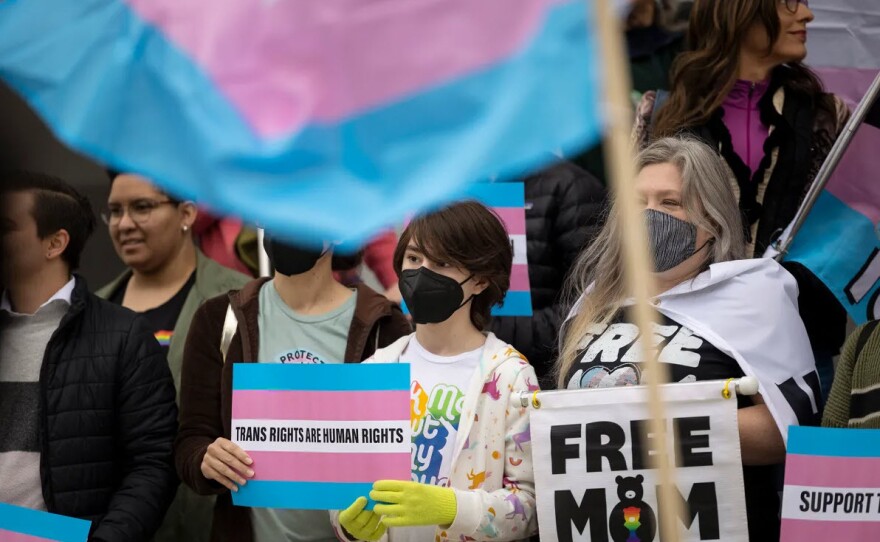
Miguel Gutierrez Jr./CalMattersSupporters of transgender rights gathered at the Capitol during a press conference on March 17, 2022.
Amid a flurry of recent school board policies aimed at the rights of transgender students, California passed a new law in July that prevents schools from requiring staff to notify parents if a student identifies as LGBTQ.
The new law, AB 1955, came in response to a handful of school boards adopting policies that require teachers and other school staff to notify parents if a student identifies as a gender other than what’s on their school records.
“Teachers can still talk to their parents,” Gov. Gavin Newsom said at a press conference on Monday in which he touted a new plan to improve career opportunities for adults. “What they can’t do is fire a teacher for not being a snitch. I don’t think teachers should be gender police.”
LGBTQ advocates said that “forced outing” policies, such as those adopted in Chino, Temecula and a dozen other districts, infringe on students’ privacy and could potentially harm students whose parents disapprove of their identity.
The state sued to stop Chino’s policy, and most districts either scrapped their policies, tweaked the language or put them on hold.
This act “could not be more timely or necessary, and LGBTQ+ students across California can breathe a sigh of relief,” Tony Hoang, executive director of Equality California, which advocates for LGBTQ rights, wrote. “LGBTQ+ youth can now have these important family conversations when they are ready and in ways that strengthen the relationship between parent and child, not as a result of extremist politicians intruding into the parent-child relationship.”
‘The battle continues’
Opponents of the new law said that parental notification policies actually strengthen ties between students and parents, and schools should not withhold information on such important matters. Even though a parental notification measure that would have applied to all schools failed to qualify for the ballot, opponents vowed to keep fighting.
“This (law) doesn’t clarify anything. And nothing prevents individual teachers from bringing the issue up with parents,” said Roseville school board member Jonathan Zachreson, an organizer of the failed ballot measure and whose district was among those that passed parental notification policies. “So the battle continues.”
The new law also requires the state Department of Education to update its LGBTQ resources and encourage school districts to offer counseling, support groups, clubs, anti-bullying policies and other measures to support LGBTQ students and their families. Schools would have to pay for those services with their existing funding.
“I don’t think teachers should be gender police.”Gov. Gavin NewsomLGBTQ young people are particularly vulnerable on school campuses. In a recent survey of 18,000 LGBTQ young people nationwide, nearly half said they had been bullied in the past year, and 10% said they had attempted suicide. Those whose schools supported LGBTQ rights were less likely to suffer from mental health challenges.
Even if the new law sparks a backlash in more conservative areas of the state, California was right to move forward with it, especially as some states push ahead with their own parental notification policies, said USC education professor Morgan Polikoff.
“Will everyone like this law? Certainly not. Will it lead to conflict? There is no doubt,” Polikoff said. “But I am hopeful this will be good for the queer kids in California’s schools and will point the way toward similar efforts in other states.”
CalMatters’ Adam Echelman contributed to this story.

Costco Board Rejects Demands Of Anti-Diversity Group
Finally a company showing how to stand up to the bigot racist and calling out the real reasons these groups are demanding these changes. I hope the shareholders stand firm on inclusion and diversity. Hugs
Newsweek reports:
The Costco Board pushed back against its anti-diversity, equity and inclusion (DEI) shareholders, who had suggested the wholesale corporation re-evaluate its “illegal discrimination” program.
The Costco board responded to a group of shareholders, unanimously recommending a vote against the proposal to “report on the risks of maintaining DEI efforts.”
The shareholders had suggested Costco employees would potentially become victim to “illegal discrimination because they are white, Asian, male or straight,” which could create “tens of billions of dollars” in legal costs to the company.
The Hill reports:
In its response to the proposal, Costco called out the group for “inflicting burdens” on companies through “policy bias” and said their proposal did not aim to address financial risks but to strike down DEI efforts.
“The proponent’s broader agenda is not reducing risk for the Company but abolition of diversity initiatives,” the board of directors added.
The annual meeting where shareholders will vote on the matter will take place in late January. Earlier this year, Lowe’s, Harley Davidson and Walmart announced the repeal of DEI practices after facing similar pushback from conservative groups.
Hit both links for much more.


 Scottie's Playtime