All slashed in order to pay for tax cuts to the wealthy.
Let’s call it what it really is. Alligator Auschwitz. A MAGA concentration camp. The prisoners of Alcatraz were CONVICTED criminals. None of these people have been charged with anything. They have not been arrested. They have been abducted.
If it took 8 days to build a massive concentration camp in Florida then it means they could build and house the homeless at any point but choose not to
Gillibrand apologizes to Mamdani over ‘jihad’ comments – POLITICOSo I am glad Gillibrand apologized but she should really do so publicly, not privately, given her smear against him was done publicly, on live radio in fact.
Heads up, the fight is not over with respect to the trans care medicaid amendment. Marjorie Taylor Greene has reintroduced it on the House side. Call your house reps now and tell them not to approve it. Even republicans, especially moderate Republicans.
Everything is bigger in Texas—except, apparently, memory of devastating mass shootings.In late June, Gov. Greg Abbott signed into law a bill known as the Anti-Red Flag Act, which preemptively bans the creation or enforcement of extreme risk protective orders.
The president is hawking fragrances while the State of Florida is celebrating its first concentration camp by handing out swag.I'm rooting for the asteroid now more than ever.#DontStopBelieving 🤞
Yes, this is true, albeit not current story it happened in 2005. There are credible sources confirming this story, BBC and Guardian reported this in 2006.
What would you call a society where it is both more expensive to be disabled and just live, and harder to earn that money to live when you live with a disability?I think we have to face some harsh realities.
July 2, 1776 New Jersey became the first British colony in America to grant partial women’s suffrage. The new constitution (temporary if there were a reconciliation with Great Britain) granted the vote to all those “of full age, who are worth fifty pounds proclamation money,” including non-whites and widows; married women were not able to own property under common law.
July 2, 1777 Vermont became the first of the United States to abolish slavery.
July 2, 1809 Alarmed by the growing encroachment of whites squatting on Native American lands, the Shawnee Chief Tecumseh called on all Indians to unite and resist. By 1810, he had organized the Ohio Valley Confederacy, which united Indians from the Shawnee, Potawatomi, Kickapoo, Winnebago, Menominee, Ottawa, and Wyandotte nations. For several years, Tecumseh’s Indian Confederacy successfully delayed further white settlement in the region. Chief Tecumseh Tecumseh’s efforts
July 2, 1839 Slave ship Early in the morning, captive Africans on the Cuban slave ship Amistad, led by Joseph Cinquè (a Mende from what is now Sierra Leone), mutinied against their captors, killing the captain and the cook, and seized control of the schooner. Jose Ruiz, a Spaniard and planter from Puerto Principe, Cuba, had bought the 49 adult males on the ship, paying $450 each, as slaves for his sugar plantation. More about Amistad Joseph Cinquè
July 2, 1964 Jobs and Freedom march April 28, 1963, Washington DC U.S. President Lyndon B. Johnson signed the Civil Rights Act of 1964 into law, thus barring discrimination in public accommodations (restaurants, stores, theatres, etc.), employment, and voting. The law had survived an 83-day filibuster in the U.S. Senate by 21 members from southern states. “I think we just delivered the South to the Republican party for a long time to come,” said President Johnson to his press secretary, Bill Moyers later that day. He anticipated a shift in white southern voting from the Democratic to the Republican party in response to the law. Massive demonstrations a year earlier ensured passage of the Act.
July 2, 1992 President George H.W. Bush (the elder) announced that the United States had completed the worldwide withdrawals of all its ground- and sea-launched tactical nuclear weapons [see September 27, 1991].
CINCINNATI — The Ohio Lesbian Archives in Cincinnati’s Over-the-Rhine neighborhood started with a friendship.
Phebe Beiser said that when she and co-founder Victoria “Vic” Ramstetter met in the 1970s, they bonded over being “hidden, secret, teenage lesbians,” growing up in what was then a conservative city and region where there were few gay role models. For a time in their 20s, they shared group houses in Clifton, where they now joke that they “survived the lesbian commune together.” They were young and idealistic. They wanted to “turn being an activist lesbian into something fun and interesting, and maybe help change the world.” Beiser, now in her mid 70s, told The 19th that they had a mantra: “We never wanted to be invisible again.”
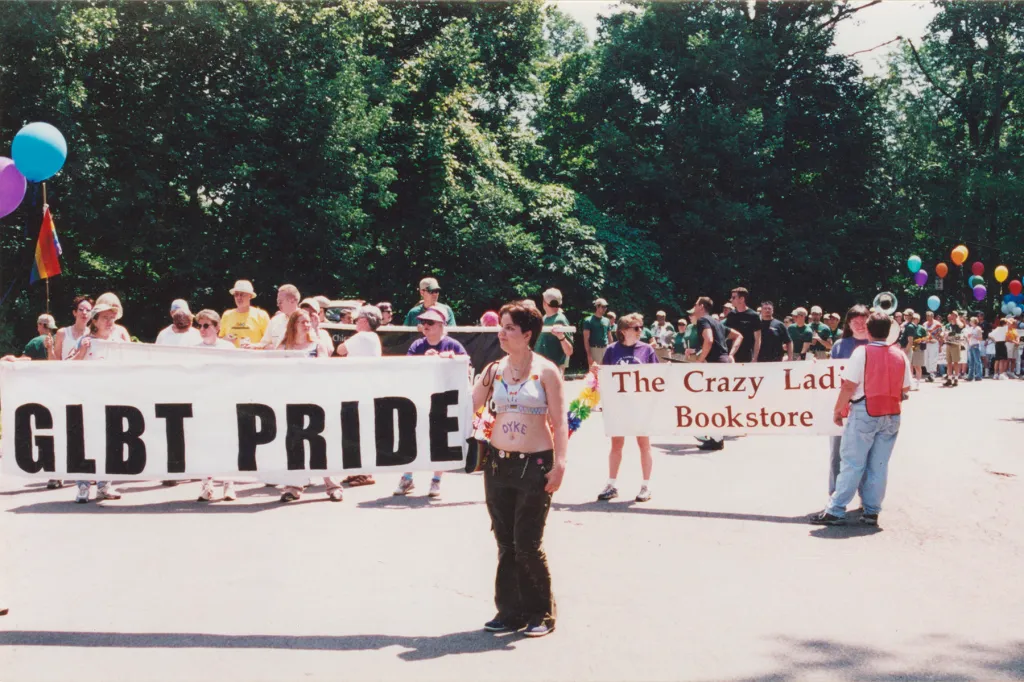
When the Crazy Ladies Bookstore, named for the women who history brushed off as “crazy,” opened in Northside in 1979, it became the center of gravity in the Cincinnati lesbian community of which Beiser and Ramstetter were a part. Women bought homes in the neighborhood, gathering at the feminist bookstore for coffee, tea and conversation about being women, and about being gay. In 1989, the Archives opened on an upper floor.
It seemed that the visibility of the Crazy Ladies Bookstore and the Ohio Lesbian Archives — and of the women who made them happen — would be cemented in history in 2023, when the Ohio History Connection, the state’s nonprofit historical society, “embarked on a three-year project to diversify Ohio’s historical markers to include ten new stories of LGBTQ+ Ohioans” via its Gay Ohio History Initiative, or GOHI. At the time, there were roughly 1,800 historical markers in Ohio’s program, but only two commemorated places, events or people from the state’s queer history. A third, recognizing Summit Station, a lesbian bar in Columbus that operated from 1970 to 2008, was dedicated during Pride Month that year. The Archives and bookstore were selected for joint recognition.
That long-overdue acknowledgement has been derailed by the Trump administration’s sweeping war on DEI, which extends beyond diversity, equity and inclusion programs to seemingly include anything that acknowledges the country’s diversity of experience. But the archives — and the volunteers who sustain it — are undeterred, carrying on as the queer community has throughout history, documenting their existence.
We never wanted to be invisible again.” Phebe Beiser
The Ohio Lesbian Archives first began in 1989 in a small room on the third floor above the Crazy Ladies Bookstore in Cincinnati, Ohio. (Cincinnati & Hamilton County Public Library)
The Marking Diverse Ohio program was financed by a $250,000 grant from the Institute of Museum and Library Services, an independent agency created by a Republican-led Congress in 1996 that is the main source of federal funding for libraries and museums. Beiser and Branstetter were interviewed for an oral history. Ohio History Connection researchers visited the Archives to peruse the collection. A location was secured in a city park near where the since-shuttered Crazy Ladies Bookstore once was. By early this year, preparations to forever commemorate the Archives and bookstore with a plaque were all but complete. Its installation was expected in June, Pride Month.
Then, in late March, President Donald Trump issued an executive order regarding “The Continuing Reduction of the Federal Bureaucracy,” singling out seven agencies for elimination — including the Institute of Museum and Library Services, or IMLS. Nearly all of its employees were put on leave and their emails were disconnected. Days later, his administration’s Department of Government Efficiency, or DOGE, canceled $25 million worth of already-awarded IMLS grants, including the $250,000 for Ohio History Connection’s Marking Diverse Ohio program. The federal agency’s seemingly final Instagram post stated: “The era of using your taxpayer dollars to fund DEI grants is OVER.” The last photo listed erecting “LGBTQIA+ historical markers across Ohio” among the alleged government excesses that would be cut.
Svetlana Harlan, a former project coordinator for Marking Diverse Ohio, recalled that when she looked at the list, and saw the program with other projects she admired, “it almost seemed like a positive thing, I was like, ‘Oh yeah, these are nice initiatives!’”
“And it turns out that [DOGE] was just taking over the account. So then I was like, ‘Oh, they’re cutting those. Oh, our name is on the list,’” she said.
DOGE’s cancellation of the $250,000 IMLS grant to Ohio History Connection threw into question the future of the markers that were supposed to ensure that Ohio’s public displays of its history include LGBTQ+ people. Along with the Ohio Lesbian Archives and the Crazy Ladies Bookstore, there were markers in the works for an LGBTQ+ district in Akron; the first professor of gay and lesbian studies at Kent State University; 19th-century sculptor Edmonia “Wildfire” Lewis; LGBTQ+ journalism in Ohio; Toledo’s first LGBTQ+ member of city council; a Columbus hospice care center for HIV and AIDs patients; an open lesbian pastor in Athens; the screen-printing company Nightsweats and T-Cells in Lakewood; and the Rubi Girls, a Dayton-area drag group that has raised more than $3 million for HIV/AIDs and LGBTQ+ causes since the 1980s.
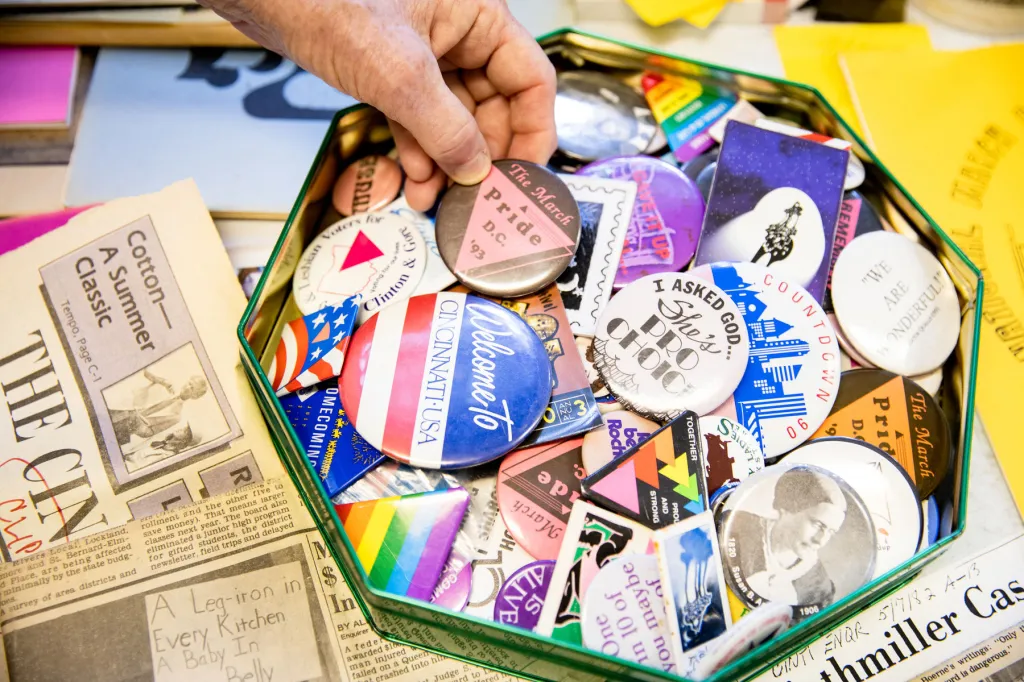
Ephemera collected at the Ohio Lesbian Archives include buttons from past Pride marches, political campaigns and other symbols of lesbian life. (Courtesy Ohio Lesbian Archives)
Preservation on hold
Marking Diverse Ohio and other programs recognizing specific communities weren’t the only programs impacted in the state when DOGE cut IMLS grants and the federal agency essentially shuttered. And, given that more than $250 million is granted annually to libraries and museums nationally, the economic chaos at the country’s museums, libraries and historical institutions wasn’t confined to Ohio.
In Ohio, other entities that received recent IMLS funding include the Frank Lloyd Wright-designed Westcott House in Springfield, for post-pandemic, on-site programming; the Cincinnati Zoo for a big cat breeding program; Dayton Metro Library programs that helped low-income Ohioans secure Internet access; and Cincinnati’s Contemporary Arts Center, which lost $175,000 slated for programming aimed at the 3,000 or more teens it serves each year.
Institutions in Pennsylvania warned the economic upheaval could scuttle the digitization of The Rosenbach museum’s collection of rare books and manuscripts; the Woodmere Art Museum was mid renovation on a building to house its collection and expected to be reimbursed. In Wisconsin, small-town libraries said without the $3 million from the IMLS they’d received the year before they would have to reduce staff and therefore services. The American Library Association, or ALA, and the American Federation of State, County and Municipal Employees, or AFSCME, the labor union representing government workers, sued the Trump administration. ALA President Cindy Hohl said at the time that, “Libraries play an important role in our democracy, from preserving history to … offering access to a variety of perspectives.” AFSCME President Lee Saunders added: “Libraries and museums contain our collective history and knowledge.”
Earlier this month, a federal judge ruled that the Trump administration could continue dismantling the Institute of Museum and Library Services as the case continues.
For now, Ohioans who want LGBTQ+ history represented among the 1,800 markers in the state will not get the federal funding that was granted and must search for alternative resources in their communities. A couple of the markers look poised to move forward with outside funding from community foundations and other organizations. Others, like the Ohio Lesbian Archives and the Crazy Ladies Bookstore, are still waiting. The remaining cost to install the marker would likely be $3,000-$5,000.
When The 19th reached out to Ohio History Connection to ask if any alternative funding sources were being explored to install the Archives’ marker, spokesperson Neil Thompson said that he was “not able to provide any additional information for an Ohio Historical Marker application that is not in the public domain” and that it is only considered in the public domain once “the markers are finalized, cast and ready to be installed and dedicated.”
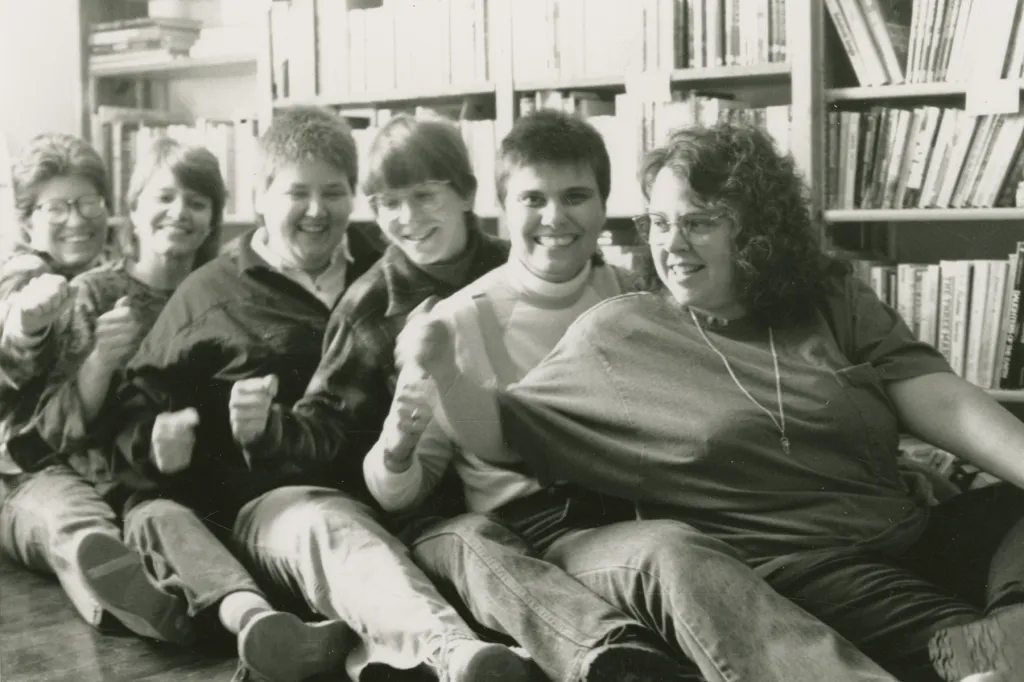
Phebe Beiser (far left), who co-founded the Ohio Lesbian Archives with her longtime friend Victoria ‘Vic’ Ramstetter, with Janice Uhlman, Elizabeth Van Dyke, Cathy McEneny, Morgan Kronenberger, and Ruth Rowan (left to right) at the Ohio Lesbian Archives in 1989. (Cincinnati & Hamilton County Public Library)
‘A reflection of themselves’
The Ohio Lesbian Archives has always been a DIY endeavor, powered by a group of passionate volunteers. When the Crazy Ladies Bookstore’s founder, Carolyn Dellenbach, moved out of the area, she handed it over to its patrons to be run as a feminist collective. A lesbian newsletter called Dinah operated out of the upper floor — they referred to the National Organization for Women’s Task Force on Sexuality and Lesbianism, established in 1973, as FOSAL, or fossil, and Dinah was a play on dinosaur. Beiser laughed explaining the name: It was the 1970s; maybe there were drugs involved. For a time she wrote for Dinah and loved interviewing famous arrivals from the “women’s music circuit” when they came to town.
At some point, the women working shifts at the bookstore, writing for Dinah and organizing talks and other events related to feminist and lesbian issues, realized that the community they had built, and the ephemera they were collecting and creating, were an important part of history — theirs, lesbians,’ Ohioans,’ and women’s.
“We held on to them because we knew they could not be replaced,” Beiser said of the collection. “It’s proof of our existence … so we held on to these things to never be invisible again.”
We held on to them because we knew they could not be replaced. It’s proof of our existence.” Phebe Beiser
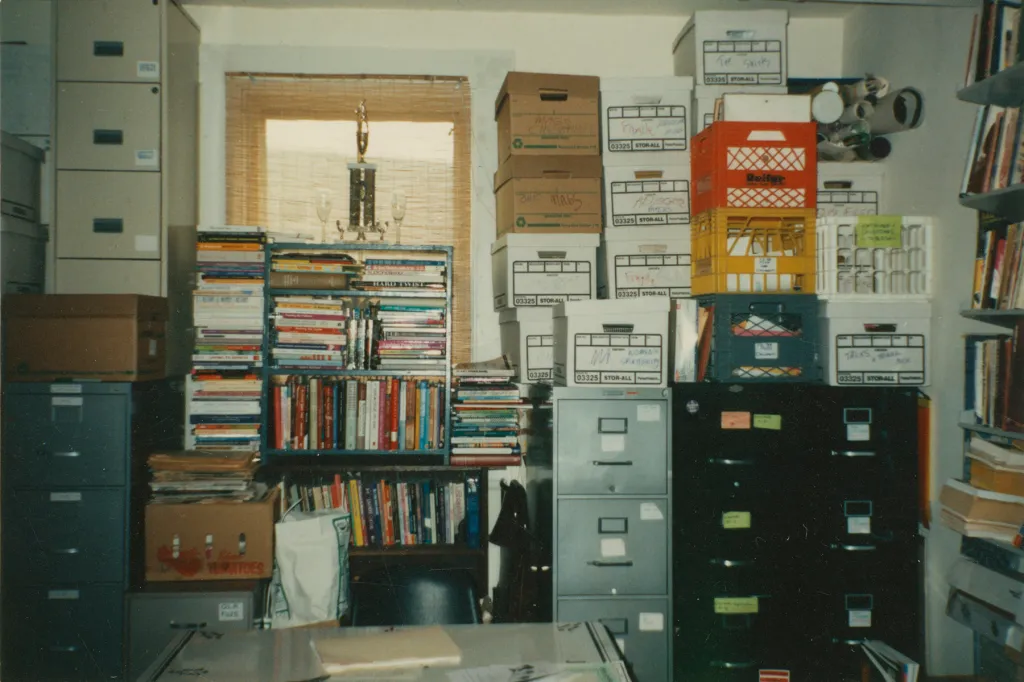
Books on lesbian history line the shelves of the Ohio Lesbian Archives. (Courtesy Ohio Lesbian Archives)
In a 1991 issue of Dinah, letters to the editor included one from “Ma” who updated the “wimmin” in the community — they often spelled variations of their gender in ways that did not include “man” — that she was homesteading outside the city with her partner and building a log cabin. Another was from a woman who said she was “shocked” to find out that her being fired for being a lesbian was not a violation of civil rights laws and she was disappointed that the LGBTQ+ community did not come out to support her recent picket, writing: “I hope that in my lifetime I will see the gay and lesbian community get off their asses and together start fighting for their rights.”
Across from the metal filing cabinet at the Archives that houses the Dinah issues, a modern-looking poster from before the Supreme Court decided Bostock v. Clayton County in 2020, which extended employment protections to LGBTQ+ Americans, reminded Ohioans that it was still legal for them to be fired for their sexual orientation or gender identity. Today, Trump’s Equal Employment Opportunity Commission is aiming to curtail those hard-won workplace protections established by Bostock.
Lüdi Rich, a 27-year-old librarian, was working a recent Sunday afternoon at the Archives’ twice-weekly open hours, organizing books and research materials while the space was open to members of the community to drop in.
When Rich moved to Cincinnati nearly two years ago, she didn’t know anyone in the area, so she looked online for queer spaces so she could start building her community. When she attended a panel on local queer history, one of the speakers was Beiser, a longtime librarian herself in the country’s second-largest public library system.
Beiser mentioned at the panel that the Ohio Lesbian Archives would be having an open house that night at its new location next to Over-the-Rhine’s Washington Square Park, where Beiser was among those who met to march in Cincinnati’s first Pride Parade in April 1973. Rich asked Beiser how she could volunteer.
A couple months later, Rich showed up for her first shift, “And I’ve been here working ever since,” she said.
Nancy Yerian, the 34-year-old president of the Archives’ board, said that when she graduated from college in Massachusetts, she didn’t know if she could return to Cincinnati, where she grew up — until she discovered the Archives. “I thought that to live the kind of life I wanted to lead, I had to get out of what I thought was a very conservative place,” said Yerian, who has been volunteering at the Archives in some capacity since shortly after she finished school.
“Finding the Archives and the people I’ve met through the organization and the community we’re creating, as well as the history we’re preserving — it gave me a lot of hope that I could create a life for myself here,” she added.
It really is just us, preserving our history.”Lüdi Rich
The Crazy Ladies Bookstore marched in a Cincinnati, Ohio Pride parade. (Cincinnati & Hamilton County Public Library)
The Archives’ volunteers have helped digitize old photos, some of which are now in a collection at the Cincinnati Public Library. They organize the books, arranged by first names instead of last, since so many women, especially in those early years, published works after taking on their husbands’ surnames. There are filing folders of Dinah newsletters. A cabinet holds multiple VHS and DVD copies of the early aughts television drama “The L Word.” A collection of buttons includes those from past Pride marches; supporting Hillary Clinton’s presidential campaigns; and one with “REMEMBER” and an inverted pink triangle, the Nazi symbol that Adolf Hitler used to identify gay and trans people. There is also one with the logo of the Crazy Ladies Bookstore, the silhouette of a woman reading while reclined in a chair, a cat by her side.
“Many people who are coming to the archives are looking for a reflection of themselves and in many ways that’s why Vic and Phebe started it. It shows models of ways to be in the world and a feeling of not being alone and not being the first queer person or lesbian,” Yerian said.
The Ohio Lesbian Archives, marker or not, is and will keep doing what it always has: making sure that lesbian Americans are visible in the country’s historical record.
“It really is just us, preserving our history,” Rich said.
Feeling overwhelmed by the news? The 19th is considering new ways to keep you informed. But we need your input! Fill out this quick survey to share your thoughts.
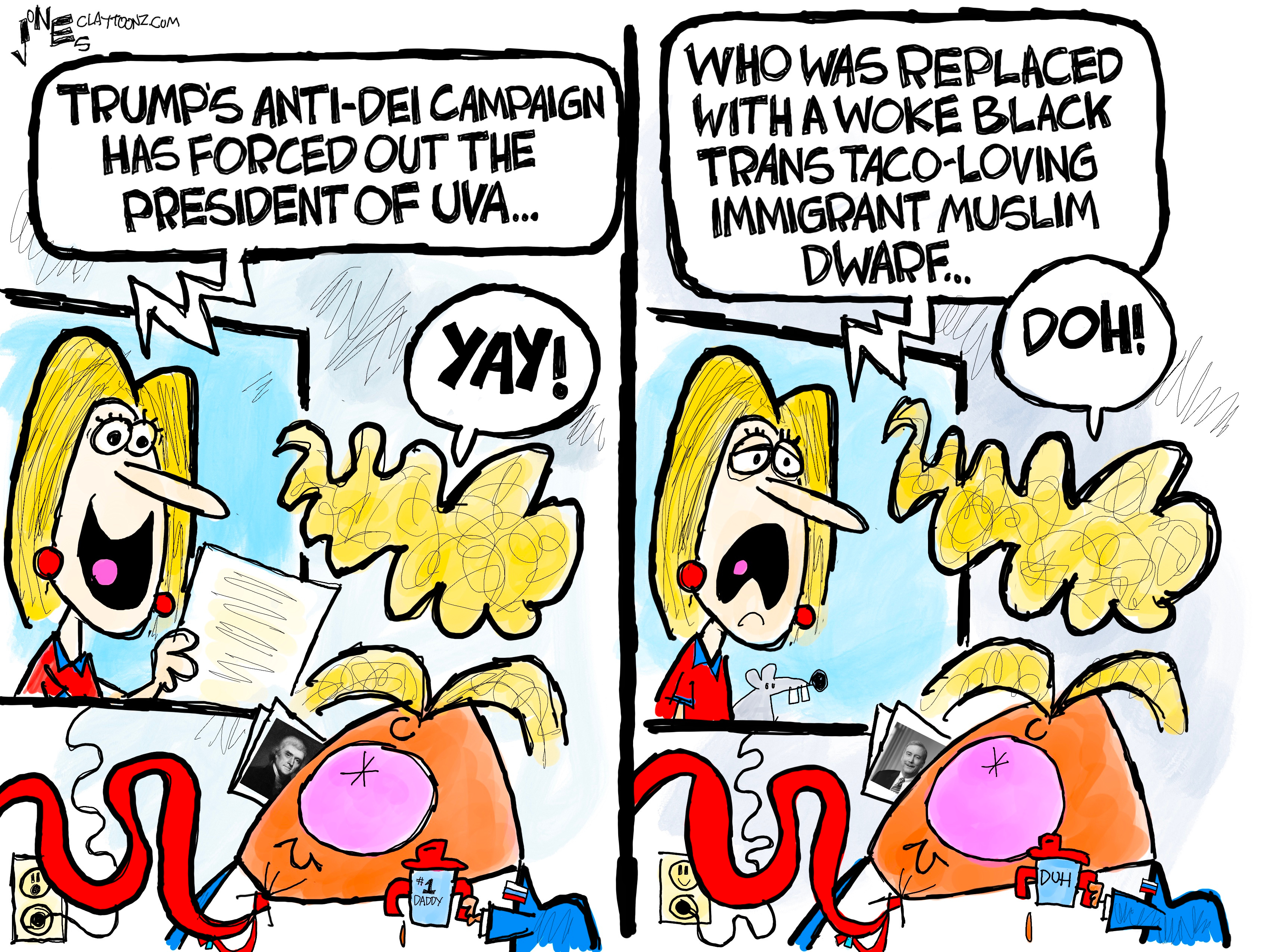
With its thuggery, bullying, and Nazi-like tactics, Donald Trump’s racist and weaponized Justice Department, led by the corrupt Pam “Eva Braun” Bondi, has forced out the University of Virginia’s president, James Ryan.
Ryan, who had a reputation for trying to make the UVA campus more diverse, was forced out to resolve a justice department investigation into UVA’s diversity, equity, and inclusion policies.
Ryan said, “I cannot make a unilateral decision to fight the federal government in order to save my own job. To do so would not only be quixotic but appear selfish and self-centered to the hundreds of employees who would lose their jobs, the researchers who would lose their funding, and the hundreds of students who could lose financial aid or have their visas withheld. This was an excruciatingly difficult decision, and I am heartbroken to be leaving this way.”
DOJ had demanded that Ryan step down as part of an agreement to settle a civil rights investigation into the school’s diversity practices, as Trump has weaponized the government agency by using its investigative powers to implement his hateful political agenda. DOJ held the university hostage to force Ryan out. (snip-MORE)
(I saw “Alligator Auschwitz” somewhere over the weekend, not in conjunction with DeS bragging about the camp’s showers, but brrr, and I’ll never think of this prison as anything but Alligator Auschwitz now. -A.)
In case it seems cruel to put undocumented immigrants, and in several cases, documented immigrants, that’s the point. Cruelty is the point with this regime and the entire MAGA agenda.
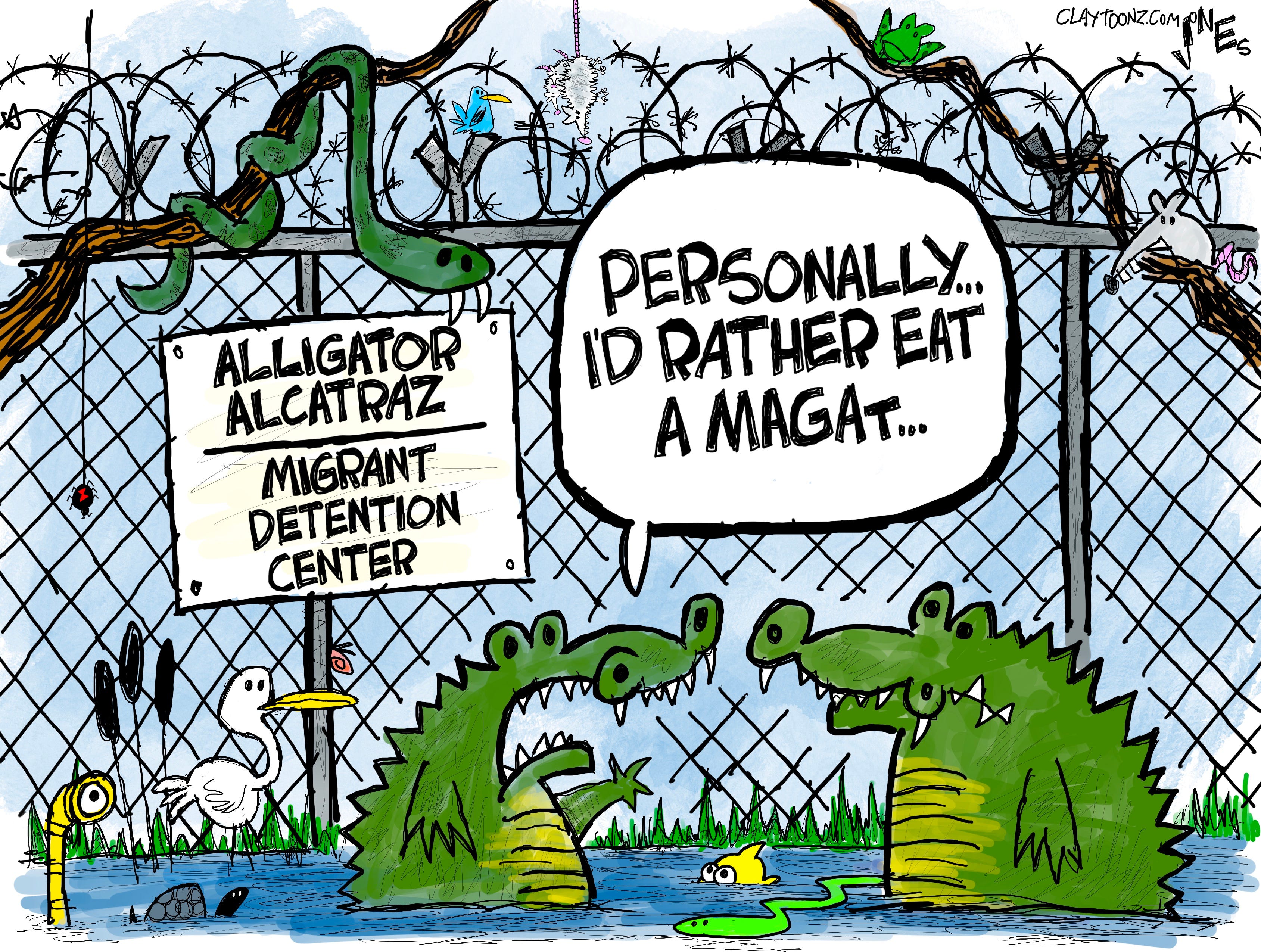
Alligator Alcatraz is the name for a detention, processing, and deportation camp for undocumented migrants in the Florida Everglades.
White House spokesbarbie Karoline Leavitt said, “The only way out is a one-way flight. It is isolated and surrounded by dangerous wildlife and unforgiving terrain. When you have illegal murderers and rapists and heinous criminals in a detention facility surrounded by alligators, yes, I do think that’s a deterrent for them to try to escape.” My first question for her is, where are all these legal murderers?
The regime loves the optics of a prison in the middle of a brutal swamp. It sounds like a bad Burt Reynolds movie (as if there were any good ones).
Border czar, Tom Homan, told CNN’s Kaitlan Collins, “Can’t wait for it to open, and we’ll put aliens in there as soon as we can.” Florida Gov. Ron DeSantis described the facility as a “one-stop shop” in a Fox interview. Trump has the most horrible people on this.
The “prison” sits along an 11,000-foot runway at an airfield mainly used for training flights, and will soon house 5,000 migrants in a tent city. This sounds as evil as the tent prison racist and corrupt Trump-pardoned sheriff Joe Arpaio erected in the Arizona desert.
Trump is visiting the site today, thinking it’ll make him look tough. Captain Bonespurs isn’t tough. The regime is mistaking being an asshole for being tough.
The Florida GOP is already selling “Alligator Alcatraz” merch, and they had to be fast to beat the Trump Organization to it. The legacy of this may match the internment camps where the US government housed Japanese Americans during World War II. Trump is also planning a new camp in Guantanamo, and I’m sure DeSantis and Noem are eyeing other sites that provide great potential for tough-guy photo-ops. If nothing else, they’re thinking of the merch.
June 30, 2025 Evrim Yazgin, Cosmos science journalist
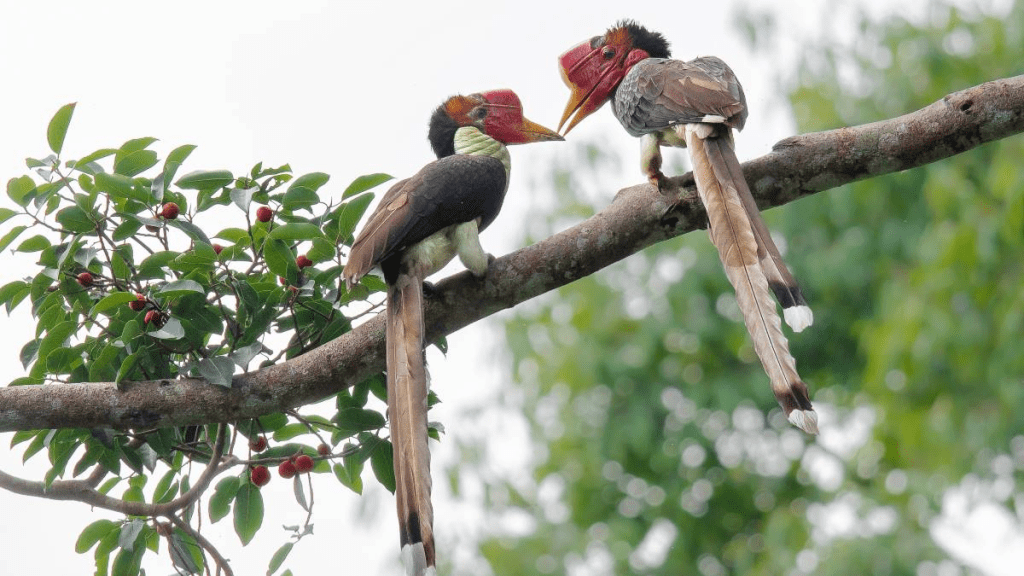
Helmeted Hornbill (Buckeroos vigil) male and female. Credit: Hello my names is james,I’m photographer / iStock / Getty Images Plus.
Researchers analysed different threat factors such as habitat loss and climate change to find that 500 bird species could go extinct in the next century. Unique species are most at risk.
The study, published in the Nature Ecology & Evolution, warns that the loss of unique birds could harm ecosystems around the world.
Vulnerable birds include the bare-necked umbrellabird found in the forests of Costa Rica and Panam, helmeted hornbill from Southeast Asia and yellow-bellied sunbird-asity endemic to Madagascar.
“We face a bird extinction crisis unprecedented in modern times. We need immediate action to reduce human threats across habitats and targeted rescue programmes for the most unique and endangered species,” says lead author Kerry Stewart from the University of Reading, UK.
The researchers studied the behavioural and morphological traits of about 10,000 bird species – representing nearly all known bird species – using data from the International Union for Conservation of Nature (IUCN) Red List.
Applying a statistical model, the researchers were able to show that large-bodied species were more at risk from hunting and climate change. Meanwhile, birds with broad wings suffer more from habitat loss.
“Stopping threats is not enough, as many as 250–350 species will require complementary conservation measures, such as breeding programmes and habitat restoration, if they are to survive the next century,” says senior author Dr Manuela Gonzalez-Suarez, also from the University of Reading. “Prioritising conservation programmes for just 100 of the most unusual threatened birds could save 68% of the variety in bird shapes and sizes. This approach could help to keep ecosystems healthy.”
“Many birds are already so threatened that reducing human impacts alone won’t save them,” adds Stewart. “These species need special recovery programmes, like breeding projects and habitat restoration, to survive.”
The authors say that “functionally unique” species – i.e. species that fill highly specialised ecological niches – are the most vulnerable. Likewise, the loss of such unique species could cause a cascading effect of harm for broader ecosystems.
“Effective targeted recovery programmes that explicitly consider species uniqueness hold great potential for conserving global functional diversity as a complementary strategy to threat abatement,” they write.
He was a man of many contradictions and continuity errors. He was a fiery televangelist who had a whole lot to say about other people’s sex lives and immorality, but who also famously enjoyed the occasional lady of the evening.
Swaggart surely served as a role model and inspiration to many future evangelical preachers, like Ted Haggard, Jerry Falwell Jr., Tony Alamo, Douglas Goodman, and so, so many others others who would go on to follow in his very holy/pervy footsteps.
In 1988 — not long after he had publicly dragged his fellow televangelist Jim Bakker for having used church funds to pay $279,000 in hush money to his former secretary Jessica Hahn after he raped her, committing multiple acts of fraud for which he was later imprisoned, as well as for owning a waterpark — a rival evangelist of Swaggart’s sold photos of him going to a motel with a sex worker, after Swaggart refused to stop accusing him of being an adulterer. That picture you see above is from his very famous apology. (snip-MORE, with a trigger warning regarding disturbing info)
I want to thank everyone that encouraged me to go forward with what is to me a scary operation. I love everyone that wrote / called me to tell me their stories. I had my second appointment with the eye doctor. Even with the prism that took some of the fussy out of the letters I was seeing the best they could do for me was 20/70. I have no idea of what that means but she asked if I was driving and I replied yes which seemed to upset the doctor. The office is wonderful and very LGBTQ+ affirmative and they included and joked with us totally comfortably. I had to laugh when the doctor asked the eye person to get his husband and she went out and told Ron he had been summoned.
It seems she feels I need to have the surgery to see. She is unsure if they will do both eyes but feels they will. She explained what she felt would be our costs, and what would happen to my eyesight if we did not go forward. Ron told them about how high the magnification is on my monitors and how he has to try to step back to read everything smoothly. He told them it was unacceptable my sight would get any worse and I would lose the ability to do what I love, be on the computer with all of you.
So they set up an appointment with the eye surgeon. I was shocked at how fast it was happening. I figured I would have a couple of months, but the appointment is for next Monday. Ok I know everyone has told me how great their experience was but … I admit to being scared. My eyes are so important to me and how I live my life. I could give many organs but if I lose my sight my life as I love it is over.
The eye doctor is a wonderful older lady who was concerned about the costs for us and Ron told her we would manage that it was important enough. She cautioned us not to be dragged into expensive things I man not need as most people getting the normal corrective lens were more than satisfied and had good vision. She warned that the market was in convincing us to pay for “Upgraded corrective lenses” that I may not need or could be avoided with a cheap pair of reader glasses.
I have to admit she was far different from the big business eye place Ron and I went to several years ago. I was not yet 62 so they told me as soon as I was I needed to see them to have the cataracts removed. Ron was already over that age for Medicare to pay for it and they pushed him hard to have the surgery. His eyesight was far better and less cloudy than mine. They just wanted the money from Medicare. Plus after my exam they took me to their glasses section. After picking out what I thought was a pair of reasonably priced frames they totaled up my new glasses … at $1,400.00
I looked at Ron, we had never paid that for any glasses. I told them I needed to think on it and never went back. The only issue I have is do I pay extra for the “corrective lenses”? If anyone could leave me a message on their experience either way, I would be so grateful. Ron was such a cheerleader for me after we left the eye doctor’s office saying how he felt this would be so good for me and make what I love doing on the computer so easy. I wish I felt as confidant as he does. Hugs








 Scottie's Playtime