
Food reviews, other interesting bits from Australian travel Josh took. Of course protect your screen and keyboard in prep for those little unexpected reactions/remarks he makes while telling a story!
Author: ali redford
I love dogs and people. I want living creatures to thrive. I love to cook, and share the food, but ya gotta get in line in front of the dog.
A Great Info & Opinion Piece About The Rich, The Poor, Capitalism, & Socialism
A good explainer written with a sense of humor. Nice things are not always bad things. -A.
We Regret To Infomrm You Zohran Mamdani’s Wife Wore Nice Boots.
Ready, Boots? Start walking!
Robyn Pennacchia Jan 05, 2026
Since returning to office, Donald Trump’s personal wealth has nearly doubled, from $3.9 billion in 2024 to $7.3 billion this past September, which includes $2 billion from his cryptocurrency ventures that no one had been buying into prior to his reelection. Donald Trump Jr. is now worth six times what he was in 2024, also due in part to the family crypto scam.
But did you hear? Zohran Mamdani’s wife, Rama Duwaji, wore some cute boots to his inauguration like a common Imelda Marcos! Quelle horreur!
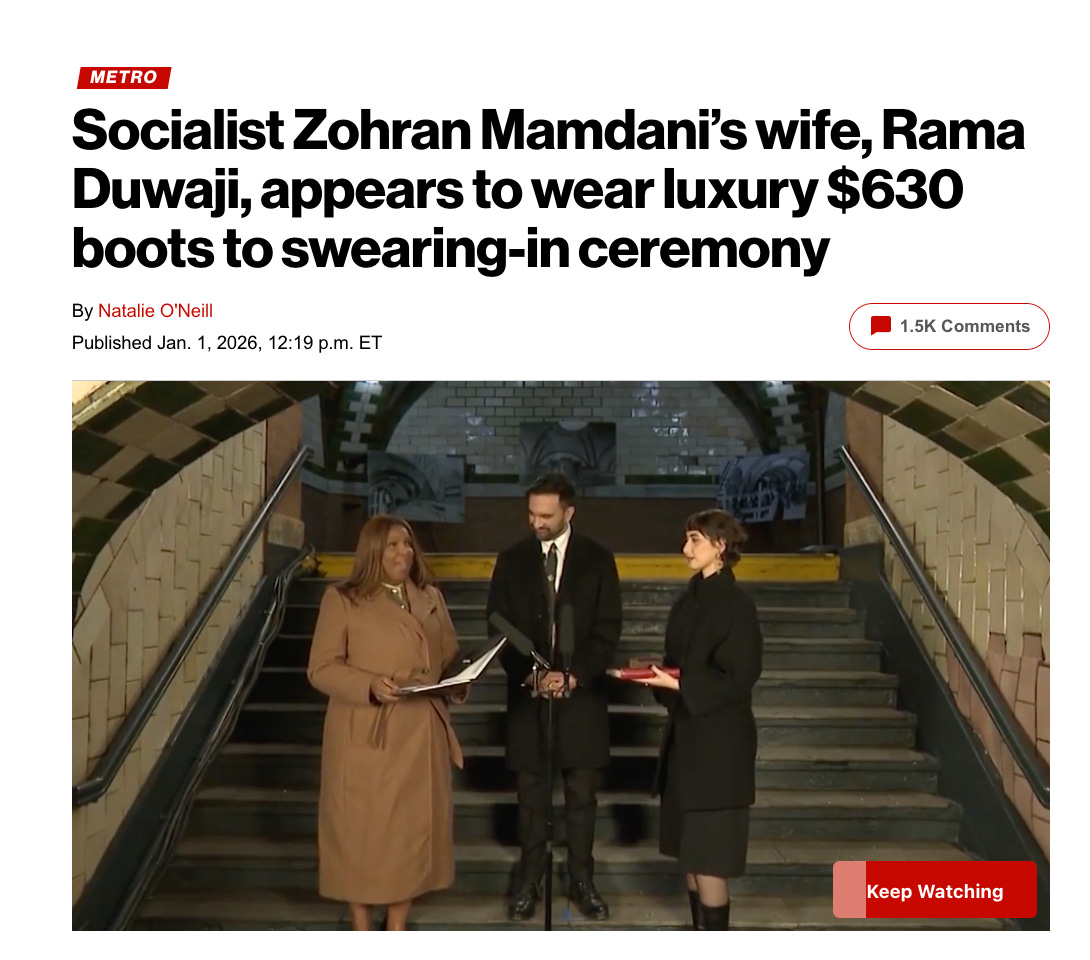
The New York Post breathlessly reported:
Their “affordability” agenda got off on the wrong foot.
New York City’s first lady Rama Duwaji appeared to wear $630 “artisan” leather boots from a high-end designer to her Democratic socialist husband Zohran Mamdani’s mayoral swearing-in ceremony — a luxury look that flew in the face of the politician’s “everyman” image, eagle-eyed critics said Thursday.
Duwaji, a 28-year-old artist, gave more socialite than socialist on New Year’s Day as she apparently rocked one of the fashion house Miista’s pricey boot designs — one which is said to be crafted from “vegetable tan cow leather” and feature an “ultra-cushioned memory foam insole.”
Not “vegetable tan cow leather”! NOT A MEMORY FOAM INSOLE!
Not that it matters, really, but $630 for boots is not “luxury.” I mean that technically. Obviously $630 is a good amount of money, but it’s not luxury. It’s what’s called “bridge” — meaning that it’s high quality and expensive, but not at the same level as actual luxury brands, which cost at least twice that. It’s not Chanel or Versace or Alexander McQueen or Louis.
Now, it turns out that the boots (and the entire outfit) were actually rented/loaned for the occasion, as her stylist Gabriella Karefa-Johnson explained in a blog post about the event:
Rama wore a vintage Balenciaga coat from Albright Fashion Library and archival earrings from New York Vintage, both rented during a single marathon day spent diving into the racks and cupboards of the city’s best small, circular fashion businesses. […]
C’mon formal shorts!! Those are from The Frankie Shop, and the boots are *ON LOAN* from Miista.
I’m just going to have to get comfortable with the fact that people on the internet do not understand what being lent a SAMPLE that has been borrowed before and will be borrowed again means but, you know what, that’s okay.
This is a big part of what stylists do. Most of the time, when you see a celebrity wearing something fancy on the red carpet or at an event like this, it’s not something from their own closet, it’s on loan from a designer (because cheap advertising) or something like the Albright Fashion Library. This is also how a lot of wardrobing for television and movies works.
But even if they weren’t on loan, the idea that “it’s hypocrisy for a Democratic socialist or even a regular liberal to wear nice boots!” is absurd. It only seems like “hypocrisy” to people who think socialism means everyone should be poor and miserable and standing in bread lines all day wearing cardboard boxes on their feet instead of shoes.
The reality is … that’s capitalism. Like, for most people, that is capitalism, except you don’t even get any free bread out of it. Indeed, most of the people in the comments on the Post’s tweet for the article were talking about how they, the proud capitalists that capitalism is definitely working out really well for, only spend $40 on boots at Walmart or Amazon. Actually, buying shoes that will only last a season (and will fuck up your feet) because that’s all you can afford, instead of boots that cost a lot up front but last forever, is a perfect example of why it costs more to be poor than it does to be rich. (This is not to say that you can’t get decent boots for a not-crazy price — I do very well at Nordstrom Rack and Marshalls, thank you very much — but you get my point.)
What we want is for people to not have to spend $2,000 a month on health insurance or on rent so that they can have nice things, so that they can buy a nice pair of boots or a warm winter coat. So that they can go out to dinner sometimes without worrying about breaking the bank. That is the whole damn point! That’s the “hearts starve as well as bodies; give us bread, but give us roses too” of it all.
Right now, 60 percent of Americans cannot afford $1,000 for an emergency expense. That’s not socialism that did that, that’s capitalism as practiced in the United States of America. Our economy literally has poverty built into the system. We literally cannot function without people to work the kind of jobs that currently do not pay enough for survival. Austerity is a way of life for a very large percentage of us, which also means that those whose income is dependent on other people having expendable income are also screwed.
New NYC Mayor Zohran Mamdani’s affordability plans don’t just benefit the poor, they benefit everyone. If people aren’t taking certain jobs because transportation costs too much to make it worth their while or they can’t afford to live in the city, everyone’s quality of life goes down. A city where only rich people can afford to live is a city where rich people have absolutely nothing to do, which kind of defeats the whole point of being rich in the first place.
The commenters complaining about all the people they could supposedly feed with the $630 those boots cost are also missing the point. Besides clearly not being how socialism is supposed to work, caring for the poor by way of charity and philanthropy is lovely, but it’s not the most effective and efficient way of doing so. Taxes are. Social programs are. GoFundMe raises about $650 million a year for medical causes, with some people getting far more than they could ever need and others getting nothing. That is a stupid way of doing things. You want to spend less on healthcare? Make the entire United States one giant insurance group with a shit ton of leverage and bulk buying power, make medical school free and invest tax money into creating more internship programs. That is how you take care of people, not by not buying a pair of shoes.
Capitalists want philanthropy to replace taxation. Right-wing libertarians frequently argue that if you just didn’t tax the rich, they would happily give huge chunks of their fortunes away to the poor, which is patently ridiculous (and, again, not effective or efficient even if things did shake out that way).
Champagne socialists are good, actually. Why on earth would it be better to be a miserly rich person than a rich person who actually believes they should be taxed at a fair rate because they want to see everyone living well? The idea that the Left wants a world in which everyone lives like they’ve taken a vow of poverty and no one gets to be “successful” is a fantasy created by rich assholes who don’t want to share and don’t care if they live in a society where everyone has at least their basic needs met.
We actually love success, which is why we want more of it for more people, rather than just one percent of one percent of people. We love people, which is why we want a safety net that keeps them from falling so far they can’t get back up again. We love ingenuity, which is why we want people to be able to go into business for themselves without having to worry about what will happen to their kids if they can’t afford good health insurance on their own right away. We want their kids to feel like it’s not hopeless to try their best in school because they don’t think they’ll be able to afford to go to college without being in debt the rest of their lives. We don’t think it’s enough that people can “dream” of being billionaires but factually never be able to afford their own home.
And yes, we even want some people to be able to afford to actually buy $630 shoes, so that other people can get paid a fair wage for designing, making and selling those $630 shoes.
Hope that clears things up!
News We Can Use In The Week Ahead
The Week Ahead
January 4, 2026 Joyce Vance
What is Donald Trump running away from so hard? Is it the fifth anniversary of his January 6 insurrection, which we will mark on Tuesday? It should be.
It could be Jack Smith’s newly released testimony, which is damning and damaging—and we haven’t even gotten the release date of Volume II of his special counsel report, due sometime in February unless Trump manages to hang it up in court. On balance, Congressman Jim Jordan’s “Weaponization” work is backfiring.
It could also be the Epstein Files. DOJ missed its reporting date to Congress over the weekend, and the full release of the files is still nowhere in sight.
Donald Trump has a lot to try to hide from. It could be all of the above, and it’s all closing in on him this week. In the past, he has always been able to delay or distract just long enough for the public to forget. But this week, the past seems to be catching up with the lame duck president.
That may be at least a partial explanation for Trump’s strike on Venezuela—distract, distract, distract. It’s a better explanation than Trump as a committed warrior against narcoterrorism. That one doesn’t work particularly well for Donald Trump, who pardoned Honduran ex-president Juan Orlando Hernández, a man who former National Security Advisor Jake Sullivan said in our Substack Live on Sunday morning, “personally trafficked tons of cocaine into the United States and actually said at one point he wanted to shove cocaine up the noses of the gringos.” When Trump pardoned Hernández, he said, “If somebody sells drugs in that country, that doesn’t mean you arrest the president and put him in jail for the rest of his life.” As Jake pointed out, and I agree, “the drugs excuse holds no water.”
This week, we’ll be watching Congress—and watching Trump watch Congress, which has been showing a few signs of life lately. I don’t want to oversell that, but this is definitely a week that warrants paying attention, particularly with the privileged War Powers Resolution I mentioned in last night’s post coming to the Senate floor this week. The ball is in Congress’ court.
Article I, Section 8, Clause 11 of the Constitution gives Congress the power to declare war, as well as to “make rules concerning captures on land and water.” Presidents before and including Trump, as experts at the Brennan Center explain, have tried to claim some of that authority for themselves, using “outdated and overstretched war authorizations like the 2001 and 2002 authorizations for use of military force.” Multiple presidents have also “asserted an inherent authority to undertake airstrikes, raids, and other military interventions without prior congressional authorization. When Congress has authorized conflict, such as the War in Afghanistan and Iraq War, presidents have overread Congress’s approval and expanded U.S. military involvement into countries that Congress never contemplated. Compounding the problem, presidents often fail to give Congress the information it needs to oversee these conflicts.” This is not a Trump problem—presidents since at least George H.W. Bush have claimed a share of Congress’ power. But Trump, who is uniquely interested in amassing presidential power, has the potential to move on from Venezuela and keep going, if Congress doesn’t step in and assert itself.
It’s possible for two things to be true at once: it’s possible that Maduro was a corrupt, dangerous leader and also, that our Constitution and the separation of powers demand preserving. Our country does not, and indeed cannot, remove every dangerous leader around the globe from office with in-country strikes. We could strengthen local populations with stability-enhancing programs like USAID (which the Trump administration, of course, has cut) to increase the ability of local populations to act on their own impulses. We can engage in vigorous law enforcement, like the prosecution of Honduras’ former president. But we can do so without permitting our president to freelance as a warlord, especially one with dubious motives. So don’t buy into the false equivalency that says the smash and grab in Venezuela that resulted in Maduro’s arrest was a righteous exercise of the president’s power.
The constitutional prescription for fixing this problem of presidential overreach is Congress. New Jersey Senator Cory Booker had something to say about that over the weekend, in light of the Trump administration’s strike on Venezuela.
Cory Booker@CoryBooker
Today, many leaders will rightly condemn President Donald Trump’s unlawful and unjust actions in Venezuela, and I join them. But just as glaring, and far more damning, is Congress’ ongoing abdication of its constitutional duty. For almost a year now, the legislative branch has
4:40 PM · Jan 3, 2026 · 70.8K Views
415 Replies · 523 Reposts · 1.93K Likes
“Today,” he wrote, “many leaders will rightly condemn President Donald Trump’s unlawful and unjust actions in Venezuela, and I join them.
But then, Senator Booker put the blame precisely where it is due. He continued, “just as glaring, and far more damning, is Congress’ ongoing abdication of its constitutional duty. For almost a year now, the legislative branch has failed to check a president who repeatedly violates his oath, disregards the law, and endangers American interests at home and abroad.”
He called out the Republican-led Congress for choosing “spineless complicity over its sworn responsibilities.” He condemned its inaction in the face of Signalgate, with Trump’s “Secretary of War” Pete Hegseth escaping any censure for “the reckless leaking of classified information that put American troops at risk.” The senator also pointed to the “stunning absence of accountability” for the administration’s “illegal use of military force destroying vessels and killing people in the Caribbean and the Pacific without congressional authorization.”
Booker cited a litany of Congressional failures:
No hearings.
No serious investigations.
No enforcement of checks and balances.
No accountability.
He called Congress cowardly and submissive.
We are long past due for someone to speak so plainly to the country about the Republican-led Congress’ failure to do its constitutional duty. The question is, who is listening, and will it lead to action this week? As my good friend Norm Eisen like to say, I am not optimistic, but I am hopeful.
Booker writes that “Republicans in Congress own this corrosive collapse of our constitutional order” and that their submission to Trump’s will “now stands as one of the greatest dangers to our nation and to the global order America claims to defend.” The fact that Maduro is “a brutal dictator who has committed grave abuses” does not, Booker concludes, suspend the Constitution. And so, he drives home the point of what must come next:
- “The Constitution is unambiguous: Congress has the power and responsibility to authorize the use of military force and declare war. Congress has a duty of oversight. Congress must serve as a check, not a rubber stamp, to the President.”
- “We face an authoritarian-minded president who acts with dangerous growing impunity. He has shown a willingness to defy court orders, violate the law, ignore congressional intent, and shred basic norms of decency and democracy. This pattern will continue unless the Article I branch of government, especially Republican congressional leadership, finds the courage to act.”
- “What happened today [in Venezuela] is wrong. Congressional Republicans would say so immediately if a Democratic president had done the same. Their silence is surrender. And in that surrender lie the seeds of our democratic unraveling.”
“Enough is enough,” Booker concludes. With three years left in this administration, it’s time to stop the (constitutional) bleeding.
Senator Booker wrote at length at a time when many Americans have lost the will or the ability to take in an argument laid out like this. For some people, it’s easier to ignore common sense and stay in the fold of the cult. But Booker’s words are well worth our time and well worth sharing with others. His argument is not subtle or nuanced, and it’s accessible to anyone who has taken a fourth-grade civics class: Congress should do its job, not Donald Trump’s bidding. The future of the Republic depends upon it. They would demand it if a Democratic president had done what Donald Trump did—something that has been true over and over, but is all the more poignant with the anniversary of January 6 staring us in the face. Maybe Congress will remember what that day felt like and how they reacted. Maybe enough of them can muster some courage—if for no other reason than that the history books, and likely voters at the midterms, will condemn them if they don’t.
Make sure you share Senator Booker’s message with your elected officials this week. They need to hear it. They need to know you heard it.
A final note: a development we won’t be following this week, because it won’t be happening, is the federal criminal trial of former FBI Director Jim Comey, which was slated to start on Monday. This trial will not take place because the case was dismissed, in a serious blow to the credibility of Pam Bondi’s Justice Department. There are, in fact, some guardrails that remain in place. And this year, we’re going to rebuild more of them. Get ready to vote.
Where you get your news and analysis is a choice. I’m very appreciative that you’re here, with me, at Civil Discourse. Your subscriptions make it possible for me to devote the time and resources it takes to research and write the newsletter, and I’m very grateful for all of you. This is what community looks like.
We’re in this together,
Joyce
Go, AZ!
Arizona cancels medical debt for almost half-a-million residents
Another more than $200 million in medical debt has been wiped out for Arizonans.
And the recipients are going to know who to thank: Gov. Katie Hobbs.
The new figure was announced Monday by Allison Sasso. She’s the president and CEO of Undue Medical Debt, a company that agreed earlier this year to use some $10 million in state American Rescue Plan COVID relief dollars to buy up medical debt from hospitals and doctors for a few pennies on the dollar, eliminating a negative mark on the credit reports of those who racked up the bills.
All totaled, according to the governor’s office, the program has so far erased $642 million owed by more than 485,000 Arizonans.
And under a deal the state cut with Undue Medical, the beneficiaries all get letters crediting not just United Medical but also the governor.
What’s behind all this is a program that United Medical has been offering across the nation.
Established in 2014, it uses government funds and private donations to acquire portfolios of medical debt from health care providers or debt buyers.
What makes the money go farther, according to company officials, is the debt has reached the point where those holding the rights are willing to sell them for pennies on the dollar.
People can’t actually apply. Instead, Undue Medical has to find them.
It starts with eligibility.
The program is aimed at those whose medical debt whose income is less than 400% of the federal poverty level. That is currently $128,600 for a family of four.Also eligible are those whose debt is 5% or more of their annual income. That would aid those who have higher income levels than the cutoff—but much higher debt than they may be able to handle.
Undue Medical works with a credit reporting agency, buying what it calls “relevant income data” from them. That’s how it gets the names of individuals who owe money.
That is then compared with the information it gets from medical providers and others who are the holders of past-due debts.
Once the bills have been paid off, the patient gets a letter in an Undue Medical envelope informing for the first time that the obligation has been wiped out and the credit bureau has been notified.
But the recipients do get some inkling at that time of who to credit.
The deal Hobbs cut with the charity when she first signed the deal in 2024 requires that beneficiaries know that the financial relief is happening because governor’s action: It spells out that any fliers, advertisements, press releases or other marketing materials to include “logos or insignia as required by the governor’s office and approved by the governor’s office before publication.”
Gubernatorial press aide Christian Slater, in defending that provision when the program was announced in July, said that is appropriate. He said the letters are designed to tell people not just that their medical debt was relieved but “how it happened.”
And why do they need to know that the governor gets credit?
“The medical debt relief would not be possible without the governor’s leadership and focus on lowering costs and delivering economic opportunity for every Arizonan,” Slater said.
Undue Medical said what’s also crucial is that the patient starts from scratch.
Generally speaking, when a debt is forgiven, it can be considered income for tax purposes. But Courtney Story, the charity’s vice president of government initiatives, said in July that doesn’t apply when the money comes from a “disinterested third party.”
“Because we’re a nonprofit, we’re not part of the health care system, we count as a disinterested third party, as does the government,” she said.
Ditto, Story said, with private donors, though they have the option of remaining anonymous or disclosing their names to recipients.
In the press release Monday, Hobbs included the anonymous comments of three Arizonans who said they were thankful that the debt had been wiped out.
She got them because the contract the state has with Undue Medical said that “patient stories and related insights shall be shared with the governor’s office on a regular basis.”
As to what the governor can do with those testimonials, a company spokesman said when the program was announced that, “to my knowledge, there isn’t a restriction on how they can be used.”
In unveiling the plan in 2024, Hobbs insisted that there’s nothing illegal about the state using money it has received from the federal government to pay off the medical debts of private Arizonans.
A provision of the Arizona Constitution makes it illegal to “make any donation or grant, by subsidy or otherwise, to any individual, association or corporation.”
“I can assure you we would not be taking this action if we weren’t fully confident in the legality of it,” Hobbs said.
Anyway, she said, Arizona wouldn’t be the first jurisdiction to use COVID dollars from the American Rescue Plan Act in this way.
Undue Medical has provided press releases from other jurisdictions that have taken advantage of the program, with recent press releases from Delaware Gov. Matt Meyer, Gov. Ned Lamont of Connecticut, Illinois Gov. JB Pritzker, and one from the Los Angeles County Board of Supervisors for a local program.
What’s Entering the Public Domain in 2026: Faulkner’s As I Lay Dying, All Quiet on the Western Front, Betty Boop & More
Though it isn’t the kind of thing one hears discussed every day, serious Disney fans do tend to know that Goofy’s original name was Dippy Dawg. But how many of the non-obsessive know that Mickey’s faithful pet Pluto was first called Rover?
“Chickadee Warbler”

About
Tiny, nimble, and sporting a bold black mask and “bib” under its bill, the Golden-winged Warbler might be mistaken for a Black-capped Chickadee at first glance. But it’s the long, thin bill and the splashes of vivid golden-yellow on its crown and wings that distinguish this long-distance migratory warbler.
Though they are denizens of shrubby, early successional habitats (areas that are in the early stages of regenerating following a disturbance, such as a fire or a clearcut) in the nesting season, Golden-winged Warblers and their recently fledged young relocate to nearby mature forests that provide adequate cover for fledglings from predators. The loss of quality brushy, young forest habitat across much of its breeding range has contributed to sharp declines in an already uncommon warbler.
Another threat comes from a close relative, the Blue-winged Warbler, which shares more than 99 percent of its genetic material with the Golden-winged Warbler. The two species regularly hybridize, and the once-uncommon Blue-winged Warbler has surged northward into the Golden-winged’s range. The Golden-winged Warbler has become much scarcer and is at risk of being genetically “swamped” by its more numerous and widespread relative where their ranges meet.
To gain a foothold and begin to recover from the loss of more than 60 percent of its population, the Golden-winged Warbler needs active habitat conservation throughout its annual life cycle, from the shrubby, early successional habitats where it nests to the open forests of Latin America and the Caribbean, where it spends its nonbreeding season.
Threats
Birds around the world are facing threats, and many species are declining. The Golden-winged Warbler has experienced a drop in its population of more than 60 percent, including a loss of nearly all of its population in the Appalachians. In addition to competition and hybridization with the Blue-winged Warbler, the Golden-winged Warbler faces challenges throughout its full annual cycle from habitat loss and degradation, and collisions. (snip-More on the page, including the songs)
How ’bout That Flu This Year?
From WIRED:
Ritsuko Kawai Science Jan 2, 2026 5:00 AM
What Is the ‘Super Flu’ That Is Spreading in the United States and Europe?
The “super flu” behind outbreaks in the US and UK is a new variant of influenza A H3N2, subclade K. Here’s what you need to know.
The spread of influenza became more severe this fall, particularly in the United States and the United Kingdom. The US Centers for Disease Control and Prevention has designated the 2024-25 flu season as the most severe season since 2017-18. In the UK, the spread has begun earlier than at any time since 2003-04.
Against this backdrop, some media outlets have begun using the term “super flu.” However, this term is not an official medical term. The actual name is “subclade K,” a new variant of influenza A H3N2.
This variant has multiple mutations in a protein on the surface of the virus called hemagglutinin, making it antigenically different from the variants used in existing vaccines. This allows it to partially evade immunity acquired through previous infection or vaccines, making people more susceptible to infection. Genetic analysis by the UK Health Security Agency has revealed that 87 percent of H3N2 viruses detected since late August 2025 are subclade K.
The Outbreak Began Earlier Than Usual
The term “super flu” is not necessarily scientifically accurate. The H3N2 strain already caused severe illness in the elderly and children, and the new mutant strain has not made it more deadly. Contrary to the name, the virus’s inherent danger is said to be no different from the conventional H3N2 strain.
In 2025, the US influenza pandemic peaked in early February, with active epidemics occurring in 87.3 percent of the country. For 11 consecutive weeks, more than 50 percent of the country recorded high epidemic levels, an anomaly that led to 287 child deaths. However, these figures reflect the scale of the epidemic and do not imply an increase in the lethality of the virus itself.
The influenza epidemic is hitting earlier this year in many parts of the world. While the usual peak in Japan occurs between late December and February, in 2025 the epidemic began in earnest at the end of September. According to the Ministry of Health, Labor, and Welfare, of the 23 H3 virus strains collected in Japan between September and November 5 that could be analyzed, 22 were subclade K.
The reason for the early outbreak is thought to be the decline in immunity of the population due to the countermeasures against new coronavirus infection (Covid-19), as well as a decline in physical strength due to the record-breaking heat wave. During the three years of the coronavirus pandemic, the influenza epidemic was largely suppressed. As a result, it is possible that population immunity to the virus was reduced. In fact, with the 2024 influenza pandemic in Australia at its highest level since 19 years, it would not be surprising to see a similar trend in the Northern Hemisphere.
Existing Vaccines Are Effective
There has also been much interest in vaccine efficacy in the face of this virulent strain. The vaccine for the 2025-26 season is based on the conventional J.2 lineage (subclade), which has different antigenicity from subclade K. However, early data from the UK has confirmed that 70-75 percent of vaccinated children and 30-40 percent of adults did not end up visiting the emergency room or being hospitalized after infection. This means that even if the antigenicity is not completely identical, the vaccine remains effective in preventing severe illness.
The basic prevention measures are the same as for conventional influenza. Vaccination is recommended from October to November before the epidemic, and the effect appears about two weeks after vaccination. It is particularly recommended for people aged 65 and over, people with underlying medical conditions, pregnant women, children aged 6 months to 5 years, and medical workers. In daily life, it is effective to thoroughly wash and disinfect your hands, and wear a mask when in crowds. Ventilation in rooms and maintaining appropriate humidity levels are also important in suppressing viral activity.
If symptoms appear, it is best to wait at least 12 hours after the onset of fever before visiting a medical institution. Anti-influenza medication is most effective when taken within 48 hours of the onset of symptoms, and Xofluza and Tamiflu are considered effective. People should refrain from going out for five days after the onset of symptoms and two days (three days for children) after the fever has subsided, and should make sure to get plenty of rest and stay hydrated.
Contrary to the impression given by the word “super,” this current epidemic is an extension of the traditional influenza. For this reason, it is essential to respond calmly based on scientific understanding rather than fear.
In fact, the risk of developing severe symptoms can be significantly reduced by combining vaccination with basic infection control measures. Because this is a rare situation in which there are consecutive high-severity seasons, making responsible choices based on accurate information will help protect the health of society as a whole.
This story originally appeared in WIRED Japan and has been translated from Japanese.
Have A Good New Year’s Day-Be Kind To Yourselves! It Will Radiate.
Enjoy some stuff I saved up to bring here today. Look/listen to whatever you care to, whenever you want. A few are shorts; 1 is a comic. The longer ones are worthy when you have a few minutes or can listen while you’re doing another thing. Relax and laugh! Open comments thread.
Note on 1/3: My apologies-this video has been taken down. Here is the link to Josh Johnson’s YouTube page; look around there. You’ll enjoy anything you choose! Again, I’m so sorry. It was there yesterday! 💐 Ali
https://www.youtube.com/@JoshJohnsonComedy
https://www.gocomics.com/lards-world-peace-tips/2026/01/01

Happy New Year; Have Some Josh With Your Parades-
May Everyone Have A Fine Evening,
and may the upcoming year be kind to us all. I think Barry already has some 2026 experience, even, so we do know it’s coming! 😀 I second Frazz’s Motion, and hope to see everyone around!
https://www.gocomics.com/frazz/2025/12/31

 Scottie's Playtime