Just In Case A Reader Happens By With Some Idea, Or Knows Where To Share This One:

Space Stuff

What’s New at the Earth Observatory April 7, 2026

Image of the Day

NASA’s Earth Observatory brings you the Earth, every day: sharing images, stories, and discoveries about the environment, Earth systems, and climate that emerge from NASA research, including its satellite missions, in-the-field research, and models.

Drought Parches Florida

4 min read

The state was unusually dry for much of 2025, but the intensity of the drought has ratcheted up since January…

Apr 7, 2026

——————————————-

Faster Detection of Forest Loss

7 min read

Scientists pioneered a new system that combines data from multiple Earth-observing satellites to identify forest clearing up to 100 days…

Apr 6, 2026

——————————————–

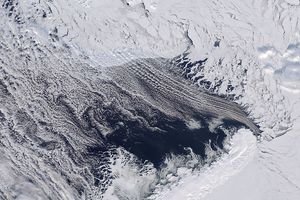
Barents Sea Tied to Low Arctic Sea Ice

4 min read

Patches of open water in the region contributed to low sea ice extent across the Arctic in March 2026, which…

Apr 3, 2026


Space Purge

Hegseth is firing Black generals

Clay Jones

The crew of Artemis II set a record for the farthest-traveled humans from Earth, and they still could not get away from Donald Trump. The mission had a 45-minute blackout from communication with Earth while flying over the dark side of the moon, and Donald Trump was waiting for them when they came out of it.

The astronauts had a very uncomfortable and awkward 12-minute Earth-to-space call, facilitated by NASA administrator and Trump acolyte, Jared Isaacman. During the call, Trump told the astronauts how they would be honored if he got their autographs. They were also honored by Trump blowing smoke up their asses and telling them that he had saved NASA from extinction when, in reality, he tried to cut their budget by 24% when he returned to office for his second term. Not just that, (snip-MORE)


And now, this brilliant story from a friend of the blog:

Josh Day, Next Day

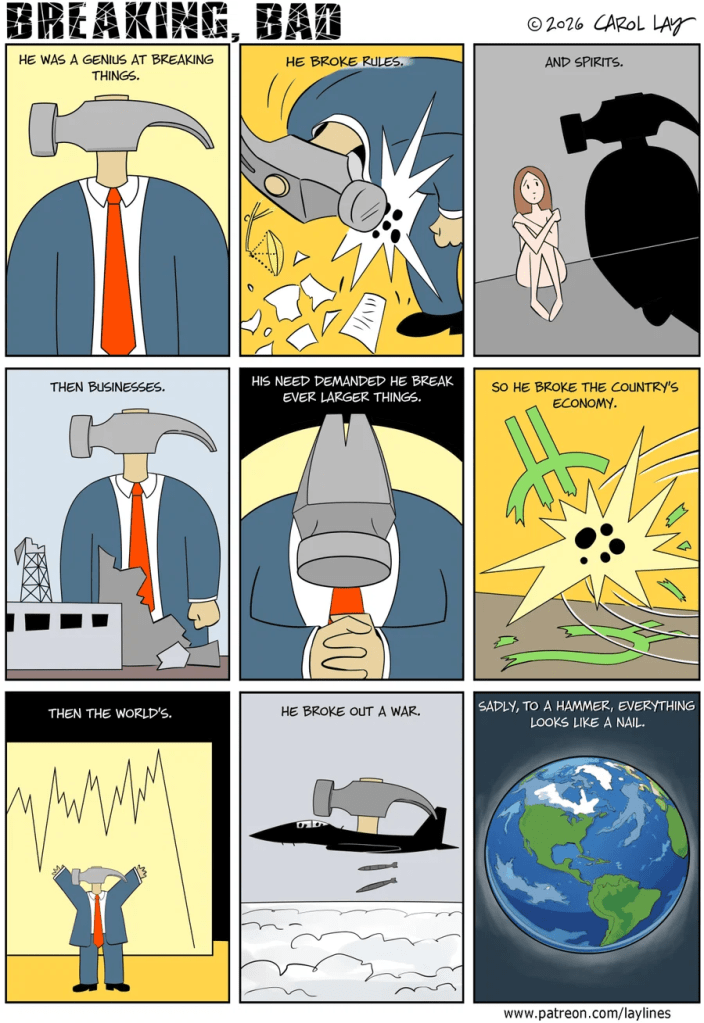
This Week’s “Lay Lines”

https://www.gocomics.com/lay-lines/2026/04/06

Open Windows & Clay Jones In

regard to POTUS’s mental acuity.

President Nucken Futz

Trump is losing what’s left of his mind

Clay Jones

On Easter Sunday, Donald Trump posted to Truth Social, “Tuesday will be Power Plant Day, and Bridge Day, all wrapped up in one, in Iran. There will be nothing like it! ! ! Open the Fuckin’ Strait, you crazy bastards, or you’ll be living in Hell – JUST WATCH! Praise be to Allah. President DONALD J. TRUMP”

Trump supporters, including the evangelicals, don’t care how vulgar he is, how insane he is, or that he is threatening to commit war crimes. They don’t care that he unleashed his tirade on Easter Sunday. They don’t care that he has gone back and forth with his demands regarding the Strait of Hormuz, from wanting to get it open, to demanding help from NATO, to saying it will open up naturally, back to demanding that Iran open it, or he will bomb them straight to hell. (snip-MORE)

Trump unhinged

Another truth social posting by the tangerine monster

Ann Telnaes

Sign The Card For Ron & Scottie!

Put whatever you’d like to inscribe with your sig. in a comment. Scottie is with Ron as Ron gets his stents today. Here’s to all the best from all of us, with positive and healing energy to you both!

Stupid Is As Stupid Does

How Trump’s Vulgar, Criminal Easter Threat Enriches Iran

Juan Cole 04/06/2026

Ann Arbor (Informed Comment) – On Easter Sunday, God’s chosen in the White House issued a vulgar and unbalanced posting on his “Truth Social” that epitomizes the insanity of his Iran War. Attending to it closely will help us understand how Trump has strengthened the government of the Islamic Republic and put it in control of global energy. Trump fondly imagines that he can dislodge Iran from this new ascendancy, but he is wrong, since it depends on sabotage, a sabotage that cannot be policed.


Piers Morgan

@piersmorgan·

Follow

This is embarrassing, Delete it, President ⁦@realDonaldTrump⁩ – unless you want everyone to think you’ve lost your marbles.

The foul language and clear mental imbalance visible in this announcement sparked a further round of calls for Trump’s removal under Article 25 of the Constitution, which is nothing more than an internet meme since Trump has surrounded himself on his cabinet with people even more certifiable than he is, and who wouldn’t dare move against him.

Trump, having imbibed whatever substance it is that makes him manic, announced that “Tuesday will be Power Plant Day, and Bridge Day, all wrapped up in one, in Iran. There will be nothing like it!!!”

He is repeating a threat he made previously, to bomb Iran’s civilian electricity-generating plants as well as its civilian bridges.

Iran has 98 major power plants fueled by fossil gas, which generate 85% of the country’s electricity. The largest, the Damavand power plant south of the capital, Tehran, has a generating capacity of over 2.8 gigawatts.

One of Iran’s power plants is nuclear, at Bushehr. If Trump or Israel bombs it, the consequent radiation pollution will deeply harm the Arab Gulf states, not only through airborne particles but also by contaminating sea water, which is drawn on by the region’s desalinization plants. This exposure to radiation would certainly increase cancer risk in the region. There are mountains between Bushehr and the Iranian interior, so the radioactive particles would be blown west toward other countries such as the United Arab Emirates, Saudi Arabia and Qatar.

Striking civilian power plants, and above all nuclear ones, endangers the noncombatant population of children, women and unarmed men and violates International Humanitarian Law.

In fact, the International Criminal Court in the Hague issued “warrants of arrest for two individuals, Mr Sergei Kuzhugetovich Shoigu and Mr Valery Vasilyevich Gerasimov, in the context of the situation in Ukraine for alleged international crimes . . .” on June 24, 2024. They were indicted for “for the war crime of directing attacks at civilian objects (article 8(2)(b)(ii) of the Rome Statute) and the war crime of causing excessive incidental harm to civilians or damage to civilian objects (article 8(2)(b)(iv) of the Rome Statute), and the crime against humanity of inhumane acts under article 7(1)(k) of the Rome Statute.”

Among the “civilian objects” that these Russian officials ordered attacked in Ukraine were power plants and structures such as the Kryukovsky Bridge.

So Trump is talking like a war criminal, which tells you why he has placed sanctions on International Criminal Court judges.

Trump already struck the unfinished B1 bridge linking Tehran to Karaj. Since it was not finished, it could not possibly have had a military purpose, contrary to the lies of the lying liars in the Trump administration who gave that as the excuse for hitting it.

Trump continued, “Open the Fuckin’ Strait, you crazy bastards, or you’ll be living in Hell– JUST WATCH!

It is not clear how a body of water such as a strait could copulate. However, it can engender revenue, and does so for Iran. A lot of revenue.

Iran has not actually closed the Strait of Hormuz entirely. It is exporting its own petroleum through that narrow aperture, mainly to China. Trump has been forced by the global oil shortage to lift sanctions on the Iranian tankers, and so Iran is also selling again to India. Before Israeli Prime Minister Benjamin Netanyahu rushed Trump into war on Iran on February 28, Iran was exporting about 1.4 million barrels a day to China. The price of petroleum was about $67 a barrel then, but Iran had to offer a steep discount to offset American sanctions, and so was probably only getting $57 or less a barrel. So Iran was getting something like $29 billion a year for its petroleum from China and a few other customers (90% goes to China).

China is now likely having to pay $110 a barrel for Iranian petroleum.

Iran’s oil income just went up to $55 billion a year if these prices and this volume of trade persists, which is plausible. So the “crazy bastards” in charge of Iran have nearly doubled their income off the Netanyahu-Trump war because of the fertility, under their control, of the “fuckin’ Strait.” The Iranian oil industry is state-owned, so all the money goes to the clerics and the Iranian Revolutionary Guards Corps, as well as to the conventional army and the elected institutions, the parliament and president. This extra income helps the government tamp down resistance, strengthening it against civil society. In any case, many Iranians under foreign attack are rallying around the flag. Of course there are also tax losses from the economic disruption of the war, but the vastly increased oil income helps make up for them as far as the government is concerned. If the price of oil goes to $200 a barrel, as it may well, Iran’s government could get $100 billion a year for its petroleum.

Not only that, but Iran has instituted a toll system, wherein countries that have good relations with Iran and pay a fee can transit the Strait without fear of an Iranian drone attack. In contrast, countries that Iran believes contribute to the American war effort against Tehran such as the Emirates and Kuwait, are blockaded by the threat of such strikes. These tolls could be an ongoing and lucrative source of income for the government. Before the war, 138 ships transited the Strait daily. If that traffic resumes but each has to pay Iran a $2 million toll, that would bring in $96 billion a year, i.e. four times what Iran was getting for its petroleum before the war.

So here’s the thing. With the advent of Iran’s Shahed drones, which can be manufactured inexpensively and of which it has tens and thousands, there is no way for anyone, including Trump and the US military, to stop Iran from sabotaging ships that won’t pay the $2 million. At least, I don’t see how it could be done. You’d need tens of thousands of interceptors, and we hardly have any left. Moreover, interceptors cost $1.5 million apiece, so it makes much more sense to allow each ship to pay Iran the $2 million.


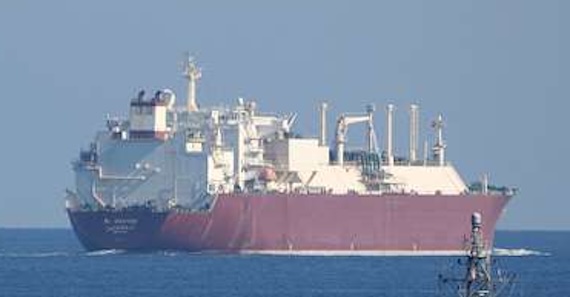
Container ship in Strait of Hormuz. (U.S. Navy photo by Mass Communication Specialist 2nd Class Indra Beaufort).Public Domain. Via Picryl .

Trump has shown Iran how it can go into the protection business in the Gulf for the long term. Nice oil shipping industry you have here, it would be a shame if anything happened to it. And off that, Iran actually increases its GDP substantially.

If Trump takes out Iran’s electricity and bridges, he can interfere with its economy and its society in a big way. But he can’t stop the drones or the protection racket that way. Moreover, Iran has made it clear that its response will be to take out the power plants in the Gulf Arab states as well as in Israel. Since the US and Israel are running low on interceptors, and since even small Shahed drones have great range and can do a lot of damage, Iran’s threat is credible.

If Trump takes out Iran’s petroleum-production capability, Iran will crash oil production in the Gulf, taking 20 million barrels a day off the market for years to come. That would certainly be another Great Depression and likely would spell the end of the oil industry, since everyone in the world would migrate to electric vehicles quickly.

So although Trump meant the phrase ironically and blasphemously, the Iranian authorities may well end up saying “Praise be to Allah” over Trump’s monumental stupidity.

https://www.juancole.com/2026/04/trumps-vulgar-criminal.html

From The “MUTTS” Blog:

Helping Pets and People When the World Feels Uncertain

There are many ways in which the world feels uncertain, and with every news update, we ask ourselves questions: What role do we play? How can we help? We know many readers turn to Mooch and Earl for a daily dose of comfort and joy. Recently, someone told us MUTTS is their “place to go for a warm hug each day.” Will raising a particular issue interrupt that sense of refuge that readers value here?

Not long ago, we received a letter from a reader named Tyla. With her permission, we’re sharing part of it below. 

“With recent ICE raids impacting Minneapolis and communities across the country, some families are being separated very suddenly, and in many cases this has meant pets are left without caregivers. Animal shelters and rescues have shared that they’re seeing more animals being taken in or surrendered unexpectedly, and in some situations, people have stepped in to foster or adopt pets whose families were detained.

“The health and well-being of both people and animals isn’t always part of the conversation when issues like this come up, even though both are affected. Animals, especially, rely entirely on their families for care and stability, and sudden disruptions can be very hard on them.

“I was wondering if this is something the [MUTTS] team might feel comfortable acknowledging this, specifically from the perspective of how animals are affected.

“I understand this is a sensitive and complicated topic … I also know that many readers, including myself, turn to MUTTS as an escape from the real world, and I truly respect that. I just wanted to offer this suggestion thoughtfully, since when people are affected in situations like these, animals are often affected too, and their needs can easily be overlooked.”

Tyla’s letter moved us. We’d been thinking about this, too. We started drafting a blog post based on one specific concern: What happens to pets when their families are detained or deported? We were discussing this internally, and considering ways to help, when the scope widened. The news headlines, unfortunately, have not slowed down.

The world feels increasingly uncertain, but one thing we know for sure is that pets depend on the humans who love them. They don’t understand geopolitics or political parties. And the truth is, preparing for any unexpected event — from a natural disaster to a family emergency or something else — is an act of love and responsibility.

At MUTTS, we believe in compassion for all creatures. With that spirit, here are practical ways we can all help our human and animal neighbors.

If You’re a Pet Parent: Plan Ahead

  • Choose a backup caregiver. Identify a trusted friend, neighbor, or family member who could step in temporarily if you can’t be home. Make sure they’re willing and understand what would be involved. Share basic care information in advance so nothing is left to guesswork. If you’re comfortable with it, you may even want to give them a spare key to your home (or tell them where one is hidden).
  • Keep identification current. Ensure your pet’s tags and microchip records are up to date. Consider listing a secondary contact (such as your backup caregiver) on file with your vet.
  • Prepare a small “just in case” kit. Put together a bag with essentials: medications, vaccination records, feeding instructions, favorite comforts like a blanket or toy, and a short written profile of your pet’s personality and needs. Think of it as something you’d want ready in any unexpected situation.

If you currently need assistance caring for your pet, know that there are many community resources around the country that may be able to help. You can start your search with PetHelpFinder.org, which allows you to search for pet pantries, affordable veterinary services, and other resources in your area. You might also contact your local animal shelter for guidance. Many shelters offer community assistance — and even if yours does not, it’s very possible they can help point you in the right direction. 

If You Want to Help In Your Community

  • Volunteer at a local shelter. Many animal shelters are already stretched thin, and shelters across the country are receiving pets whose guardians were detained or unexpectedly displaced. Time, donations, and supplies all help. 
  • Consider fostering. This is an incredibly impactful way to help pets in your community, especially right now. Fostering gives an animal stability during a time of upheaval. In some cases, it provides time and space for an eventual reunion with their family. It also helps shelters by freeing up room so they can care for more animals.
  • Offer to be a backup pet caregiver for friends, family, or neighbors. You don’t need a specific reason to make this offer. You can simply say you’ve been thinking about family preparedness and realized how comforting it would be to know someone nearby could step in for your own pet if needed. Sometimes people hesitate to ask for help, and by offering proactively (and gently), you can remove that barrier and replace it with reassurance.
  • Create or strengthen local support networks. If your area doesn’t have a pet food pantry, consider starting one. Offer to deliver pet food or walk dogs for families facing temporary hardship. Some communities have organized quiet grocery or supply deliveries for neighbors who are unable to leave home. No pet should go hungry because their family is going through a difficult time.

Build Real Connections In Your Community

This may sound simple, but it really matters. Support systems don’t appear overnight. They grow from familiarity and trust. If you don’t already have a close-knit community, consider planting the first seed. For example:

  • Start a “take one, leave one” table or box. This could include books, baked goods, even extra apples or herbs from plants in your own yard.
  • Bring back front-yard or porch time. Read or drink your coffee outside. Smile and wave at anyone who passes. This invites casual conversation without any pressure.
  • Check on neighbors during extreme weather. A quick knock before a storm or heat wave can go a long way. 

Remember that when communities feel connected, pets are safer too.

Share Your Ideas to Help Pets and People

If you have ideas we haven’t mentioned, we would love to hear them. In the spirit of MUTTS, we ask that comments remain friendly and constructive, aimed at helping animals and strengthening compassion. That’s something we can all stand behind.

— Ali Datko

This Week, From Joyce Vance

The Week Ahead

Joyce Vance

The president of the United States greeted the country with this Truth Social post about his intentions in Iran on Easter Sunday: “Tuesday will be Power Plant Day, and Bridge Day, all wrapped up in one, in Iran. There will be nothing like it!!! Open the Fuckin’ Strait, you crazy bastards, or you’ll be living in Hell – JUST WATCH! Praise be to Allah. President DONALD J. TRUMP

No one seems to have got so far into the post as to notice that he said “Praise be to Allah,” which he would most certainly say was a jest, if asked. But imagine Joe Biden, or worse still, Barack Obama, saying that “in jest” and how Republicans would have responded. Trump is completely off the rails and Republicans are turning a blind eye, pretending it’s not happening.

Earlier this week, Trump’s “spiritual advisor” Paula White-Cain compared him to Jesus. Trump, too, was “betrayed and arrested and falsely accused,” she said. No one in the Republican Party seems to have believed they need to strenuously resist that characterization.

And so, we enter the new week with an unstable president at the helm in wartime. Meanwhile, at home, there are plenty of issues mounting. But Trump seems to have largely gotten away with knocking his connection to Jeffrey Epstein and allegations about his personal conduct off the front burner.

Laura Loomer is influencing policy changes at DOJ

After Trump fired Attorney General Pam Bondi, there appears to be another significant personnel change in the works at DOJ, this one inspired at least in part by Laura Loomer’s dislike of the number three official at DOJ, Associate Attorney General Stanley Woodward. Trump appears to be on the verge of replacing him with the current Assistant Attorney General for the Civil Rights Division, Harmeet Dhillon, who has upended its work and overseen a mass exodus of career personnel.

Woodward was the defense lawyer for one of Trump’s co-defendants in the Mar-a-Lago case, Walt Nauta. His client hung in there with Trump, instead of flipping and offering testimony against him in exchange for a deal. That worked out well for Nauta, but only because Trump won the election. Most lawyers acting in the client’s best interests in that type of situation would have worked toward a plea. Lost in the plot from that case was the conflict of interest Woodward had that could easily have kept him from representing Nauta and might have resulted in another lawyer voluntarily stepping aside. Woodward had previously represented one of the witnesses who decided to cooperate with the prosecution after receiving advice from a lawyer who wasn’t connected to other defendants. Judge Cannon permitted Woodward to represent Nauta despite that conflict, after Nauta waived it. Woodward has also represented White House adviser Peter Navarro, who was prosecuted for obstructing Congress when he ignored a subpoena from the January 6 committee, FBI Director Kash Patel when he testified before a grand jury about Trump’s retention of classified documents, and one of the defendants in the Oath Keepers prosecution.

All that to say, Woodward was a known quantity for Trump when he appointed him. But that doesn’t seem to have been enough to save his job, just over a year into it.

There’s been some suggestion on social media that Laura Loomer is, at least in part, responsible for the change. Loomer is a conservative activist and online influencer who has claimed the ability to impact Trump’s hiring and firing decisions in the past. Last August, Trump was asked about that and said, “She makes recommendations on things and people. And sometimes I listen to those recommendations, like I do with everybody. I listen to everybody. And then I make a decision.” Loomer has never been a fan of Woodward’s.

Her concerns center on Woodward’s wife, apparently, not Woodward. She has had them since before he was confirmed.

Woodward’s wife apparently has the audacity to have her own views on issues, and they are…not racist. Loomer reiterated her take just before Trump made his move at DOJ, also attacking Todd Blanche, the former Trump criminal defense lawyer who is now in charge of the Justice Department in an acting capacity. Blanche and Woodward may have been surprised to learn that, according to Loomer, they’re now Democrats.

That’s a lot of maneuvering, that benefits Dhillon, who has overseen the dismantling of much of the Civil Rights Division’s work, including voter and election protection, and gone on the attack for the administration. That might have made her an attractive candidate for the position to Trump without more. If confirmed by the Senate as “the Associate,” as the number three position at DOJ is called, Dhillon would supervise her old division, Civil Rights, as well as the Civil Division, the Antitrust Division, the Environment and Natural Resources Division, and an administrative division that oversees grant funding. It’s a substantial role and could be a stepping stone to a still higher office.

This is more than a personnel squabble within DOJ and warrants our close attention. Since taking over the Civil Rights Division, Dhillon has made a number of decisions with significant consequences that run contrary to the history of the Division, including:

  • Setting priorities for the Division that included putting an end to DEI, supporting gun rights, protecting religious liberty by filing lawsuits challenging what DOJ views as anti‑Christian discrimination, and opposing transgender participation in women’s sports.
  • Pressuring colleges and universities over DEI programs and allegations of antisemitism. In one notable instance, the president of the University of Virginia was forced out for failing to move quickly enough to end DEI.
  • Ending, as her predecessor Jeff Sessions did, consent decrees with Police Departments. In her case, it was Minneapolis (George Floyd) and Louisville (Breonna Taylor), in cases involving systematic misconduct. She ended investigations in other jurisdictions, changing the environment to one that is far more tolerant of police misconduct.
  • Abandoning employment discrimination cases, as well as the work of the disability section to protect access, and work combating housing discrimination.
  • Countermanding early work in the U.S. Attorney’s office in Minneapolis to investigate ICE agent Jonathan Ross, who fired the shots that killed Renee Good. Much of the career leadership in that office resigned in the wake of that decision.

We don’t yet know who Trump will nominate to be the next Attorney General. Dhillon was confirmed 52-45 for the Civil Rights job, garnering no votes from Democrats but mustering support from every Republican. She’s been effective at pushing her priorities, which are Trump’s priorities, and at pushing career people out the door. A Justice Department under her leadership might make people long for Bondi’s simpering incompetence.

To come full circle, this was Dhillon’s response to Trump’s “Fuckin’ Strait” post this morning:

The Trump Administration appeals Anthropic’s victory.

Thursday morning, the government filed its notice of appeal after Anthropic won a victory against it in the lower court. That means it will try to overturn Judge Lin’s injunction, which prevents Trump/Hegseth’s designation of Anthropic as a supply-chain risk. We’ll likely see an effort to get an order from the Ninth Circuit to set that injunction aside while the litigation is underway this week

The federal civil rights investigation and prosecution we won’t see.

The Buffalo Medical Examiner ruled that the death of a legally blind elderly Burmese refugee dropped off by Border Patrol at a closed shop late at night in winter was a homicide. The facts of the case are terrible. And there’s a federal criminal law designed to address this kind of civil rights violation by federal agents acting “under color of law.”

NBC reported that Nurul Amin Shah Alam died of a burst ulcer caused by severe stress brought on by dehydration and hypothermia, which was brought on by the agents’ abandonment of him. The statute permits prosecution of agents who deprive a person of their rights because they are an alien. If DOJ were operating properly, there would be an open investigation. The potential charge is a serious one, based on the denial of rights, not a homicide. The punishment under the law, “if death results” from agents’ actions, can be life imprisonment or even the death penalty. Any other DOJ would be focused on getting this case and doing justice.

The DHS shutdown is still on.

The House failed to take action to pass the Senate’s bipartisan funding deal to reopen the Department of Homeland Security last week. That means the shutdown will continue at least until Monday, when Congress is back in Session. The Senate compromise withhold money the administration wanted to push Trump’s immigration agenda, but would fund DHS until the end of the fiscal year.

TSA workers in the Portland, Maine, airport cheerfully told me last week that they had received some back pay, but had no assurances of receiving paychecks going forward. Hard-working TSA employees are being forced to bear the brunt of Trump’s inability to run the government. It’s surprising Democrats aren’t driving this message every day. And, with hurricane and fire seasons approaching, FEMA funding is sure to be an issue soon, as well.

And, DOJ still hasn’t released all of the Epstein Files.

I have no intention of forgetting that there is more to that story.

Thank you for being here with me at Civil Discourse. It’s going to take all of us, staying informed and working together, to keep the Republic. If you’ve been enjoying the free posts, upgrading to a paid subscription is a great way to help keep the newsletter coming and to contribute to the time and resources it takes to stay on top of law, politics, and this administration.

We’re in this together,

Joyce

3 Women In History Who Rocked

Kickass Women in History: Tarenorerer

by Carrie S · Apr 4, 2026 at 2:00 am 

Please be advised that this post contains the names of deceased persons. In lieu of images of the deceased, which are offensive to Aboriginal persons, this post contains images of art by contemporary Aboriginal artists.

TW: genocide, slavery, exile, sexual violence, imprisonment, forced labor

For this month’s Kickass Women in History, we go to Tasmania, an island state of Australia, home of the Palawa people. The Palwala people called their home Lutruwita, and early British colonizers referred to it as Van Diemen’s Land. From 1803 to 1853, Van Dieman’s Land was Australia’s primary penal colony. Later on, the island’s name was changed to Tasmania to avoid the stigma of its penal colony history.

Tarenorerer was a Tommeginne woman born around 1800. Between 1800 and 1850, more than 70,000 people were exiled from England and forcibly deported to Van Diemen’s land and subjected to forced labor. This was an incredibly violent time in Tasmania. The convicts were disproportionately male and sexual violence against women was pervasive, while the convicts in general struggled to survive a harsh environment and harsh treatment from their overseers.

Two Women, by Alison Munti Riley

While life was difficult for the convicts, it was worse for the Aboriginal people who were murdered on sight. The convicts and their overseers carried out systemic genocide against Aboriginal Tasmanians during a conflict known as ‘The Black Wars.’ While most of the genocide focused on mass murder, George Augustus Robinson developed the “Friendly Mission,” a plan to forcibly deport Aboriginal Tasmanians to Flinders Island.

When Tarenorerer was in her teens, she was captured and taken from her family by another clan and sold to White sealers on the Bass Strait Islands. During her captivity, she learned to speak English and to use guns.

Tarenorerer escaped in 1828 and became the leader of the Plairhekehillerplue clan of Emu Bay. She led them in a guerilla war against the colonizers.  (snip-a bit MORE)


Kickass Women in History: Queen Himiko

by Carrie S · Mar 7, 2026 at 2:00 am ·

For this month’s kickass woman, we turn our attention to Japan and the legendary life of Queen Himiko, the first recorded ruler of ancient Japan – not only the first female ruler, but the first ruler, period. I’m going to do a little summarizing here, but I’m also going to be very link-heavy. So much legend surrounds Queen Himiko that I am waaay over my head in terms of describing her life, but I do want to give you some links to explore so that you can learn about this fascinating woman.

Once upon a time, before Japan was a country, in the Yayoi (300BC-300AD) and Kofun (250-538AD) periods, there were all these island city-states. Rulers were also religious figures, and female shamans were highly regarded.

The written records of this period come from Chinese historians, who referred to this region as “The Land of Wa”, home of the “Eastern Barbarians.” We also have writings from Korean historians. As summed up in the article “Queen Himiko: Badass Women in Japanese History” by Chelsea Bernard:

During the second half of the 2nd century (ca. 147-190 AD), the lack of a capable leader plunged the Land of Wa into political turmoil and violent upheaval. Finally, in 190 AD the unmarried shamaness was chosen by the people to rule. Installed in a palace with armed guards and watch towers, she was served by “1,000” female attendants while her “brother” acted as a medium of communication, transmitting her instructions and pronouncements to the outside world. After ascending to the throne, she went on to restore order and maintain peace like a boss for the next 50 or 60 years.

Queen Himiko pulled about 100 kingdoms and confederacies and clans together. She sent diplomatic missions to China, which formally recognized her rule. This video explains her role as a verifiable person in written record and archeology. It’s pretty dry but also very detailed.

(snip-a little MORE on the page)


Kickass Women in History: Arnarulunnguaq

Feb 07, 2026 02:00 am | Carrie S

I don’t know why, but I am a total sucker for books about Arctic and Antarctic exploration. Bring me your frostbite, your scurvy, your long marches, and, above all, bring me my warmest pajamas and a hot cup of tea and we have what I consider to be the perfect ingredients for a cosy night in.

The Heroic Age of Antarctic Exploration (1897ish – 1922ish) and the many efforts to locate the Northwest Passage in the Arctic are simply crammed with stoic imperialist White men who suffer terribly for what, frankly, does not strike me as terribly good reasons. Perhaps my ability to read of their sufferings with ghoulish fascination stems from the fact that none of these guys needed to be either North or South in the first place. To borrow and bend a common phrase: you live by the poorly sealed canned goods, you die by the poorly sealed canned goods*.

black and white photo shows a smiling young woman in furs
Arnarulunnguaq on the Fifth Thule Expedition

Of course, in the case of the Arctic, people were already living there long before any White explorers staggered upon the scene. Yu’pik and Inuit peoples were instrumental in exploratory expeditions in the Arctic and, less directly, the Antarctic. I’ve already written about Ada Blackjack, an Inupiaq woman who survived on Wrangel Island alone for eight months after the other members of her party died.

Other Indigenous women often supported expeditions, especially Arctic ones, by sewing, skinning and preserving fur and leather and cooking. Taqulittuq (also known as Tookoolito and as Hannah), an Inupiaq woman, accompanied Charles Francis Hall on many expeditions including one in which she and some crew members were marooned for months and survived because of the skills of Taqulittuq and her husband. Many other Indigenous women accompanied and supported expeditions and were never formally recognized for their valor.

Arnarulunnguaq, the first woman to travel from Greenland to the Pacific, was born in Greenland in 1896. She related that when she was six or seven, her father, a hunter, died and the family became so desperate for food that they prepared to sacrifice Arnarulunnguaq so the the rest of the family could live, having one less mouth to feed. However, at the very last minute, her brother started crying and her mother decided not to kill Arnarulunnguaq after all. Arnarulunnguaq was (of course) powerfully changed by this experience. According to the explorer Knud Ramussen:

She says herself that the gratitude that she came to feel many years later, and the life she had almost received as a gift, has made her placid towards people.

Arnarulunnguaq married a hunter named Iggiannguaq (allegedly she had a previous marriage that failed because she was “too lazy,” a trait which truly does not match the historical records of her life!). The two planned to accompany Knud Rasmussen on his Fifth Thule Expedition (1921 – 1924). This trip involved travelling from Greenland to Siberia via dogsled. Iggiannguaq died before the trip commenced, and Arnarulunnguaq asked to be allowed to continue with the trip. Her cousin, Qaavigarsuaq Miteq, filled the role of hunter.

(snip-MORE on the page)