Clay Jones, Leading Kansas

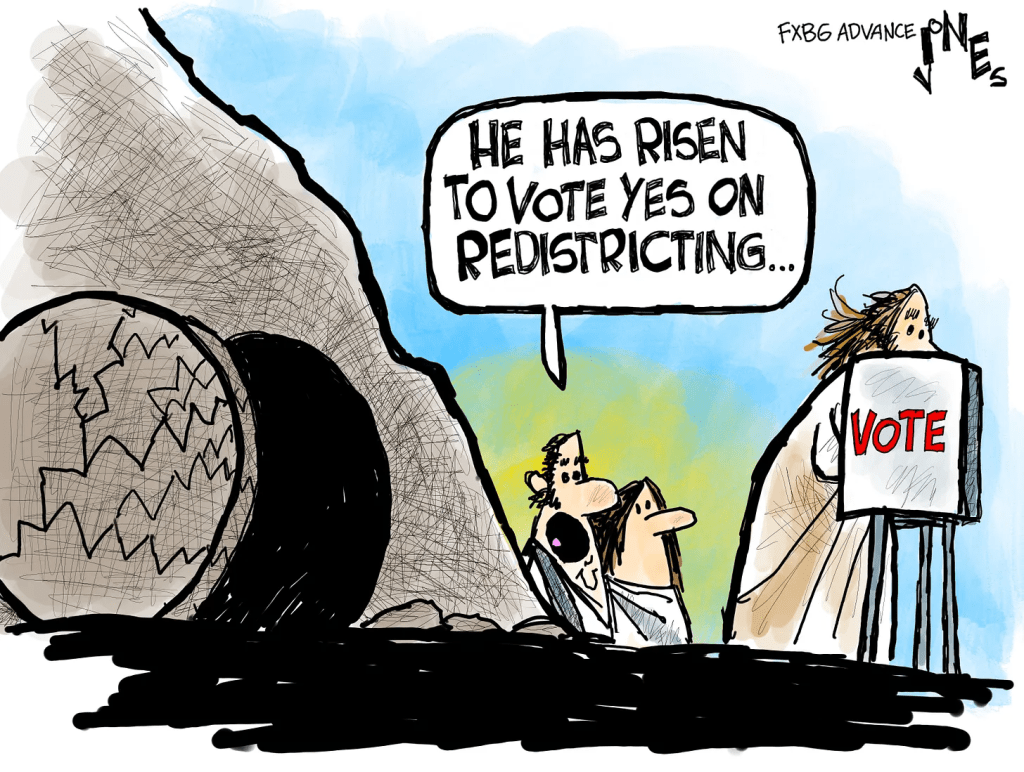
He Has Risen

To vote yes

Clay Jones

This cartoon was drawn for the Fredericksburg Advance. But don’t yell at them for it; you can yell at me.

If you live in Virginia, you have been bombarded with flyers about the special election on redistricting. And it’s not just flyers but also TV commercials, which are also popping up online. We are getting these things from both sides.

There is a special election in November on a state constitutional amendment that would give Democrats as many as four seats in Congress. The measure would also temporarily bypass the state’s redistricting commission to redraw maps in the middle of the decade.

The state’s Supreme Court approved the measure to be on the ballot less than a week before early voting began. State Republicans repeatedly tried to stop Democrats from moving forward with the referendum. The irony here is that Republicans claim that voting yes will disenfranchise voters, while they literally tried to keep this off the ballot so people couldn’t vote on it.

This is a direct response to Donald Trump and Republicans redistricting mid-decade to give themselves more seats. Donald Trump even said he was entitled to have more congressional seats. This is one reason why we need to No Kings protest. Donald Trump already believes he’s entitled to win elections he’s lost. (snip-MORE, and it’s on point)


The Parsons Project

by André Swartley

Leading Kansas

Key points at a glance

  • Energy company Deep Fission is in the process of building a new and untested type of underground nuclear reactor in Parsons, KS
  • The Trump administration has reduced regulations to encourage nuclear power production
  • The reactor will likely power data centers for artificial intelligence
  • Large data centers consume huge amounts of water and energy and produce different types of pollution, leading to health risks for nearby residents

In November 2025 a two-year-old energy company called Deep Fission broke ground in Parsons, Kansas. They hope this project will enable them to install the second ever energy producing nuclear reactor in the state, after Wolf Creek, potentially with more reactors on the way in the future. If the early “characterization” drilling goes to plan, they claim the reactor could begin pumping electricity into the grid in the near future.

Parsons is a city of 10,000 in southeastern Kansas, near the Oklahoma border. I’ve lived in Kansas for most of my life and I had not heard of Parsons until last week. So, why is Deep Fission in Parsons, Kansas, and why now? Not coincidentally, the Great Plains Industrial Park, also located in Parsons, has lately been advertised as a prime location for new data centers to power the trillion-dollar (yes, trillion with a T) artificial intelligence boom forced upon us by large technology corporations and their venture capitalist backers. Which means the Parsons nuclear reactor project would likely come as a package with one or more new data centers, along with potential economic prosperity and a host of legitimate concerns that community members have already raised.

Part 2: The New Nuclear Power

While the Department of Energy set a goal for the Parsons reactor to go online in July of this year, Deep Fission themselves are aiming to connect to the grid by 2027 or 2028. Two years is still an unusually rapid rollout for a nuclear power plant, which usually takes 6-10 years from groundbreaking to full operation.

This reduced timeline comes by way of the Trump Administration’s efforts to slow the national and worldwide adoption of renewable energies like wind and solar power. In February of this year alone, Trump’s Department of Energy halted the approval of “168 projects – those that focused on renewable energy projects” while allowing nearly 11,000 other energy projects to proceed as planned, including new nuclear energy projects. Executive Order 14301 in May of 2025 provided Deep Fission with the means to build their experimental nuclear reactor on such a short timetable.

Nuclear energy is typically labeled as “clean” energy compared to coal, oil, and natural gas, meaning that it releases fewer pollutants into the air and water than fossil fuel consumption. Still, there are two main concerns. First is the disposal of nuclear waste, which ranges from the lightly contaminated clothing of plant workers to the lethally radioactive spent fuel a plant produces over time. This latter “accounts for just 3% of the total volume of waste, but contains 95% of the total radioactivity.”

A relatively new method in the US and Europe for disposing of our most dangerous nuclear waste is to bury it very deep underground, so that it can be surrounded by solid rock to provide the same level of pressure containment as required at structure at a surface nuclear reactor facility. The father-daughter team that eventually founded Deep Fission originally created Deep Isolation to dispose of nuclear waste. Deep Fission takes their concept a step further by placing the entire reactor, and therefore its most dangerously radioactive elements, into a borehole drilled one mile underground.

The second main concern related to nuclear energy production is, of course, accidents or attacks. It is true that large-scale nuclear accidents are very rare, but when they happen, they become instant, globally recognized disasters whose names we all know: Chernobyl, Three Mile Island, Fukushima. The effects are so widespread as to be practically impossible to quantify. The reactor explosion and meltdown in Chernobyl, for example, caused several dozen deaths directly related to radiation exposure, but various studies have predicted anywhere from thousands up to a million eventual additional cancer deaths. Not to mention the environmental and economic cost to the entire region around Chernobyl. And radioactive boars still terrorize people and farmland in the region around the Fukushima plant in Japan.

But those issues are known, and regulations have historically attempted to shore up potential dangers posed by new plants. In contrast, nothing like the underground nuclear reactor in Parsons, Kansas has ever been attempted before, and thanks to Executive Order 14301, will not need to go through long established design and testing phases that other types of nuclear reactors have been subject to in the past. John Young, a mining environmental regulatory specialist who lives in Sedgwick County, asks, “Why abandon the current regulatory process for something created out of whole cloth with no public input? And no one can define the current regulatory pathways for Federal and State authorizations.

“What,” Young asks in frustration, “could possibly go wrong?”

Part 3: Data Centers and Artificial Intelligence

So that is a glimpse into the nuclear energy side of things. Next we must address concerns around data centers and artificial intelligence. Data centers come in different sizes, like the smaller center being proposed in Wellington, KS, which would reportedly “use roughly 30% of the city’s electrical capacity while generating an estimated $1.3 million in annual electric utility revenue” while consuming only two gallons of water per day. Larger data centers consume resources less modestly. “Around the country, and the world, there is a land race among the big tech companies for sites for their data centers,” claims a November 2024 investigative report by Rolling Stone. Data centers are much newer than nuclear energy technology, yet the ways in which they harm communities near them have already become apparent.

Water: “Large data centers can consume up to 5 million gallons per day, equivalent to the water use of a town populated by 10,000 to 50,000 people,” according to a June 2025 study by the Environmental and Energy Study Institute (EESI). And data centers built explicitly to power AI represent the fastest growing portion of the market.

Last year, researchers at the University of California, Riverside calculated that ChatGPT—one of several popular Large Language Models (LLMs) vying for marketplace dominance—answered about 10,000 queries per second. The processing load to do so guzzled about 6,000 liters (or about 1,000 toilet flushes) of fresh water per second, all day, every day. That is only generating written text. AI photos require more water, and still more for AI video. “The extraction process is permanent,” explains the University of Alabama at Birmingham Institute for Human Rights. Water used to cool data centers evaporates as it cools hot components, meaning it can no longer be used by people in the region who need water for drinking, cooking, bathing, laundry, and general survival.

Pollution: Unfortunately, it is not only consumption of water to worry about. The evaporation of water cooling data centers leaves behind higher concentrations of nitrates and other contaminants leaked through agricultural fertilizers and pesticides into local water supplies, drastically increasing incidents of “rare cancers, muscle disorders, and miscarriages” among people who live nearby. Geographically, Parsons, Kansas sits atop the Alluvial and Ozark Aquifers.

Reports of noise pollution have increased near data centers as well. Residents in different Virginia towns experienced disturbing high and low frequency humming in a wide radius around two new data centers.

Energy: New York City is the most populous city in the United States. The population consumes about 11 billion watts of electricity per hour. However, by 2030, “power usage of…data centers is projected to rise to nearly 2967 trillion watts an hour,” increasing load and wear on current energy infrastructure and raising energy prices for regular people while tech companies receive sweetheart discounts from local and state institutions.

Gradual Disempowerment: Artificial Intelligence scholars and ethicists have identified a trend they call “gradual disempowerment.” As AI becomes more capable, people will continue to offload, “almost all societal functions, such as economic labor, decision making, artistic creation, and even companionship” to their favorite AI service. The scariest part is that these studies have actually measured reduced cognitive ability “at neural, linguistic, and behavioral levels” after only a few months of using services like ChatGPT.

These same experts predict that the disempowerment will not only come at the individual level, but also at the societal level, as lawmakers turn their attention and favor even more toward tech companies and AI services that increasingly take over tasks that used to be performed by human beings.

DHS and ICE: The Department of Homeland Security (DHS) and Immigration and Customs Enforcement (ICE), and have been using AI models to power their violent and unpopular immigration raids across the country. They are also surveilling, threatening, and creating databases of protesters.

Part 4: What Next?

The purpose of this article is not to overwhelm with doomsaying or inevitability. If the Deep Fission underground reactor works as advertised, it could genuinely provide cleaner energy than fossil fuel and mitigate some of the effects of climate change. But to get there safely, we need to demand transparency and regulatory protections from political and corporate leaders. If enough of us speak up in place like ParsonsTopekaSedgwick County, and every corner of our town, state, country, and world, we embolden those watching, each other, and ourselves to continue building the world we want and deserve.

Some Shorts & A Story

Science-y, funny, not as or at all funny, plus a big surprise. Enjoy!


A man planted tomato seeds from two McDonald’s burgers. Three months later, whoa.

“I expected this tomato to grow,” James Prigioni said, “but I did not expect this.”

By Annie Reneau

In many ways, fast-food restaurants feel like the opposite of a backyard vegetable garden. But one gardener has tied a McDonald’s hamburger directly to a garden harvest in a way that even surprised him.

James Prigioni makes popular gardening videos on YouTube. In one, he wanted to see if he could grow a whole tomato plant by planting the seeds from a tomato on a McDonald’s burger. He picked up a Deluxe Quarter Pounder with cheese, pulled out a tomato slice, and removed two seeds. After rubbing the seeds on a paper towel to remove the protective coating, which can inhibit sprouting, they were ready to plant.

Trying out different seed-planting methods

But like any good scientist, Prigioni wanted to try a different method for testing McDonald’s tomato seeds. So he pulled a slice of tomato from a second Quarter Pounder and, instead of extracting the seeds, planted the entire slice.

With the help of a heat mat and a grow lamp, both sets of seedlings germinated and sprouted in soil-filled red Solo cups in about a week. After they were fully established, Prigioni separated the plants so they could thrive individually before being planted outside.

He planted one of the plants in the ground outside and another in a 5-gallon bucket. He then showed how he culled the lower leaves as they developed blight and used a tomato cage to support the plants as they produced fruit and grew heavier. He also added extra fertilized soil and mulch to the bucket plant.

The harvest was unexpected

After three months, the plants were producing abundant fruit. The bucket plant didn’t perform as well as the in-ground plant, which Prigioni said was due to insufficient watering during very hot days. The bucket plant also ripened faster, likely due to the stress it had been under. Still, it was an impressive harvest, especially for a plant that started on a McDonald’s burger.

The in-ground McDonald’s plant was even more incredible, with dozens of tomatoes dripping from it.

“I expected this tomato to grow,” Prigioni said, “but I did not expect this.”

The fruit from both plants tasted good and sweet, he said. By the fourth month, the in-ground plant was starting to struggle with its health, but not with its fruit production.

“The plant had so many tomatoes on it that it seemed like it was having a little difficulty ripening that much fruit at one time,” Prigioni said. “I mean, I have had some plants with a lot of tomatoes on them, but never in my life have I seen a single tomato plant with this much fruit on it. I was completely blown away.”

How the McDonald’s tomatoes compared

He said one of his favorite parts of the experiment was seeing what kind of tomatoes would grow from the seeds. He thought it might be a beefsteak variety, but it turned out to be a Roma type. However, he surmised that the McDonald’s tomato was likely a hybrid, based on its ripening characteristics.

Prigioni also shared how the McDonald’s tomato plants compared with his other tomato plants.

“In another area of the garden, I grew Roma tomatoes that I got from Lowe’s, and I planted them at the same time as the McDonald’s tomatoes,” he said. “The harvest from them wasn’t quite as large, but the fruit ripened way more evenly, and I was able to harvest a lot more fresh fruit right off the vine that was ripe.”

A ripe harvest of Roma tomatoes growing in a garden
There’s nothing like a tomato right off the vine. Photo credit: Canva

“Overall, I was shocked with the level of production,” he continued. “And this is probably my favorite experiment that I’ve ever done. I mean, to be able to take a cheeseburger, grab a tomato from it, then grow a tomato plant, and then harvest pounds and pounds of tomatoes from it is just such a unique and refreshing experience.”

Perhaps an unexpected result, but a great way to challenge our assumptions and demonstrate the power of nature, even in the context of fast food.

You can follow The Gardening Channel with James Prigioni on YouTube for more gardening education.

Along With A Thing We Can Do:

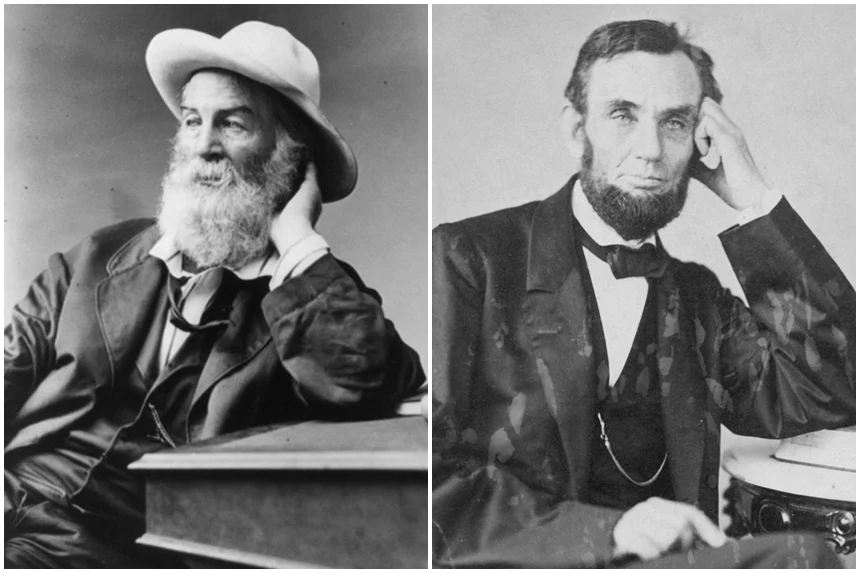
Clay Jones, Walt Whitman?

Walt Whitman, Abraham Lincoln, and the “Terrible Duties” of Democracy

Abraham Lincoln’s faith in the Declaration of Independence ultimately influenced Walt Whitman’s harsh but optimistic appraisal of the American experiment.

Ryan Reft

Walt Whitman and Abraham Lincoln (Library of Congress)

“The United States are destined either to surmount the gorgeous history of Feudalism, or else prove the most tremendous failure of time,” wrote American poet Walt Whitman in his 1871 work, Democratic Vistas. Despite writing in the wake of a brutal civil war and a failing Reconstruction Era, Whitman remained optimistic. “Not the least doubtful am I on any prospects of their material success.”

Known more for his poetry, exemplified by Leaves of Grass (1855), Whitman’s dark 1871 treatise on the nation remains a harsh but ultimately optimistic appraisal of the American experiment. It serves as a useful tool for thinking about the nation’s current state on the 250th anniversary of the Declaration of Independence.

Whitman’s revolutionary patriotism had long been part of his worldview. He celebrated the Declaration of Independence and the Revolution in the preface to Leaves of Grass, noting that a poet must “enter the essences of the real things and past and present events,” among them “the haughty defiance of ’76, and the war and peace and formation of the constitution.”

But for all his celebration of the Declaration and the nation’s founding, he did not mince words regarding the nation’s failings. He wrote of a “hollowness” at the center of American life at the time, calling the business classes depraved and the government saturated in corruption. (snip-go see the rest!)


Trump Age

Trump threatens to bomb Iran back to the Stone Age

Clay Jones

Donald Trump is threatening to bomb Iran back to the Stone Age, which, if he does, would be a war crime.

Trump’s chosen war is with the government of Iran, not the people, yet he continues to threaten to destroy its infrastructure. The more Donald Trump and Pete Hegseth brag about their success in the war, the more it seems that Iran fights back.

Trump tells us that the war is won and that Iran’s ability to wage war is nearly depleted if not already destroyed, yet missiles still rain on Israel and our other allies in the Gulf. And if Iran doesn’t have any weaponry left, then how did they shoot down two American jets? If the war is already won, then why are we still fighting? (snip-click on the title to get the rest!)

Some Shorts For A.M. Fun


For Those Of US Who Wondered…

Scottie mentions restroom etiquette sometimes. Turns out, there’s an actual etiquette, as he says, and here’s a story about it!

1976 research study confirms science behind ‘urinal etiquette’

The “buffer urinal” is more important than we realize.

By Evan Porter

There’s a theory that most men, and people in general, intuitively understand “urinal etiquette.” It’s the art and science of where to stand in relation to other men when using a public restroom. Stand too far away, and you risk coming across as standoffish or rude. Stand too close, and you’ll make the other person uncomfortable.

Most people prefer to have a “buffer” between themselves and strangers, and it’s not limited to urinals or public restroom stalls. When given the option, most of us will sit at least one seat away from the nearest stranger in a movie theater or auditorium. We’ll leave a bench or treadmill between ourselves and a fellow gym-goer.

The buffer may seem like common decency and consideration for the people around us, but there could be more to it than that, according to a decades-old research study.

Scientists put theory to the test

In 1976, a team of researchers actually got the idea to test whether the proximity of a stranger had an effect on the way men urinated. Yes, really.

More specifically, they wanted to test what happens when someone invades your personal space. Do you just feel awkward or uncomfortable, or are there more measurable things happening in the body.

Objectively, the worst kind of urinal. Photo Credit: Photo credit: Wikimedia Commons

For the experiment, researchers began with a pilot study in a men’s public restroom. An observer stood by the sink, appearing to busy himself with washing and grooming, all while secretly keeping tabs on the men who entered. The published study takes it from there:

“When a potential subject entered the room and walked to a urinal, the observer recorded the selected urinal and the placement of the next nearest user. He also noted (with a chronographic wristwatch) and recorded the micturation delay (the time between when a subject unzipped his fly and when urination began) and the micturation persistence (the time between the onset and completion of urination). The onset an cessation of micturation were signaled by the sound of the stream of urine striking the water in the urinal.”

Ethical concerns about observing unsuspecting men in a restroom aside, the study found that none of the 48 subjects chose to stand directly next to another “user” at the urinal banks. The data also showed that men urinated longer the farther they were from the nearest person.

The study was repeated, but this time, confederates were involved. Volunteers were stationed at specific distances from unsuspecting bathroom users, while another observer hid in a nearby stall and used a “periscope” to get a clear sightline of the urine stream.

The surprising findings

Once again, the data was extremely conclusive: men who stood directly next to a confederate while urinating took longer to begin and also urinated for longer overall.

“These findings provide objective evidence that personal space invasions produce physiological changes associated with arousal,” the authors noted in their abstract.

It was an important, if controversial, study in advancing the field of proxemics—the study of physical space in human nonverbal communication. Research like this unusual bathroom study has helped us understand “intimate distance,” a space very close to our bodies that we reserve for romantic partners, children, and close friends.

Research in the field has also mapped the “personal bubble,” or “personal distance,” typically reserved for family members and friends. However, when strangers invade this space—in a crowded elevator, a packed subway car, or by standing next to us at the urinal—that’s when things get really interesting.

Our bodies respond, and MIT Press notes that people often deal with an invasion of personal space by “psychologically removing themselves from the situation” by listening to music or staring blankly at a wall.

Now we know a little more about the physiological response behind this aversion, and it makes urinal etiquette make much more sense. It’s not just “machismo” or homophobia—it’s a way of avoiding a serious stress and anxiety trigger. Or, at the very least, a way to have a much more satisfying pee.

Political Tests?

How gender-affirming care is becoming a political test for top medical groups

Orion Rummler

This story was originally reported by Orion Rummler of The 19th. Meet Orion and read more of their reporting on gender, politics and policy.

The largest medical association in the United States supports gender-affirming care — a stance it has reiterated in different ways over the last 10 years. But as Republicans press leading medical organizations on health care for transgender youth, the American Medical Association (AMA) is the latest group caught between political rhetoric and the complex realities of specialized care that few people receive.  

As patients, families and doctors navigate this care in an increasingly confusing and hostile landscape, what medical groups say matters. But lately, what they’ve had to say — and how politicians interpret it — has only caused more uncertainty. 

The AMA’s stance was already in question after a January meeting between leaders of major medical groups and Dr. Mehmet Oz, the head of the Centers for Medicare and Medicaid Services. After that meeting, which was first reported by The New York Times, one group in attendance — the American Society of Plastic Surgeons (ASPS) — muddied the waters about whether it had taken a more restrictive stance on gender-affirming care.

Questions soon followed for the AMA, the nation’s most prominent organization representing doctors.

Twenty Republican state attorneys general are pushing for the AMA to broadly oppose gender-affirming care for minors, in response to news coverage about their recommendations around youth surgeries. The attorneys suggest that the AMA may be violating state consumer protection laws by confusing, or even misleading, medical providers and patients about their stance. They mention wanting to “avoid a formal investigation” into the issue. 

The attorneys, led by Steve Marshall in Alabama, wrote a letter in February asking whether the group recommends hormone therapy or puberty blockers to treat gender dysphoria in minors. 

“If you agree that there is insufficient evidence to support using surgical interventions to treat gender dysphoria in minors — as your recent statement indicates — we do not understand how you can find that there is sufficient evidence to support using hormonal interventions to treat gender dysphoria in minors,” their letter reads. 

This is an escalation of a familiar tactic, said Khadijah Silver, director of gender justice and health equity at Lawyers for Good Government. And if it works, it will be a major weapon in the political fight to delegitimize gender-affirming care, they said. 

“If you can convince the public that they have shifted stance, that’s extremely powerful,” they said, referring to the AMA. 

In some ways, that impact is already being felt.

In a recent congressional hearing on rising health care costs, the board of trustees chair for the American Medical Association was asked about how patients across the country are struggling to find doctors. Two hours into the hearing, he was also asked about gender-affirming care for trans youth — a topic that affects few Americans, but takes up a lot of political air. 

Rep. Erin Houchin, a Republican from Indiana, asked why the medical group changed its position on surgeries for trans youth. 

But the AMA maintains that it has not changed its position. 

“In surgery and minors, our belief is that it should generally be deferred until adulthood. But, we respect the physician-patient-family relationship in determining that,” Dr. David H. Aizuss answered in response to the question from the congresswoman. 

That exchange took only a few minutes out of a hearing that spanned the gamut of crises facing the U.S. health care system, like skyrocketing insurance premiums and a worsening physician shortage. But it represents a growing tension between Republicans and medical groups, as elected officials who oppose gender-affirming care push for major health care organizations to do the same. 

The American Medical Association declined to comment on the attorneys general’s letter, which had asked for a response by March 25. In a broader statement, the medical group said it supports gender-affirming care. 

“We support evidence-based treatment for medical care, including gender affirming care,” an AMA spokesperson said in an email. “Currently, the evidence for surgical intervention in minors is insufficient for us to make a definitive statement. In the absence of clear evidence, surgical interventions in minors should be generally deferred to adulthood. Treatment decisions should be made between the physician and the patient (and family) based on the best medical evidence and clinical judgment.”

That position aligns with the World Professional Association for Transgender Health (WPATH), an authority on medical care for trans people. WPATH recommends that patients generally wait until adulthood before seeking surgery. Trans youth rarely undergo surgery of any kind; of the small number performed on adolescents, the majority are mastectomies. 

If an adolescent does need surgery, WPATH recommends they meet extensive criteria — including a full understanding of reproductive side effects, a year’s worth of hormone therapy, sustained gender incongruence, plus emotional and cognitive maturity. 

The questions surrounding surgery come on the heels of the American Society of Plastic Surgeons’ response to the January meeting with Oz. In what the Times described as a “tense” meeting, Oz pressed leaders of organizations including the AMA and the ASPS on why they recommend gender-affirming care for trans youth. At that meeting, the surgeons group said it would be changing its position, per the Times.

Weeks after the meeting, ASPS released a nine-page statement saying that gender-affirming surgery should be delayed for minors until a patient is at least 19. The surgeons’ group cited insufficient evidence that benefits for surgery outweigh risks, and pointed to a controversial report created by the Trump administration to back its position. 

The surgeons group noted that it still opposes criminalization of such medical care. The Trump administration celebrated the announcement. 

“Today marks another victory for biological truth in the Trump administration,” said former Deputy Health and Human Services Secretary Jim O’Neill, in a press release. Oz, who has compared gender-affirming care for minors to lobotomies, applauded the American Society of Plastic Surgeons “for placing itself on the right side of history.”

In the following days, the surgeon’s group appeared to backtrack. The American Society of Plastic Surgeons reportedly told NPR that its position “does not include a blanket recommendation for surgery for minors.” The ASPS did not respond to a request for comment on this story. 

The AMA has had its own trouble communicating its position. In a recent internal newsletter from the board chair, the association said that its policy on gender-affirming care has not changed at all; and that it requested a correction from The New York Times in response to the outlet’s coverage of its initial statement on youth surgeries. However, the Times says it has received no such requests.

This back-and-forth is taking place against an intense political backdrop: Six states have made it a felony for doctorsto provide gender-affirming care to trans youth. Hospitals across the country have shuttered gender clinics in response to pressure from the administration. As a result, some young patients are cut off in the middle of treatment and medical professionals are grappling with how the law impacts them. 

And despite ample news coverage, gender-affirming care is still not widely understood. 

Very few transgender youth seek and access surgeries. More rely on hormone therapy and puberty blockers to treat gender dysphoria, which is a medical condition that can cause significant distress for trans people. 

Puberty blockers delay the hormones that cause kids to go through puberty, which can be an intense and emotionally fraught time for trans youth. Many families say this treatment is crucial for their child’s wellbeing and prevents distress caused by dysphoria. There are potential risks, like decreased bone density, which is monitored by medical providers. Some providers recommend weight-bearing exercise or diet optimization to boost calcium and vitamin D levels while on puberty blockers. 

Hormone therapy, which involves taking testosterone or estrogen to cause physical changes that align one’s body with their gender identity, is another treatment that some trans youth receive to alleviate dysphoria. As with puberty blockers, clinics require a mental health assessment as well as parental or guardian consent for the treatment. 

Multiple studies have found that access to these treatments decrease depression and anxiety for trans youth. Butthey are now banned in much of the country, after Republican politicians and conservative lobbying groups flooded statehouses with bills aiming to restrict the care for minors. 

The Endocrine Society and the American Academy of Pediatrics are under federal investigation over their support for gender-affirming care. Both medical groups have sued, as the government seeks information to determine if they have made “false or unsubstantiated representations” regarding the care. 

The attorneys’ general letter to the American Medical Association is leveling up that pressure on medical groups, Silver said. 

“Because the care is so politicized, any association that stands up and asserts its support for physicians who provide the care, will be made an example of,” they said. 

Justice Jackson In Court, re The 14th Amendment

Black America Rallies Behind Justice Kentanji Jackson as She Shreds Trump’s Birthright Challenge

Ketanji Brown Jackson stood out from several justices appearing to be skeptical of the president’s argument against the Citizenship Clause in the 14th Amendment.

By Phenix S Halley

As the Supreme Court continues to debate President Donald Trump’s case to end birthright citizenship, Justice Ketanji Brown Jackson is going viral after clips of her questioning Trump’s interpretation of the 14th Amendment began circling the internet.

(embedded social media post-see it on the page)

As we previously told you, the high court heard arguments on Wednesday (April 1) for the landmark case. Jackson stood out from several justices, appearing to be skeptical of the president’s argument against the Citizenship Clause in the 14th Amendment. Specifically, the first Black woman Supreme Court Justice grilled Solicitor General D. John Sauer about how enforcing Trump’s January 2025 executive order would actually work.

“How does this work? Are you suggesting when a baby is born people have to present documents,” Jackson asked. “Is this happening in the delivery room? How are we determining when or whether a newborn child is a citizen of the US under your rule?” 

The Root reported that the president attempted to axe birthright citizenship on his first day back in the White House and was met with serious backlash from folks who saw the order as an attack against immigrants and an attack on the U.S. Constitution.

Online, folks praised Jackson for getting straight to business. “Had his a** sounding like he just smoked a whole carton of Newport box short cigarettes,” @PatrickJnmarie said.

(embedded post, visible on the story page)

Pew Research estimated that 320,000 infants were born on American soil to immigrant parents without authorization in 2023. Under Trump’s order, babies of millions of migrants who enter the country– legally or not– wouldn’t automatically be eligible for citizenship. This is a complete turnaround from the way the U.S. has viewed birthright citizenship since 1868.

“This isn’t just a misstep it’s a fundamental misunderstanding of the Fourteenth Amendment to the United States Constitution,” @Popular_EY said.

Other folks online gave President Joe Biden credit for choosing Jackson for her position on the court. “Shoutout to President Joe Biden. You did good, kid,” @CarolDright said. “God love ya.” @WmAG_V agreed, writing, “Joseph Robinette Biden Jr did his MF job when he got Justice KBJ on the bench!”

Jackson became the first Black woman to serve as Supreme Court justice back in 2022. Since then, she’s positioned herself as a liberal leader unafraid to go against her fellow justices on the bench. “Justice Ketanji is head and shoulders above trumps DEI pics on the Supreme Court,” @ClaudetteGGibs1 tweeted.

(embedded tweet or whatever they are on X, on the story page)

But while many Black folks rallied behind Jackson’s Wednesday remarks, she was also met with conservative and MAGA supporters like Fla. Gov. Ron Desantis, who called her bluff.

Still, it seems Jackson is supported by plenty of Black Americans rooting for her. “Ketanji Brown Jackson has more real, hands-on experience in the justice system than any current Supreme Court Justice—including the Chief,” @lab_ftwtx pointed out. “She’s been a public defender, a trial judge, and an appellate judge. She’s actually worked at every level, not just one side of it. Facts.”

SBTB’s Hide Your Wallet, Featuring Queer Romances

Hide Your Wallet

April 2026 Queer Romances

by Dahlia Adler · Apr 3, 2026 at 5:00 am 

New month, new collection of queer romances, and this month we’re going heavy on historicals! Treat yourself to love throughout the ages with these sweet new reads.

Set Point

Set Point by Meg Jones

Author: Meg Jones
Released: April 7, 2026 by Avon
Genre: Contemporary RomanceLGBTQIARomance
Series: Game, Set, and Match #3

A sizzling sapphic enemies-to-lovers romance between two rival tennis superstars, taking place during the US Open!

Nothing fades faster than a former prodigy—and Inés Costa is dangerously close to disappearing.

Once queen of the court, Inés is limping through qualifiers. And after losing her biggest sponsor to Chloe Murphy, the sport’s fiery new favorite, she and her bank account are running on fumes.

Chloe, known as much for her talent as her temper, is a top seed for the upcoming US Open. But thanks to broken rackets, code violations, and the inability to play well with others, her “favorite” status is slipping away.

However, when they are forced to share the same side of the court, and the world surprisingly doesn’t implode, Chloe makes an she’ll fund Inés’s journey to the US Open, but only if Inés agrees to be her hitting partner and teach her to keep a level head.

It’s strictly business, but somewhere between practice drills and tour stops, the line between rival and something more begins to blur.

As the summer burns toward Flushing Meadows, their sizzling tension catches fire. With a trophy in sight and emotions running high, will their romance double fault at set point?

The Game, Set and Match series gets its first f/f in this third book, bringing a heated rivalry to the tennis court. This one’s chock full of favorite tropes and is decidedly steamy, the perfect pick to tide you over until nonfictional players hit the US Open in a few months. (snip-MORE, plus ordering info, on the page)

The Word

The Bird’s The Word:

Least Flycatcher

Empidonax minimus

Also Known As:

  • Chebecker
  • Mosquero Mínimo (Spanish)
  • Mosquerito Chebec (Spanish)
  • Papamoscas Chico (Spanish)

About

The Least Flycatcher is a small but fierce bird of North American forests, known for its fearlessness in confronting birds much larger than itself, including formidable foes like Blue Jays and even hawks. They often share habitat and compete with American Redstarts, a fly-catching warbler, which they exclude from the best habitat through repeated chases and attacks. Of course, Least Flycatchers defend their territories from their neighbors as well.

However, despite their intense territoriality, these flycatchers are widely known to form dense clusters of breeding territories, even in areas with plenty of suitable habitat. Interestingly, the males closest to the center of a cluster are the healthiest, and the first to find mates. Conversely, birds that don’t join a cluster usually do not mate at all that season. While other factors may contribute to this pattern, the main influence seems to be that it facilitates birds mating with their neighbors in addition to their social mate.

Least Flycatchers are socially monogamous, pairing with a single bird during the breeding season with whom they defend a territory and raise young. But these birds are also quite promiscuous. More often than not, the nest of a mated pair will have at least one nestling sired by another male. “Spreading the love” in this way benefits both males and females — females end up with more genetic diversity in their nests, while males don’t have all their eggs in one “basket,” in case a nest fails. This breeding system, where territories are clustered together, females seek matings outside of the pair, and paired males compete for each other’s mates, has been described as a “hidden lek.” In some ways, this system is quite similar to the communal display areas, or leks, where birds like Lesser Prairie-Chicken and Greater Sage-Grouse defend small arenas to display for females.

One big difference between a classic lek and the so-called “hidden lek” of Least Flycatchers is that both the male and female in a pair are looking to mate with other birds without their own mate knowing about it. Also, the displays are a bit less dramatic. Rather than elaborate plumages, dances, and bizarre methods of sound production, these drab males instead opt to sing the same monotonous two-note song several thousand times an hour.

Threats

Though fairly common in appropriate habitat, Least Flycatcher populations have been declining since the 1970s. There are now a little over half as many Least Flycatchers as there once were. As such, Partners in Flight lists them as a Common Bird in Steep Decline. More research is needed to better understand the causes of this decline, but factors affecting the structure and health of forests probably play an important role. (snip)