Telling of the Scuba Spider & the Slow-Motion Climate Crisis Storm by Jerileewei
How a French Quarter Phantasm Teaches Writers to Stop Drowning Their Audience Read on Substack
Recently some of the Cajun Chronicles Podcast Corporation writer staff enjoyed a well attended writers conference at a ritzy island resort about as far away from Louisiana as you can get. Some of us were aware of the show Mother Nature was putting on there. Not only in terms of their native flowers and fruits, but also the job certain natural Apex Micro-Predators play around the world in the grand scheme of pest control and climate change globally.
Once home, those lessons and lessons about writing creative technical content were sources of wonderment and inspiration. Louisiana is no stranger to all things buggy, nor the climate change side-effects we have always been experiencing with rising waters all around us. Similarly, those among us struggle with solutions to writing and broadcasting the messages we all need to heed on such important topics.
A Fishing Spider Story Exercise In Creative Nonfiction Oddity
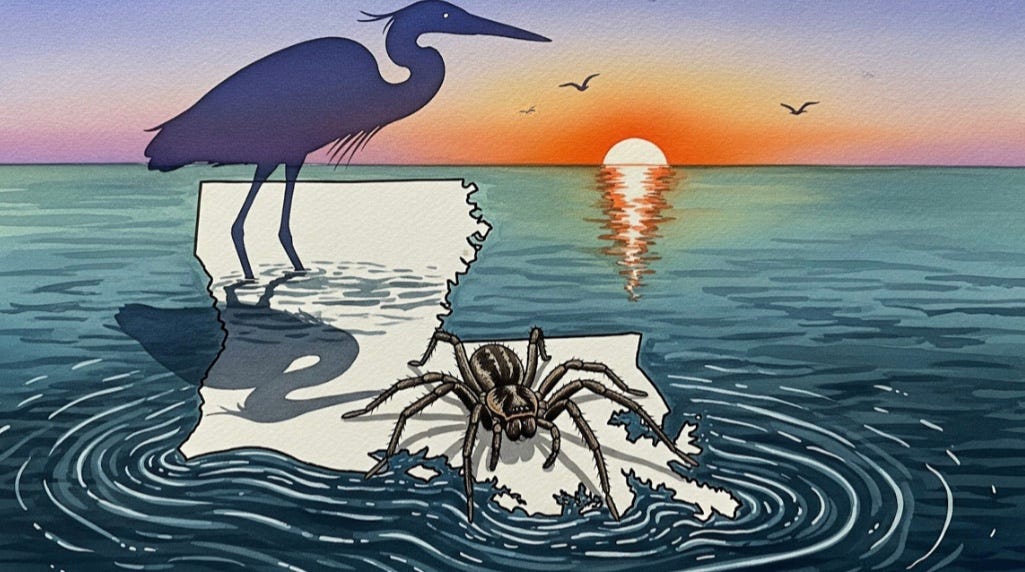
The thing about the Louisiana bayou country is that its weirdness is not just for show, cher. It’s a matter of absolute, high-stakes survival. It is an ecosystem that has perfected the art of the improbable. Take the Dark Fishing Spider,Dolomedes tenebrosus, the one whose leg span can cover half your hand. She is one of the largest spiders in North America, yet she operates with the silent precision of a naval scout.
You’re floating placidly in the moss-draped gloom of the Atchafalaya Basin, and there she is, perched carrément (directly) on a gnarled bald cypress knee. Her nickname is Scuba Spider. Unlike her cousin, the Six-spotted Fishing Spider (D. triton), who is a permanent waterside resident, D. tenebrosus often wanders about. She’s basically a French Quarter phantasm land tourist with aquatic superpowers. Uniquely, her front four long legs still rest on the water like silent radar antennae.
Here’s the first oddity: She doesn’t spin a trap-web to catch supper. She uses the very surface of the water as a vast, vibrating, liquid snare. That surface tension, which allows a single droplet of dew to hold its perfect sphere, is her hunting ground. To your amazement, a Yellow Fever (Aedes aegypti) mosquito lands, an unlucky Cocahoe Minnow (Fundulus grandis) minnow surfaces, or you see a mayfly struggling.
Those water disturbances, even a tiny ripple, are all the information she needs. She bolts across the water, comme ça (like that), defying gravity and the laws of physics with a waxy-haired gait, grabs her prey, and retreats just as swiftly. She is an apex-predator extraordinaire! As an Eight-Legged Lagniappe
The truly bizarre part of her story happens when danger comes. If a hungry Great Heron swoops too close, or a massive Alligator Gar glides by, this spider doesn’t run toward the shore. She, as we say in Cajun French, simply plonges (plunges/dives). Happily, for her, she’s not drowning. She’s engaging in a peculiar act of biological brilliance.
Her entire body is covered in fine, dense hairs. As she slips beneath the surface, these hairs trap a thin, glistening layer of air, her personal silvery scuba suit, that surrounds her like a portable bubble. She becomes a living submarine. She can cling to an underwater root, or the submerged bark of a Bald Cypress tree.
There she sits, breathing her little pocket of swamp-air, and waiting out the trouble for up to half an hour. She makes the L’Affaire Fini threat simply disappear. That fact, c’est vrai (that’s true), is a mighty fine trick.
Now, here is where the bayou’s natural spider oddity connects to a deeper, more human reality. She shows how to tell scientific facts about climate change and its effect on nature factually without putting your audience to sleep. That’s because the constantly-evolving existential crisis of the climate often feels a lot like that of the ol’ White Heron. It’s a huge bad case of the vois-là, an inevitable danger that you can’t run away from.
The way some creative technical writers are trying to capture that reality is just as strange as a certain spider species’ scuba dive. When you can’t outrun the misère (misery/trouble), you have to find a new way to tell the story.
This is so much like very act of writing creative nonfiction through the climate crisis has its own set of odd, profound, and fun facts:
Odd Fun Facts of Writing the Existential Reality
1. The “Slow Violence” Problem Demands New Forms
The climate crisis rarely involves a neat, dramatic explosion. It’s mostly “slow violence.” The gradual, almost invisible rising of the water, the creeping salinity, the erosion of the marsh. The odd challenge for the Louisiana writer, is that they have to invent entirely new, often experimental, narrative techniques just to make a slow-motion disaster feel as urgent as a gunshot.
This is why you sometimes see writers like us using techniques like fractured chronology, list-memoirs, or braided essays. They are desperate attempts to make the un-dramatic and continuous nature of environmental trauma feel viscéral (visceral) to the reader.
2. The Rise of the “Carrier Bag Narrative”
Forget the epic traditional story of the single hero conquering the storm. Many climate writers are advocating for author Ursula K. Le Guin’s concept of the “Carrier Bag Theory of Fiction.” The odd fun fact here is that the best climate stories shouldn’t have a single, satisfying plot arc (a triumph!). They should be a messy “bag” full of diverse voices, ongoing processes, small acts of loss, and fragments of hope.
Strive for mirroring the complex, non-linear reality of the crisis. This form rejects the idea that a single person can ‘solve’ the problem, instead emphasizing the power of collective, ongoing endurance. (snip)
More than half a million people flooded Washington, D.C., demanding civil rights for gay and lesbian Americans, now celebrated each year as National Coming Out Day. Many of the marchers objected to the government’s response to the AIDS crisis, as well as the Supreme Court’s 1986 decision to uphold sodomy laws in Bowers v. Hardwick.
The NAMES Project AIDS Memorial Quilt was first displayed there, bringing national attention to the impact of AIDS on gay communities, a tapestry of nearly two thousand fabric panels each a tribute to the life of one who had been lost in the pandemic.
<–The AIDS quilt, first displayed in 1987 in Washington, DC
trays with elaborate appetizers on toothpicks and skewers – Chaloner Woods/Getty Images
Yahoo is using AI to generate takeaways from this article. This means the info may not always match what’s in the article. Reporting mistakes helps us improve the experience.
Step back in time and into the kitchens of mid-century America, where no party would be complete without tiny morsels of food elegantly arranged on colorful plates to greet guests. In the 1950s, home entertaining was all the rage thanks to postwar prosperity and the rise of suburban living, and dinner parties became a cornerstone of middle-class American society. Hosts armed with cookbooks like “Betty Crocker” and “Good Housekeeping” perfected the art of elegant yet approachable hors d’oeuvres. Unlike more formal, old-fashioned dining customs, these appetizers were often served in the living room before dinner. In theory, they were meant to stimulate both the guests’ appetite and their conversation; in practice, they gave the host some breathing room to prepare for the elaborate meal ahead. Regardless, appetizers were expected to delight both the eyes and the palate. In the ’50s, presentation was everything.
Appetizers have been around since Ancient Greece, when feasts would begin with small plates of snails, sea urchins, and pickled cabbage to leave guests just a little hungry for the main course. Later, appetizers gained popularity across Europe, from Russian caviar to Scandinavian smorgasbords. By the 1950s, these bite-sized offerings were still relatively rare in everyday American cuisine but quickly became commonplace at formal banquets, weeknight dinners, and casual gatherings. From the ubiquitous shrimp cocktail to the adventurous rumaki, these classic nibbles came to represent hospitality, abundance, and the optimistic spirit of the era. Keep reading to discover the most popular appetizers that delighted hungry guests in mid-century America.
a green fruity punch served in glasses with garnishes – Primestock Photography/ShutterstockMore
When you picture a 1950s dinner party, you might imagine classic cocktails like martinis and highballs in every hand. But if you flip through cookbooks from that era, you’ll find that many hosts actually served fruitcocktails before dinner. These could take the form of diced fruit served in dainty sherbet cups, or a simple blend of fruit and vegetable juices presented in stemware. Far from being an afterthought, they were considered a refreshing and wholesome start to a meal, whether served on their own or alongside other appetizers.
Juice itself was a relatively new commodity at the time. During World War II, scientists developed frozen orange juice concentrate to provide soldiers with vitamin C. This innovation led to the formation of Minute Maid, which made juice more affordable and firmly established it as a household staple by the 1950s. Many baby boomers grew up drinking juice daily as a part of a well-balanced diet.
Cookbooks of the era reinforced the idea that juice cocktails were a sign of good hosting. Betty Crocker cheerfully advised (albeit in very dated language), “The clever wife has a simple appetizing cocktail ready for her weary husband when he comes home at night. Vegetable or fruit juices are at their best when two or three tart flavors are chilled and served ice cold in appropriate glasses.” A 1951 home economics textbook also suggested that a proper informal dinner should begin with cold tomato juice seasoned with spices, served alongside canapés as a complete appetizer. For more elaborate entertaining, Betty Crocker and Good Housekeeping recommended tomato-sauerkraut juice or even pineapple-lemon foam cocktails made with whipped egg whites.
Shrimp cocktail
a plate with shrimp on a bed of ice and a bowl of cocktail sauce – Bhofack2/Getty Images
Shrimp cocktail is a retro favorite that’s never really gone out of style. Visually striking and refreshingly simple, it epitomized mid-century elegance. Surprisingly, cocktail sauce was originally created as an oyster pairing; shrimp only took center stage in the 1950s. The shift came about due to dwindling oyster supplies and major advances in refrigeration. By the late 1940s, shipping fresh shrimp by truck had become standard practice, and suddenly, this once-coastal delicacy was available nationwide. Shrimp cocktails quickly became a glamorous staple, especially in the glitzy casinos of Las Vegas.
Cookbooks of the era eagerly embraced the trend, showcasing seafood cocktails with zesty cocktail sauces. Presentation was considered just as important as flavor. Betty Crocker’s 1950 cookbook suggested serving shrimp with chopped celery or skewering them on toothpicks for easy nibbling. Good Housekeeping’s 1955 cookbook offered more dramatic ideas — arrange the shrimp in a lettuce-lined sherbet glass for formal occasions, or, for casual living-room entertaining, serve them on a plate with cocktail sauce tucked into a hollowed-out tomato, grapefruit, or avocado shell. It also suggested adding a green garnish and keeping toothpicks on hand so guests could keep their fingers clean.
Deviled eggs
a close-up of classic deviled eggs – Samantha Gossman/Getty Images
A simple recipe with elegant results, deviled eggs have been a crowd-favorite appetizer for ages. In fact, deviled eggs are significantly more vintage than you might think — as in, 13th-century vintage. Medieval cookbooks include recipes for eggs filled with all kinds of ingredients, including saffron, mint, cilantro, and pepper. The term “deviled” didn’t come around until the late 1700s, when it was used to refer to dishes prepared with spicy seasonings, the idea being that the devil loved heat.
Deviled eggs were particularly popular appetizers in the 1950s. Advances in refrigeration made eggs easy to store, and their affordability and versatility made them a natural choice for home entertainers. They were simple to prepare, endlessly customizable, and visually appealing. Betty Crocker’s 1950 cookbook praised deviled eggs with poetic flair, describing them as “Mounds of savory yellow egg yolks in white frames. A stunning garnish and satisfying appetizer…food for picnics and parties.”
The basic formula involves mashing hard-boiled egg yolks with mayonnaise, mustard, or salad dressing and a handful of spices before piping the mixture back into the whites. Mid-century cooks often added their own twists, using ingredients like paprika, pimientos, minced ham, or dried beef to create deluxe versions of the bite-sized treat. Whether served at picnics, cocktail hours, or holiday spreads, deviled eggs embodied the 1950s love of practical and pretty appetizers.
Stuffed celery
a wooden plate with five stuffed celery pieces – Mariha-kitchen/Getty Images
A beloved retro appetizer perfect for summer picnics and cocktail parties, stuffed celery enjoyed a long stretch of popularity throughout the 20th century. Conceptually, it’s not far from deviled eggs — many recipes even use similar fillings, which is why the two often appeared side by side on appetizer platters. The appeal is easy to see: stuffed celery is incredibly easy to make, relatively light, and looks elegant on a serving dish.
Stuffed celery can be endlessly customizable. In the 1950s, Good Housekeeping suggested six variations, ranging from olive-nut and sardine-pickle fillings to pineapple-horseradish for more adventurous palates. Meanwhile, Betty Crocker kept it simple, suggesting a filling of Roquefort and cream cheese seasoned with Worcestershire sauce.
There are all sorts of ways to present stuffed celery, too. The stalks can be served whole, cut into bite-sized sticks, or pressed together and sliced into decorative pinwheels. Betty Crocker even suggested tying string around the stalks while they chill so the celery curls into appealing shapes. As with most mid-century appetizers, appearance was key. But the real charm of stuffed celery was the crisp and refreshing taste that didn’t spoil your appetite.
Pigs in a blanket
a baking tray with pigs in a blanket – Lauripatterson/Getty Images
Pigs in a blanket remain an enduring American favorite, beloved for their simplicity and universal appeal. They’re the perfect finger food: sweet, salty, savory, easy to make, and even easier to eat. Pigs in a blanket are a descendant of the British sausage roll but first started appearing in American cookbooks in the 1930s.
“The Joy of Cooking,” an iconic cookbook from 1936 that’s worth a pretty penny today, included a recipe for “Sausages in Pastry or Biscuit Dough.” By 1944, a U.S. military cookbook was calling them “Pigs in Blankets,” cementing the dish as a mainstay of American food culture.
Despite requiring only two ingredients, there is some room for customization. Betty Crocker recommended using Vienna sausage halves wrapped in thinly rolled pastry or rich biscuit dough, baked until golden and flaky. However, for an even more retro meat choice, you can substitute the hotdogs with Spam. Whether they’re making the rounds at a 1950s cocktail party or showing up at a modern potluck, pigs in a blanket have never really fallen out of fashion.
Dips and spreads
a bowl of dip surrounded by chips – NatalyaBond/Shutterstock
Dips and spreads were everywhere in the 1950s, a trend reflected in the sheer number of recipes found in cookbooks of the era. Most of these recipes revolved around soft dairy bases like cream cheese, sour cream, or mayonnaise, all of which had become more widely available thanks to the rise of home refrigeration. With reliable cold storage now standard in American kitchens, perishable ingredients could be shipped, stored, and served more safely, fueling a boom in dairy-rich appetizers.
There was also a clever shortcut that made dips a breeze — just one of many forgotten cooking hacks from a bygone era. One of the decade’s most enduring innovations was French onion dip. Sometime in the 1950s, an anonymous home cook discovered that stirring a packet of Lipton’s dehydrated onion soup mix into sour cream created a quick and delicious dip. The recipe caught on like wildfire. Lipton quickly embraced it, marketing the mixture as California Dip in advertisements that doubled as recipe cards. Soon, copycat versions hit the market, using the name French onion dip.
For homemade spreads, Betty Crocker offered combinations like cheese-anchovy or herring-apple, along with the infamous Hollywood Dunk, made with deviled ham, horseradish, onion, chives, and whipped cream. Typically served in the living room with colorful garnishes on a festive tray, dips and spreads epitomized the 1950s love of convenience and creativity.
Cheese ball
a nut-encrusted cheese ball with crackers – Liudmyla Chuhunova/Getty Images
Cheese balls were the life of the party in the 1950s. Like so many mid-century appetizers, they were popular because they were extremely simple to make, easy to customize, and had an undeniable visual appeal. After all, nothing says “Wow!”quite like a giant ball of cheese at the center of the snack table.
Legend has it that the very first cheese ball dates back to 1801, when a Massachusetts farmer presented President Thomas Jefferson with a colossal 1,200-pound wheel of cheese. However, the appetizer-sized version didn’t appear in print until 1944, listed in a Minneapolis cookbook. From there, the ’50s home-entertaining culture elevated cheese balls to a party staple that would remain popular throughout the rest of the century.
Cheese balls are typically made by combining cream cheese with shredded cheese, herbs, and spices. Some enterprising cooks even include a meaty element in their recipe, fortifying their cheese balls with dried beef. This mixture is then shaped into a sphere and rolled in chopped nuts or fresh herbs for added texture. Paired with chips or crackers, the cheese ball was the mid-century party centerpiece guests could literally gather around.
Rumaki
a plate with rumaki on toothpicks – Tim Bieber/Getty Images
Special occasions call for stylish appetizers, and rumaki was a trendy mid-century favorite. First introduced at Trader Vic’s in the 1940s, the dish fit neatly into America’s burgeoning tiki craze. The name might not ring many bells today, but rumaki is closely related to the vintage British seafood-based appetizer, Angels on Horseback. Its classic form features water chestnuts and chicken liver, both wrapped in bacon, marinated in soy sauce, and flavored with ginger and brown sugar.
By the 1950s, rumaki was a common feature at prominent U.S. tiki bars and Chinese-American restaurants, often appearing on pupu platters alongside egg rolls and chicken-on-a-stick. By the 1960s, rumaki had crossed into the suburban mainstream — it even makes a cameo on the TV show “Mad Men,“ when Betty Draper serves it at an international-themed dinner party.Trader Vic’s founder, Victor Bergeron, suggested the recipe came from Chinese cooking by way of Hawaii, but it’s more likely that it was his own invention. Authentic or not, rumaki embodied the mid-century appetite for exotic flavors in appetizer form.
I haven’t posted Clay Jones’s work in a while, though I’ve read it on Substack. His work is important, but I haven’t had the heart to post it; we all know what’s happening all around us, and I’d rather post solutions and mental health minutes. Anyway, this is news that is not good, though it could be so much worse. sigh
Unfortunately, this week I had a stroke and my right side is partially paralyzed. This means the streak is over, and I have to relearn how to use my hand and my voice.
Please bear with me until I figure this out. I appreciate everyone’s love and concern. I will see you when I see you.
This post was made with great difficulty using voice messaging. Please do not call or message me.
I love you all,
Clay Jones
Oh yeah. They also discovered I am diabetic, and of course, the Eurotrip is off. (snip)
October 10, 1699 The Spanish issued a royal decree which stated that every African-American who came to St. Augustine, Florida, and adopted Catholicism would be free and protected from the English.
October 10, 1963 The Limited Test Ban Treaty—banning nuclear tests in the oceans, in the atmosphere, and in outer space—went into effect. The nuclear powers of the time—the United States, Great Britain, and the Soviet Union—had signed the treaty earlier in the year. In 1957, Nobel Prize-winner (Chemistry) Linus Pauling drafted the Scientists’ Bomb-Test Appeal with two colleagues, Barry Commoner and Ted Condon, eventually gaining the support of 11,000 scientists from 49 countries for an end to the testing of nuclear weapons. These included Bertrand Russell, Albert Einstein, and Albert Schweitzer. Linus Pauling Pauling then took the resolution to Dag Hammarskjöld, then Secretary-General of the United Nations, and sent copies to both President John F. Kennedy and Soviet Premier Nikita Kruschev. The final treaty had many similarities to Pauling’s draft. It went into effect the same day as the announcement of Pauling’s second Nobel Prize, this time for Peace.
October 10, 1967 The Outer Space Treaty (Treaty on Principles Governing the Activities of States in the Exploration and Use of Outer Space, Including the Moon and Other Celestial Bodies) demilitarizing outer space went into force.It sought to avoid “a new form of colonial competition” as in the Antarctic Treaty, and the possible damage that self-seeking exploitation might cause. Discussions on banning weapons of mass destruction in orbit had begun among the major powers ten years earlier. 1949 painting by Frank Tinsley of the infamous “Military Space Platform” proposed by then Secretary of Defense James Forrestal in the December 1948 military budget. The text of the treaty Read more
October 10, 1986 Elliott Abrams, then assistant secretary of state for inter-American affairs, testified before the Senate Foreign Relations Committee (in closed executive session) that he did not know that Marine Lt. Col. Oliver North, a White House employee in the Reagan administration, was directing illegal arms sales to Iran and diverting the proceeds to assist the Nicaraguan contras. Abrams pled guilty in 1991 to withholding information on the Iran-contra affair during that congressional testimony, but was pardoned by President George H.W. Bush. Elliott Abrams Presidents George W. Bush & George H.W. Bush Oliver North Read more about the pardons
October 10, 1987 Thirty thousand Germans demonstrated against construction of a large-scale nuclear reprocessing installation at Wackersdorf in mostly rural northern Bavaria.
October 10, 2002 The House voted 296-133 to pass the “Joint Resolution to Authorize the Use of United States Armed Forces Against Iraq,” giving President George W. Bush broad authority to use military force against Iraqi leader Saddam Hussein, with or without U.N. support.
I can do box breathing, but it takes more effort to do properly than I want to expend if I want to settle to sleep. This idea is the very thing, though! A person can do it any time; I did it for the little bit of time it takes to read MM’s post, and lowered my heart rate 3 BPM. It’s great!
The Great Chicago Fire by Heather Cox Richardson Read on Substack
Today is the anniversary of several deadly wildfires that took place in 1871. While it was not the deadliest— that label went to the Peshtigo Fire in Wisconsin— the Great Chicago Fire tends to be the one people remember, not least because observers turned it into anti-immigrant propaganda even before the flames had died out.
A short history of the facts behind the popular memory of the Great Chicago Fire.
(This is not tonight’s letter, by the way. It’s just cool history, and I don’t get to do enough of that lately.)
Though neurodivergent people tend to love the world of academia and absorbing information, the systems and structure of higher education is often antithetical to the needs of differently abled people, both mentally and physically. Author Courtney Floyd expands on this in the Big Idea for her newest novel, Higher Magic, as she recounts her experience with earning her PhD and seeing how the world of education wasn’t designed with inclusivity and accessibility in mind.
COURTNEY FLOYD:
When I first sat down to write the first draft of Higher Magic, I was two years out of my PhD program and still trying to balance the sum of my time there. My sense of the possible had shifted profoundly as I studied literature, learned to research, traveled to conferences and archives, and honed my analytical and interpretive skills. My life had changed for the better. But I was still discovering the many ways my program had taught me to ignore my body and push through exhaustion and anxiety, no matter the cost.
In higher education, you’re supposed to act as though you’re nothing but a floating brain. Oh, nobody ever says that outright. Especially not when you’re a first generation student who slid sideways into the academy and, to everyone’s bewilderment, stuck around. But the expectation is there. Lurking.
I learned to see it sidelong, in the way I was expected to write without using the first person and also in the lack of understanding some professors showed when I couldn’t attend office hours or study groups because I was juggling several jobs to pay my tuition. It reared its head in my mentor’s office, when she snapped impatiently at me because I got jury duty, and couldn’t defer it. It showed up with the brain fog and intense hand cramps after two-hour midterms in which I had to handwrite entire essays.
I came to see it even more clearly as an instructor, in the way boilerplate attendance policies penalized students who were late because of health issues or irregular bus schedules. It haunted me, one term, when one of my students––a veteran who’d recently undergone major surgery––apologized for every single essay he turned in, not because it was late but because he was worried his medication had made him incoherent.
By the end of my time in grad school, I saw the floating brain edict at work every day. In the exam prep or the job search eating up my own and my peers’ lives, turning us into bleary-eyed shadows. In the exhausted way my officemate staggered back from her two week maternity leave, which we’d gone on strike only a year earlier to get. In the student in my cohort who weighed the cost on her mental health and withdrew from the program.
Mind over matter is a brutal either/or.
Either you’re smart enough to figure it out, or you’ll drop out. Either you’ll burn your candle at both ends, or you’ll snuff yourself out trying.
In her book Teaching to Transgress, Black feminist scholar and educator, bell hooks, writes that in classrooms and other institutionalized spaces, “the person who is the most powerful has the privilege of denying their body,” of becoming the invisible default. The cog at the center of the complicated machine. But, as we’ve seen in the past couple of years, when our bodies become too inconvenient–too vocal or visible or vexing–the people in power (in and beyond the ivory tower) can decide to deny our bodies, too. Or make them disappear.
In SFF, we love a good literalized metaphor. When I first had the idea for Higher Magic, graduate students weren’t being literally disappeared for protesting, but students were being quietly pushed out of the academy for needing access and inclusion. For needing systems built to support white, male, nondisabled scholars to change, just a little, so that others could participate.
Fresh out of PhD school in 2019, I knew I wanted to write about that kind of disappearing. Because bell hooks didn’t just pinpoint a problem, she shared a solution, too: “Once we start talking in the classroom about the body, and about how we live in our bodies, we’re automatically changing the way power orchestrate[s] itself.”
Enter Dorothe Bartleby, a first-generation, neurodivergent grad student who is trying her best to be a floating brain at the start of Higher Magic. She quickly learns it’s not sustainable, and spends the rest of the book slowly figuring out how to be a body and a brain at the same time. While tracking down her disappearing students. And getting ready for her last attempt at passing her qualifying exam. (snip-go finish the rest on the page!)








 Scottie's Playtime