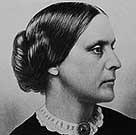
Despite the passage of the Indian Citizenship Act in 1924, Native American activists have had to repeatedly take their fight for voting rights to Congress.
In June 1986, Judge Edward Rafeedie handed down a ruling. Indigenous voting rights were being suppressed in Montana’s Big Horn County, where “official acts of discrimination…have interfered with the rights of Indian citizens…to register and vote.” This was a victory for voting equality, but it wasn’t met with open arms. County Commissioner Ed Miller, for example, was dismayed, citing a longing for the “good old days.”
“The Voting Rights Act is a bad thing,” Miller claimed, according to the San Francisco Examiner. “[T]hings were fine around here. Now they (Indians) want to vote. What next?”
It shouldn’t have been as difficult for Native Americans to vote as it was. The Indian Citizenship Act of 1924, in theory, settled the question of whether Indigenous people were citizens. They were. And they were entitled to vote. However, as historian Orlan J. Svingen explains, this law didn’t prevent discrimination.
A government study in 1936, for example, found that seven states were actively preventing Native Americans from voting. Much like the laws that prevented Black Americans from voting, these states enacted laws specifically targeting Native American voters, including mandating that all voter registrars be taxpayers (many Native Americans were exempt from certain local taxes, and this law depressed voter registrations on reservations) and literacy tests as a requirement for voting. One Cherokee voter was told by a judge that despite his master’s degree from the University of North Carolina, “You couldn’t read or write to my satisfaction if you stayed here all day.”
Though there was anger and a number of court battles in earlier years, it may have been the start of World War II that acted as a catalyst for activism, McCoy notes. Though Native American soldiers were being sent overseas to fight for freedom, that same freedom eluded them at home. Navajo soldier Ralph Anderson sent a letter to tribal leaders in 1943 with this exact contradiction on his mind.
“We all know Congress granted the Indians citizenship in 1924,” he wrote, “but we still have no privileges to vote. We do not understand what kind of citizenship you would call that.”
In the following years, Native activists took their fight to Congress several times, meeting denials of their rights most times. But they were undeterred and began leading direct actions. In 1946, for example, Navajo citizens attempted to register to vote in Arizona and were denied, as were two people from the Yavapai tribe. The latter denial led to a court case, Harrison v. Laveen, that overturned a previous ruling that classified Native Americans living on reservations as being essentially wards of the state and ineligible for voting. A case in 1948 successfully took the fight to the federal government, arguing that the denial of voting rights was unconstitutional. And as Svingen writes, in the 1970s, “exemptions from certain taxes no longer limits [Native Americans’] right to vote, and election districts must be apportioned under the ‘one person one vote’ principle,” rules that officials in Big Horn County were simply ignoring.
if we all click our heels together three times, everything will be okay Read on Substack (Language NSFW, as always with Jeff Tiedrich’s writing)
the worthless scribblers of the corporate-controlled media utterly failed us during the 2024 campaign season.
New York Times executive editor Joe Kahn came right out and said it: defending democracy is a ‘partisan act,’ and we won’t do it — and, fuck us all, the press kept their word, and didn’t do it. they enthusiastically put their fingers on the scale for Donny Convict.
arguably, the media’s worst transgression was the sanewashing — the cleaning-up of Donny’s incomprehensible blitherings, to hide his obvious cognitive disintegration and make him sound coherent.
a minutes-long disjointed word-salad about how tariffs on Chinese goods were going to lower the cost of childcare became “a major economic speech.”
Donny’s inability to keep his increasingly-demented mind on the topic at hand — his crazypants pinballing from they’re eating the dawgs to Hannibal Lecter wants to have you for dinner to would you rather be eaten by a shark or electrocuted — was explained away by Donny as his brilliant “weave.”
[Wishcasting is] the act of interpreting information or a situation in a way that casts it as favorable or desired, despite the fact that there is no evidence for such a conclusion; a wishful forecast.
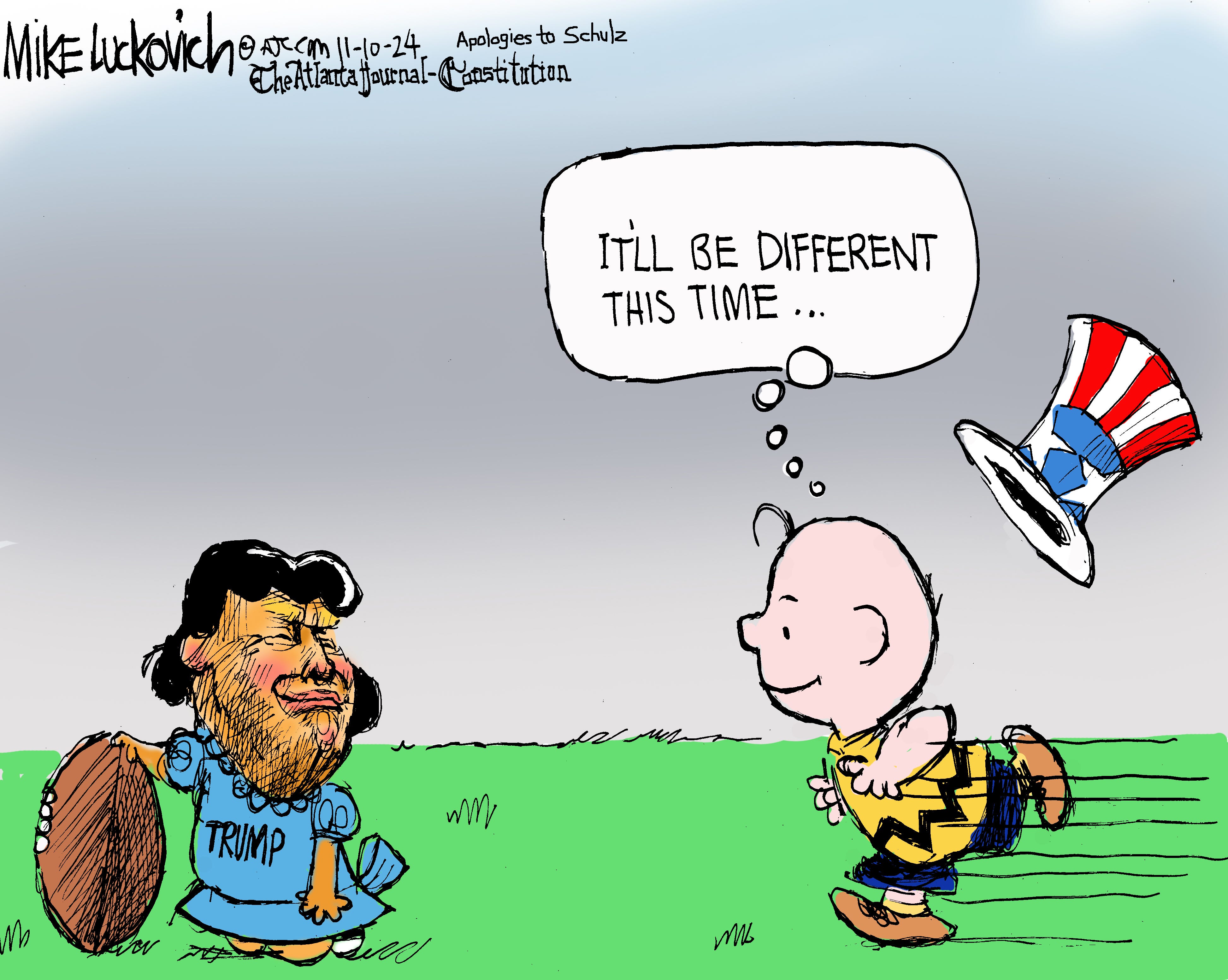
sure enough, the media has now gone into overdrive, churning out piece after piece in which they promise us that if we all click our heels together three times, everything will be okay.
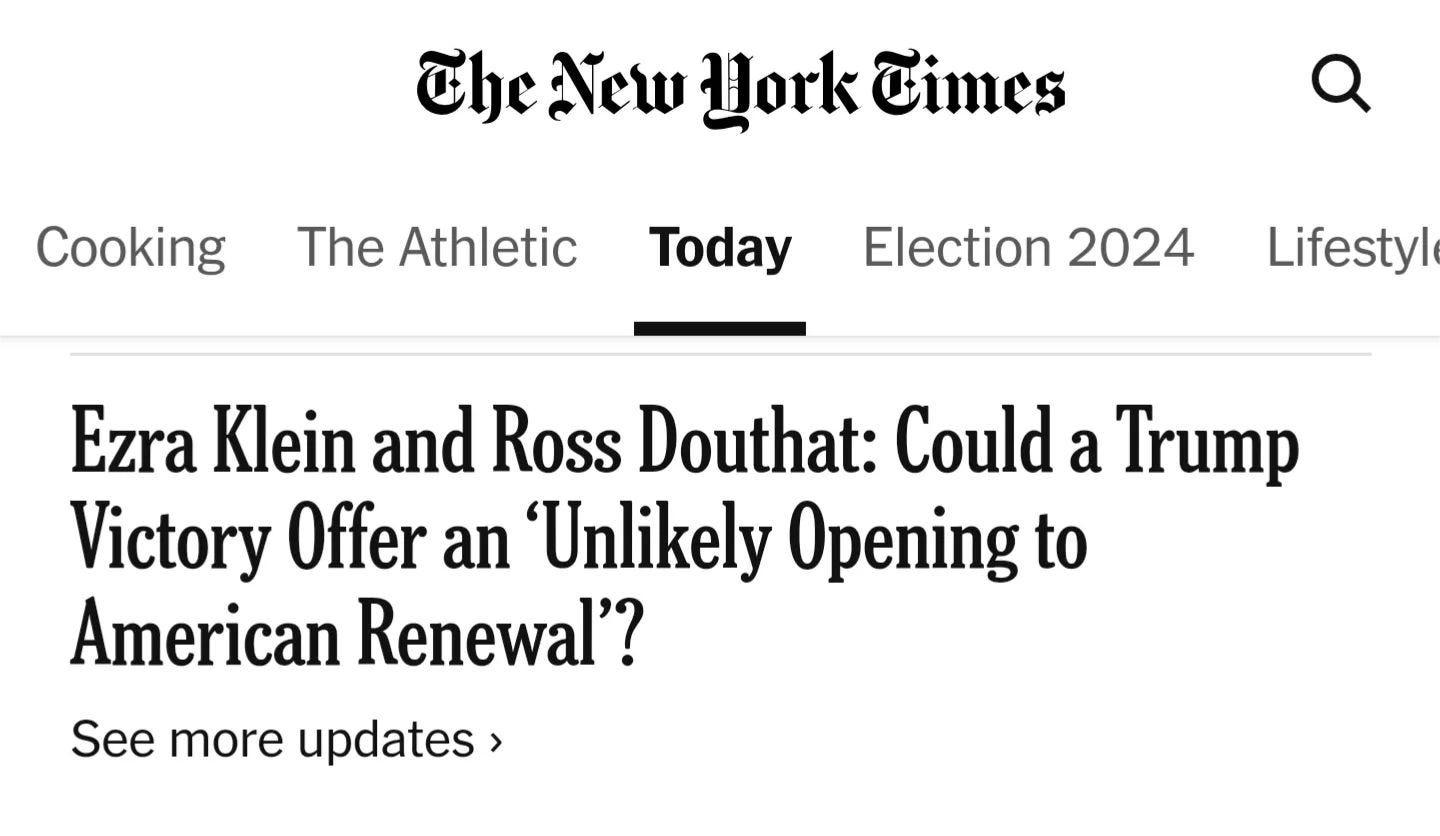
not twelve hours after the election had been called for Donny, the Times wasted no time in assuring us that the election of a vindictive fascist is an amazing opportunity for vindictive fascism not to happen.
what kind of magical, everybody-gets-a-pony thinking is this? just fucking stop it.
did Ezra Klein and Ross Douthat both experience some kind of recent head trauma that has caused them to forget the years 2017 through 2020? Donny’s first presidency was a dumpster fire of corruption, mismanagement and mass death — but somehow now, given a second chance to fuck shit up worse, Donny’s going to bring us an “American renewal”?
anything’s possible, right? overnight, Donny Convict could magically become a wise and fair statesman — also, technicolor pigs could fly out of my ass.
oh my god, the media never stops imagining that Donny is going to somehow become presidential. during his first term — over and over — every time Donny stopped short of taking out his dick and pissing on the floor, the press would fall all the fuck over itself in a mad dash to proclaim him presidential.
spoiler alert: Donny never became presidential. not from the the first time he threw a ketchup-hurling tantrum in the White House, to the moment he absconded back to his Florida golf motel, taking with him boxes of stolen classified documents.
the premise here is that if we’re respectful to Donny — if we fucking kowtow to him, and stop opposing him — he’ll be nice to us in return. he’ll become — dare I say it? — presidential.
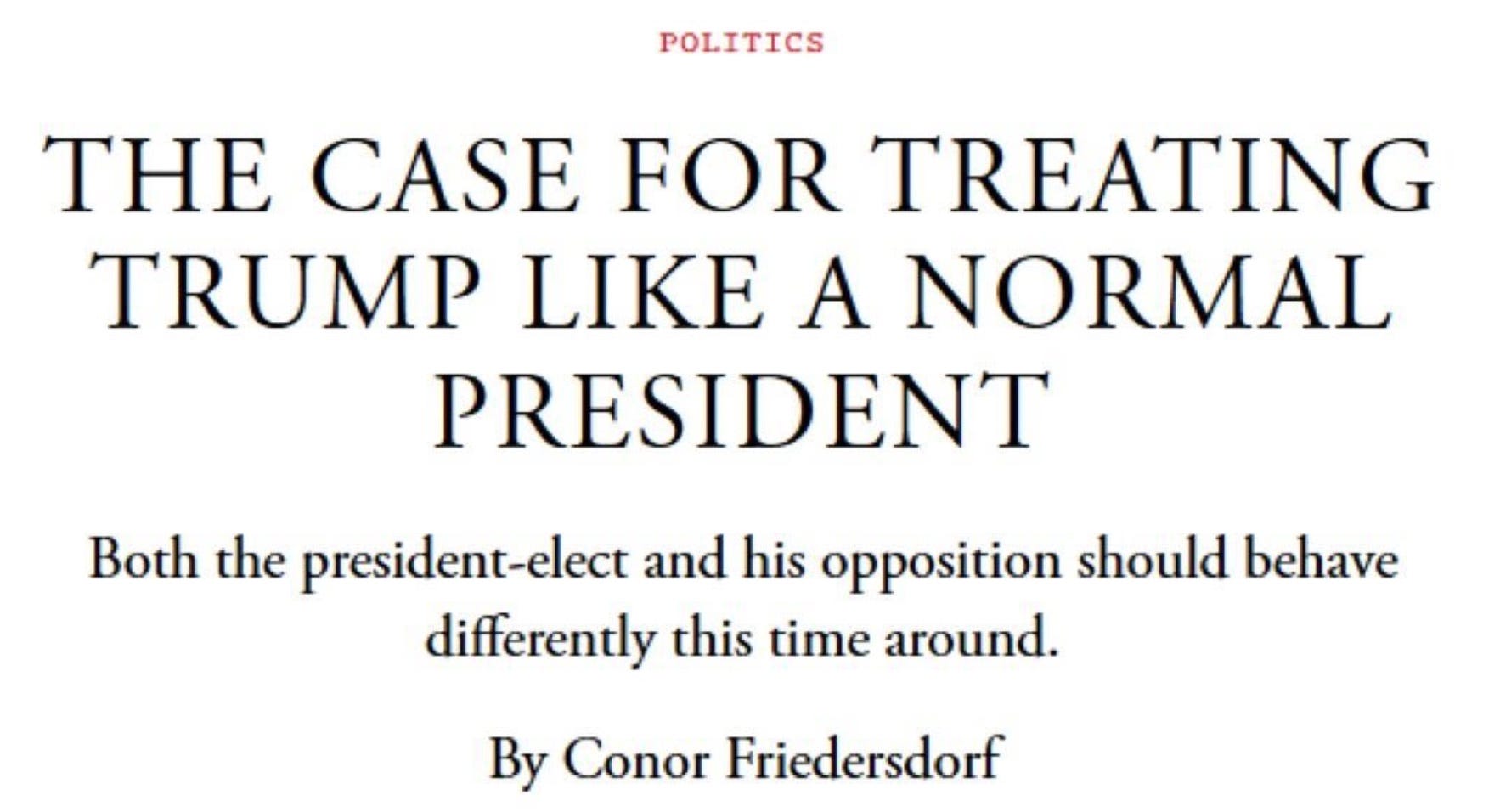
Stop indulging the fantasy that outrage, social stigma, language policing, a special counsel, the Twenty-Fifth Amendment, or impeachment will disappear him. And stop talking as if normal political opposition is capitulation.
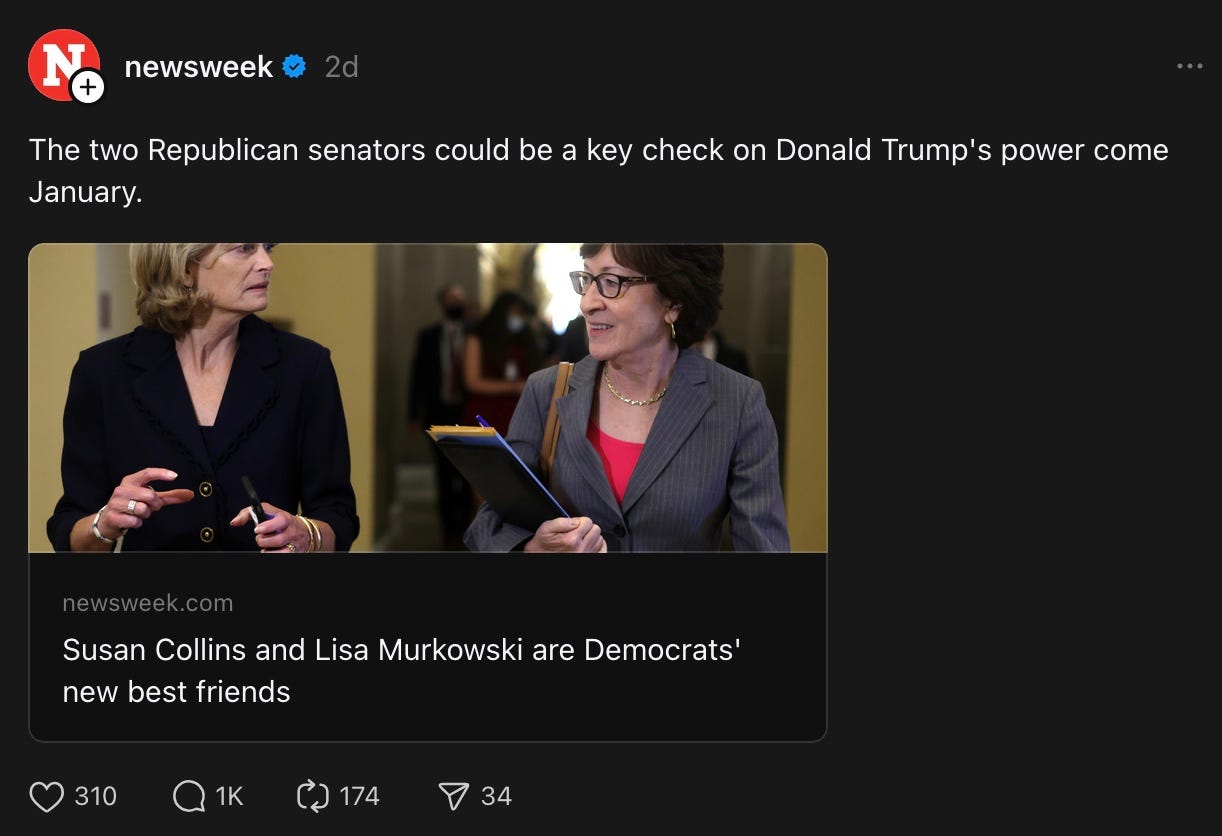
Everyone should normalize Trump. If he does something good, praise him. Trump is remarkably susceptible to flattery.
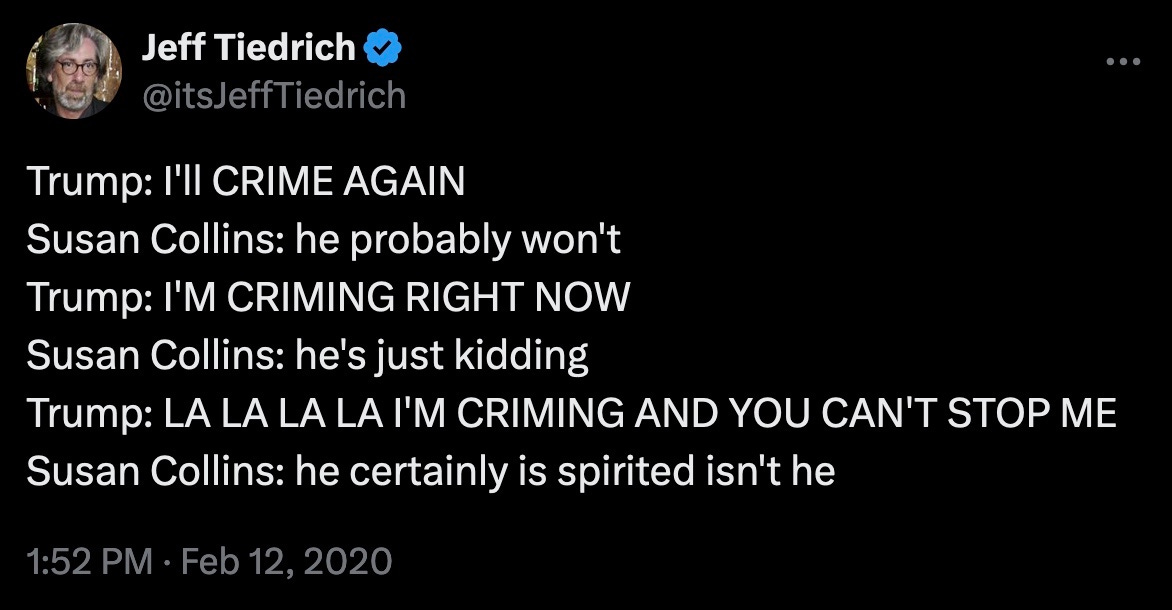
okay, I will grant that Newsweek may be half right. Lisa Murkowski seems to genuinely loathe Donny, and we can probably count on her to vote against the worst of his fuckery — but Susan Collins? the credulous naïf who assured us over and over again that Donny had learned his lesson, and would never transgress again?
now, let’s bask under some rays of hope from people who aren’t just blindly wishcasting, but are actually offering reasoned arguments.
in the middle of a fairly clear-eyed assessment of the Trumpian horrors to come, the Guardian gives us this:
Elaine Kamarck, a former official in the Bill Clinton administration, said: “For him to expand presidential power, Congress has to give up power and they’re not in the mood to do that. They’ve never done that. There are plenty of institutionalists in Congress.”
Kamarck also expressed faith in the federal courts, noting that judges appointed by Trump only constitute 11% of the total placed on the bench by former presidents. A Trump dictatorship is “not going to happen,” she added. “Now, there might be things that the president wants to do that people don’t like that the Republican Congress goes along with him on but that’s politics. That’s not a dictatorship.”
Paradoxically, however, Trump’s reckless venality is a reason for hope. Trump has the soul of a fascist but the mind of a disordered child. He will likely be surrounded by terrible but incompetent people. All of them can be beaten: in court, in Congress, in statehouses around the nation, and in the public arena. America is a federal republic, and the states—at least those in the union that will still care about democracy—have ways to protect their citizens from a rogue president. Nothing is inevitable, and democracy will not fall overnight.
Americans cannot vote themselves into a dictatorship any more than you as an individual can sell yourself into slavery. The restraints of the Constitution protect the American people from the unscrupulous designs of whatever lawless people might take the reins of their government, and that does not change simply because Trump believes that those restraints need not be respected by him. The Constitution does not allow a president to be a “dictator on day one,” or on any other day. The presidency will give Trump and his cronies the power to do many awful things. But that power does not make them moral or correct.
I sure hope to fuck they’re right.
This is going to be my closing message for the foreseeable future:
practice self-care. do what you need to do to keep sane. if that means disengaging with my daily posts for a while, I get it. this community of ours will still be here when you return.
to all the people who have signed on in the days since the election, welcome aboard. settle in as we all try to deal with the shitfuckery that’s ahead of us.
we are all in this together, and we are all here for each other.
This is the growing anti-LGBTQ+ that the right has been working on creating since the first tRump term. The person who helped craft the don’t say gay bill in Florida was a fundamentalist Christian who said he did it because it horrified him that fellow students, other kids welcomed the LGBTQ+ kids that came out. He felt they should be attacked, beaten, ostracized, made friendless, scared, and stay in hiding. That is what these people want. We must find a messaging to fight back. Blue states have it but it must find a way to reach into red states. My husband is terrified to even let me fly a progressive pride flag in one of our front facing windows. That is what these people want, they want us afraid. I don’t want to live that life, I stopped living like that when I was 23. I took the hits for it. I am almost 62. I don’t want to live the rest of my life in a closet I never fitted in. Hugs
——————————————————————————————————–
“No one in the restaurant intervened. No one screamed ‘stop.’”
Sebastian Thomas Robles Lascarro before and after the attack
A group of 10 to 15 individuals allegedly attacked Sebastian Thomas Robles Lascarro, a 22-year-old Colombian model, inside a Washington, D.C., McDonald’s fast food restaurant after a member of the group uttered homophobic slurs. The attack left Lascarro hospitalized, and he criticized both emergency personnel and local police for their responses to the violence.
The attack allegedly occurred in the early morning hours of Sunday, October 27, after Lascarro and his husband left two nearby LGBTQ+ nightclubs: Crush Bar and Bunker. While Lascarro was in line to use a McDonald’s self-service kiosk to place his order, Lascarro’s spouse, Stuart West, said a woman then screamed at his husband to “watch where the f**k he was going,” he told WTTG.
Lascarro reportedly tried to leave in order to avoid a conflict, when a group of 10 to 15 individuals — who were reportedly the woman’s friends — blocked Lascarro from leaving and allegedly called him homophobic slurs like “fa**ot” and demanded he apologize to the woman. Lascarro refused, and the assault allegedly began.
“Five to 10 individuals started just punching him all over his face, all over his body,” West said. “No one in the restaurant intervened; no one screamed ‘stop.’”
The attack reportedly left Lascarro injured and bleeding on the sidewalk outside the restaurant while the mob threw food, trash, and drinks at him. Two passers-by eventually contacted emergency medical services to assist Lascarro.
At Howard University Hospital, Lascarro was treated for a busted lip, scrapes, and bruises. He was placed in a neck brace and photos show him with bruises and blood on his face. Lascarro is reportedly recovering from his injuries.
“I fear for his mental health,” West said. “We’ve had conversations about whether D.C. is safe for us and whether the United States was the right choice.” Lascarro is originally from Colombia, moved to Washington, D.C., last year, and became a permanent resident of the U.S. this year, NBC News reported.
West and Lascarro said that they felt dismissed by both the emergency medical technicians (EMTs) who arrived at the scene and police who took a report of their incident later on. Lascarro said the EMTs failed to “acknowledge the severity of the assault and his experience as a gay man,” and West said police initially refused to acknowledge the attack as a possible hate crime until he contacted the police department’s LGBTQ+ liaison.
West launched a GoFundMe crowdfunding campaign to help pay for Lascarro’s medical bills, as the attack has made it difficult for him to keep modeling. The campaign had raised $7,037 of its $20,000 goal by Monday morning.
“Thomas is a loving, compassionate person who did not deserve this, and no one in our community should face this kind of hatred,” West wrote for the campaign website. “Any help to ensure he gets the care he needs to regain his health and peace of mind will be a blessing.”
November 5, 1872 Susan B. Anthony and a few other women in Rochester, New York, voted in the presidential election, all of them for the first time. Susan B. Anthony She wrote later that day to her fellow suffragist Elizabeth Cady Stanton, “If only now—all the women would work to this end of enforcing the existing constitution—supremacy of national law over state law—what strides we might make . . . .” Anthony’s vote went to U. S. Grant and other Republicans, based on that party’s promise to consider the legitimacy of women’s suffrage. Elizabeth Cady Stanton Read Susan B. Anthony’s speech On Women’s Right to Vote
November 5, 1949 The Peace Pledge Union in Great Britain set up the Non-Violence Commission to study nonviolent resistance and how the ideas of Gandhi could be used to reach the Union’s goals of getting U.S. troops out of Britain and to end production of nuclear weapons there.
November 5, 1969 Bobby Seale Bobby Seale, a founder of the Black Panther Party, was sentenced to four years in prison on sixteen counts of contempt of court during the federal Chicago Eight trial in Chicago; he was charged for his insistent claims to the right to choose his own lawyer, or to represent himself. After the Chicago Eight verdict, the contempt charges were withdrawn.
November 5, 1982 36 were arrested in a demonstration at Honeywell, Minnesota’s largest defense contractor. The “Honeywell Project,” a local campaign against the arms maker, dogged the company for over three decades, at times with success. It continues today, targeting Alliant Technologies, the arms-making branch of Honeywell that was spun off in the 1990s. Protests at Alliant continue today. Alliant is the manufacturer for the Pentagon of artillery shells made with depleted uranium (DU or U-238, a by-product of uranium enrichment) which have been used extensively in Iraq and Kosovo. The Defense Department denies any health effects from use of DU (though army manuals warn soldiers of its toxicity), and contests accusations of DU’s role in Gulf War Syndrome. More about the Honeywell project from War Resisters’ international
November 5, 1987 Govan Mbeki, an early leader of the African National Congress, was released from South Africa’s Robben Island prison after serving twenty-four years (for treason). He served his sentence alongside Nelson Mandela, Walter Sisulu and many others who fought apartheid. Govan Mbeki His son, Thabo Mbeki, was elected in 1998 (and force to resign in 2008) to succeed Mandela, who was the first president elected following a new constitution which granted the right to vote to the entire non-white population, comprising 85% of the country’s population. Read more about Govan Mbeki
A broken window on an LGBTQ fashion boutique storefront in Manhattan, New York on June 12, 2023.Photo: Shutterstock
There has been a 112% increase in documented attacks on LGBTQ+ people nationwide, according to a newly unveiled Anti-LGBTQ Extremism Reporting Tracker (ALERT) from the queer media watchdog organization GLAAD. GLAAD hopes to use the tracker to provide comprehensive reporting and analysis detailing anti-LGBTQ+ hate in the U.S. and the specific communities and targets affected by it.
ALERT recorded 524 such incidents between June 2022 and 2023 and 1,109 incidents from June 2023 to 2024. These attacks have included over 450 protests, 330 propaganda drops, 320 acts of vandalism, 200 bomb & mass shooting threats, 130 assaults, and 45 cases of arson that have resulted in at least 161 injuries and 21 deaths, GLAAD’s ALERT Desk reported.
While the cases focus on drag bans and trans protections, they address larger issues of free speech and civil rights.
The attacks have also included over 567 attacks on transgender and gender non-conforming people, 360 incidents targeting educational institutions and libraries, 325 incidents targeting Pride flags and other LGBTQ+ community symbols, 160 protests and violent threats against drag performers, and 140 incidents targeting health care providers of gender-affirming care and their patients.
The tracker, which will be updated quarterly, includes data on criminal and non-criminal acts of hate from sources like news media, partner organizations (like the Human Rights Campaign or Anti-Defamtion League’s Center on Extremism), right-wing forums on social media sites like Gab or chat apps like Telegram as well as incident reports submitted via GLAAD’s website. All documented incidents must occur against groups or individuals within the U.S. and must include harassment, threats, or actual violence specifically targeting LGBTQ+ people.
GLAAD’s ALERT team will verify the validity of each incident to maintain credibility, remove duplicates, and exclude spam and trolling, the organization said.
“The ALERT Desk tells a story not entirely captured by the FBI’s hate crime statistics because many of these incidents, like protests at Pride events, don’t meet the criteria necessary to bring legal charges [and] aren’t included in most official hate crime counts,” GLAAD wrote in its recently released report on ALERT’s findings. “However, we must recognize that the impact of these acts on local LGBTQ communities is felt regardless of whether or not the incident is prosecuted.”
“We must recognize that the impact of these acts on local LGBTQ communities is felt regardless of whether or not the incident is prosecuted.”
GLAAD’s 2024 report on ALERT’s findings
During a press call, Barbara Simon, senior director of news and campaigns at GLAAD, noted that ALERT seeks to contextualize anti-LGBTQ+ incidents to help media and other experts understand larger systems of violence.
“[Recently], there was a bomb threat against a library in Massachusetts,” Simon said, a threat against a Drag Queen Story Hour at the public library in Somerville. “But it’s not just about that library. It’s not just about the inclusive materials and programs they had, about how the bomb squad had to come in and sweep the library, how children and families and patrons had to evacuate the library.”
“Our data shows how that incident is connected to the bigger picture, which is more of a broad-based, systemic attack against LGBTQ people, our visibility, our equality and our allies,” Simon added. “It is one of 365 attacks nationwide against drag artisan events. It’s one of 63 anti-LGBTQ attacks in Massachusetts alone, one of 15 attacks specifically against drag in Massachusetts.”
The quarterly reports will also include stories from those affected by the incidents.
GLAADA bar graph showing anti-LGBTQ+ hate incidents from GLAAD’s ALERT Desk. | GLAAD
For example, Dr. Jack Turban, pediatric psychiatrist and director of the gender psychiatry program at the University of California in San Francisco, said during the press call that bans on gender-affirming care for youth in 26 states have worsened the mental health of his young trans patients even though they live in a state where such health care is protected. Their mental health has been worsened, Turban said, because of an increase in anti-trans rhetoric nationwide whose indirect effects cross state lines.
“Kids are hearing things like being trans is a mental illness, or being trans is bad, or you shouldn’t be allowed to use the bathroom that aligns with your gender identity because trans people are sexual assaulters, or you shouldn’t be allowed to play on sports teams with your friends because you’re going to physically hurt them,” Turban said. “My patients know that none of those things are true, right? They can know that, but if you’re hearing it every single day, all over social media and all over the news and now right in their communities, even it’s impossible to not be impacted by that.”
GLAAD pointed out that media coverage tends to falsely frame medical care for transgender people as a “debate” despite every major medical association supporting the care. This coverage compounds the effect of hateful rhetoric from anti-trans politicians, protestors, and pundits.
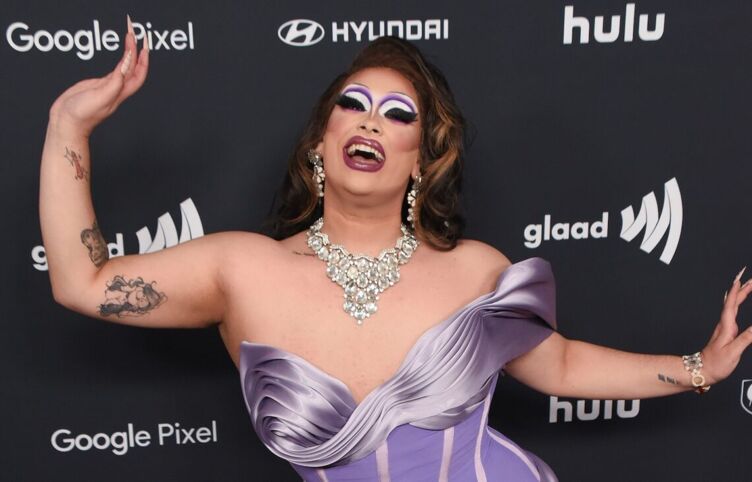
ShutterstockSalina EsTitties attends the 35th Annual GLAAD Awards on March 14, 2024 in Beverly Hills, California. | Shutterstock
The hateful rhetoric affects even LGBTQ+ celebrities and their fans, like Salina EsTitties, a competitor who appeared in Season 15 of RuPaul’s Drag Race. EsTitties told the press call that she’s generally insulated from hatred against gender non-conforming people since she lives in the very gay city of West Hollywood, California. However, she sees its impact whenever she travels to other states or posts social media videos about LGBTQ+ issues.
“There’s comments every single day of people being like, ‘This is not what God created. God created two genders. Oh, they keep adding alphabets. Oh, just shoot it between the eyes and get rid of it,’” EsTitties said. “The online hate is insane and there’s so much of it, and people are so willing to just let it all out, but it’s a clear representation of how people actually feel in America and across, you know, the U.S. here.”
“Not only are our LGBT community dealing with having to be their authentic selves,” she continued. “Being their authentic selves with just who they are outside of their queer identity is a lot to navigate, and it’s not easy, especially when people are telling you, ‘You’re the Devil, you’re a demon,’ or ‘It’s not acceptable to be that.’”
Hate crimes typically increase during presidential election years. Marie Cottrell, executive director for the New Jersey-based LGBTQ+ advocacy center Out Montclair, said she hopes that increased awareness of anti-LGBTQ+ hate incidents will empower communities to build intersectional coalitions between other demographic groups whose members are targeted by similar hate.
“I think that it’s really important that you be the person that the community needs,” Cottrell told the press call. “They need to see you stand for and with them. Find folks who in your community who will stand with you in the face of intolerance, build a community of support within your township — whether that’s forging a relationship with your LGBTQ liaison within the local police department … working with the township, the mayor, the town council, and really having open conversations … having conversations that address really hard questions and topics and that starts the process of understanding and healing in your community.”
“It’s a small step, but it’s a step forward and a step forward in helping others understand the community,” she said.
Subscribe to the LGBTQ Nation newsletter and be the first to know about the latest headlines shaping LGBTQ+ communities worldwide.
November 3, 1883 The U.S. Supreme Court, in its decision Ex Parte Crow Dog, declared Native Americans were ultimately subject to U.S. law, “not in the sense of citizens, but . . . as wards subject to a guardian . . . as a dependent community who were in a state of pupilage.” However, the Court acknowledged the sovereignty of tribal authority in the particular case at hand. The Congress, however, essentially overturned the Court’s decision two years later. Chief Crow Dog, 1898 More on Ex Parte Crow Dog
November 3, 1917 Bolsheviks, the followers of Vladimir Lenin, took control of the capital, Moscow, and the Kremlin, the fortress-like grouping of government buildings and churches at the center of the capital city, as the Russian revolution succeeded.
November 3, 1969 President Nixon announced the “Vietnamization” program to shift fighting by U.S. troops to U.S.-trained Vietnamese troops. “We have adopted a plan which we have worked out in cooperation with the South Vietnamese for the complete withdrawal of all U.S. combat ground forces, and their replacement by South Vietnamese forces on an orderly scheduled timetable.” The last U.S. troops didn’t return home until 1975.
November 3, 1972 Five hundred protesters from the “Trail of Broken Treaties,” a Native American march, occupied the Bureau of Indian Affairs offices (part of the Department of Interior) in Washington, D.C., for six days. Their goal was to gain support from the general public for a policy of self-determination for American Indians. Read more about the occupation: Read the Indian Manifesto:
November 3, 1979 Five members of the Workers Viewpoint Organization (later the Communist Workers Party) which had organized a “Death to the Klan” rally, were murdered and ten others injured when the rally was attacked by 40 Ku Klux Klan members and Nazis in Greensboro, North Carolina. The political organization had been joined in the march by a group of local African-American mill workers. At the time of the shootings, not one police officer was present. Two all-white juries acquitted the murderers despite the fact that the whole incident was on videotape. But in 1985 a federal jury found two policemen, a police informant/Klan leader, and five Klansmen and Nazis liable for the wrongful death of one of the demonstrators.
November 3, 1985 The Rainbow Warrior bombed Two French agents of the DGSE (Secret Service) dramatically changed their pleas on charges related to the bombing and sinking of the Greenpeace’s ship, Rainbow Warrior, and pled guilty. The ship was attacked in Auckland (New Zealand) harbor in anticipation of sailing to Moruroa Atoll to interfere with French nuclear weapons testing. It was the first act of terror ever committed in New Zealand. Read more
The stakes in United States v. Skrmetti are even higher than most Americans realize and could have wide-reaching consequences if the court rules to keep the ban on gender-affirming care in place.
This piece was published in partnership with The 19th, a nonprofit newsroom covering gender, politics, and policy. Sign up for their newsletter here.
A Supreme Court case that will decide whether Tennessee can continue to ban gender-affirming care for transgender youth could imperil the ability of all Americans to make decisions about their health care, experts say. The outcome depends on how far the court is willing to stretch its ruling that overturned federal abortion rights.
In United States v. Skrmetti, the court has agreed to take up the question of whether gender-affirming care bans for trans youth are unconstitutional, in response to the Biden administration petitioning on behalf of trans youth and their families in Tennessee — one of 26 states that has bannedsuch care for minors. The outcome of the case will grant much-needed clarity in a political landscape that has thrown the lives of trans people across the country into turmoil, as hospitals turn patients away, pharmacies deny prescriptions and families travel hundreds of miles to find care.
But with the case set for oral arguments on December 4, the stakes are even higher than most Americans realize, legal and policy experts say. Tennessee has banned gender-affirming care, such as puberty blockers and hormone replacement therapy, for a specific demographic — trans youth — while allowing those same treatments for cisgender youth. If the Supreme Court allows the state to keep its ban in place, that could imperil everyone’s access to health care.
“What the state of Tennessee is arguing is really dangerous for any person who has any sort of medical condition,” says Ezra Young, a civil rights lawyer and constitutional scholar. Tennessee is dictating what medical treatments people should or should not be allowed to have, Young said; that goes well beyond states’ authority to regulate medicine, specifically because giving health care to trans people is not a public health concern.
“The state can make sure that the doctor you see has a medical degree and has an active medical license, for instance,” he says. “What the state can’t do is micromanage the medical decision-making of patients or doctors, and that’s for good reason. Bureaucrats or lawmakers aren’t medical experts.”
Yet in half of U.S. states, Republican lawmakers have banned or restricted medical care that many trans people need to live, over the protests of the American Medical Association, American Psychiatric Association, and other leading medical groups. Federal judges have attempted to block these bans from taking hold, finding them to be likely unconstitutional. Appeals court judges have disagreed and overturned those decisions. Now, the Supreme Court will have the final say.
“If we don’t win here, it’s going to be open season on any health care related to transgender people,” says Shannon Minter, legal director of the National Center for Lesbian Rights. If the Supreme Court holds that banning gender-affirming care is not discriminatory, then trans people would no longer be protected under the Affordable Care Act, he argues. States and private insurers would be able to exclude gender-affirming care from coverage plans.
“It would be devastating. I mean, absolutely catastrophic,” Minter says.
Ultimately, the outcome of this case will have a wider impact beyond gender-affirming care. A Supreme Court ruling endorsing Tennessee’s argument that the state can ban safe medical care — just because it disagrees with who that treatment is being given to — would enable the government to control people’s health decisions and enact other blatantly discriminatory policies, legal experts say.
“I think this case has bigger and broader implications than a lot of people realize, even frankly within the legal community,” says Michael Ulrich, an associate professor of health law, ethics and human rights at Boston University’s School of Public Health and School of Law. If the Supreme Court agrees with Tennessee’s ban, there’s nothing stopping states from banning or restricting other kinds of health care, he said — like what gets covered under Medicaid.
Solicitor General Elizabeth Prelogar’s office, representing the Biden administration, will split argument time before the Supreme Court with Chase Strangio, co-director of the American Civil Liberties Union’s LGBTQ & HIV Project.
The United States v. Skrmetti case is focused on whether Tennessee’s gender-affirming care ban violates the 14th Amendment’s equal protection clause, which prohibits discrimination on the basis of sex. The state insists that its ban has nothing to do with sex and that it does not target trans people. Instead, the law “sets age and use-based limits,” Tennessee’s attorney general argues. Minors can still access hormones and puberty blockers for medical purposes, as long as those treatments are not being used as part of a gender transition or to alleviate gender dysphoria. The state claims such a distinction is not based on sex because “neither boys nor girls can use these drugs for gender transition.”
In Dobbs v. Jackson Women’s Health Organization, the Supreme Court found that there is no constitutional right to an abortion in the United States. This ruling overturned Roe v. Wade, the landmark case that had guaranteed the right to an abortion since 1973. When writing the majority opinion in Dobbs, Supreme Court Justice Samuel Alito briefly addressed a theory that suggests abortion could be covered under the 14th Amendment’s equal protection clause. This idea is not part of Roe, or at issue in Dobbs, but was invoked in a separate “friend of the court” brief. Alito dismissed it, saying that state regulations on abortion do not discriminate based on sex.
“So that’s what the state of Tennessee is now latching on to, this passing reference, this brief statement in Dobbs, and they’re pinning their whole argument on it,” says Minter. “Everything hinges on it.”
In Dobbs, Alito wrote that abortion cannot be protected under the 14th Amendment’s equal protection clause, citing the arcane Geduldig v. Aiello — a case about pregnancy-related disability benefits — and Bray v. Alexandria Women’s Health Clinic, a case dealing with the rights of anti-abortion protesters. These rarely cited cases found that state regulations on abortion and pregnancy, or opposing abortion, are not sex discrimination. Tennessee is now using this framework to argue that “any disparate impact on transgender-identifying persons” caused by its law does not single trans people out for discrimination in ways covered by the 14th Amendment.
If the state’s gender-affirming care ban is found by the Supreme Court to be discriminatory under the 14th Amendment, it is subject to heightened scrutiny — a more rigorous review to determine whether a law is constitutional or not. In that scenario, Tennessee is more likely to lose.
Using abortion case law to support bans on gender-affirming care is especially dangerous, experts say. Tennessee is taking the Supreme Court’s own decision in Dobbs out of context, according to lawyers who have worked in LGBTQ+ rights cases for decades. And, if the justices read Tennessee’s law, it is obvious that banning gender-affirming care for trans people is discriminating based on sex, they say.
The United States v. Skrmetti case is focused on whether Tennessee’s gender-affirming care ban violates the 14th Amendment’s equal protection clause, which prohibits discrimination on the basis of sex. The state insists that its ban has nothing to do with sex and that it does not target trans people. Instead, the law “sets age and use-based limits,” Tennessee’s attorney general argues. Minors can still access hormones and puberty blockers for medical purposes, as long as those treatments are not being used as part of a gender transition or to alleviate gender dysphoria. The state claims such a distinction is not based on sex because “neither boys nor girls can use these drugs for gender transition.”
But, although the question before the court has become more specific, this ruling still has the potential to broadly set back LGBTQ+ rights.
Tennessee argues that the Supreme Court’s 2020 ruling in Bostock v. Clayton County, which found that employment discrimination against LGBTQ+ workers is sex-based discrimination prohibited under the Civil Rights Act, has nothing to do with this case. But going down this road leads to more questions, Ulrich says: Is discriminating due to sexual orientation also not considered sex-based discrimination?
“Then you can see just a proliferation of discriminatory laws that are coming out thereafter,” he says. “That’s a really dangerous proposition for the entire LGBTQ+ community and it’s setting us back significantly.”
Sruti Swaminathan, an ACLU staff attorney who has been counsel in this case from the beginning, said United States v. Skrmetti will test how far the Supreme Court is willing to stretch its Dobbs decision. They are well aware that the outcome of this case could curtail bodily autonomy for everyone. And taking this challenge before a conservative-majority Supreme Court has stoked fears among trans people of worst-case scenarios.
“We’re already at the place where half the country has banned this care. We need to not let the 6th Circuit decision stand idly and be utilized in the way it has,” Swaminathan says.
But Tennessee’s tactics, and the consequences that they could have during a time when laws targeting reproductive and transgender health care are proliferating, still worry them.
“I’m terrified. What we learned from Dobbs is that these attacks won’t stop with abortion,” Swaminathan says. “Banning abortion seems to be one pillar of an effort to write outdated gender norms into the law.”
U.S. v. Skrmetti began as a lawsuit against Tennessee’s ban on gender-affirming care for minors.
Tennessee’s argument in this case illustrates a larger coordinated effort to attack abortion access alongside gender-affirming care, says Logan Casey, director of policy research at the Movement Advancement Project, a nonprofit that tracks LGBTQ+ legislation.
States across the country have attempted to define sex based on reproductive capacity at birth. These efforts open transgender people up to discrimination and ignore the realities of intersex people, as well as cisgender women with conditions like primary ovarian insufficiency. Proponents of gender-affirming care bans inaccurately portray the effects of hormone replacement therapy on trans people’s reproductive ability by conflating the treatment with sterilization.
This Supreme Court case exemplifies a much larger argument that’s been a through line across attacks on transgender care and trans issues across the country, Casey says: What is sex, and who is protected when we think about that?
“Many of these state actors and politicians and extremists are clearly very invested in the concept of sex and defining sex in a very restricted and extraordinarily old-fashioned way that focuses only on people’s reproductive capacity, and then they use that argument in whatever context they can to advance the policies that would match that worldview,” he says.
November 1, 1872 Susan B. Anthony and her three sisters entered a voter registration office set up in a barbershop. They were part of a group of fifty women Anthony had organized to register in her home town of Rochester. Anthony walked directly to the election inspectors and, as one of the inspectors would later testify, “demanded that we register them as voters.” The election inspectors refused, but she persisted, quoting the Fourteenth Amendment’s citizenship provision and the article from the New York Constitution pertaining to voting, which contained no sex qualification. She persisted: “If you refuse us our rights as citizens, I will bring charges against you in Criminal Court and I will sue each of you personally for large, exemplary damages!” The inspectors sought the advice of the Supervisor of elections: “Young men,” he said, “do you know the penalty of law if you refuse to register these names?” Registering the women, the registrars were advised, “would put the entire onus of the affair on them.” The inspectors voted to allow Anthony and her three sisters to register. In all, fourteen Rochester women successfully registered that day. But the Rochester Union and Advertiser editorialized: “Citizenship no more carries the right to vote that it carries the power to fly to the moon . . . if these women in the Eighth Ward offer to vote, they should be challenged, and if they take the oaths and the Inspectors receive and deposit their ballots, they should all be prosecuted to the full extent of the law.”
November 1, 1929 Australia abolished peace-time compulsory military training.
November 1, 1954 A war of independence to end French colonial rule over the north African nation of Algeria began when 60 bombs were set off on this day in Algiers, the capital. Over the next eight years 1.5 million Algerians would die, along with about 30,000 French. The French had dominated the country since 1830. French troops clash with Algerian civilians Read more
November 1, 1954 The U.S. produced the biggest ever man-made explosion in the Pacific archipelago of Bikini, part of the Marshall Islands. The hydrogen bomb, equivalent of 20 million tons of TNT was up to 1,000 times more powerful than the atomic bomb that destroyed Hiroshima. It overwhelmed the measuring instruments, indicating that the bomb was much more powerful than scientists had anticipated. One of the atolls was totally vaporized, disappearing into a gigantic mushroom cloud that spread at least 100 miles wide, dropping back to the sea in the form of radioactive fallout.
November 1, 1961 50,000-100,000 women joined protests against the resumption of atmospheric nuclear tests by both the U.S. and the Soviet Union. The demonstrations, in at least 60 U.S. cities, led to the founding of Women Strike for Peace. Their slogan: “End the Arms Race – Not the Human Race.” See Photos from Swarthmore College Peace Collection “Women’s Strike for Peace” storming the Pentagon in a 1967 protest against the war in Vietnam. Bella Abzug demonstrating with WSP photo: Dorothy Marder
November 1, 1970 Detroit’s Common Council voted for immediate withdrawal of U.S. armed forces from Vietnam.
November 1, 1983 A senior State Department official, Jonathan T. Howe, told Secretary of State George P. Shultz about intelligence reports that showed Iraqi troops resorting to “almost daily use of CW [chemical weapons]” against the Iranians. Saddam Hussein had invaded Iran in 1980. But the Reagan administration had already committed itself to a large-scale diplomatic and political overture to Baghdad, culminating in several visits by the president’s recently appointed special envoy to the Middle East, Donald H. Rumsfeld.
November 1, 1990 As part of the adoption of the International Law of the Sea, forty-three nations agreed to ban dumping industrial wastes at sea by 1995. Neither the U.S. nor Canada (along with Albania, Burundi, Ethiopia, Uzbekistan and San Marino) have ever ratified the treaty which thus lacks the force of U.S. federal law. More on the Law of the Sea
November 1, 2003 The Tel Aviv memorial for Israeli leader Yitzhak Rabin, slain eight years previously, was transformed into a peace rally with over 100,000 protesting the military policies of Prime Minister Ariel Sharon.”Yitzhak was right, and his path just,” said Shimon Peres, the former prime minister and architect of the Oslo peace accords with Mr Rabin. “His views today are clear and enduring. There will be no retreat; we will continue.” Read more
Pres. Biden did not call Trump supporters garbage. He called the the rhetoric from the comic supporter on stage at MSG garbage. I’ve read about this, and seen the WH transcript, but somehow, the other story keeps being disseminated, even though Pres. Biden is not running for President, so I feel this should be addressed. I looked around for the most mainstream media outlet that told the full story at the beginning where people can see it, rather than writing it up as a did-he-or-didn’t-he, or worse, as a he-did with a later tiny retraction that will remain unseen. It wouldn’t hurt to mention this if the subject arises out there in the world. I don’t know why it’s such a big deal when the same media outlets don’t bother informing the country about any of the stuff the Republicans say about their political oppo, on the regular.
President Biden reinserted himself into the contentious campaign to succeed him, appearing to call former President Donald Trump’s supporters “garbage” on a video call with Latino activists Tuesday evening. Republicans seized on the comments, while the White House offered a different explanation of what Mr. Biden said.
The president was responding to a joke made at a Trump rally Sunday at Madison Square Garden by comedian Tony Hinchcliffe, in which Hinchcliffe called Puerto Rico a “floating island of garbage.”
In the video clip obtained by CBS News, it sounded like Mr. Biden, who was speaking by video to left-leaning group Voto Latino, might be denouncing Trump supporters as “garbage.”
“The only garbage I see floating out there is his supporters,” he seemed to say. “His demonization of Latinos is unconscionable.”
But the White House denied that the president had said this about Trump supporters and released a transcript with a statement noting that “supporters” was in fact “supporter’s,” and Mr. Biden was referring to Hinchcliffe and his joke.
A White House transcript says this is what Mr. Biden said: “And just the other day, a speaker at his rally called Puerto Rico a “floating island of garbage.” Well, let me tell you something. I don’t — I — I don’t know the Puerto Rican that — that I know —or a Puerto Rico, where I’m fr— in my home state of Delaware, they’re good, decent, honorable people. The only garbage I see floating out there is his supporter’s — his — his demonization of Latinos is unconscionable, and it’s un-American. It’s totally contrary to everything we’ve done, everything we’ve been.”
“The President referred to the hateful rhetoric at the Madison Square Garden rally as ‘garbage,'” White House deputy press secretary Andrew Bates said in a statement. (snip-More, but it’s mostly Republican commentary about it with no ownership of what they’ve actually said.)
October 30, 1967 Martin Luther King, Jr. and seven other clergymen were jailed for four days in Birmingham, Alabama. They were serving sentences on contempt-of-court charges stemming from Easter 1963 demonstrations they had led against discrimination. The U.S. Supreme Court had upheld their convictions for violating a court order enjoining them from marching [Walker v. Birmingham]. Public Safety Commissioner Eugene “Bull” Connor had twice denied them a parade permit. The law Connor used was declared unconstitutional two years later [Shuttlesworth v. City of Birmingham]. The constitutional issues
October 30, 1995 Over 80 people were arrested at Sugarloaf Mountain in southern Oregon during a massive direct action to prevent clear-cutting of old-growth forests on public land by private timber companies. Sugarloaf protest
October 30, 2000 George Mizo of the United States, Rosi Hohn-Mizo of Germany (his wife) and Georges Doussin of France were awarded Vietnam’s first-ever State Medal of Friendship by the President of the Socialist Republic of Vietnam for their work in building the Vietnam Friendship Village. The Vietnam Friendship Village after five years; the medical clinic is in the foreground, other buildings are residences.
Mizo and the Vietnam Veterans Association built a residential facility for orphan children and elderly or disabled adults. George Mizo was a veteran of both the Vietnam War and the struggle to end U.S. support of the contra insurgency in Nicaragua, and repressive regimes elsewhere in Central America [see September 15, 1986]. General Vo Nguyen Giap, Vietnam’s senior military commander during both the French and American wars advised the Mizo’s 12-year-old son, Michael, “Never go to war.” About the Vietnam Friendship Village Project



 Susan B. Anthony
 Elizabeth Cady Stanton
 Bobby Seale
 Protests at Alliant continue today.
 Govan Mbeki


 Chief Crow Dog, 1898

 The Rainbow Warrior bombed