Springfield, Ohio's city hall was evacuated this morning due to a bomb threat.
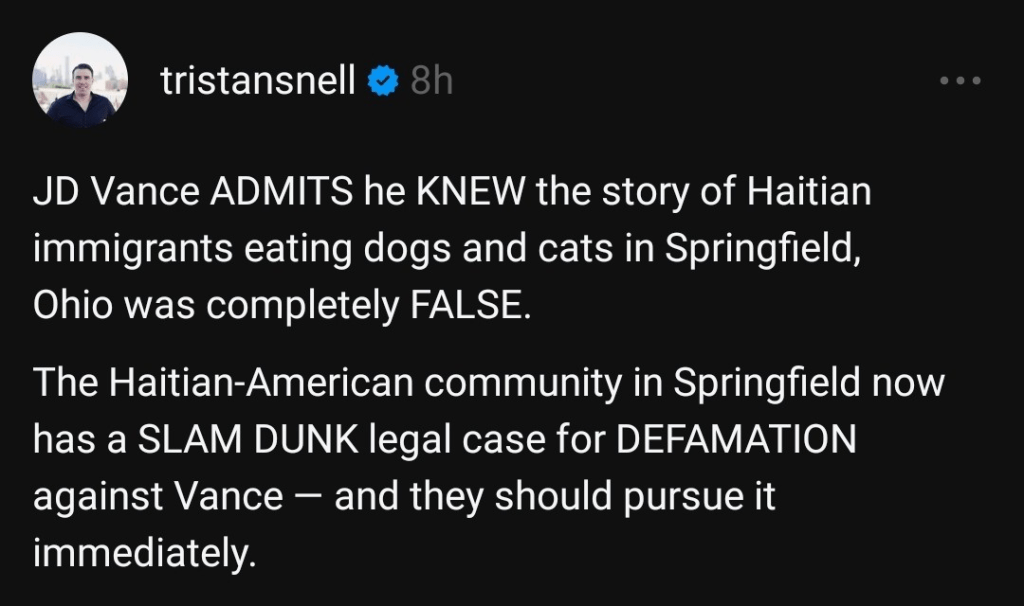
This comes two days after former President Donald Trump boosted the baseless rumor that Haitian immigrants there were “eating the pets of the people that live there.” pic.twitter.com/VnCwYE5Zpy
Springfield Police confirmed to me that "multiple facilities" including at least city hall and Fulton Elementary have been evacuated due to a bomb threat received around 8:20 this morning https://t.co/MyOVu2bgze
Wittenberg University is currently taking precautions following a possible threat to campus tomorrow, Sunday, Sept. 15, 2024. All events and activities tomorrow are canceled. See alert website at https://t.co/q8SBqL88p1 for more information, safety tips, and resources. pic.twitter.com/w7GcwjIlWC
Ohio Gov. Mike DeWine defends Haitian immigrants, telling @MarthaRaddatz that while there are “legitimate” problems at the border, “What’s going on in Springfield is just fundamentally different.”
A day after a Springfield school and other public buildings were evacuated and closed due to bomb threats, and the same day that two other Springfield elementary schools were evacuated and one middle school closed due to a new, separate bomb threat, Husted posted a photo of two geese on X Friday morning with the comment, “Most Americans agree that these migrants should be deported.”Husted’s spox has refused to comment. He first appeared here in 2012 when as Ohio secretary of state he eliminated extended hours for early voting.
NEW: Fraudulent petition signatures cited by the DeSantis administration to justify its probe of Amendment 4 had already been rejected by a local supervisor of elections.
They were never counted toward the total that got the initiative on the ballot. https://t.co/f0sXetVwUW
Ron DeSantis has mobilized the Florida state government to spend taxpayer resources on the political process. He's now waging a multi-front war against Amendment 4, which would restore abortion rights pic.twitter.com/QreyQAi7Kn
This kind of propaganda issued by the state, using taxpayer money and operating outside of the political process sets a dangerous precedent.https://t.co/dJbVj8A6kK
After sending police to knock on doors of voters who signed petitions to get the FL abortion rights amendment on the ballot, now Ron Desantis is using taxpayer funds to illegally have a state agency & website campaign against the amendment. Story.https://t.co/2ywnO6kALR
BREAKING: In a 2022 tirade against reproductive health care, Mark Robinson repeatedly waves his hand by his groin, says young women just need to “get this under control." #NCGovpic.twitter.com/QXuUtZuBAL
“When people ask me…What’s gonna happen if the Flip – Flopping, Laughing Hyena Wins?? I say…write down all the addresses of the people who had her signs in their yards! Sooo…when the Illegal human ‘Locust’ (which she supports!) Need places to live…We’ll already have the addresses of the their New families…who supported their arrival!” Zuchowski wrote.
Read the full article. Replies to his post are turned off. Zuchowski made news several years ago for a rant about the name change for the Cleveland Indians, which he claimed was “erasing our heritage.”
Ryan Routh voted for Trump in 16’, then supported Gabbard, and then moved on to Hailey. He’s no liberal. He’s a Republican who is disillusioned with Trump’s foreign policy and Putin-phelia. pic.twitter.com/PaEkWoPcqX
Suspect Ryan Wesley Routh is a Democrat. He was allegedly hiding in the bushes with an AK-47 with a scope, two backpacks, and a GoPro and was spotted by the Secret Service before he could take action on President Trump #shootingpic.twitter.com/3xkbB7EU19
Elon/X has allowed someone to create a fake account under the alleged shooter’s name (Ryan Wesley Routh), and it’s now being used to spread vile anti-Semitic content including quotes from a Hitler account that X is also allowing on the platform. pic.twitter.com/reqGUcmynS
“I’ve seen the guns myself and all, and, yeah, they had a lot of guns and stuff over there, and, yeah, a lot of people were afraid of him back in the day,” she said.
The State Attorney for Palm Beach County is an elected Democrat, so Desantis is doing what Desantis does.
Maybe Desantis should investigate himself for making it so easy to acquire and walk around with an assault rifle in FL even with an extensive criminal history. pic.twitter.com/DwAWAE928L
“These are people that want to destroy our country. It is called the enemy from within. They are the real threat. They do it with a combination of rhetoric and lawsuits they wrap me up in.
The Mississippi Black Women’s Roundtable has traveled around the state for “boot camps” aimed at better mobilizing Black women to get out the vote. They face roadblocks in a state with a deep history of voter suppression.
This article is part of U.S. Democracy Day, a nationwide collaborative on September 15, the International Day of Democracy, in which news organizations cover how democracy works and the threats it faces. To learn more, visit usdemocracyday.org.
SOUTHAVEN, MISSISSIPPI — The training in northwest Mississippi that Cassandra Welchlin led was focused on get-out-the-vote efforts, but the longtime community organizer wanted to make space to sing.
Ain’t gonna let nobody turn me around, turn me around …
“Come on, y’all!” Welchlin told the crowd of nearly 100, who joined in on the next verse. Turn me around …
Ain’t gonna let nobody turn me around. I’m gonna keep on walking, keep on talking, marching up to freedom lane …
“I am so happy to have y’all in the house,” she said at one point. “If y’all could see what I see.”
What Welchlin saw that August morning were the faces of Black women — and a lot of them. Their interests, varied and historically overlooked, are at the center of a new kind of intentional voter engagement training.
“Black women mobilize their communities,” she told The 19th. “They are the catalyst.”
Welchlin is executive director of the Mississippi Black Women’s Roundtable, a civic engagement and policy advocacy organization whose members, all of them Black women, have traveled the state for months to host trainings called the “Power of the Sister Vote Boot Camp.”
On paper, their goal with the boot camps is an increase in voter turnout among Black women in the Mississippi counties where they visit. They also want to create a years-in-the-making pipeline to better mobilize Black women, whom Welchin views as the glue holding together democracy, especially in a state and region that continues to be impacted by policies that have historically suppressed Black voters.
“I was raised in a house of Black women — my aunties, my grandma, and then the neighborhood of elders,” she said. “I know the power of Black women taking care of Black women, and taking care of the community.”
At the trainings, Welchlin and her staff dress in military fatigues — a “boot camp” theme that has manifested into the advertisement the group uses to promote the events and the T-shirts they distribute to attendees. But there is a deeper significance.
“Voting feels like a battle in Mississippi,” she explained.
Mississippi is one of just three states that does not offer early voting to all residents, and one of eight states that does not offer online voter registration. The 12-hour window that many residents have to cast a ballot on Election Day can be difficult for people with irregular work shifts, child care responsibilities and challenges to accessing transportation.
Welchlin said she knows Black women overwhelmingly run their households. They also take on the added responsibility of getting their communities to the ballot box.
“I wanted to do something a little bit more strategic and formal that would bring excitement,” Welchlin said. “I just kind of sat with the idea of, ‘What would make people want to come?’”
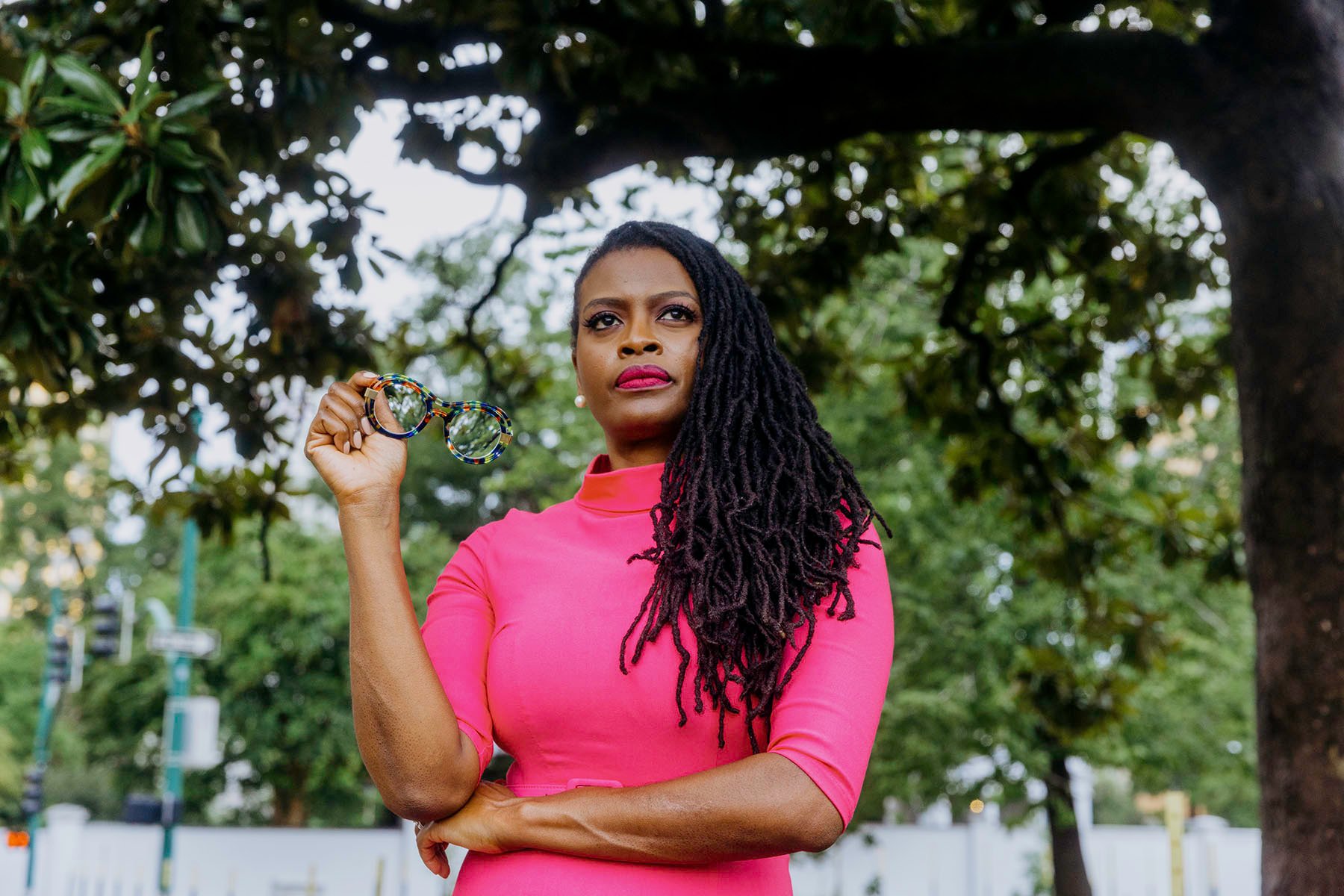
Cassandra Welchlin, executive director of the Mississippi Black Women’s Roundtable, emphasizes the role of Black women as catalysts for democracy and community change. (Imani Khayyam for The 19th)
Melanie Campbell, president and CEO of the National Coalition on Black Civic Participation, and convener of the national Black Women’s Roundtable programming, credited Welchlin for designing a training theme that not only has the potential to turn out more voters, but could lead to more Black women becoming leaders who run for office. She added that Welchlin is taking their political power “to another level.”
“Having a Cassandra Welchlin in leadership, who’s doing unique things — there could be more Black elected officials in the state of Mississippi, because the demographics are there. But when you talk statewide, it’s not reached its full potential,” she said.
There are about 1.9 million registered voters in Mississippi, where the governor’s office, Senate and House of Representatives are controlled by Republicans. Welchlin’s group estimates that more than 123,000 Black women in the state did not vote in the past three election cycles. The group’s goal is to increase voter participation among these women by 10 percent this November. Black women voters in the counties the group has targeted for boot camps are among those who have voted most infrequently since 2021.
It’s part of why Allytra Perryman, deputy director of the Mississippi State Conference of the NAACP, which has partnered to help host some boot camps, also sees such potential in mobilizing them.
“When you train a Black woman on how to do anything, you train a community,” she said.
On the morning of the boot camp, Velvet Scott seemed to be everywhere.
As director of civic engagement and voting rights for the Mississippi Black Women’s Roundtable, she was ready to help roll out attendee tables and chairs; she was there to open boxes and hand materials to roundtable staff. She and Welchlin made sure the check-in table had updated registration lists, lunch was ordered and the child care in a nearby room was set up.
“Today we’re going to go through, of course, important information, but we’re going to have fun while doing it,” Scott told the women, many already wearing the matching boot camp T-shirts.
Their meeting space was attached to a church on a hill — New Hope Missionary Baptist Church — nestled along a road filled with so many churches it’s called Church Road. Among the permanent signage adorning the room were Biblical-themed messages of hope: “We will not fail nor be discouraged, till our mission is complete….”
“We welcome you today to be energized and to be educated,” said Pamela Helton, a leader within New Hope and the wife of the church pastor, in opening remarks.
Earlier, Welchlin seemed determined to shake the hands of every person who walked through the doors. For those she knew, she offered a hug. “So glad to see so many beautiful Black women,” she said at one point. “We comin’.”
When Welchlin helped host the first boot camp ahead of last year’ gubernatorial race, her organization did not collect data about the trainings. Anecdotal feedback showed a clear interest in organizing Black women around voter turnout, but the full scope of the programming’s reach in its pilot run is unclear.
“We realized that we had a gap,” Welchlin said. “But part of it had to do with capacity on our end to collect that data and do the follow-up.”
Scott, who joined the Mississippi Black Women’s Roundtable late last year, has committed to doing things differently. She honed a data mindset while first working in insurance, a job that brought her into the homes of Black and Brown people who increasingly sought her guidance about available social services. In 2018, Scott began volunteering at a youth-focused civic engagement organization and then joined the staff full-time.
At the Mississippi Black Women’s Roundtable, Scott tries to capture more information about the organization’s approach to community programming. That’s meant more of a focus on spreadsheets, more surveys and more individual follow-ups to ensure attendees have support afterward.
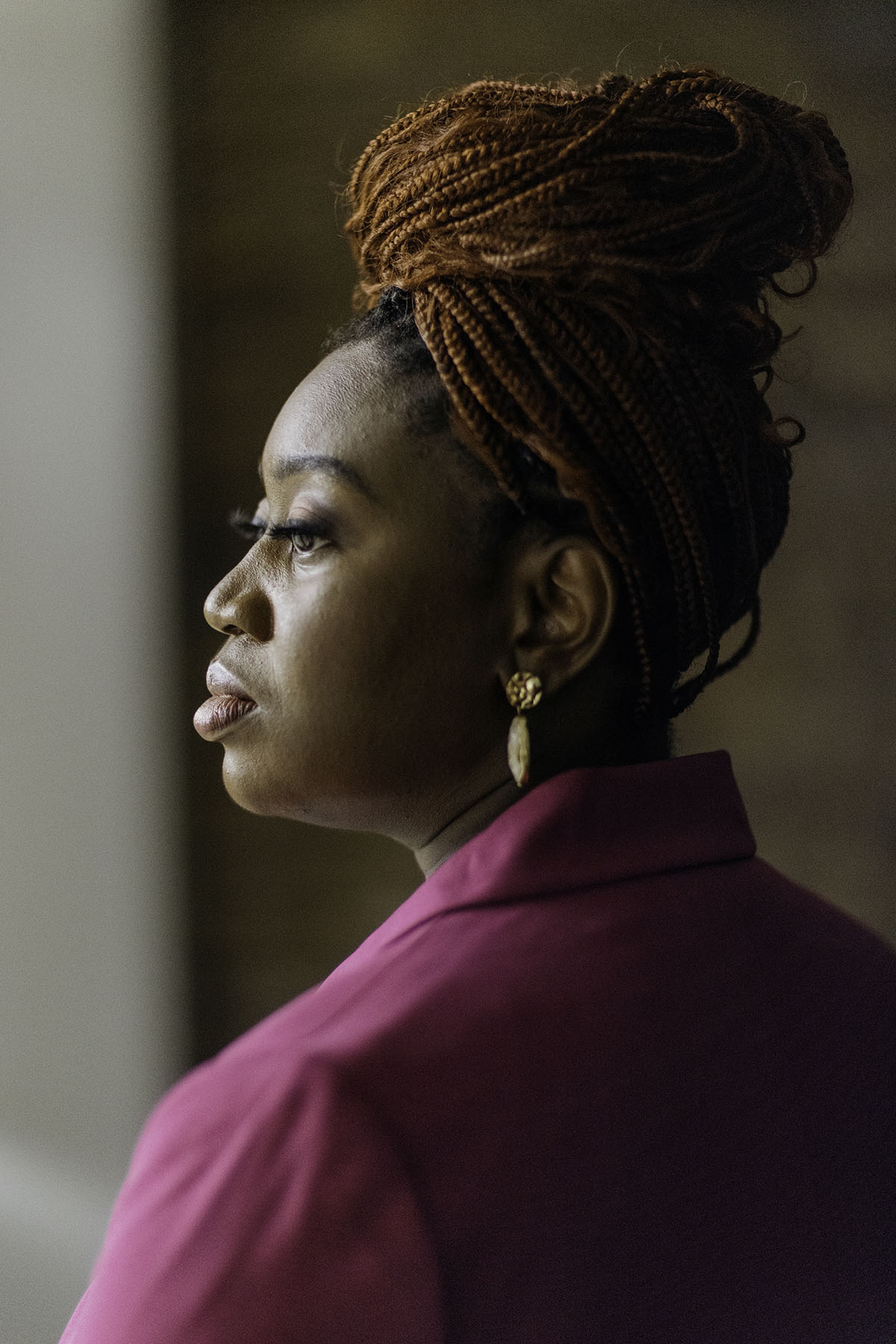
Velvet Scott, director of civic engagement and voting rights for the Mississippi Black Women’s Roundtable, believes in the power of organizing and uplifting Black women in community spaces. (Imani Khayyam for The 19th)
Scott has tweaked the boot camps since they launched in April in order to make them more accessible. She’s made some trainings available on weeknights instead of Saturdays, when people tend to be most busy with family responsibilities. She has sometimes shortened the hours of programming to see if a tighter agenda keeps up engagement. She recently helped organize a virtual training.
As a mother to a newly walking toddler, she tries to think about what the attendees might need. She, like Welchlin, feels strongly about onsite child care. (During the Southaven training, Scott stepped away to breastfeed her child.) She ensures that a meal is provided during the trainings, as well as a gift card. The group set aside roughly $50,000 to run the program this election cycle, according to Scott. They’ve been under budget thanks to partnerships with other civic engagement groups.
Scott believes strongly in the power of Black women organizing their communities.
“We don’t live single-issue lives,” she said. “So to uplift Black women in the room is to say, ‘Hey, I see you. We’re going to work on this together, we’re going to be in community together, and we’re going to be in fellowship together.’”
Scott also wants to find the balance in her work. She’s tried to move away from an unspoken expectation in community organizing that she must be go-go-go. She doesn’t want to burn out, and she wants to be present with her family.
“Rest is resistance,” Scott said, who referenced research on the topic. “And advocates deserve joy.”
When Jessica Orey hears Welchlin’s singing, she perks up. Orey is attending alone, and the music comforts her.
As a young adult, Orey jumped into organizing through a local NAACP chapter. Those meetings also made space for “freedom songs” used at the height of the Civil Rights Movement. It’s why Orey was impressed by its emphasis in Southaven.
“She’s kind of bringing back the old school type-feel of it,” Orey said of Welchlin. “Like, hey, we’re going to sing our way through. This is what’s going to push us to the next level.”
Welchlin said her mentor, Hollis Watkins, the late civil rights activist who founded the voting rights organization Southern Echo, taught her the freedom songs that he once sang at mass organizing meetings.
“It’s teaching a new generation about what the meaning of song is, and what these words mean,” she said. “And so it’s a history lesson, while it’s also a spiritual blessing to our souls.”
Sheneka Bell is also in the room alone, listening along.
At 45, Bell is a longtime voter but has not been active in voter turnout efforts. But politics continues to seep into her life — from the national debate about reproductive rights, to local property rezoning. Last year, Bell joined the local county chapter of the NAACP.
“I have a responsibility to understand what’s going on in my neighborhood and beyond,” she said.
In some ways, Orey felt compelled to be at the boot camp: Her grandmother is Delores Orey, a longtime civil rights activist who worked alongside key leaders of the Civil Rights Movement.
“This is all I know. This is what Big Mama taught us,” said the 36-year-old, referring to her grandmother. “This is what Big Mama pushed for. So if any injustice is around me, it’s like, ‘What would Big Mama do?’ A lot of this stuff is ingrained. It’s a part of my DNA.”
After her grandmother died in 2014, Orey stepped back from community organizing. But she wants to get involved again, and she felt like the boot camp was a first step. Orey has since signed up for roundtable updates and alerts from several civic engagement groups. She recently participated in a GOTV event in Jackson.
“I know it’s time for me as a former advocate,” she said. “I need to get my shoes back in the game. There’s work to be done.”
Since the boot camp, Bell has looked into signing up to be a poll worker. She is open to phone banking, and recently showed her nieces how to check their voter registration statuses.
“I’m new to this space,” she said. “I’ve never done any of this before.”
Welchlin cautioned against ignoring inequity around the ballot box in Mississippi, especially as Republican lawmakers advance voting restrictions around the country. They have increasingly claimed without proof that there is widespread voter fraud, and such policies often appear in states with large Black and Brown populations.
“Mississippi is part of the fabric of the struggles in the South,” Welchlin said. “We have a history, and a muscle, and a foundation in which we have built.”
As the boot camps in Mississippi wrap up this election cycle, its ripple effect is coming into focus. A state lawmaker recently expressed interest in running a boot camp. At least one organization is now trying to offer similar programming targeting Black men. And the umbrella organization’s Michigan affiliate has reached out about replicating some of boot camp programming.
“We know that their data is going to look different, but we’re giving them the template to adjust it the way they need,” she said. “It’s a model, and Michigan is going to be testing it.”
Welchin has tried to lean into the joy of the work ahead, despite the obvious obstacles. With Black women by her side, she feels empowered to find a way.
“Good things do come from the South, and we know that Black women have been a part of making that happen,” she said.
To check your voter registration status or to get more information about registering to vote, text 19thnews to 26797.
September 15, 1915 In a letter, Turkish Minister of the Interior Mehmet Talaat Pasha explained that the real intention of sending the Armenians to the Der-el-Zor (Deir el-Zor) Desert (now in Syria) was to annihilate them. Talaat had primary responsibility for planning and implementing the Armenian Genocide. The day before, The New York Times reported that the murder of 350,000 Armenians in Turkey had already occurred. 1915, orphaned Armenian children in the open, many covering their heads from the desert sun. Location: Ottoman empire, region Syria. The Turkish Adolf Eichmann
September 15, 1935 The “Law for the Protection of German Blood and German Honor” and the “Reich Citizenship Law” were adopted by the Nazi (National Socialist German Workers’) Party Rally in Nuremberg, depriving German Jews of their citizenship.
September 15, 1963 During Sunday School, 15 sticks of dynamite blew apart the Sixteenth Street Baptist Church in Birmingham, Alabama, killing four children in the basement changing room, and injuring 23 others. Prime suspects were the Ku Klux Klan (KKK) and Nacirema (both white supremacist organizations; Nacirema is “American” spelled backwards). A week before the bombing Governor George C. Wallace had told The New York Times that to stop integration, Alabama needed a “few first-class funerals.” The four girls lost in the Sixteenth Street Baptist Church bombing, the ruins of the church and grieving parents This event set off racial rioting and other violence in which two African-American boys were shot to death, and became a turning point in generating broad American sympathy for the civil rights movement. A member of the church, studying on a scholarship in Paris at the time, was Birmingham High School student Angela Davis. Lives cut short… Addie Mae Collins (14), Cynthia Wesley (14), Caole Robertson (14), Denise McNair (11) Read more
September 15, 1981 A blockade started at a nuclear power plant construction site in Diablo Canyon near San Luis Obispo, California. Nearly 10,000 people tried to prevent fuel rods from being loaded into the two reactor cores. Over two weeks, 1,901 are arrested in the largest occupation of a nuclear power site in U.S. history. Their immediate major concern was over the region being seismically active and the plant’s location near the Hosgri fault. In 2004 a 6.5 (on the Richter Scale) earthquake was centered less than 40 miles from the plant. Four other faults nearby have since been identified. Additionally, 9.5 billion liters (2.5 billion gallons) of water needed to cool the reactors each day are discharged directly into the Pacific 11°C (20°F) warmer than the surrounding ocean water, affecting marine plant and animal life there.Diablo canyon As with all nuclear plants, the problem remains with storage of spent nuclear fuel that remains dangerously radioactive for more than 10,000 years. Diablo Canyon generates 110 spent fuel rod assemblies each year. There is still no satisfactory solution to this long-term storage problem. Diablo Canyon timeline
September 15, 1986 Veterans Duncan Murphy (World War II) and Brian Willson (Vietnam) joined Charles Liteky & George Mizo in the Fast For Life, opposing U.S. support for the terrorist contra war against Nicaragua. The contras were insurgent guerillas using violence against civilians in the countryside to bring down the newly formed Sandanista government. The contras were supported in contravention of the Boland Amendment which prohibited U.S. agencies from providing military equipment, training or support to anyone “for the purpose of overthrowing the Government of Nicaragua.” Duncan Murphy, Brian Willson, Charles Liteky, George Mizo The Fast for Life from Brian Willson’s perspective
September 15, 1996 6,000 rallied and 1,033 were arrested near the Headwaters Grove in rural Carlotta, California, in protest against cutting one of the last large unlogged stands of redwood trees in the world. Redwoods are coniferous trees (sequoia sempervivens: the genus is named for Sequoya, or George Guess, an American Indian scholar; sempervivens is ever alive in Latin) that can reach over 90m (300 ft.) over a life as long as 2000 years.
September 15, 1997 Sinn Fein, the political party closely allied with the goals of the Irish Republican Army (IRA), entered Northern Ireland’s peace talks for the first time.
September 15, 2001 Four days after 9/11, Representative Barbara Lee (D-California) cast the only congressional vote against authorizing President Bush to use “all necessary and appropriate force” against anyone associated with the terrorist attacks of September 11. “I am convinced that military action will not prevent further acts of international terrorism against the United States.” Barbara Lee – Alone on the Hill
The below is my response to a thread on the Male Survivor site where people were talking about intervening if they saw something suspicious but not outright abuse with a child. One guy commented that what if the adult later took it out on the child. Sorry but these are the memories and never seeming to stop thoughts I am dealing with right now. Hugs. Scottie
—————————————————————————————————————
Hi. That is what happened to me. I was driving my snowmobile to a basket making shop to cut up cardboard for the owner. It was a job a kid could do and earn a little money. The owner was friends with my parents. I hit ice, couldn’t completely stop in time, bumped the bumper of a large car. No damage to the car but the cowling / hood of the snowmobile was broken badly. That meant I had to call my AF (the male of the couple who adopted me, the woman is AM, their children are the hell spawn) who showed up at the place while I was inside cutting the cardboard in a separate area of the shop. He came in and started to beat me. My AF is a large man with huge arms and shoulders who was a barroom brawler when younger. The man who owned the shop was a former Marine and taller than the AF but maybe as strong. He heard my cries and AF swearing at me, rushed in to the area I was being beaten, grabbed the AF and pushed him to the wall away from me. It might have got worse but the other workers were now watching. I never saw what happened as very quickly someone grabbed me and took me to the other part of the shop and got me calmed down. I was so relieved. The owner came to tell me that the AF had left and they were going to fix my machine at the shop, so someone would drop me off at home. Then came the time I had to go home.
There was no one there to protect me. I walked through the door and closed it, and the fist smashed into my face throwing me back into the door. He picked me up and slammed me into the door, then turned around still holding me and threw me down on the floor. He was furious raging about me embarrassing him, and he would teach me not to go crying to others. Had I not learned it before never to tell, take like the … I was. The beating was bad with slaps, punches, and kicks, the sexual torture horrible starting with oral and going to hurt rape anal, and the humiliating thing he made me do after he finished in me was just more salt in my wounds. At least after he finished I knew it would be over, he had spent his rage but his anger would simmer until the next time. I was in bed in my little tiny room hardly big enough for a small bunk bed having been warned to keep my sniveling quiet so the AM wouldn’t be upset when she got home. I was told not to come out or let him see me again that day / night. I heard him yelling telling the AM that I was grounded and wouldn’t get supper for smashing the snowmobile and disobeying him. He told her only that he punished me. She never checked on me. The next day trying to move and get up was horrible. The AM seen me and told me to stay home from school. I was terrified because the AF would be home from work soon as he worked nights. As soon as she left I took a small pack with water / soda and stole snacks from the pantry and went into the woods to hide for the day. After the weekend I went back to school. Same story, I got hurt fighting with other kids, or fell off my bike going very fast, or one of the other ones I was practiced at telling such as fell down the stairs in a home that had no stairs. I was terrified to touch the snowmobile after that.
Unless you can get the child or abused person away from the abuser intervening might make it much worse for them when no one is there to stand up for them. Best wishes. Scottie
September 9, 1862 Minnesota Governor Alexander Ramsey declared that “The Sioux Indians of Minnesota must be exterminated or driven forever beyond the borders of the state.” The previous month the Dakota, or Santee, Sioux, long burdened by treaty violations and late or unfair payments from Indian agents, killed four settlers and decided to attack settlers throughout the Minnesota River valley. The number killed was estimated between 300 and 800, until 9/11 the largest civilian death toll in the U.S. The number of Indian deaths was not recorded.
September 9, 1944 Religious conscientious objector Corbett Bishop was arrested after walking out of a Civilian Public Service Camp. During subsequent trials and imprisonments, he refused any type of cooperation with the government until he was released 193 days later. “I’m not going to cooperate in any way, shape or form. I was carried in here.If you hold me, you’ll have to carry me out.War is wrong. I don’t want any part of it.” – Corbett Bishop, 1906-1961
September 9, 1963 Students at Chu Van An boys’ high school in Saigon tore down the government flag and raised a Buddhist flag to protest the corrupt Diem regime in South Vietnam; 1,000 were arrested.
September 9, 1971 The Attica (New York) State Penitentiary revolt began. The interracial revolt was led by blacks but featured cooperation between prisoners of different racial and ethnic backgrounds. It was finally brutally suppressed by the state five days later, upon orders from Governor Nelson Rockefeller who refused to become directly involved. 29 prisoners and 10 guards were shot and killed by attacking state troopers in the bloodiest prison confrontation in U.S. history. The prisoners had been demanding improvements in their living and working conditions at the increasingly overcrowded facility.
September 9, 1980 Eight activists from the Atlantic Life Community were arrested after hammering the nose cones of two missiles at the General Electric plant in King of Prussia, Pennsylvania. Read about Plowshares 8 The Plowshares 8 (in alphabetical order): Daniel Berrigan, Philip Berrigan, Dean Hammer, Carl Kabat, Elmer Maas, Anne Montgomery, Molly Rush, and John Schuchardt. This action would become the first of an international movement of dozens of “Plowshares” anti-nuclear direct actions. A chronology of Plowshares actions
September 9, 1997 Sinn Fein (pronounced shin fayn), the Irish Republican Army’s allied political party, formally renounced violence by accepting the principles put forward by former U.S. Senator George Mitchell (D-Maine) who was mediating the talks between the Irish Republicans and the British Unionists on Northern Ireland’s future. Senator George Mitchell The Mitchell Principles: • To democratic and exclusively peaceful means of resolving political issues; • To the total disarmament of all paramilitary organisations; • To agree that such disarmament must be verifiable to the satisfaction of an independent commission; • To renounce for themselves, and to oppose any effort by others, to use force, or threaten to use force, to influence the course or the outcome of all-party negotiations; • To agree to abide by the terms of any agreement reached in all-party negotiations and to resort to democratic and exclusively peaceful methods in trying to alter any aspect of that outcome with which they may disagree; and, • To urge that “punishment” killings and beatings stop and to take effective steps to prevent such actions.
(I debated about putting this here; the page is a bit complicated for copy-pasting, but the material is important, as sometimes the passage of time blurs memories. There is work for justice being done on these cases and the whole of it, and here’s a nice gathering of information to date. Maybe a thing to read when you’ve got a few minutes. It is longer, but not TL;DR. You’ll want to know this stuff. )
by Michael Kunzelman, Alanna Durkin Richer, and Cal Woodward
Snips:
The Associated Press has spent more than three years tracking the nearly 1,500 Capitol riot cases brought by the Justice Department. AP reporters have reviewed hours of video footage and thousands of pages of court documents. They have sat through dozens of court hearings and trials for the rioters who descended on the Capitol and temporarily halted the certification of President Joe Biden’s victory. These videos represent a mere fraction of the evidence that prosecutors have presented to juries and judges deciding these cases.
Inside Washington’s federal courthouse, there’s no denying the reality of Jan. 6, 2021. Day after day, judges and jurors silently absorb the chilling sights and sounds from television screens of rioters beating police, shattering windows and hunting for lawmakers as democracy lay under siege.
But as he seeks to reclaim the White House, Donald Trump continues to portray the defendants as patriots worthy of admiration, an assertion that has been undercut by the adjudicated truth in hundreds of criminal cases where judges and juries have reached the opposite conclusion about what history will remember as one of America’s darkest days.
The cases have systematically put on record — through testimony, documents and video — the crimes committed, weapons wielded, and lives altered by physical and emotional damage. Trump is espousing a starkly different story, portraying the rioters as hostages and political prisoners whom he says he might pardon if he wins in November.
There are no broadcast television cameras inside the E. Barrett Prettyman federal courthouse on Constitution Avenue. But the real story of Jan. 6 is found in the mounds of evidence and testimony judges and juries have seen and heard behind the doors of the courthouse where hundreds of Trump’s supporters have been convicted in the attack. (snip-go read when you have a little time)
Barbara Gittings was a lover of books. She realized, from a young age, that she also loved girls. So when, in 1949, she left Wilmington, Delaware to attend Northwestern University, she did what any bookish young lesbian would do: research homosexuality in the school’s library. What Gittings found was not comforting. The vast majority of sources were written by medical professionals and described homosexuality as an illness or a perversion. She became so consumed with spending time in various Chicago libraries that she neglected her coursework and flunked out of school. But as a result of the discouraging information she found, an activist was born. With passion, determination, and what she would come to refer to as “gay gumption,” Gittings would spend the rest of her life working, in various ways, to correct those lies she found in the pages of books and scientific journals on the library shelves.
Gittings moved to Philadelphia in 1950 and supported herself with part-time clerical work. She continued to read everything she could find on homosexuality and, as part of her search, discovered Donald Webster Cory’s The Homosexual in America: A Subjective Approach, originally published in 1951. Gittings was particularly impressed with Cory’s arguments that gays and lesbians constituted a large unrecognized minority who deserved civil rights and his attempts to cultivate empathy in his readers by outlining the difficulties faced by American homosexuals. She wrote to Cory’s publisher and discovered he lived in New York City. The two met on several occasions, and Cory informed Gittings of a newly-formed gay organization in Los Angeles: the Mattachine Society, founded in 1950 by Harry Hay.
In the summer of 1956, when she was on vacation from her office job, Gittings boarded a plane to Los Angeles and visited the office of ONE, Inc., a homophile organization who had amicably split from the Mattachine Society in 1952. The members of ONE, Inc. informed her of the existence of a San Francisco-based organization for lesbians, the Daughters of Bilitis (DOB), founded in 1955 by lesbian partners Del Martin and Phyllis Lyon.
Gittings once again boarded a plane, this time bound for San Francisco. The DOB were, fatefully, having a meeting that very evening in a member’s apartment. The meeting was the first time in her life Gittings would interact with a group of lesbians outside of a bar setting. Two years later, in 1958, Gittings officially joined the DOB and was tapped by Martin and Lyon to start an East Coast chapter of the organization based in New York City. With her co-founder, Marion Glass, Gittings built the chapter into the largest in the country.
In 1963, Gittings, whose enthusiasm and knowledge of literature left an impression on Martin and Lyon, was tapped to be the editor of The Ladder, the DOB’s national magazine for gay women. Gittings transformed The Ladder from what was essentially a newsletter to a national magazine respected within gay circles. With the help of her partner, Kay “Tobin” Lahusen, whom she met in 1961 at a DOB picnic in Rhode Island, Gittings replaced the amateurish illustrations that typically adorned the cover of The Ladder with photographs taken by Lahusen of actual lesbians who appeared confident and happy.
Gittings began to take The Ladder in an increasingly militant direction, reporting on protests, questioning the merits of various activist strategies such as picketing, and engaging in debates with so-called “experts,” arguing that homosexuality was a social and cultural problem, not a psychological problem. The activist bent of The Ladder under Gittings’ editorship alarmed the West Coast leadership of the DOB. When Gittings, amidst her many activities on behalf of gay rights, was late with the August 1966 issue, Martin and Lyon used her tardiness as an excuse to oust her as editor.
Gittings would also find a kindred spirit in Frank Kameny, who she credited as the first person to articulate a fully coherent philosophy of gay rights. She and Lahusen partnered with Mattachine Washington, of which Kameny was a co-founder, working alongside other lesbians and gay men to directly challenge the federal government. Gittings participated in the first picket of the White House for homosexual rights on April 17th of 1965.
Gittings worked with Kameny and other activists to lobby the American Psychiatric Association (APA) to remove homosexuality as a diagnostic category from the Diagnostic and Statistical Manual (DSM). At the APA’s 1972 conference, held in Dallas, Texas, Gittings, Kameny, and Lahusen created a display entitled “Gay, Proud, and Healthy: The Homosexual Community Speaks.” The exhibit, which featured photographs of gay couples taken by Lahusen, was adorned with the word “LOVE” in bold letters and portrayed gay people as healthy and happy, not as patients who were tormented and in need of a cure. In December of 1973, the APA board of trustees voted to pass a resolution to remove homosexuality from the DSM, effectively declassifying it as a mental illness.
Gittings was a lifelong bibliophile, and though she recognized the importance of taking on the federal government and institutions such as the APA, she never lost sight of the “lies in the libraries” she discovered as a college freshman and the importance of gay representation. In 1970, she joined the American Library Association’s (ALA) newly-formed Task Force on Gay Liberation (TFGL). The TFGL, whose mission was to provide support for gay librarians within the profession and increase gay representation in libraries, was glad to have a veteran activist like Gittings join their ranks.
With the help of Israel Fishman, the first coordinator of the TFGL, Gittings organized a gay kissing booth — titled “Hug-a-Homosexual: Free Kisses” — for the 1971 ALA conference in Dallas, Texas. While the group could have created a nice display featuring gay books, periodicals, and their bibliography, they instead decided to make their presence known by showing gay love live. The publicity was better than Gittings and the TFGL could have imagined, and continued to spark discussions within the ALA over the next year.
In 1999, in honor of her contributions to create more visibility for gays and lesbians in libraries and in the profession, Gittings was awarded a lifetime membership at the annual ALA conference, held that year in New Orleans, Louisiana. The ALA also named an award after Gittings as part of their Stonewall Book Awards, sponsored by the Gay, Lesbian, Bisexual, and Transgender Round Table (GLBTRT), the contemporary iteration of the TFGL. The Stonewall Book Award-Barbara Gittings Literature Award is given annually for works of fiction that exhibit “exceptional merit relating to the LGBT experience.”
Barbara Gittings died on February 18th, 2007 at the age of 74 after a long battle with breast cancer. In a 1999 interview with American Libraries magazine, she summarized her career as a gay activist with the wit and wisdom she was known for:
“As a teenager, I had to struggle alone to learn about myself and what it meant to be gay. Now for 48 years I’ve had the satisfaction of working with other gay people all across the country to get the bigots off our backs, to oil the closet door hinges, to change prejudiced hearts and minds, and to show that gay love is good for us and for the rest of the world too. It’s hard work — but it’s vital, and it’s gratifying, and it’s often fun!”
(Now that things have calmed down media-wise, and there is solid information, here’s a post. I’m glad to see the parent and gun owner held accountable; for this, and always. I am never in favor of charging a minor as an adult, though there should be consequences laced heavily with rehabilitation. But the parent and gun owner should be fully responsible because they’re actual adults, and the parents (some child shooters will not have parents, so this goes to the caregiver.) Gun owners should always know that their guns are secure, and tell law enforcement when they’re not secure. Others’s mileage with these things may vary, and you’re welcome to chime in!)
Colin Gray faces four involuntary manslaughter, two second-degree murder and eight cruelty to children counts
The father of the teen suspected in the Georgia school shooting has been arrested, the Georgia bureau of investigation has said.
Colin Gray, 54, was arrested by the bureau in connection to the shooting at Apalachee high school. Colin is the father of Colt Gray, the 14-year-old who is suspected of fatally shooting two students and two teachers with an assault-style rifle at the high school on Wednesday.
He is charged with four counts of involuntary manslaughter, two counts of second degree murder and eight counts of cruelty to children, the Georgia bureau said.
“His charges are directly connected with the actions of his son and allowing him to possess a weapon,” Chris Hosey, director of the Georgia bureau of investigations, told reporters on Thursday evening.
“What are we facing? Heartbreak. A young person brought a gun into a school, committed an evil act and took lives, and injured people not just physically but mentally,” said the Barrow county sheriff, Jud Smith, during the news conference.
The teenager has been charged as an adult in the deaths of the school students Mason Schermerhorn and Christian Angulo, both 14, and educators Richard Aspinwall, 39, and Christina Irimie, 53, Hosey said.
At least nine other people – seven students and two teachers – were taken to hospitals with injuries and all are expected to make a full recovery, Smith said.
Colin Gray is being held at the Barrow county detention center.
More than a year ago, the alleged shooter was interviewed by Georgia police after they received tips about online posts threatening a school shooting. Police did not have enough probable cause to arrest him then, according to the Georgia bureau of investigation.
In that 2023 inquiry, the father said he had hunting guns in the house but that his son did not have unsupervised access to them, and the son denied making the threats online, the FBI said.
Georgia state and Barrow county investigators say the younger Gray used an “AR platform style weapon”, or semiautomatic rifle, to carry out the attack in which two teachers and two 14-year-old students were killed.
It remained unclear how the shooter obtained the weapon.
Investigators have yet to comment on what may have motivated the first US campus mass shooting since the start of the school year.
Jackson county sheriff’s investigators closed the case after being unable to substantiate that either Gray was connected to the Discord account where the threats were made, and did not find grounds to seek the needed court order to confiscate the family’s guns, according to police reports released by the sheriff’s office on Thursday.
“This case was worked, and at the time the boy was 13, and it wasn’t enough to substantiate,” Janis Mangum, the Jackson county sheriff, said in an interview. “If we get a judge’s order or we charge somebody, we take firearms for safekeeping.”
The younger Gray was taken into custody shortly after the shooting and was being held without bond at the Gainesville regional youth detention center, Glenn Allen, the Georgia department of juvenile justice communications director, said on Thursday.
His arraignment is set for Friday morning before a Georgia superior court judge in Barrow county by video camera.
While parents are not usually held criminally liable if their child shoots someone, recent high-profile events are evidence that they could face charges in the future. In November 2023, Deja Taylor of Virginia was sentenced to 21 months on two federal charges after her then six-year-old son shot his teacher in January.
The elder Gray’s arrest also comes months after the unprecedented conviction of the parents of a Michigan high school student who shot and killed four students on 30 November. In February, Jennifer Crumbley was convicted on four counts of involuntary manslaughter. The next month, her husband, James Crumbley, was convicted on the same charges. The pair was sentenced to serve at least 10 years in prison.
“I didn’t really think about what precedent it was setting,” Karen McDonald, the prosecutor for Oakland county who brought the case against the Crumbleys, told CNN on Thursday. “If nothing else I would’ve hoped that the highly publicized details of this case would steer parents and make them think twice.”
“It’s enraging that this could still happen when it’s so easily preventable,” she continued.
This article was amended on 6 September 2024. An early version said Deja Taylor was sentenced to 21 years, not 21 months.



 Diablo canyon


 Senator George Mitchell
 Scottie's Playtime