October 7, 1989 Tens of thousands (estimates ranged from 40,000 to 150,000) from all over the country marched on Washington, lobbied Congress and Housing Secretary Jack Kemp to provide affordable housing for the homeless. Some of the signs read, “Build Houses, Not Bombs.” Kemp signed a letter committing the George H.W. Bush administration to several steps to help the homeless, including setting aside about 5000 government-owned single-family houses for them.
=============== October 7, 1998 Matthew Shepard Matthew Shepard, a gay student at the University of Wyoming, was beaten, robbed and left tied to a wooden fence post outside Laramie, Wyoming; he died five days later. His death helped awaken the nation to the persecution of homosexuals and their victimization as objects of hate crimes. A play about the incident, and later an HBO movie, “The Laramie Project,” has been performed all over the country. Watch a preview MatthewShepard.org Matthew’s Place
I will be discussing the Koch brothers in this essay. If you are unfamiliar with them, here is a primer.
“Never, ever be afraid to make some noise and get in good trouble, necessary trouble.”
~John Lewis
I once left an educational conference with nearly a dozen cans of Diet Coke, several boxed lunches, a handful of cookies, and every handout I could get my hands on. I left with every pen, lanyard, and every lesson plan that was out for the taking.
I’m not a hoarder or even participating in minor theft — it was all free. I was attending a Koch-funded Bill of Rights Teacher Institute and I was going to take those folks for every penny I could. The next day, I delivered the cookies and boxed lunches to the teachers’ lounge. I drank the Diet Cokes.
Koch money paid for my day out of school for this seminar by giving me a stipend and paying for my sub while I was out of the classroom. I think it was around $400 in total.
Did I make a dent in a billionaire’s pocketbook? No. Would I participate as a cog in the wheel in their dystopian vision of education? Hell no.
“If the injustice is part of the necessary friction of the machine of government, let it go, let it go: perchance it will wear smooth–certainly the machine will wear out… but if it is of such a nature that it requires you to be the agent of injustice to another, then I say, break the law. Let your life be a counter-friction to stop the machine. What I have to do is to see, at any rate, that I do not lend myself to the wrong which I condemn.”
~Henry David Thoreau
I have read enough protest literature to know one thing: don’t be a cog in the wheel. If you see something you don’t like, shut it down. If you can’t shut it down, make the harmful agenda more difficult.
That’s exactly the sort of minor mayhem I have caused for years. Slight chaos. A burr under the saddle. A thorn in the side. A constant irritation.
The older I get, the more brazen I have become in not lending myself to the wrong which I condemn. I applied to the Koch-funded Bill of Rights Teacher Institute after hearing about it at other teacher seminar I had attended.
My last five years of teaching had grown a little tired and monotonous so I applied for summer travel institutes with the National Endowment for the Arts and the National Endowment for the Humanities and others like the summer program at George Washington’s Mount Vernon. All were prestigious and admission was difficult.
I was lucky to be admitted to several.
I love to travel, but what I really loved about these institutes was learning about American History from scholars in the places where history happened. It makes a huge difference. I have learned from scholars across the country.
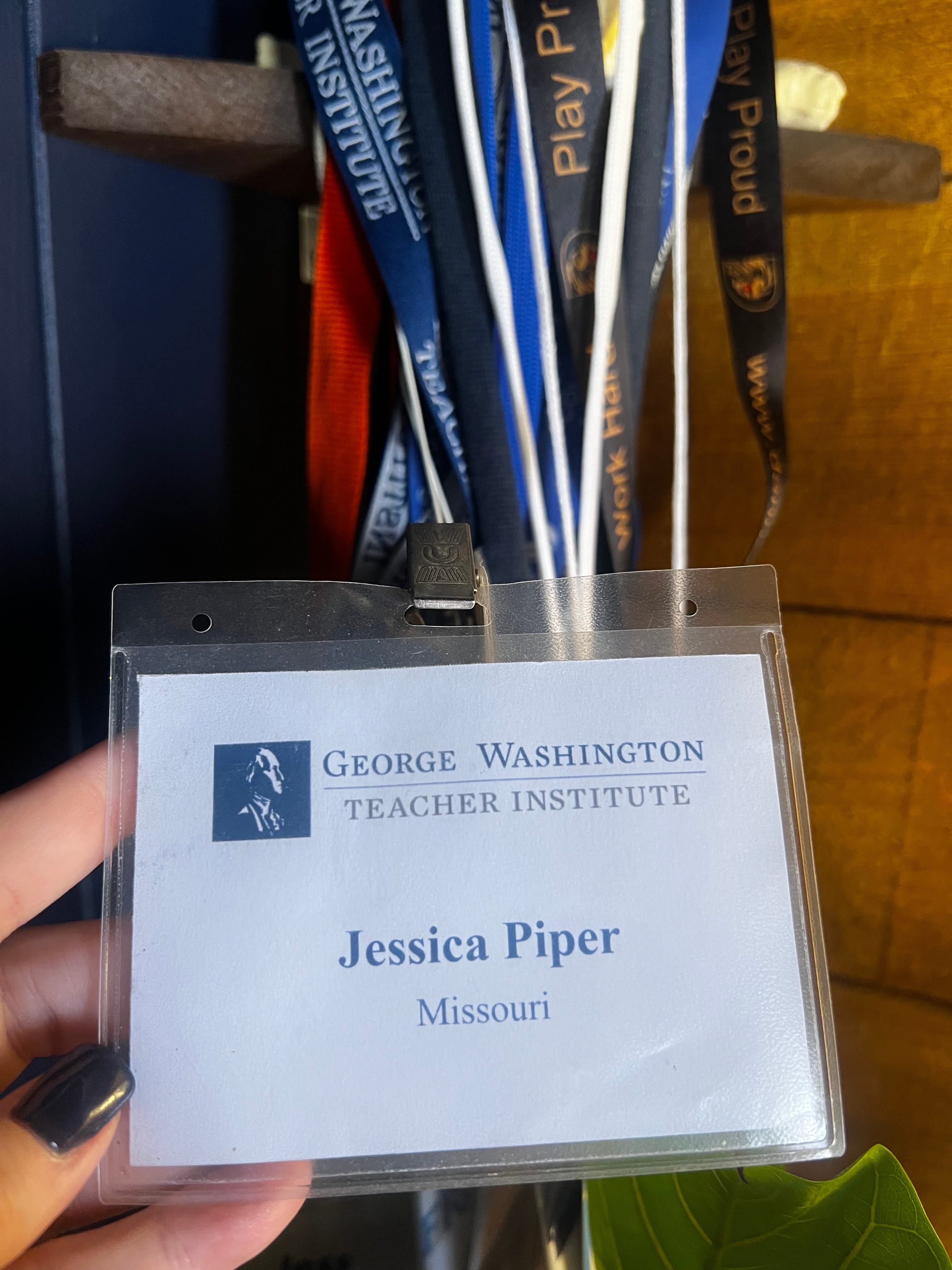
My lanyard from the George Washington Institute. I have 15 keepsake lanyards from teacher institutes I have attended. I am almost as proud of them as I am my degrees.
Once I found out that Koch money is used to sponsor teacher institutes, I knew I had to go. The Koch brothers —David has since died, while Charles remains— are from Kansas and several seminars happen right over the state line.
By attending these seminars, I was taking up the space of another educator. I was thinking of young teachers who might be indoctrinated by their bullshit. I was using up Koch time and resources and there was no way I would use their material or their instruction in my classroom.
Koch money is funding extremism across the country, especially in their vision of the future when it comes to education. They push for universal school vouchers which defund public schools, but it’s even more insidious than that. The Bill of Rights Institute offers curriculum workshops throughout the country, distributes teaching materials, holds essay contests for students, and displays its wares at the National Council for the Social Studies conference.
In its materials for teachers and students, the Bill of Rights cherry-picks the Constitution, history, and current events to hammer home its libertarian message that the owners of private property should be free to manage their wealth as they see fit. As one lesson insists: “The Founders considered industry and property rights critical to the happiness of society.” This message—that individual owners of property are the source of social good, their property sacred, and government the source of danger—is woven through the entire Koch curriculum.
The material and the professional development are sneaky. A teacher could attend a training and walk out thinking not much about it, but there is an underlying premise…the right to private property (wealth) is the only right that needs any defense. That is exactly the point of the Koch doctrine.
The Koch billionaires spent much of their lives and a good chunk of their fortune pushing anti-tax policies. They helped found the Cato Institute, a right-wing think tank, and helped fund the Heritage Foundation.
Yes, the folks behind Project 2025.
I found it so odd that the Bill of Rights Institute was even funding teacher seminars in the first place knowing that the brothers hate public education.
David Koch once stated, “We advocate the complete separation of education and state. Government schools lead to the indoctrination of children and interfere with the free choice of individuals. Government ownership, operation, regulation, and subsidy of schools and colleges should be ended.”
Good god. Talk about the quiet part out loud. Koch money is hosting seminars to disseminate propaganda directly to public school teachers in an effort to end public schools.
They also fund seminars for students.
I had heard they have a Bill of Rights summer institute for students in high school. A fully-paid trip to Washington, DC. I encouraged my 16-year-old son to apply and he was accepted. He learned to interact with very right-wing topics and children who are being indoctrinated to speak and debate on those topics.
My son came out stronger in his liberal values — he also used up about $2500 in Koch money and took the seat of a student who may have been susceptible to indoctrination.
I do these things to give these oligarchs no rest. No peace. It is my small way of throwing a wrench into the gears.
I work just as hard to be a constant sort of irritation to the Herzog Foundation. A billion dollar Missouri-based company whose mission is to “catalyze Christian education.” In smaller words, they want to send taxpayer money to private religious schools and even push for vouchers for homeschoolers. The less they know, right?
The Herzog Foundation is also on the Board of Advisory for Project 2025.
I once stood in a cornfield with a dozen friends to protest the “school choice” grifter they brought to town. I often tweet out their events and hundreds of folks have signed up to fill the seats. The foundation had to shut down an event and re-register people after I tweeted out the registration link for a Sarah Huckabee Sanders visit. She came to Missouri to sell her school voucher snake oil.
How can I help it if hundreds of folks who have no interest in an event, and have a burner email account, register for Herzog events and break the registration links?
I constantly comment on their social media posts. I write about them. I tell others about their mission. In general, I make a nuisance of myself.
No rest. No peace.
You can do these things too. You can be a burr. A constant irritation. An annoyance.
What can we do about the oligarchs who are taking over our institutions and forcing propaganda into our schools?
We can be counter-friction to stop the machine. We can create good trouble.
Springfield city government announced Wednesday that only residents of Clark County will be permitted to speak during the public comment portion of City Commission meetings in the future.
“The city of Springfield is committed to prioritizing the voices of our local residents at all commission meetings,” a city statement released Wednesday said. “To enhance community engagement and ensure that our decisions reflect the needs and interests of Springfield residents, we are implementing a new policy effective immediately.”
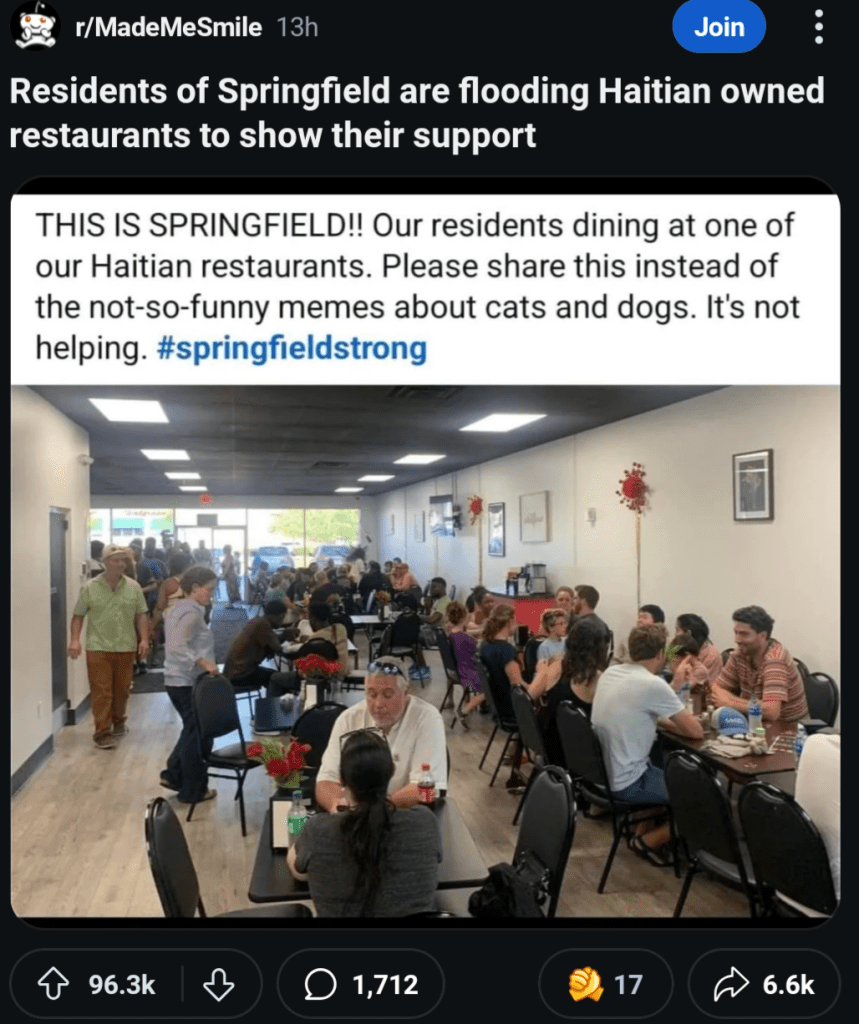
For months, Springfield City Commission meetings have been packed with attendees, many of them addressing grievances toward the commission over Haitian immigration issues. Some recent meetings have met the capacity limit for the City Hall Forum, forcing some later arrivals to sit outside on City Hall plaza.
To participate in the public comment portion of future commission meetings, speakers will have to complete a comment card and present valid proof of residency. Accepted forms of identification will include a State of Ohio driver’s license or a State of Ohio ID card.
“This requirement for proof of residency is designed to uphold the integrity of our meetings by ensuring that Clark County residents have a proper platform to address issues that matter to them,” city officials said. “This policy also aims to minimize disruptions from individuals who may misrepresent their residency to seek notoriety or cause distractions during meetings.
City officials said they do encourage all residents to speak up and share their perspectives on community matters at the meetings.
The next City Commission meeting is scheduled for 7 p.m. Tuesday, Oct. 8, in the City Hall Forum at 76 E. High St. in downtown Springfield.
I am enjoying “Elizabeth and Essex” with Bette Davis because I’ve not seen it in full to just enjoy her talent. Tonight’s debate will be very like the first debate between the Don and Pres. Biden, with Sen. Vance playing the Don. I have no doubt Gov. Walz can handle it all, but there will be no fact checking or corrections, the two mods are women so I expect Vance to be abusive if one does try to control the program, and then there is this from the Daily Beast:
Look for candidate JD Vance to come out swinging at Tuesday’s vice presidential debate against Minnesota Governor Tim Walz. Odds are good that Vance will go for the Trumpian emotional trifecta: playing the victim, spewing anger, and attacking women and immigrants.
While not everyone is charmed by righteous rage, Donald Trump is the “audience of one” who needs to hear his chosen candidate mimic the boss. There’s precedent for this behavior from fellow Yale Law School graduate, Brett Kavanaugh. (snip)
Vance knows that his debate performance must please an “audience of one.” Job one is to make Daddy Donald proud. Reasonable and empathetic just won’t cut it. Here are ten predictions for how Vance will follow in Kavanaugh’s footsteps by using a sharp tone, being overly emotional and saying a few things he should not say. (snip-MORE)
September 28, 1836 Cherokee Chief John Ross wrote a letter to both houses of the U.S. Congress stating that the Treaty of New Echota was not negotiated by any legitimate representatives of his nation. Its terms required the Cherokees to relinquish all lands east of the Mississippi River for a payment of $5 million. Ross was the democratically chosen leader of a nation with its own language, its own newspaper, a bi-cameral legislature and a republican form of government.
Cherokee Chief John Ross The Cherokee Nation celebrated its own arts and sports, and produced a wide variety of agricultural and commercial goods. I had twelve political units ranging from northern Alabama to western North Carolina.Writing from north Georgia, Ross said: “The makers of it [the treaty] sustain no office nor appointment in our Nation, under the designation of Chiefs, Head men, or any other title, by which they hold, or could acquire, authority to assume the reins of Government, and to make bargain and sale of our rights, our possessions, and our common country . . . . “ We are despoiled of our private possessions, the indefeasible property of individuals. We are stripped of every attribute of freedom and eligibility for legal self-defence. Our property may be plundered before our eyes; violence may be committed on our persons; even our lives may be taken away, and there is none to regard our complaints. We are denationalized; we are disfranchised. We are deprived of membership in the human family!” Full text of the letter
September 28, 1917 166 people who were (or had been) active in the I.W.W. (Industrial Workers of the World, whose members were also known as Wobblies) were indicted for protesting World War I.They were accused of trying to “cause insubordination, disloyalty, and refusal of duty in the military and naval forces” in violation of the Espionage Act. One hundred and one defendants were found guilty, and received prison sentences ranging from days to twenty years, with accompanying fines of $10,000-$20,000. This was part of a successful U.S. government campaign to cripple the radical union movement. The I.W.W. – A Brief History (U.S.) I.W.W. home
September 28, 1943 In Denmark, underground anti-Nazi activists began systematic smuggling of Jews to Sweden. In just three weeks, all but 481 of Denmark’s 8000 Jews had been moved to safety. Kim Malthe-Bruun, a 21-year-old Danish resistance fighter. Unfortunately one of the ones who did not make it.
September 28, 2005 The lawyer who wrote the original legal complaint in the case of Brown v. Board of Education, Constance Baker Motley, died in New York City. She had led a remarkable career which began at the NAACP Legal Defense and Educational Fund (LDF) where she was their first female attorney. The first black woman to argue before the Supreme Court, she was successful in nine of her ten cases. Motley went on to achieve three more firsts as an African American woman: being elected to the New York State Senate and shortly thereafter to the Manhattan Borough presidency. Finally, Pres. Lyndon Johnson appointed her to the U.S. District Court for the Southern District of New York in 1966 where she served until her passing.
An analysis by ProPublica and FRONTLINE shows a surge in activity on Telegram channels aligned with the Terrorgram Collective, as allies tried to rally support for their comrades in custody and sought to oust users they believed to be federal agents.
It’s a worthy read. Also, if you prefer to listen, click through to listen.
The recent crackdown on the social media platform Telegram has triggered waves of panic among the neo-Nazis who have made the app their headquarters for posting hate and planning violence.
With over 900 million users around the globe, Telegram has been both revered and reviled for its hands-off approach to moderating posted content. The platform made headlines this summer when French authorities arrested Durov, seeking to hold him responsible for illegal activity that has been conducted or facilitated on the platform — including organized drug trafficking, child pornography and fraud.
Durov has called the charges “misguided.” But he acknowledged that criminals have abused the platform and promised in a Telegram post to “significantly improve things in this regard.” Durov’s announcement marked a considerable policy shift: He said Telegram will now share the IP addresses and phone numbers of users who violate the platform’s rules with authorities “in response to valid legal requests.”
This was the second time in weeks that extremists had called on their brethren to abandon Telegram. The first flurry of panic followed indictments by the Justice Department of two alleged leaders of the Terrorgram Collective, a group of white supremacists accused of inciting others on the platform to commit racist killings. (snip)
An analysis by ProPublica and FRONTLINE, however, shows that despite the wave of early panic, users didn’t initially leave the platform. Instead there was a surge in activity on Terrorgram-aligned channels and chats, as allies of the group tried to rally support for their comrades in custody, railed against the government’s actions and sought to oust users they believed to be federal agents.
Federal prosecutors in the U.S. have charged Dallas Humber and Matthew Allison, two alleged leaders of the Terrorgram Collective, with a slew of felonies including soliciting the murder of government officials on Telegram.
Humber has pleaded (sic) not guilty. She made a brief appearance in federal court in Sacramento, California, on Sept. 13, during which she was denied bail. Humber, shackled and clad in orange-and-white jail garb, said nothing. Allison, who has not yet entered a plea, was arrested in Idaho but will face trial in California.
Attorneys for Humber and Allison did not respond to separate requests for comment.
The two are alleged Accelerationists, a subset of white supremacists intent on accelerating the collapse of today’s liberal democracies and replacing them with all-white ethno-states, according to the indictment.
Through a constellation of linked Telegram channels, the collective distributes books, audio recordings, videos, posters and calendars celebrating white supremacist mass murderers, such as Brenton Tarrant, who in early 2019 stormed two mosques in New Zealand and shot to death 51 Muslim worshippers.
The group explicitly aims to inspire similar attacks, offering would-be terrorists tips and tools for carrying out spectacular acts of violence and sabotage. A now-defunct channel allegedly run by Humber, for example, featured instructions on how to make a vast array of potent explosives. After their arrests, channels allegedly run by Humber and Allison went silent.
But within days of the indictments, an anonymous Telegram user had set up a new channel “dedicated to updates about their situation.” (snip)
Matthew Kriner, managing director of the Accelerationism Research Consortium, said the Terrorgram Collective had already been badly weakened by a string of arrests in the U.S., Europe and Canada over the past two years. “Overall, the arrests of Humber and Allison are likely the final blow to the Terrorgram Collective,” Kriner said.
In the U.S., federal agents this year have arrested at least two individuals who were allegedly inspired by the group. The first was Alexander Lightner, a 26-year-old construction worker who was apprehended in January during a raid on his Florida home. In a series of Telegram posts, Lightner said he planned to commit a racially or ethnically motivated mass killing, according to prosecutors. Court records show that agents found a manual produced by the Terrorgram Collective and a copy of “Mein Kampf” in Lightner’s home.
Lightner has pleaded (sic) not guilty to charges of making online threats and possessing an illegal handgun silencer. His attorney declined to comment. (snip)
In extremist circles, there was more discussion about fleeing Telegram after Durov’s announcement this week. “Time is running out on this sinking ship,” wrote one user. “So we’re ditching Telegram?” asked another.
“Every time we have a success against one of them, they learn, they adapt, they modify,” said Don Robinson, who as an FBI agent conducted infiltration operations against white supremacists. “Extremists can simply pick up and move to a new platform once they are de-platformed for content abuses. This leaves law enforcement and intelligence agencies playing an endless game of Whac-a-Mole to identify where the next threat may be coming from.”
This is sickening, so of course it is Florida. Seriously this is an adult sheriff mad at other adults and taking it out on a child. This is an 11 year old, impressionable child who has not formed critical thinking skills. In Florida this boy couldn’t read books with LGBTQ+ characters or plots, But we think they are smart enough to process the wrongness of their actions? If someone had talked him into taking off his clothing and letting them take pictures, we would not blame the kid would we. Seriously this is a 5th grader, being perp walked by adults. Tell me how this teaches the kid anything but the bigger the bully who carries a gun the more they can push around others. This trauma of being arrested, placed in a cop car, treated like a criminal is going to scar this child for life. Being locked in a cell, hell did they book and process him … with all that entails. Where is the right of the minor to have his parents present. There are better ways to handle this. All because adults don’t want to give up their damn guns. Hugs. Scottie
A Florida sheriff fed up with a spate of false school shooting threats is taking a new tactic to try get through to students and their parents: he’s posting the mugshot of any offender on social media. (Sept. 17, 2024)
Ok. Fair warning, as this is still fresh for me. I don’t imagine this post flows right, but here goes:
As a man well into my 50’s, I should not allow myself to feel the same bullying I felt in childhood. I shouldn’t allow the blather of others to live within my soul, my thoughts, to change my outlook, to destroy my peace. But I did. I most certainly did.
Recently, in partnership with another employee, I was given the task of wiring in an actuator control switch. I was looking forward to this task because I have little experience with this type of electronics and wiring, and the person I was to be working with had a lot of experience but his age was making the physical work difficult. A great pairing, I thought.
He ordered the components and designed the support structure while I assembled the structuring and then attempted to follow his written directions on the wiring. I told him I didn’t understand his wiring diagram but I’d do my best and let him know if I had problems. Yep, I had problems.
This older man entered back into the project angry. Ok, he is always angry. But, I called him back into it because I had done the best I could, the very best I could, but I was at a loss. So, I left everything open, labeled, easily changed. His first words were “Why in the hell did you do it like that?”
Ok, I’m new at this. How would you have done it. Grumpily, he tells me. Cool, information! I can use this in the future! Then, he grumpily complains about how I’ve done it again.
And again. And again. And again. And again. He complains about my multimeter, which is owned by the shop, not me, and is the only one I have available. Why did you buy this meter? This is a stupid design. Anyone who uses a meter like this shouldn’t be using a meter. Why did you leave so little wire where this gets connected? (He ordered the wire, and I used every bit of it as best as able). You should have left more. Dammit, this is horrible, why’d you leave this so short? You should have left more….
Outwardly I stood quiet, but, inside sat a little boy who couldn’t hold a flashlight right or grab a 7/16 box end wrench fast enough. I tell you now, when I realized I had put my hands in my pockets I ripped them out so fast I’m surprised I didn’t start a friction fire!
This type of stuff continued, repeatedly continued. I’d done the best I could with what I had available. I’d done the best I could to understand his diagram. I’d done the best I fucking well could!….. and all I could do was hold back the scream that it was all unfair and swallow my own anger as he let his flow. I needed to get this component wired and get this machine working again. I needed his help.
I’m a grown-assed man well into my 50’s, why am I suddenly that little boy again? Why am I so incapable of lifting my head? Why am I so hurt by someone so much smaller than I am? Why did I allow myself to be so abused?
Wiring complete, machine put back together. I trained the operators, watched them operate the machine successfully, then quietly collected my tools and went home. On the way home another driver passed me on the highway as I was changing lanes. He was speeding, nearly hit me – I could have reached out my window and changed his radio station! Then he sped away on the highway, and I was pissed! Finally, I was pissed!! I’d had enough this day and dammit someone was going to pay! I chased that guy for two miles at over 90 miles an hour before I realized that – a: I was never going to catch him in my little car. And, b: I needed to forgive that man or I was going to end up in an accident or jail or both.
Many years ago I stumbled upon a little blog that talked about a lot of stuff. I read his offered story, read his posts, then one day I commented. See, I liked how he signed off on his posts with “hugs”. We became grand friends, this virtual hugger and me, and I learned how incredibly important hugs were to him, and to my surprise, to me. To receive them, and to give.
Of course, I know this is a sad, angry, lonely, pathetic old man. I know this is just how he is, and I’ll never see him different. But. I also “know” he spoke to me that way because I was no good. I “know” I was horrible at my job. I “know” I’m dumb. I “know” I had no business trying to do that wiring job. I “know”… I “know”… Yeah, I “know”.
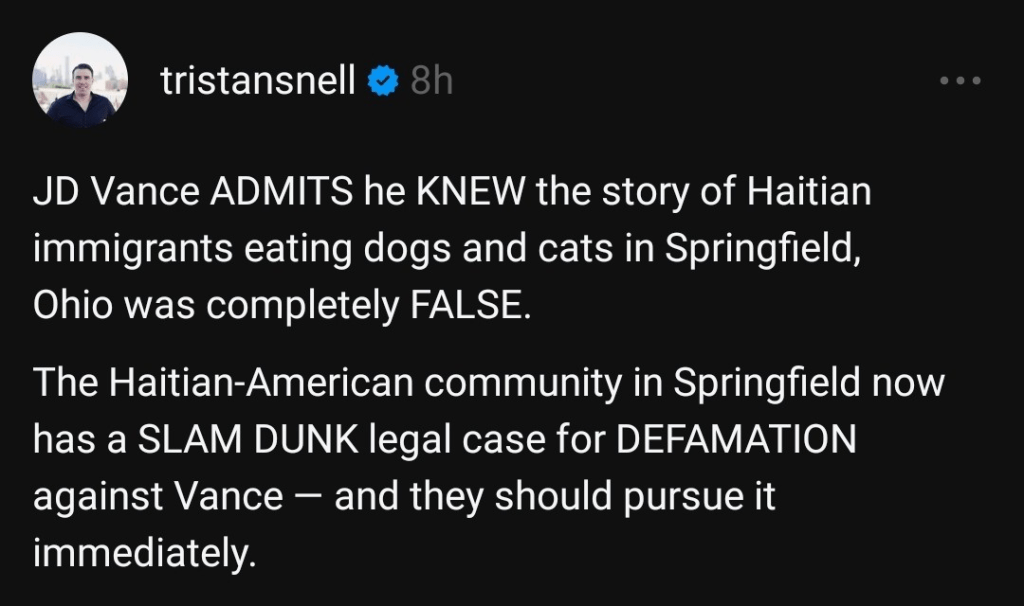
Springfield, Ohio's city hall was evacuated this morning due to a bomb threat.
This comes two days after former President Donald Trump boosted the baseless rumor that Haitian immigrants there were “eating the pets of the people that live there.” pic.twitter.com/VnCwYE5Zpy
Springfield Police confirmed to me that "multiple facilities" including at least city hall and Fulton Elementary have been evacuated due to a bomb threat received around 8:20 this morning https://t.co/MyOVu2bgze
Wittenberg University is currently taking precautions following a possible threat to campus tomorrow, Sunday, Sept. 15, 2024. All events and activities tomorrow are canceled. See alert website at https://t.co/q8SBqL88p1 for more information, safety tips, and resources. pic.twitter.com/w7GcwjIlWC
Ohio Gov. Mike DeWine defends Haitian immigrants, telling @MarthaRaddatz that while there are “legitimate” problems at the border, “What’s going on in Springfield is just fundamentally different.”
A day after a Springfield school and other public buildings were evacuated and closed due to bomb threats, and the same day that two other Springfield elementary schools were evacuated and one middle school closed due to a new, separate bomb threat, Husted posted a photo of two geese on X Friday morning with the comment, “Most Americans agree that these migrants should be deported.”Husted’s spox has refused to comment. He first appeared here in 2012 when as Ohio secretary of state he eliminated extended hours for early voting.
NEW: Fraudulent petition signatures cited by the DeSantis administration to justify its probe of Amendment 4 had already been rejected by a local supervisor of elections.
They were never counted toward the total that got the initiative on the ballot. https://t.co/f0sXetVwUW
Ron DeSantis has mobilized the Florida state government to spend taxpayer resources on the political process. He's now waging a multi-front war against Amendment 4, which would restore abortion rights pic.twitter.com/QreyQAi7Kn
This kind of propaganda issued by the state, using taxpayer money and operating outside of the political process sets a dangerous precedent.https://t.co/dJbVj8A6kK
After sending police to knock on doors of voters who signed petitions to get the FL abortion rights amendment on the ballot, now Ron Desantis is using taxpayer funds to illegally have a state agency & website campaign against the amendment. Story.https://t.co/2ywnO6kALR
BREAKING: In a 2022 tirade against reproductive health care, Mark Robinson repeatedly waves his hand by his groin, says young women just need to “get this under control." #NCGovpic.twitter.com/QXuUtZuBAL
“When people ask me…What’s gonna happen if the Flip – Flopping, Laughing Hyena Wins?? I say…write down all the addresses of the people who had her signs in their yards! Sooo…when the Illegal human ‘Locust’ (which she supports!) Need places to live…We’ll already have the addresses of the their New families…who supported their arrival!” Zuchowski wrote.
Read the full article. Replies to his post are turned off. Zuchowski made news several years ago for a rant about the name change for the Cleveland Indians, which he claimed was “erasing our heritage.”
Ryan Routh voted for Trump in 16’, then supported Gabbard, and then moved on to Hailey. He’s no liberal. He’s a Republican who is disillusioned with Trump’s foreign policy and Putin-phelia. pic.twitter.com/PaEkWoPcqX
Suspect Ryan Wesley Routh is a Democrat. He was allegedly hiding in the bushes with an AK-47 with a scope, two backpacks, and a GoPro and was spotted by the Secret Service before he could take action on President Trump #shootingpic.twitter.com/3xkbB7EU19
Elon/X has allowed someone to create a fake account under the alleged shooter’s name (Ryan Wesley Routh), and it’s now being used to spread vile anti-Semitic content including quotes from a Hitler account that X is also allowing on the platform. pic.twitter.com/reqGUcmynS
“I’ve seen the guns myself and all, and, yeah, they had a lot of guns and stuff over there, and, yeah, a lot of people were afraid of him back in the day,” she said.
The State Attorney for Palm Beach County is an elected Democrat, so Desantis is doing what Desantis does.
Maybe Desantis should investigate himself for making it so easy to acquire and walk around with an assault rifle in FL even with an extensive criminal history. pic.twitter.com/DwAWAE928L
“These are people that want to destroy our country. It is called the enemy from within. They are the real threat. They do it with a combination of rhetoric and lawsuits they wrap me up in.


 Cherokee Chief John Ross
 Kim Malthe-Bruun, a 21-year-old Danish resistance fighter. Unfortunately one of the ones who did not make it.