Some Useful Information For Los Angelenos
Biden commutes sentence of Native American activist Leonard Peltier

It’s Ollie! (I’m sorry, Pete, if you’re reading this; he came with the name. I hope he’s a good namesake, and so far, he is.)
Ollie is around 5. He was rescued from a kill shelter by another family, who’s since had a baby, and Ollie and babies don’t get along. I’m sorry they had to give up their doggy, but I’m happy to have a new buddy to play and run with. He’d been here about 3.5 hours, and considering he’s likely confused and worried about what’s happened to him, he’s a very good boy, and we’re getting along really well.


Ollie is half dachsie, half Corgi. He’s about 25 pounds, and very healthy. In the outdoor pic, he was surveying the boundaries of his domain, and receiving a welcome from the neighbor across the street. In the photo above, he was playing with his favorite ball, with me. He’s pretty cute, kinda funny, and again, a good good boy. He’s here for good, too, which is nice, that I don’t have to worry about him going to a rescue for some medical condition. He’ll likely become part of my conversation now and then, and photos will be shared as he allows. I set this up before bed, so I’ll know more tomorrow.
Please remember these are in 4k. Hugs
January 16, 2025

Not simply Roman propaganda, new research has found that women were at the centre of social networks in Celtic communities and may have been influential in many spheres of Iron Age life.
“When the Romans arrived [in Britain], they were astonished to find women occupying positions of power,” says archaeologist Dr Miles Russell. “Two of the earliest recorded rulers were queens – Boudica and Cartimandua – who commanded armies.
“It’s been suggested that the Romans exaggerated the liberties of British women to paint a picture of an untamed society.”
But Russell and a team examined the DNA of 57 individuals from a burial site in Dorset, Southern England, dating from 100 BC to 100 AD, and the results suggest women were influential in many spheres of Iron Age life.
“Indeed, it is possible that maternal ancestry was the primary shaper of group identities,” says Russel.
They found a striking three quarters of individuals were related through their maternal line, indicating the community, named the “Durotriges” by the Romans, was a “matrilocal” society.
“We reconstructed a family tree with many different branches and found most members traced their maternal lineage back to a single woman, who would have lived centuries before,” says Dr Lara Cassidy, assistant professor at Trinity College Dublin in Ireland and lead author of a paper describing the findings in Nature Communications.
In contrast, relationships through the father’s line were almost absent.
“This tells us that husbands moved to join their wives’ communities upon marriage, with land potentially passed down through the female line,” says Cassidy.
Patrilocal societies, in which married women move to their male partner’s community, are more commonly observed in European Neolithic, Copper and Bronze Age sites.

According to Cassidy, it is the first time a matrilocal system has been documented in European prehistory.
“It predicts female social and political empowerment,” says Cassidy. “It’s relatively rare in modern societies, but this might not always have been the case.”
Looking at data from previous genetic surveys of several other Iron Age burial sites revealed similar matrilocal patterns across Britain.
“We saw cemeteries where most individuals were maternally descended from a small set of female ancestors,” says Dan Bradley, professor of population genetics at Trinity and a co-author of the study.
“In Yorkshire, for example, one dominant matriline had been established before 400 BC. To our surprise, this was a widespread phenomenon with deep roots on the island.”
According to a related Nature News & Views article, matrilocality often correlates with women having a central role in maintaining family or social networks and determining who inherits land. Previous excavations of Durotriges burials have also found the tribe buried women with valuable items.
Russell, who directed the excavation and co-authored the DNA study, says that beyond archaeology, knowledge of Iron Age Britain has come primarily from the Greek and Roman writers.
“But they are not always considered the most trustworthy,” he says. “That said, their commentary on British women is remarkable in light of these findings.”
January 16, 1966 Joan Baez Folksinger Joan Baez was sentenced to 10 days in jail for participating in a protest which blocked the entrance to the Armed Forces Induction Center in Oakland, California. She was part of an action to impede the drafting of young men for the U.S. war in Vietnam. Joan Baez Press Conference On Vietnam War (1966) Read more about Joan Baez |
| January 16, 1979 Faced with strikes, violent demonstrations, an army mutiny and clerical opposition to his repressive rule, the Shah of Iran, its hereditary monarch since 1941, was forced to flee the country. He had been installed in a CIA- and British-engineered 1953 coup which overthrew elected Prime Minister Mohammad Mossadeq. Mossadeq’s government had voted to nationalize Iran’s oil industry, displacing the Anglo-Iranian Oil Company.The U.S. gave substantial and continuous military and intelligence support to the Shah throughout his regime. Despite having imposed martial law the previous October, Mohammad Reza Shah Pahlavi fled the Peacock Throne for Egypt and, later, the U.S. for medical care. Following the subsequent revolutionary overthrow, an Islamist state under Ayatollah Ruhollah Khomeini was established.  The Shah and family Chronology of Iran in the 20th century: More on the Shah |
| January 16, 1987 Eight members of the Nanoose Conversion Campaign were acquitted of trespassing on Canadian Department of National Defence property. The group had picnicked on Winchelsea Island, part of the Canadian Forces Maritime Experimental and Test Ranges, where both Canadian and U.S. weapons are tested, in the Georgia Strait along the British Columbia coast. |
| January 16, 1992 The government of El Salvador and rebel leaders signed a pact in Mexico City ending 12 years of civil war that had killed at least 75,000 people. |
| January 16, 2001 Eight Greenpeace activists were arrested by Gibraltar police as they boarded a damaged British nuclear submarine. The HMS Tireless was considered a radioactivity hazard because of a cracked pipe in its reactor’s cooling system. Those living near Gibraltar Harbour and in Spain were concerned for their safety as the ship had been docked for more than six months awaiting repair. The problem was serious enough that Great Britain removed twelve comparable subs from service until they could be checked for similar problems. Greenpeace unfurled a banner just before the arrests reading Mares Libres del Peligro Nuclear, or “For a Nuclear-Free Sea.” |
https://www.peacebuttons.info/E-News/peacehistoryjanuary.htm#january16
(Not to take away from the Love good news post.)
December 19, 2024 · Written by Matthew Russell
In the fight against climate change, every small action counts. From renewable energy to forest conservation, many solutions are on the table, but one of the most unexpected contributors could be plankton poop. This tiny marine byproduct, aided by a unique natural process, could help the world combat rising carbon dioxide levels in the atmosphere.
The concept hinges on the “biological carbon pump,” a natural process in the ocean where microscopic marine life absorbs carbon dioxide and stores it in the deep sea. However, much of this carbon is returned to the atmosphere before it can reach the ocean floor, where it could remain sequestered for centuries. But what if we could enhance this process?

Photo: Pexels
Plankton poop could significantly enhance carbon sequestration in the ocean.
Phytoplankton, tiny organisms that float in the ocean, are responsible for capturing a significant portion of atmospheric carbon dioxide through photosynthesis. As NASA Earth Observatory points out, these organisms form the base of the marine food chain, feeding zooplankton, small fish, and other sea life. As phytoplankton die or are consumed, some of their carbon sinks into the ocean, but a large portion of it is recycled by marine bacteria, eventually returning as CO2. This cycle presents a challenge in efficiently storing carbon in the ocean’s depths.
However, researchers from Dartmouth College and other institutions are exploring how to enhance the efficiency of this biological pump. Their solution involves adding clay dust to the surface of the ocean. This seemingly simple intervention could significantly boost carbon sequestration by aiding the formation of dense particles that sink rapidly, carrying carbon along with them.

Photo: Pexels
Adding clay dust to ocean waters can help carbon-rich particles sink deeper.
The Dartmouth team’s experiments demonstrated that when clay minerals are added to the ocean’s surface, they bond with organic carbon, forming sticky balls known as “flocs.” These flocs are irresistible to zooplankton, which feed on them, The Debrief, reports. As zooplankton ingest the flocs, they excrete carbon-laden feces, which sink deeper into the ocean. This process not only prevents carbon from escaping back into the atmosphere but also speeds up the ocean’s natural carbon sequestration process.
This enhancement could have profound implications. By accelerating the process by which carbon is transported from the ocean surface to the depths, this method offers a new, scalable approach to mitigate climate change. The addition of clay to phytoplankton blooms could significantly boost the amount of carbon trapped in the ocean, as demonstrated by the increased concentration of sticky organic particles—up to ten times more than usual—following the clay treatment.

Photo: Pexels
The biological carbon pump is the ocean’s natural system for removing CO2.
Plankton poop might seem like an unlikely hero in the climate crisis, but its potential is undeniable. Zooplankton, the tiny creatures that feed on plankton, play a crucial role in the ocean’s carbon cycle. Normally, only a small fraction of the carbon captured by phytoplankton makes it into the deep ocean for long-term storage. However, by feeding on clay-enhanced carbon particulates, zooplankton can create fecal pellets that sink faster, ensuring that the carbon is stored more effectively in the ocean’s depths.
The use of clay dust to enhance this process could be a game-changer. According to Oceanographic Magazine, the addition of clay allowed carbon to be captured in feces and sequestered at depths where it can stay for millennia, potentially reducing atmospheric CO2 levels significantly.

Photo: Pexels
Zooplankton ingest carbon-laden particles, trapping CO2 in their feces.
As scientists continue to explore this technique, there’s growing optimism about its potential. The use of clay is particularly promising because of its low cost and abundance. Unlike other carbon capture methods that rely on expensive technology, clay dust is a natural material that could be dispersed across ocean regions with phytoplankton blooms.
The team is currently focused on identifying the best regions for applying this method, particularly areas with high primary production, such as the California Current and the Mediterranean Sea.
Though the technique is still in its early stages, it holds promise as a sustainable and scalable solution for reducing atmospheric CO2 levels. The process, which relies on the ocean’s natural mechanisms, could complement other climate mitigation strategies, such as reforestation and direct air capture. Moreover, by enhancing the biological carbon pump with a simple addition of clay dust, the oceans could play an even greater role in addressing the climate crisis.
The next steps involve testing the method in real-world ocean settings. If successful, this approach could become an essential tool in the global effort to combat climate change, one tiny poop at a time.
https://shop.freetheocean.com/blogs/news/plankton-poo-climate-change
Biologists antagonised ants and found out they can hold grudges
January 12, 2025 Imma Perfetto

Previous research has shown that ant colonies are more likely to behave aggressively towards neighbouring colonies, but less likely to do so against unfamiliar ones.
It’s known as the “nasty neighbour effect” and, until now, researchers weren’t sure why it exists.
A new Current Biology study has discovered that ants remember the smell of their enemies.
“We often have the idea that insects function like pre-programmed robots,” says Volker Nehring from the University of Freiburg, Germany.
“Our study provides new evidence that, on the contrary, ants also learn from their experiences and can hold a grudge.”
The researchers pitted colonies of the black garden ant, Lasius niger, against each other. In the first phase of the experiment, they were exposed either exposed to nestmates or to ants from a different colony.
Each meeting lasted for one minute and was repeated once per day for 5 consecutive days. Ants’ aggression when encountering non-nestmates increased significantly during this training phase.
On day 6, the team found that ants acted most aggressively when encountering the non-nestmate colony they had previously fought but were less aggressive towards ants from a non-nestmate colony they hadn’t yet encountered. Unsurprisingly, they weren’t aggressive towards their own nestmates.
In the second phase of the experiment, encounters were repeated with either aggressive or passive ants from a different colony. They found the ants that had previously only encountered passive competitors behaved significantly less aggressively.
Because ants use odours to distinguish between members of their own nest and those from other nests, the study suggests that ants learned to associate aggression with the non-nestmate colony’s specific scent.
Nehring and his team now plan to investigate whether and to what extent ants adapt their olfactory receptors to their experiences.
Originally published by Cosmos as Biologists antagonised ants and found out they can hold grudges
(Worriedman comments on another blog I read; I found he has a substack, and it’s beautiful. Enjoy!)
That red bird comes all winter /Firing up the landscape /As nothing else can do. by Worriedman
Mary Oliver – Red Bird Read on Substack
The whole poem –
Red Bird
Red bird came all winter
Firing up the landscape
As nothing else could.
Of course I love the sparrows,
Those dun-colored darlings,
So hungry and so many.
I am a God-fearing feeder of birds,
I know he has many children,
Not all of them bold in spirit.
Still, for whatever reason-
Perhaps because the winter is so long
And the sky so black-blue,
Or perhaps because the heart narrows
As often as it opens-
I am grateful
That red bird comes all winter
Firing up the landscape
As nothing else can do.
No way to go wrong with Mary Oliver!
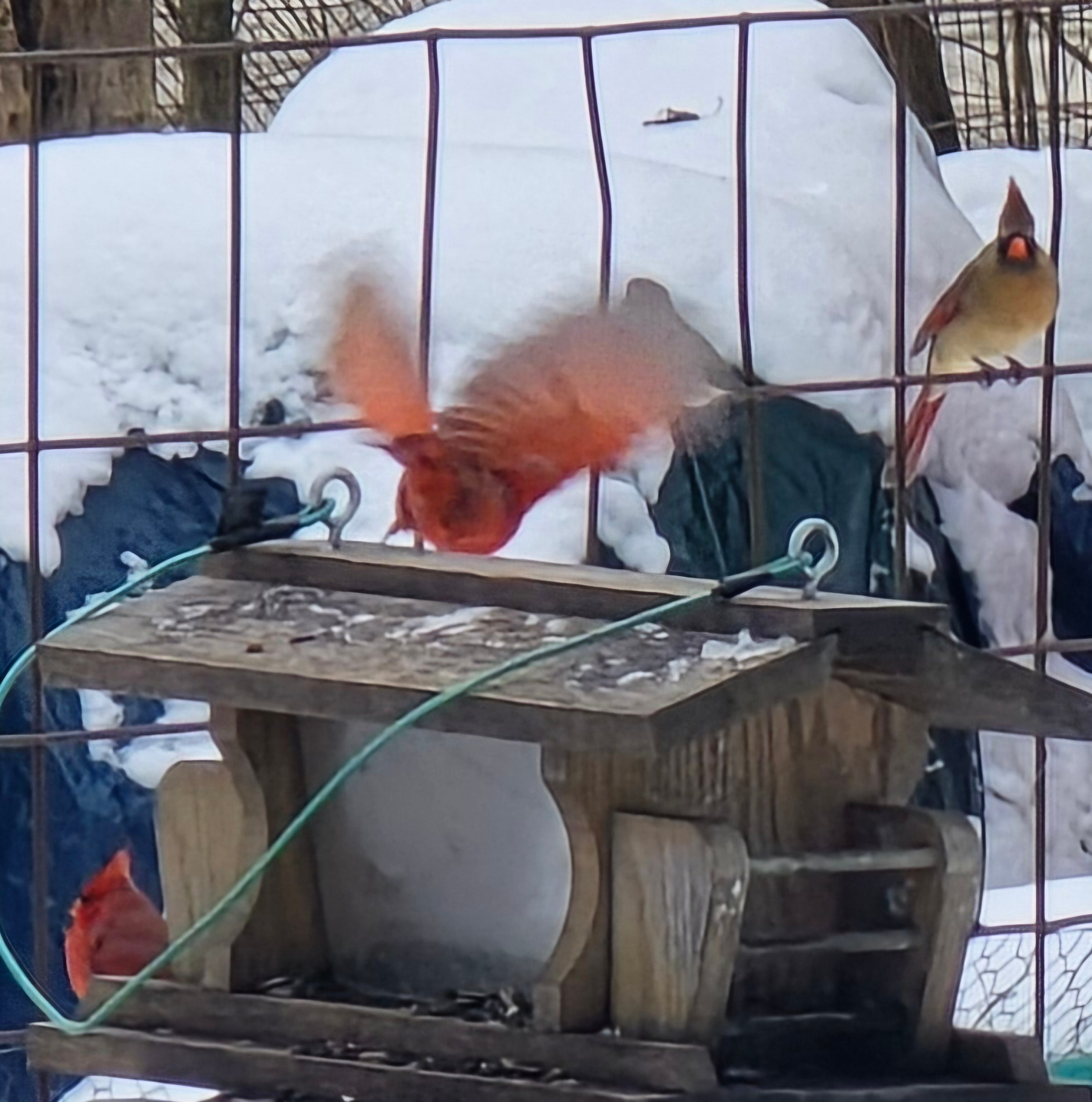
I was really happy to take these photographs today! I filled the feeders yesterday. By this morning the word had spread! Places full of birds. I’m out of bird food now. It’ll be a week before I can get to Costco. I was hoping the Cardinals would show up when I put the food out yesterday! I love the one in the lower left that’s all puffed up.




Huck!


He has space issues.
Paulo! It’s hard to go wrong taking pictures of him. The trick is to put the Pale Blue Eye of Judgement right in the center of the photograph.


Can you feel him looking into your soul?
This is Fenn pretending she didn’t take a bite of my lemon bar while I went to get a fork.

She was guilty. Guilty as Hell. Her breath smelled like lemon curd.
Sam is obviously quite wise. He’s very much against Bitcoin.


I had the greenhouse to myself this weekend. It was nice! It was snowing pretty hard at sunrise on Saturday. Today was mostly clear when the sun came up. A few clouds to shed some color.

That’s all I got room for – thanks for dropping by! (snip)
 Scottie's Playtime