
Category: Bigotry
Let’s talk about Trump’s losing streak in court….
A few news stories that I wanted to post but was unable. Read as you wish. Hugs
Peace & Justice History for 2/8

| February 8, 1962 More than 20,000 attended a demonstration in Paris against the Secret Army Organization (Organisation de l’Armée Secrète or OAS), a group of European-Algerians which used terrorist methods to keep Algeria a French colony. They set off bombs in Metropolitan France and made multiple attempts on President Charles DeGaulle’s life. DeGaulle had chosen a referendum among Algerians to decide their independence; Europeans were outnumbered 9:1 by the native population of Sunni Muslim Arabs and Berbers. The demonstration was held in violation of a declared state of emergency (because of OAS actions) and, in the subsequent rioting, at least eight people were killed and 240 injured (half of them police officers).  The terrorist crimes of the OAS |
| February 8, 1968 The Orangeburg Masssacre  Three black students were killed and 50 wounded in a confrontation with highway patrolmen at a South Carolina State rally supporting arrested civil rights protesters. Orangeburg’s only bowling alley, the All Star, was still segregated years after the Civil Rights Act of 1964 had outlawed discrimination based on race in such public accommodations. On the previous two days, college students had entered the bowling alley, refusing to leave after they were not allowed to bowl. Fifteen of the second group were arrested. The Orangeburg Massacre (2 links) |
| February 8, 1980 President Jimmy Carter unveiled a plan to re-introduce draft registration. |
https://www.peacebuttons.info/E-News/peacehistoryfebruary.htm#february8
Peace & Justice History for 2/6

| February 6, 1899 Spain agreed to abandon all claims of sovereignty over Cuba, the cession of Puerto Rico and Guam, the cession of the Philippine Islands; and in exchange the U.S. agreed to pay $20,000,000 in a treaty ratified by the U.S. Senate on this day. The previous July the U.S. took control of Gantanamo Bay, blockaded Cuba’s other ports and destroyed the Spanish fleet at Santiago Bay. The U.S. Army, landed at Guanica, near Ponce, Puerto Rico, and shortly took possession of the island with the exception of San Juan. The Spanish Pacific fleet was destroyed and the U.S. took control of Manila, the capital, and Luzon, the main island of the Philippines a few weeks later. |
| February 6, 1943 The U.S. government required the 110,000 disposessed Japanese Americans forcibly held in concentration (internment) camps to answer loyalty surveys.  Some of the interned were U.S. citizens, and some volunteered to serve in the armed forces during the war with Japan. The Nisei, as they were known, were kept in the camps until the end of World War II.  The Manzanar Relocation Center, a one of the concentration camps where Japanese-Americans were forced to live throughout World War II. |
| February 6, 1956 Autherine Lucy was excluded from classes just three days after becoming the first black person allowed to attend the University of Alabama. Her suspension “for her own safety” followed three days of riots over her Supreme Court-ordered enrollment.  Autherine J. Lucy and her attorney Thurgood Marshall Crowds of students, townspeople and members of the Ku Klux Klan shouted, “Kill her!” among other things. It is unclear why the University did not suspend the students who were among the rioters. Lucy had originally applied for graduate study in library science in 1952, and had been accepted until the University realized her race, and claimed state law prevented her admission. A graduate of traditionally black Miles College, she was only admitted with the help of the National Association for Colored People Legal Defense and Education Fund (NAACP-LDEF) and lawyers Thurgood Marshall (later a Supreme Court justice), Constance Baker Motley (future federal judge) and Arthur Shores (elected to Birmingham City Council). Read more |
| February 6, 1959 The United States successfully test-fired its first intercontinental ballistic missile (ICBM), known as Titan, from Cape Canaveral. It was a two-stage rocket designed to carry nuclear warheads.Titans were also capable of boosting satellites and spacecraft into orbit. Before the last was produced in 2002, they launched several two-man Gemini missions in the 1960s and launched the first spacecraft to land on Mars.  First test launch of Titan booster rocket from Cape Canaveral, Florida. |
| February 6, 1961 The civil rights jail-in movement began when ten negro students in Rock Hill, South Carolina, were arrested for requesting service at a segregated lunch counter. They refused to post bail and demanded jail time rather than paying fines, refusing to acknowledge any legitimacy of the laws under which they were arrested. More about Charles Sherrod Reverend Martin Luther King, Jr. wrote to Charles Sherrod, Diane Nash and the others in jail: ‘‘You have inspired all of us by such demonstrative courage and faith. It is good to know that there still remains a creative minority who would rather lose in a cause that will ultimately win than to win in a cause that will ultimately lose.’’ |
| February 6, 1985 The Molesworth Common Peace Camp, just outside the Royal Air Force Base there, was evicted by the British Army. The 300 inhabitants and their many supporters had been nonviolently protesting the siting of nuclear-tipped U.S. cruise missiles at the base. Peace camps were established at several locations in Europe in the early 1980s to protest the destabilizing nuclear weapons buildup.  Molesworth Common peace camp |
https://www.peacebuttons.info/E-News/peacehistoryfebruary.htm#february6
Some TizzyEnt clips. They are mostly short with the longest a few seconds over 5 minutes.
History, and Why Some Women Ought To Know Better Than How They Behave…
In the Ladies’ Loo
Gender-segregated bathrooms tell a story about who is and who is not welcome in public life.
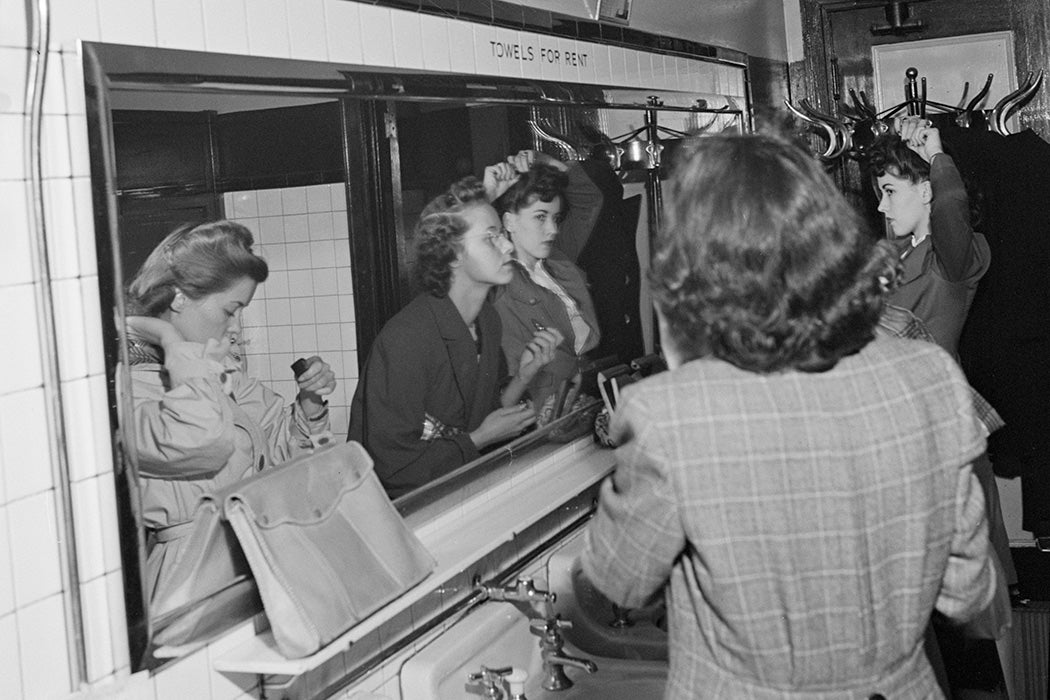
Passengers freshening up in the ladies’ restroom at the Greyhound bus terminal, Chicago, 1943 via LOC
By: Emily McCrary-Ruiz-Esparza
Women’s entry into public life around the turn of the twentieth century was a major catalyst for the creation of sex-segregated public restrooms. As scholar Daphne Spain writes, female civic reformers lobbied municipal governments to make cities more inclusive places for women, pushing for amenities such as health clinics and kindergartens. And in both small towns and big cities, notes historian Peter C. Baldwin, women worked to ensure the availability of public toilets. The first gender-segregated public bathrooms afforded women privacy, safety, and autonomy—if, that is, the women were white and of means; otherwise, access to bathrooms served as a tool of segregation. The history of the women’s bathrooms in the United States is a story of who does—and who doesn’t—get to belong in public life.
The first public bathrooms in the United States appeared in the late 1800s. Pub owners offered them to paying customers to drum up business and keep drinkers drinking. But, as Baldwin notes, pubs and saloons were improper, unwelcoming, and sometimes dangerous environments for women, and were effectively male-only establishments whose facilities only catered to men.
Just a few decades later, according to Spain, women had begun to challenge their “proper place” in society. While middle- and upper-class women increasingly ventured out of the home into the burgeoning urban environment to shop and to socialize, their lower-class counterparts increasingly found work in factories and other non-domestic environments where they could earn their own money. And some, many of whom belonged to the upper classes, forced their way into political and civic life, lobbying for, and winning, suffrage. Changing social stations pushed women and men together in public. They shared sidewalks, transportation, parks, stores, and restaurants. Women entered public life, and standards of decorum shifted to accommodate them, though certainly not to include them—gender segregation became a paramount concern, according to Baldwin, for preserving the modesty and propriety of women. Still, a dramatic shift had occurred: Men no longer wielded a monopoly on public life.
In the absence of an available pub bathroom, men were accustomed to relieving themselves in the street. Not only did that suddenly seem crass in mixed company, but the new science of germ theory made it clear that using the city as a toilet posed a health hazard, Baldwin says. Urban designers, physicians, and civic groups lobbied municipal governments in Chicago, Boston, New York, and elsewhere to provide a sanitary solution to the problem of human waste.
The first public toilets, euphemistically called “comfort stations,” appeared in American cities in the 1890s, according to Baldwin. By 1919, roughly one hundred cities, including Denver, Cleveland, Detroit, Philadelphia, and Seattle made toilet facilities available to the public for free or a small fee. Some were funded by health-minded philanthropists and reformers concerned not only with physical cleanliness, but “moral cleanliness,” writes sociologist Alexander K. Davis. They believed the two were intrinsically linked.
Comfort stations were gender segregated but not gender equal. While men were afforded the opportunity to take care of their most basic needs—the need to relieve themselves—women were not given the same. Women’s facilities were often smaller and had fewer toilets than the men’s, writes Baldwin, and were consistently inferior to the semi-private “customers only” bathrooms available in the “Adamless Eden” of a department store, as one such store owner Spain quotes called them; these were available only to patrons.
For those women denied the privilege of department store entry owing to race or lack of means, the comfort station was the only option for getting some privacy in public. Businesses, manufacturing plants, offices, and government buildings almost entirely lacked gender-segregated bathrooms, and because it was scandalous for a woman to enter a bathroom that men used, the lack of women’s toilets sent a clear signal about who was and wasn’t welcome in a particular space. Without equitable access, women were not able to fully participate in life outside the home. If you can’t empty your bladder or your bowels with dignity, it’s hard to be away from home for long.
Public stations were expensive to maintain and quickly became dirty and malodorous. Many were underground or in secluded areas and were dangerous for female users. Baldwin points out that by the early 1920s, cities cut budgets and patrons abandoned the cause, so stations fell into disrepair almost as soon as they appeared, and some of the same women’s groups that had petitioned for their creation eventually pressed for their closure. The provision of bathrooms became largely the remit of private business owners who could provide or restrict access as they pleased.
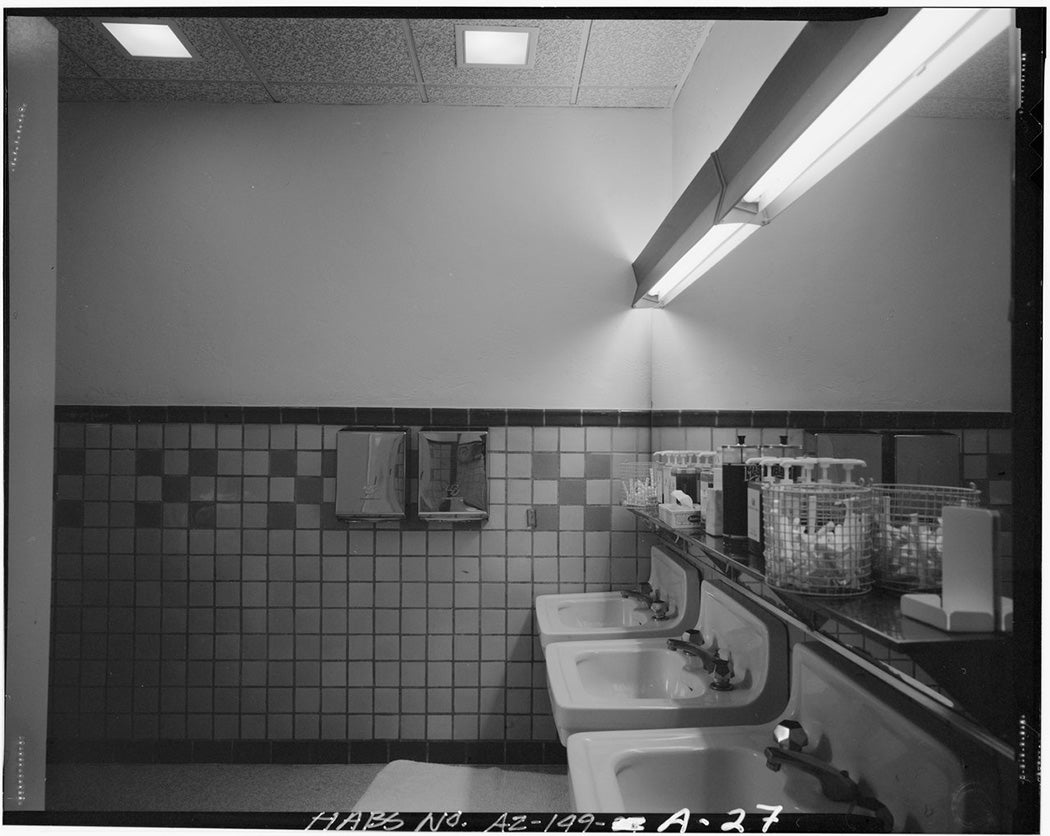
Though the truly public bathroom—where access is free to all—is increasingly rare today, the semi-public toilet is taken for granted. The ladies’ room in restaurants, bars, airports, train and bus stations, hotel lobbies, schools, and event venues remains one of the few spaces where men are strictly prohibited. Though many are accessible only to those who can patronize a business or afford a ticket for travel.
It’s such an important part of female culture that the women’s bathroom is a convenient prop in movies, TV, and books. Writers set a scene in the ladies’ room, where women gather to complain, cry, confide, confess, gossip, preen, or bully. And though such scenes sometimes lean on tired tropes of female behavior, the gender-segregated bathroom is a place to exist beyond the gaze and reach of men. Here, women speak candidly about feelings, bodies, periods, sex, romantic partners, friends, jobs, and family.
“They offer a space for bonding, the exchange of information, and personal recovery,” writes scholar Christine Overall. “Sex-segregated toilets provide ‘the element of sociability important to many women, who also use the women’s room as a refuge, ‘a place to feel safe, both physically safe but also psychologically safe.’” On the wall and in stalls, it’s not uncommon to see phone numbers for domestic violence helplines or, in bar bathrooms, instructions for ordering an “angel shot”: a coded way to ask a bartender for help in the face of harassment.
Of course, the ladies’ room by design isn’t a safe space for all women.
“At various points in US history, the absence of toilet facilities has signaled to [B]lacks, to women, to workers, to people with disabilities, to transgender people, and to homeless people that they are outsiders to the body politic and that there is no room for them in public space,” writes the feminist scholar Judith Plaskow. If these bathrooms are supposedly for the public, then by virtue of excluding certain people, the message is that their needs are not for consideration.
Access to public space in the US has even been explicitly exclusionary. When the Boston-based advocacy organization Women’s Educational and Industrial Union pressed for the creation of health clinics and lunch rooms in the early twentieth century, it made it clear that their goal was to segregate classes and create spaces, Spain explains, where only “middle-class and elite women could appear without being declassed and working women could appear in public without having their virtue questioned by being ‘on the streets.’”
In the Jim Crow south, writes Baldwin, Black women had to use separate bathrooms, typically older and poorly maintained, and were not afforded the privacy of gender-segregated facilities. In some cases, Black people in the segregated South had no access to public bathrooms at all.
Now, the current campaigns of exclusion seek to bar transgender women from accessing the ladies’ room. In 2016, the North Carolina state legislature passed “the bathroom bill,” which forced people to use the bathroom that corresponds to the gender they were assigned at birth. The next year, eight more states moved to impose similar restrictions. North Carolina’s bill was met with such anger on behalf of the LGBTQ community that some elements were quickly scrapped, and the remainder was left to lapse in 2020. While campaigns for equity have made such laws and restrictions exceedingly unpopular, they have not yet made them extinct.
In November 2024, Sarah McBride became the first openly transgender person elected to Congress, representing the state of Delaware. Within weeks, representative Nancy Mace of South Carolina introduced a resolution banning transgender women from the ladies’ bathrooms on Capitol Hill. Within days, House Speaker Mike Johnson announced the official ban.
Observing Black History Month, Because This Is The Fkn’ US, Dammit!
The Negro’s “America” by Frank Barbour Coffin 1870–1951
My country, ’tis of thee,
Sweet land of liberty,
Would I could sing;
Its land of Pilgrim’s pride
Also where lynched men died
With such upon her tide,
Freedom can’t reign.
My native country, thee
The world pronounce you free
Thy name I love;
But when the lynchers rise
To slaughter human lives
Thou closest up thine eyes,
Thy God’s above.
Let Negroes smell the breeze
So they can sing with ease
Sweet freedom’s song;
Let justice reign supreme,
Let men be what they seem
Break up that lyncher’s screen,
Lay down all wrong.
Our fathers’ God, to Thee,
Author of liberty,
To Thee we sing;
How can our land be bright?
Can lynching be a light?
Protect us by thy might,
Great God our king!
This poem is in the public domain. Published in Poem-a-Day on February 1, 2025, by the Academy of American Poets.
As always, click the title to get more about the poet and their work. Today’s background is especially poignant, and work the click.
MR Crew Exposes The Truth About Trans Kids In America
Trans People Are Real and Detransitioning Isn’t That Common – SOME MORE NEWS
Ok the first few minutes are sort of campy and over the top, it is the guy’s style thing I guess. But then he settles down and delivers the facts and debunks a lot of stuff by showing the actual studies the right wrong claim back them up, but he shows how the studies say the opposite of that the trans haters claimed. Great info on trans people and the made up faked outrage caused by a small group of trans haters who are making big money off of pushing lies about trans kids and trans issues. Hugs
Hi. Right-wing politicians, lawyers, and grifters (and some liberals) want to convince you that trans youth are the victims of a social contagion and that the majority of those who transition will detransition. This is a lie that puts all trans people at risk. Get the world’s news at https://ground.news/SMN to compare coverage and see through biased coverage. Subscribe for 40% off unlimited access through our link.
 Scottie's Playtime