A History Worth Reading

because when the US does these things, they take place in all of our names whether we want it, or not. It’s part of why the power for these things lies in our legislature. The power does not rest with the executive unless the legislature votes to give it.

โ€˜You donโ€™t brag about wiping out 60โ€‘70,000 peopleโ€™: the men who dropped the atomic bombs on Hiroshima and Nagasaki

Stephen Walker Sun 22 Jun 2025 07.00 EDT

This summer will mark 80 years since the attacks stunned the world. Today, every one of the crew members who carried out the bombings is dead. Here, one of the last writers to interview them reopens his files

Stephen Walker

Sun 22 Jun 2025 07.00 EDTShare

โ€˜It was a beautiful morning. The sun was shining on the buildings. Everything down there was bright โ€“ very, very bright. You could see the city from 50 miles away, the rivers bisecting it, the aiming point. It was clear as a bell. It was perfect. The perfect mission.โ€

Iโ€™m sitting in a Chinese restaurant in San Francisco opposite the navigator of the Enola Gay, the B-29 bomber that dropped the atomic bomb on Hiroshima on 6 August 1945. The year is 2004, and Theodore โ€œDutchโ€ Van Kirk, aged 83, has agreed to be interviewed for a book Iโ€™m writing for the 60th anniversary of that fateful mission. Van Kirk informs me, with the trace of a smile, that this will probably be the last interview in his life.

We have spent the afternoon looking through wartime logbooks from his 58 overseas combat missions. Now, between servings of dim sum, he is telling me about the 59th, the one that wiped out a city, along with well over 100,000 people.

โ€œThe instant the bomb left the bomb bay, we screamed into a steep diving turn to escape the shockwave. There were two โ€“ the first, like a very, very, very close burst of flak. Then we turned back to see Hiroshima. But you couldnโ€™t see it. It was covered in smoke, dust, debris. And coming out of it was that mushroom cloud.โ€

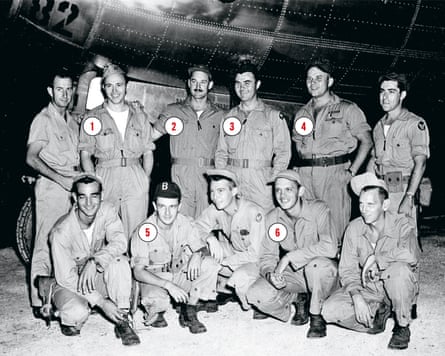
The crew of the B-29 bomber Enola Gay. Stephen Walker interviewed Theodore โ€˜Dutchโ€™ Van Kirk, navigator (1); Tom Ferebee, bombardier (2); Paul Tibbets, pilot (3); Bob Lewis, co-pilot (4); George โ€˜Bobโ€™ Caron, tail gunner (5); and Robert Shumard, assistant engineer (6).

The crew of the B-29 bomber Enola Gay. Stephen Walker interviewed Theodore โ€˜Dutchโ€™ Van Kirk, navigator (1); Tom Ferebee, bombardier (2); Paul Tibbets, pilot (3); Bob Lewis, co-pilot (4); George โ€˜Bobโ€™ Caron, tail gunner (5); and Robert Shumard, assistant engineer (6).ย Photograph: Photogquest/Getty Images

He stops a moment, awe visibly registering on his face. โ€œThe city was gone. It was only three minutes since weโ€™d dropped the bomb.โ€

Van Kirk died in 2014. In the years since we met, all the other crew members who flew on the missions to Hiroshima, and to Nagasaki three days later on 9 August, have also died. Meanwhile, the numbers of hibakusha, those who survived the attacks, are rapidly dwindling. We are passing into a twilight of history. As we approach the 80th anniversary of the atomic bombings, this biological fact seems disturbingly relevant. Twenty years ago, the world was a dangerous place. Today, itโ€™s more so. More nations are developing nuclear weapons with few, if any, effective international controls. Tactical nuclear strikes have been explicitly threatened by Vladimir Putin and Kim Jong-un. And, just in the last week, war has broken out in the Middle East over fears that Iran may be very close to having a bomb. In such times, perspective matters. The shocked testimony of those like Van Kirk needs to be heard. History has lessons to teach us.

It was this thought that prompted me to reopen my files, to reread the transcripts of interviews with some of the crew members of both attacks. Much of this material was untouched for two decades; nothing relating to the Nagasaki mission was published. Here were some of the last testimonies of those who did the unthinkable. They were in their 80s or 90s, nearing the end of their lives. How did they remember it?


On 4 August 1945, Charles โ€œDonโ€ Albury, a 24-year-old B-29 pilot, was summoned to a secret briefing on Tinian, a Pacific island 1,500 miles south of Japan. Then the biggest bomber base in the world, Tinian was a jump-off point for a conveyor belt of the almost daily destruction of Japan. About 300,000 people had already died and 9 million were now homeless.

But Alburyโ€™s outfit had yet to take part in the attacks. Known as the 509th Composite Group, they occupied a secret compound on a far corner of the base. โ€œSecurity was very, very tight,โ€ Albury told me when I met him at his home in Orlando, Florida. Then aged 83, he grinned mischievously. โ€œI remember one time the base commander got too near one of our planes. A guard nearly shot him.โ€

Even the 509thโ€™s crews knew nothing about their ultimate missions. And they had been training for almost a year. First in Utah, later on Tinian: โ€œWe kept dropping practice bombs and flying these crazy steep turns. We did it day after day. For months.โ€ But nobody told them why, and few dared ask. Those who did could find themselves swiftly dispatched by their leader, Paul Tibbets, a battle-hardened bomber pilot, to hardship posts above the Arctic Circle. โ€œYou learned to keep your mouth shut,โ€ said Albury.

But in that 4 August briefing a part of the secret was about to be revealed.

Nine days earlier, on 26 July, President Truman had delivered his ultimatum to Japan in the Potsdam declaration: either surrender unconditionally, or face โ€œprompt and utter destructionโ€. The means of that destruction was not specified. And Japan had not surrendered.

If I live for 100 years I will never get these few minutes out of my mind

(snip-MORE)

“Endangered Earth Dove”

A Cool Little Thing That Snuck Into My Stream-

http://youtube.com/post/Ugkx8mgtHXeOK7b-_xiROs4ZDVNa1yp1OOjs?si=l5aDKScsiGL5mZzj

This Just Showed Up This Morning; It’s Funny-Enjoy!

Peace & Justice History for 6/20

June 20, 1960
Nobel Prize-winner in Chemistry Linus Pauling [for study of the nature of the chemical bond and the determination of the structure of molecules and crystals] defied the U.S. Congress by refusing to name circulators of petitions calling for the total halt of nuclear weapons testing. Pauling later won a second Nobel, a Peace Prize, for his work championing nuclear disarmament.

Linus Pauling
Interview with Linus Pauling on the peace movement, 1983
June 20, 1965
Hundreds protested following a military coup in Algiers, the capital of Algeria. The military, under chief of the armed forces Colonel Houari Boumedienne and his National Revolutionary Council, had deposed President Ahmed Ben Bella, the first president of an independent Algeria (following the withdrawal of French colonial control).
On the news at the timeย 
June 20, 1967
Boxer Muhammad Ali was convicted in Houston, Texas, of violating the Selective Service law by refusing induction into the U.S. Army (during the Vietnam War). The World Heavyweight Champion had claimed conscientious objector status on the basis that he was a Muslim minister. The conviction, for which Ali was sentenced to five years in prison and a $10,000 fine, was later overturned by the Supreme Court.

“I ain’t got no quarrel with those Vietcong.”
June 20, 1982
2500 were arrested during a two-day blockade of Lawrence Livermore National Laboratory, about 50 miles east of San Francisco, the principal American nuclear weapons research facility, operated by the University of California.
June 20, 1995
Shell Oil gave in to international pressure and abandoned its plans to dispose of the Brent Spar oil-drilling platform and its contents into the North Atlantic. The environmental group Greenpeace spearheaded the effort to prevent Shell from sinking the rig, its members boarding and occupying it as a tactic to stop the deep sea disposal, and to call attention to the issue peacefully.
Shellโ€™s plan would have dumped toxic and radioactive sludge into the ocean just west of the British Isles. A month later, at the Oslo and Paris Commission (OSPARCOM) meeting, 11 out of 13 countries agreed to a moratorium on the โ€œdumpingโ€ of offshore installations, pending agreement on an outright ban.

Greenpeace climbers on Brent Spar platform

Shell ships use water cannons against Greenpeace activists on board the rig.
Read more about Greenpeace and Brent Spar
June 20, 2002
The U.S. Supreme Court declared executing mentally retarded individuals convicted of capital crimes to be unconstitutionally cruel [Atkins v. Virginia]. Besides being in line with a consensus among state legislatures, the court found that โ€œTheir deficiencies [the mentally retarded] do not warrant an exemption from criminal sanctions, but diminish their personal culpability.โ€

https://www.peacebuttons.info/E-News/peacehistoryjune.htm#june20

Starry, Starry Night … & Happy Birthday, APOD!

APOD is 30 Years Old Today
Image Credit: Pixelization of Van Gogh’s The Starry Night by Dario Giannobile

Explanation: APOD is 30 years old today. In celebration, today’s picture uses past APODs as tiles arranged to create a single pixelated image that might remind you of one of the most well-known and evocative depictions of planet Earth’s night sky. In fact, this Starry Night consists of 1,836 individual images contributed to APOD over the last 5 years in a mosaic of 32,232 tiles. Today, APOD would like to offer a sincere thank you to our contributors, volunteers, and readers. Over the last 30 years your continuing efforts have allowed us to enjoy, inspire, and share a discovery of the cosmos.

https://apod.nasa.gov/apod/astropix.html

Good News Sunday-

Scientists develop plastic that dissolves in seawater

Scientists in Japan have developed a plastic that dissolves in seawater.

Experts say the new material breaks down quickly in around two to three hours, depending on its thickness and size.

Many existing biodegradable plastics aren’t able to fully dissolve, leaving behind harmful microplastics that can pollute the ocean and harm wildlife.

But it’s hoped that the new non-toxic material could offer a future solution as it disappears completely.

The new plastic was co-developed by the University of Tokyo in Japan and the country’s RIKEN Centre for Emergent Matter Science (CEMS).

Researchers say it is made by combining two small molecules which form a strong bond that allows the new material to stay tough and flexible.

While scientists have long experimented with biodegradable plastics, the team say their invention breaks down much more quickly and leaves no trace.

When placed in a mixture which had the same amount of salt as seawater, they found the new plastic dissolved “quickly in about two to three hours, depending on its thickness and size.”

And it’s not just in water where the new plastic can dissolve.

Takuzo Aida, lead researcher at CEMS, explained: “Similarly, when tested in soil..a piece of plastic about 5 centimetres in size, it completely disappears after a little over 200 hours.”

Plastic pollution is a big global problem, with experts at the UN Environment Programme (UNEP) saying the amount of waste is set to triple in the next 15 years.

Recent studies have shown the damage microplastics cause as they pollute the environment and create health problems for animals, because they can be easily eaten.

The new plastic is still in the early phase of development but Mr Aida said their research has attracted a lot of interest, including from those in the packaging sector.

He added: “In Japan, almost all packaging is made of plastic, and if we can really manage to reduce that, we can expect less environmental damage.”

Currently, less than 9% of globalย plastic wasteย is successfully recycled. (snip)

“Small Southern Specialty”

The Port Huron Statement & More in Peace & Justice History for 6/11

June 11, 1962

Students for a Democratic Society (SDS) held its founding convention in Michigan and issued The Port Huron Statement, laying out its principles and program.
โ€œIn social change or interchange, we find violence to be abhorrent because it requires generally the transformation of the target, be it a human being or a community of people, into a depersonalized object of hate. It is imperative that the means of violence be abolished and the institutionsโ€”local, national, internationalโ€”that encourage non-violence as a condition of conflict be developed.โ€

Complete text of the Port Huron Statementย  (it’s a .pdf, in case you’re on a phone)
Students for a Democratic Society: A Graphic History: Paul Buhle, Editorย 
June 11, 1963
Thich Quang Duc, a Buddhist monk from the Linh-Mu Pagoda in Hue, Vietnam, burned himself to death (self-immolation) in front of the U.S. embassy in downtown Saigon (now known as Ho Chi Minh City) to protest the the South Vietnamese regime the U.S. supported, and the war the Americans were waging.

A painting of the scene on the street as Thich Quang Duc self-immolates in protest of the government and war in Vietnam
June 11, 1963

Vivian Malone (later Jones) preparing to enroll at Alabama with Deputy Attorney Gen, Nicholas Katzenbach (L) at her side.
Alabama Governor George C. Wallace stood in the doorway of the University of Alabama in order to prevent the admission of two negro students in a failed attempt to maintain segregation in educational opportunities.
He was forced to step aside later in the day when Vivian Malone and James Hood were registered as students.
June 11, 1968
Daniel Cohn-Bendit, known as Danny the Red, arrived in Britain, stirring up fears of campus unrest. The 23-year-old Paris law student had been given permission to remain in the U.K. just 24 hours, but immediately threatened to defy the authorities and out-stay his official welcome [his visit was later legally extended to 14 days].ย Cohn-Bendit, a German citizen, had been expelled from France in May for being an organizer of the French student and worker demonstrations which almost brought that country to a standstill the previous month.

Daniel Cohn-Bendit and a Paris policeman in 1968.
“I don’t know how long I will stay. I think it’s a free country” -Daniel Cohn-Bendit
He currently sits as a Green Party deputy in the European Parliament.
The news at the timeย 
Daniel Cohn-Bendit todayย 
June 11, 1970
Representative Martha Griffiths (D-Michigan) filed a discharge petition signed by a majority of all members of the U.S. House of Representatives, a seldom used parliamentary move, to bring the Equal Rights amendment to the House floor for consideration.
She saw this as the only way to get the constitutional amendment out of the Judiciary Committee where it had been held by its chairman, Emmanuel Cellar (D-New York), who had refused to even hold hearings on the matter. Representative Griffiths had introduced the amendment every year since 1948.

Representative Martha Griffiths from Detroit’s west side
June 11, 1988
100,000 marched from United Nations headquarters in New York City to Central Park during the 3rd U.N. Special Session on Disarmament. Though there had been progress in recent years on disarmament, the U.N. meeting yielded nothing but stalemate.
Read moreย 
June 11, 2010
Scientists studying the scale of the then-ongoing BP oil spill in the Gulf of Mexico doubled the previous estimate of the scale of the flow of oil into the Gulf. Initially, BP and the government had said that no more than 1000 barrels (42 U.S. gallons per barrel) per day were leaking, later raised to 5000.
The fine for oil spills was $4300 per barrel.


The new estimate was between 20,000 and 40,000 barrels per day.
If the spill had been stopped that day (the well was not capped until early August), it would have exceeded the Exxon Valdez spill by a factor of eight.

https://www.peacebuttons.info/E-News/peacehistoryjune.htm#june11

“High-altitude Flycatcher”