Super Salmon!

Pharmaceutical Pollution Is Shifting the Balance of Ocean Ecosystems

April 15, 2025 Written by Matthew Russell

In rivers and oceans across the globe, fish are behaving strangely. Some swim faster than they should. Others take risks they’d normally avoid. Many abandon the social structures that once protected them. These shifts are not random. They point to an invisible threat flowing just beneath the surface: pharmaceutical pollution.

Drugs designed for human anxiety, pain, and insomnia are entering the world’s water systems through sewage, manufacturing waste, and improper disposal. Once there, they don’t vanish. They linger, affect wildlife, and disrupt entire ecosystems.

Bold Fish, Bigger Risks

Juvenile salmon migrating from Sweden’s River Dal to the Baltic Sea have become an unexpected case study. Researchers implanted hundreds of these fish with tiny slow-release doses of clobazam, an anti-anxiety drug commonly prescribed to humans. Tracking tags revealed something remarkable: salmon exposed to the drug completed their journey faster and in greater numbers than their drug-free peers.

According to Jack Brand, a researcher at the Swedish University of Agricultural Sciences, these medicated salmon passed through hydropower dams two to three times faster than untreated fish, likely because they were less hesitant around the turbines, NPR reports.

This boldness might sound like a survival advantage. But in ecosystems, risk-taking has consequences. When predators lurk or conditions shift, impulsive behavior can turn deadly.

Anti-anxiety drugs are altering fish behavior in the wild.

A Global Cocktail of Contaminants

The scope of contamination is staggering. Almost 1,000 pharmaceutical compounds have been detected in waterways around the world—including Antarctica. A Cary Institute report found that up to 80% of streams in the U.S. alone are polluted with pharmaceuticals and personal care products.

These compounds are potent by design. Many target receptors in the human brain, and those same receptors are found in fish and other species. Drugs like benzodiazepines, used to treat anxiety in people, also alter the stress response in fish. As a result, animals become less risk-averse, change their migration timing, or fail to form protective schools—shifts that can affect survival.

Drugged salmon are taking dangerous risks during migration.

From Lab to Wild

Previous experiments hinted at these effects. In labs, fish exposed to psychoactive drugs became more isolated and less cautious. But the new field studies from Sweden show that these behavioral changes persist—and even intensify—in the wild.

A follow-up experiment revealed that drugged salmon formed looser groups, even when a predator was nearby. The tighter a school, the safer its members. Disrupted shoaling behavior means more fish swimming solo—making them easier prey.

Michael Bertram, an ecologist leading the study, described the salmon’s altered behavior as a form of “unnatural selection,” The New York Times reports. If bolder fish survive migration but die later in predator-rich waters, the long-term outcome could be population decline, not resilience.

Predator-prey dynamics are being disrupted by pharmaceutical waste.

The Long Tail of Human Medicine

Human waste isn’t the only path these drugs take to the water. Wastewater from hospitals, improper drug disposal, and runoff from pharmaceutical manufacturing sites all contribute. Deutsche Welle reports that some wastewater treatment plants near manufacturing facilities have drug levels 1,000 times higher than others.

Yet most treatment plants are not equipped to filter out pharmaceuticals. Some drugs pass through the system unchanged. Others break into byproducts that are just as toxic.

Unknowns Beneath the Surface

Despite years of research, the full ecological impact of pharmaceutical pollution is unknown. Scientists have documented effects on hundreds of species, including reproductive issues and behavioral disruptions. A Cary Institute investigation described how certain antidepressants alter fish breeding cycles, while hormones from birth control pills can cause male fish to develop female egg cells.

As compounds accumulate in fish, they climb up the food chain. Birds, mammals, and even humans may be exposed through drinking water or consumption of contaminated seafood.

Solutions and Setbacks

There are potential fixes. Advanced treatment technologies like ozonation and membrane filtration can help. But they’re expensive and rare. Designing drugs that biodegrade safely—an approach known as green chemistry—is promising, though slow to implement.

Policy change is another lever. Currently, pharmaceutical companies are responsible for testing their own products for environmental safety. Critics argue that these reviews are insufficient and underregulated.

Improved drug disposal practices, public education, and cross-agency coordination could all make a difference. But as things stand, no pharmaceuticals are currently regulated under the EPA’s primary drinking water standards, Cary Institute reports.

The Cost of Inaction

The salmon darting through Swedish dams may seem like a scientific curiosity. But they are just one visible indicator of a much larger, invisible crisis. Every flushed pill, every untreated discharge, adds to a global experiment with no control group and no reset button.

What happens in rivers doesn’t stay there. It shapes the ocean, the land, and the web of life that connects them all.

Click and help us keep our oceans clean! (Note from A: this is a simple free Greater Good organization click-to-donate; the easily ignored ads help pay for cleaning the ocean. I’ll never know whether you click or not, I just wanted to let you know what it is.)


Black Hole Week!

These pages are awesome! Here are some snippets:

Black holes are one of our favorite cosmic objects

So we created Black Hole Week to celebrate them.

Throughout the week, science communicators from across the globe will be sharing news, videos, and social media posts about black holes. Our goal is that no matter where people turn that week, they’ll run into a black hole. (Figuratively, of course — we don’t want anyone falling in!) (snip)

=====

=====

First Tip: Don’t Visit Black Holes!

But if you must, read our safety guide.

Learn more about black holes, how to find them, and how to stay safe on your travels!Read More snip) Enjoy!

https://science.nasa.gov/un (snipiverse/black-hole-week

He bought a president and got everything he wanted

“Stripe-Headed Skulker”

This Is A Thing In Which I Am Very Interested

I’ve even made plans, presuming some of this becomes legal in the next 10 years where I live. I have high hopes for sky burials and terramation, at least those are my 2 favorites.) I have links to more info, but this is good for some who maybe haven’t thought of this aspect of the circle of life.

Think Outside the Coffin: Green Burials Gain Popularity

Green burials have been gaining favor for nearly 30 years, offering an eco-friendly way to say goodbye.

Chi Sherman

As Ben Franklin once said, “In this world, nothing can be said to be certain except death and taxes.” While the subject of taxes may be unpleasant, conversations about death don’t have to be.

“Most families are close enough to know what their loved ones want, [but] a lot of people don’t learn about death care until a loved one dies,” says B. Milton, a retired death care industry professional in Indiana. End-of-life discussions can be uncomfortable to broach — a lot of people don’t pre-plan, according to Milton — but having direction for your post-life care allows for peace of mind, both emotionally and financially.

As most people know, conventional burials — those that include options like a viewing, a funeral service, and burial in a casket — can be very expensive. The national median cost of a funeral with a burial in 2023 was $8,300, according to the National Funeral Directors Association. Caskets alone can cost thousands of dollars. Of course, the sentiment is wonderful; there is a true gift in being able to choose a beautiful vessel as a loved one’s final resting place. A growing number of people, however, prefer to keep funeral costs lower and more eco-friendly with green burial options, including burial shrouds, terramation, and aquamation.

Burial Shrouds

“Green burials are in their infancy,” says Russ Burns, director of All Saints Cemetery and The Preserve, a natural burial site in Michigan. “In 20 to 30 years, they’ll be up there with traditional burials,” noting that customers interested in green burial are well-informed and concerned less about themselves post-mortem and more about how the area where they will be interred will remain green.

A cenotaph wall at The Preserve. The wall is a collection of rocks engraved with names of those buried on the property. It offers a physical place for family and friends to visit their loved ones as graves are inaccessible after the burial service. (Image courtesy of Mt. Elliott Cemeteries)

The use of a burial shroud is simple: The deceased is placed in a shroud made of a biodegradable material like canvas and committed to the earth about three feet underground. The shallower depth allows for more oxygen flow than the standard six-foot depth for coffins, which helps the body decompose and return to the soil. The process takes about a year and costs, at the lower end, around $1,800.

Burns cautions customers to do their research and make sure they work with an organization that is fully funded and has “more than good intentions.” Following burial, the land continues to require maintenance you would expect, like mowing and landscaping, but may also need an environmental impact study or a controlled burn to get rid of invasive plant species.

Terramation

Terramation, to put it simply, is human composting. If you’ve ever joked about having a green thumb, now you can have green everything and quite literally be turned into soil.

The first stage of terramation takes about a month. The deceased is placed in a vessel and covered in organic materials like straw, alfalfa, and wood chips. Families who attend the preparation of the body also known as a laying-in ceremony — sometimes bring garden clippings and assist in the process. The vessel is then closed and stored while microbes break the body down to roughly one cubic yard (or several hundred pounds) of soil. The material is examined for any remaining organic matter like bone or non-organic matter like surgical implants and then left to cure. Before being released to the family, the soil must pass safe compost regulations, including tests for the presence of arsenic or lead.

The process of composting people has only been around for about 10 years and is currently legal in 12 states, including Minnesota, Arizona, California, Colorado, New York, and Washington state. Cost can range from $5,000 to $7,000. In the video below, mortician and green death advocate Caitlin Doughty chats with Katrina Spade, the founder and CEO of Recompose, a green funeral home near Seattle that specializes in terramation.

(snip-some MORE)

https://www.saturdayeveningpost.com/2025/04/think-outside-the-coffin-green-burials-gain-popularity

Two From Werd.io: About An EV, And More

 The $20,000 American-made electric pickup with no paint, no stereo, and no touchscreen

[Tim Stevens at The Verge]

It’s rare these days that I see a new product and think, this is really cool, but seriously, this is really cool:

“Meet the Slate Truck, a sub-$20,000 (after federal incentives) electric vehicle that enters production next year. It only seats two yet has a bed big enough to hold a sheet of plywood. It only does 150 miles on a charge, only comes in gray, and the only way to listen to music while driving is if you bring along your phone and a Bluetooth speaker. It is the bare minimum of what a modern car can be, and yet it’s taken three years of development to get to this point.”

So far, so bland, but it’s designed to be customized. So while it doesn’t itself come with a screen, or, you know, paint, you can add one yourself, wrap it in whatever color you want, and pick from a bunch of aftermarket devices to soup it up. It’s the IBM PC approach to electric vehicles instead of the highly-curated Apple approach. I’m into it, with one caveat: I want to hear more about how safe it is.

It sounds like that might be okay:

“Slate’s head of engineering, Eric Keipper, says they’re targeting a 5-Star Safety Rating from the federal government’s New Car Assessment Program. Slate is also aiming for a Top Safety Pick from the Insurance Institute for Highway Safety.”

I want more of this. EVs are often twice the price or more, keeping them out of reach of regular people. I’ve driven one for several years, and they’re genuinely better cars: more performant, easier to maintain, with a smaller environmental footprint. Bringing the price down while increasing the number of options feels like an exciting way to shake up the market, and exactly the kind of thing I’d want to buy into.

Of course, the proof of the pudding is in the eating – so let’s see what happens when it hits the road next year.

#Technology

[Link]

=====================

 Trump ‘Alarmists’ Were Right. We Should Say So.

[Toby Buckle at LiberalCurrents]

This resonates for me too.

About the Tea Party, the direction the Republican Party took during the Obama administration, and then of Trump first riding down the escalator to announce his candidacy:

“If you saw in any of this a threat to liberal democracy writ large, much less one that could actually succeed, you were looked at with the kind of caution usually reserved for the guy screaming about aliens on the subway.”

And yet, of course, it got a lot worse.

The proposal here is simple:

“I propose we promote a simple rule for these uncertain times: Those who saw the danger coming should be listened to, those who dismissed us should be dismissed. Which is to say that those of us who were right should actively highlight that fact as part of our argument for our perspective. People just starting to pay attention now will not have the bandwidth to parse a dozen frameworks, or work backwards through a decade of bitter tit-for-tat arguments. What they might ask—what would be very sensible and reasonable of them to ask—is who saw this coming?”

Because you could see it coming, and it was even easy to see, if you shook yourself out of a complacent view that America’s institutions were impermeable, that its ideals were real and enduring, and that there was no way to overcome the norms, checks, and balances that had been in place for generations.

What this piece doesn’t quite mention but is also worth talking about: there are communities for whom those norms, checks, and balances have never worked, and they were sounding the alarm more clearly than anyone else. They could see it. Of course they could see it. So it’s not just about listening to leftists and activists and people who have been considered to be on the political fringe, but also people of color, queer communities, and the historically oppressed. They know this all rather well.

#Democracy

[Link]

“Open Windows” and Clay Jones

Slapshot by Clay Jones

That ship’s gonna sink Read on Substack

If they weren’t so pathetic, you might could possibly be sad for some MAGAts. Take Juanita Broaddrick as an example, whose entire national profile is built upon debunked claims she was raped by Bill Clinton in the 1970s and who is now a full-fledged lying MAGAt.

After Canada’s Conservative Party Leader Pierre Poilievre distanced himself from Donald Trump, Broaddrick claimed he would lose the election because Canada loved Trump so much, which didn’t make any sense.

If Canadians loved Trump so much, then why did they just elect Liberal Mark Carney to become their new Prime Minister? That’s like denying Trump’s current favorability numbers. They suck.

There’s also the fact that Trump lost this election for the Conservatives. The Conservatives were ahead by double digits when Trump entered office last January, then he started barking at Canada, waged a tariff war, and repeatedly insulted them by claiming they should be America’s 51st state.

If Donald Trump had kept his mouth shut and had waited at least 100 days for his stupid tariff war, Poilievre would be Prime Minister today.

Yesterday, thanks to Donald Trump, Canadian Liberals won. Trump is now internationally toxic. Everything Trump touches…dies. Super Bowl champion running back Sequon Barkley played golf with Trump a few days ago, and now I expect his knees to give out during the preseason. Trump is poison. I would tell you to ask Elon, but he hasn’t figured it out yet.

Pierre didn’t just lose his race for Prime Minister, he also lost his seat in parliament. (snip-MORE)

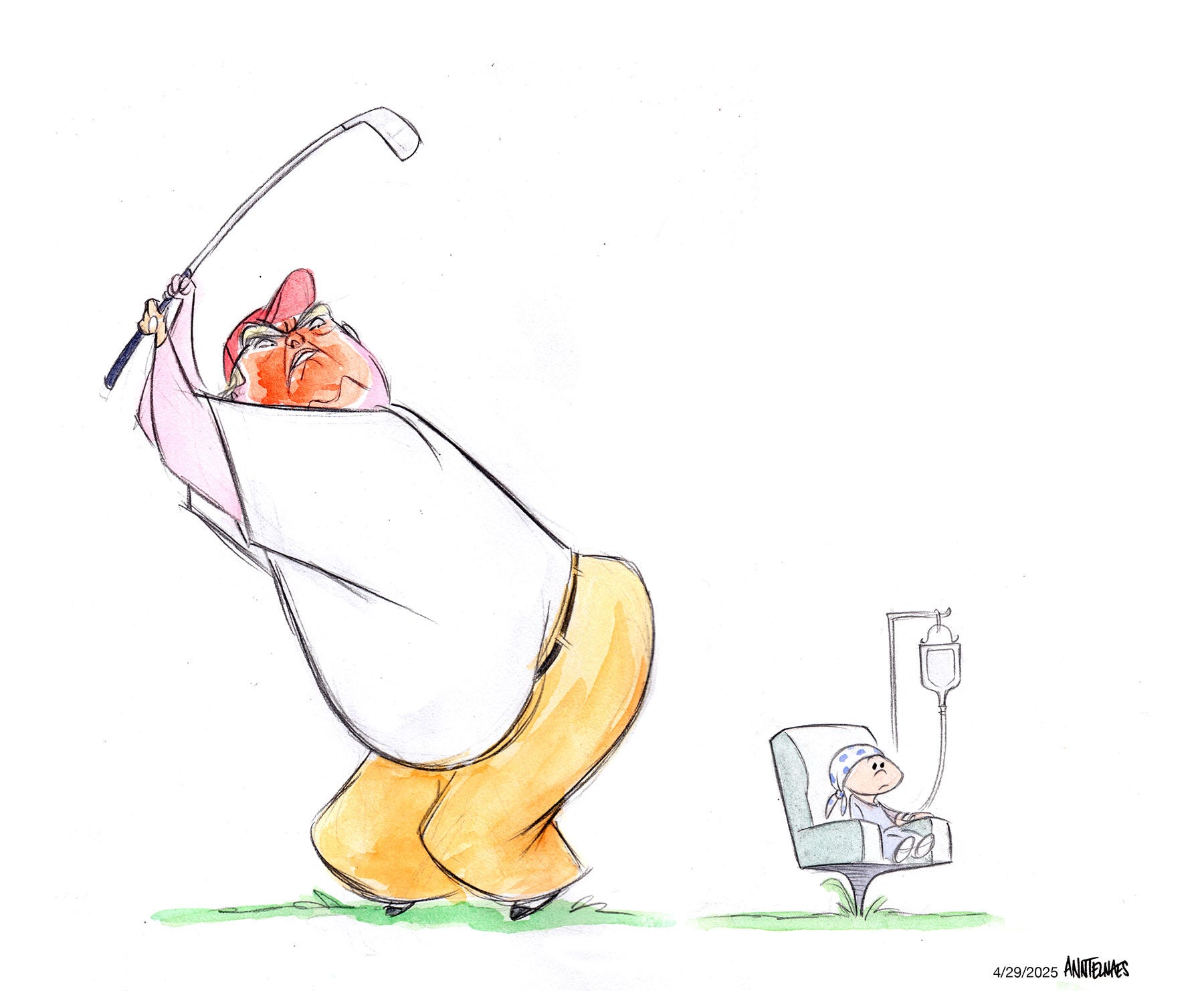
A four-year old cancer patient deported by Ann Telnaes

The boy and his sister, both U.S. citizens, were deported to Honduras with their undocumented mother Read on Substack

https://www.democracynow.org/2025/4/28/us_citizen_children_expelled_from_country

This Is Beautiful-

go see the entire post! 🐙

“Mighty Monarch”

Peace & Justice History For 4/26

April 26, 1954
The Geneva Conference began for the purpose of bringing to an end the conflicts in Korea and Indochina. This followed the defeat of the French in Vietnam at Dien Bien Phu. France had been trying to reassert colonial control over Indochina following World War II.
The conferees included Cambodia, France, Laos, the People’s Republic of China, the Democratic Republic of Vietnam, the Soviet Union, Vietnam, the U.S. and the United Kingdom.
As a result, Vietnam was temporarily partitioned pending elections on reunification to be held in 1956; those elections were never held.
April 26, 1966

Rodolfo “Corky” Gonzales
Rodolfo “Corky” Gonzales founded the Crusade for Justice, a Chicano activist group, in Denver, Colorado, and marked his departure from the Democratic Party. It was the beginning of a nationalist strategy for the attainment of Chicano civil rights.
Read more
video  Democracy Now
April 26, 1968
A national student strike against the Vietnam war enlisted as many as one million high school and college students across the U.S.
April 26, 1986
A major accident occurred at the Chernobyl nuclear power plant in the Ukraine near the border with Belarus, both then part of the Soviet Union (Union of Soviet Socialist Republics). An explosion and fire in the No. 4 reactor sent radioactivity into the atmosphere. Only after Swedish authorities reported the fallout over their country 1385 km away (860 miles), did Soviet authorities reluctantly admit that an accident had occurred.
During a fire that burned for 10 days, 190 tons of toxic materials were expelled into the atmosphere (3% of the reactor core). Winds blew 70% of the radioactive material into neighboring Belarus.


The explosion at Chernobyl was the world’s largest-scale nuclear accident. Approximately 134 power-station workers were exposed to extremely high doses of radiation directly after the accident. About 31 of these people died within 3 months. Another 25,000 “liquidators”—Soviet soldiers and firefighters who were involved in clean-up operations — have died since the incident of diseases such as lung cancer, leukemia, and cardiovascular disease.
400,000 were evacuated and over 2,000 towns and villages were bulldozed to the ground in areas considered permanently contaminated.
Deaths and illnesses directly attributable to radiation exposure continue.

“Chernobyl is a global environment event of a new kind. It is characterized by the presence of thousands of environmental refugees, long-term contamination of land, water and air, and possibly irreparable damage to ecosystems.”
– Christine K. Durbak, Chairwoman of the World Information Transfer, New York
Chernobyl for Kids
April 26, 1998

Bishop Juan Gerardi Conedera
Bishop Juan Gerardi Conedera, a leading human rights activist in Guatemala, was bludgeoned to death two days after a report he had compiled was made public. The report blamed the U.S.-backed Guatemalan military government and its agencies for atrocities committed during Guatemala’s 36-year civil war.
About Bishop Gerardi’s murder  (Democracy Now)

https://www.peacebuttons.info/E-News/peacehistoryapril.htm#april26