The Chaos Monkeys Have Already Taken Over the Zoo by Paul Krugman

The peddlers of misinformation are high on their own supply Read on Substack

(Thanks to BruceDesertRat who comments here, for linking this really useful Substack!)

Well, I was going to post about proposals for bank deregulation, but I think that can wait for a bit. The news of the moment is the looming prospect that the federal government will shut down over the weekend.

We’ll have to see how much damage this does, but it’s already clear that assuming the worst happens — and it’s hard to see how it won’t — this will be the dumbest shutdown ever. I’d say that the incoming Musk administration (so far Musk, not Trump, appears to be calling the shots) is trying to hold itself up for ransom, but it doesn’t even rise to that level. This isn’t like 1995, when Newt Gingrich shut down the government in an attempt to extract cuts in Medicare and Medicaid — a move that seemed (and was) a foolish act of petulance, but at least had a ghost of motivation.

No, Musk is demanding — apparently successfully — that Republicans in Congress renege on a deal they had already agreed to, a continuing resolution that would keep the federal government going for the next few months. Why? Because, Musk says, of the outrageous provisions in that CR.

Except none of the items Musk is complaining about are actually in the bill. No, Congress isn’t giving itself a 40 percent raise. No, the bill doesn’t fund a $3 billion stadium in Washington. No, it doesn’t block future investigations into the Jan. 6 committee. No, it doesn’t fund bioweapons labs.

I have an embarrassing admission to make. I thought that Muskaswamy’s obvious problems with getting DOGE going would have inspired, not humility — never that — but at least a bit of caution. That is, I imagined that Musk would by now have at least an inkling of two things.

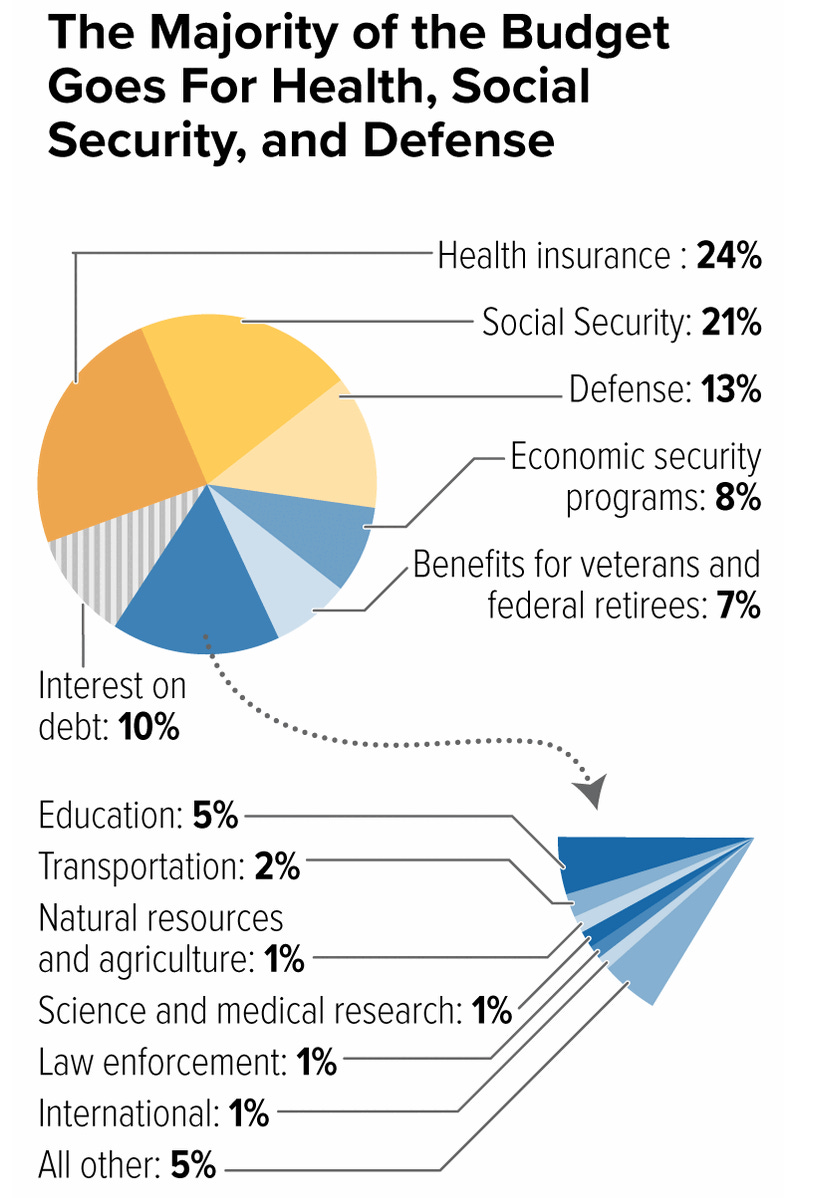
First, finding big-ticket examples of government waste is hard, because the government mostly spends money on things people want. Here’s a nice chart from the Center on Budget and Policy Priorities, showing where the money goes:

Yes, the federal government is an insurance company with an army.

Second, you shouldn’t trust claims about the budget coming from Some Guy on the Internet. You might have imagined that the world’s richest man could have a couple of fact-checkers on retainer to help ensure that he isn’t making clearly stupid assertions. But nooo.

In a barrage of posts on X Musk pushed misinformation about a more or less routine, place-holding bill that was basically a way to keep the ship of state afloat until Trump takes charge. Maybe this was in part a power play, an attempt to make Republicans in Congress show fealty to a man who clearly imagines that he’s the real president — and Trump, by meekly endorsing Musk’s position, did in fact convey the impression that Musk is leading the guy who is supposed to be in charge by the nose. But this political theater will have real consequences, for America, for Trump, and for Musk himself.

Musk has asserted that shutting the government down for a month would do no harm. And it’s true that Social Security, Medicare and Medicaid funding — which is where the bulk of the money goes — will continue. But many services people rely on will be disrupted, especially if the shutdown goes on for more than a month, which seems all too likely given Republicans’ razor-thin House majority and the dominance of misinformation in many members’ thinking.

Maybe Musk himself doesn’t expect to experience any hardship, but put it this way: I’m glad that I won’t need to renew my passport any time soon, that I don’t expect to be trying to get through airport security for a while, and especially glad that I don’t rely either on food stamps or on small business loans. For all of these things have been disrupted in past government shutdowns.

Do Musk and Trump know any of this? Almost surely not.

Beyond the specifics, my guess is that antics like the potential shutdown will do much more damage to the Musk/Trump administration than they realize. (There’s also this other guy — JV Dance or something? — but he clearly doesn’t matter.)

First, since the election financial markets have clearly been betting that Trump will do very little of what he promised during the campaign — that we won’t really have a trade war, just some minor trade skirmishes, that we’ll have symbolic deportations rather than a mass roundup of immigrants, and so on. Markets have, in effect, discounted the disastrous consequences that would follow if Trump honored his own promises.

But a government shutdown in response to completely false claims about what’s in an innocuous short-term funding measure suggests that the peddlers of misinformation are high on their own supply. Trump may really believe that foreigners will pay tariffs, that U.S. trade deficits subsidize the rest of the world, that there’s a reserve army of American workers available to fill the gaps deportation would create. I don’t want to put too much weight on the latest market fluctuations, but it is starting to look as if investors are questioning their own complacency.

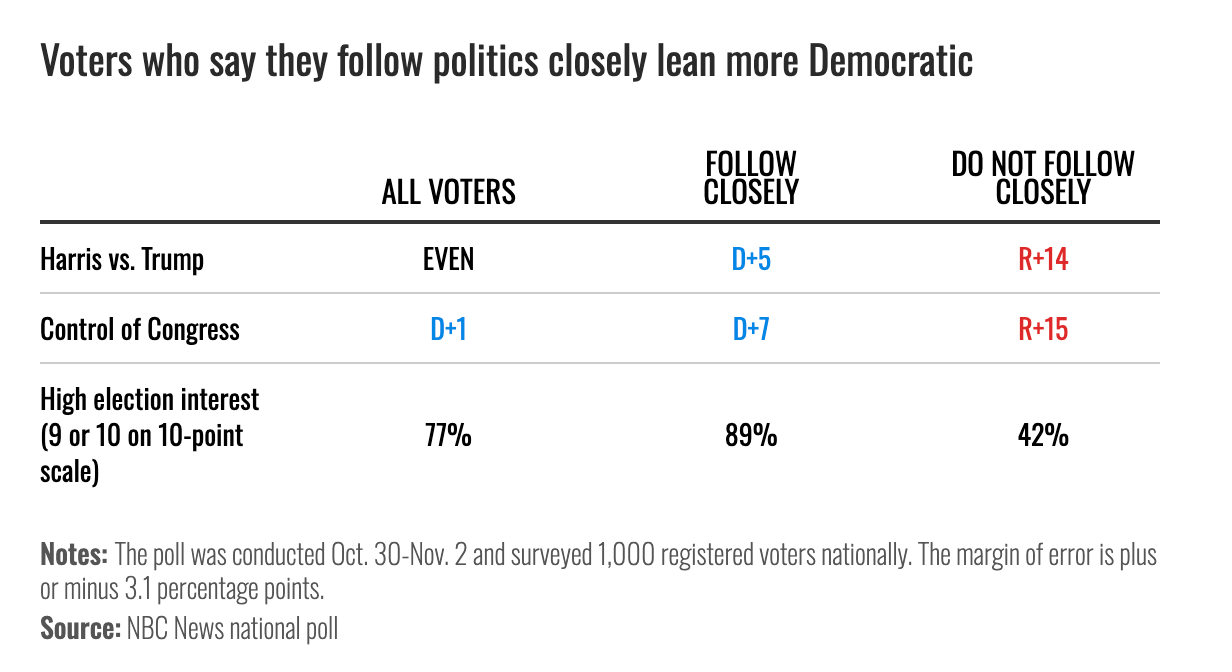
Second, many, probably most people who voted for Trump believed that he really is the character he played on The Apprentice — a highly competent manager. The other day I said that Trump was elected by low-information voters; this wasn’t a slur on Americans’ intelligence, it was a reference to survey results showing that Trump’s edge depended entirely on support from voters who don’t pay much attention to politics:

How will these voters react if, as seems all too likely, the second Trump administration is instead marked by rolling chaos?

Anyway, it’s pretty remarkable. Inauguration Day is still a month away, yet the chaos monkeys have already taken over. (snip)

Cookies In The Oven

but this is so nice, I had to share it. Sorry about the cookies, though. Our moon isn’t full here until 3:01 Sunday AM.

december full moon by onecloud

fri 13, 2024 over richmond st. at spadina ave. Read on Substack

december full moon

over richmond at spadina

at 5 PM

under full moon 
traffic west bound
bound for home

at oxford st

at richmond

Covers Everything Well

Israel Executing Land Grabs In Syria

Here’s a cool thing-

Wheels of Good Fortune: Transforming Lives Through Free Wheelchairs

Don Schoendorfer’s nonprofit delivers more than free wheelchairs to people in developing countries. It delivers dignity and hope — and transforms lives.

Ken Budd

Wheel man: Don Schoendorfer shows off his foldable, third-generation wheelchair, which his charity distributes for free around the world. (Photo courtesy Free Wheelchair Mission)

The first thing they see are our feet,” says Don Schoendorfer. The organization he founded, Free Wheelchair Mission (FWM), delivers wheelchairs to people with disabilities in developing nations, from Uganda to Brazil. When Schoendorfer and his team arrive, recipients are often on the ground, lying on their stomachs. Some drag themselves with their hands.

“They’ve looked up at people their whole lives,” Schoendorfer says. “When you get them into a chair, they often break out in happy tears. And they look different than when they were on the ground. Suddenly the dignity they never had is coming back. You give them a hug and they don’t want to let go because they’re crying. And you look around and the whole family is crying.”

Schoendorfer has seen this “phenomenal change” on multiple continents. FWM has distributed over 1.4 million wheelchairs in 95 countries since he founded the nonprofit in 2001, driven by the low-cost wheelchair he designed and constructed in his garage. The wheelchairs have improved over the past 23 years, but they’re still cost-efficient. For just $96, the Irvine, California-based organization can build, ship, and deliver a wheelchair anywhere around the world.

Schoendorfer was the right man for this globe-trotting mission. “He has this scrappiness — he can make something out of nothing,” says Nuka Solomon, the organization’s CEO. And he was born to build: His father was a machinist for the New York Central Railroad.

“My father taught me and my two older brothers about mechanical things,” he says of family life in Ashtabula, Ohio. “I knew I was going to be an engineer.”

It wasn’t easy. When his two brothers went to college — one became a civil engineer, the other a chemical engineer — his parents told the then-eight-year-old Schoendorfer that little money would remain for his education. He needed to improve his grades and start saving money, Mom and Dad said. He did both. For 10 years, the future engineer had a paper route. He earned an undergraduate degree from Columbia University and a Ph.D. in mechanical engineering from MIT.

Two years later, he experienced a life-changing moment. He and his wife, Laurie, were on vacation in Tétouan, Morocco, when they saw a woman on the ground, crawling with her fingernails, digging them into a dirt road.

“She was pulling herself, one hand at a time, a few inches,” he remembers. “I suspect she had polio. She was bleeding. Her clothes were shredded. And people were stepping over her, not wanting to touch her, not wanting to help her, not wanting to talk to her.”

The woman disappeared down an alley. Schoendorfer and Laurie looked at each other and thought: Why did we see this?

The image was planted in his mind. But for the next 20 years, Schoendorfer continued a career in biomedicine. He enjoyed the work and holds more than 60 biomedical patents. His life started to change when the oldest of his three daughters, then 13, began a long struggle with bulimia. Schoendorfer had always been religious — his father was the sexton of a small Congregational Church — and as their daughter fought her illness, he and his wife “surrendered to the Lord.”

“I think we need to do this,” he told Laurie. “We’ve got to figure out how to get help from God.”

The battle with bulimia, he says, was a “dreadful” time for his family. But they were going to church on Sundays, and his spirituality was deepening. And then, God spoke to him.

“The way I sum it up, it was like a phone call in the middle of the night,” he says. The voice told him he was wasting his time; that he wasn’t using his gifts. “And then this vision of the woman trying to get across the dirt road was right in front of me,” he recalls. “It had been sitting there for 20 years.”

A world of difference: Free Wheelchair Mission has touched 95 countries, including Armenia, Morocco, Vietnam, and (shown here) Peru. (Photo courtesy Free Wheelchair Mission)

His priorities changed. Schoendorfer identified around 20 organizations that distributed wheelchairs. Together, however, the nonprofits had only donated about 100,000. That number seemed low. His idea: To increase donations by developing a less-expensive wheelchair.

He started at a local shopping center. Home Depot had white resin lawn chairs for $4 each. Toys’R’Us sold bicycles made in China for $60.

“From what I know about manufacturing, those wheels probably cost about $3 each to make in China,” he says. “So for $10, I had the two most important parts: The chair and the back wheels.”

He showed a prototype to the pastor of his church, who had just returned from a mission trip to the Democratic Republic of Congo. The timing was remarkable. The pastor had seen numerous people who needed wheelchairs — and it had weighed on him.

“There were people crawling, and here you walk in with a solution three days later,” the pastor told Schoendorfer.

That moment convinced Schoendorfer to keep working. Soon he had 100 homemade wheelchairs in his garage. Then his wife saw an announcement for a medical outreach trip to Chennai, India. He could only take four wheelchairs with him — and his fellow volunteers, mostly doctors and nurses, were not impressed.

“It didn’t even look like a wheelchair to them,” he says. “It was a bright white patio chair with mountain bike tires. And they tried to make me come to my senses by asking logical questions like, ‘Who’ll do the training? Where’s the money coming from? Who’s going to give them out? How are you going to deal with repairs?’ And I said, ‘Listen, my main point here is to prove this works.’”

That opportunity came on a visit to Chennai’s suburbs. A family had carried their son three miles on a dirt road to reach the team’s makeshift clinic. The son had advanced cerebral palsy. He seemed agitated. He had uncontrolled contractures of his arms and his legs, and he’d been carried by a hot body in 100-degree heat and 100 percent humidity. Schoendorfer pulled down a wheelchair from the top of the medical team’s white bus.

“The mom put her son in the wheelchair. She started pushing it around and he started to calm down,” he says.

They drove the family back to their village. The home was a roughly 8-by-10-foot cinderblock structure with a corrugated tin roof. Inside was a hammock and a pen on the dirt floor for their son. They were thrilled by the wheelchair — but suddenly, the medical mission’s director told Schoendorfer they needed to leave. Now. The team had forgotten to ask the elders for permission to enter the village. The group scrambled into their bus, but villagers blocked their path.

And then the boy’s mom approached with two glasses of water.

“We were leaving without the wheelchair, so she realized it was a gift,” he says. “And in her culture, you had to repay a gift with a gift. The only thing she could afford to give us was water.”

After that first experience — and similar emotional encounters when he distributed the other three wheelchairs — Schoendorfer’s mission changed. Originally he planned to conduct clinical trials in India and write a paper. But the medical mission’s local partners drove him through Chennai to show how many people were disabled.

“They wanted to be a distribution partner,” he says. “They wanted more wheelchairs. They were so far ahead of me. I never thought of anything like that. I wanted to just write that paper.”

Fate intervened. Two weeks later, back in California, Schoendorfer returned to work. It was a Monday morning, but the parking lot was empty: The company had gone bankrupt while he was in India. Meanwhile, at his church, the story of his donations had spread through the congregation. Schoendorfer planned to get another job — his wife wasn’t working at the time — but his fellow parishioners shared a different vision.

“They said, ‘No, no, you can’t do that. This is going to be your job,’” he says. “They knew what God was doing. I didn’t. They said, ‘These aren’t coincidences. I’m going to send you some money so you can make more wheelchairs.’ And I said, ‘Please don’t — I’ve still got 96 in the garage.’ But I started to think. … Maybe this is what God wanted me to do.”

After 15 years as a stay-at-home mom, Laurie went back to work, and Schoendorfer focused on wheelchairs. He bought a book — Nonprofits For Dummies — and founded FWM. That same year, he found a manufacturer in China.

The wheelchairs are distributed by local partners in each country where they work. “We’re giving them out as quickly as we can have them made — and as quickly as we can get the money to have them made,” Schoendorfer says.

The wheelchairs have evolved since that first simple model. The next two versions were more adjustable, more comfortable, and built to last in tough terrains. The third-generation model has a fold-up design, which makes it easier to carry on buses.

“We’ve also learned the importance of adjusting the wheelchair and training people on how to use it. That was something we didn’t do in the beginning,” he says. “If it doesn’t fit right, they won’t use it.”

The demand remains great. Roughly 80 million people worldwide — most in developing countries — need a wheelchair, according to the World Health Organization.

“It’s an emotional event because many have been waiting their whole life for a wheelchair,” Schoendorfer says. “And when they get one, many of them tell me… This is a miracle.”

(Note from me: This is not a religious post. Though helpful people feel that they’ve been led to do things, they did the things themselves. Either way, a great, great service is being done! That’s why I posted this story.)

As Ten Bears has reported-

How climate risks are driving up insurance premiums around the US – visualized

‘Tight correlation’ between premium rises and counties deemed most at risk from climate crisis, experts say

Concern over the climate crisis may evaporate in the White House from January, but its financial costs are now starkly apparent to Americans in the form of soaring home insurance premiums – with those in the riskiest areas for floods, storms and wildfires suffering the steepest rises of all.

mounting toll of severe hurricanes, floods, fires and other extreme events has caused average premiums to leap since 2020, with parts of the US most prone to disasters bearing the brunt. A climate crisis is starting to stir an insurance crisis.

Across all US counties, those in the top fifth for climate-driven disaster risk saw home premiums leap by 22% in just three years to 2023, compared to an overall average of a 13% rise in real terms, research of mortgage payment data has found. The Guardian has analyzed the study’s data to illustrate the places in the US at highest risk from disasters and insurance hikes. (snip)

“This has been the canary in the climate coalmine, and it’s now hitting households’ pocketbooks,” said Ben Keys, an economist at the University of Pennsylvania’s Wharton School and co-author of the research. “You can deny climate change for whatever motivations you have but when insurance is going up because you live in a risky area, that’s hard to deny.” (snip-MORE)

The graphics on this article are Amazing, and should be seen. But I couldn’t get them to embed this time, so please click through.

https://www.theguardian.com/environment/2024/dec/05/climate-crisis-insurance-premiums

Peace & Justice History for 12/5

(Barfbag alert for the 2002 entry. But it is US history.)

December 5, 1955
Five days after Rosa Parks was arrested for refusing to give up her bus seat to a white man, the African-American community of Montgomery, Alabama, launched a boycott of the city’s bus system.
The Montgomery Improvement Association (MIA) was formed to coordinate the boycott with Dr. Martin Luther King, Jr.,
elected as its president.

Out of Montgomery’s 50,000 black residents, 30,000-40,000 participated. They walked or bicycled or car-pooled, depriving the bus company of a substantial portion of its revenue.
The boycott lasted (54 weeks) until it was agreed the buses would be integrated.


Waiting at a transportation pickup point during the Montgomery bus boycott – 1955-1956
< What was the Montgomery Bus Boycott? > 
December 5, 1955
The American Federation of Labor, which had historically focused on organizing craft unions, merged with the Congress of Industrial Organizations, an organization of unions largely representing industrial workers, to form the AFL-CIO with a combined membership of nearly 15 million.
George Meany was elected its first president.


AFL-CIO history 
December 5, 1957
New York became the first city to legislate against racial or religious discrimination in housing (Fair Housing Practices Law).
December 5, 1967

Dr. Benjamin Spock  
264 were arrested at a military induction center in New York City during a Stop the Draft Week Committee action. Dr. Benjamin Spock and poet Allen Ginsberg were among those arrested for blocking (though symbolically) the steps at 39 Whitehall Street where the draft board met. 2500 had shown up at 5:00 in the morning to show their opposition to the draft and the Vietnam War.
 
Allen Ginsberg
December 5, 1980
The United Nations adopted the charter for the University for Peace in Costa Rica. Its purpose would be “promoting among all human beings the spirit of understanding, tolerance and peaceful coexistence, to stimulate cooperation among peoples and to help lessen obstacles and threats to world peace and progress . . . .”

The monument sculpted by Cuban artist Thelvia Marín in 1987, is the world’s largest peace monument.
It also established short-wave Radio for Peace International (RFPI)which was shut down by the University in 2004 when RFPI exposed a plan between the University for Peace and the U.S. to hold anti-terrorist combat training on campus. 
Interview with James Latham, CEO of RFPI when it was under siege 
December 5, 2002

President George W. Bush with Sen. Lott and Sen. Thurmond
At the 100th birthday celebration for Senator Strom Thurmond (R-South Carolina), Senate Republican leader Trent Lott (R-Mississippi) praised Thurmond’s Dixiecrat Party 1948 presidential campaign (official slogan: “Segregation Forever!”).
“I want to say this about my state. When Strom Thurmond ran for president, we voted for him. We’re proud of him. And if the rest of the country had followed our lead, we wouldn’t have had all these problems over all these years, either.”
The reaction to this sentiment led to Lott’s resignation as Senate majority leader.

https://www.peacebuttons.info/E-News/peacehistorydecember.htm#december5

US economy grows at 2.8% pace in third quarter on consumer spending

https://abcnews.go.com/Business/wireStory/us-economy-grows-28-pace-quarter-consumer-spending-116269393

The American economy expanded at a healthy 2.8% annual pace from July through September on strong consumer spending and a surge in exports, the government said Wednesday, leaving unchanged its initial estimate of third-quarter growth

ByPAUL WISEMAN AP economics writer
November 27, 2024, 8:39 AM
 

The American economy expanded at a healthy 2.8% annual pace from July through September on strong consumer spending and a surge in exports, the government said Wednesday, leaving unchanged its initial estimate of third-quarter growth.

U.S. gross domestic product — the economy’s output of goods and services — slowed from the April-July rate of 3%, the Commerce Department reported Wednesday.

But the GDP report still showed that the American economy — the world’s largest — is proving surprisingly durable. Growth has topped 2% for eight of the last nine quarters.

Within the GDP data, a category that measures the economy’s underlying strength rose at a solid 3.2% annual rate from July through September, up from 2.7% in the April-June quarter. This category includes consumer spending and private investment but excludes volatile items like exports, inventories and government spending.

Still, American voters — exasperated by high prices — were unimpressed by the steady growth and chose this month to return Donald Trump to the White House to overhaul the nation’s economic policies. He will be supported by Republican majorities in the House and Senate.


Consumer spending, which accounts for about 70% of U.S. economic activity, accelerated to a 3.5% annual pace last quarter, up from 2.8% in the April-June period and fastest growth since the fourth quarter of 2023. Exports also contributed to the third quarter’s growth, increasing at a 7.5% rate, most in two years. Still, the third-quarter growth in both consumer spending and exports was lower than the Commerce Department initially estimated.

But growth in business investment slowed sharply on a drop in investment in housing and in nonresidential buildings such as offices and warehouses. By contrast, spending on equipment surged.

When he takes office next month, President-elect Trump will inherit an economy that looks broadly healthy.

Growth is steady. Unemployment is low at 4.1%. Inflation, which hit a four-decade high 9.1% in June 2022, has fallen to 2.6%. That is still above the Federal Reserve’s 2% target, but the central bank felt satisfied enough with the progress against inflation to cut its benchmark interest rate in September and again this month. Most Wall Street traders expect the Fed to cut rates again in December.

Wednesday’s report also contained some encouraging news on inflation. The Federal Reserve’s favored inflation gauge — called the personal consumption expenditures index, or PCE — rose at just a 1.5% annual pace last quarter, down from 2.5% in the second quarter. Excluding volatile food and energy prices, so-called core PCE inflation was 2.1%, down from 2.8% in the April-June quarter.


The public still feels inflation’s sting: Prices are about 20% higher than they were in February 2021, just before inflation started picking up

Trump has promised an economic shakeup. On Monday, for example, he vowed to slap new import taxes on goods from China, Mexico and Canada. Mainstream economists view such taxes — or tariffs — as inflationary. That is because they are paid by U.S. importers, who then seek to pass along the higher costs to their customers.

Wednesday’s report was the second of three looks at third-quarter GDP. The Commerce Department will issue the final report on Dec. 19.

___

This story has been corrected to show that consumer spending rose at the fastest pace since the fourth quarter, not the first quarter, of 2023.

Letters From An American for 11/17:

This is pretty cool to read!

November 17, 2024 by Heather Cox Richardson Read on Substack

Tonight is a break from the craziness of the news. 

I often say that 1883 is my favorite year in history because of all that happened in that pivotal year, and one of those things is the way modernity swept across the United States of America in a way that was shocking at the time but that is now so much a part of our world we rarely even think of it….

Until November 18, 1883, railroads across the United States operated under 53 different time schedules, differentiated on railroad maps by a complicated system of colors. For travelers, time shifts meant constant confusion and, frequently, missed trains. And then, at noon on Sunday, November 18, 1883, railroads across the North American continent shifted their schedules to conform to a new standard time. Under the new system, North America would have just five time zones. 

Fifteen minutes before the time of the shift, the telegraph company Western Union shut down all telegraph lines for anything but the declaration of the new time. It identified the moment the new time went into effect in telegraph messages to local railroad offices and to the jewelers known in cities for keeping time. In offices that got the message, men had their timepieces in their hands and ready to reset when the chief operator shouted “twelve o’clock!” 

In Boston the change meant that the clocks would move forward about 16 minutes; in New York City, clocks were set back about four minutes. For Baltimore the time would move forward six minutes and twenty-eight seconds; in Atlanta it went back 22 minutes. 

The system was a dramatic wrench for the rural United States, bringing it into the modern world. Uniform time zones had been proposed by pioneering meteorologist Cleveland Abbe, who developed the U.S. system of weather forecasting. Having joined the United States Weather Bureau as chief meteorologist in 1871, he recognized that predicting the weather required a nationally coordinated team and worked with Western Union to collect information about temperature, wind direction, precipitation, and sunset times from across the country. 

Coordinating that information required keeping time across all the stations he had set up. To do so, Abbe divided the United States into four time zones, each one hour apart, and in 1879 he suggested those zones might smooth out the chaos of the railroad systems, each trying to coordinate schedules across a patchwork of local times. Railroad executives, who were concerned that if they didn’t do something, the government would, listened to Abbe, and by 1883 they had concluded to put his new system in place.

Members of the new professional class who traveled by train from city to city were on board because they thought the need to regularize train schedules was imperative. But standard time was controversial. In the United States, people had operated entirely by the rhythms of the sun until the establishment of factories in New England in the 1830s, and most people still lived by those rhythms, their local time adjusting to solar time according to their geographical location. 

Telling the time by sundial and history not only was custom, but also was understood as following God’s time. The idea of overriding traditional timekeeping because of the needs of the modern world seemed positively sacrilegious. “People…must eat, sleep and work…by railroad time,” wrote a contributor to the Indianapolis Daily Sentinel. “People will have to marry by railroad time…. Ministers will be required to preach by railroad time…. Banks will open and close by railroad time; notes will be paid or protested by railroad time.” 

The mayor of Bangor, Maine, vetoed an ordinance in favor of standard time, saying it was unconstitutional, that it changed the immutable law of God, that the people didn’t want it, and that it was hard on the working men because it changed day into night. Those planning for a switch to standard time tried to ease fears by providing that Americans would operate on both local time and standard time, with both times represented on clocks.

On November 18, no one quite knew what the dramatic wrench into the future might mean. 

What did it mean to gain or lose time? Many people expected “a sensation, a stoppage of business, and some sort of a disaster, the nature of which could not be exactly ascertained,” a New York Times reporter recorded. As the great moment approached, people crowded the streets in front of jewelers to see the “great transformation.” 

They were disappointed when, after all the buildup, the future arrived quietly.

The New York Times explained: “When the reader of THE TIMES consults his paper at 8 o’clock this morning at his breakfast table it will be 9 o’clock in St. John, New Brunswick, 7 o’clock in Chicago, or rather in St. Louis—for Chicago authorities have refused to adopt the standard time, perhaps because the Chicago meridian was not selected as the one on which all time must be based—6 o’clock in Denver, Col. and 5 o’clock in San Francisco. That is the whole story in a nut-shell.”

Notes:

Chicago Daily Tribune, “At Noon today Most of the Railroads Will Discard the Old and Adopt the New,” November 18, 1883, p. 12. 

Boston Daily Globe, “Modern Joshuas: They Make Clocks, If Not the Sun, Stand Still,” November 19, 1883, p. 5.

Boston Daily Globe, “At the Railroad Stations, At the Churches,” November 19, 1883, p. 5.

Washington Post, “New Time in Other Cities,” November 18, 1883, p. 1.

Chicago Daily Tribune, “Standard Time,” November 19, 1883, p. 1.

Indianapolis Daily Sentinel, November 21, 1883, p. 4, Quoted in Ian R. Bartky, Selling the True Time: Nineteenth-Century Timekeeping in America (Stanford: Stanford University Press, 2000), p. 144.

New York Times, “Time’s Backward Flight,” November 18, 1883, p. 3. https://historymatters.gmu.edu/d/5748

Robert E. Riegel, “Standard Time in the United States,” American Historical Review 33 (October 1927): 84–89.

CBPP Statement: November 14, 2024 – For Immediate Release

Republican Economic Proposals Would Harm the People Trump Promised to Help

Statement of Sharon Parrott, CBPP President, on key priorities for the 2025 policy agenda

While the new President and new Congress will not take office until early next year, they have already put forward an agenda — through Project 2025, Republican budget plans, and campaign proposals — that would increase poverty and diminish opportunity. Their proposals would raise costs for basics like housing, food, and health care and take health coverage away from people; slash funding for schools where our children learn, roads and bridges we use to get to work, and scientific and medical research that improve our health and strengthen our economy; double down on tax giveaways for wealthy households and corporations while imposing tariffs that fuel inflation; and further widen already glaring differences in people’s well-being and opportunity across income, race, and ethnicity.

These policymakers campaigned on promises to make the economy work better for people without big bank accounts who are trying to get ahead. But their proposals to date seldom match those promises.

Instead, a policy agenda designed to advance economic opportunity and racial justice and help families make ends meet would:

  • Make it easier for people to afford housing, food, health care, and prescription drugs.
  • Support children and families with an expanded Child Tax Credit, especially for children who don’t get the full credit today because their families’ incomes are too low; more affordable child care; and investment in our schools so that all of our nation’s children get what they need to thrive.
  • Invest in the things that will keep the economy strong and growing, including basic building blocks like roads, bridges, and research, as well as protections that keep our communities’ food, air, water, and workplaces safe.
  • Support these investments with a fairer federal tax system that requires wealthy households and corporations to pay their fair share and strengthens our fiscal outlook.
  • Create an immigration system that recognizes the critical role that immigrants and their families play in our communities and the economy, eschewing harsh deportation regimes that separate families and embracing reforms that provide people with a workable opportunity to gain legal status and a pathway to citizenship.

This kind of policy agenda would build toward a nation where everyone — regardless of their income or their background — can get the health care they need, afford to put groceries on the table, live in safe homes and strong communities, and have the income, education, and child and home care they need throughout their lives. And it would reflect the truth that our nation succeeds only when all of us succeed.

We are eager to work with policymakers who put forward policies that advance this agenda and we — together with our partners — will work hard against policies that make people less economically secure, less healthy, and have less access to opportunity.