What is shocking is how ill informed some people in the US are. This is part of the dumbing down of the US education system. So many right wing / or maga people are so uneducated and wrong because they believe the misinformation fed them along with the hyper US is always correct and never wrong they are fed by the right wing media that is designed to mislead the maga public ready to accept / follow an authoritarian government meant to make their lives harder while making the lives of the very wealthy even more wealthy. Just listen to the arrogance the person asking the question has even though they are totally incorrect on everything they claim / write to Belle. Hugs
Of course tRump gets to control the money himself and he claims he will control all of Gaza with the goal of creating a beachfront resort and hotel complex with no input from the Palestinian people nor any mention of where they will live. It is a total money making gambit with no humanitarian aid allowed for the Palestinians at all. No food, no healthcare, nothing. It is like they simply will not be there one way or the other. Hugs
What is the US treasury not secure enough? Who is getting the money? Who bought the oil. As the report says this is all to side step the legalities that would or could arise if the money was held under the US legal system in the US. Which leads to questions. Again who is getting the money and why? Is this going to tRump and family while the US taxpayer gets the bill for securing the ill gotten gains? Is it so creditors can’t collect their legally due money again so tRump and family get to keep it. See my issue with all this? The US is being led by a mob boss wannabe gangster. Hugs
I put this one here with because tRump needs to be a total authoritarian strong man dictator to be able to grift and steal as much money as possible both from the US treasury along with other sources. Hugs
Full disclosure I love watching Digby when she is on The Majority Report. That lady knows her stuff. I don’t know much about Tom Sullivan but if she is willing to put him on her site I will give him the benefit of the doubt. As for Randy Fine. He is a fanatic Christian nationalist who wants the US to be run by his church doctrines, who help write and push for the don’t say gay bill in Florida saying he couldn’t tolerate that when LGBTQ+ people came out to their peers they were accepted instead of being ostracized and beaten up. Yes he wants to return to the days of being different from the straight cis majority got you harassed, harmed, and injured. I guess that means if you are too afraid to come out and live as who you are it will make you a good straight cis person willing to submit to his god? He also is desperately stupid and is full die hard maga. He is another racist who thinks might makes right. Hugs
Where are the Epstein files? A social media poster on Monday noted, “So when an ICE officer tells you to get out of the car, you’re supposed to get out of the car, what are you supposed to do when a judge tells you to release the Epstein files?”
Thus in the field failure to comply with orders barked by kitted-out and under-trained DHS enforcers merits a bullet to the head. Yet failure of AG Pam Bondi’s DOJ to comply with the Epstein Files Transparency Act, passed overwhelmingly by Congress and signed by Dear Leader, seems not to merit not even a slap on the wrist. Immediately after the killing of Renee Good in Minneapolis, the right claimed her death was the consequences of her own choices.
Donald Trump’s “Great Again”: For my friends, a pardon; for my enemies, a bullet to the head. God bless America.
Here’s a choice a fine Republican from Florida’s 6th District made on Monday: H.R.7012 – To authorize the annexation and subsequent admission to statehood of Greenland, and for other purposes.
Is it a troll by a Trump brown-noser? The image suggests that that is likely. But these days, who can tell? Rep. Randy Fine has one cosponsor. Greenland has a tenth the population of Wyoming and no love for Donald Trump. Fine would likely oppose statehood for Puerto Rico or the District.
“By acquiring Greenland, we would prevent our adversaries from controlling the Arctic Region and secure our northern flank from Russia and China,” writes Fine.
Malcolm Nance, former naval intelligence officer, foreign policy analyst and pundit, itemized for Fine a few consequences of annexing Greenland. One assumes from the worst-case rant (and a few misspellings) that Nance is emptying both barrels at the former gaming executive. Nance’s response on X is over the top, but satisfying nonetheless:
CONSEQUENCES FOR DUMBASSES: You are an F’ing idiot. If we invade Greenland we go to war with 31 nations. NATO stays together but without us. Its HQ is in Brussels, not the Pentagon. Our global reach across the Atlantic will end with our closest refueling base in Israel or Egypt. 100,000 American soldiers will be forced to board civil airliners and sent home or be taken as POWs/Detainee sWITHOUT WEAPONS OR EQUIPMENT. Canada will close its airspace and sea space. US Ballistic Missile Defense at Pettufik and Fylingdales ENDS, which means we see nothing except what space sensors can see. US Intelligence is reduced to Fort Meade, Ft Gordon and Colorado Springs and Hawaii. CIA spies will be rolled up by their former friends in HOURS. NO ONE WILL SHARE ANYTHING WITH US. ALL GLOBAL SHIPPING WILL BE CLOSED TO US. Denmark operates the largest shipping company in the world. SIX OUT OF TEN global shipping companies are in Europe … Worlds Biggest container ships? DENMARK! Australia, NZ, Canada are Commonwealth so they will cut ties with us or be neutral too.
PS Denmark & locals tun all life support and generators at Pittufik and Canada resupplies it … all 150 US Spece force personnel would become POWs to guys on sleds. FYI They have troops there now and 35,000 Caribou hunting rifles.
FYI France and UK have nukes. Hundreds of them so you cannot intimidate them with that.
Oh and they collapse the US economy by sanctioning us and selling off 2.3 Trillion in US treasuries simultaneously. Also no Botox, Ozempic or insulin. Its made in Denmark.
Ya fucking dope.
That’s fair. Over the top, but fair. (I especially appreciate Nance’s observation about the potential loss of strategic refueling bases.)
Marcy Wheeler already pointed out that Trump admitted to the New York Times that his need to possess Greenland stems from a personal problem.
Elon Musk’s own AI already reported that not owning Greenland is no impediment to building new U.S. bases there or expanding existing ones. As for mining, several reports observe that if whatever useful minerals lie buried in Greenland, if they were “getable,” mines would already be in operation:
Researchers say it would be extremely difficult and expensive to extract Greenland’s minerals because many of the island’s mineral deposits are located in remote areas above the Arctic Circle, where there is a mile-thick polar ice sheet and darkness reigns much of the year.
Not only that, but Greenland, a self-ruling territory of Denmark, lacks the infrastructure and manpower required to make this mining dream a reality.
“The idea of turning Greenland into America’s rare-earth factory is science fiction. It’s just completely bonkers,” said Malte Humpert, founder and senior fellow at The Arctic Institute. “You might as well mine on the moon. In some respects, it’s worse than the moon.”
So is our sitting president. Pray for consequences for him.
I still do not see the emergency need here as none is really stated. What is the security issue? I think the thing is tRump’s admin wants to erase anything that as any other administration’s branding on it. The object is to make DC tRump’s city bearing only his branding and everything named after him. He sees other tyrant authoritarian dictator has a city named after them, he wants DC to be his, the White House to be a palace like other royalty has so he must have, and his rule to be unquestioned. Hugs.
The Trump administration is extending its wrecking ball to yet more historic buildings in Washington as the president’s pet projects — including his golden ballroom and triumphal arch — press forward.
Homeland Security Secretary Kristi Noem appears before the House Committee on Homeland Security on Capitol Hill on Dec. 11, 2025.Mark Schiefelbein / AP Photo
The Trump administration is looking to tear down more historic buildings in Washington as the president, nearly a year into his final term, looks for ways to leave his mark on the District of Columbia.
This includes the destruction of the East Wing of the White House to make way for the president’s grand ballroom, which he now says will cost some $400 million, as well as a massive so-called arc de Trump.
But a memo uncovered by The Washington Post on Tuesday shows the administration using a new justification (that is, other than Trump’s vanity) to explain its latest effort to raze a part of D.C.’s history: a so-called emergency.
The Post reports Department of Homeland Security Secretary Kristi Noem, whose agency has engaged in some rather lavish spending on her behalf this year, issued a memo earlier this month “seeking to fast-track the demolition of more than a dozen historic buildings at St. Elizabeths in Southeast Washington,” which officials have been converting into a sprawling headquarters for DHS over more than a decade in accordance with historic preservation of treasured landmarks.
Per The Post:
‘Demolition is the only permanent measure that resolves the emergency conditions,’ Noem wrote in the memo. A risk assessment report undertaken by her agency ‘supports immediate corrective action,’ she wrote. The assessment report, which Noem included with her memo, concludes the vacant buildings ‘may be accessed by unauthorized individuals seeking to cause harm to personnel.’ The structures ‘provide a tactical advantage for carrying out small arms or active shooter scenarios,’ the report states.
MS NOW has not independently confirmed the memo. A spokesperson for the General Services Administration, which is overseeing development of the St. Elizabeths campus, confirmed to The Post that the agency had been alerted by the DHS about “a present security risk to life and property” at the campus “that may require us to demolish buildings.”
The report notes the push is being opposed by multiple preservationist groups, including the National Trust for Historic Preservation, which has also sought to thwart Trump’s ballroom project.
It’s yet to be seen whether there’s any true risk in need of being resolved by Trump’s demolition of yet more historic buildings. But if past is prologue, there’s certainly reason to doubt the administration’s “emergency” claims here: namely, the president’s obvious desire to remake the nation’s capital and his administration’s tendency to use claims of “emergencies” to impose a slew of radical policies.
tRump is using the people’s house, the house for the president while he is in office as if it was one of his own properties. Like he was always going to stay there. He is acting like the White House should be a palace like the Saudi royalty or the English kings / queens. He wants the place to be spectacle and pomp instead of what it really is for, a work place for the president to live and work. He also spends the public treasury paid for by the taxpayer as his own private checking account when the laws say that is illegal. Congress approves the budget not the president, but the republicans in congress are too afraid of him to even say anything. I bet you they find their voice if a democrat wins the presidency. Hugs.
President Donald Trump is continuing his renovations of the White House with potential new additions to the West Wing.
After demolishing the White House’s East Wing to make way for a new ballroom in 2025, Trump is now setting his sights on the colonnade linking the West Wing to the executive residence, where he wants to add a second level.
The administration unveiled the plan during a meeting of the National Capital Planning Commission in Washington this week.
Newsweek has contacted the White House for comment via email.
Why It Matters
The White House announced the East Wing ballroom project in late July, with demolition beginning in October, when workers were seen tearing it down.
The White House has said the project will be funded by private donations and no taxpayer burden, though the projected cost has increased from an estimate of $200 million to $400 million.
New Renovation Plans
In an interview with The New York Times on Wednesday, Trump said he was calling the project the “Upper West Wing.” He said it was still in the design phase and that the space could be used for additional West Wing offices or serve as “first ladies’ offices for future first ladies.” These were previously in the East Wing.
The project’s architect, Shalom Baranes, said the White House was weighing up the one-story addition to the West Wing to restore what he described as the complex’s “symmetry” once the East Wing ballroom was finished.
Architect Shalom Baranes shows elevation drawings for a new $400 million ballroom at the White House to members of the National Capital Planning Commi… | Chip Somodevilla/Getty
“I did mention the potential for a future addition, a one-story addition to the West Wing,” Baranes told the commission. “The reason to think about that is so that we would reinstate symmetry along the central pavilion of the White House.”
He made the remarks after unveiling plans for a two-story colonnade that would link the East Room to the new ballroom. The ballroom is set to be about 22,000 square feet and designed to accommodate 1,000 seated guests.
In a statement released in July, the White House said the “much-needed and exquisite addition” would add “approximately 90,000 total square feet of ornately designed and carefully crafted space, with a seated capacity of 650 people—a significant increase from the 200-person seated capacity in the East Room of the White House.”
Backlash
The overall renovation plans have been met with some backlash in recent months.
In December, the National Trust for Historic Preservation filed a lawsuit to stop the East Wing project, saying the administration had dodged a required review process for federal projects. During a hearing in the case, the administration told a federal judge it would submit the project’s plans to the appropriate federal oversight bodies. The judge said he would schedule a follow-up hearing in January to review the White House’s process and declined to halt construction in the meantime.
The trust said following the meeting on Thursday: “Today’s NCPC informational presentation about the White House ballroom was a good and necessary first step. The National Trust continues to urge the Administration to comply with all legally required review and approval processes before commencing construction, including the NCPC, the Commission of Fine Arts, compliance with the National Environmental Policy Act, and approval by Congress.”
It added that it looked “forward to the American people having a voice in the process moving forward.”
Billionaire Toby Neugebauer laughed when the Amarillo City Council asked him how he planned to handle the waste his planned datacenter would produce.
“I’m not laughing in disrespect to your question,” Neugebauer said. He explained that he’d just met with Texas Governor Greg Abbott, who had made it clear that any nuclear waste Neugebauer’s datacenter generated needed to go to Nevada, a state that’s not taking nuclear waste at the moment. “The answer is we don’t have a great long term solution for how we’re doing nuclear waste.
(snip-you can hear a 404 Media podcast if you click through to the story on 404, up there in the post title.)
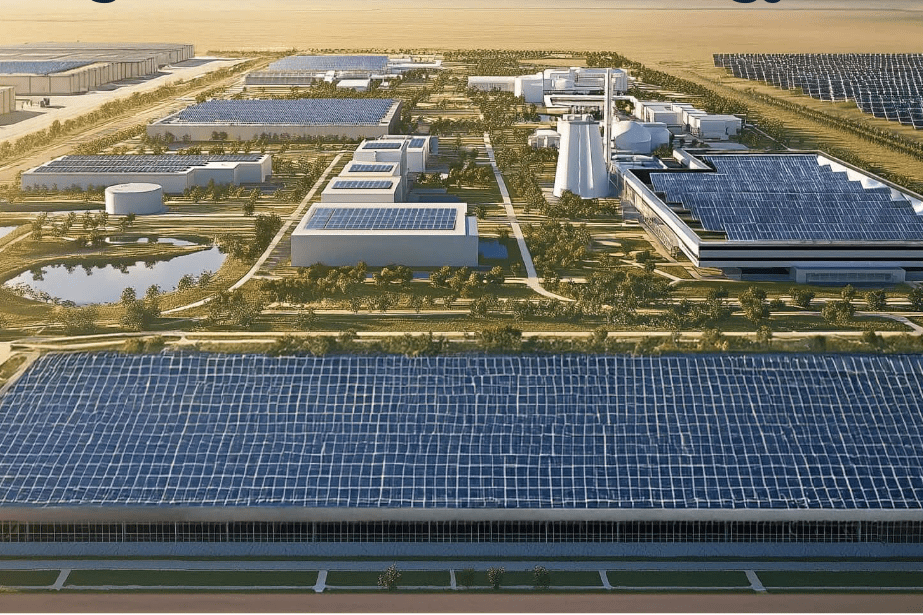
The meeting happened on October 28, 2025 and was one of a series of appearances Neugebauer has put in before Amarillo’s leaders as he attempts to realize Project Matador: a massive 5,769 acre datacenter being built in the Texas Panhandle and constructed by Fermi America, a company he founded with former Secretary of Energy Rick Perry.
If built, Project Matador would be one of the largest datacenters in the world at around 18 million square feet. “What we’re talking about is creating the epicenter for artificial intelligence in the United States,” Neugebauer told the council. According to Neugebauer, the United States is in an existential race to build AI infrastructure. He sees it as a national security issue.
“You’re blessed to sit on the best place to develop AI compute in America,” he told Amarillo. “I just finished with Palantir, which is our nation’s tip of the spear in the AI war. They know that this is the place that we must do this. They’ve looked at every site on the planet. I was at the Department of War yesterday. So anyone who thinks this is some casual conversation about the mission critical aspect of this is just not being truthful.”
But it’s unclear if Palantir wants any part of Project Matador. One unnamed client—rumored to be Amazon—dropped out of the project in December and cancelled a $150 million contract with Fermi America. The news hit the company’s stock hard, sending its value into a tailspin and triggering a class action lawsuit from investors.
Yet construction continues. The plan says it’ll take 11 years to build out the massive datacenter, which will first be powered by a series of natural gas generators before the planned nuclear reactors come online.
Amarillo residents aren’t exactly thrilled at the prospect. A group called 806 Data Center Resistance has formed in opposition to the project’s construction. Kendra Kay, a tattoo artist in the area and a member of 806, told 404 Media that construction was already noisy and spiking electricity bills for locals.
“When we found out how big it was, none of us could really comprehend it,” she said. “We went out to the site and we were like, ‘Oh my god, this thing is huge.’ There’s already construction underway of one of four water tanks that hold three million gallons of water.”
For Kay and others, water is the core issue. It’s a scarce resource in the panhandle and Amarillo and other cities in the area already fight for every drop. “The water is the scariest part,” she said. “They’re asking for 2.5 million gallons per day. They said that they would come back, probably in six months, to ask for five million gallons per day. And then, after that, by 2027 they would come back and ask for 10 million gallons per day.”
During an October 15 city council meeting, Neugebauer told the city that Fermi would get its water “with or without” an agreement from the city. “The only difference is whether Amarillo benefits.” To many people it sounded like a threat, but Neugebauer got his deal and the city agreed to sell water to Fermi America for double the going rate.
“It wasn’t a threat,” Neugebauer said during another meeting on October 28. “I know people took my answer…as a threat. I think it’s a win-win. I know there are other water projects we can do…we fully got that the water was going to be issue 1, 2, and 3.”
“We can pay more for water than the consumer can. Which allows you all capital to be able to re-invest in other water projects,” he said. “I think what you’re gonna find is having a customer who can pay way more than what you wanna burden your constituents with will actually enhance your water availability issues.”
According to Neugebauer and plans filed with the Nuclear Regulatory Commission, the datacenter would generate and consume 11 gigawatts of power. The bulk of that, eventually, would be generated by four nuclear reactors. But nuclear reactors are complicated and expensive to make and everyone who has attempted to build one in the past few decades has gone over budget and they weren’t trying to build nuclear power plants in the desert.
Nuclear reactors, like datacenters, consume a lot of water. Because of that, most nuclear reactors are constructed near massive bodies of water and often near the ocean. “The viewpoint that nuclear reactors can only be built by streams and oceans is actually the opposite,” Neugebauer told the Amarillo city council in the meeting on October 28.
As evidence he pointed to the Palo Verde nuclear plant in Arizona. The massive Palo Verde plant is the only nuclear plant in the world not constructed near a ready source of water. It gets the water it needs by taking on the waste and sewage water of every city and town nearby.
That’s not the plan with Project Matador, which will use water sold to it by Amarillo and pulled from the nearby Ogallala Aquifer. “I am concerned that we’re going to run out of water and that this is going to change it from us having 30 years worth of water for agriculture to much less very quickly,” Kay told 404 Media.
The Ogallala Aquifer runs under parts of Colorado, Kansas, Nebraska, New Mexico, Oklahoma, South Dakota, Texas, and Wyoming. It’s the primary source of water for the Texas panhandle and it’s drying out.
“They don’t know how much faster because, despite how quickly this thing is moving, we don’t have any idea how much water they’re realistically going to use or need, so we don’t even know how to calculate the difference,” Kay said. “Below Lubbock, they’ve been running out of water for a while. The priority of this seems really stupid.”
According to Kay, communities near the datacenter feel trapped as they watch the construction grind on. “They’ve all lived here for several generations…they’re being told that this is inevitable. Fermi is going up to them and telling them ‘this is going to happen whether you like it or not so you might as well just sell me your property.’”
Kay said she and other activists have been showing up to city council meetings to voice their concerns and tell leaders not to approve permits for the datacenter and nuclear plants. Other communities across the country have successfully pushed datacenter builders out of their community. “But Texas is this other beast,” Kay said.
Jacinta Gonzalez, the head of programs for MediaJustice and her team have helped 806 Data Center Resistance get up and running and teaching it tactics they’ve seen pay off in other states. “In Tucson, Arizona we were able to see the city council vote ‘no’ to offer water to Project Blue, which was a huge proposed Amazon datacenter happening there,” she said. “If you look around, everywhere from Missouri to Indiana to places in Georgia, we’re seeing communities pass moratoriums, we’re seeing different projects withdraw their proposals because communities find out about it and are able to mobilize and organize against this.”
“The community in Amarillo is still figuring out what that’s going to look like for them,” she said. “These are really big interests. Rick Perry. Palantir. These are not folks who are used to hearing ‘no’ or respecting community wishes. So the community will have to be really nimble and up for a fight. We don’t know what will happen if we organize, but we definitely know what will happen if we don’t.”
About the author
Matthew Gault is a writer covering weird tech, nuclear war, and video games. He’s worked for Reuters, Motherboard, and the New York Times. More from Matthew Gault







 Scottie's Playtime