December 15, 1791 The Bill of Rights became law when Virginia ratified the first 10 amendments to the United States Constitution. Read The Bill of Rights The Bill of Rights Defense Committee (emphasis mine -A. It’s an important site these days!)
December 15, 1930 Albert Einstein, 1930 Albert Einstein urged militant pacifism and the creation of an international war resistance fund. Einstein stated in New York that if two percent of those called for military service were to refuse to fight, and were to urge peaceful means of settling international conflicts, then governments would become powerless since they could not imprison that many people. He struggled against compulsory military service and urged international protection of conscientious objectors. He concluded that peace, freedom for individuals, and security for societies depended on disarmament; otherwise, “slavery of the individual and the annihilation of civilization threaten us.” Einstein on Peace and World Government
December 15, 1946 Vietnamese leader Ho Chi Minh sent a note to French Premier Leon Blum congratulating him for his selection as French Premier and asking for peace talks. France had exercised colonial power over the Vietnamese as part of French Indochina, formed in October 1887 from the provinces of Annam, Tonkin, Cochin China, and the Kingdom of Cambodia; Laos was added in 1893. Vietnamese nationalists, however, had demanded independence for the three provinces at the end of World War II.
December 15, 1973 The American Psychiatric Association reversed its long-standing position and declared that homosexuality is not a mental illness and “…deplores all public and private discrimination in such areas as employment, housing, public accommodation…” Read the APA policy on discrimination against [gays]
December 15, 2000 The Chernobyl nuclear power plant was shut down 14 years after becoming the site of the world’s worst nuclear accident ever. Nearly nine tons of radioactive material – dozens of times as much as the Hiroshima and Nagasaki bombs – were released in the explosion. The radioactive fallout affected 23% of Belarus, with 4.8% of Ukrainian territory and 0.5% of Russia. The Belarussian government spends 30% of its annual budget dealing with the aftermath of Chernobyl.
She explains how the equation makes it simple, you can not cut your way out of the debt problem as it is a revenue issue. The country needs to take in more money. How does the country take in money, taxes. The poor are already taxed out, but there is a group whose taxes keep getting cut, they will have to pay more. Oh listen to the ones with more money than they will ever need cry about that idea. They would prefer the debt than pay an extra nickle. Hugs
(I was about to post this one but I wanted to read Ten Bears’s first, and that one’s an essential with lots of news. This is a single positive, and possibly a resource for someone. -A)
Last year, Sammi Mrowka, a graduate student at San Diego State University who is nonbinary and transgender, completed the legal process for changing their name and gender marker on IDs. Mrowka, who uses “he” and “they” pronouns, participated in a name and gender marker change clinic run by law students at the University of San Diego, who helped him fill out the paperwork.
“It was worth it to go through all of the mental stress and gymnastics with these government offices to finally get the relief of, for example, going to a doctor’s office and not having to worry about them using my deadname or misgendering me,” Mrowka said. “I can feel the huge, huge relief, realizing how intense it was every single day having to think about all that, to now, where everything’s done.”
University of San Diego and Loyola Marymount University, both Catholic colleges, host name and gender marker change clinics run by law students. The clinics assist trans and nonbinary people in California who want to change their name and/or gender marker on documents like birth certificates, marriage licenses, driver’s licenses, passports, and social security cards.
Accurate IDs allow trans and nonbinary people to live more safely and gain access to resources and public spaces. Accurate IDs can also reduce the risk of harassment, discrimination, or violence.
At LMU in Los Angeles, Siobhan Kelly Fogarty and Rachana Reddi, both third-year law students, are the leaders of Loyola Maymount’s name and gender marker change clinic. LMU had a name-change clinic in 2022, but it had been on hiatus, and Fogarty and Reddi spent the last year reviving it. They held their first virtual clinic this fall, with five people in attendance. At their first in-person clinic at the Los Angeles LGBT Center, around 75 people came.
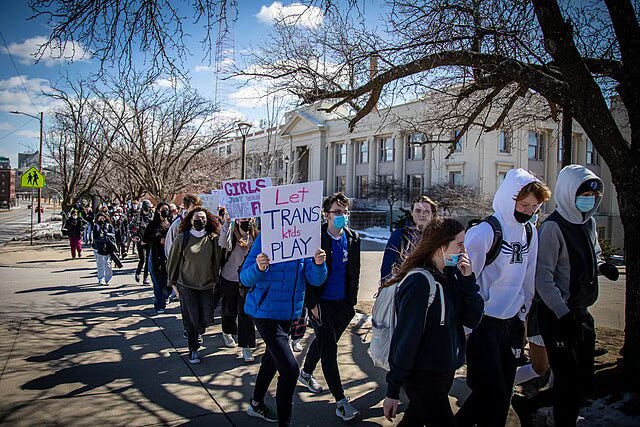
Especially now, when anti-trans rhetoric and legislation is on the rise, Fogarty said the Loyola clinic explicitly connects to the school’s religious mission.
“We’re a Jesuit university, and our school has this social justice mission. [The clinic’s] mission is to serve the LGBTQIA+ community seeking name and gender marker changes,” Fogarty said.
USD’s clinic started in 2018 and meets virtually about once a month. Mrowka contacted the clinic in July 2023 after hearing about it on Instagram and through their therapist. Soon after, he had a Zoom meeting with a student volunteer and lawyer who helped him fill out the paperwork.
“I was kind of shocked initially since it is affiliated with a religious institution, but them even having this clinic made me feel comfortable talking to them,” he said. According to clinic volunteers and attorneys, USD’s clinic has helped more than 1,200 people since opening in 2018.
Lilly Wood is a law student at USD and on the clinic’s board. “The school is supportive of the clinic, but it’s unique in the sense that it is entirely student run,” Wood said. Other clinics at USD, Wood said, are either run through the school itself, meaning students can participate for credit, or are run through Legal Aid Society and facilitated by the school.
“The name change and gender marker clinic is run more like a student organization,” Wood said. “There are six or seven of us right now and we run everything.” In addition, attorney volunteers supervise and assist as needed.
As a virtual clinic, Wood said people reach out via email and give basic information, and law student volunteers begin filling out the proper paperwork. There are multiple forms — “it’s very complicated, but they all make up the petition for a name and gender marker change,” Wood said.
On the night of the clinic, participants from all over the state join on a Zoom call, and the volunteers meet with participants individually to make sure the paperwork is correct, then cover next steps for how to proceed.
“A lot of the legal clinics at USD are very meaningful but different from the gender marker clinic,” Wood said. “We have a domestic violence clinic, a worker’s rights clinic, and a lot of times people are coming in with challenging, sad issues that are happening in their personal lives. Usually when people come into the [gender marker change] clinic, they’re so happy to be there. You’re helping them be themselves in a more honest way. It’s celebratory.”
Shortly before Wood came to law school, she said her friend from high school who was a trans woman passed away.
“She really inspired me with her optimism for life even under horrible transphobia,” Wood said. “When I learned about the clinic, it made me want to honor her memory in lending assistance to other trans people in the community.”
Although Mrowka had been out as nonbinary and trans for about a year before coming to the clinic, they said they had little experience finding affirmation in legal and medical spaces.
“It was really nice to feel the difference of talking to professionals and not having to feel the tension in my body,” he said. “There was no, ‘oh god, hopefully they don’t ask about this or that.’”
Mrowka said he also has trouble filling out forms, and having the volunteers fill them out and answer any questions was a huge help. Once the forms were filled out, Mrowka brought them to the courthouse.
LMU’s clinic is one of the only on campus that isn’t officially organized, meaning they don’t receive school funding, which would allow for a director, office on campus, and for students to get school credit.
Reddi and Fogarty are pushing for it to become an official clinic and hope to see it grow in the coming years, continuing their partnerships with the Long Beach and Los Angeles LGBTQ+ centers and faculty members at Loyola. They’ve received a lot of interest from student volunteers.
“Being able to sit with people and fill out the forms, which for me didn’t feel like a huge task — I would have done as many as they needed me to do — it felt good to be a part of someone’s journey in that way,” Reddi said. “It’s more important than ever to continue to do the work that we’re doing.”
Fogarty went to Catholic school growing up and “didn’t have the best experience as an openly queer kid,” she said. “I was concerned about coming to Loyola at first, and finding these communities is what made me feel okay. I saw that Loyola had an LGBTQ org that was the first of its kind in the country. [It’s important] to create space in these faith-based communities where everyone is welcome and seen and heard and safe.”
Part of Wood’s role on the clinic board at USD is keeping up-to-date on changes in the legal landscape of gender record changes.
“It’s hard to be optimistic right now,” Wood said. “We hear a lot from participants about their concerns. It’s unsettling to not know what’s going to happen next, but we’ll be here to support the community as much as possible. We’re lucky enough to be in California, which is very protective of trans rights, but we’re still kind of at the mercy of the federal government in some ways.”
For Mrowka, though they are no longer religious, USD’s clinic “practiced a lot of the virtues that I learned as a kid growing up in church, in terms of radical acceptance and deep compassion and servitude toward the community,” they said. “It’s another example of what neighborly love could look like. They don’t pretend everything is fine in the United States, but it’s so focused on what we can do with what we have.”
Unaccompanied children detained at the border are first processed by Customs and Border Patrol before being handed over to other US authorities.
Donald Trump’s incoming border tsar, Tom Homan, has said that the US government “can’t find” more than 300,000 migrant children – and that many have been lured into forced labour and sex trafficking.
President-elect Donald Trump and his political allies, including Vice-President-elect JD Vance, have repeatedly made similar claims.
Some experts have accused them of distorting statistics to suggest the children are “lost” and victims of crime, although there is agreement that aspects of the system need to be changed.
The incoming administration has made immigration enforcement a priority, promising to clamp down on the US-Mexico border and conduct mass deportations of undocumented immigrants.
Let’s take a look at the claims of missing migrant children.
What are the Trump team’s claims?
In an interview with Fox News on 26 November – just before a visit to the US-Mexico border in Texas – Homan accused the Biden administration of “bragging” about how quickly children are released from custody, as well as “not properly vetting” adult sponsors in the US.
“Shame on them,” he said of the Biden administration. “They have over 300,000 children that they have released [to] unvetted sponsors that they can’t find.”
“Many are going to be in forced labour. Many forced sex trade,” Homan added. “We need to save these children.”
In his October debate against Minnesota Governor Tim Walz, JD Vance also said that the Department of Homeland Security “effectively lost” a total of 320,000 migrant children.
Concerns over the plight of migrant children were also starkly highlighted earlier this week when authorities in Texas shared an image of a two-year-old girl from El Salvador found at the border clutching a piece of paper with a phone number.
“Putting optics over safety has led to countless children in danger or unaccounted for,” Tennessee Republican representative Mark Green told the New York Post.
“This refusal to protect vulnerable alien children from abuse, exploitation, and human trafficking will be one of the defining failures of the Biden-Harris administration.”
Are the children actually missing?
According to immigration experts and attorneys, the claims largely stem from an August report from the Department of Homeland Security’s inspector general’s office, which found that 32,000 unaccompanied minors failed to show up for court dates at immigration courts from 2019-23.
The report noted that 291,000 migrant children received no court notices at all. It also called on the US Immigration and Customs Enforcement (Ice) to “take immediate action to ensure the safety” of unaccompanied migrant children in the US.
Migrant children “who do not appear for court are considered at higher risk for trafficking, exploitation, or forced labor”, the inspector general’s office reported.
But Aaron Reichlin-Melnick, policy director at the American Immigration Council, a migrant advocacy group, told the BBC the figures are indicative of a bureaucratic “paperwork issue” rather than “anything nefarious”.
“When you hear the phrase ‘missing’, you think that there is a child that someone is trying to find and can’t,” he said.
“That’s not the case here. The government has not made any effort to find these children.”
Many of the children, experts say, may well be at the addresses that are on file with the government, but were simply unable to make their court dates.
“That doesn’t mean something bad happened to them,” Mr Reichlin-Melnick said. “It means you missed a court hearing.”
Mr Reichlin-Melnick added that there are “valid concerns” about exploitation.
“We cannot, however, suggest that all 320,000 of those children are being labour trafficked,” he said.
Eric Ruark, an immigration researcher with NumbersUSA – which calls for tighter border controls – said that the children are difficult to track “because of some combination of apathy, incompetence and bureaucratic inefficiency”.
“Many, hopefully even most, are safe with caring sponsors,” he added. “But the Biden administration can’t actually say one way or the other, and apparently doesn’t care enough to find out.”
What happens to children at the border?
Unaccompanied minors detained at the US-Mexico border go through a complicated process that begins with detention and processing by Customs and Border Patrol, or CBP.
If the child is from a foreign country that is not Mexico or Canada, they are placed into removal proceedings and transferred to the US Department of Health and Human Services, or HHS.
HHS, through its Office of Refugee Resettlement office, cares for the children in a network of state-licensed providers.
The office also seeks to reunify children with family members in the US or with individual or organizational sponsors – who in turn are obligated to ensure they arrive at immigration court dates.
What can the Trump administration do?
Homan and other Trump administration officials have so far not provided many details about how they plan to address the issues that plague the detention of undocumented minors.
Several immigration attorneys contacted by the BBC suggested that the administration is likely to make becoming a “sponsor” for undocumented children much more difficult, even if the sponsor is a member of their family.
In practice, this would mean that more undocumented children are kept in detention.
“They could do what the Obama administration did, and detain them,” said Alexander Cuic, an immigration attorney and professor at Case Western Reserve University.
The controversial “Remain in Mexico” programme could also be applied to children, forcing them to wait across the border for the outcome of immigration proceedings.
“I’m not sure even they know what they’re going to do with the kids,” Mr Cuic said of the Trump administration. “But there’s a border problem they’re trying to figure out first, and that’s the first concern before whether they’re going to be harsh to both children and adults.”
When the BBC asked the Trump transition team what plan they have for the undocumented migrant children, spokesman Taylor Rogers said only that “Democrats’ wide-open border policies” have led to the children going “missing”.
“President Trump and leaders in his administration will deliver on their promise to end the invasion at our southern border that puts innocent children in harm’s way,” she added.
Remember Mace is a notorious attention hound, demanding her staff book her constantly on different media. She does any stunt she thinks will gain her attention. She made over 500 tweets in two days about a new trans member to congress and the bathroom ban she was pushing but at no time did she mention anything helping her constituents. She even sent a staffer back an hour or so later to ask the man to repeat what he said to Mace. So she clearly did not feel assaulted then. But after a time thinking how to spin it for more attention she suddenly claimed to have been badly assaulted with damage to both wrists and her arm so bad that she is parading around with her arm in a sling. What a phony. Slandering an advocate for foster youth and trans kids for clicks and views. She never grew up, she is still a high school girl chasing fame on social media. Hugs
This breaking news story will be updated as more information becomes available.
Aformer foster youth and award-winning advocate for children was arrested at the U.S. Capitol tonight — a bizarre twist in an otherwise celebratory day of events — after South Carolina Rep. Nancy Mace accused him of assault.
The incident took place outside a House of Representatives office building following an event honoring the anniversary of a landmark child welfare law where Mace, a firebrand Republican, had given a speech. Three witnesses at the scene told The Imprint their accused colleague James McIntyre had done nothing more than shake the congress member’s hand at the House reception, and asked her to protect the rights of transgender people.
But in a post on the social media platform X, Rep. Mace described a violent confrontation.
U.S. Rep. Nancy Mace
“I was physically accosted at the Capitol tonight by a pro-tr*ns man. One new brace for my wrist and some ice for my arm and it’ll heal just fine,” she posted at 8:43 p.m. “The Capitol police arrested the guy. Your tr*ns violence and threats on my life will only make me double down.”
The arrest stunned onlookers.
A group of McIntyre’s fellow foster youth advocates rushed to the outside of the Rayburn House Office Building to watch the scene unfold. They stood by tearfully as he was searched for several minutes by police, asking officers where he’d be taken and calling frantically for an attorney who could represent him.
McIntyre, 33, has spoken publicly about his excruciating experience growing up in foster care, and is now a leading voice in policymaking in his home state of Illinois. He is also a chapter co-founder of the influential group Foster Care Alumni of America. In 2019, the National Association of Social Workers’ Illinois chapter named him the “Public Citizen of the Year.”
An officer with the Capitol Police Department told a reporter present at the scene that they were responding to a call about an “assault.” McIntyre was then placed into a police van and driven off.
Other attendees have reacted with outrage since McIntyre’s arrest.
“I want to express deep disappointment in the fact that Congresswoman Nancy Mace came to a national foster youth event, told participating youth that it was a safe space — and literally had one of them arrested by Capital police for simply shaking her hand and asking about trans rights,” said Lisa Dickson, a veteran advocate for foster youth from Ohio, in a Facebook post.
Mace is not new to such publicity. In recent weeks, she has been in the news for her successful campaign to bar newly elected Rep. Sarah McBride — a Democrat from Delaware who is transgender — from using the public women’s bathrooms in the U.S. Capitol.
At tonight’s event, Mace, who co-chairs Congress’ bipartisan foster care caucus, joined a group of legislators at a House reception celebrating the 25th anniversary of the Foster Care Independence Act of 1999. The act created the John H. Chafee Foster Care Program for Successful Transition to Adulthood, legislation that significantly expanded federal support for foster youth who leave the system after turning 18 without a permanent home.
Today’s events featured speeches from some of the former foster youth whose advocacy led to the writing and passage of the law known as the Chafee Act.
In her remarks at the House event, Rep. Mace told the crowd that while she was not an adoptee or former foster youth, she had been a victim of sexual abuse as a child. She called the dozens of advocates and foster youth in attendance — McIntyre among them — “the cream of the crop.”
“I look forward to working with each and every one of you. God bless you, I will be praying for you,” Mace said.
As she finished her comments and moved to leave the room, McIntyre approached her near an exit door, witnesses said.
Elliott Hinkle, a former foster youth and advocate for LGBTQ rights, said McIntyre shook her hand, and made a comment about how many transgender youth are in foster care, adding: “They need your support.”
“From what I saw, it was a normal handshake and interaction that I would expect any legislator to expect from anyone as a constituent,” said Hinkle, a consultant who has advised the federal government on issues affecting youth in foster care.
Later, Hinkle said, one of Mace’s aides returned to the reception and asked McIntyre his name and whether he would repeat what he had told the legislator. Two other people who witnessed the interaction confirmed that description of the brief episode.
McIntyre left the celebration, but he was later summoned back to the Rayburn Building by police.
Hinkle said his subsequent arrest “sends a chilling effect of, you’re not actually safe to go to the Capitol Hill and share an opinion that is true for you, that isn’t violent — because right now if you do, a congressperson might say that they were physically assaulted and call the police on you. So how would a young person in care feel safe?”
Michael Fitzgerald contributed to this report.
I hope everyone can see what the rabid right haters are trying to do. Not only gaslight everyone lying that a horrible assault happened and trans people are the fault and guilty party, but that the left endorses it. A woman was assaulted by a pro trans … trying to hint or make it sound like it was a trans man who did it. The log cabin people are the silliest as they claim she is a supporter of the LGBT, notice the last letter. They can not find a real attach on a woman by a trans person so now they are trying to make one up. Normal maga right dirty tricks. Hugs
With new restrictions on gender-affirming care, prisons confiscate underwear from trans people and compel them to cut their hair.
Earlier this fall, Florida officials ordered transgender women in the state’s prisons to submit to breast exams. As part of a new policy for people with gender dysphoria, prison medical staff ranked the women’s breast size using a scale designed for adolescents. Those whose breasts were deemed big enough were allowed to keep their bras. Everyone else had to surrender theirs, along with anything else considered “female,” such as women’s underwear and toiletry items.
This article was published in partnership with the Tampa Bay Times.
The examinations came after people who had been diagnosed with gender dysphoria by the prison system’s own providers were brought into meetings at the end of September and told of the prisons’ new policy, which would make it nearly impossible for them to get hormone therapy and other gender-affirming medical care, according to interviews and emails with more than a dozen transgender women who said they attended the meetings.
Josie Takach, who is incarcerated in a men’s facility south of Tallahassee, said a male doctor told her to lift up her shirt, then glanced at her breasts and wrote something down without saying a word. When she tried to ask a question, a nurse “told me not to ask any questions and to just shut up and do what I’m told,” she recalled.
“It felt like I was being treated less than human,” she said.
The state’s chapter of the ACLU sued Florida’s Department of Corrections, which operates the prisons, in late October, calling the policy draconian and arguing it amounts to an unconstitutional ban on gender-affirming care. The new policy is the latest maneuver in the culture war around transgender people’s civil rights in the Sunshine State. Florida Gov. Ron DeSantis championed a raft of anti-trans legislation, including a law passed last year that prohibited children with gender dysphoria from accessing treatments like puberty blockers and hormone therapy. A similar law in Tennessee was the subject of arguments in a case before the U.S. Supreme Court last week.
In Tallahassee Monday, a federal judge held a preliminary hearing in the ACLU case. The state had asked the judge to dismiss the lawsuit altogether, and the ACLU asked him to stop the state from enforcing the new rules. The judge is expected to issue a ruling on these questions in the coming weeks.
The Florida Department of Corrections’ media office did not respond to multiple emails and phone calls with detailed questions, but in court papers responding to the ACLU’s lawsuit, the department’s lawyers argued that the new rules are “a carefully crafted policy that creates an individualized course of treatment for each inmate based on scientific evidence and clinical judgment.”
Under the new policy, the Department of Corrections stated that the prisons will only provide those with gender dysphoria with psychotherapy — and not cross-gender hormones — except “in rare instances … if necessary to comply with the U.S. Constitution or a court decision.” The policy argues that “unaddressed psychiatric issues and unaddressed childhood trauma could lead to a misdiagnosis of gender dysphoria,” and that cross-gender hormones “may be requested by persons experiencing short-termed delusions or beliefs which may later be changed and reversed.”
Florida has the country’s third-largest state prison system, with more than 87,000 people incarcerated at the end of September. Of those, 181 have been identified by the department as transgender, and about 100 received hormone treatment, according to documents state officials filed with the courts in the ACLU case.
The new policy was announced in meetings in several prisons across the state at the end of September. Transgender women who attended the meetings said they were told by officials that everyone identifying as transgender would be “re-evaluated” to assess whether they can have continued access to the care and accommodations they had been receiving, such as permission to grow their hair long. Officials have not told the women whether and under what circumstances they will be allowed to stay on the hormones they have been receiving.
Since then, more than a dozen transgender people said corrections officers ordered them to cut their hair. Mariko Sundwall told The Marshall Project that she was given a disciplinary infraction and spent 10 days in solitary confinement for refusing to cut her hair before officers put her in handcuffs and led her to the prison barber where her hair was cropped short.
“[Before] my hair was long enough for a ponytail. Now I have a buzz cut,” said Jada Edwards, incarcerated in Dade Correctional Institution south of Miami. “I’m very sad and depressed. I feel like they’re taking away my identity.”
Scores of women also had their breasts examined, according to filings in the suit and interviews with some of the women. A medical provider for the state assigned each transgender woman a rating on the Tanner scale, a system used by pediatricians to assess the development of adolescents during puberty. Several of the women said they weren’t told what stage was required for permission to keep their bras, but that almost everyone they knew had theirs taken away.
Some report hiding bras or sewing makeshift underwear — although now women’s undergarments are considered contraband and could result in disciplinary charges — because they feel naked and exposed without them.
“I feel like I’m 12 years old again, sneaking around wearing a bra,” said Takach, after her female undergarments were confiscated.
The new policy, which requires psychotherapy to treat underlying issues rather than treating the dysphoria, “comes off like conversion therapy,” says Daniel Tilley, the lead attorney from the ACLU of Florida. “We’re trying to change your fundamental nature to get you to stop being who you are.”
Sarah Maatsch, who is incarcerated in a men’s prison south of Orlando, said she was told that the gender dysphoria diagnosis she received from corrections department doctors in 2019 would now be considered a serious psychiatric illness. If she wants to continue her treatment, she said she was told, she would have to move to a more restrictive prison with more psychiatric services, but fewer work and programming opportunities.
“We are all devastated,” said Maatsch. “There are good days, bad days and the very bad days where a part of you hopes you have a heart attack.”
The new policy is the latest change in health care for transgender people in Florida after a 2023 law said any “governmental entity” in Florida “may not expend state funds … for sex-reassignment prescriptions or procedures.” It did not name prisons specifically, but the Department of Corrections’ new policy says it “shall comply” with this law.
Shortly after DeSantis’ anti-trans bills were passed, transgender people in state prisons began reporting that medications were abruptly changed or delayed with little or no explanation.
Courts have held that prisons are required under the U.S. Constitution to provide gender-affirming hormones as needed. Dan Karasic is a psychiatrist at the University of California, San Francisco who helped develop international standards for treatment of transgender people and who has testified against bans on gender-affirming care in Florida and elsewhere. He read Florida’s new guidelines at The Marshall Project’s request and called them “a fig leaf on their efforts to ban gender-affirming care. They are really trying to skirt the law, as determined by multiple courts, that gender-affirming medical and surgical care must be provided when medically necessary.”
The Florida prison system’s program to treat prisoners with gender dysphoria began in 2017, after Reiyn Keohane sued the state. The federal judge in the case said that the Department of Corrections’ refusal to provide Keohane with hormones and social accommodations, like women’s clothing and haircuts, caused her “to continue to suffer unnecessarily and poses a substantial risk of harm to her health.” During the course of the lawsuit, the state began providing gender-affirming hormone therapy, access to makeup, women’s clothing and other social accommodations within its prisons.
Behind the scenes, Danny Martinez, the state prison system’s medical director, began revising the state’s gender-affirming care program in 2020, he said in a court declaration in response to the ACLU’s recent lawsuit. As many as one-third of the people on hormones in Florida’s prisons were not attending group or personal therapy sessions, he said. “I observed no decrease, and in fact an increase in grievances to the medical and mental health staff from inmates receiving hormone therapy, indicating to me that the treatment solely based on hormone therapy without additional mental health treatment produced limited success,” he wrote. An email to Martinez seeking comment was not returned.
Martinez said he designed the new program based on a 2022 report by Florida’s Medicaid organization that found “insufficient evidence” that medical interventions for gender dysphoria are safe or effective. The report led to the state’s Medicaid program banning coverage of gender-affirming medical care. But a federal judge, in striking down the Medicaid ban last year, found that the report was “a biased effort to justify a predetermined outcome, not a fair analysis of the evidence,” and the report’s conclusion was “not supported by the evidence and was contrary to generally accepted medical standards.”
So far, none of the transgender women incarcerated in Florida have reported being taken off their hormones, but the looming threat has led to widespread anxiety.
“If they took away my hormone therapy treatment, I would be ready to end my life. I’m at that point,” said Sasha Mendoza, who is incarcerated in a men’s prison near Miami, in a declaration filed in the ACLU case. “It may sound drastic. But FDC just let me start my transition and I was doing so well, and now they are making me stop. I’m halfway there and halfway not there.”