The denial of federal money to assist Maryland’s flood recovery continues a trend of spurning devastated residents in states with Democratic governors.
After the recent deadly flooding in Texas, Trump and his administration promised, and ultimately approved, FEMA aid for the Republican-controlled state. In the time since, FEMA’s response there has received criticism — including from the agency’s now-former head of urban search and rescue operations, who just resigned in disgust.
But the fact that Texas received a promise of FEMA aid at all was noteworthy. As I wrote at the time, it was a markedly different stance than the one Trump’s administration has taken with numerous states led by Democratic governors — such as North Carolina, Washington and California — who’ve had their requests for federal assistance denied.
Ja’han Jones is an MSNBC opinion blogger. He previously wrote The ReidOut Blog. He is a futurist and multimedia producer focused on culture and politics. His previous projects include “Black Hair Defined” and the “Black Obituary Project.”
While America’s distracted by the Steven Colbert Show drama and South Park revenge, Trump’s government just dropped over a billion dollars to build the largest detention center in U.S. history
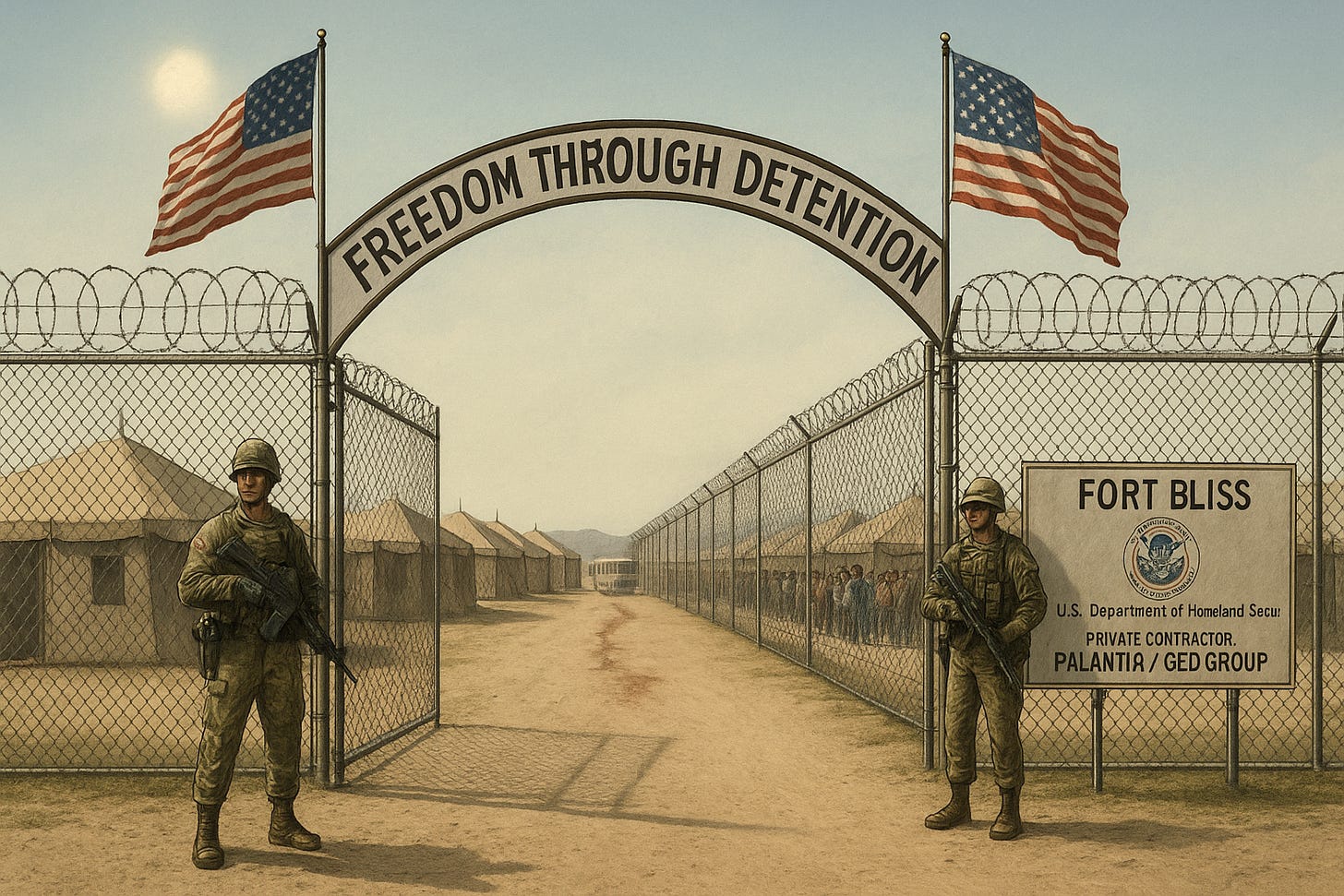
Welcome to Fort Bliss—A $1.2 Billion Dystopian Human Suffering Factory—Funded By You.
You read that right.
Everything is bigger in Texas. $1.26 billion taxpayers money funneled to private pockets. 5,000 prisoners. No due process. Tent concentration camp in a desert.
America 2025 – Detention Will Make You Free
What’s Being Built—And Why It Should Terrify You
A $1.26 billion federal contract has been awarded to construct a 5,000-bed detention camp at Fort Bliss in El Paso, Texas.
It will be operated under military supervision with private contractors and no guaranteed legal oversight.
This is part of a broader Trump-era policy goal: scaling ICE detention to 100,000 beds nationwide—up from around 40,000.
This facility is slated to fast-track deportations under EO 14159, which targets up to 1 million removals per year.
Subscribe
Fort Bliss? It’s Another Alligator Auschwitz,
Of Texas Desert Kind
Let’s be clear: this isn’t just a holding site—it’s inhumane state-sanctioned cruelty.
Fort Bliss sits in El Paso’s desert, where summer temps regularly hit 100–110°F. Inside tents, that can spike above 120°F. No air conditioning. No proper plumbing. Just canvas and suffering. And in winter? Temperatures dip below freezing at night, with no insulation to protect detainees.
Just like at Florida’s now-notorious “Alligator Alcatraz,” ambulances driving through the gate will be a daily feature. Already, reports from that prototype camp detail detainees suffering from medical neglect, contaminated food, and makeshift showers rigged with hoses. Some have called it “worse than jail”—and Fort Bliss will be five times bigger.
Here’s what we know—and why it’s enraging—that private contractors stand to profit from building this $1.2 billion tent detention camp at Fort Bliss:
Based in Virginia, without previous large-scale detention experience, mostly focused on smaller administrative and logistics contracts (often under $2 million).
Disaster Management specializes in erecting large-scale temporary housing (often used in refugee projects). It has received over $500 million in federal contracts since 2020.
Its workforce practices have drawn legal and ethical scrutiny: a 2022 Department of Labor review found wage and overtime violations, leading to nearly $16 million in recovered back pay and compliance enforcement.
Amentum(Another Subcontractor)
A large engineering and tech services firm tapped to support unspecified portions of the Fort Bliss project, likely involving logistics, structure builds, and base coordination.
Why This Should Outrage You
It’s Yet Another Trumpian Grift! Public Funds Are Fueling Private Profits Taxpayer money is funding manufacturers of suffering—people with no due process detained in harsh, tented desert conditions. It’s a state funded deliberate cruelty.
The Blueprint of Authoritarianism
Let’s break it down:
Scapegoat a vulnerable group.
Detain them en masse with no trial.
Use military infrastructure and private contractors to bypass accountability.
Build in remote areas—out of sight, out of mind.
Brand it with Orwellian irony.
“Fort Bliss”? That’s not just cruel. It’s fascist stagecraft.
This isn’t about security. It’s about dehumanization at scale, with taxpayer money funding open-air internment that recalls the ugliest chapters of history. Sound familiar?
PolitiSage
The International Criminal Court Must Indict Donald Trump NOW.
Read more
10 days ago · 2292 likes · 111 comments · Morgaan Sinclair, Ph.D.
What You Can Do
Expose it – Share this article. Make people say the name: Fort Bliss Concentration Camp.
Demand Oversight: Call reps. Demand medical transparency, independent inspections, and an immediate halt to construction.
Support Legal Aid: Many detainees will have no lawyer. Contribute to immigrant defense funds now.
Final Thought
Stop saying “it can’t happen here.” It already is.
We’re not just locking people up—we’re engineering human suffering. And we’re doing it with public funds, in military facilities, under desert sun, with names like Alligator Alcatraz, Fort Bliss to mock our conscience.
If we let this slide, history won’t ask if we knew. It will ask why we stayed silent.
Being Liberal Substack – From Revolution to Resistance is a reader-supported publication. Subscribe. Resist. Share. Fight.
Trump doesn’t rule out pardon for Epstein co-conspirator Ghislaine MaxwellIt comes as Deputy Attorney General Todd Blanche met with Maxwell – who’s serving 20 years in prison for sex trafficking – for a second time.
Ghislaine Maxwell, who sources told ABC News initiated the meetings with the Department of Justice, answered questions for about nine hours over two days after being granted a limited form of immunity, the sources said.
The immunity allowed Maxwell to freely answer Deputy Attorney General Todd Blanche’s questions without fear that her responses could later be used against her, the sources said.
The so-called proffer immunity is commonly granted to individuals prosecutors are seeking to make cooperators in a criminal case. Maxwell has already been tried, convicted and sentenced for sex trafficking underage girls.
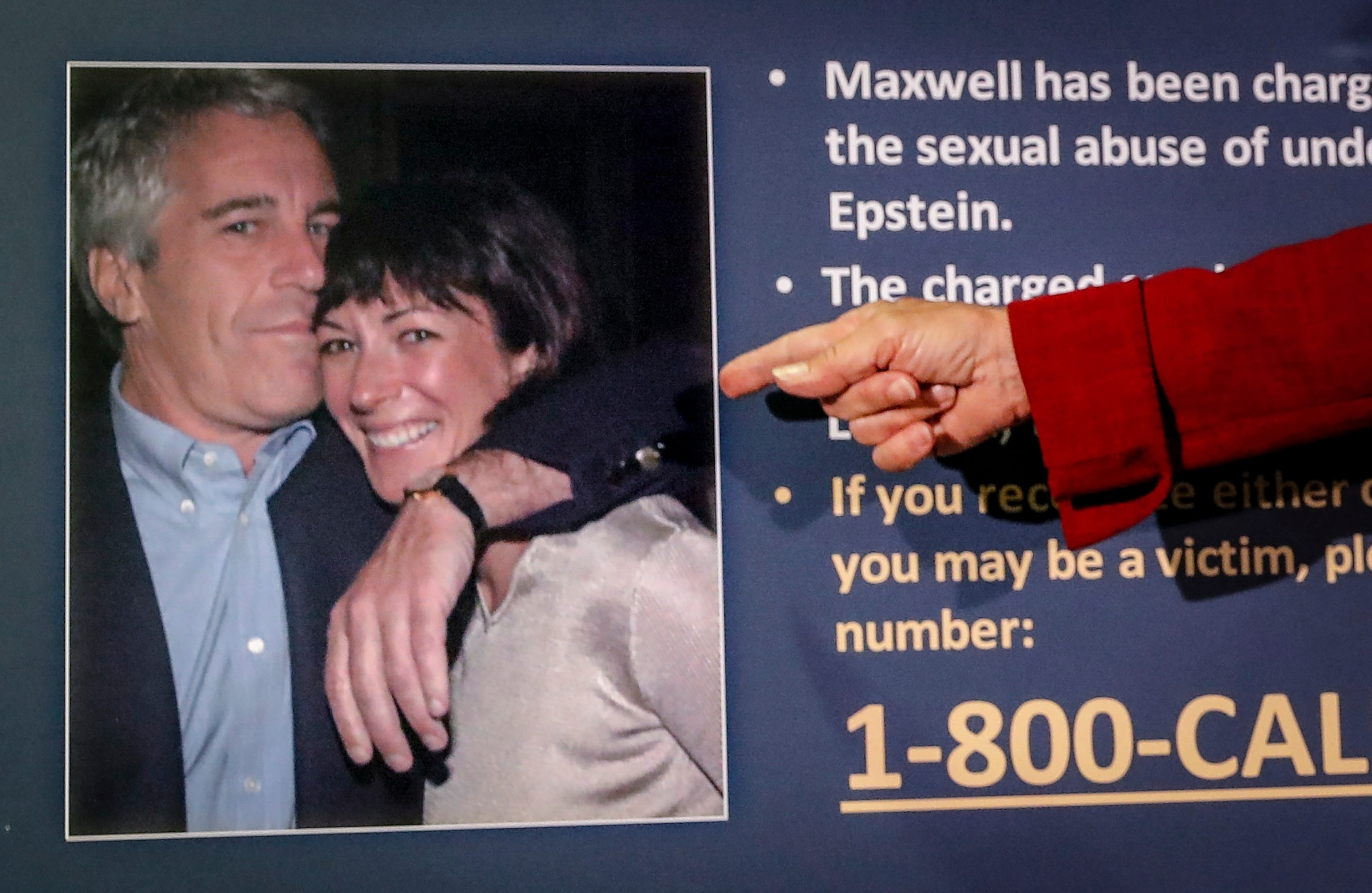
FILE – Audrey Strauss, acting U.S. attorney for the Southern District of New York, points to a photo of Jeffrey Epstein and Ghislaine Maxwell, during a news conference in New York on July 2, 2020.
John Minchillo/AP
DOJ did not immediately respond to request for comment. A lawyer for Maxwell did not immediately respond.
The second meeting between Maxwell and Blanche lasted for about three hours.
Maxwell’s attorney, David Markus, told ABC News afterward, “There have been no asks and no promises.”
Markus said Maxwell was asked about “maybe 100 different people” during her interview with the deputy attorney general. He said she answered every question.
“She didn’t hold anything back,” Markus said.
He declined to be specific about who Maxwell was asked about or whether she provided information about others who might have allegedly committed crimes against victims, as Blanche said he was seeking.
“We haven’t asked for anything. This is not a situation where we are asking for anything in return for testimony or anything like that,” Markus added on Friday. “Of course, everybody knows Ms. Maxwell would welcome any relief.”
Blanche didn’t speak to reporters upon his arrival at the federal courthouse in Tallahassee, Florida. On social media, Blanche said he would reveal what he learned from Maxwell “at the appropriate time.”
FILE – Audrey Strauss, acting U.S. attorney for the Southern District of New York, points to a photo of Jeffrey Epstein and Ghislaine Maxwell, during a news conference in New York on July 2, 2020.
John Minchillo/AP
The first meeting between Maxwell and Blanche on Thursday lasted six hours.
Maxwell is currently appealing her 20-year prison sentence for child sex trafficking and other offenses in connection with Epstein, the deceased financier and convicted sex offender.
“We don’t want to get into the substance of the questions,” Markus had said about Thursday’s meeting. “There were a lot of questions and we went all day and she answered every one of them. She never said ‘I’m not going to answer,’ never declined.”
It is almost unheard of for a convicted sex trafficker to meet with such a high-ranking Justice Department official, especially one who used to be the president’s top criminal defense attorney.
ABC News Chief White House Correspondent Mary Bruce asked President Donald Trump on Friday if clemency is on the table for Maxwell.
“I can’t talk about that now because, you know, it’s a very sensitive interview going on,” Trump responded. He went on to call Blanche a “great attorney” and said “I don’t know exactly what’s happening. But I certainly can’t talk about pardons.”
Trump was also pressed by ABC News’ Bruce if he can trust what Maxwell is telling the DOJ during these interviews.
“Well, he’s a professional lawyer. He’s been through things like this before,” Trump said, referring to Blanche.
After Trump’s comments on Friday about clemency, ABC News asked Maxwell’s attorney whether that gave her an incentive to tell Blanche what he wanted to hear.
“No,” Markus answered. “She wants to tell the truth.”
Markus said Maxwell’s legal team has not approached Trump about a pardon, but suggested it could happen in the future.
“We haven’t spoken to the president or anyone about a pardon just yet. And listen, the president this morning said he had the power to do so we hope he exercises that power in the right and just way,” he said.
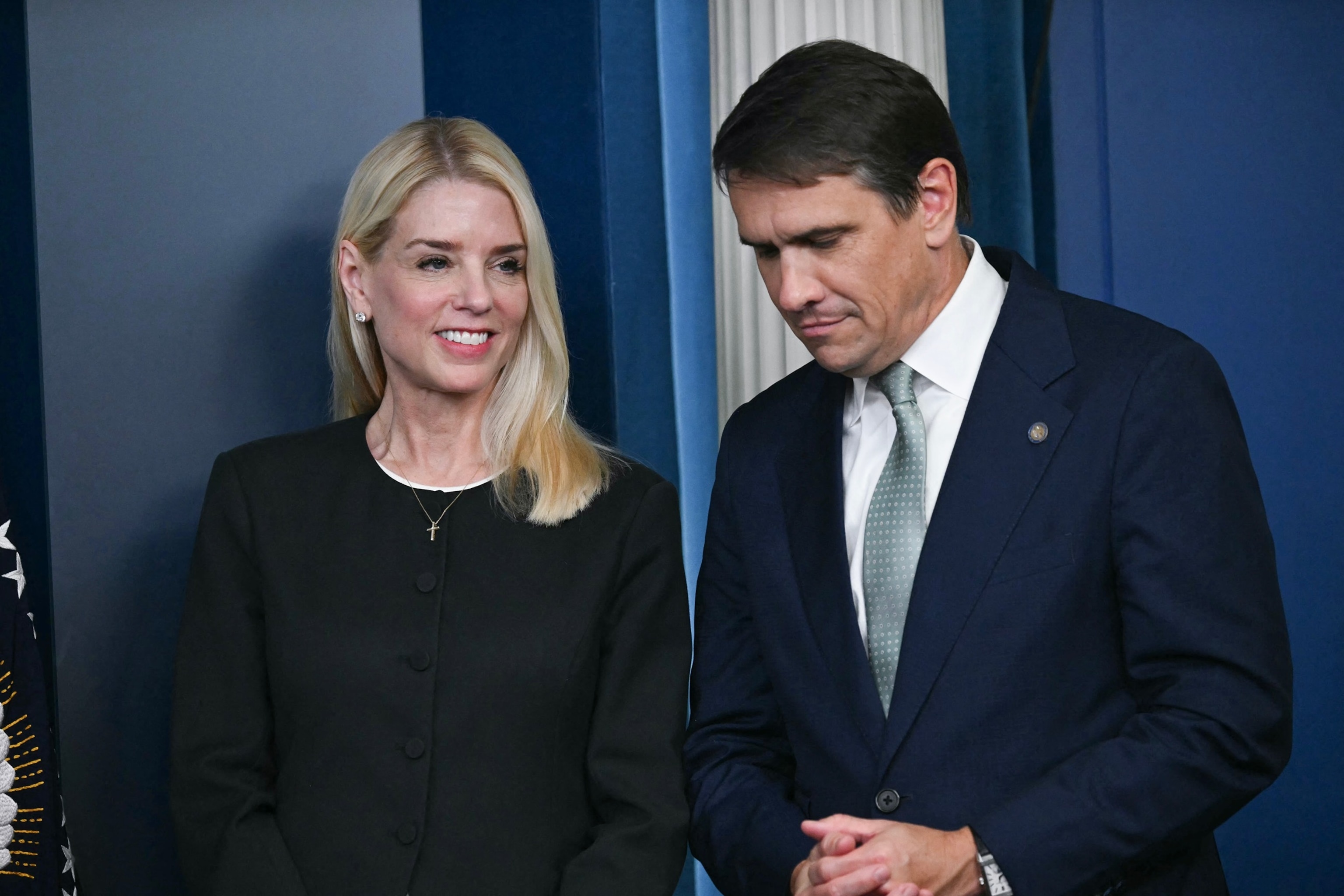
Attorney General Pam Bondi and Deputy Attorney General Todd Blanche look on as US President Donald Trump (not on frame) speaks during a news conference in the Brady Briefing Room of the White House on June 27, 2025, in Washington, DC.
Andrew Caballero-reynolds/AFP via Getty Images
Annie Farmer, who testified against Maxwell at trial, questioned why Maxwell was granted a meeting with the deputy attorney general in the first place.
“It’s very disappointing that these things are happening behind closed doors without any input from the people that the government asked to come forward and speak against her in order to put her away,” Farmer said. “There were so many young girls and women that were harmed by her.”
Maxwell’s attorney said on Friday she’s been treated poorly for the last five years and is grateful to be able to meet with Blanche as she appeals her sex trafficking conviction and seeks to leave prison.
“If you looked up scapegoat in the dictionary, her picture would be next to the definition,” Markus said. “She’s keeping her spirits up as best she can.”
Blanche’s meetings with Maxwell comes as the Justice Department has tried to quiet calls from Senate Republicans to release more information about Epstein and his interaction with high-profile figures.
And it comes as questions swirl about Trump’s connections to Epstein and reports that his name appeared in the Epstein files.
The Wall Street Journal reports that Attorney General Pam Bondi told Trump in May that his name was mentioned in the Epstein files multiple times, along with other high-profile people.
Trump has denied that account, and appearing in the files is not necessarily indicative of any wrongdoing.
“I want all the information out,” said Republican Sen. Josh Hawley.
“Just put everything out, make it as transparent as you can,” echoed Republican Sen. Lindsey Graham.
The Justice Department said earlier this month that it planned to release no additional information despite an earlier commitment to do so.
Brendan Carr listens during a Senate Commerce, Science, and Transportation committee hearing to examine the Federal Communications Commission on Capitol Hill in Washington, June 24, 2020. Jonathan Newton/The Washington Post via AP
Brendan Carr listens during a Senate Commerce, Science, and Transportation committee hearing to examine the Federal Communications Commission on Capitol Hill in Washington, June 24, 2020. Jonathan Newton/The Washington Post via AP
On Thursday, the head of the Federal Communications Commission, Brendan Carr, approved the $8 billion merger between Skydance Media and Paramount, a deal that would allocate more than a billion dollars towards the latter company’s staggering debt.
But the agreement came with one major caveat: The media company must appoint a “bias monitor.”
According to reporting from The Wrap, an FCC “ombudsman” would work directly with New Paramount’s president, Jeff Shell, to review “any complaints of bias or other concerns” regarding CBS News, a subsidiary under Paramount.
Paramount also agreed to eliminate its diversity, equity, and inclusion initiatives, including scrapping all DEI messaging from its internal training programs and removing DEI objectives in its compensation plans.
This move comes after the company announced the cancellation of The Colbert Report only a few days after the eponymous host critiqued the network’s recent settlement with the president. Earlier this month, Paramount agreed to cough up $16 million to Trump after the president sued the network for allegedly unfairly editing an interview with Kamala Harris, an accusation that many legal experts have called “baseless.”
As my colleague, Inae Oh, has reported, Colbert’s cancellation marks a dark new chapter for our culture as a whole. Oh writes:
Though his second term has already produced a string of stunning capitulations by some of the most powerful forces in the country, one could argue that Trump’s attacks had yet to take down our actual culture. I’m talking about the literal content we consume—the television, art, movies, literature, music—no matter how much Trump complained. That it remained protected and free-willed, a rare area of control for a public that otherwise feels powerless to take action. Clearly, that was magical thinking. If this can happen to Colbert and a storied franchise, this can happen to anyone.
And when it comes to using his presidential power as a cudgel against the media that critiques him, Trump clearly shows no signs of stopping. This week alone, the president threw a tantrum over two TV shows that joked about him. On Wednesday, the White House issued a statement threatening the ladies of The View after host Joy Behar joked that Trump was jealous of former president Barack Obama’s “swag.”
A White House spokesperson told Entertainment Weekly, “Joy Behar is an irrelevant loser suffering from a severe case of Trump Derangement Syndrome.”
A White House spokesperson toldEntertainment Weekly, “Joy Behar is an irrelevant loser suffering from a severe case of Trump Derangement Syndrome” who “should self-reflect on her own jealousy of President Trump’s historic popularity before her show is the next to be pulled off air.”
Behar’s joke was tame compared to the animated show, South Park‘s treatment of Trump, who was depicted naked in bed with Satan. In response, the White House claimed that the show hasn’t been relevant in “20 years” and said “no fourth-rate show can derail President Trump’s hot streak.”
How long will South Park, whose creators just signed a 50-episode deal with Paramount, last under Trump’s regime? Let’s hope the ombudsman finds the Trump jokes funny.
This is a hard story for me to cover and keep hearing about. It is picking the scab of my healing over my childhood abuse. I was also trafficked. These were girls but I was used as if I was a girl because to these people if you are young enough it doesn’t matter, you either have three holes to use or only two holes to use. I struggle to remember the many times I was told I was better than YYY girl or better than my hell spawn sibling, or that a boy was better than a girl we knew what to do and were more trainable … that one was when I was 6 years old.
Sorry as I said this issue is hard for me to deal with. I am not feeling well to begin with and this issue I am constantly dealing with has made my own abuse come to the front of my mind / memories. I am again not sleeping and Ron has been constantly waking me from vocal violent nightmares. I recently wrote a male survivor friend that while I always knew and dealt with my abuse I am still recovering memories of it that my mind has denied me from knowing to protect me. Some of them are the most abusive or when I was given to others … the feelings of betrayal. Those memories are mostly from when I was very young.
The last thing I would ask is not that you feel sympathy for me. I am now 62 years old and while I suffer the scars of my childhood I worry about the children of today. Please keep your eyes and ears open. If you hear a child cry, especially in a public place find out why. If you see a child not wanting to go with an adult and the child is very upset / crying investigate. I read an article how a little girl before puberty had been abducted and abused for several days was rescued because a store worker noticed how she pulled back when the abductor reached for her and how she held herself. The store worker noticed how strained the little girl was with the man and how she reacted when the man touched her, then called the police.
I know it is too late for me, but I wonder at the people who knew or suspected that tried to help on the margins like keeping library books for me when they knew I couldn’t take them home, or those that seen the bruises and welts yet never asked questions. Would my life have been changed? Hugs
Ghislaine Maxwell, who sources told ABC News initiated the meetings with the Department of Justice, answered questions for about nine hours over two days after being granted a limited form of immunity, the sources said.
The immunity allowed Maxwell to freely answer Deputy Attorney General Todd Blanche’s questions without fear that her responses could later be used against her, the sources said.
The so-called proffer immunity is commonly granted to individuals prosecutors are seeking to make cooperators in a criminal case. Maxwell has already been tried, convicted and sentenced for sex trafficking underage girls.
Alan Dershowitz, who was very close with Epstein and served as an attorney for both Epstein and Trump, called for Ghislaine Maxwell to be given immunity just a few days ago.
“We are just learning that Ghislaine Maxwell was granted limited immunity in order to talk with Trump’s personal attorney turned deputy attorney general.” – CNN
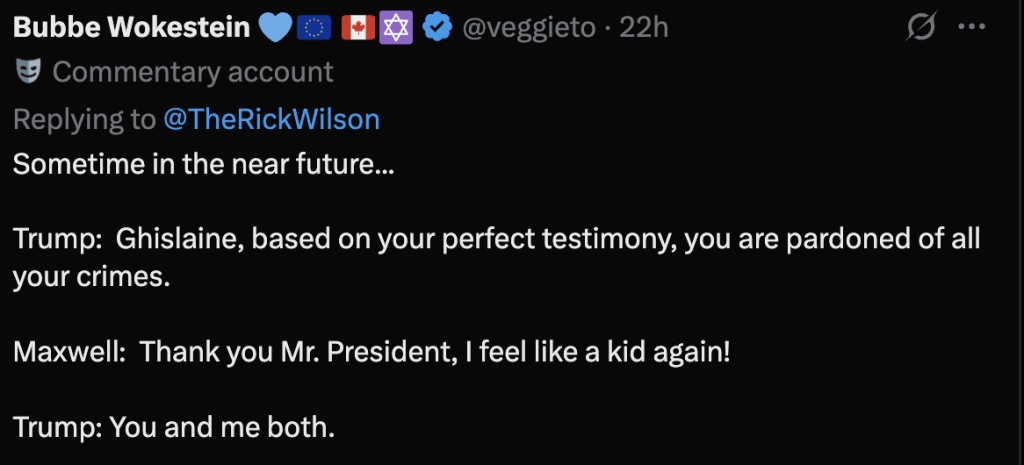
Ghislane Maxwell is a child sex trafficker that Trump just gave immunity to in exchange for her silence on him.
Wanna bet she only names democrats now and magically gets pardoned in a few years?
— Adam Kinzinger (Slava Ukraini) 🇺🇸🇺🇦 (@AdamKinzinger) July 26, 2025
Maxwell’s only hope to get out of jail is a pardon from Trump.
When Trump pardons her for her “truthful” information, it will be blatant corruption: an official act (pardon) for a thing of value (favorable testimony).
But SCOTUS gave Trump criminal immunity so he can’t be…
🚨BREAKING: Trump’s DOJ gave Ghislaine Maxwell LIMITED IMMUNITY for her answers over the last few days, per ABC. So not only has Trump kept the door open on a pardon but now she is protected for her recent answers. Wow.
This is long. Even long for a news nerd like me. But it is well worth it if you want to see how the current administration is using the military in ways it was not designed to do and against the laws to make it easier for them to be used in civilian control to enforce the will of tRump should he again refuse to accept the fact he has to leave office or if he wants something a governor / state won’t give him. The article shows how the military is tRump’s big stick to hit anyone who disagrees with him. Hugs
A U.S. Marine with 3rd Battalion, 7th Marine Regiment, 1st Marine Division, attached to Task Force 51, guards a federal area in Los Angeles on July 12, 2025. Photo: Lance Cpl. Andrew Whistler/U.S. Marine Corps/DVIDS
In his first six months in office, President Donald Trump has overseen the deployment of nearly 20,000 federal troops on American soil, including personnel from the National Guard, the Army, the Navy, the Air Force, and the Marines, according to the Pentagon’s public statements.
But the true number of troops deployed may be markedly higher. When asked directly, the Army said it has no running tally of how many troops have been deployed. These federal forces have been operating in at least five states — Arizona, California, Florida, New Mexico, and Texas — with more deployments on the horizon, all in service of the Trump administration’s anti-immigrant agenda.
Experts say military involvement in domestic anti-immigrant operations undermines American democracy and has nudged the United States closer to a genuine police state.
“If the president can use the military as a domestic police force entirely under his control, it can be used as a tool of tyranny and oppression.”
“This level of involvement of the military in civilian law enforcement in the interior of the country is unprecedented — and really dangerous,” said Elizabeth Goitein, senior director of the Brennan Center’s liberty and national security program, who told The Intercept that recent deployments violated the Posse Comitatus Act, a bedrock 19th-century law seen as fundamental to the democratic tradition in America which bars federal troops from participating in civilian law enforcement.
She added: “If the president can use the military as a domestic police force entirely under his control, it can be used as a tool of tyranny and oppression. We’ve seen it all around the world and throughout history.”
The norms surrounding the use of military force within U.S. borders are eroding, and the executive branch is operating with free rein, emboldened by a legislature and judiciary seemingly uninterested in curtailing its actions.
These soldiers have been sent to patrol the border, put down popular protest against Immigration and Customs Enforcement operations, participate in ICE raids, and assist in immigration enforcement missions from coast to coast. Here, to the extent of what is known so far, is what they’ve been up to.
Most Read
Feds Make It a Crime to Give PPE to ICE Protesters
Akela Lacy
Our Reporter Got Into Gaza. He Witnessed a Famine of Israel’s Making.
Afeef Nessouli, Steven W. Thrasher
Border Patrol Wants Advanced AI to Spy on American Cities
Sam Biddle
President Donald Trump began the further militarization of America on his first day back in office. “Our southern border is overrun by cartels, criminal gangs, known terrorists, human traffickers, smugglers, unvetted military-age males from foreign adversaries, and illicit narcotics,” Trump announced on January 20, directing the military to “assist the Department of Homeland Security in obtaining full operational control of the southern border.”
Despite the fact that Trump’s fearmongering was his typical hyperbole, more than 10,000 troops are deploying or have deployed to the southern border, according to U.S. Northern Command, or NORTHCOM, which oversees U.S. military activity from Mexico’s southern border up to the North Pole.
Under the direction of NORTHCOM, military personnel — including soldiers from the Fourth Infantry Division at Fort Carson in Colorado, one of the Army’s most storied combat units — have deployed under the moniker Joint Task Force-Southern Border, or JTF-SB, since March, bolstering approximately 2,500 service members who were already supporting U.S. Customs and Border Protection’s border security mission.
One-third of the U.S. border is now completely militarized due to the creation of four new national defense areas, or NDAs: sprawling extensions of U.S. military bases patrolled by troops who can detain immigrants until they can be handed over to Border Patrol agents.
The Air Force is responsible for the recently created South Texas NDA, which encompasses federal property along 250 miles of the Rio Grande River. The Navy controls the Yuma NDA, which extends along 140 miles of federal property on the U.S.–Mexico border near the Barry M. Goldwater Air Force Range in Arizona.
The New Mexico NDA, created in April, spans approximately 170 miles of noncontiguous land along that state’s border, serving as an extension of the Army’s Fort Huachuca. Another NDA was created in May in West Texas and covers approximately 63 miles of noncontiguous land between El Paso and Fort Hancock, serving as an extension of the Army’s Fort Bliss.
Related
When Soldiers Patrol the Border, Civilians Get Killed
Around 8,500 military personnel were assigned to JTF-SB to “enhance US Customs and Border Patrol’s capacity to identify, track and disrupt threats to border security,” chief Pentagon spokesperson Sean Parnell said at the beginning of the month. JTF-SB says the current number of personnel deploys stands at 7,600, while NORTHCOM says the current number of federal troops providing border security is closer to 8,600.
No one actually knows how many troops have been involved in border operations this year. “We do not maintain a running total of Service Members who have served with JTF-SB since its inception, so the total number since March is currently unavailable,” Kent Redmond, a spokesperson for JTF-Southern Border told The Intercept. NORTHCOM didn’t have a number on hand either. But more than 10 Task Forces have assisted JTF-SB, including Task Force Mountain Warrior, consisting of soldiers from the 2nd Stryker Brigade Combat Team; Task Force Castle, made up of soldiers from the 41st Engineer Battalion; 500 Marines and Navy personnel from Task Force Sapper; and 500 Marines and sailors from Task Force Forge. The latter replaced the Task Force Sapper troops and are now conducting patrols in the Yuma NDA.
Since March alone, Parnell said, the JTF-SB has conducted more than 3,500 patrols, including more than 150 “trilateral” patrols with CBP and the Mexican military. There have, however, been only seven temporary detentions by troops within the National Defense Areas, according to Redmond. He said the seven persons were “detained in place” by JTF-SB personnel for less than 10 minutes.
“The amount being spent to have the world’s best fighting force walk around the border to pick up a handful of people is shocking.”
“Setting aside the threats to democracy and liberty, the sheer waste is staggering. The amount being spent to have the world’s best fighting force walk around the border to pick up a handful of people is shocking,” said Goitein, who also noted that the detentions violated the Posse Comitatus Act.
“They may think if they detain people for only 10 minutes it’s not a violation, but that’s not how the law works,” Goitein explained. “They may also say that the Posse Comitatus Act simply doesn’t apply when the purpose is to protect a military base, but here it’s clear that the primary purpose is enforcement of immigration law.”
Related
How Post-9/11 Visions of an Imperiled Homeland Supercharged U.S. Immigration Enforcement
The military has even dispatched Navy warships offshore to secure the border. After battling Yemen’s Houthi rebels in the Gulf of Aden earlier this year, for example, the USS Stockdale — a guided-missile destroyer — was deployed to support NORTHCOM’s southern border operations alongside the Coast Guard on the U.S.–Mexico maritime border. That ship took over for the USS Spruance, another guided-missile destroyer drafted into anti-immigrant operations.
“We are dead serious about 100% OPERATIONAL CONTROL of the southern border,” Defense Secretary Pete Hegseth said in a post on X in March.
Since then, the Department of Homeland Security has repeatedly announced historically low apprehensions along the southern border. “The numbers don’t lie — under President Trump’s leadership, DHS and CBP have shattered records and delivered the most secure border in American history,” said DHS Secretary Kristi Noem earlier this month. And as early as April, DHS announced, “Customs and Border Protection now has total control of the border.”
Despite all of this, as well as the huge influx of troops and weapons of war deployed at the border, when The Intercept inquired whether full operational control of the border had been achieved and “if not, why not?” DHS demurred. A senior DHS official, who offered comments on the condition of anonymity for no discernible reason, provided rote talking points and praise of Trump and Noem. The official added that the department was “grateful” for JTF-SB’s “support.”
More than 5,000 troops have also been deployed to Los Angeles since early June.
The National Guard soldiers and Marines operating in Southern California — under the command of the Army’s Task Force 51 — were sent to “protect the safety and security of federal functions, personnel, and property.” In practice, this has mostly meant guarding federal buildings across LA from protests against the ongoing ICE raids sweeping the city.
Since Trump called up the troops on June 7, they have carried out exactly one temporary detainment, a Task Force 51 spokesperson told The Intercept.
Related
The Military Occupied LA for 40 Days and All They Did Was Detain One Guy
Parnell, the Pentagon spokesperson, described this deployment as Task Force 51 supporting “more than 170 missions in over 130 separate locations from nine federal agencies, including the Drug Enforcement Agency, the U.S. Marshal Service, ICE and the Department of Homeland Security” in a briefing in early July. Task Force 51 failed to provide any other metrics regarding troops’ involvement in raids, arrests, or street patrols in response to questions by The Intercept.
Troops were sent to LA over the objections of local officials and California Gov. Gavin Newsom.
In addition to guarding federal buildings, troops have also recently participated in raids alongside camouflage-clad ICE agents. An assault on MacArthur Park, a recreational hub in one of LA’s most immigrant-heavy neighborhoods on July 7, for example, included 90 armed U.S. troops and 17 military Humvees. Its main accomplishment was rousting a summer day camp for children. No arrests were made.
California National Guard soldiers also backed ICE raids on state-licensed marijuana nurseries this month. The troops took part in the military-style assaults on two locations, one in the Santa Barbara County town of Carpinteria, about 90 miles northwest of LA and one in the Ventura County community of Camarillo, about 50 miles from LA. ICE detained more than 200 people, including U.S. citizens, during the joint operations. One man, Jaime Alanís Garcia, died while trying to flee from the raid in Camarillo.
On July 1, Task Force 51 announced that it would release approximately 150 members of the California National Guard from their LA duty. That same day, NORTHCOM said that the Marines from the 2nd Battalion, 7th Marine Regiment were leaving Los Angeles but would be replaced by the 3rd Battalion, 7th Marine Regiment.
Last Tuesday, Trump administration officials announced that about 2,000 more National Guard members deployed to LA would be released from service. On Monday, the Trump administration announced it was withdrawing the 700 active-duty Marines from Los Angeles. The withdrawals followed repeated reporting by The Intercept highlighting the failure of the troops to do much of substance.
All told, since the deployments began, around 5,500 troops have been sent to southern California, according to Becky Farmer, a NORTHCOM spokesperson.
On the other side of the country, Marines are being hustled to Florida to aid the administration’s anti-immigrant agenda. Responding to a DHS request, Hegseth approved a mobilization of up to 700 active, National Guard, and Reserve forces.
The first contingent — approximately 200 Marines from Marine Wing Support Squadron 272, Marine Corps Air Station New River, North Carolina — have been mobilized to support ICE’s “interior immigration enforcement mission” in Florida, NORTHCOM announced earlier this month. The command noted that they were only the “first wave” of ICE assistance. NORTHCOM says additional forces will be deployed to Louisiana and Texas. Hundreds more Guardsmen are expected to be sent to assist in more than a half dozen other states, including Arkansas, Indiana, Iowa, Nebraska, South Carolina, Utah and Virginia.
Related
Greg Abbott’s Border Theater Is Having Disastrous Consequences for Everyone Involved
Some of these same states are also using their own National Guard members in their own anti-immigrant operations. More than 4,200 Texas National Guard soldiers and airmen on state duty are engaged in Operation Lone Star, a border security initiative launched by Texas Gov. Greg Abbott in March 2021. Texas’s forces were bolstered, until April, by members of the Indiana National Guard.
Nearly 70 Florida National Guard members are also on state duty, conducting base camp security at the remote migrant detention center in the state’s Everglades known as “Alligator Alcatraz.” While Trump insisted that the swamp gulag was reserved for “deranged psychopaths” and “some of the most vicious people on the planet,” it was revealed that hundreds of detainees had committed no offense other than civil immigration violations.
“Governors should be doing everything in their power to avoid their state’s national guard troops being pulled into this lawless, authoritarian power grab, not spending precious resources to help it along,” Sara Haghdoosti, the executive director of Win Without War, told The Intercept.
The Trump administration’s use of military forces in its anti-immigrant crusade has been criticized as a publicity stunt and an authoritarian power play.
The directive signed by Trump calling up the California National Guard, for example, cited “10 U.S.C. 12406,” a provision within Title 10 of the U.S. Code on Armed Services that allows the federal deployment of National Guard forces if “there is a rebellion or danger of a rebellion against the authority of the Government of the United States.”
There was, however, no rebellion. Vice President JD Vance even recently vacationed at Disneyland in Anaheim, about 25 miles from LA.
Still, experts say that the stunt deployments represent a clear danger to American democracy by violating the Posse Comitatus Act; normalizing the use of the military in civilian law enforcement activities; and further transforming the armed forces into a tool of domestic oppression by aiding ICE, which increasingly operates as a masked, secret police force.
“ICE is running a nationwide campaign of violent, racist kidnappings, and Hegseth’s Pentagon is bending over backward to make the military into ICE’s chief sidekicks,” said Haghdoosti. “Troops abetting violence against their own neighbors isn’t tenable for our communities, our democracy, or the troops themselves.”
IT’S EVEN WORSE THAN WE THOUGHT.
What we’re seeing right now from Donald Trump is a full-on authoritarian takeover of the U.S. government.
This is not hyperbole.
Court orders are being ignored. MAGA loyalists have been put in charge of the military and federal law enforcement agencies. The Department of Government Efficiency has stripped Congress of its power of the purse. News outlets that challenge Trump have been banished or put under investigation.
Yet far too many are still covering Trump’s assault on democracy like politics as usual, with flattering headlines describing Trump as “unconventional,” “testing the boundaries,” and “aggressively flexing power.”
The Intercept has long covered authoritarian governments, billionaire oligarchs, and backsliding democracies around the world. We understand the challenge we face in Trump and the vital importance of press freedom in defending democracy.
We’re independent of corporate interests. Will you help us?
The Trump administration sent five deportees to Eswatini, an African kingdom, saying that their own countries would not take them. But Eswatini says it will send them home.
Mswati III, King of Eswatini, addressing the United Nations General Assembly in New York in 2023.Credit…Dave Sanders for The New York Times
The tiny African kingdom of Eswatini announced on Wednesday that it would repatriate the five migrants who had been deported there by the United States, a day after American officials said the migrants’ home countries had refused to accept them.
The migrants came from Vietnam, Jamaica, Laos, Yemen and Cuba, and had been serving time in American prisons for serious offenses, according to the Department of Homeland Security.
Their removal was the first so-called third-country deportation from the United States to take place since the Supreme Court ruled this month that the Trump administration could move forward with the practice.
The flight included individuals whose own countries “refused to take them back,” Homeland Security Department Assistant Secretary Tricia McLaughlin wrote on X Tuesday night.
But an Eswatini government spokeswoman, Thabile Mdluli, said in a statement on Wednesday that the governments of her country and the United States, together with the International Organization for Migration, will “facilitate the transit of these inmates to their countries of origin.”
The International Organization for Migration said that it had no involvement in the removal of the migrants from the United States and had not been asked to provide any support with repatriation.
The Trump administration has worked aggressively to broker deals with international partners willing to take deportees. Legal experts have challenged the deportations on the grounds that the migrants could be subject to mistreatment and torture.
Earlier this month the Supreme Court approved the deportation of eight men to South Sudan, only one of whom is from that country. Their families have not heard from them since, according to their legal team. Officials in South Sudan have said the men are “under the care of the relevant authorities,” but have provided no further details.
After the Supreme Court decision, immigration officials acted quickly to implement new regulations that allow the government to carry out third-country deportations in as little as six hours, even without assurances that the migrants will be safe.
Former immigration officials view the deportation efforts as part of the administration’s push to get migrants to self-deport.
“This is another clear example of how the United States is flagrantly violating the law restricting it from deporting people to countries where they will likely be persecuted or tortured,” said Matt Adams, a lawyer for the migrants sent to South Sudan.
The Trump administration used the deportations to Eswatini “simply for political theater,” he said. “Spending millions of dollars to fly five men to the other side of the planet.”
Eswatini, formerly known as Swaziland, is tucked between South Africa and Mozambique and has one of Africa’s last ruling monarchies. The kingdom is divided between those who praise its adherence to tradition and those who argue that the lavish lifestyle of King Mswati III stands in painful contrast to the poverty afflicting many of the country’s 1.2 million people.
Some citizens of Eswatini and foreign governments have also raised concerns about the country’s human rights record, accusing the government of using excessive — sometimes lethal — force against people who oppose the king.
Those opposed to the monarchy were quick to condemn the arrival of the deportees.
“This is appalling,” said Lioness Sibande, the secretary general of the Swaziland Peoples Liberation Movement, an opposition group. She described the move as an example of the West’s long history of exploiting African nations. “The West is always disrespecting us as Africans and thinking we are their dumpsite,” she said.
In her statement, Ms. Mdluli, the government spokeswoman, sought to temper the concerns of Eswatini citizens. She said the deportees were being held in isolation units at correctional facilities.
The decision to take migrants from the United States came after months of talks that included “rigorous risk assessments and careful consideration for the safety and security of citizens,” she said. “The nation is assured that these inmates pose no threat to the country or its citizens.”
Ms. Mdluli added that she could not reveal what Eswatini received in return for taking the migrants because the terms of the agreement with the United States remain classified.
A correction was made on
July 16, 2025
:
An earlier version of this article referred incorrectly to eight men deported to South Sudan by the Trump administration. One of the men is from South Sudan; they are not all from other countries.
GENEVA — The U.N. Human Rights Council voted on Monday to renew the mandate of an LGBTQ rights expert, a move welcomed by advocates amid the absence of the United States, a former key supporter that is now rolling back such protections.
Western diplomats had previously voiced concerns about the renewal of the mandate of South African scholar Graeme Reid who helps to boost protections by documenting abuses and through dialogue with countries.
The motion for a three-year renewal passed with 29 votes in favor, 15 against and three abstentions. Supporters included Chile, Germany, Kenya and South Africa while several African nations and Qatar opposed it.
“The renewal of this mandate is a spark of hope in a time when reactionary powers worldwide are trying to dismantle progress that our communities fought so hard to achieve,” said Julia Ehrt, executive director of campaign group ILGA World.
The United States, which has disengaged from the council under President Donald Trump, citing an alleged antisemitic bias, was previously a supporter of the mandate under the Biden administration.
Since taking office in January, Trump has signed executive orders to curb transgender rights and dismantle diversity, equity and inclusion practices in the government and private sector.
His administration says such steps restore fairness, but civil rights and LGBTQ advocates say they make marginalized groups more vulnerable.
In negotiations before the vote, Pakistan voiced opposition to the mandate on behalf of Muslim group OIC, calling it a tool to advocate “controversial views.”
Video from Kenny Laynez-Ambrosio, 18, puts fresh scrutiny on the harsh tactics used to reach the Trump administration’s ambitious enforcement targets
‘You’ve got no rights’: teenage US citizen records violent arrest by immigration officers – video
On the morning of 2 May, teenager Kenny Laynez-Ambrosio was driving to his landscaping job in North Palm Beach with his mother and two male friends when they were pulled over by the Florida highway patrol.
In one swift moment, a traffic stop turned into a violent arrest.
A highway patrol officer asked everyone in the van to identify themselves, then called for backup. Officers with US border patrol arrived on the scene.
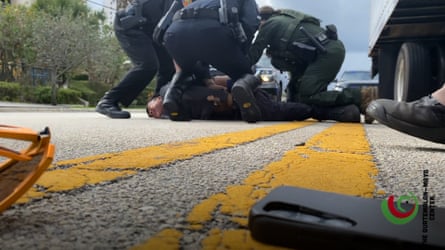
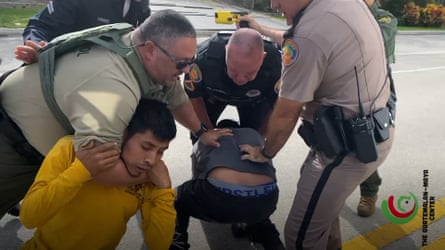
Video footage of the incident captured by Laynez-Ambrosio, an 18-year-old US citizen, appears to show a group of officers in tactical gear working together to violently detain the three men*, two of whom are undocumented. They appear to use a stun gun on one man, put another in a chokehold and can be heard telling Laynez-Ambrosio: “You’ve got no rights here. You’re a migo, brother.” Afterward, agents can be heard bragging and making light of the arrests, calling the stun gun use “funny” and quipping: “You can smell that … $30,000 bonus.”
“The federal government has imposed quotas for the arrest of immigrants,” said Jack Scarola, an attorney who is advocating on behalf of Laynez-Ambrosio and working with the non-profit Guatemalan-Maya Center, which provided the footage to the Guardian. “Any time law enforcement is compelled to work towards a quota, it poses a significant risk to other rights.”
Chokeholds, stun guns and laughter
The incident unfolded at roughly 9am, when a highway patrol officer pulled over the company work van, driven byLaynez-Ambrosio’smother, and discovered that she had a suspended license. Laynez-Ambrosio said he is unsure why the van was pulled over, as his mother was driving below the speed limit.
Laynez-Ambrosio hadn’t intended to film the interaction – he already had his phone out to show his mom “a silly TikTok”, he said – but immediately clicked record when it became clear what was happening.
The arrest of an undocumented man in Florida, as caught on video by Kenny Laynez-Ambrosio on 2 May 2025. Photograph: Screengrab from video by Kenny Laynez-Ambrosio/Courtesy of the Guatemalan-Maya Center
The video begins after the van has been pulled over and the border patrol had arrived. A female officer can be heard asking, in Spanish, whether anyone is in the country illegally. One of Laynez-Ambrosio’s friends answers that he is undocumented. “That’s when they said, ‘OK, let’s go,’” Laynez-Ambrosio recalled.
Laynez-Ambrosio said things turned aggressive before the group even had a chance to exit the van. One of the officers “put his hand inside the window”, he said, “popped the door open, grabbed my friend by the neck and had him in a chokehold”.
Footage appears to show officers then reaching for Laynez-Ambrosio and his other friend as Laynez-Ambrosio can be heard protesting: “You can’t grab me like that.” Multiple officers can be seen pulling the other man from the van and telling him to “put your fucking head down”. The footage captures the sound of a stun gun as Laynez-Ambrosio’s friend cries out in pain and drops to the ground.
Laynez-Ambrosio said that his friend was not resisting, and that he didn’t speak English and didn’t understand the officer’s commands. “My friend didn’t do anything before they grabbed him,” he said.
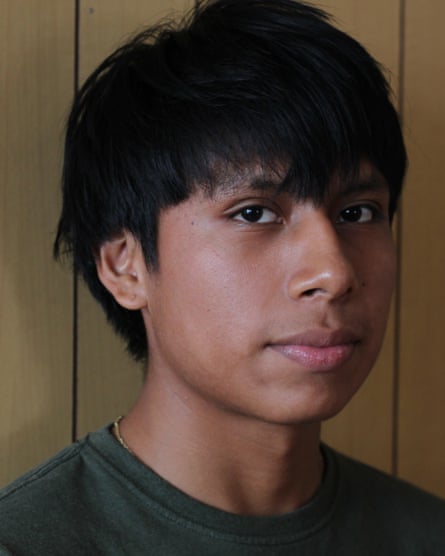
Kenny Laynez-Ambrosio, 18, filmed his own arrest in Florida. Photograph: The Palm Beach Post/Reporter Valentina Palm
In the video, Laynez-Ambrosio can be heard repeatedly telling his friend, in Spanish, to not resist. “I wasn’t really worried about myself because I knew I was going to get out of the situation,” he said. “But I was worried about him. I could speak up for him but not fight back, because I would’ve made the situation worse.”
Laynez-Ambrosio can also be heard telling officers: “I was born and raised right here.” Still, he was pushed to the ground and says that an officer aimed a stun gun at him. He was subsequently arrested and held in a cell at a Customs and Border Protection (CBP) station for six hours.
Audio in the video catches the unidentified officers debriefing and appearing to make light of the stun gun use. “You’re funny, bro,” one officer can be overheard saying to another, followed by laughter.
Another officer says, “They’re starting to resist more now,” to which an officer replies: “We’re going to end up shooting some of them.”
Later in the footage, the officers move on to general celebration – “Goddamn! Woo! Nice!” – and talk of the potential bonus they’ll be getting: “Just remember, you can smell that [inaudible] $30,000 bonus.” It is unclear what bonus they are referring to. Donald Trump’s recent spending bill includes billions of additional dollars for Ice that could be spent on recruitment and retention tactics such as bonuses.
Laynez-Ambrosio said his two friends were eventually transferred to the Krome detention center in Miami. He believes they were released on bail and are awaiting a court hearing, but said it has been difficult to stay in touch with them.
Laynez-Ambrosio’s notice to appear in court confirms that the border patrol arrived on the scene, having been called in by the highway patrol. His other legal representative, Victoria Mesa-Estrada, also confirmed that border patrol officers transported the three men to the border patrol facility.
The Florida highway patrol, CBP, and Immigration and Customs Enforcement did not respond to requests for comment before publication.
‘We are good people’
Trump officials increasingly recruit local police for immigration enforcement despite ‘red flags’
Read more
Laynez-Ambrosio was charged with obstruction without violence and sentenced to 10 hours of community service and a four-hour anger management course. While in detention, he said, police threatened him with charges if he did not delete the video footage from his phone, but he refused.
Scarola, his lawyer, said the charges were retaliation for filming the incident. “Kenny was charged with filming [and was] alleged to have interfered with the activities of law enforcement,” he explained. “But there was no intended interference – merely the exercise of a right to record what was happening.”
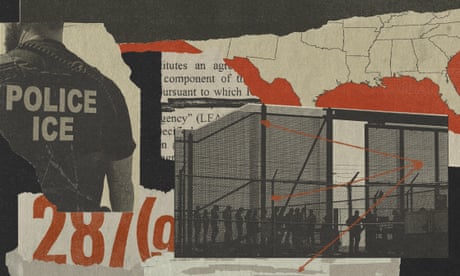
In February, Florida’s governor, Ron DeSantis, signed an agreement between the state and the Department of Homeland Security allowing Florida highway patrol troopers to be trained and approved by Ice to arrest and detain immigrants. While such agreements have been inked across the US, Florida has the largest concentration of these deals.
The arrests of 2 May 2025. Photograph: Screengrab from video by Kenny Laynez-Ambrosio/Courtesy of Guatemalan-Maya Center
Father Frank O’Loughlin, founder and executive director of the Guatemalan-Maya Center, the advocates for Laynez-Ambrosio, says the incident has further eroded trust between Florida’s immigrant community and the police. “This is a story about the corruption of law enforcement by Maga and the brutality of state and federal troopers – formerly public servants – towards nonviolent people,” he said.
Meanwhile, Laynez-Ambrosio is trying to recover from the ordeal, and hopes the footage raises awareness of how immigrants are being treated in the US. “It didn’t need to go down like that. If they knew that my people were undocumented, they could’ve just kindly taken them out of the car and arrested them,” he said. “It hurt me bad to see my friends like that. Because they’re just good people, trying to earn an honest living.”
The Guardian is granting anonymity to Laynez-Ambrosio’s mother and the men arrested in the footage to protect their privacy





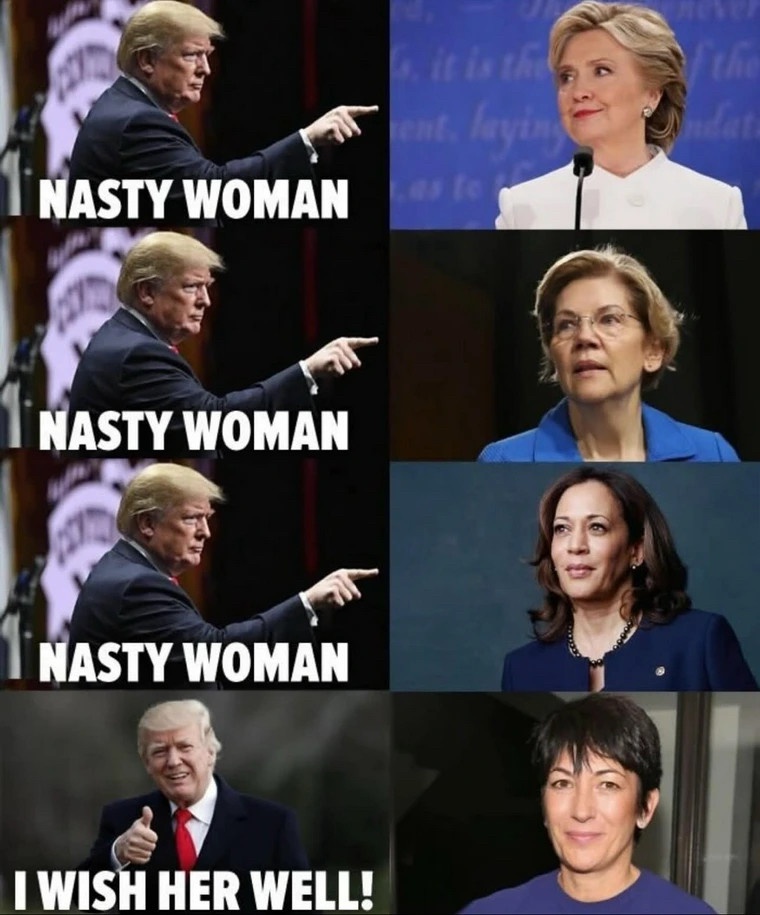


 Scottie's Playtime