Clay Jones

Homeless Geese by Clay Jones

And no, it’s not about Gary Read on Substack
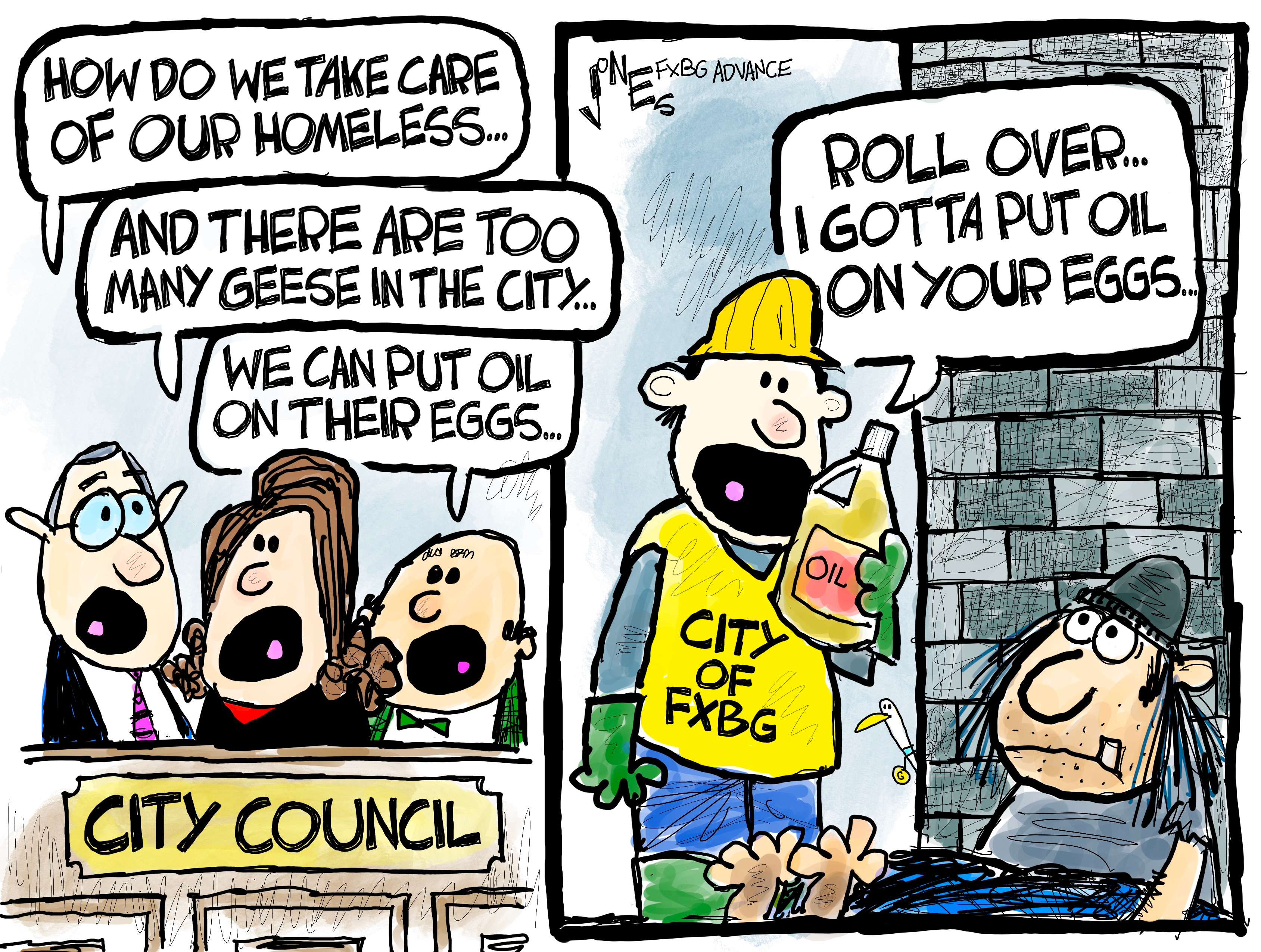
This was drawn for the Fredericksburg Advance, which wrote with the cartoon:

The Advance prides itself on attracting superior talent to our pages, and Clay Jones may well be at the top of the totem pole if awards are the measure. In 2022 he won the Robert F. Kennedy Award, and he has been a finalist for the Herblock Prize. What makes a great political cartoonist? That’s tough to say, but certainly the ability to make connections that others miss, and that force us to both laugh and think about issues in ways we may not have previously imagined — even (perhaps especially) when it makes us uncomfortable. That’s precisely what Jones has accomplished today, building off this week’s seemingly unrelated stories about geese and the endless struggle in our community over the homeless.

Dawwwww. Thank you, guys. That’s super nice.

I was just being silly with this, but proofer Laura said it was “silly, but kinda accurate.” I was afraid my editor would hate it because it was so weird.

Creative note: I wrote this Thursday night, and drew at home Friday night at the end of a long day. I wanted it to be finished before Saturday so I could focus on all the DC stuff.

Music note: Dammit, I don’t remember because I drew it two nights ago.

Drawn in 30 seconds: (snip-go see!)

Birthday Fascist by Clay Jones

Not even on your birthday Read on Substack
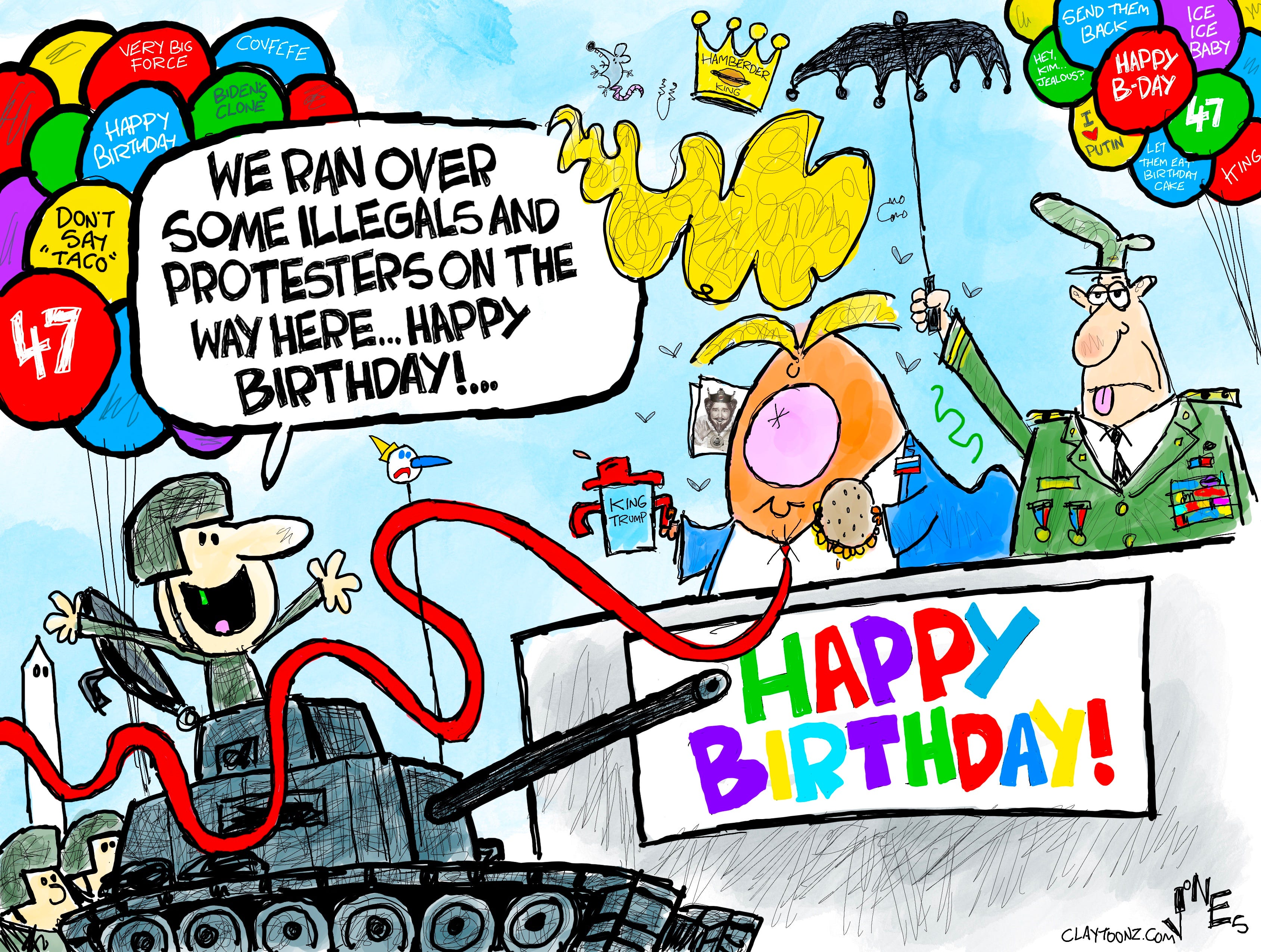
I’m sorry I made you wait for today’s blog, but I thought it would be more interesting to write the blog about Trump’s birthday parade after I actually attended his birthday parade.

And let’s not make mistakes about this. This military parade was not for the Army, but for Donald Trump.

Here’s the funny thing: I didn’t make it to the parade. Yes, I got a hotel room, and I planned to attend the parade, but three things happened. There were fences. Long long long fences. There was not a huge crowd, but it was tough to get through the snake of fences. Then, there were lines. But didn’t I just say the crowds were not huge? They weren’t, but the Trump organization likes to make people wait because it gives the impression that the crowds are large when they’re not.

And they must have expected much larger crowds because there were MAGA merchants everywhere. Yet, it didn’t seem like they were having a lot of customers. The street vendors selling ice cream had longer lines. I bought a cone.

If you want a huge crowd, go back to President Barack Obama’s inauguration. That was a huge crowd. Go back to Kamala Harris’ speech last November. That was a huge crowd. Or, go back to the last time I went to a Washington Capitals game. It was incredible if you could find a seat on the metro because the crowds were so large. But today, I took a metro at 5 p.m. and it was easy to find a seat. It wasn’t packed. And it wasn’t packed after the event either.

The parade started early because they wanted to beat the rain that never came. There were sprinkles, but nothing that should be able to stop a tank.

I said there was a thing that kept me from making it to Constitution Avenue, where the parade was held. The first were the fences, the second were the lines, and the third were the protests. The protests distracted me.

The official No Kings protests did not happen in Washington, DC. They didn’t want to start a fight. But, that didn’t stop independent protesters who did outnumber the MAGAts in my opinion. And readers, I feel bad because I wasn’t very nice to the MAGAts. You’ll see.

The closest thing I saw to violence was when a woman took a wild swing at a man holding a sign. They crossed paths, and she took a swing as they passed each other, which I don’t think she intended to connect. But he turned around and said, “Did you just take a swing at me?” She did not turn around, so he yelled, “Fuck Trump.” Yes, she was a MAGAt. And no, the man didn’t try to do anything violent. He kept on his way after yelling, “Fuck Trump.”

I had to know what was on his sign that made her want to take a swing, and here it is.
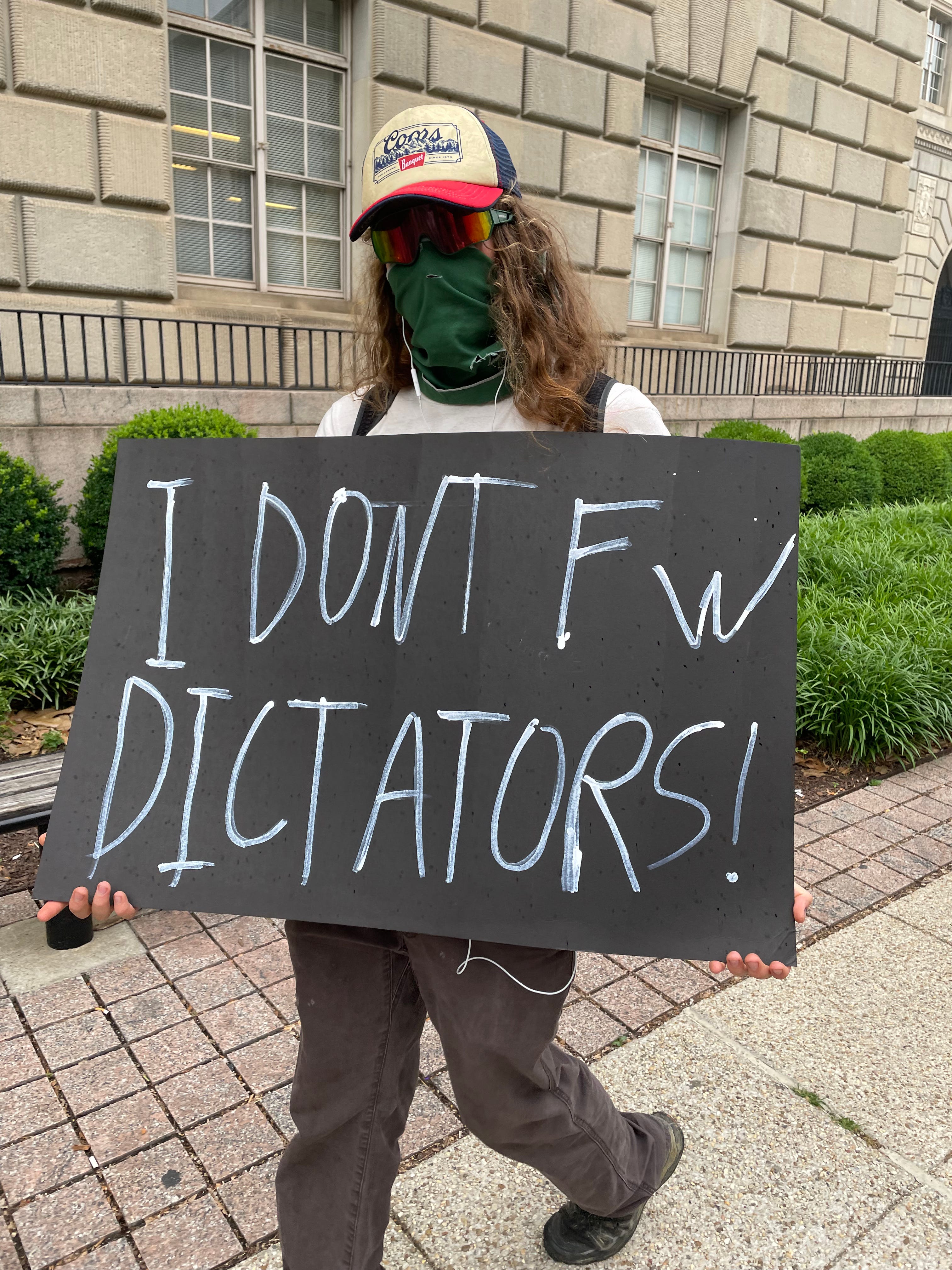
He hit a nerve. Here are some other scenes.
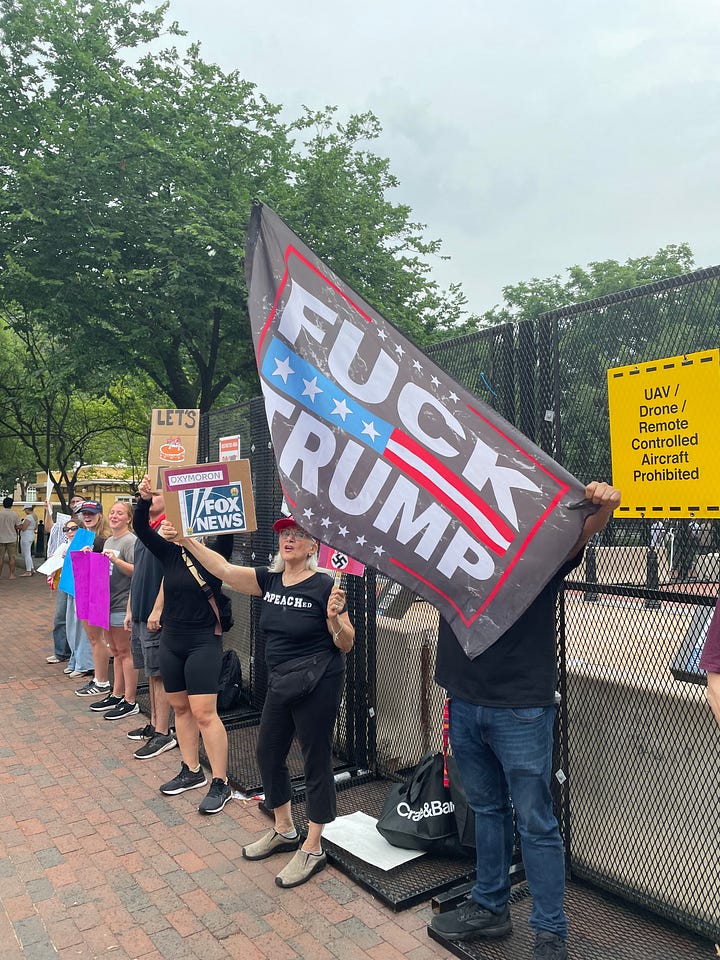
And then things got weird.

First, I saw this. (snip-yeah, go see it!!)

Ear Diaper Hater Club by Clay Jones

Read on Substack
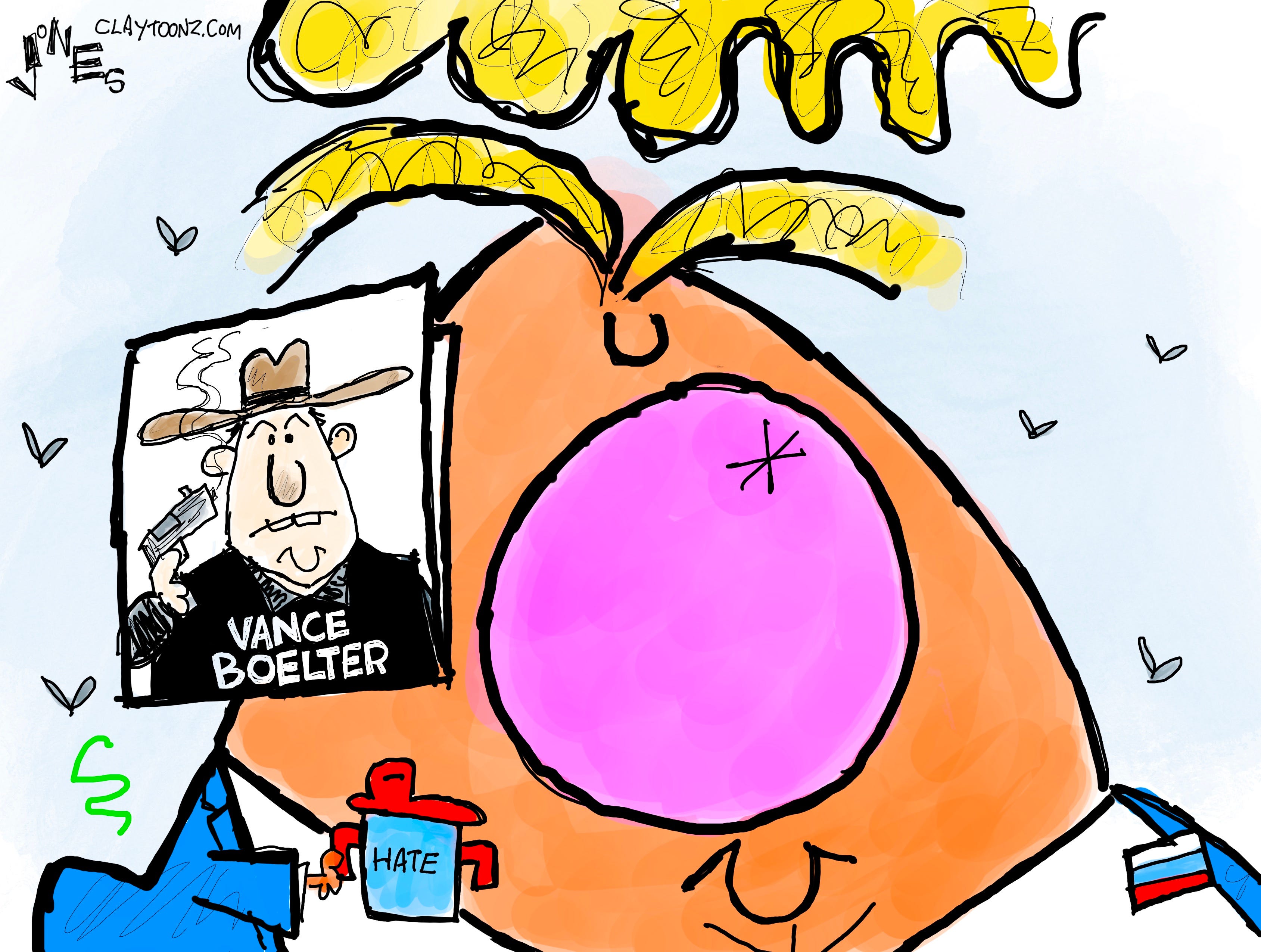
In a telephone interview this morning with ABC’s Rachel Scott, Donald Trump said he “may” call Minnesota Governor Tim Walz about the targeted attack in Minneapolis that killed Melissa Hortman, a state legislator, and her husband.

In a moment that needs bipartisanship, empathy, and for a president to actually act presidential, Donald Trump said, “Well, it’s a terrible thing. I think he’s a terrible governor. I think he’s a grossly incompetent person. But I may, I may call him, I may call other people too.”

He just can’t do it. He gave it a shot yesterday, issuing a statement someone else obviously wrote, “I have been briefed on the terrible shooting that took place in Minnesota, which appears to be a targeted attack against state lawmakers. Our Attorney General, Pam Bondi, and the FBI, are investigating the situation, and they will be prosecuting anyone involved to the fullest extent of the law. Such horrific violence will not be tolerated in the United States of America. God Bless the great people of Minnesota, a truly great place.”

Forgive me if I don’t put a lot of faith into the investigative skills of Pam Bondi and FBI Director (sic) Kash Patel.

Trump blamed “hateful rhetoric” from the left when an assassin took aim at his ear. You’re not going to hear the term “hateful rhetoric” from Trump over the assassination of a state legislator in Minnesota.

We’re going to hear a lot of hypocrisy this week coming from MAGA Land.

For Trump, it was “hateful rhetoric” that got his ear shot, but the “targeted attack” on the left is a mystery.

I wanted to give you a long and in-depth blog on this, but I totally forgot while waiting at the airport. The worst part is, my flight was delayed for over two hours, so I had time to write it. Now, my flight is boarding and I’m still typing.

The next time you hear from me, I’ll be in California.

The view from my room:

I’m staying at the Sheraton by the Pentagon. Here’s the view I took yesterday afternoon. (snip-MORE)

IOKIYAR, & More, In Peace & Justice History for 6/16

June 16, 1961
Following a meeting between South Vietnamese envoy Nguyen Dinh Thuan and President John F. Kennedy, the United States agreed to increase the presence of American military advisors in Vietnam from 340 to 805, and to provide direct training and combat supervision to South Vietnamese troops.
The number of U.S. personnel rose to 3,200 by the end of 1962.

President Ngo Dinh Diem and President Eisenhower in DC, five years earlier
June 16, 1965
A planned civil disobedience turned into a five-hour teach-in on the steps and inside the Pentagon about the escalating war in Vietnam.
In two days, more than 50,000 leaflets were distributed without interference at the building that houses the U.S. Department of Defense. A World War II artillery officer, Gordon Christiansen, turned in his honorable discharge certificate in protest.
June 16, 1976

South African police opened fire on black students peacefully protesting the requirement to learn Afrikaans, the language of the small white minority that enforced the racially separatist regime known in Afrikaans as apartheid.
Neither black nor colored (other non-white or mixed race) South Africans could vote or live where they chose.

Over 150 South African children were killed and hundreds more were injured in the shooting—what became known as the Soweto Massacre.
fact: Soweto stands for: SOuth WEst TOwnships

The History of Apartheid in South Africa 
Read more on Soweto 
June 16, 1992
Former Reagan Defense Secretary Caspar Weinberger was indicted for his participation in the Iran-Contra affair, charged with four counts of lying to Congress and prosecutors.
He had concealed the secret arrangement to provide funds to the Nicaraguan insurgent contra rebels with profits from selling arms to Iran, which in turn were to encourage the release of hostages held by groups allied with Iran.


President Ronald Reagan with Caspar Weinberger, George Shultz, Ed Meese, and Don Regan, discussing the President’s remarks on the Iran-Contra affair.
The Reagan administration (1981-1989) had been circumventing the legal ban on material support for the terrorist activities of the contras. Iran had needed the weapons for its war with Iraq, and it was hoped that Iran would respond by encouraging the release of hostages being held by Islamist groups in Lebanon.
President Reagan had publicly and repeatedly promised never to negotiate with terrorists, and had maintained the break in diplomatic relations with the Iranian revolutionary government.
Weinberger and the five others charged were all pardoned by President George H.W. Bush six months later, days before the trial was to start, and shortly before President Bush would be leaving office.

More on Iran-Contra pardons 

https://www.peacebuttons.info/E-News/peacehistoryjune.htm#june16

LAPD Targets Australian Reporter On Camera

Sen. Padilla Tackled & Handcuffed | Canadian MP Rips Trump & Defends Protesters

I am sorry I am posting so many videos and cartoon memes.  The issue is my cataracts are so bad one of my eyes is no longer working and my glasses are useless.  I saw an eye doctor on Tuesday and when Ron gets back we will have a talk about surgery.  It will have to be done on both eyes.  What bothers me is the last time I was under for surgery they had a hard time bring me back.  My breathing got too shallow and … well it took them a lot longer than they expected to bring me back to consciousness.   I am worried if I go under again … I may stay there.   But it is a struggle to do anything on the computer now.  All the letters are made of fuzzy caterpillars and things I look at even with my glasses have fur on them.  But I need my glasses for the computer, phone, and watch but can’t wear them for anything else.  So I can take them off for bigger things like watching videos, moving around doing things, even driving.   Just need them for reading and typing which gives me a headache after a bit.  Hugs.

Federal prosecutors now charging immigrants who don’t submit fingerprints under dormant 1940s law

https://www.politico.com/news/2025/06/14/trump-administration-alien-registration-act-00403535

The Alien Registration Act requires non-citizens to register with the federal government. That provision hadn’t been enforced in 75 years.

Demonstrators protest against ICE and the Trump administration on June 9 in Louisville, Kentucky.

Federal officials have begun carrying out President Donald Trump’s orders to enforce a World War II-era criminal law that requires virtually all non-citizens in the country to register with and submit fingerprints to the government.

Since April, law enforcement in LouisianaArizonaMontanaAlabamaTexas and Washington, D.C., have charged people with willful “failure to register” under the Alien Registration Act, an offense most career federal public defenders have never encountered before. Many of those charged were already in jail and in ongoing deportation proceedings when prosecutors presented judges with the new charges against them.

The registration provision in the law, which was passed in 1940 amid widespread public fear about immigrants’ loyalty to the U.S., had been dormant for 75 years, but it is still on the books. Failure to register is considered a “petty offense” — a misdemeanor with maximum penalties of six months imprisonment or a $1,000 fine.

In reviving the law, the Trump administration may put undocumented immigrants in a catch-22. If they register, they must hand over detailed, incriminating information to the federal government — including how and when they entered the country. But knowingly refusing to register is also a crime, punishable by arrest or prosecution, on top of the ever-present threat of deportation.

“The sort of obvious reason to bring back registration in the first place is the hope that people will register, and therefore give themselves up effectively to the government because they already confessed illegal entry,” said Jonathan Weinberg, a Wayne State University law professor who has studied the registration law.

But the Trump administration also has another goal. It says one purpose of the registration regime is to provoke undocumented immigrants to choose a third option: leave the country voluntarily, or, in the words of the Department of Homeland Security, compulsory “mass self-deportation.” Those efforts, alongside the administration’s invocation of the Alien Enemies Act and a more aggressive approach to immigration raids, are meant to achieve a broader, overarching campaign promise: the largest deportation program in the history of America.

“For decades, this law has been ignored — not anymore,” the department said in a February announcement that it would enforce the law. The department called “mass self-deportation” a “safer path for aliens and law enforcement,” and said it saves U.S. taxpayer dollars.

The Department of Homeland Security did not answer questions about its enforcement policies.

A long dormant law will now affect millions

The Alien Registration Act was passed in 1940, amid fears about immigrants’ loyalties. A separate provision of the statute criminalizes advocacy for overthrowing the government. For about two decades, that provision was used to prosecute people who were accused of being either pro-fascist or pro-Communist.

The registration provision, though, remained largely dormant, and had not been enforced in 75 years. It applies to non-citizens, regardless of legal status, who are in the U.S. for 30 days or longer.

Certain categories of legal immigrants have already met the requirement. Immigrants who have filed applications to become permanent residents are considered registered by DHS, for example. And even some undocumented U.S. residents are already registered: U.S. residents who have received “parole” — a form of humanitarian protection from deportation — are also considered registered.

Still, DHS estimates that up to 3.2 million immigrants are currently unregistered and are affected by the new enforcement regime. The administration has created a new seven-page form that non-citizens must use. The form requires people, under penalty of perjury, to provide biographical details, contact information, details about any criminal history and the circumstances of how they entered the U.S.

After DHS issued regulations to enforce the registration requirement in April, the administration announced that 47,000 undocumented immigrants had registered using the new form.

A legal challenge and a series of prosecutions

The Coalition for Humane Immigrant Rights and other advocacy groups filed a lawsuit challenging Trump’s move to revive the registration requirement in March.

U.S. District Judge Trevor McFadden, a Trump appointee, initially expressed skepticism toward the administration, saying in a recent hearing that officials had pulled a “big switcheroo” on undocumented immigrants. But McFadden in April refused the plaintiffs’ request to temporarily block the policy, saying the Coalition likely lacks the legal standing to sue because it has not shown that it would be harmed by the policy. The group has appealed McFadden’s decision.

In the meantime, the administration has begun to prosecute people for failure to register for the first time in seven decades.

The prosecutions so far have stumbled.

On May 19, a federal magistrate judge in Louisiana consolidated and dismissed five of the criminal cases, saying prosecutors had no probable cause to believe the defendants had intentionally refused to register.

Judge Michael North wrote that the Alien Registration Act requires “some level of subjective knowledge or bad intent” behind the choice not to register. The prosecutions, the judge wrote, are impermissible because most people are simply unaware of the law, and the government “did not provide these Defendants — as well as millions of similarly situated individuals here without government permission — with a way to register” since 1950.

But North also pointed out that the government may have an easier path to proving probable cause in the future, given that DHS created a new registration form in April. And government attorneys have appealed the five dismissed cases.

The Justice Department and the U.S. Attorney’s Office for the Eastern District of Louisiana declined to comment on recent charges filed under the law.

A spokesperson for the U.S. Attorney’s Office for the District of Columbia said the office “is aggressively pursuing criminals in the district and will use all criminal justice resources available to make D.C. safe and to carry out President Trump’s and Attorney General Bondi’s direction to support immigration enforcement.”

The other federal district attorneys whose offices filed charges did not respond to a request for comment.

Michelle LaPointe, legal director at the American Immigration Council, an immigrants’ rights advocacy group, said these initial cases are the “tip of the iceberg.” LaPointe is among the attorneys representing the Coalition in its lawsuit against the administration.

“I don’t expect them to abate just because there were some dismissals,” LaPointe said, pointing to North’s statements about future charges. “They have already stated that they intend to make prosecution of the few immigration-related criminal statutes a priority for DOJ, and it’s very easy for them to at least charge, even if they’re not always gonna be able to sustain their burden to secure a conviction.”

Weinberg, the Wayne State law professor, agreed that the administration will likely continue attempting broad enforcement.

“If they bring a whole lot of prosecutions and end up losing all, they may step back,” Weinberg said. “If they bring a whole lot and win a few, they’ll say, ‘Well, that’s the basis on which we can move further’” and appeal — potentially all the way to the Supreme Court, he noted.

Screaming, Indeed!

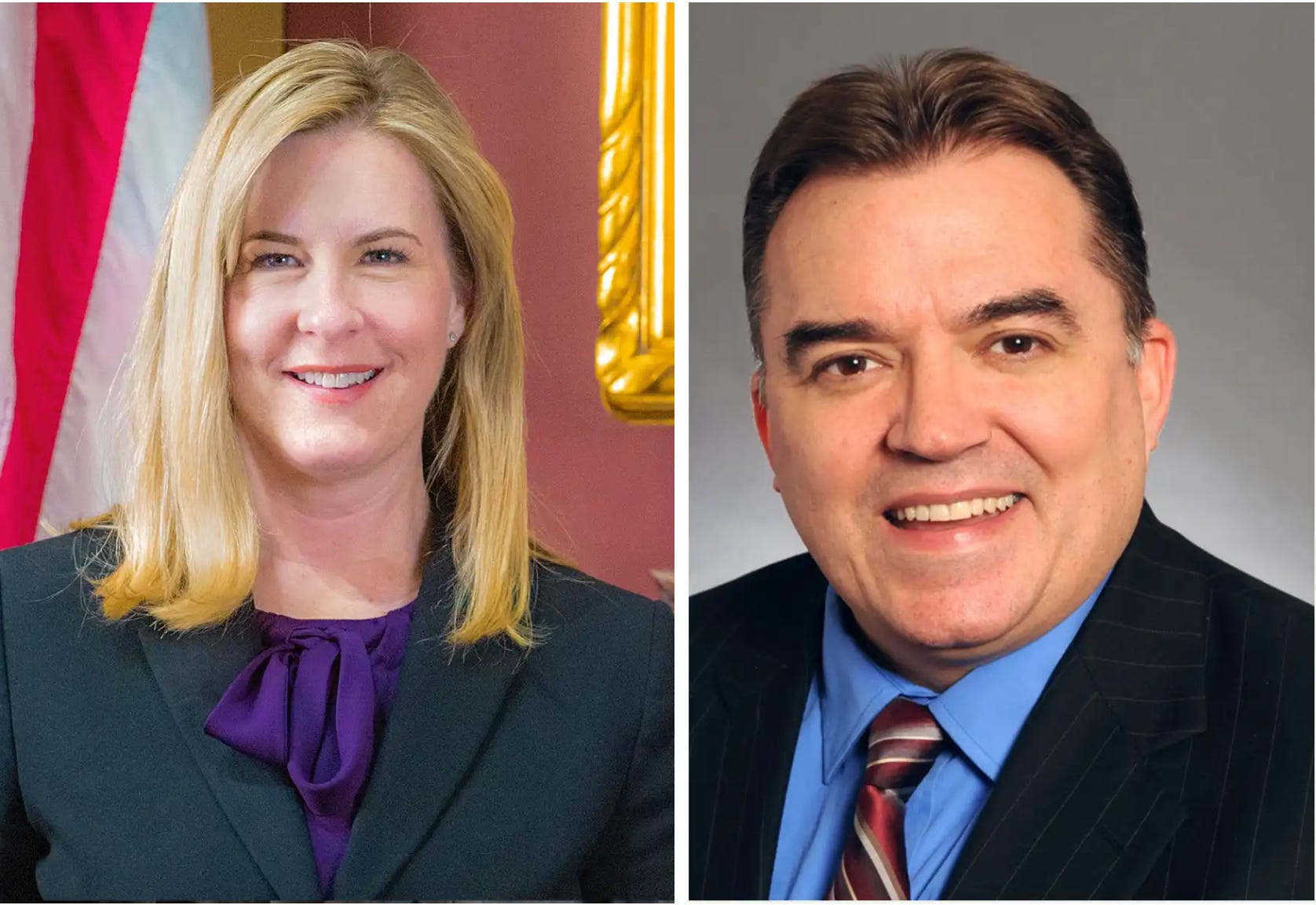
Somebody Is Shooting — Strike That — *Killing* Minnesota’s Democratic Lawmakers, Dressed As A Cop by Rebecca Schoenkopf

Well, here is some fucking news. Read on Substack

Melissa Hortman has died. John Hoffman and his wife have survived surgery.

Here is a fast post before I take a breath, make my signs, and go outside to scream my head off.

Someone or someones dressed as law enforcement — or law enforcement! with ICE covering their faces, there’s really no way to know anymore who is who! — has gone and shot Democratic lawmakers in Minnesota. The Minnesota House is split 67-67, and the Minnesota Senate has a plus-one majority for Democratic-Farm-Labor. These are targeted assassinations.

Sen. John Hoffman (DFL-Champlin) and Minnesota House DFL Leader Melissa Hortman of Brooklyn Park are reportedly in grave condition. Reportedly, both of their spouses were shot too. Update 10:50 eastern: KSTP is reporting that Hortman and her husband Mark have died.

Update 11:00 eastern: Per an officer at the press conference above, officers responding to the shooting at Hoffman’s house asked Brooklyn Park officers to go check Hortman’s house — out of a vague foreboding. Those officers found the fake cop coming out of her house, when he immediately shot at them and went back inside.

Update 11:30 eastern: NOWHERE in this CNN story on the “politically motivated assassination” does it tell its readers that the victims were Democrats. Why do you suppose that is?

Everything is escalating. Nothing is all right.

The last time someone tried to kill Democrats, it was a lunatic who bashed Nancy Pelosi’s octogenarian husband in the head with a hammer. This was considered very hilarious by our president, Donald Trump.

Here is Minnesota Gov. Tim Walz a day ago.

https://embed.bsky.app/embed/did:plc:kkowgxq2se4x5lo4zyipch6a/app.bsky.feed.post/3lriop3puf22w?id=18887764160362552

Jesus Fucking Christ.

Clay Jones

Handcuffing Padilla by Clay Jones

This is a bunch of bullshit Read on Substack

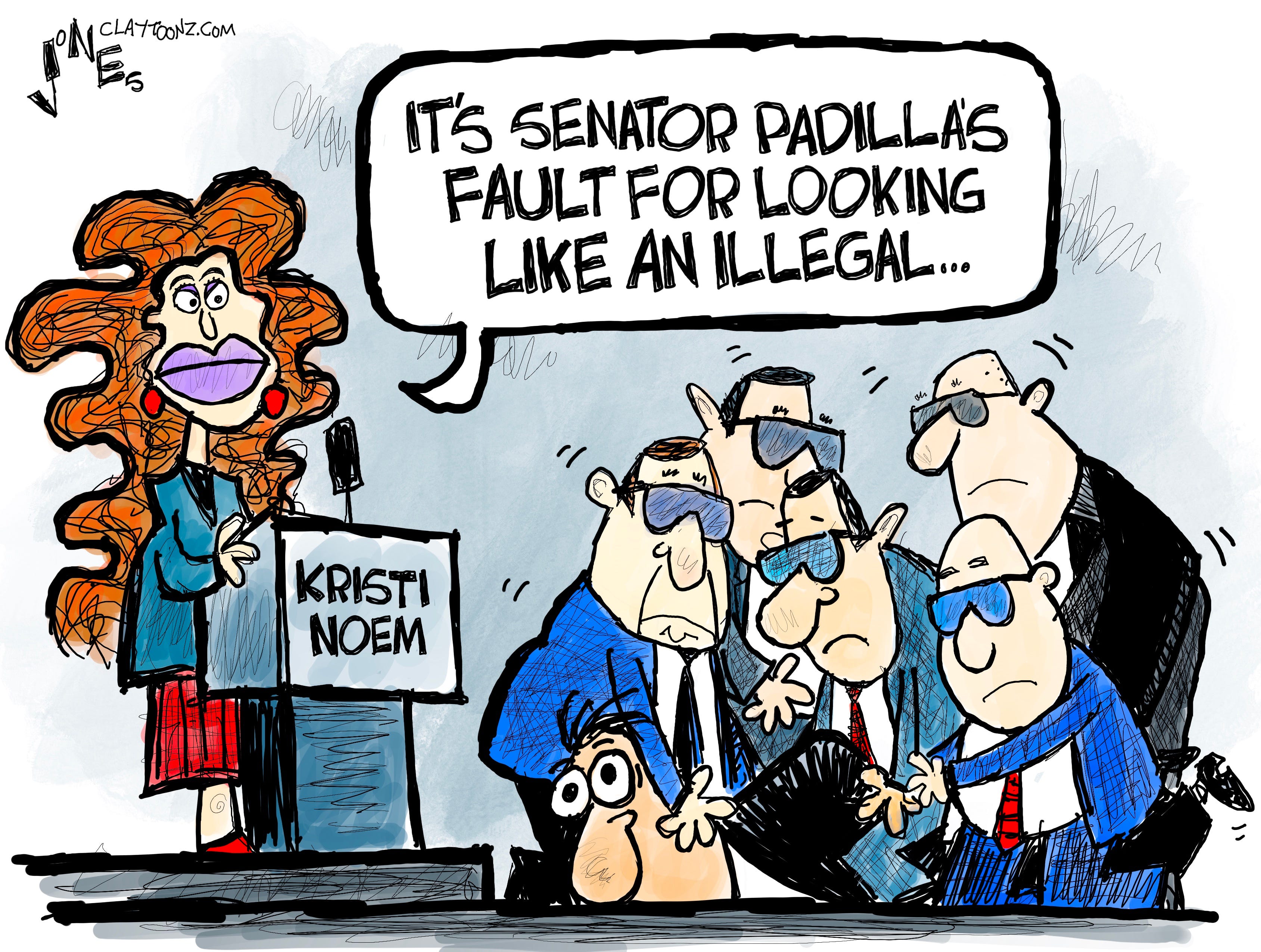
Right before Senator Alex Padilla of California was frog-marched out of the room and handcuffed, Secretary of Homeland Security Kristi Noem said she was going to “liberate” Los Angeles “from the socialists and the burdensome leadership this governor and mayor have placed on this country and this city.”

What happened to the National Guard and the Marines being deployed to Los Angeles to stop non-existent riots? Now it’s “liberate” the city from socialist and “burdensome” leadership? Does that mean Noem plans to overthrow Mayor Karen Bass and Governor Gavin Newsom with the military?

On one hand, the regime is trying to portray what’s going on in LA as a rebellion or insurrection, and on the other hand, they’re talking about staging their own rebellion and insurrection.

Noem, the lying pig she is (I want to use another word that many wouldn’t like), claims Senator Padilla “lunged” toward the stage, and after hearing her plans to “liberate” Los Angeles, who could blame him? Except he didn’t “lunge” toward her.

If you’re in the right in a situation, then why are you lying? Kristi Noem is lying about what happened yesterday with Senator Alex Padilla.

Was Padilla “lunging” here? You don’t see it. You don’t see it from this angle, either. But you do hear him identify himself. So when Noem and other Republicans say he didn’t, you know they’re lying. If they’re lying to cover their actions, then you know they’re wrong. They know they’re wrong.

Noem also claims the senator “barged” into the building. That’s a lie. He was escorted into the building and into the room where Noem was having her press conference. He was escorted into the room by an FBI agent and a member of the California National Guard. It was a federal building, which means nobody is getting in there without going through security first. There’s no way she could think Padilla was an angry “illegal” there to steal her purse.

Padilla, who has a reputation in Washington of being extremely nice and kinda nerdy, was no threat to Noem in this federal building. She didn’t seem concerned at all about a guy “lunging” toward her, as she barely paused her yammering while he was being dragged away by her goons.

Noem and her security detail claim they didn’t recognize Padilla, but I call bullshit on this one. It seems before going to California, Noem would familiarize herself with some of the players, like the mayor of Los Angeles, the governor of California, House reps of the area, and the state’s two senators. I’m sure she would have recognized Adam Schiff and Gavin Newsom, so why didn’t she recognize Senior Senator Alex Padilla? Why didn’t her security? If nothing else, he was identifying himself and wearing a shirt with the Senate logo.

She’s also the director of Homeland Security, which deals with immigration. So, shouldn’t be somewhat familiar with the ranking member of the Senate Judiciary Committee’s Subcommittee on Immigration, Citizenship, and Border Safety.

The only somewhat acceptable reason that Kristi Noem didn’t recognize Senator Alex Padilla is that she’s fucking stupid. I can believe that she’s a moron, but I don’t buy that she nor her security could recognize United States Senator Alex Padilla. Plus, you can’t trust the word of anyone who would shoot a puppy.

And because Republicans are vile evil scum, Speaker Mike Johnson, even without looking this, wants to censure Padilla for his actions. What actions? Being brown? Being a child of Mexican immigrants? This is like the cop who pulls people over for being Black.

Padilla’s crime here is that he cares about the people ICE is going after, that he does his job, he’s a Democrat, and he’s non-White. I would love to see that in the empty censure Johnson is dreaming up.

Padilla’s biggest crime might be that he dared to question Kristi Noem.

The goons are using the military to shut down protests. They don’t want to be questioned. For the love of god, they literally handcuffed a United States Senator for challenging them.

Noem admitted it. The military is in Los Angeles to replace its elected leadership.

Republicans want to punish Padilla, but for what? Interrupting? After saying she was there to use the military to replace elected leadership, she should be interrupted. She needs to be questioned after proposing replacing California’s leadership with a military junta.

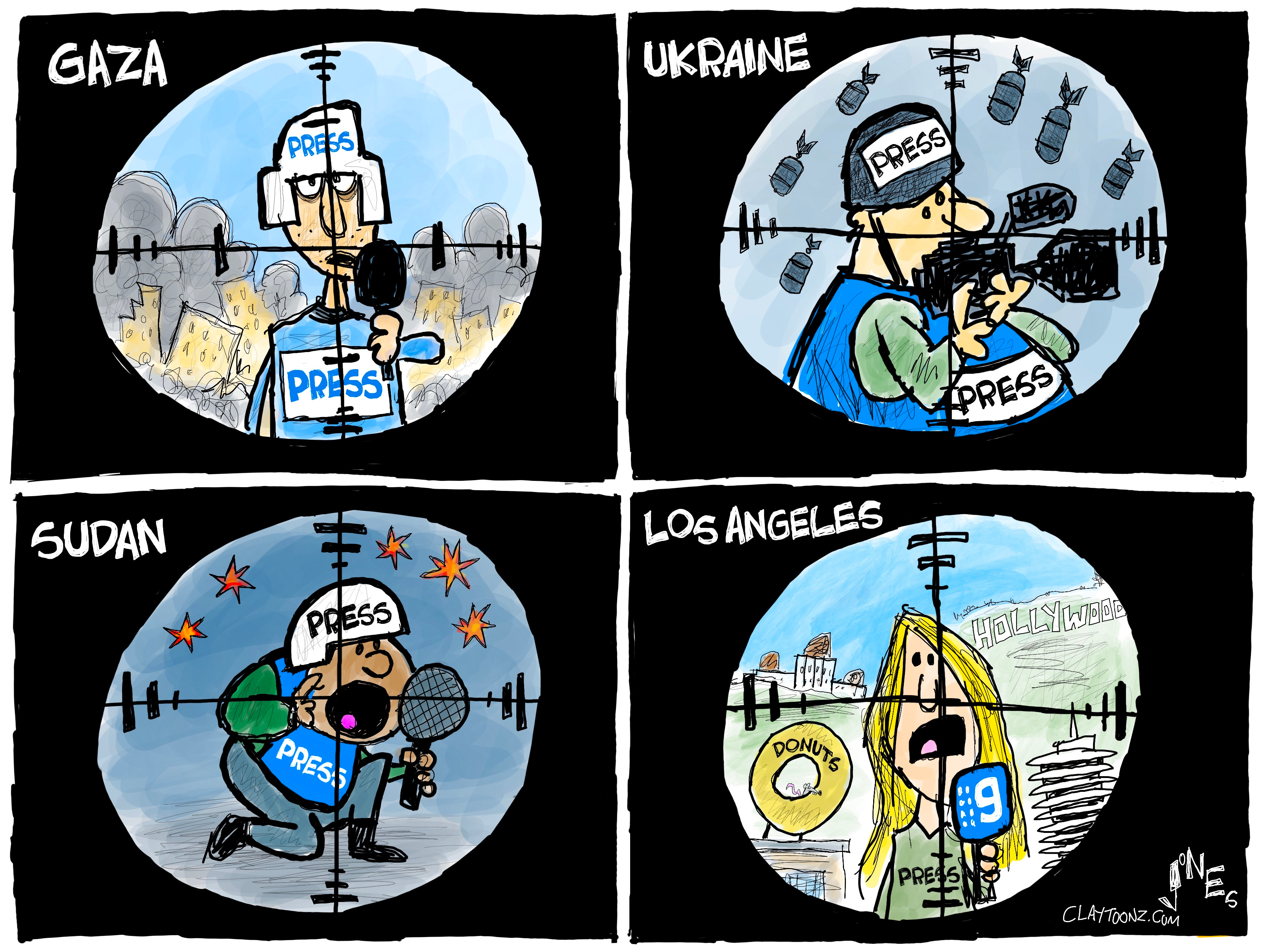
Every American needs to question Noem about this. Every Republican should question her. And for the love of god, every journalist needs to question, so long as the LAPD doesn’t shoot them in the process.

Alex Padilla stood up and questioned her, just like he should have. Alex Padilla didn’t just do his job, but did his duty as a patriotic American, which is more than can be said for every Republican who has folded to Donald Trump.

Every single one of us needs to be more like Alex Padilla. Today, Alex Padilla is my hero.

What would Alex Padilla do? He would do the right thing, and he did. (snip-MORE)

Police secretly monitored New Orleans with facial recognition cameras

https://www.washingtonpost.com/business/2025/05/19/live-facial-recognition-police-new-orleans/

Following records requests from The Post, officials paused the first known, widespread live facial recognition program used by police in the United States.

A Project NOLA security camera keeps watch over the corner of Conti and Burgundy streets in New Orleans on May 8. (Edmund D. Fountain/For The Washington Post)

NEW ORLEANS — For two years, New Orleans police secretly relied on facial recognition technology to scan city streets in search of suspects, a surveillance method without a known precedent in any major American city that may violate municipal guardrails around use of the technology, an investigation by The Washington Post has found.

Police increasingly use facial recognition software to identify unknown culprits from still images, usually taken by surveillance cameras at or near the scene of a crime. New Orleans police took this technology a step further, utilizing a private network of more than 200 facial recognition cameras to watch over the streets, constantly monitoring for wanted suspects and automatically pinging officers’ mobile phones through an app to convey the names and current locations of possible matches.

This appears out of step with a 2022 city council ordinance, which limited police to using facial recognition only for searches of specific suspects in their investigations of violent crimes and never as a more generalized “surveillance tool” for tracking people in public places. Each time police want to scan a face, the ordinance requires them to send a still image to trained examiners at a state facility and later provide details about these scans in reports to the city council — guardrails meant to protect the public’s privacy and prevent software errors from leading to wrongful arrests.

Since early 2023, the network of facial recognition cameras has played a role in dozens of arrests, including at least four people who were only charged with nonviolent crimes, according to police reports, court records and social media posts by Project NOLA, a crime prevention nonprofit company that buys and manages many of the cameras. Officers did not disclose their reliance on facial recognition matches in police reports for most of the arrests for which the police provided detailed records, and none of the cases were included in the department’s mandatory reports to the city council on its use of the technology. Project NOLA has no formal contract with the city, but has been working directly with police officers.

“This is the facial recognition technology nightmare scenario that we have been worried about,” said Nathan Freed Wessler, a deputy director with the ACLU’s Speech, Privacy, and Technology Project, who has closely tracked the use of AI technologies by police. “This is the government giving itself the power to track anyone — for that matter, everyone — as we go about our lives walking around in public.”

New Orleans Police Superintendent Anne Kirkpatrick during an interview this month. (Edmund D. Fountain/For The Washington Post)

Anne Kirkpatrick, who heads the New Orleans Police Department, paused the program in early April, she said in an interview, after a captain identified the alerts as a potential problem during a review. In an April 8 email reviewed by The Post, Kirkpatrick told Project NOLA that the automated alerts must be turned off until she is “sure that the use of the app meets all the requirements of the law and policies.” The Post began requesting public records about the alerts in February.

The police department “does not own, rely on, manage, or condone the use by members of the department of any artificial intelligence systems associated with the vast network of Project Nola crime cameras,” Reese Harper, a spokesman for the agency, said in an emailed statement.

Police across the country rely on facial recognition software, which uses artificial intelligence to quickly map the physical features of a face in one image and compare it to the faces in huge databases of images — usually drawn from mug shots, driver’s licenses or photos on social media — looking for possible matches. New Orleans’s use of automated facial recognition has not been previously reported and is the first known widespread effort by police in a major U.S. city to use AI to identify people in live camera feeds for the purpose of making immediate arrests, Wessler said.

The Post has reported that some police agencies use AI-powered facial recognition software in violation of local laws, discarding traditional investigative standards and putting innocent people at risk. Police at times arrested suspects based on AI matches without independent evidence connecting them to the crime, raising the chances of a false arrest. Often, police failed to inform defendants about their use of facial recognition software, denying them the opportunity to contest the results of a technology that has been shown to be less reliable for people of color, women and older people.

A facial recognition system deployed by police in London’s Oxford Circus on May 13. London is one of the few places where live facial recognition is known to be in wide use. (Leon Neal/Getty Images)

One of the few places where live facial recognition is known to be in wide use is London, where police park vans outside of high-traffic areas and use facial recognition-equipped cameras to scan the faces of passersby, and confront people deemed a match to those on a watch list. While the city says the program has never led to a false arrest since launching in 2016, Big Brother Watch, a London-based civil liberties group, argues that the practice treats everyone as a potential suspect, putting the onus on the people who were falsely matched to prove their innocence.

Real-time alerts

The surveillance program in New Orleans relied on Project NOLA, a private group run by a former police officer who assembled a network of cameras outside of businesses in crime-heavy areas including the city’s French Quarter district.

Project NOLA configured the cameras to search for people on a list of wanted suspects. When the software determined it had found a match, it sent real-time alerts via an app some officers installed on their mobile phones. The officers would then quickly research the subject, go to the location and attempt to make arrests.

Police did not set up the program nor can they directly search for specific people, or add or remove people from the camera system’s watch list, according to Bryan Lagarde, Project NOLA’s founder.

Little about this arrangement resembles the process described in the city council ordinance from three years ago, which imagined detectives using facial recognition software only as part of methodical investigations with careful oversight. Each time police want to scan a face, the ordinance requires them to send a still image to a state-run “fusion center” in Baton Rouge, where various law enforcement agencies collaborate on investigations. There, examiners trained in identifying faces use AI software to compare the image with a database of photos and only return a “match” if at least two examiners agree.

Investigators have complained that process takes too long and often doesn’t result in any matches, according to a federally mandated audit of the department in 2023. It has only proved useful in a single case that led to an arrest since October 2022, according to records police provided to the city council.

A surveillance camera mounted to the underside of a balcony on Bourbon Street in New Orleans. (Edmund D. Fountain/For The Washington Post)
Freddie King, a New Orleans council member who represents the district that includes the French Quarter, voted in support of a 2022 ordinance that authorized police to use facial recognition as long as they adhered to certain guardrails. (Edmund D. Fountain/For The Washington Post)

By contrast, Project NOLA claims its facial recognition cameras played a role in at least 34 arrests since they were activated in early 2023, according to the group’s Facebook posts — a number that cannot be verified because the city does not track such data and the nonprofit does not publish a full accounting of its cases. Without a list of the cases, it’s impossible to know whether any of the people were misidentified or what additional steps the officers took to confirm their involvement in the crimes.

Kirkpatrick said her agency has launched a formal review into how many officers used the real-time alerts, how many people were arrested as a result, how often the matches appear to have been wrong and whether these uses violated the city ordinance.

“We’re going to do what the ordinance says and the policies say, and if we find that we’re outside of those things, we’re going to stop it, correct it and get within the boundaries of the ordinance,” she said.

There are no federal regulations around the use of AI by local law enforcement. Four states — Maryland, Montana, Vermont and Virginia — as well as at least 19 cities in nine other states explicitly bar their own police from using facial recognition for live, automated or real-time identification or tracking, according to the Security Industry Association, a trade group.

Lawmakers in these places cited concerns in public meetings that the technology could infringe on people’s constitutional rights or lead police to make mistakes when they rush to arrest a potential suspect before taking steps to confirm their connection to the crime, as many people look alike. At least eight Americans have been wrongfully arrested due to facial recognition, The Post and others have reported.

The unsanctioned surveillance program in New Orleans highlights the challenge of regulating a technology that is widely available, at a time when some police see AI as an invaluable crime fighting tool. Even in some places where officials have banned facial recognition, including Austin and San Francisco, officers skirted the bans by covertly asking officers from neighboring towns to run AI searches on their behalf, The Post reported last year.

Violent crime rates in New Orleans, like much of the country, are at historic lows, according to Jeff Asher, a consultant who tracks crime statistics in the region. But city officials have seized on recent instances of violent crime to argue that police need the most powerful tools at their disposal.

Last month, an independent report commissioned after the New Year’s Day attack that left 14 people dead on Bourbon Street found the New Orleans police to be understaffed and underprepared. The report, overseen by former New York City police commissioner William Bratton, advised New Orleans to explore adopting several new tools, including drones, threat prediction systems and upgrades to the city’s real-time crime center — but did not recommend adding any form of facial recognition.

Kirkpatrick, the city’s top police official, and Jason Williams, its top prosecutor, both said they are in discussions with the city council to revise the facial recognition ordinance. Kirkpatrick says she supports the idea of the city legally operating its own live facial recognition program, without the involvement of Project NOLA and with certain boundaries, such as prohibiting use of the technology to identify people at a protest.

“Can you have the technology without violating and surveilling?” she asked. “Yes, you can. And that’s what we’re advocating for.”

5,000 cameras

Few people have as much visibility into the everyday lives of New Orleans residents as Lagarde, a former patrol officer and investigator who started his own video surveillance business in the late 1990s before launching Project NOLA in 2009.

Funded by donations and reliant on businesses that agree to host the cameras on their buildings or connect existing surveillance cameras to its centralized network, Lagarde said Project NOLA has access to 5,000 crime cameras across New Orleans, most of which are not equipped with facial recognition. The cameras all feed into a single control room in a leased office space on the University of New Orleans campus, Lagarde said in an interview at the facility. Some camera feeds are also monitored by federal, state and local law enforcement agencies, he said.

Bryan Lagarde, who founded Project NOLA in 2009, in a real-time video monitoring room at the University of New Orleans in 2017. (Max Becherer/The Advocate)

Project NOLA made $806,724 in revenue in 2023, tax filings show. Much of it came from “cloud fees” the group charges local governments outside of New Orleans — from Monticello, Florida, to Frederick, Colorado — which install Project NOLA cameras across their own towns and rely on Lagarde’s assistance monitoring crime. He’s experimented with facial recognition in Mississippi, he said, but his “first instance of doing citywide facial recognition is New Orleans.” New Orleans does not pay Project NOLA.

For more than a decade, Lagarde used standard cameras outside businesses to monitor crime and offer surveillance clips for officers to use in their investigations. Lagarde’s cameras became so widespread that police began calling him when they spotted a Project NOLA camera hovering near a crime scene they were investigating, according to police incident reports, interviews with police and emails obtained through a public records request.

Lagarde began adding facial recognition cameras to his network in early 2023, after an $87,000 bequest from a local woman. Lagarde used the money to buy a batch of cameras capable of detecting people from about 700 feet away and automatically matching them to the facial features, physical characteristics and even the clothing of people in a database of names and faces he has compiled.

Lagarde says he built his database partly from mug shots from local law enforcement agencies. It includes more than 30,000 “local suspected and known criminals,” Project NOLA wrote on Facebook in 2023. Lagarde can quickly identify anyone in the database the moment they step in front of a Project NOLA camera, he said. He can also enter a name or image to pull up all the video clips of that person Project NOLA captured within the last 30 days, after which Lagarde says videos get automatically deleted “for privacy reasons.”

Project NOLA found enthusiastic partners in local business owners, some of who were fed up with what they saw as the city’s inability to curb crime in the French Quarter — the engine of its tourism economy that’s also a hub for drug dealers and thieves who prey on tourists, said Tim Blake, the owner of Three Legged Dog, a bar that was one of the first places to host one of Project NOLA’s facial recognition cameras.

“Project NOLA would not exist if the government had done its job,” Blake said.

Tim Blake’s bar, the Three Legged Dog, was one of the first places to host a Project NOLA camera. (Edmund D. Fountain/For The Washington Post)

While Lagarde sometimes appears alongside city officials at news conferences announcing prominent arrests, he is not a New Orleans government employee or contractor. Therefore, Lagarde and the organization are not required to share information about facial recognition matches that could be critical evidence in the courtroom, said Danny Engelberg, the chief public defender for New Orleans.

“When you make this a private entity, all those guardrails that are supposed to be in place for law enforcement and prosecution are no longer there, and we don’t have the tools to do what we do, which is hold people accountable,” he said.

Lagarde says he tries to be transparent by posting about some of his successful matches on Facebook, though he acknowledges that he only posts a small fraction of them and says it would be “irresponsible” to post information about open investigations. Project NOLA, he added, is accountable to the businesses and private individuals who host the cameras and voluntarily opt to share their feeds with the network.

“It’s a system that can be turned off as easily as it’s been turned on,” he said. “Were we to ever violate public trust, people can individually turn these cameras off.”

Banned devices

Lagarde declined to say who makes the equipment he uses, saying he doesn’t want to endorse any company.

Several Project NOLA cameras in the French Quarter look nearly identical to ones on the website of Dahua, a Chinese camera maker, and product codes stamped on the backs of these devices correspond to an identical camera sold by Plainview, New York-based equipment retailer ENS Security, which has acknowledged reselling Dahua cameras in the past. Project NOLA’s website also contains a link to download an app where police officers can view and manage footage. The app, called DSS, is made by Dahua.

Congress banned federal agencies from using products or services made by Dahua and a list of other Chinese companies in 2018, citing concerns that the equipment could be used by President Xi Jinping’s government to spy on Americans. Since 2020, the law has barred any agency or contractor that receives federal funds from using those funds on the banned products.

“This technology requires accountability,” said Stella Cziment, a lawyer who heads a watchdog agency overseeing the practices of the New Orleans Police Department. “I am never going to be satisfied with the accountability it receives if it’s in a private entity’s hands.” (Edmund D. Fountain/For The Washington Post)
A Project NOLA security camera mounted to the Hotel Monteleone. (Edmund D. Fountain/For The Washington Post)

A Dahua spokesperson declined to comment on the New Orleans cameras and said the company stopped selling equipment in the U.S. last year.

The New Orleans Police Department has received tens of millions of dollars from the federal government in recent years and confirmed that some officers have installed this DSS app on mobile phones and police workstations. Kirkpatrick said she was not aware of who made the app or cameras but would look into it.

Lagarde said Project NOLA uses “American-made, brand-name servers to operate our camera program.”

Some city officials argue that police are not violating the city’s facial recognition ordinance because they do not own the cameras or contract with Lagarde; they are merely receiving tips from an outside group that is performing facial recognition scans on its own.

“If Bryan Lagarde calls an officer and says ‘I think a crime is occurring on the 1800 Block of Bienville,’ that’s no different than Miss Johnson looking out of her window and saying ‘I think a crime is occurring on 1850 Bienville,’” Williams, the Orleans Parish district attorney, said in an interview.

But in many cases, police have gone to Lagarde to request footage or help identifying and locating suspects, according to police reports, Project NOLA social media posts and internal police emails.

Tracking a suspect

In one case last year, a police detective investigating a snatched cellphone relied on Project NOLA to identify the perpetrator and track him down using facial recognition alerts, according to accounts of the investigation drawn partly from the police incident report and partly from Project NOLA’s Facebook post.

The detective contacted Lagarde “to assist locating the perpetrator on Project NOLA cameras,” according to the police report, providing still shots taken from the city’s surveillance camera footage. Lagarde used Project NOLA’s clothing recognition tool to find previous video footage of a suspect. With the new, better images of his face, Project NOLA used facial recognition to learn his possible identity and share that with the detective.

The detective took that name and found photos of a man on social media whose appearance and tattoos matched the phone-snatcher. Police got a warrant for his arrest. Lagarde added that name and face to Project NOLA’s watch list, and a few days later, cameras automatically identified him in the French Quarter and alerted police, who found and arrested him. The man was charged with robbery but pleaded guilty to the lesser offense of theft, court records show.

The police report mentioned that Lagarde helped identify the suspect, but did not mention that he used facial recognition to do so or used live facial recognition and automated alerts to monitor for and locate him.

New Orleans Police Sgt. David Barnes. (Edmund D. Fountain/For The Washington Post)

David Barnes, a New Orleans police sergeant overseeing legal research and planning, said officers are trained to always find probable cause before making an arrest. He said Lagarde sometimes overstates in Facebook posts the role his technology played in some of the cases. He said the detective investigating the phone-snatching case was only asking Lagarde to find videos of the suspect, not the location of the suspect.

On a rainy May morning outside the Three Legged Dog, a Project NOLA camera swiveled about, blinking red and blue lights, and twitching side to side as it followed cars and people based on an automated program. The camera is no longer pinging the police on an app — at Kirkpatrick’s request.

“Like you and everybody else, I do not want to lose any cases of violent criminals based on policy violations or violations of our ordinances,” Kirkpatrick said in her email last month to Lagarde.

But the alerts still go to Project NOLA staff, who Lagarde said convey the location of wanted suspects to the police via phone calls, texts and emails.

Schaffer reported from Washington. Nate Jones and Jeremy Merrill contributed to this report.

Thurgood Marshall Nominated for SCOTUS, & More, in Peace & Justice History for 6/13

June 13, 1967

Thurgood Marshall was nominated for justice of the Supreme Court by President Lyndon Johnson. Marshall was then Solicitor General of the United States, and had been the lead attorney in the Brown v. Board of Education case that ended legal segregation in the schools. He would be the first African American on the Court.
Synopsis of Juan Williams’s biography of Justice Thurgood Marshall 
June 13, 1971

The New York Times began publishing the Pentagon Papers, a series of excerpts from the Defense Department’s classified history of the Vietnam War, giving details of U.S. involvement in Vietnam from the end of World War II to 1968. Publication was interrupted after the Nixon administration went to court to block it, asserting its power to exercise prior restraint over public release of what it considered classified material. The Washington Post then began publishing the papers. On June 30 the Supreme Court, 6-3, allowed publication to resume.
What started that day and how Nixon’s people dealt with it 
June 13, 1991
Jeffrey Collins was awarded a $5.3 million settlement from Shell Oil which had fired him for being gay. Collins had offered to settle out of court for $50,000, but Shell refused.

https://www.peacebuttons.info/E-News/peacehistoryjune.htm#june13

Open Windows, Clay Jones

Journalists In Crosshairs by Clay Jones

Read on Substack

Press freedom is an issue close to my heart.

Here in America, Journalists have never had to worry so much for their physical safety. That’s one reason why political cartoonist, Cameron Cardow, pissed me off so much when he started working as “Rivers,” an anonymous cartoonist pretending his life was in danger for supporting Donald Trump with lies and conspiracy theories while being a Canadian pretending to be an American.

If anything, Cam working anonymously, with the aid of syndicate boss Daryl Cagle, was threatening journalism by telling editors that it wouldn’t violate their ethics policies because political cartoonists are not journalists. Rivers has since quit, but Cagle is still doing his best to undermine political cartoonists as journalists.

Just in case they’re reading this, Daryl, you’re a huge disappointment who fails to exercise responsibility or even quality control when distributing misinformation powered by racism. Next time we meet, we’re gonna have a talk.
Cam, you’re just a lying piece of shit, but I’m thankful for your career change and hope you’re doing well, at least well enough not to come back to cartooning.

There are other places outside the United States where being a journalist can be very dangerous. Mexico can be a very bad place for journalists, not so much from the government but from drug cartels. Murderers of journalists in Haiti are likely to go unpunished. Pakistan is considered extremely dangerous for a reporter. The wars in Myanmar and Sudan are also killing journalists.

No deaths of journalists from White Genocide in South Africa have been reported, maybe because there’s no White Genocide in South Africa.

Since 2014, at least 17 journalists have been killed in the Russo-Ukrainian War. Since Hamas attacked Israel on October 7, 2023, at least 184 journalists and media workers have been killed in Gaza.

12 people were killed in Paris, which is not a war zone, in 2015 at the offices of satirical magazine Charlie Hebdo, by terrorists angered by cartoons of Muhammad in 2012. Five of the 12 killed were cartoonists.

Here in the United States, despite Rivers’ cowardice, a political cartoonist has never been assassinated. The biggest threat to our press freedom here comes from the owners of news outlets, as they all bow in fear before Tiny TACO. But that might be changing. (snip-MORE)

The one who should be going to prison by Ann Telnaes

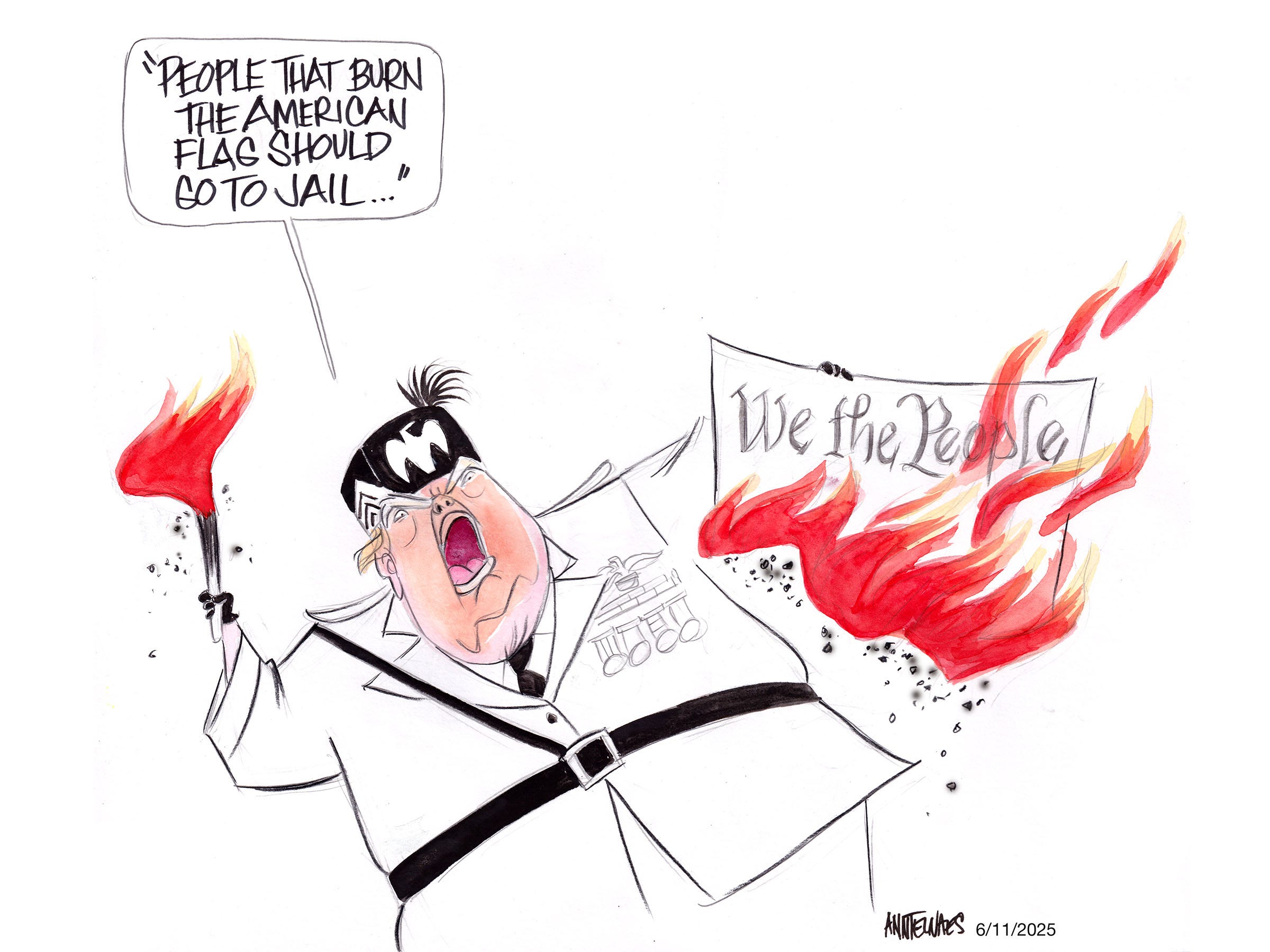
Trump calls for jailing people who burn the U.S. flag Read on Substack

More proof Trump doesn’t respect the First Amendment and isn’t familiar with the Supreme Court decision protecting flag-burning.