“We’re not looking to arm up and storm the Capitol,” one gun owner said. “We just don’t want to be put in concentration camps.”
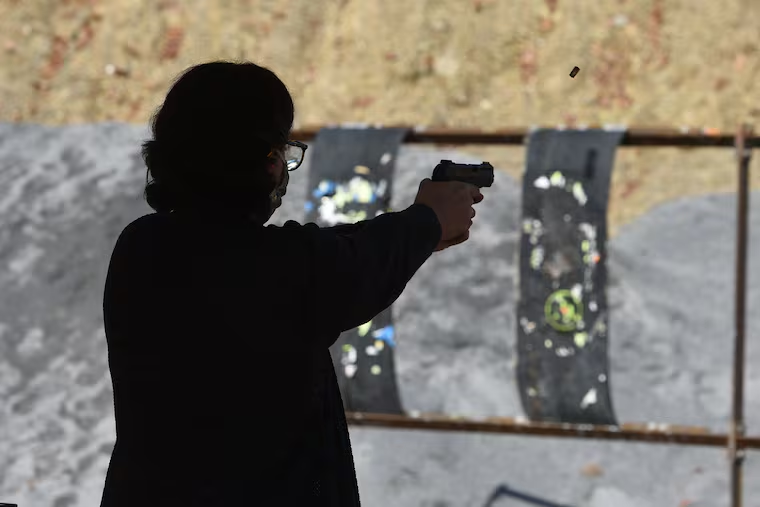
A., who the Inquirer is identifying by the first letter of her first name for safety reasons, stapled two paper plates to the range for her target practice.Bradley C Bower / For The Inquirer
On a brisk Saturday afternoon, A. crouched in a boxer’s stance, knees bent, one hip forward, raised her new Ruger Security-380 pistol aloft with both hands, and pulled the trigger. Spent gold casings clinked to the ground as a paper plate across the range filled with bullet holes. Next to her, a row of men in sweatshirts and earmuffs affably shot their own marks.
A., who The Inquirer is identifying by the first letter of her first name because of safety concerns, is new to the world of shooting ranges and target practice. As a trans woman who lives in Philadelphia, she began seriously considering armed self-defense this summer, as she saw Texas uphold a ban on gender-affirming care for minors and Florida prohibit nurse practitioners from prescribing hormones to transgender people. She watched with increasing dread as Republicans spent nearly $215 million on network TV ads portraying people like her as a dangerous threat to the country.
“Three months before the election, that’s when the alarm bells started to ring,” A., who is 24 and speaks carefully and thoughtfully, said recently. When she mentioned wanting to learn how to fire a gun to friends, they stared at her blankly.
But she felt she couldn’t have been more rational. On Nov. 2, she bought her first gun, at Delia’s Gun Shop in Northeast Philly.
“Minorities that are armed are more difficult to legally oppress,” she said. She was reassured by the idea that “in the event of hate crimes or terrorist attacks, knowing that, ‘OK, I’m personally armed and I can protect my property and people that are close to me.’” She is applying for a concealed carry permit in Pennsylvania, though she doesn’t plan to carry the gun with her every day.
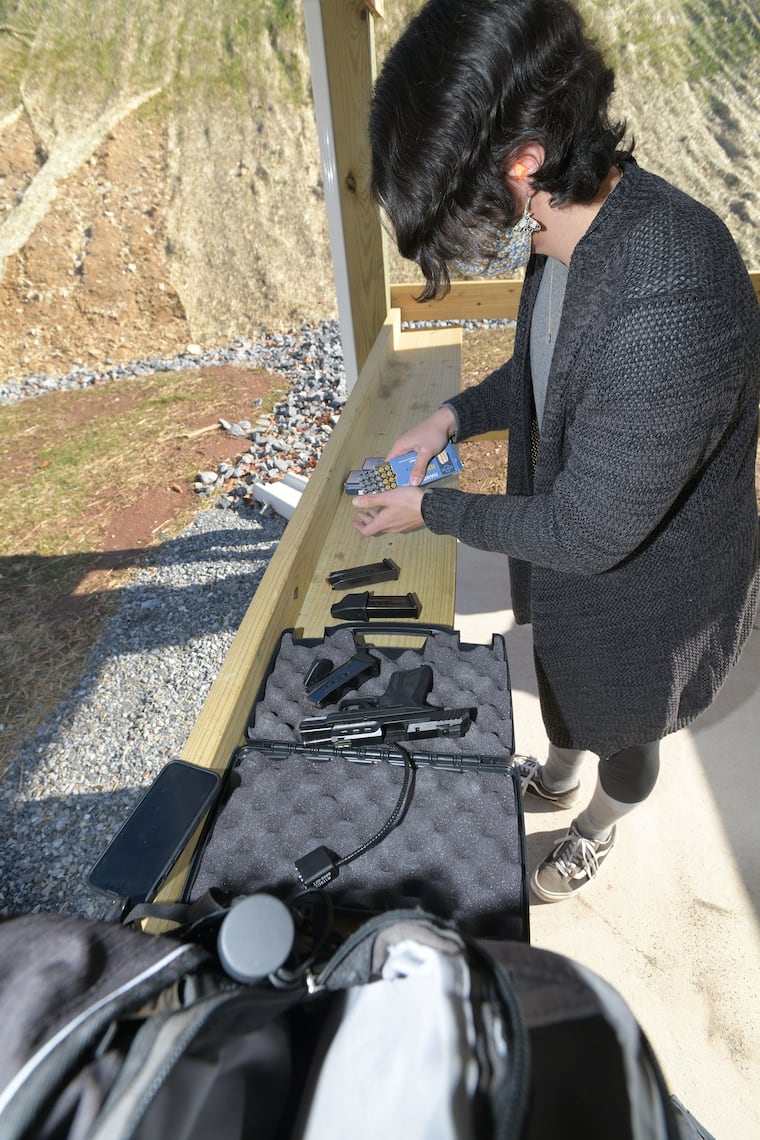
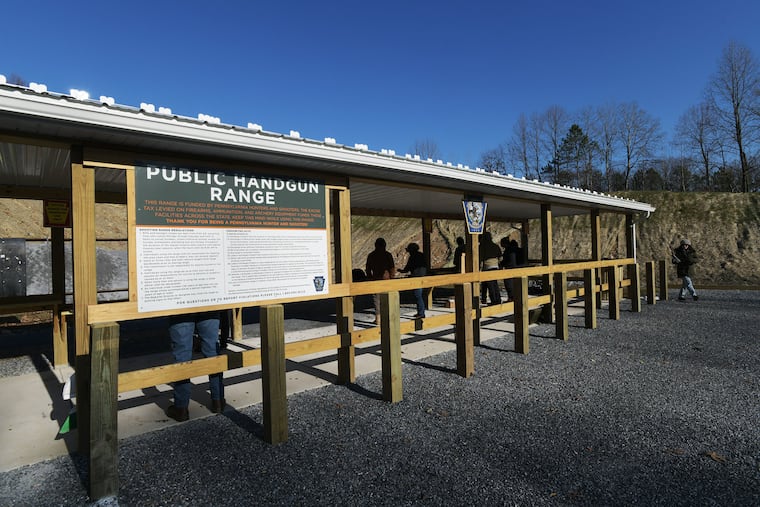
By the end of her practice at the outdoor range at French Creek State Park, bullet casings littered the ground near her backpack and water bottle, which was decorated with rainbow hearts and a “Protect Trans Kids” sticker.
A. prepared to shoot at the French Creek State Park outdoor range.Bradley C Bower / For The Inquirer
‘If I can’t protect myself, who will?’
Since Donald Trump’s reelection in November, nontraditional gun groups across the city and country have seen a flood of interest. The national Liberal Gun Club said it has received thousands of training requests since the election, more than in all of 2023. A spokesperson for the group estimated that roughly a quarter were from LGBTQ people.
In Philadelphia, in the waning weeks of the year, residents peppered local queer Facebook groups with questions about guns and training. The local chapter of the Socialist Rifle Association, a leftist analogue to the National Rifle Association, said it saw a surge in paid memberships; its regular classes about gun safety filled up immediately, so they added more. The head of the Delaware Valley chapter of the Pink Pistols, a longtime gay gun group with the slogan “Armed Gays Don’t Get Bashed,” said he received a sudden flurry of emails inquiring about gun training.
“There’s definitely a feeling among a lot of LGBT individuals: ‘If I can’t protect myself, who will?’” said Madeline Shearman, a trans woman based in Glen Mills who runs a casual and growing “2A social group” in Pennsylvania. “I feel that way myself.”
In Pennsylvania, overall gun sales were down in 2024, according to figures from the State Police: 666,759 firearms were lawfully purchased or privately transferred through the end of October, a drop from the 2020 record high of 1.1 million.
It’s difficult to track rises and falls in LGBTQ gun ownership because there are few published studies about the relatively small population, said David Yamane, a professor of sociology at Wake Forest University and author of the book Gun Curious.
But in general, Yamane argues that American gun culture has dramatically shifted in recent years, away from a focus on hunting and recreation and toward a focus on self-defense, the core of what he calls “Gun Culture 2.0.” As the culture has shifted, people who own guns have become far more diverse. He pointed to 2020 as a pivotal year.
“It was a period of tremendous social unrest and social uncertainty. And a large number of people in the United States, under those conditions, look to firearms to reestablish some sense of safety and security,” Yamane said. He added that racial and gender minorities “led the way” in terms of new gun ownership rates in 2020 and afterward.
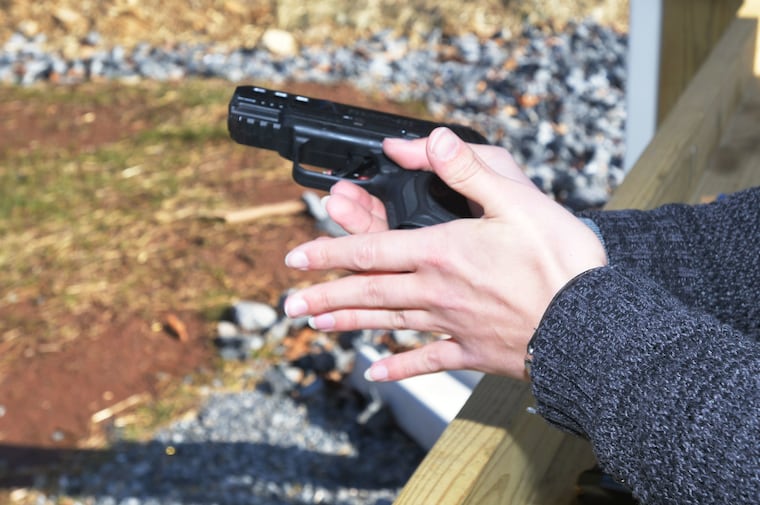
A. purchased her gun on November 2, 2024.Bradley C Bower / For The Inquirer
Yamane also pointed to other political moments that have fueled gun interest in the LGBTQ community. Pink Pistols, which has more than two dozen chapters across the country, was originally founded in 2000 after the writer Jonathan Rauch proposed in a Salon article that “homosexuals should embark on organized efforts to become comfortable with guns, learn to use them safely and carry them. They should set up Pink Pistols task forces, sponsor shooting courses and help homosexuals get licensed to carry.”
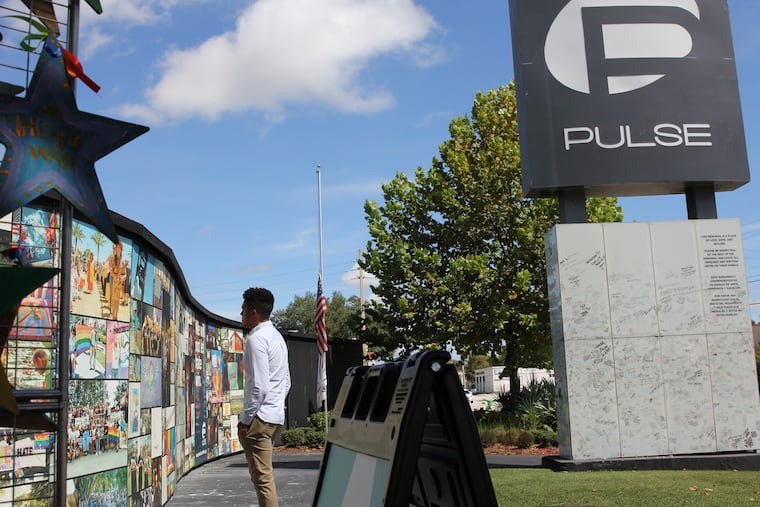
Brandon Wolf, a survivor of the Pulse nightclub shooting and activist, looks at the photos that were part of a Pulse memorial in Orlando, Fla., in 2022.Cody Jackson / AP
The devastating mass shooting at the Pulse nightclub in Florida in 2016 was another catalyst. That’s when Matthew Thompson, who lives in Oakland, N.J., purchased his first gun. A gay man and custom leather worker, Thompson often travels to leather and bear events on the weekends, and feared what might happen. He began practicing drills at home — setting a timer on his phone, wearing his unloaded gun around the house, and drawing it quickly when the timer went off.
Days after the presidential election, he began pursuing his concealed carry permit in New Jersey. He is also organizing other LGBTQ people to practice at a local gun range.
“The people I’ve been seeing on the left and the gay people who are out purchasing guns for the first time, it’s all about self-defense and fear,” said Thompson, who is 36. “We’re not looking to arm up and storm the Capitol. We just don’t want to be put in concentration camps.”
Gun safety with the Socialist Rifle Association
In mid-December, the Socialist Rifle Association’s local chapter held its monthly “Gun-damentals” class. A dozen people gathered in a ramshackle room at the Lava Community Center in West Philadelphia, where a range of unloaded firearms were displayed on the front table. Many of the attendees said they had little or no experience with guns.
The organization, founded nationally in 2018, tries to take a community-based approach to defense, organizers said. Once a month, its volunteers distribute food and medical supplies to people living on the street in Kensington, and the group also leads first aid and de-escalation training classes.
The recent gun-safety class was earnest and efficient: two organizers led the group through an information-packed PowerPoint presentation, explaining the legal landscape in Pennsylvania, the process of purchasing a gun, and basic safety tips, using a laser pointer to emphasize certain points.
Despite people’s hopes about increasing their safety, researchers have found that higher rates of gun ownership and access is correlated with higher rates of gun-related homicides, suicides, accidental deaths, and injuries. In an effort to reduce that danger, the SRA said it focuses on teaching responsible firearm ownership and safe storage.
The public handgun range at French Creek State Park.Bradley C Bower / For The Inquirer
An organizer wearing an Eagles cap and a black sweatshirt lingered on a slide about mental health.
“So guns are weapons, and they’re really good at what they do, which is killing things,” he said, as some attendees nodded and took notes. “85% of suicides attempted with firearms lead to death. … So you have to be mindful, if this is something that you do want to bring into your life, that you’re aware of your own mental health going into it.”
Doug, a therapist who asked to be identified solely by their first name to maintain professional privacy, joined the SRA after the election. They had been in the Boy Scouts growing up, had shot BB guns at camp, and gone to the shooting range occasionally with friends. But they had never owned a gun.
They attended the gun-safety class. Then in early December, they purchased their first gun, an AR-15. Doug was partly motivated by the fact that their official identifications are gender nonspecific, which could alert authorities to the fact that they are nonbinary. They feared they might not be able to buy a gun in the future.
“This country is not, I wouldn’t say, on very solid footing,” Doug said. “As a Boy Scout, I’d rather be prepared.”
Jan 06, 2025 Mariel Padilla Originally published by The 19th
Rep. Becca Balint of Vermont, who was elected to the 118th Congress in 2022, said she was shaped and largely motivated by January 6, 2021 — the day a mob of President Donald Trump’s supporters stormed the U.S. Capitol and temporarily halted the certification of the legitimate results of the 2020 election.
“A lot of the members who ran in the 118th and 119th Congress understood that we were running towards a house on fire and that being honestly democracy itself,” Balint said.
Balint said she vividly remembers January 6, 2021, because it was supposed to be one of the happiest days of her life: She was being sworn in as the first woman to lead the Vermont Senate. When her security team popped into her office to tell her that the U.S. Capitol was under attack, Balint said the footage “shook me to my core.”
The attack, which the Federal Bureau of Investigation called an act of domestic terrorism, sparked the Department of Justice’s largest criminal investigation in the country’s history and led to more than 1,500 people being federally charged. Rioters brought firearms, knives, hatchets, pepper spray, baseball bats, stun guns and explosive devices to fight Capitol Police officers and storm the building where lawmakers were actively voting to certify the 2020 election. Five people died during or soon after the riot, approximately 140 law enforcement officers were injured and $2.9 million worth of damage was done to the Capitol.
The day after the Capitol riot, Trump referred to the event as a “heinous attack” but has since promised to pardon those who were arrested in connection with the insurrection. Trump himself was indicted on felony charges in 2023 for attempting to overturn the results of the 2020 election — a criminal case that was dismissed shortly after he won the 2024 presidential election. The president-elect has since started describing January 6 as a “day of love,” as he did on the campaign trail.
As Congress votes again to certify the results of the 2024 presidential election, the country prepares to welcome back to the Oval Office the same man who denied his loss four years ago and threatened the country’s tradition of a peaceful transfer of power.
“It always sends a shiver down my spine when I hear people say ‘Americans don’t care about January 6 anymore — move on,’” Balint said. “I’m not moving on. It was a dark day in our history, and I’m not moving on.”
The 19th reached out to every woman in Congress — just as it did in 2021 and 2022 — to collect reflections on how January 6 continues to impact them and the country. Seventeen Democratic congresswomen and one senator responded and talked about their remaining trauma, their concern about the normalization of violence and their strong sense of duty to combat any efforts to whitewash that day.
‘There’s a record of this.’
Here’s what they said about how the spread of misinformation and disinformation surrounding that day has downplayed the severity of violence and the gravity of what was almost destroyed.
Rep. Suzanne Bonamici of Oregon: I still have seared in my memory the images of Capitol Police officers and other people being beaten. People lost their lives. … It’s not like somebody made this up. There are videos. There are pictures. There are statements. There’s a record of this. And there were people that were convicted by juries of their peers.
Rep. Deborah Ross of North Carolina: I think the most important thing is to be brutally honest about what happened that day. Many of us were there to witness, and we’re here to testify. We cannot allow Donald Trump and his cronies to deny what needs to be preserved for history. The next generation should know how fragile our democracy is and march forward, clear-eyed and ready to fight.
Balint: My grandfather was killed in the Holocaust and so I was raised in a family in which we were taught to be vigilant when people start eroding rights, upending norms, scapegoating people. When up is down and black is white and we can’t agree on basic facts, that is all an indication that we are headed in a very scary direction as a country.
Rep. LaMonica McIver of New Jersey: I think [Trump] is going to do whatever he can to make January 6 be remembered like it’s July 4. In his mind, I think it’s going to be put in the highest regard and glorify the day as much as he can. And he’s going to have four years to try and get the rest of the country to do the same.
Rep. Chellie Pingree of Maine: I think it’s very troubling that this incoming president could convince people that he either wasn’t responsible or that somehow all that didn’t matter. But sometimes it takes us a while to process big, complicated changes like this. Maybe there will be a time when we can reflect back and say that this was a mistake, that we overlooked it, that it took us time to realize how serious that movement was.
Rep. Jill Tokuda of Hawaii: As we approach January 6 once again, we all have a responsibility to stand up against the normalization of political violence and disinformation. We cannot forget what happened that day and as Americans, it is incumbent on us to reject violence in any form from infecting our politics and our democracy.
‘Deeply, deeply disappointed.’
Many of the lawmakers said they are still processing what it means about the state of our country that the same man who incited an insurrection could be re-elected four years later. Several emphasized that those involved in planning, executing or inciting the riot still need to be held accountable before the country can heal and move forward.
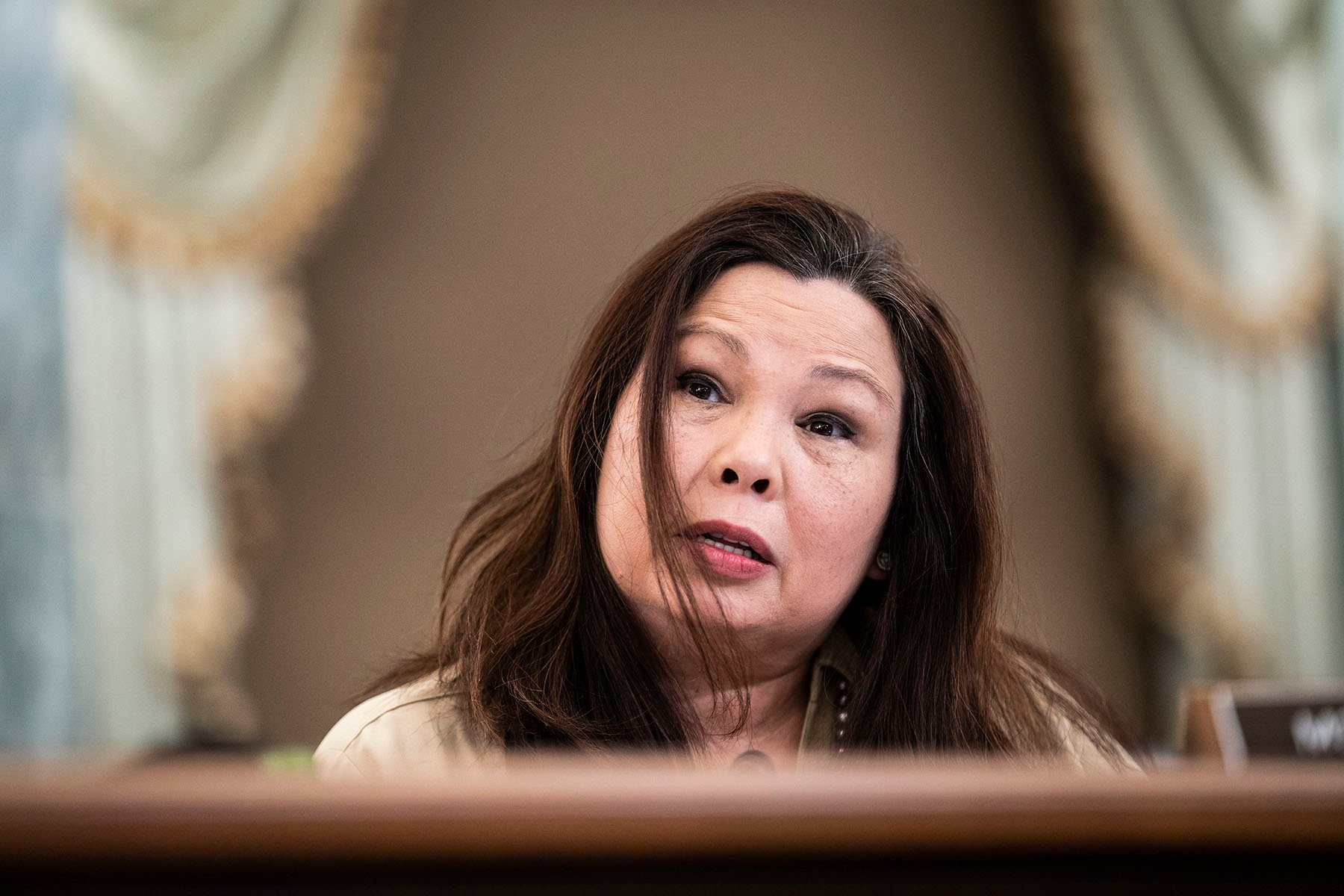
Sen. Tammy Duckworth speaks on Capitol Hill on in February 2023, in Washington D.C. (Jabin Botsford/The Washington Post/Getty Images)
Sen. Tammy Duckworth of Illinois: As deeply, deeply disappointed as I am that that same twice-impeached president who led a coup against our government is headed back to the Oval Office, make no mistake: My Democratic colleagues and I, unlike many Republicans after the 2020 election, will uphold the will of the American people, fulfill our constitutional duty and do our part to ensure a peaceful transfer of power.
Rep. Rosa DeLauro of Connecticut: As Donald Trump returns to the presidency, I feel an even greater responsibility to ensure that we do not let an election outcome diminish the gravity of what happened that day. His re-election does not change the reality of the insurrection or absolve those who incited and participated in it. It does not erase the trauma experienced by Capitol staff and Capitol Police officers who defended our democracy at great personal risk.
Rep. Gwen Moore of Wisconsin: Donald Trump, a convicted felon and aspiring autocrat, is promising to let loose dangerous rioters into our communities and threatening lawmakers and journalists with imprisonment. Trump’s lawlessness and thirst for political revenge is why I have repeatedly said he is unfit for office.
Rep. Lois Frankel of Florida: People have short memories. People are more consumed with their own lives [when they go to the polls]. And I’m not saying that’s a bad thing; it’s just an observation. What was probably on people’s minds? Their bank account, their rent, price of food, right?
Rep. Joyce Beatty of Ohio: We learned a lot of lessons through this last election. The American people know what they want to hear, whether it’s true or not.
Rep. Judy Chu of California: No matter what happens during Trump’s second term, the events of January 6, 2021, will forever be his legacy. He refused to concede or even acknowledge that there was a free and fair election in 2020, and he is still pressuring the Justice Department and intends to continue to pressure the Justice Department.
Rep. Ayanna Pressley of Massachusetts: Trump’s return to the highest office in the land, despite his central role in the insurrection, is a gut punch to anyone who cares about our democracy. But it does not absolve us of our responsibility to pursue accountability and continue telling the story of what happened that day.
Rep. Pramila Jayapal of Washington: I still put the onus on the Republicans in the Senate who refused to convict him. That’s something I think about all the time being on the Judiciary Committee. I think our founding fathers assumed that perhaps there would be a dictator as president — that’s envisioned in the Constitution. But they also assumed that an entire party would not just enter into a cult and follow that dictator. They assumed that there would be enough people on both sides of the aisle willing to do what it takes to preserve democracy, and that is clearly not the case.
‘I still tremble at the mere mention of the date.’
For many of the women, there is lingering trauma.
Jayapal: It will always be a day that is very, very tough emotionally. I started a gallery group after, a very close support group to process the trauma — it’s something that none of us will ever forget.
Rep. Frederica Wilson of Florida: I still tremble at the mere mention of the date January 6, a day that is forever tainted with fear, violence and terror. To have lived it is to never ever forget it. America can never fathom what we experienced. It was like playing a role in a horror movie and hoping that it would soon come to an end.
Rep. Teresa Leger Fernandez of New Mexico: It makes me sick to my stomach that the people who desecrated our democracy will be pardoned and potentially invited back into the Capitol. It makes me incredibly sad to think that there will be Capitol Police — police who were brutalized and beaten by the mob — who will just have to stand there.
Rep. Sara Jacobs of California: I’ve been very nervous thinking about and leading up to January 6. I still have lingering trauma from the first one. I don’t like big crowds and loud noises. And I just keep thinking that they have no incentive to be violent this time, right? But it still makes me very nervous because we haven’t actually done the sort of reconciliation and hard work and accountability work that we need to do as a country. … I know that people’s trust and faith in institutions is a key part of addressing political violence because political violence only happens when people don’t feel like the nonviolent, institutional way of doing things is actually going to create the effect they want.
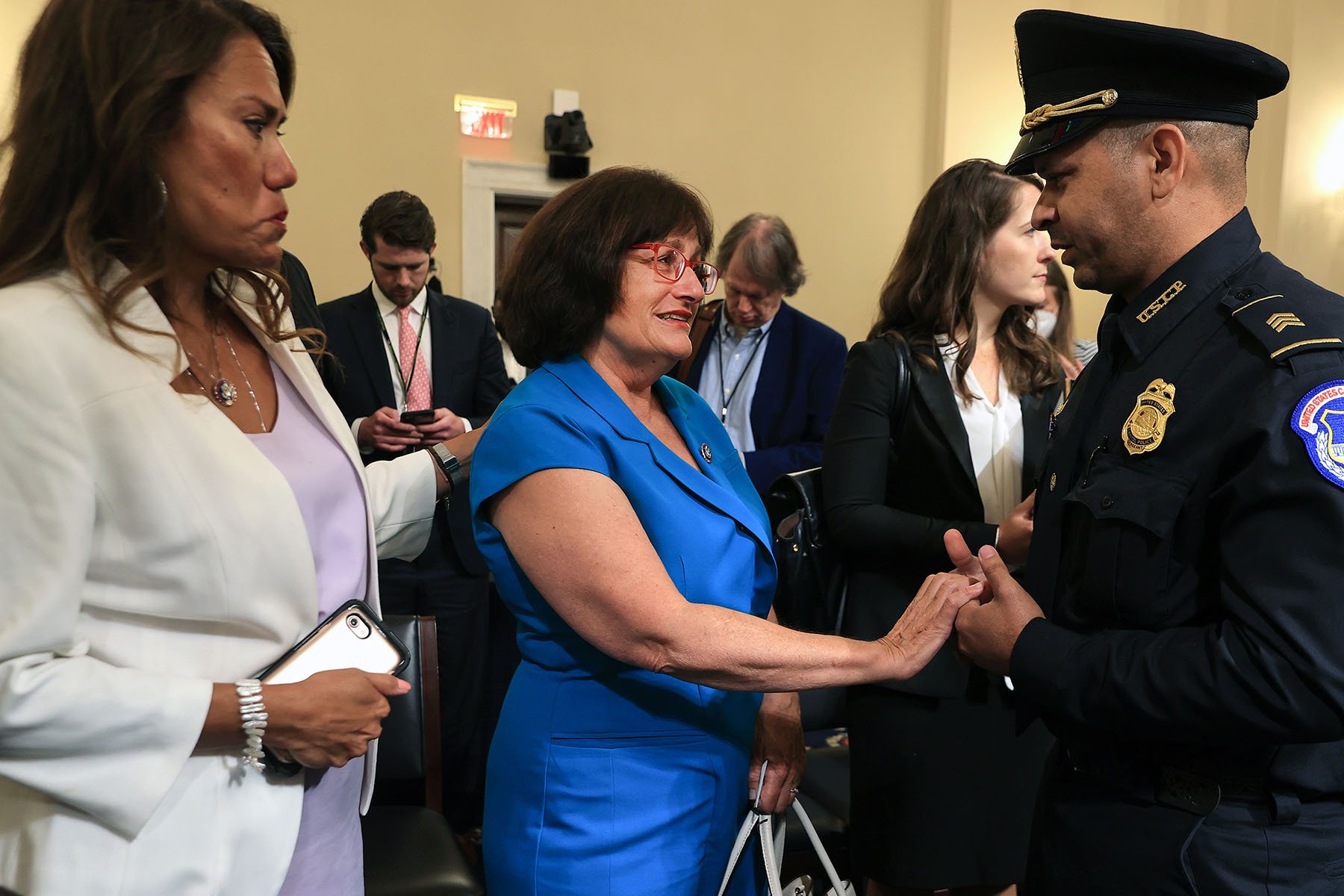
Rep. Ann McLane Kuster talks to Capitol Police officer Sgt. Aquilino Gonell after he testified before the House Select Committee investigating the January 6 attack on the Capitol on July 27, 2021, in Washington, D.C. (Chip Somodevilla/Getty Images)
Rep. Ann McLane Kuster of New Hampshire said she is still dealing with lasting post-traumatic stress disorder from January 6, one the “most impactful events” in her life. Kuster was also one of the last five lawmakers to be evacuated from the House floor. She could hear the thundering crowds and pounding on the doors and experienced a panic attack as officers snuck them into an elevator and rushed them through an underground tunnel to safety. Kuster later saw security footage of insurrectionists with backpacks, bear mace and zip ties entering the same hallway she had just evacuated 30 seconds earlier.
“I’m haunted by the idea that if the police hadn’t pushed back five seconds here, five seconds there, pushing back on the bicycle racks, pushing back on the people who were crushed in the doors — that the five of us would have been kidnapped, murdered or maimed,” Kuster said. “It was only a five-vote majority and if we hadn’t been there, America might not have woken up to Joe Biden as the lawfully elected president of the United States.”
Kuster decided to retire this year before Trump is sworn in as the 47th President of the United States and attributes January 6 as one of the reasons for that decision. In addition to the lingering trauma, Kuster said she’s received more and more death threats and has noticed a marked increase of violent rhetoric in public discourse.
“He tried to kill me once,” Kuster said. “I’m not available for it again.”
Seems the tRump / right wing cult playbook for domination and elimination of democracy is going worldwide. This is of course pushed by the mega wealthy in their quest to return the world to where they were mini kings and the people were just desperate peasants taking any job at any risk. Remember that Musk wanted people to work 80 hours a week with no pay. He would find it shocking if someone wanted him to work for free with no income. But he thinks it is fine to demand others do it. Look at how Bezos of Amazon wrote about workers. He wrote that upper management should push the workers as hard as possible until they were worn and broken, then fire the worker and hire new ones. He called workers lazy and useless unless driven ever harder with no mercy. Also according to the comments South Korea has a large fundamentalist Christian population who also want to force their religion into government the same way US Christian Nationalist do. Hugs
Supporters of impeached South Korean President Yoon Suk Yeol are adopting “Stop the Steal” slogans popularized by President-elect Donald Trump supporters and said they hoped the incoming president would help their embattled leader.
As Yoon supporters gathered outside his residence in the pre-dawn hours of Friday in an effort to prevent his arrest, some carried signs in English saying “Stop the Steal,’ a slogan Trump supporters used to question the results of the 2020 U.S. presidential election, which he lost.
Yoon avoided arrest on Friday after presidential guards and troops blocked efforts to carry out a warrant in a criminal insurrection investigation into his short-lived martial law on Dec. 3.
While pro-Yoon groups criticize their opponents as being subservient to North Korea, they openly venerate the United States. Over recent years, these groups, which remain a fringe element of South Korean society, have increasingly adopted rhetoric from the American right, particularly around claims of election fraud.
The allegations have been amplified through a network of far-right YouTube channels, where conservative commentators livestream the rallies and promote a wide range of conspiracy theories.
These online echo chambers, which Yoon himself has been accused of relying on for information, have become key platforms for spreading unfounded claims and maintaining supporter morale.
The Trump disease is truly global. Watch the video report below in which supporters attempt a feeble rendition of the US national anthem.
I’m from Louisiana, mostly. But I always tell people I’m from the part of the state that’s not fun, which means I’m not from New Orleans because that’s the impression most people get when I say I’m from Louisiana. Yes, I am a Saints fan. Who dat?
It breaks my heart to see New Orleans suffer. While I haven’t been there in over two decades, it’s a city I love. While every city is different and has its own character, New Orleans is special. I read somewhere a long time ago that the four most distinctive cities in this nation are Boston, Austin, San Francisco, and New Orleans. I don’t know if I believe that because I’d throw New York City and Chicago into that mix.
But like New York City, New Orleans knows how to rebound after a disaster. While 9/11 was hard, it didn’t destroy NYC. Katrina nearly destroyed New Orleans and the city was down for the count, but it’s back. And I assure you that an ISIS-inspired terrorist from Texas isn’t going to take the city out either.
And now I want an oyster po’boy.
What New Orleans nor the nation needs right now is Donald Trump.
Trump has blamed this attack on President Biden, open “border’s,” and immigrants. He also trashed law enforcement. But the thing is, this attack wasn’t perpetuated by an immigrant but by a U.S.-born citizen who’s in the military.
Donald Trump probably followed a false news report by Fox News, which they quickly corrected, but Trump doubled down on his lies.
But Trump isn’t just any American citizen. He’s the president-elect. He is receiving an intelligence briefing daily which means he knows he’s lying.
The election is over, so what the hell is Trump campaigning for? He’s scaring America so it’ll go along with his hate agenda, especially when he starts rounding up immigrants along with his enemies.
Creative note: I thought I had my idea for this in my head yesterday. But I went north to Northern Virginia last night and when I started work this morning in a different location, I decided I didn’t like my original idea. But then this hit me.
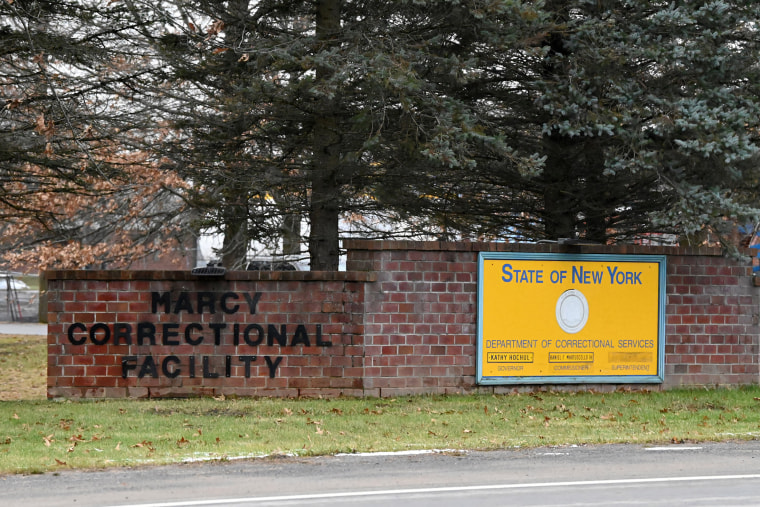
Robert Brooks, 43, died a day after being attacked by several correctional officers at the Marcy Correctional Facility on Dec. 9. His death has prompted a state investigation.
*** There is a video at the site linked above that is very informative and shows the man before the police killed him. ***
The office of New York’s attorney general released body camera footage Friday showing the fatal beating of a state prisoner this month by correctional officers who punched and kicked him repeatedly while he was handcuffed on an infirmary bed.
The incident, which has drawn outrage from political leaders and was condemned by the officers’ union as “incomprehensible,” is being investigated by state Attorney General Letitia James. The inmate, Robert Brooks, 43, died in the hospital a day after the Dec. 9 attack.
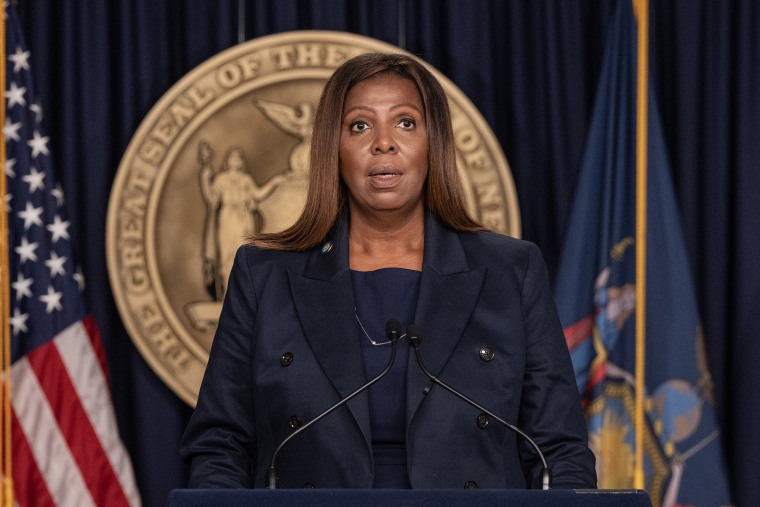
“I do not take lightly the release of this video, especially in the middle of the holiday season,” James said at a virtual news conference.
“These videos are shocking and disturbing,” she added.
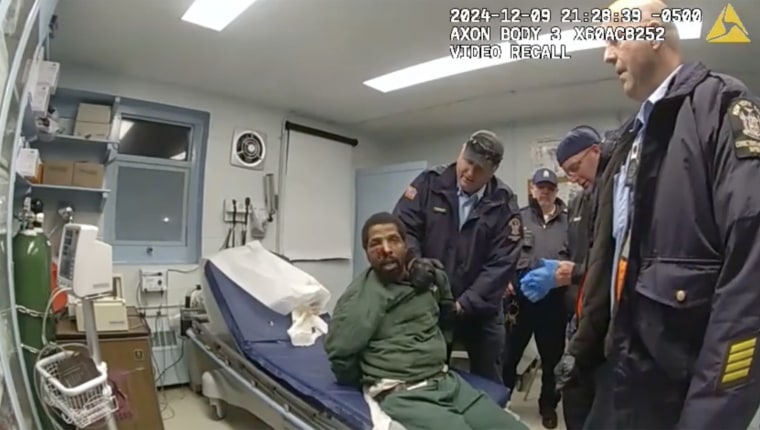
Brooks can be seen in the videos with his hands cuffed behind his back. In one video, he is sitting up as an officer presses his foot down on him. He is then punched by two officers.
At another point, he is forcefully yanked from the bed by his shirt collar and held up above the ground, his face visibly bloodied.
Robert Brooks as seen in body camera footage at the Marcy Correctional Facility in Oneida County, New York, on Dec. 9.Office of the New York State Attorney General
Last week, Gov. Kathy Hochul ordered the state Department of Corrections and Community Supervision to begin the process of firing 14 workers at the Marcy Correctional Facility in Oneida County, where the incident occurred. They include correctional officers, sergeants and a prison nurse. In the interim, all have been suspended without pay, except for one officer, who already resigned. In a statement following the release of the videos, Daniel Martuscello, the commissioner of the state corrections department, said his office has launched its own investigation in an effort to bring “institutional change.”
“Watching the video evidence of Robert Brooks’ life being taken left me feeling deeply repulsed and nauseated,” Martuscello said. “There is no excuse and no rationalization for a vulgar, inhumane act that senselessly took a life. This type of behavior cannot be normalized, and I will not allow it to be within DOCCS.”
James said the officers had not activated their body cameras, but they were still on and recorded in standby mode. As a result, she added, they did not capture audio and only recorded for 30 minutes.
Her office released the entirety of the four officers’ videos, which included some blurring.
On Dec. 9, James said, Brooks was being transferred from the Mohawk Correctional Facility, also in Oneida County, to Marcy Correctional Facility. The events unfolded in a medical exam room before 9:30 p.m. Brooks was carried into the room hanging upside down with his hands handcuffed behind his back, one video shows.
The entrance to Marcy Correctional Facility state prison on Thursday, Dec. 19, 2024, in Marcy, N.Y. (Will Waldron/Albany Times Union via Getty Images)Will Waldron / Albany Times Union / Getty Images
Without audio, it’s unclear what words were exchanged between Brooks and the officers. While he does not appear to physically retaliate in the footage, the videos present different angles, and at times it’s unclear what is happening to Brooks as officers move and stand around the room. After the officers yank Brooks from the bed, he is brought to a corner. Later, he is seen on the bed wearing only his underwear and being tended to by the nurse.
Brooks was taken to the hospital and died the following day. An autopsy was conducted, and “preliminary findings show concern for asphyxia due to compression of the neck as the cause of death, as well as the death being due to actions of another,” according to a state corrections office investigative report obtained by NBC affiliate WKTV in Utica.
In the wake of the initial media reports, James said her Office of Special Investigation would conduct a review and make the video public after Brooks’ family viewed it first.
“I have a responsibility and duty to provide the Brooks family, their loved ones and all New Yorkers with transparency and accountability,” she said Friday.
Attorney General Letitia James speaks during a press briefing on Nov. 6.Lev Radin / Pacific Press / Getty Images
Brooks had been imprisoned since 2017 on a 12-year sentence for first-degree assault involving a longtime girlfriend. State corrections officials declined to detail what led Brooks to be transferred to the Marcy Correctional Facility, a medium-security prison, that night. The New York State Correctional Officers and Police Benevolent Association did not immediately respond to a request for comment Friday, but the union has previously said it viewed parts of the videos.
“What we witnessed is incomprehensible to say the least and is certainly not reflective of the great work that the vast majority of our membership conducts every day,” the union said in a statement this week, adding what transpired is the “opposite of everything NYSCOPBA and its membership stand for.”
Hochul said in a statement that the “vast majority” of correctional officers “do extraordinary work under difficult circumstances,” but “we have no tolerance for individuals who cross the line, break the law and engage in unnecessary violence or targeted abuse.”
Martuscello said the agency has expanded its body camera policy effective immediately, requiring all corrections officers to have their cameras activated any time they are engaging directly with inmates.
The Correctional Association of New York, an independent prison oversight group, released a report last year after monitoring the Marcy Correctional Facility in October 2022. The report noted complaints of “rampant” physical abuse by staff members, with 80% of incarcerated people reporting having witnessed or experienced abuse and nearly 70% reporting racial discrimination or bias.
Brooks’ family thanked Hochul in a statement this week for taking action “to hold officers accountable.”
“We cannot understand how this could have happened in the first place,” the family said. “No one should have to lose a family member this way.”
The Colorado TV reporter told police that he believed he had been followed by the man because he is Pacific Islander.
Colleen Slevin
A Colorado man is facing possible bias-motivated charges for allegedly attacking a television news reporter after demanding to know whether he was a citizen, saying “This is Trump’s America now,” according to court documents.
Patrick Thomas Egan, 39, was arrested Dec. 18 in Grand Junction, Colorado, after police say he followed KKCO/KJCT reporter Ja’Ronn Alex’s vehicle for around 40 miles (64 kilometers) from the Delta area. Alex told police that he believed he had been followed and attacked because he is Pacific Islander.
After arriving in Grand Junction, Egan, who was driving a taxi, pulled up next to Alex at a stoplight and, according to an arrest affidavit, said something to the effect of: “Are you even a U.S. citizen? This is Trump’s America now! I’m a Marine and I took an oath to protect this country from people like you!”
Alex, who had been out reporting, then drove back to his news station in the city. After he got out of his vehicle, Egan chased Alex as he ran toward the station’s door and demanded to see his identification, according to the document laying out police’s evidence in the case. Egan then tackled Alex, put him in a headlock and “began to strangle him,” the affidavit said. Coworkers who ran out to help and witnesses told police that Alex appeared to be losing his ability to breathe during the attack, which was partially captured on surveillance video, according to the document.
According to the station’s website, Alex is a native of Detroit. KKCO/KJCT reported that he was driving a news vehicle at the time.
Egan was arrested on suspicion of bias-motivated crimes, second degree assault and harassment. He is scheduled to appear in court Thursday to learn whether prosecutors have filed formal charges against him.
Egan’s lawyer, Ruth Swift, was out of the office Friday and did not return a telephone message seeking comment.






 Scottie's Playtime