Robert Brooks, 43, died a day after being attacked by several correctional officers at the Marcy Correctional Facility on Dec. 9. His death has prompted a state investigation.
*** There is a video at the site linked above that is very informative and shows the man before the police killed him. ***
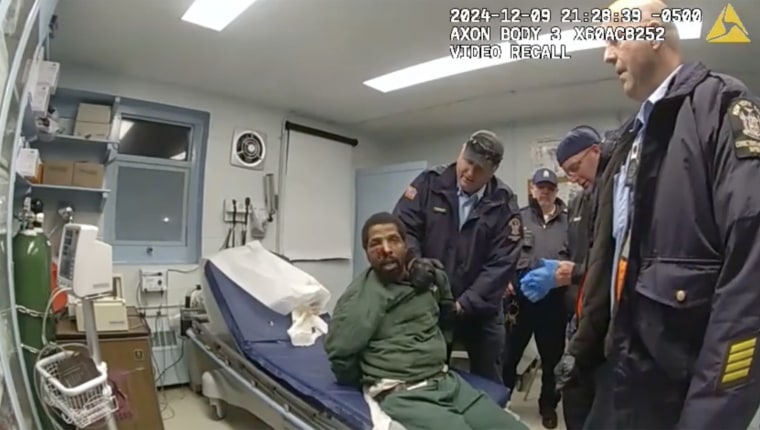
The office of New York’s attorney general released body camera footage Friday showing the fatal beating of a state prisoner this month by correctional officers who punched and kicked him repeatedly while he was handcuffed on an infirmary bed.
The incident, which has drawn outrage from political leaders and was condemned by the officers’ union as “incomprehensible,” is being investigated by state Attorney General Letitia James. The inmate, Robert Brooks, 43, died in the hospital a day after the Dec. 9 attack.
“I do not take lightly the release of this video, especially in the middle of the holiday season,” James said at a virtual news conference.
“These videos are shocking and disturbing,” she added.
Brooks can be seen in the videos with his hands cuffed behind his back. In one video, he is sitting up as an officer presses his foot down on him. He is then punched by two officers.
At another point, he is forcefully yanked from the bed by his shirt collar and held up above the ground, his face visibly bloodied.
Robert Brooks as seen in body camera footage at the Marcy Correctional Facility in Oneida County, New York, on Dec. 9.Office of the New York State Attorney General
Last week, Gov. Kathy Hochul ordered the state Department of Corrections and Community Supervision to begin the process of firing 14 workers at the Marcy Correctional Facility in Oneida County, where the incident occurred. They include correctional officers, sergeants and a prison nurse. In the interim, all have been suspended without pay, except for one officer, who already resigned. In a statement following the release of the videos, Daniel Martuscello, the commissioner of the state corrections department, said his office has launched its own investigation in an effort to bring “institutional change.”
“Watching the video evidence of Robert Brooks’ life being taken left me feeling deeply repulsed and nauseated,” Martuscello said. “There is no excuse and no rationalization for a vulgar, inhumane act that senselessly took a life. This type of behavior cannot be normalized, and I will not allow it to be within DOCCS.”
James said the officers had not activated their body cameras, but they were still on and recorded in standby mode. As a result, she added, they did not capture audio and only recorded for 30 minutes.
Her office released the entirety of the four officers’ videos, which included some blurring.
On Dec. 9, James said, Brooks was being transferred from the Mohawk Correctional Facility, also in Oneida County, to Marcy Correctional Facility. The events unfolded in a medical exam room before 9:30 p.m. Brooks was carried into the room hanging upside down with his hands handcuffed behind his back, one video shows.
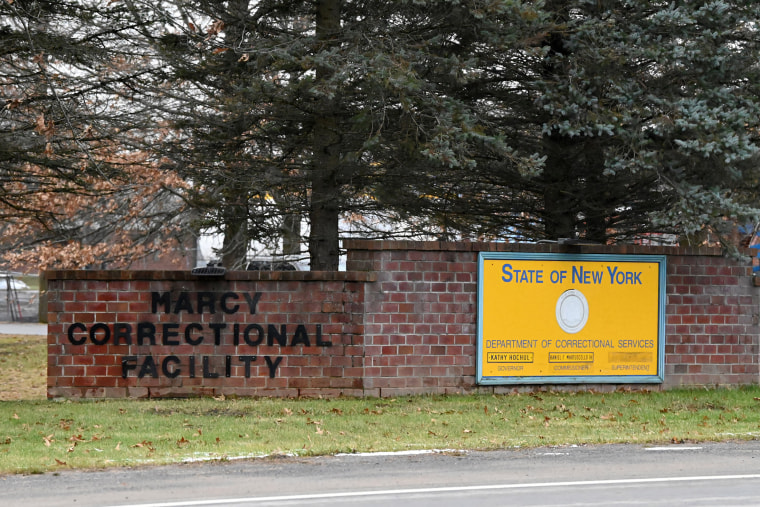
The entrance to Marcy Correctional Facility state prison on Thursday, Dec. 19, 2024, in Marcy, N.Y. (Will Waldron/Albany Times Union via Getty Images)Will Waldron / Albany Times Union / Getty Images
Without audio, it’s unclear what words were exchanged between Brooks and the officers. While he does not appear to physically retaliate in the footage, the videos present different angles, and at times it’s unclear what is happening to Brooks as officers move and stand around the room. After the officers yank Brooks from the bed, he is brought to a corner. Later, he is seen on the bed wearing only his underwear and being tended to by the nurse.
Brooks was taken to the hospital and died the following day. An autopsy was conducted, and “preliminary findings show concern for asphyxia due to compression of the neck as the cause of death, as well as the death being due to actions of another,” according to a state corrections office investigative report obtained by NBC affiliate WKTV in Utica.
In the wake of the initial media reports, James said her Office of Special Investigation would conduct a review and make the video public after Brooks’ family viewed it first.
“I have a responsibility and duty to provide the Brooks family, their loved ones and all New Yorkers with transparency and accountability,” she said Friday.
Attorney General Letitia James speaks during a press briefing on Nov. 6.Lev Radin / Pacific Press / Getty Images
Brooks had been imprisoned since 2017 on a 12-year sentence for first-degree assault involving a longtime girlfriend. State corrections officials declined to detail what led Brooks to be transferred to the Marcy Correctional Facility, a medium-security prison, that night. The New York State Correctional Officers and Police Benevolent Association did not immediately respond to a request for comment Friday, but the union has previously said it viewed parts of the videos.
“What we witnessed is incomprehensible to say the least and is certainly not reflective of the great work that the vast majority of our membership conducts every day,” the union said in a statement this week, adding what transpired is the “opposite of everything NYSCOPBA and its membership stand for.”
Hochul said in a statement that the “vast majority” of correctional officers “do extraordinary work under difficult circumstances,” but “we have no tolerance for individuals who cross the line, break the law and engage in unnecessary violence or targeted abuse.”
Martuscello said the agency has expanded its body camera policy effective immediately, requiring all corrections officers to have their cameras activated any time they are engaging directly with inmates.
The Correctional Association of New York, an independent prison oversight group, released a report last year after monitoring the Marcy Correctional Facility in October 2022. The report noted complaints of “rampant” physical abuse by staff members, with 80% of incarcerated people reporting having witnessed or experienced abuse and nearly 70% reporting racial discrimination or bias.
Brooks’ family thanked Hochul in a statement this week for taking action “to hold officers accountable.”
“We cannot understand how this could have happened in the first place,” the family said. “No one should have to lose a family member this way.”
The Colorado TV reporter told police that he believed he had been followed by the man because he is Pacific Islander.
Colleen Slevin
A Colorado man is facing possible bias-motivated charges for allegedly attacking a television news reporter after demanding to know whether he was a citizen, saying “This is Trump’s America now,” according to court documents.
Patrick Thomas Egan, 39, was arrested Dec. 18 in Grand Junction, Colorado, after police say he followed KKCO/KJCT reporter Ja’Ronn Alex’s vehicle for around 40 miles (64 kilometers) from the Delta area. Alex told police that he believed he had been followed and attacked because he is Pacific Islander.
After arriving in Grand Junction, Egan, who was driving a taxi, pulled up next to Alex at a stoplight and, according to an arrest affidavit, said something to the effect of: “Are you even a U.S. citizen? This is Trump’s America now! I’m a Marine and I took an oath to protect this country from people like you!”
Alex, who had been out reporting, then drove back to his news station in the city. After he got out of his vehicle, Egan chased Alex as he ran toward the station’s door and demanded to see his identification, according to the document laying out police’s evidence in the case. Egan then tackled Alex, put him in a headlock and “began to strangle him,” the affidavit said. Coworkers who ran out to help and witnesses told police that Alex appeared to be losing his ability to breathe during the attack, which was partially captured on surveillance video, according to the document.
According to the station’s website, Alex is a native of Detroit. KKCO/KJCT reported that he was driving a news vehicle at the time.
Egan was arrested on suspicion of bias-motivated crimes, second degree assault and harassment. He is scheduled to appear in court Thursday to learn whether prosecutors have filed formal charges against him.
Egan’s lawyer, Ruth Swift, was out of the office Friday and did not return a telephone message seeking comment.
On the clear, cold morning of December 29, 1890, on the Pine Ridge Reservation in South Dakota, three U.S. soldiers tried to wrench a valuable Winchester away from a young Lakota man. He refused to give up his hunting weapon. It was the only thing standing between his family and starvation, and he had no faith it would be returned to him as the officer promised: he had watched as soldiers had marked other confiscated valuable weapons for themselves.
As the men struggled, the gun fired into the sky.
Before the echoes died, troops fired a volley that brought down half of the Lakota men and boys the soldiers had captured the night before, as well as a number of soldiers surrounding the Lakotas. The uninjured Lakota men attacked the soldiers with knives, guns they snatched from wounded soldiers, and their fists.
As the men fought hand to hand, the Lakota women who had been hitching their horses to wagons for the day’s travel tried to flee along the nearby road or up a dry ravine behind the camp. Stationed on a slight rise above the camp, soldiers turned rapid-fire mountain guns on them. Then, over the next two hours, troops on horseback hunted down and slaughtered all the Lakotas they could find: about 250 men, women, and children.
Fifteen years ago, I wrote a book about the Wounded Knee Massacre, and what I learned still keeps me up at night. But it is not December 29 that haunts me.
What haunts me is the night of December 28.
On December 28 there was still time to avert the massacre.
In the early afternoon, the Lakota leader Sitanka had urged his people to surrender to the soldiers looking for them. Sitanka was desperately ill with pneumonia, and the people in his band were hungry, underdressed, and exhausted. They were making their way south across South Dakota from their own reservation in the northern part of the state to the Pine Ridge Reservation. There they planned to take shelter with another famous Lakota chief, Red Cloud. His people had done as Sitanka asked, and the soldiers escorted the Lakotas to a camp on South Dakota’s Wounded Knee Creek, inside the boundaries of the Pine Ridge Reservation.
For the soldiers, the surrender of Sitanka’s band marked the end of what they called the Ghost Dance Uprising. It had been a tense month. Troops had pushed into the South Dakota reservations in November, prompting a band of terrified men who had embraced the Ghost Dance religion to gather their wives and children and ride out to the Badlands. But at long last, army officers and negotiators had convinced those Ghost Dancers to go back to Pine Ridge and turn themselves in to authorities before winter hit in earnest.
Sitanka’s people were not part of the Badlands group and, for the most part, were not Ghost Dancers. They had fled from their own northern reservation two weeks before when they learned that officers had murdered the great leader Sitting Bull in his own home. Army officers were anxious to find and corral Sitanka’s missing Lakotas before they carried the news that Sitting Bull had been killed to those who had taken refuge in the Badlands. Army leaders were certain the information would spook the Ghost Dancers and send them flying back to the Badlands. They were determined to make sure the two bands did not meet.
But South Dakota is a big state, and it was not until late in the afternoon of December 28 that the soldiers finally made contact with Sitanka’s band. The encounter didn’t go quite as the officers planned: a group of soldiers were watering their horses in a stream when some of the traveling Lakotas surprised them. The Lakotas let the soldiers go, and the men promptly reported to their officers, who marched on the Lakotas as if they were going to war. Sitanka, who had always gotten along well with army officers, assured the commander that the band was on its way to Pine Ridge and asked his men to surrender unconditionally. They did.
By this time, Sitanka was so ill he couldn’t sit up and his nose was dripping blood. Soldiers lifted him into an army ambulance—an old wagon—for the trip to the Wounded Knee camp. His ragtag band followed behind. Once there, the soldiers gave the Lakotas an evening ration and lent army tents to those who wanted them. Then the soldiers settled into guarding the camp.
And the soldiers celebrated, for they saw themselves as heroes of a great war, and it had been bloodless, and now, with the Lakotas’ surrender, they would be demobilized back to their home bases before the South Dakota winter closed in. As they celebrated, more and more troops poured in. It had been a long hunt across South Dakota for Sitanka and his band, and officers were determined the group would not escape them again.
In came the Seventh Cavalry, whose men had not forgotten that their former leader George Armstrong Custer had been killed by a band of Lakota in 1876. In came three mountain guns, which the soldiers trained on the Indian encampment from a slight rise above the camp.
For their part, the Lakotas were frightened. If their surrender was welcome and they were going to go with the soldiers to Red Cloud at Pine Ridge, as they had planned all along, why were there so many soldiers, with so many guns?
On this day and hour in 1890, in the cold and dark of a South Dakota December night, there were soldiers drinking, singing, and visiting with each other, and anxious Lakotas either talking to each other in low voices or trying to sleep. No one knew what the next day would bring, but no one expected what was going to happen.
One of the curses of history is that we cannot go back and change the course leading to disasters, no matter how much we might wish to. The past has its own terrible inevitability.
But it is never too late to change the future.
—
Note:
Every year on this date, I post the story of the Wounded Knee Massacre.
My book about that event was so hard to write I had to take a long break in the middle of it. When you write a book, you get to know your characters as if they were family. Sometimes you love them and sometimes you don’t, but they become part of you. As the massacre drew inexorably closer, I wrote about the scenery, plant life, and animals of the Plains as a distraction from what I knew was coming.
But it came anyway. Even after all these years, I still have a hard time on the date of the massacre.
In an interview this year, someone asked me why I write as if I am running out of time, and it hit me that I write these letters because no matter how hard I tried, I could not stop the Wounded Knee Massacre.
December 27, 1914 The International Fellowship of Reconciliation (IFOR), an inter-religious peace group, was founded in Cambridge, England. “The International Fellowship of Reconciliation (IFOR) is an international spiritually based movement composed of people who commit themselves to active nonviolence as a way of life and as a means of transformation – personal, social, economic and political.” “Your goal is, in my opinion, the only reasonable one and to make it prevail is of vital importance.” –Albert Einstein, in a letter to the FOR Read more
December 27, 1971 Vietnam Veterans Against the War staged a peace protest at historic Betsy Ross House, Philadelphia.
December 27, 2002 North Korea ordered U.N. nuclear inspectors to leave the country and said it would restart the Yongbyon plutonium Plant to meet the fuel needs of its nuclear power reactor. The plant had been shut down and sealed by the U.N. in 1994 in exchange for shipments of fuel oil. When it was discovered that the North Korean had been pursuing a uranium-based weapons program, the U.S. and Japan, South Korea and the European Union suspended the fuel shipments.
December 27, 2002 1500 people gathered in Tel Aviv, Israel, the protest the Israeli military occupation of land beyond the 1948 borders of the country. With the slogans “End the Occupation” and “No to Racism,” and dressed mostly in black, they used a variety of means – drumming, singing, art installations, giving away olives and olive oil – to express their frustration and anger over the ongoing occupation. Alternative Ten commandments at demonstration in Tel Aviv, Israel The Coalition of Women for Peace also showed a movie, Jenin, Jenin, which had been banned for public showing, in defiance of police orders to stop the projector. Shown on a large outdoor screen, it was a narrative about the actions of the Israeli army the previous Spring in the occupied West Bank town of Jenin.
December 24, 1865 Months after the fall of the Confederacy and the end of slavery, several veterans of the Confederate Army formed a private social club in Pulaski, Tennessee, called the Ku Klux Klan (KKK). Its first priority, declared in its creed, was “to protect the weak, the innocent, and the defenseless from the indignities, wrongs, and outrages of the lawless, the violent, and the brutal.” In fact, the Klan terrorized and killed former slaves, sympathetic whites and immigrants. Three Ku Klux Klan members, September 1871. The building where it happened still stands with a bronze plaque reading, “Ku Klux Klan organized in this, the law office of Judge Thomas M. Jones, Dec. 24, 1865.” When the building was purchased in 1990, the new owner, Don Massey, instead of removing the plaque, simply reversed it, showing the smooth back side. More on the Klan
December 24, 1924 Costa Rica indicated its intention to withdraw from The League of Nations to protest lack of progress on regional issues, particularly U.S. dominance of the hemisphere. The Monroe Doctrine, declared by President James Monroe in 1823, established the U.S. sphere of influence encompassed the entirety of North and South America, as well as the Caribbean island nations. Read more
December 24, 1947 President Truman pardoned 1,523 of the 15,805 World War II draft resisters who had been convicted and served time in prison for their offense. Five years later on the same day, shortly before leaving office, he granted full pardon and restoration of civil and political rights to former convicts who had served in the peacetime army or who had not been covered by his earlier pardon, as well as all convicted peacetime deserters. Read more
December 24, 1991 Parents of reservists from Grocka protested at Army headquarters in Belgrade, Yugoslavia, worried their sons would be caught up in the war threatened by Serbian nationalist expansionism.
December 24, 1992 President George Herbert Walker Bush pardoned six Reagan administration appointees in the Iran-Contra case, among them former Secretary of Defense Casper Weinberger, and Robert McFarlane, the President’s former national security advisor.He did so with less than one month to go in his presidency, and one week before Weinberger’s trial on four felony charges was to begin. These people and others were responsible for selling arms to the revolutionary government of Iran in hope of the release of hostages held in Lebanon, despite then-President Ronald Reagan’s repeated pledge not to negotiate with hostage-takers.
The Iran-Contra Boys Otto Reich /Elliott Abrams /John Poindexter/Edwin Meese George H.W. Bush/Casper Weinberger/Oliver North/Robert McFarlane
The money raised through the arms sales was used to fund the Contra insurgents in Nicaragua, who were violently trying to overthrow the government. This support was in violation of an explicit legal ban on such activities under the Boland Amendment [see December 21, 1982].
One thing we know Trump was for sure looking forward to for his second term was getting to kill more federal death row prisoners. During the last months of his first term, he went on a full-on killing spree, with his administration carrying out 13 federal executions after a 17-year hiatus.
To put things into perspective, of the 13 prisoners executed prior to his administration, two of them were Julius and Ethel Rosenberg. Only 37 federal death row prisoners were executed between 1927 and 2019, so 13 in six months was quite the bloodbath.
Alas, his dreams have been dashed, for President Joe Biden has announced that he will commute the death sentences for nearly all of the prisoners on federal death row.
“Today, I am commuting the sentences of 37 of the 40 individuals on federal death row to life sentences without the possibility of parole,” Biden said in a statement released Monday morning.
“Make no mistake: I condemn these murderers, grieve for the victims of their despicable acts, and ache for all the families who have suffered unimaginable and irreparable loss,” he continued. “But guided by my conscience and my experience as a public defender, chairman of the Senate Judiciary Committee, Vice President, and now President, I am more convinced than ever that we must stop the use of the death penalty at the federal level. In good conscience, I cannot stand back and let a new administration resume executions that I halted.”
It’s unlikely that this was simply meant to bust Trump’s balls and make him sad — Biden had pledged to “work to pass legislation to eliminate the death penalty at the federal level, and incentivize states to follow the federal government’s example” in his 2020 campaign.
The three prisoners whose sentences will not be commuted are those who committed crimes related to terrorism and hate-motivated mass murders — Dylann Roof, the white supremacist who killed nine people and injured one in a Charleston, South Carolina, church in 2015; Dzhokhar Tsarnaev, one of the two brothers responsible for the Boston Marathon bombing in 2013 (his brother, Tamerlan Tsarnaev, was killed in a shootout with police after the attack); and Robert Bowers, who killed 11 people at the Tree of Life Synagogue in Pittsburgh, Pennsylvania, in 2018.
The other prisoners were given their federal death sentences for far lesser crimes, like killing prison guards or drug trafficking-related murders.
It’s certainly nice to get this news after Biden’s 1,500 commutations of federal prisoners failed to include political prisoners like Leonard Peltier or Mumia Abu-Jamal and did include the kids-for-cash judge. It’s also nice to see, considering the fact that the DNC removed opposition to the death penalty from its platform after eight years of including it. Hopefully we can get back on that one, given the fervor with which Republican governors have pursued the executions of people who were almost definitely innocent in the last few years.
Anti-death penalty advocates, including Martin Luther King III, Sister Simone Campbell, Rev. Ralph McCloud, and exoneree Herman Lindsey made a video thanking President Biden for taking this step.
“President Biden has shown our country – and the rest of the world – that the brutal and inhumane policies of our past do not belong in our future,” Anthony D. Romero, executive director of the ACLU said in a statement. “By commuting 37 federal death row sentences, he has paved the way for other elected officials to build on his legacy of racial justice, humanity and morality by commuting state death rows and passing legislation to abolish capital punishment.”
“Biden has commuted almost all federal death row. This is indeed a good day to do the Lord’s work,” Sister Helen Prejean wrote on Bluesky. I’m thankful to so many religious leaders and justice advocates who helped make this possible. I pray for victims’ families, knowing that wishing for death is not a healing course.”
Personally, as horrible as their crimes were, and as hard of a decision as it would have been, I still think he should have commuted the sentences of all of the prisoners, simply because — to quote a bumper sticker — I don’t believe we should kill people who kill people to show people that killing people is wrong. Also there is evidence that Dzhokhar Tsarnaev was unduly influenced by his brother and also afraid he might kill him if he didn’t go along with his plan, and that the jury was biased against him. (Which would be entirely understandable given that they were all from the Boston area, but also technically unfair.) Family members of those who were killed in the Charleston church shooting have said for years that they don’t want Roof executed, and as loathsome as he is, that ought to be taken into consideration. Two of the families who lost loved ones in the Tree of Life shooting, and the rabbi who was shot himself also asked for Bowers to get a life sentence, due to their opposition to the death penalty. One of the many injustices of the death penalty is that it puts those who oppose it in the position, occasionally, of having to ask for leniency for those who hurt them or have killed their loved ones.
But, you know, optics.
In any case, this is a great day for those of us who oppose the death penalty, and for all Americans who may not oppose it but still do not deserve to be hardened by its application.
Some western observers don’t quite understand why General Igor Kirillov was a legitimate military target (see: what is a “general”?) or understand that lying war criminals are actually bad. Kirillov was behind the dumb propaganda that there were US/Ukrainian biolabs about to threaten the RU/UKR border. I always thought this was a little bit of a backhand at the US for claiming mobile biolabs in Iraq before 2003. But it is totally not the case and never was. And the fuckers who play games with the Zaporizhzhia nuclear plant have no business talking up Ukrainian “dirty” nuclear bomb threats anyway.
Which brings me to Elon Musk, incoming US president in fact if not in name, who is goofing with a government shutdown even before his old-age addled proxy is sworn in, threatening the GOP Speaker (presumptive) of the next Congress and also lying his dumb goofy pale face off. He says this on his dumb loss-leader propaganda site:
Remember me just recently pointing out Liz Churchill to you? Well, this is her, boosting hypnotically cult-like speaking pro RU and pro-Assad Trump DNI hopeful Tulsi Gabbard: (snip-embedded tweet on the page, also see some ‘shtuff’ from this blog’s nemesis, Libs Of TikTok)







 Scottie's Playtime