The Zeal of the Convert

Matthew Sheffield, a former rising star in the conservative movement, turned away from what he finally realized was an extremist, anti-truth agenda.

by Rick Perlstein  September 11, 2024

Matthew Sheffield is one of the most interesting people I’ve ever met. His father had rebelled against the Mormonism of his youth, resentful of how it had shed its original, 19th-century strangeness. So he invented his own version, one in which he had direct prophetic access to the supernatural realm—for instance, the time Satan tempted him to become gay. He spent several years beseeching God, walking around in the mountains above the University of Utah, nearly killing himself several times from starvation.

The elder Sheffield was a professor of classical guitar, a brilliant composer beloved by the great Andrés Segovia. God commanded him to abandon his job, pack up his growing family, and become an itinerant street musician instead. “There were times we were homeless,” Matthew Sheffield told me. “One of my brothers was born in a tent. My mother gave birth to my sister by herself, in our apartment, with two kids around.”

He corrects himself: “No, three kids. Right next to her.”

Busking became a family profession. (“The Dark Osmonds,” I propose. “Yeah,” Matthew replies, “but we were classical.” He played French horn.) He grew interested in politics, in part from family connections (a grandfather was the Republican whip in the Utah state Senate), in part because the family did a lot of performing in the streets of Washington, D.C., because it was easy to scavenge food that vendors on the Mall threw away.

He and a brother developed computer proficiency, and he picked up a college education in dribs and drabs. He has a hard time remembering which of the nine universities he attended when he developed the first college newspaper website. He was around 20, and still on the road with his family, when he and his brother decided that CBS Evening News anchorman Dan Rather was too mean to Kenneth Starr, the special counsel investigating Bill Clinton. His brother came up with the idea to put some quotes of Rather’s on the internet to reveal his stealth liberalism. Matt said they should aim higher, and build a comprehensive website. So they did. “But we were afraid to put our names on it because we were two college kids. So we didn’t. And, um, the CBS people accused us of being a secret operation funded by Republican donors!”

The exclamation is a rare touch. He explained the rest nonchalantly at the Szechuan restaurant where we’re lunching in Chicago’s South Loop during the Democratic convention. Sheffield’s typical mien is sardonic bemusement at the strangeness of the world he managed to escape—as when he explains a second reason why he and his brother kept themselves hidden.

“Also, we were afraid because my mom had a dream that Bill Clinton was going to try to kill us.”

Sheffield’s faculty profile at the Leadership Institute, a right-wing clearinghouse for what they call “journalism training,” is no longer online, but it had noted that RatherBiased.com was “credited by the New York Times as being the most influential blog in taking down Dan Rather during the famous ‘Memogate’ scandal. Since that time, Matt has worked with … groups such as the Media Research Center where he created NewsBusters, Rush Limbaugh’s favorite blog. He also works with the Washington Examiner, helping them increase their traffic by over 600 percent to over a million visitors per month.”

Sheffield has long since become a committed leftist. I’m writing about him not just because he fascinates me. I’m writing about him because the lessons he learned on the road to becoming a right-wing media operative, and what he has learned since in his almost entirely frustrated efforts to impart those lessons to the upper echelons of the Democratic Party, are so crucial for all of us to know.

SHEFFIELD’S CAREER ON THE RIGHT was rather doomed from the start. Because he cared about the truth.

His damnable allergy to propaganda had already shown out by the time he came up with an idea for a study during a stint at Virginia Commonwealth University. It asked: Where Do Columnists Come From? “And my general thesis was that newspaper columnists who are on the right come out of political operations, and ones from the left come out of—journalism.” That is to say, they carry with them journalistic values of fairness and accuracy, by which conservative columnists remain blessedly unburdened.

In 2007, he joined Brent Bozell III’s Media Research Center, because that’s where the money was. He started NewsBusters, the site Limbaugh loved, which ferreted out alleged liberal media bias. NewsBusters would run pieces about Michelle Obama, “and we’d have to shut off the comments because they were too disgusting.”

RatherBiased, Sheffield notes, got all that New York Times attention because “it was completely accurate in every way. We didn’t use inflammatory language; we didn’t even state any political opinions.” No room for that in his next lunge up the right’s greasy pole. “I was horrified a lot of the time, quite honestly. You know when Ted Cruz was doing his first government shutdown attempt? I was in meetings about how we should cover the media’s coverage. I said, ‘Well, it’s an objectively stupid idea. It’s not unfair for the media to say that this is destabilizing and extreme and absurd.’”

My response is a guffaw, his a sardonic chuckle. “Uh, yeah. They looked at me like I had suggested they grow a third eye or something.”

THERE WAS A SECOND REASON Matthew Sheffield did not fit the conservative movement mold. “Our family musical group never really got off the ground. So we were beginning to wonder whether, you know, our father was as divinely led as he told us.” So he became an atheist. And you could only get so far in the conservative world without being religious, or at least paying religion obsequious tribute. “What’s her name, S.E. Cupp? She actually wrote an entire book saying, ‘Well, I’m not religious but I sure wish I was.’ That was her way of trying to get on the gravy train. And I wasn’t willing to do that.”

The consequences are more than theological. When it comes to conservatism, “the one thing that non-Republicans don’t understand is that almost all of them are bizarre religious fundamentalists. Even the ones who don’t present that to you.” And that’s how they learn to reason: as fundamentalists. Sheffield saw it over and over again on the job.

Sheffield became the first managing editor of the Washington Examiner. It’s now a website. But the project, handsomely funded by a right-wing billionaire, began in 2005 as a suite of local daily tabloids in several cities, as a strategy to move the media environment to the right by making readers feel like they were reading normal news in a normal local newspaper. “The people who I was recruiting and were writing for me often had no concept of verifying a story … Because religious fundamentalists don’t need that.” Conservatives always descend from some sacred, impregnable prior truth. As Sheffield says: “The reasoning is about affirming the concept.”

Sheffield tells a story from the Obama era about the federal program known as “Cash for Clunkers,” a rather thoughtful policy win-win that got inefficient cars off the road, stimulated new auto sales, and put cash in folks’ pocket after the financial crash. It was administered through car dealers. Someone sent the Examiner a tip that the Obama administration was discriminating against Republican car dealers. “But the thing is, almost all car dealers are Republican. It’s almost impossible to discriminate against Republican car dealers and have that program!” He nonetheless farmed it out to a young colleague, just in case. “You know: ‘This could be a really hot story if it’s true.’”

Two hours later, the kid comes up to him, exultant: “Yes! I got a Drudge link!”

“I was like, ‘Wait, for what?’ And he’s like, ‘That story you gave me.’ And I was like, ‘Wait, did you …verify it at all?’”

Right there, I put down the cumin lamb and leaned in. This was the real shit.

“And he’s like, ‘It had everything we needed right there!’ And of course it came out almost immediately that it was all bullshit. We had to pull the article. But ultimately, the fact that I believed in empirical reasoning was what destined me to flee. It meant I was not a good fit.”

[Correction: I had misheard Sheffield over restaurant din. It turns out the writer wasn’t a junior colleague, but a senior executive, the editorial page editor.]

THE SHUDDER INTO FULL APOSTASY came on the next rung up the ladder. He was working on a right-leaning comedy show, a kind of SNL “Weekend Update” rip-off, aiming for syndication on broadcast TV. It actually wasn’t terrible. (Here’s a segment covering Donald Trump and Barack Obama’s infamous convergence at the 2011 White House Correspondents’ Association Dinner.)

“We actually got more favorable coverage from the mainstream media than the right-wing media. The right-wing media didn’t like us because it wasn’t nasty enough.” (It was plenty nasty: Grok the joke about Sharia law.) But for Sheffield’s team, not-as-nasty was the feature, not the bug. That was the pitch they made for the better part of a year to, among others, the Koch organization: “We’re going for a broadcast audience here. We’re going for Jay Leno, but slightly more conservative.” That, he argued, was the missing piece of the puzzle to keep conservatism a thriving concern: to build and keep a majority coalition. He also pointed out that without conservative-dominated media organizations that aspired to some degree of mainstream credibility, like the sort he built with RatherBiased.com, they’d lose all the smart young talent, “because the only paths available to them are to become talk radio hosts or crazy bloggers.”

This pitch failed. “They thought it didn’t go hard enough after the Democrats.” This is conservatism’s authoritarian ratchet in action: the way the movement contains no mechanism for moderation—only for ever-greater extremism.

The last straw was when Sheffield learned about a lawsuit evangelicals filed against a liberal church in North Carolina, before the Supreme Court’s gay marriage ruling, that was blessing gay unions. “I was just horrified at all the awful things they were saying, and how anti-American they were, how they literally don’t believe in freedom of religion,” he said. The conservatives’ argument was: “Unless you’re historically rooted in your doctrines, you don’t have religious freedoms.”

I’d never heard of that, but it doesn’t surprise me, having written about the nascent religious right’s arguments in the late 1970s about why the state had no right to regulate churches at all, whether it came to building codes or segregation laws. They published law review articles saying that the Founders intended only Christian schools to have public legitimacy, that in fact non-Christian schools violated the First Amendment because they discriminated against Christians by inculcating a “state religion,” which was “secular humanism.”

Liberals tend to maintain a lingering sentimental attachment to the idea that people calling themselves “Christians” are, well, Christian as the word is commonly understood outside the evangelical world. Faith, hope, and charity, turning the other cheek, that sort of thing. The people who most clearly understand and articulate their imperialist designs for the rest of us tend to be apostates like Sheffield, Matt Sitman, and Frank Schaeffer.

Exiles, Bertolt Brecht suggests, make the best dialecticians. They refuse protective sentimentality toward the world they left behind. Thus Sheffield. “I was looking at polling and demographics that younger people do not believe in fundamentalist religion, that many of them are explicitly nonreligious; we have to change to have a future, to be relevant to people. If we actually want to serve people, we have to change for them.” That’s when the whole thing collapsed. “I realized that they don’t actually want to serve the public.”

I ask him to explain to liberals for whom this makes no sense how someone can be interested in the profession we after all call “public service” and not be interested in serving the public.

He replies, “The core American reactionary motivation is that they want to force the public to obey their principles.”

SHEFFIELD SHOULD BE MUCH BETTER KNOWN. You can read the exposés he wrote in Salon during the Trump presidency and his reporting from The Hill after that, or listen to his ambitious podcast theorizing how change-making works, or see him pop up in the media from time to time as a disinformation expert. But like my friend David Neiwert, the calls aren’t coming from the people who really need to understand what we’re up against, like strategists in the Democratic Party and the media voices to whom they pay most attention.

He’s a little bitter about it—“I haven’t been invited on MSNBC once”—but that’s OK; so am I, and so should you be. A party opposing authoritarianism ignoring resources like this is leaving money on the table.

“There are a lot of people like me. I have ten million-plus Twitter engagements every month. People like what I’m saying. But it goes back to that liberal thing—that they think the Republicans can be saved. They can’t be saved.”

Maybe that bluntness limits his impact. That sentimentality that there are no red states or blue states, only the United States, remains oh so seductive. Sheffield finally grasped the impossibility of Republican redemption during the high tide of Barack Obama’s fervor imploring Democrats to believe in the existence of Republicans of good faith—and that once he was re-elected, “the fever will break,” and “we can start getting some cooperation again.”

That wasn’t true then. And to believe it is bonkerdoodles now.

The conservative movement, he says, is “100 percent controlled by extremists. And they are very, very wealthy. So they can afford to push a politics that almost no one believes in. We’re not to that point yet, but let’s just say that at some point in the future the Republican Party is not getting even 15 percent in elections. They’re rich enough, fanatical enough, that they wouldn’t change. They would just keep trying to push the same things. And it might get more extreme. It will get more extreme. They have no relationship to the political marketplace.”

Who needs mere votes when you’re in direct touch with God?

“That’s right. There’s nothing that these people will do to compromise with you.”

The fever is not going to break?

He said it, I didn’t: “They have to be broken.”

https://prospect.org/politics/2024-09-11-zeal-of-the-convert-matthew-sheffield/

A thoughtful post by Suze Hartline

JKR is back with yet another trans complaint, but I saw this to post instead-

Positive news, instead of the other. If you click through to read, roam around a little. There are some other interesting bits to read.

KAOS Star Misia Butler Says Elliot Page Is His “Biggest Queer Role Model”

Butler plays the romantic lead in a new Netflix show that retells Greek mythology stories with a modern twist.

By Quispe López August 30, 2024

Misia Butler never thought that, as a tranmasc person, he would be cast as a romantic lead. And yet that’s exactly what happened. In an as-told-to essay for Yahoo U.K. for Queer Voices, Butler opened up about playing Caeneus in Netflix’s new show KAOS, which retells stories from Greek mythology with a modern twist. Among other topics, the young actor touched on the inherent queerness of Greek mythology and his biggest role model: Elliot Page.

Butler wrote in the essay that Page, the original transmasculine heartthrob, has been an important inspiration for breaking down boundaries for trans people in film. From his early roles in Juno and Whip It to his latest work on Netflix’s The Umbrella Academy, Butler says Page has in many ways paved the way for trans actors like him to continue shattering onscreen stereotypes.

“Elliot Page is probably my biggest queer role model, him coming out was such a moving thing for me because I’ve always felt this draw to him ever since I was a kid,” Butler recalled. “When The Umbrella Academy came out I was bingeing that, so when he came out as trans that felt like an almost earth shattering moment.”

But when Butler was growing up, before there was fuller representation for transmasculine people in television and film, he said he felt resigned to never being cast as a romantic lead. Because he hadn’t seen any transmasculine people play characters who were romantically sought after, he didn’t think it would be possible for him.

“For a long time I never asked anyone out, I never talked to people I was attracted to, because I thought, ‘Well, they’re never gonna view me that way because why would they? I don’t exist in that sphere,’” the actor wrote. “So I really hope that seeing Caeneus in that light helps other people.”

Through his romance with Riddy (played by Aurora Perrineau), Caeneus will become the primary romantic interest in the show. The actor described how his character Caeneus will explore his transness with subtlety, as his identity is organically embedded in the plot. Butler noted that Greek myths are already so queer, making KAOS the perfect setting for this kind of nuanced storytelling.

“The Greek myths are such a queer group of stories, so KAOS’s approach to inclusivity is amazing and the fact that it’s so understated is a real power,” he wrote. “I think it just naturally brings in the diversity of us as humans and, especially as a Greek myths nerd myself, I love how it brings out the diversity of the original myths in such a natural way.”

Butler’s work on KAOS will only expand the ever-growing canon of transmasculine representation on screen (Queer Percy Jackson and the Olympians fans, rejoice!), this time with some romance and flair that only a Greek mythological backdrop can bring. For those of you who are scrambling to add the series to your watch list, it’s currently available to stream on Netflix.

https://www.them.us/story/misia-butler-elliot-page-netflix-kaos-role-model

Did I just duplicate a post?

As a reminder, Trump has publicly floated Loomer to be his next White House press secretary and he has reposted hundreds of her tweets on Truth Social.

Molson Coors joins Ford, Harley Davidson, Lowes, Tractor Supply, John Deere, and the maker of Jack Daniel’s in retreating from diversity and pro-LGBTQ programs.

Coors beer, once the subject of a nationwide boycott by gay bars over its founder’s anti-LGBTQ stance, has been prominent at Pride events in recent years. Last year, for example, Coors Light was the main sponsor of Denver Pride despite attacks by the cult.

In 2015, when the company was called MillerCoors, its chairman and then-US Senate candidate Pete Coors, dropped out of a speaking gig at the convention of Legatus, the ex-gay and pro-ex-gay torture Catholic group, after widespread criticism.

The company’s current brands include Coors, Coors Light, Blue Moon, Icehouse, Miller, Miller Light, Keystone, Molson, and dozens of others.

I’m sorry to read this

Maybe others here enjoyed Sergio Mendes’s talent, too.

Sérgio Mendes, Brazilian Bossa Nova Musician, Dies of Long Covid at 83

The two time Grammy winner died on Thursday, Sept. 5, in a Los Angeles hospital

By Charna Flam Published on September 6, 2024 06:40 PM EDT

Kendall Jenner’s Most Stylish MomentsClose

Sergio Mendes arrives for red carpet arrivals to the Women's Guild Cedars-Sinai Women's Guild Cedars-Sinai60th Anniversary Diamond Jubilee Gala held at The Beverly Hilton Hotel on May 3, 2018
Sérgio Mendes in Beverly Hills in May 2018. Photo: Chrissy Hampton/Getty

Sérgio Mendes, the Brazilian-born musician who brought bossa nova music to a global audience in the 1960s, died on Thursday, Sept. 5, in a Los Angeles hospital. He was 83.

The renowned musician’s family announced his death in a statement on his social media channels. His family said that his death was caused by effects of long Covid.

“His wife and musical partner for the past 54 years, Gracinha Leporace Mendes, was by his side, as were his loving children,” the statement read. “Mendes last performed in November 2023 to sold out and wildly enthusiastic houses in Paris, London and Barcelona.”

Throughout his six-decade career, Mendes recorded more than 35 albums, but he is best known for popularizing Brazilian music on a global stage beginning in the 1960s, starting with his composition of “Mas Que Nada.” 

“It was completely different from anything, and definitely completely different from rock ’n’ roll,” the Latin music scholar Leila Cobo said in the 2020 HBO documentary Sergio Mendes in the Key of Joy. “But that speaks to how certain Sérgio was of that sound. He didn’t try to imitate what was going on.” (snip-MORE)

https://people.com/sergio-mendes-dead-age-83-long-covid-8708012

Barbara Gittings: Mother of the Gay Rights Movement

(From the link on Peace History.)

Day 2 of the Pride 30 Project for Pride Month, 2018.

Jeffry J. Iovannone published in Queer History For the People Jun 2, 2018

Barbara Gittings was a lover of books. She realized, from a young age, that she also loved girls. So when, in 1949, she left Wilmington, Delaware to attend Northwestern University, she did what any bookish young lesbian would do: research homosexuality in the school’s library. What Gittings found was not comforting. The vast majority of sources were written by medical professionals and described homosexuality as an illness or a perversion. She became so consumed with spending time in various Chicago libraries that she neglected her coursework and flunked out of school. But as a result of the discouraging information she found, an activist was born. With passion, determination, and what she would come to refer to as “gay gumption,” Gittings would spend the rest of her life working, in various ways, to correct those lies she found in the pages of books and scientific journals on the library shelves.

Gittings moved to Philadelphia in 1950 and supported herself with part-time clerical work. She continued to read everything she could find on homosexuality and, as part of her search, discovered Donald Webster Cory’s The Homosexual in America: A Subjective Approach, originally published in 1951. Gittings was particularly impressed with Cory’s arguments that gays and lesbians constituted a large unrecognized minority who deserved civil rights and his attempts to cultivate empathy in his readers by outlining the difficulties faced by American homosexuals. She wrote to Cory’s publisher and discovered he lived in New York City. The two met on several occasions, and Cory informed Gittings of a newly-formed gay organization in Los Angeles: the Mattachine Society, founded in 1950 by Harry Hay.

In the summer of 1956, when she was on vacation from her office job, Gittings boarded a plane to Los Angeles and visited the office of ONE, Inc., a homophile organization who had amicably split from the Mattachine Society in 1952. The members of ONE, Inc. informed her of the existence of a San Francisco-based organization for lesbians, the Daughters of Bilitis (DOB), founded in 1955 by lesbian partners Del Martin and Phyllis Lyon.

Gittings once again boarded a plane, this time bound for San Francisco. The DOB were, fatefully, having a meeting that very evening in a member’s apartment. The meeting was the first time in her life Gittings would interact with a group of lesbians outside of a bar setting. Two years later, in 1958, Gittings officially joined the DOB and was tapped by Martin and Lyon to start an East Coast chapter of the organization based in New York City. With her co-founder, Marion Glass, Gittings built the chapter into the largest in the country.

In 1963, Gittings, whose enthusiasm and knowledge of literature left an impression on Martin and Lyon, was tapped to be the editor of The Ladder, the DOB’s national magazine for gay women. Gittings transformed The Ladder from what was essentially a newsletter to a national magazine respected within gay circles. With the help of her partner, Kay “Tobin” Lahusen, whom she met in 1961 at a DOB picnic in Rhode Island, Gittings replaced the amateurish illustrations that typically adorned the cover of The Ladder with photographs taken by Lahusen of actual lesbians who appeared confident and happy.

Gittings began to take The Ladder in an increasingly militant direction, reporting on protests, questioning the merits of various activist strategies such as picketing, and engaging in debates with so-called “experts,” arguing that homosexuality was a social and cultural problem, not a psychological problem. The activist bent of The Ladder under Gittings’ editorship alarmed the West Coast leadership of the DOB. When Gittings, amidst her many activities on behalf of gay rights, was late with the August 1966 issue, Martin and Lyon used her tardiness as an excuse to oust her as editor.

Gittings would also find a kindred spirit in Frank Kameny, who she credited as the first person to articulate a fully coherent philosophy of gay rights. She and Lahusen partnered with Mattachine Washington, of which Kameny was a co-founder, working alongside other lesbians and gay men to directly challenge the federal government. Gittings participated in the first picket of the White House for homosexual rights on April 17th of 1965.

Gittings worked with Kameny and other activists to lobby the American Psychiatric Association (APA) to remove homosexuality as a diagnostic category from the Diagnostic and Statistical Manual (DSM). At the APA’s 1972 conference, held in Dallas, Texas, Gittings, Kameny, and Lahusen created a display entitled “Gay, Proud, and Healthy: The Homosexual Community Speaks.” The exhibit, which featured photographs of gay couples taken by Lahusen, was adorned with the word “LOVE” in bold letters and portrayed gay people as healthy and happy, not as patients who were tormented and in need of a cure. In December of 1973, the APA board of trustees voted to pass a resolution to remove homosexuality from the DSM, effectively declassifying it as a mental illness.

Gittings was a lifelong bibliophile, and though she recognized the importance of taking on the federal government and institutions such as the APA, she never lost sight of the “lies in the libraries” she discovered as a college freshman and the importance of gay representation. In 1970, she joined the American Library Association’s (ALA) newly-formed Task Force on Gay Liberation (TFGL). The TFGL, whose mission was to provide support for gay librarians within the profession and increase gay representation in libraries, was glad to have a veteran activist like Gittings join their ranks.

With the help of Israel Fishman, the first coordinator of the TFGL, Gittings organized a gay kissing booth — titled “Hug-a-Homosexual: Free Kisses” — for the 1971 ALA conference in Dallas, Texas. While the group could have created a nice display featuring gay books, periodicals, and their bibliography, they instead decided to make their presence known by showing gay love live. The publicity was better than Gittings and the TFGL could have imagined, and continued to spark discussions within the ALA over the next year.

In 1999, in honor of her contributions to create more visibility for gays and lesbians in libraries and in the profession, Gittings was awarded a lifetime membership at the annual ALA conference, held that year in New Orleans, Louisiana. The ALA also named an award after Gittings as part of their Stonewall Book Awards, sponsored by the Gay, Lesbian, Bisexual, and Transgender Round Table (GLBTRT), the contemporary iteration of the TFGL. The Stonewall Book Award-Barbara Gittings Literature Award is given annually for works of fiction that exhibit “exceptional merit relating to the LGBT experience.”

Barbara Gittings died on February 18th, 2007 at the age of 74 after a long battle with breast cancer. In a 1999 interview with American Libraries magazine, she summarized her career as a gay activist with the wit and wisdom she was known for:

“As a teenager, I had to struggle alone to learn about myself and what it meant to be gay. Now for 48 years I’ve had the satisfaction of working with other gay people all across the country to get the bigots off our backs, to oil the closet door hinges, to change prejudiced hearts and minds, and to show that gay love is good for us and for the rest of the world too. It’s hard work — but it’s vital, and it’s gratifying, and it’s often fun!”

Peace & Justice History for 9/7:

(Really!)

September 7, 1948
3,000 attended a rally to publicly launch the Peace Council in Melbourne, Australia.
September 7, 1957
Barbara Gittings leading a picket in the ’60s
Barbara Gittings organized the first New York meeting held for the Daughters of Bilitis, a pioneer lesbian organization. The group was founded two years earlier in San Francisco.
Barbara Gittings: Mother of the Gay Rights Movement  (This link requires a sign-in on Medium, so I’m going to post it in another entry on its own.)

Cover from their magazine “The Ladder”, October,1968
September 7, 1990
Two British peace activists, Stephen Hancock and Mike Hutchinson known as the Upper Heyford Plowshares were sentenced to 15 months in prison for disabling an F-111 bomber in Oxford, England.
A brief History of Direct Disarmament Actions 
September 7, 1992
South African troops killed at least 24 people and injured 150 more at an African National Congress (ANC) rally on the border of Ciskei, in South Africa. 50,000 ANC supporters had turned out to demand Ciskei’s re-absorption into South Africa. Ciskei was one of ten black “homelands,” so designated to keep blacks from claiming citizenship in South Africa itself. They were a legal fiction, not recognized by any other country, that was part of the racially separatist apartheid regime.
News at the time BBC
September 7, 1996
Two women were arrested for trespass at the Norfolk (Virginia) Naval Base after walking into the base with a banner reading,
“Love Your Enemies.”

https://www.peacebuttons.info/E-News/peacehistoryseptember.htm#september7

ABC’s Bird Library ›

Rhinoceros Auklet

“Unicorn Puffin”

Jen Sorensen Nails It

Thanks to Zorba for this:

How a Native elections official is breaking down voting barriers in Arizona

Sep 03, 2024, Jessica Kutz

Originally published by The 19th

Your trusted source for contextualizing Election 2024 news. Sign up for our daily newsletter.

About a month before Arizona’s July primary, Pima County Recorder Gabriella Cázares-Kelly and her older sister Elisa Cázares were driving around Three Points, a rural community between Tucson and where they grew up on the Tohono O’odham Nation, dropping off flyers for the recorder’s reelection campaign. Some 5,000 people live in Three Points, which leans conservative. The properties, an assortment of mobile homes and ranch-style houses, are separated by chain link fences, but their yards blend into the Sonoran desert landscape of mesquite trees, saguaros and chollas. 

They stopped at a trailer whose address popped up on a canvassing app on Cázares-Kelly’s phone, programmed to scan voter rolls and identify homes of registered Democrats who voted in the last election. Old Volkswagens were rusting in the yard. There was a “beware dog” sign attached to the fence. No one came out to greet them, so Cázares-Kelly left her campaign materials wedged outside. Her sister made a note of it on the phone as a “lit drop.” 

At the second stop, Cázares-Kelly — dressed in tennis shoes, distressed jeans and a black shirt that says “Elect Indigenous Women” in big white letters — had just tucked fliers under a car’s windshield wiper when a little girl opened the door of the house, followed by a woman sporting a slightly wary expression.

“Hi. My name is Gabriella. I’m actually the county recorder. I’m running for reelection and just sharing some information about my campaign,” Cázares-Kelly said warmly through the fence, the sun beating down on her long black hair. 

Cázares-Kelly, who is Pima’s first Indigenous person to hold a countywide seat, quickly explained that part of her job is to be responsible for early voting, mail-in voting and voter registration. She was there soliciting voters for herself and also canvassing for her best friend April Ignacio, who was running for a Pima County Board of Supervisors seat. They grew up together on the Tohono O’odham Nation and got into politics to bring more rural and Indigenous representation to a county where about 4 percent of the residents identify as Indigenous and whose votes could help decide a closely-contested November election in a battleground state. 

Over the loud barks of two dogs, the woman explained that she can’t vote because she has felonies on her record. Cázares-Kelly’s demeanor shifted as she began talking about her favorite subject: voting rights. She told the woman about a free legal clinic provided by the county’s public defenders where she might be able to restore her voting rights and that all the information is on the recorder’s website.  

“Oh really?” the woman responded, her eyes lighting up. “That’s the only reason I haven’t is because it costs so much money.” 

“They’ll help you fill out the paperwork,” Cázares-Kelly said reassuringly. 

Cázares-Kelly headed back to the car and reported to her sister about the possible voter education win. “That was cool,” she said.

Her sister noted the interaction in the app and looked for the next address. 

Most stops resulted in lit drops at homes whose residents don’t seem to trust strangers walking up to their doors. At one, Cázares-Kelly was already on the front steps when the word “shotgun” on a sign caught her eye. She turned to the Ring camera and explained why she was there before briskly getting off the porch, entering the car and telling her sister to book it. 

To Cázares-Kelly, each conversation feels like a small victory. It’s rare to have politicians canvas in these harder-to-reach communities, including those on Indigenous lands; almost everyone perks up once she explains who she is and what she’s doing. 

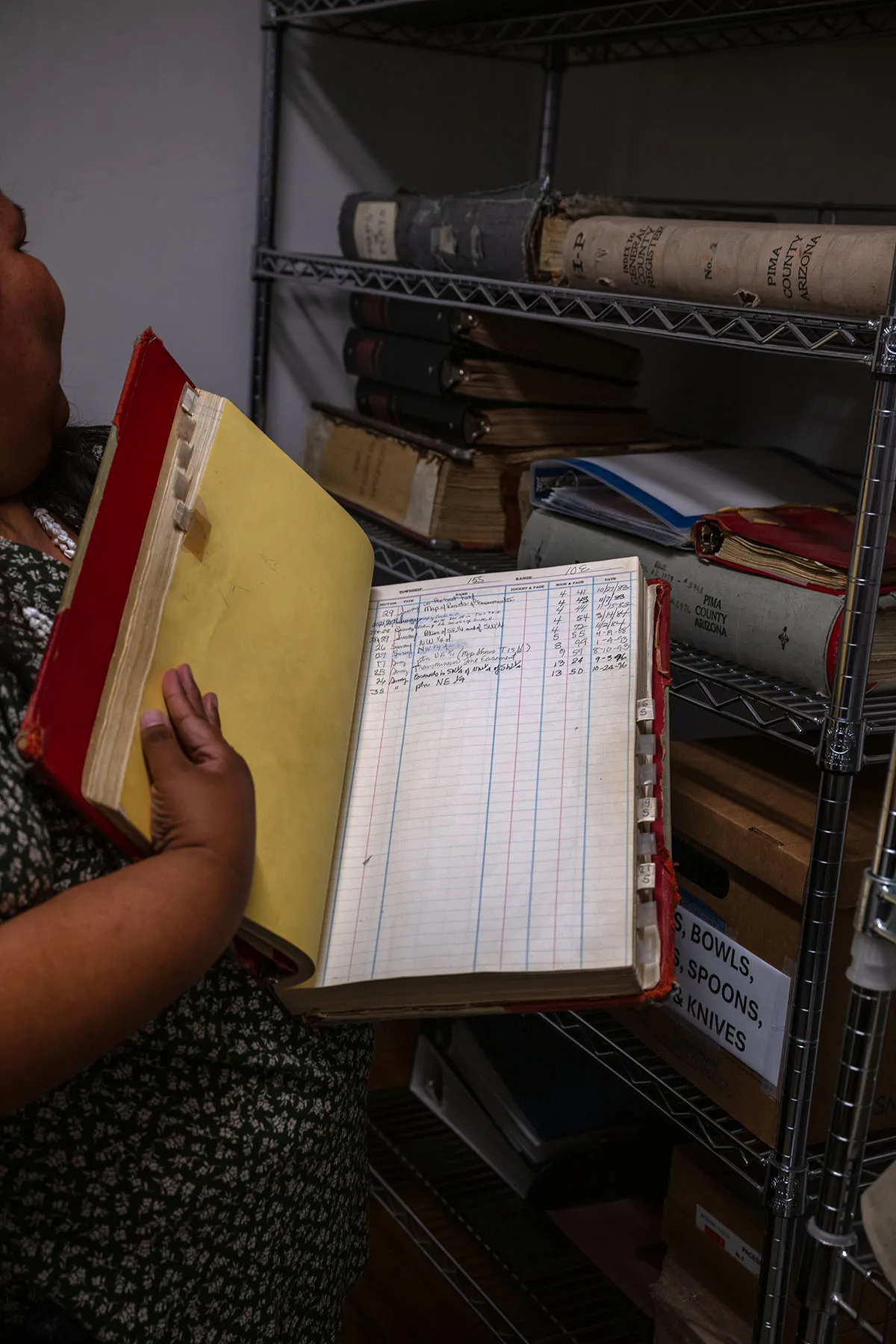
Gabriella Cázares-Kelly, partially visible, holds an open, large ledger book filled with handwritten entries. She stands in front of shelves filled with old, worn books and binders in a storage room.
Gabriella Cázares-Kelly goes through old Pima County records at her offices in Tucson, Arizona. (Ash Ponders for The 19th)

She doesn’t really need to get the vote out to be reelected; in solidly Democratic Pima County, it’s extremely unlikely that a Republican would flip her seat. But as a member of the Tohono O’odham Nation, whose broad territory extends along 62 miles of the U.S.-Mexico border, she knows the obstacles to participating in elections. It’s the whole reason she ran in 2020: to represent people who were being ignored by the democratic system and denied the right to vote. 

But Indigenous voters can swing election results in this battleground state, home to 22 federally recognized tribes. In 2020, President Joe Biden won Arizona by just 10,457 votes. That year, Democrats garnered 10,657 more votes from inside Native American reservations than they had in 2016. 

Now, as a presidential election draws near, Cázares-Kelly is working to ensure that every eligible resident has a chance to cast their ballot. 

At one of the last homes she approached that day, an older woman named Ann Gail opened the front gate to chat, her eyes shielded by dark sunglasses. She said she stopped believing in mail-in ballots after the fake narrative of a stolen election pushed by former President Donald Trump and his Republican allies took hold in 2020. When it comes to her own ballot, she said, “I feel like it needs to be counted and I need to see it.”

Cázares-Kelly tried to reassure her. “Vote by mail is very safe,” she said. “But I absolutely respect your decision to vote on Election Day.” 

“As an elected official, and as a candidate, we need people to trust in the system and to recognize it’s non-partisan,” Cázares-Kelly continued. “Today I’m here on a partisan basis, but when I’m working, it is not partisan. It is about everybody voting.”

Gail assured her that she’ll be voting and will “get everybody in my neighborhood” to vote, too,” she said. “It’s so important. My grandson turns 18 in July, and I’ve told him, ‘You have to vote.’” 


Cázares-Kelly jokes that she got into voting rights work by accident. In 2016, she was an academic adviser at the Tohono O’odham Community College when her friend and colleague Daniel Sestiaga, a member of the Fort Yuma Quechan Indian Tribe, approached her about a favor. He had been recruited by the American Indian Higher Education Consortium, which represents the interests of tribal colleges across the country, to register students to vote. He asked Cázares-Kelly if she could help. She knew all the students by name and was “just like a changemaker on campus,” he said. 

On the first registration day, Sestiaga got pulled into a meeting, so Cázares-Kelly had to do the work by herself. Despite not having any training, she thought, “It’s probably not that hard. I’ve registered myself and other people. Like, it’ll be fine.”

Instead, she recalled, “It turned out to be really hard.” 

One of the challenges is that voter registration isn’t set up for the realities of tribal land. “The problem on the reservation is if you’re asked for your physical address, you just kind of make it up,” she said. “Because there is nothing you can really reference.” Instead of a street name, one might describe where they live in relation to a landmark or a mile marker. For example, the college’s address was Highway 86, milepost 125-and-a-half, she said. 

The form also includes a spot to draw where you live. “Well, my nation is the size of Connecticut,” Cázares-Kelly said. “Are you asking for the shape of my nation and a star? Like, what are you looking for here?” 

All of this can create confusion for residents who sometimes just list their PO boxes, which don’t count as physical addresses. That will delay their registration, Cázares-Kelly said.

Non-native students had issues, too, particularly if they were from out of state. Some students didn’t have driver’s licenses. “Every single person’s situation was so completely different,” she said. “It ended up being incredibly complex.” 

She took her questions to the office of then-recorder F. Ann Rodriguez. She had so many that, at one point, she bumped her sister’s number off her speed dial list and replaced it with the number for Rodriguez’s office. 

And the work was just beginning. “People started getting the voter registration cards back, getting their voter IDs in the mail, and they were so excited to show me or thank me for helping them register,” she said. But then it became, “My mom wants to register now, my auntie, my boyfriend, my uncle. How do I get them a form?” Cázares-Kelly realized she didn’t know. “It was like I pulled a thread from a sweater and all of a sudden this sweater started unraveling.”

One of the things she learned is that the post office on the reservation should have voter registration forms available, but hadn’t stocked them in years. “Having no influence and no title and no anything, I reached out to the postmaster, I reached out to the recorder’s office, and I connected the two,” she said. Soon, the forms were where they should have been all along. 

Cázares-Kelly’s voting advocacy quickly turned into an obsession, Sestiaga said. One day, he recalled, “We were cruising through the village on a lunch break or something and she said, ‘If there was a way that I could make a full-time job out of getting people registered to vote, I would do it.’” Teasing her, he told her she’d just have to become the next county recorder. “She was like, ‘Get out of here! Like, I have no interest in politics. I have no interest in campaigning.’” 

But she also recognized there was a need for better outreach, particularly on the Nation, he said. So when Rodriguez announced in 2019 that she was going to retire after 28 years of service, it felt a little bit like fate to Sestiago. A lot of other people who knew Cázares-Kelly had a feeling she would go for the seat. “I remember seeing that headline, and I just thought to myself, ‘Oh my goodness, she’s going to run for this,’” her husband, Ryan Kelly, said.

Cázares-Kelly wasn’t sold yet. She was, first and foremost, an educator. She had no desire to be a politician, and the thought of raising campaign money made her uncomfortable. 

But it nagged at her how long it had taken to build a relationship with the current recorder’s office. She thought about having to do that all over again once Rodriguez left office. And what if the new recorder was anti-Native? “I was worried,” she said. “Eventually, I recognized that I care about this office and I understand a lot about the needs that are not being met, and I have a sense of duty to at least try.” 

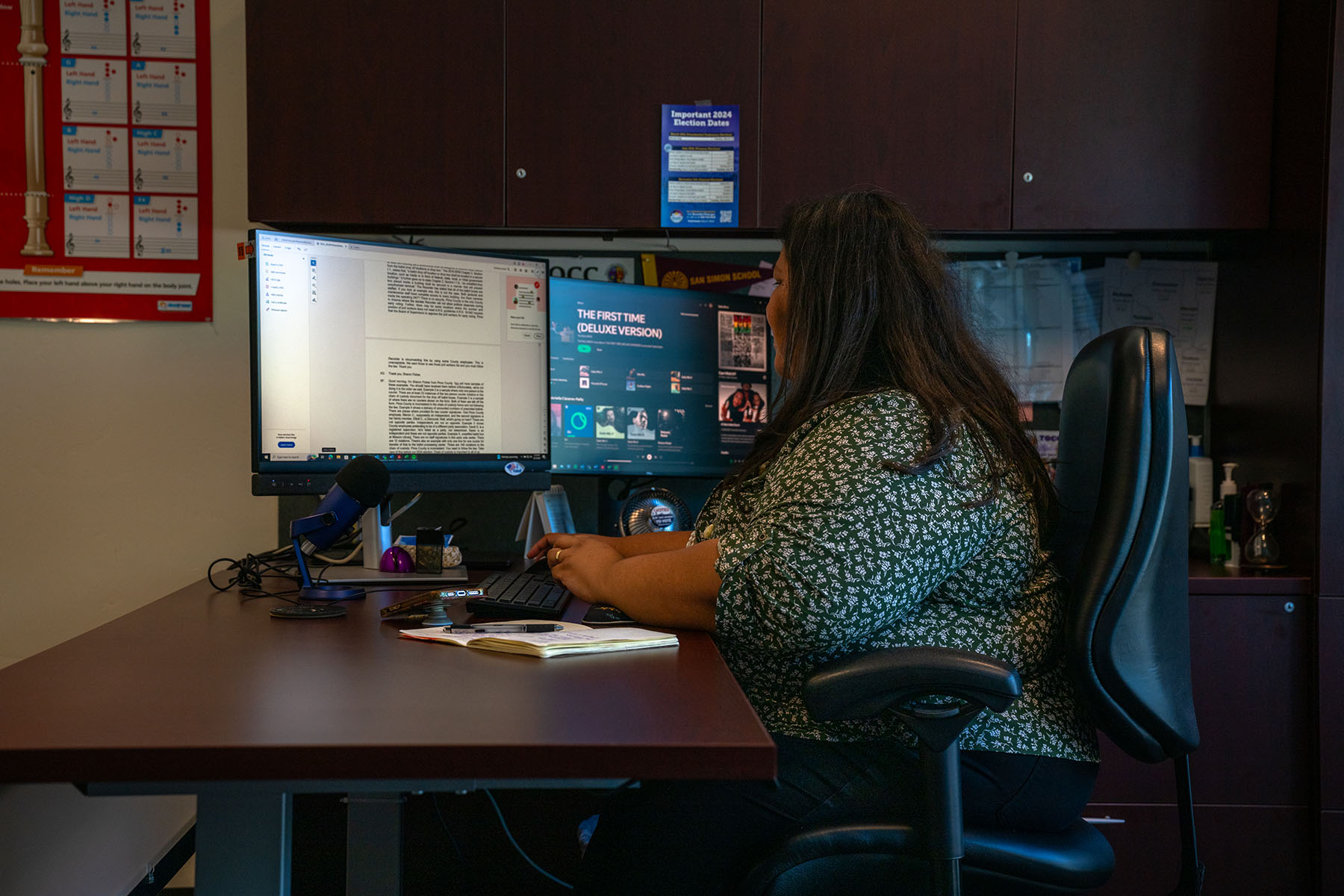
Gabriella Cázares-Kelly sits at her office desk, typing on a computer.
Gabriella Cázares-Kelly works in her office in Tucson, Arizona. (Ash Ponders for The 19th)
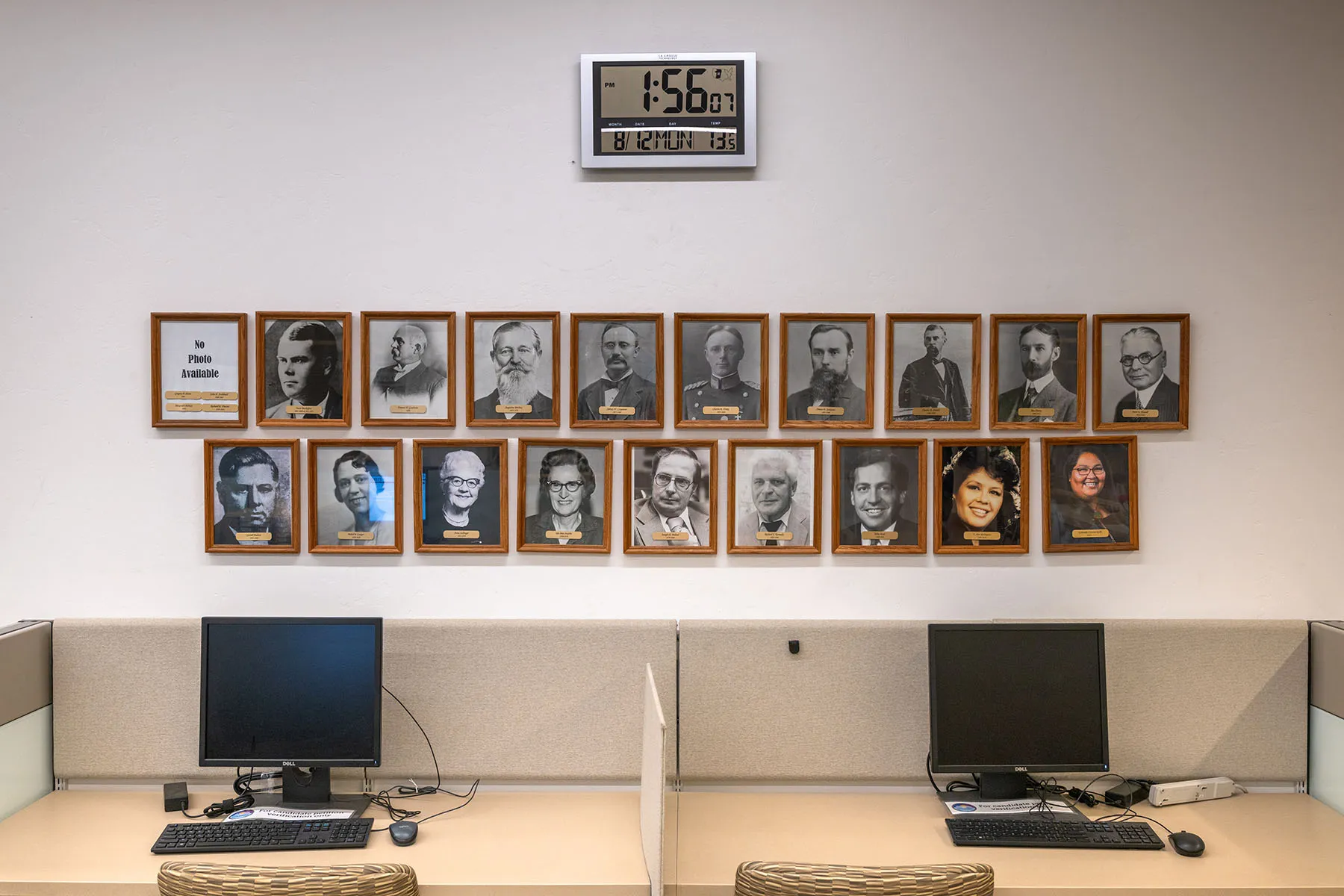
A wall in an office space displays framed portraits of county recorders, including Gabriella Cázares-Kelly, whose photo is in the bottom row. A digital clock above the frames shows the current time.
A wall displays framed portraits of Pima County Recorders, including Cázares-Kelly, at her offices. (Ash Ponders for The 19th)

She launched her campaign in 2020, right at the start of the COVID-19 pandemic. That meant having to canvass neighborhoods with social distancing measures in place, doing no-contact lit drops and outreach through Zoom forums and virtual fundraisers.

Worse, a candidate who wanted to win her community would need to do a lot of driving — and her car was having engine problems. She needed money to get back on the road. When she was registering voters, she sold banana bread to pay for gas. But fixing the car would take a much bigger sum, and she felt bad asking for money from people who might not have any to spare. A friend assuaged her guilt: “I think you’re saying, ‘Hey, community, I’ve invested in you,’” she recalls him telling her. “Now you’re asking, ‘Can you invest in me?’”  

She set up a GoFundMe for $3,500 and quickly met the goal. “It was just shocking to me that people would give me money,” she said. But it didn’t surprise her husband, a former teacher who is now a labor organizer with the AFL-CIO. Because she never wanted to get into politics, she had won community support just by being herself, he said. “Gabby walked into the race already having so many meaningful community relationships,” he said.

Those ties had deepened in 2017, when she, her longtime friend April Ignacio and a few others co-founded an advocacy organization called Indivisible Tohono. They have organized everything from sock drives to candidate forums to Pride events on the Nation.

That network of friends was ready to spread the word about her campaign. It helped that she made a TikTok video that went viral, showing her speeding by the National Mall in Washington, D.C. on an electric scooter while wearing a traditional red dress and yelling, “Excuse me, I’m Indigenous, coming through!” That moment became part of her campaign slogan and bumper sticker design. 

So when Election Day came, her supporters were hopeful that she might have a shot. “We had a good group of people who are really all rooted in the community,” her husband said. “I think we quietly suspected that it was going to be a landslide victory.” 

And they were right. She beat her opponent by more than 80,000 votes.  

Ignacio said it was a barrier-breaking moment for Cázares-Kelly. “As a rez girl growing up, we didn’t have the idea that we could do this. We didn’t have people in our community who were doing things like this,” she recalled. “For me to watch my best friend make history, it’s still very emotional. And I think that she’s the star who she’s always been.” 


Cázares-Kelly followed the canvassing in Three Points with a Juneteenth event in Tucson, where she gave the land acknowledgment at the opening ceremony, recognizing tribes like her own that have stewarded the land. Then she stayed to mingle with the crowd. As she strolled by the booths — some selling lemonade, others representing the gun reform group Moms Demand Action and the African American Democratic Caucus — people stopped her to shake her hand and fangirl about meeting her. 

She’s something of a local celebrity, which she didn’t expect as an elected official doing an administrative job. When she ran, “it wasn’t a sexy position,” she said. “Most people didn’t care about the recorder’s office.” 

Two things contributed to her popularity. One is that Cázares-Kelly, despite her initial shyness, is charismatic and funny and beloved by Pima County voters, who cast more votes for her than any other Democratic countywide candidate in the July primary. The other, a more somber reality, is that the 2020 election raised the profile of county recorders after the Trump administration spread unfounded conspiracy theories that votes in Arizona weren’t being counted. 

That fundamentally changed how she had to run her office. She immediately created a communications team to counter disinformation and teach people how voting works. In May, they invited a small group of community members and journalists into a highly restricted part of the office to see how ballots are counted. She also recently hosted a series with the Pima County Interfaith Council, visiting five churches to talk about a “day in the life” of the ballot. She draws inspiration from educational programs like “Mr. Rogers” and the “How It’s Made” videos about crayons or peanut butter. “I think people just want to know those types of things,” she said. 

She also uses social media to spread information about voting, tailoring the messages to the medium. Twitter is for journalists and other “nerds,” as she put it, so she tends to be wonkier there. Facebook and Instagram are for people like her sister, who don’t really care about the granularity of politics, but might be enticed if she can explain what her office does. 

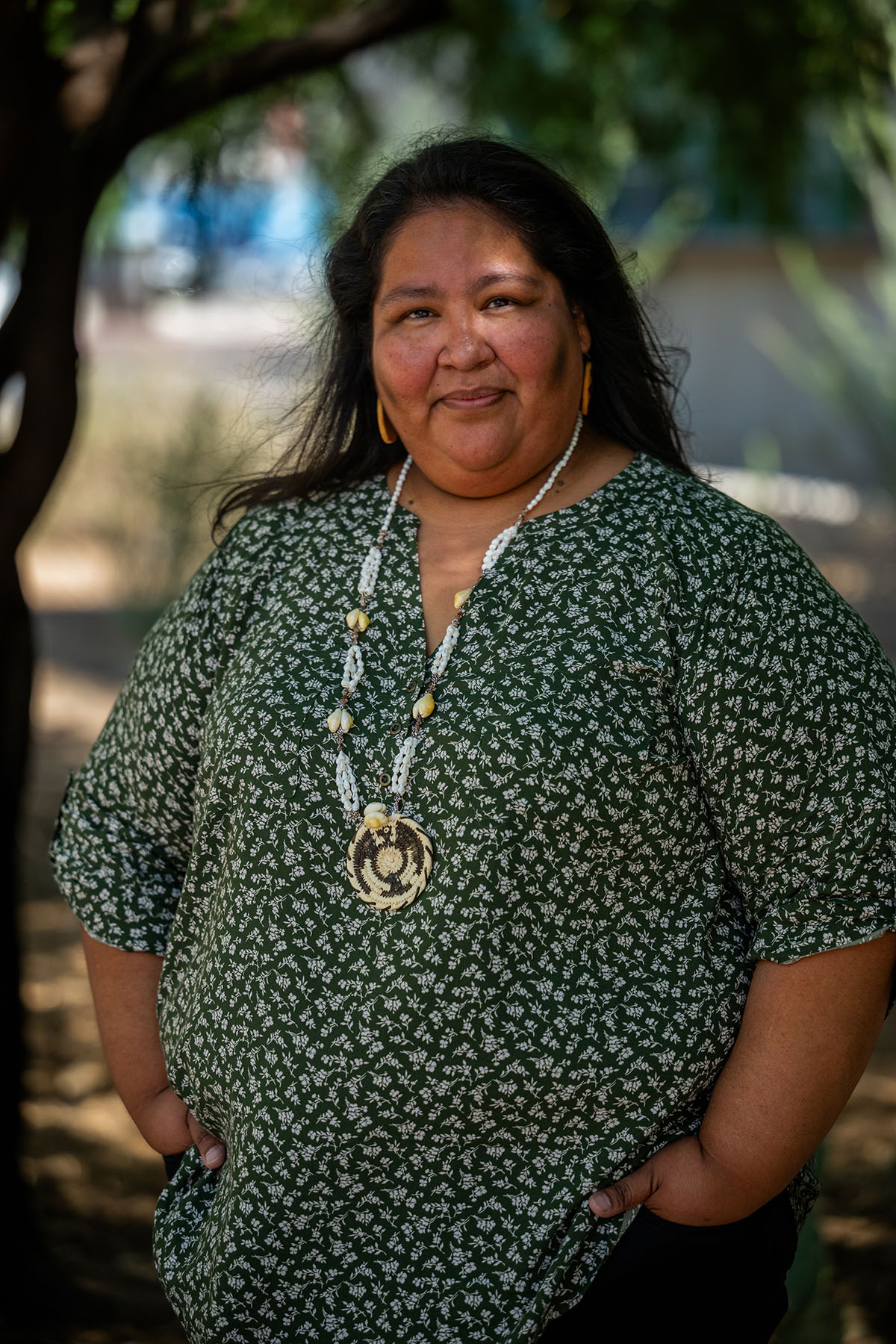
Gabriella Cázares-Kelly stands outdoors, wearing a green patterned blouse and a beaded necklace with her hands in her pockets. She smiles slightly, and trees create dappled light on her face and clothing.
Pima County voters cast more votes for Cázares-Kelly than any other Democratic countywide candidate in the July primary. (Ash Ponders for The 19th)

“I think people have for a really long time been very dismissive of social media,” she said. “But we can very much see a parallel between what happens on Twitter and Instagram and what happens in person.” For example, she said, when Kari Lake, a far-right Republican who ran for governor in 2022 and is now running for the U.S. Senate, sent out a tweet suggesting ballot counting was being slow-rolled to prevent her from winning, “it results in physical phone calls to my office.” 

Voter outreach will matter a lot this year, in what former recorder F. Ann Rodriguez describes as a “big election” for both the county and the nation. She points out that Pima is Arizona’s second most-populated county, after Maricopa, which happens to be one of the fastest-growing counties in the United States. And several hot-button issues will bring out voters: This year both abortion rights and the wages of restaurant workers are on the Arizona ballot.

For now, a lot of Cázares-Kelly’s work happens at events like this one, where she can answer questions in person. At the booth for NextGen America, which focuses on getting out the youth vote, she chatted about how the work was going and offered a pro tip learned from years of dealing with registration hassles: Instead of asking if someone is registered to vote, ask if they are registered at their current address. (Sometimes people move without updating it.)

Two booths down, at the Saavi Services for the Blind tent, she talked to Mohammed Falah about a tool called a ballot marking device — a machine that helps people with disabilities vote. It can read a ballot to a person through headphones, offers functions for large print or color contrast and has a controller that people with hand mobility issues can use to select their voting option. She said her office would be happy to demonstrate it for his organization. 

The county had the machines before she came into office, but, she said, much of the staff didn’t know how to use them. “They were like a nice decorative thing on the side of the room and if somebody asked to use it, [staff] would have to take out the instruction booklet and troubleshoot,” she said. “Then that person’s having to wait. And often it would lead to people feeling discouraged and embarrassed. And, you know, they may choose not to participate.” 

Listening to what the community needs, Cázares-Kelly said, “makes it better for everybody.” Sometimes it’s as simple as having a table with chairs at early voting locations. Older people started requesting that accommodation, she said, “but then we would see people who come in with a boot on their foot.” Once, she watched a mom sit down to breastfeed her child while voting.  

Her office has taken other accessibility measures, like making sure that PDF documents are compatible with a screen reader, a tool that can read text aloud or translate it into Braille. All of her social media communications include an image description for the same reason. 

As of 2016, there were about 175,600 visually impaired people in Arizona, and the population is aging, Falah said. This means more people will soon need these accommodations. “We are a retirement state,” he said. “If we do not tackle it now, then when?” 


A few weeks later, Cázares-Kelly was standing in front of a class of soon-to-be graduates from a training program that helps Indigenous people overcome the unique challenges they’ll face while running for office. Native politicians are often some of the first from their communities to either run or hold their positions and that usually comes with a fair amount of pushback or skepticism. 

Cázares-Kelly opened her talk by greeting the students in the Tohono O’odham language. Switching back to English, she said, “You are on O’odham land.” Then she added, with a smirk, “So — you’re welcome.” The group burst into laughter. It felt like a cheeky inside joke for a group of people who’ve likely been asked to do land acknowledgements for non-Native audiences. But the lighthearted moment quickly turned serious as Cázares-Kelly launched into the story of how she became involved in voting rights work thanks to her earliest influence, her grandmother. 

Cázares-Kelly grew up in two different communities in the Tohono O’odham Nation. One is called Kupk, a remote place where she spent her summers. The rest of the year, she lived in the village of Pisin’ Mo’o, which had some services, like a bus stop. She lived next door to her grandmother, Catherine Josemaria. Cázares-Kelly refers to her affectionately as her Hu’uli-bat, which is O’odham for “my dearly departed mother’s mother.”

They would communicate across their two languages, her grandmother in her broken English and Cázares-Kelly in her broken O’odham. They were always together, she said. Her grandmother showed her how to harvest traditional foods and she recalls watching her grind corn and clean tepary beans in the kitchen. 

But she also remembers another tradition: her grandmother’s voting ritual. It was a right Josemaria did not have until she was 30 years old. She was born in 1918 and granted citizenship six years later, but it wasn’t until 1948 that Native Americans won the right to vote. Even then, for decades, voting barriers like literacy tests specifically disenfranchised non-White and Indigenous people. 

But that didn’t stop Josemaria from being politically active. “She was a brilliant woman and she was a community leader,” Cázares-Kelly told the group. “We had visitors every single day of my youth, people wanting to hear her stories and her gossip — she was the gossip queen — and get her advice and have political discussions with her.”

On election days, Cázares-Kelly would comb and braid her grandmother’s long gray hair and pin it up in a bun. Her grandmother would don a dress and a little purse, and Cázares-Kelly would help her into the passenger seat of her car. Cázares-Kelly was too young to legally drive, but it was pretty common to start driving young on the reservation — and extremely important to get her grandmother to the polls. It only occurred to her later that what her grandmother was doing was a big deal, an act of defiance. “She would not have had the full freedom of having a language translator until the mid 1970s, which isn’t that long ago,” she said.

Once they returned home, her grandmother would go to her bedroom and tack her “I voted” sticker on the vinyl faux wood wall next to other stickers she had collected over the years. The oldest ones, Cázares-Kelly remembers, were yellow and worn. 

The importance of those stickers stayed with her. They serve as reminders to vote and are a source of pride. It’s part of the reason why in 2022, Cázares-Kelly’s office released new stickers for early voters with the words “I voted” written in English, Spanish and O’odham, one on top of the other. 

Her office has also expanded the role of the Tohono O’odham outreach coordinator to spend more time in the field talking to tribal residents and made it a priority to reinstate an early voting site for the Pascua Yaqui Tribe. The tribe had sued the previous county recorder after she closed the site in 2018 just a few weeks before an election. (A judge sided with the decision to close the site, saying there wasn’t evidence that closing it made it harder to vote.) 

Sestiaga recently told Cázares-Kelly how crucial that voting center has been for him. Even though he’s not a member of that tribe, voting at a site where people look like him makes him feel safer. He used to vote at a church in a predominantly White neighborhood and “going in as the young, Brown-skinned, darkest person in the room, I got looked at. I felt like people were watching me, like I was getting judged.” 

Sestiaga is able to vote at that site due to a change the county government made in 2022: Instead of having to go to a specific precinct, a resident can vote at any center in the county. Eleven other Arizona counties use this model and its popularity is spreading. According to the Voting Rights Lab, an advocacy organization, voter centers are more convenient, widely popular and could increase turnout. 

The centers also make voting easier for people on the reservation. As with any rural area, if someone shows up at the wrong precinct, it can be a long drive to the right one. And not everyone can afford that kind of error, said Cázares-Kelly. Many people don’t have cars or can’t afford to spend extra money on gas. Public transportation systems aren’t reliable, if they exist at all. 

As she wound down her speech at the leadership conference, Cázares-Kelly reminded the students that running for office is about advocating for their communities — not just when it comes to voting rights, but other policy decisions that are shaped by elected officials, like in health care or infrastructure.

“It’s our duty to protect our community,” she told them. “And if that means that we’re not doing it in the traditional way, but we’re having to learn the language of government and policy and funding to protect our people, then it’s our duty to at least try.” 


A few weeks after she announced she would run for president, Kamala Harris held a rally in Glendale, Arizona, a sprawling suburb just outside Phoenix. As she watched one of the opening speakers, the governor of the Gila Indian River Community, come up to the stage, Cázares-Kelly exclaimed, “There’s hella Natives up in this piece!” 

Harris and vice presidential nominee Tim Walz talked about some of the most pressing issues in Arizona: immigration and abortion restrictions. Harris also promised to pass the John Lewis Voting Rights Advancement Act, which would strengthen protections against discriminatory voting practices.

Cázares-Kelly was happy to hear it. But on the drive back home, she said that some of the things she heard at the rally didn’t resonate with her, like when Arizona Sen. Mark Kelly talked about the “army” Democrats need to win the next election. Her tribe, whose ancestral lands straddle both sides of the border, is heavily surveilled by the border patrol, which has a history of harassing and even deporting tribal members. The military rhetoric, she said, “doesn’t make me feel safe.”

Though she is a registered Democrat and a delegate at the Democratic National Convention, she stands to the left of the Harris-Walz ticket and has felt conflicted by its more moderate stances. Also, as an Indigenous person, her identity is inherently political. One of her idols, Minnesota Lieutenant Governor Peggy Flanagan, a citizen of White Earth Band of Ojibwe, once put it this way: These political systems were not designed to include people like her, but to eradicate and assimilate Indigenous people. 

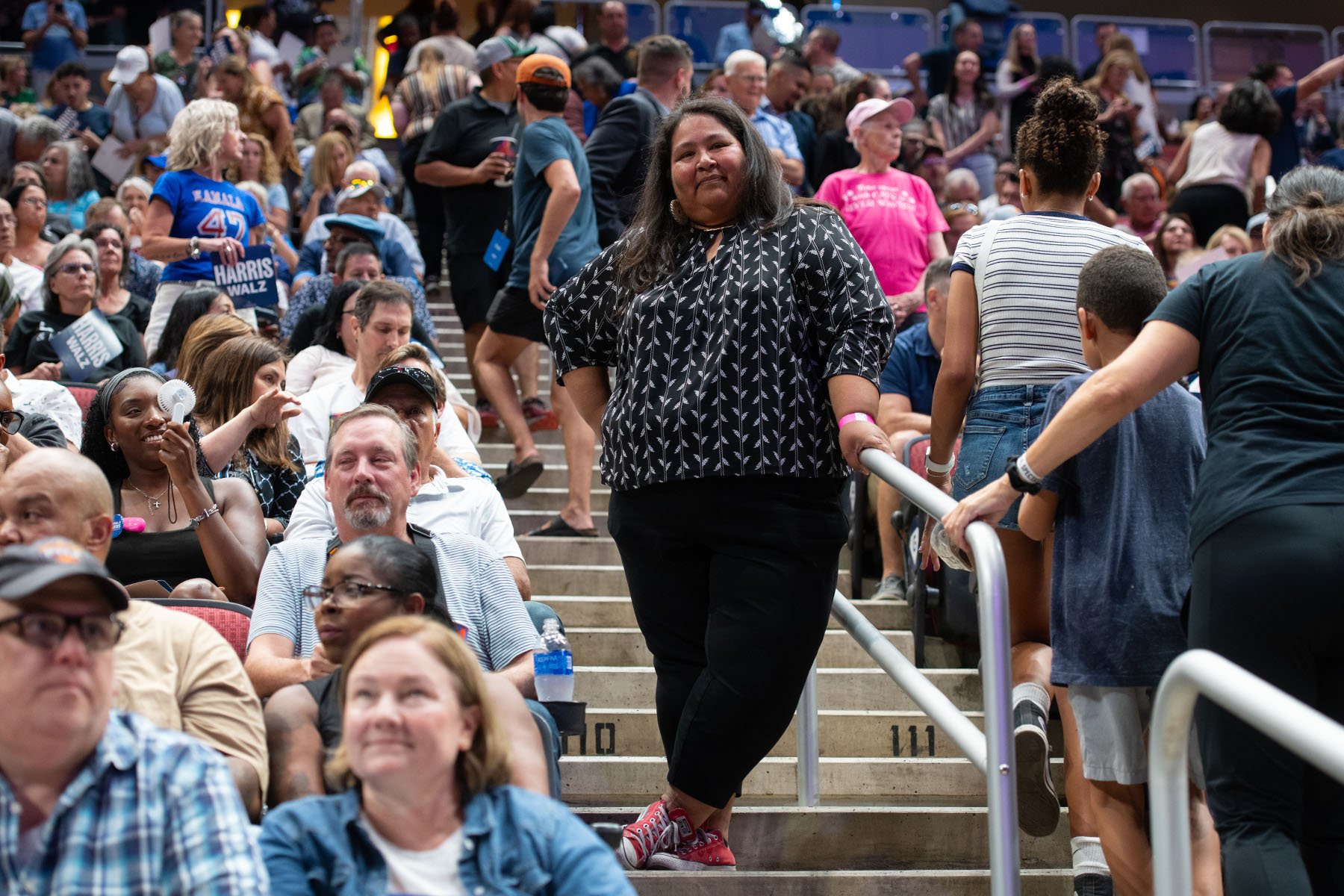
Gabriella Cázares-Kelly stands on the steps inside an arena filled with people attending a campaign rally for Vice President Kamala Harris. She wears a black patterned top and smiles, while attendees around her are engaged in conversations or looking around.
Gabriella Cázares-Kelly poses for a portrait before a Harris Walz campaign rally at Desert Diamond Arena in Glendale, Arizona. (Caitlin O’Hara for The 19th)

“So we’re still fighting the structure of white supremacy and anti-Indigenous sentiment and all of these other issues,” Cázares-Kelly said, “and we’re having to change the culture about what our role is in that.”

Eventually, the conversation turned to her own political future. Already, people have been speculating about whether she’d consider a higher office, but she promised herself she’d stay in the role for at least two terms. “I don’t know how I’ll feel in another four years, but four years has flown by for me,” she said.

It was past 10 p.m. and she was still making her way home. But the long day hadn’t sapped the energy in her voice or her enthusiasm for the job.

“There is so much work to do,” she said. 

To check your voter registration status or to get more information about registering to vote, text 19thnews to 26797.