September 4, 1954 The Peace Pledge Union (PPU) organized a demonstration against the H-Bomb in London’s Trafalgar Square. The PPU dates back to October 1934. Young Peace Pledge Union members today. The PPU today History of the Peace Pledge Union __________________________________________________ September 4, 1957 Elizabeth Eckford and eight other young Negroes were blocked from becoming the first black student at Central High School in Little Rock, Arkansas. Elizabeth Eckford Governor Orval Faubus had called out the National Guard to prevent the court-ordered integration of the public schools in the state’s capital. President Dwight Eisenhower eventually sent in federal troops to guarantee the law was enforced. Elizabeth Eckford followed and taunted by mob, 1957.Read more Read More A very interesting related story: ____________________________________________________ September 4, 1970 Vietnam Veterans Against the War (VVAW) began Operation RAW (Rapid American Withdrawal). Over the following three days more than 200 veterans, assisted by the Philadelphia Guerilla Theater, staged a march from Morristown, New Jersey, to Valley Forge, Pennsylvania, reenacting the invasion of small rural hamlets along the way. Operation Rapid American Withdrawal 1970-2005: Memories ______________________________________________________________ September 4, 1978 Simultaneous demonstrations in Moscow’s Red Square and in front of the White House in Washington, D.C. were organized by the War Resisters League, calling for nuclear disarmament.
NEW YORK, NEW YORK – SEPTEMBER 05: Kate Harrison (L) and Chloe Grace Moretz are seen at the 2023 US Open Tennis Championships on September 05, 2023 in New York City. (Photo by Gotham/GC Images) Gotham
Moretz and her partner, Kate Harrison, were married in a private ceremony over the weekend, as they confirmed to Vogue. The magazine also published exclusive photos and videos of the couple’s final fittings. Rather than a traditional white gown, Moretz went with a pale blue number with elbow length opera gloves. “It just feels like me. It feels like an extension of what I would have always hoped for,” she told Vogue. The actor added that she “never really envisioned a wedding dress” in her mind, so when the time came to figure out her actual wedding look, she knew that she “wanted to do something non-traditional and not wear white and have it feel different.”
After the couple got engaged, Moretz told Vogue that she knew that she wanted to reach out to Nicolas Ghesquière, women’s creative director of Louis Vuitton, to ask if he would be interested in making her dress. He went a step further and made both Moretz and Harrison’s dresses, as well as their afterparty looks. Rather than going with another dress for the festivities, Moretz decided on a white cutout suit accessorized with a cowboy-esque hat. She explained to the magazine that the hat was partially inspired by the activities of the wedding itself — “fishing, horseback riding, and poker.” “Our second day is going to be line dancing and everything,” she added.
In an Instagram post, Moretz thanked Louis Vuitton and Ghesquière for the dress, writing, “Your generosity, artistry, dedication and kindness knows no bounds. We feel so incredibly grateful. Thank you doesn’t even begin to cut it, but, thank you. Your vision made our day all the more meaningful.”
Moretz casually came out as a “gay woman” in November 2024 via Instagram, when she shared that she had voted for Kamala Harris in the presidential election. But even before formally coming out, she’s been seen with Harrison for years, including in a 2023 Instagram post of the two of them at the New York City Dyke March. Per Cosmopolitan, the two have seemingly been linked since 2018, but they’ve kept their relationship very private. Still, we’re glad that we at least get a glimpse into what was surely a stunning wedding. Congrats to the newlyweds!
Alex Consani confirmed that a tucking panty can be an Angel’s best friend.
The superstar model, who became the first trans woman to win Model of the Year in 2024, shared some behind-the-scenes footage from a recently released campaign with lingerie brand Victoria’s Secret on her Instagram on Tuesday. Alongside usual brand accoutrement, including the iconic angel wings, was another important accessory: a tucking panty.
“Cant stop smiling! So happy to have the opportunity to shoot with the baddest group of girls and the best team there is!” Consani wrote. “I’m so so so grateful!”
The carousel of images and selfies in the mirror featured Consani’s outfit for the day, group shots with her winged campaign colleagues, shots of her in the glam chair and raw footage from the shoot. The shoot celebrated “the first six angels hitting the Victoria’s Secret Fashion Show 2025 runway,” according to the brand’s Instagram.
One shot featured the aforementioned Tuck Kit, a product of Unclockable, a trans-led brand that was founded “to meet the unique needs of trans and queer people,” per its website. The description of the product Consani showed says that it allows the wearer to don their “favorite feminine styles without a gaff and with no bulge,” and “zero panty lines.”
In 2024, Consani became the first trans model, alongside Valentina Sampaio, to walk a Victoria’s Secret runway show. Their casting came six years after Ed Razek, the brand’s former chief marketing officer, made regrettable comments to Vogue about casting “transsexuals” in their fashion shows. ‘
“Shouldn’t you have transsexuals in the show? No. No, I don’t think we should,” he said. “Well, why not? Because the show is a fantasy. It’s a 42-minute entertainment special.” Days after the interview, a statement released by the brand attributed to Razek backtracked to say that the brand “would cast” a trans model for the show, and that it has considered trans models at castings, though one had never been hired. “It was never about gender,” he added.
In 2019, Valentina Sampaio became the first out trans model to work with Victoria’s Secret as part of a shoot with the brand’s VS Pink label. Days later, Razek retired from the company. Emira D’Spain, Edun Sodipo, Honey Dijon and Ceval Omar, all trans women, have since worked with the brand. Consani’s BTS shot is a reminder of her own declaration about the fashion industry that “the future is dolls,” as she stated in a June interview with Them.
“Seeing more of us, not just white versions of our community, not just thin versions of our community, not just able-bodied versions of our community, but all of the facets of being trans,” she said. “I think that’s so fashionable: the expression that comes from having an identity, especially now, that’s so unappreciated and unsupported.”
These bans have been successful in part because of a toxic and ruthless ecosystem of far-right influencers, like Riley Gaines, who have formed entire careers around attacking trans athletes by prioritizing hate and misinformation.
“So much of what we see … just seems like it’s wrapped up in really hateful and negative messages that aren’t good for anyone,” says Mary Fry, a professor of sport and exercise psychology at the University of Kansas. “We’re creating issues where maybe we don’t need to.”
The anti-trans attacks in sports are also affecting cis women. Ayala, a competitive cyclist, remembers one race where she and her trans friend both made the podium. When photos of the event were posted on Facebook, people accused her of being trans, and she was added to a “list of males who have competed in female sports” maintained by Save Women’s Sports.
Earlier this year, 16-year-old AB Hernandez became the target of nationwide hate and harassment when the president of a local school board publicly doxxed the track and field athlete and outed her as transgender. Right-wing activists misgendered her and called her mom “evil;” swarms of adults showed up to heckle her at games; Charlie Kirk pushed state governor Gavin Newsom to condemn her; and President Donald Trump threatened to withhold federal funding from California over her participation.
While transgender athletes are very rare, this type of harassment towards them is playing out across the country and internationally. A trans girl was harassed at a soccer game in Bow, New Hampshire, by adult protestors wearing XX/XY armbands, representing an anti-trans sports clothing brand. And in British Columbia, a 9-year-old cis girl was accosted by a grown man who accused her of being trans and demanded that she prove her sex to him.
While research into the relative athletic capabilities of trans and cis women is ongoing, far-right groups, including the Alliance Defending Freedom and the Leadership Institute, have been putting hate before science to turn the public against trans athletes since at least 2014. And it’s working.
Laws, rules or regulations currently ban trans athletes from competing in sports consistent with their gender identity in 29 states, with 21 beginning the ban in kindergarten. The majority-conservative Supreme Court announced this month that it’ll be taking on the question of the constitutionality of the bans. Meanwhile, the federal government is pressuringstates without bans to change their policies in compliance with a Trump executive order that attempts to institute a nationwide ban.
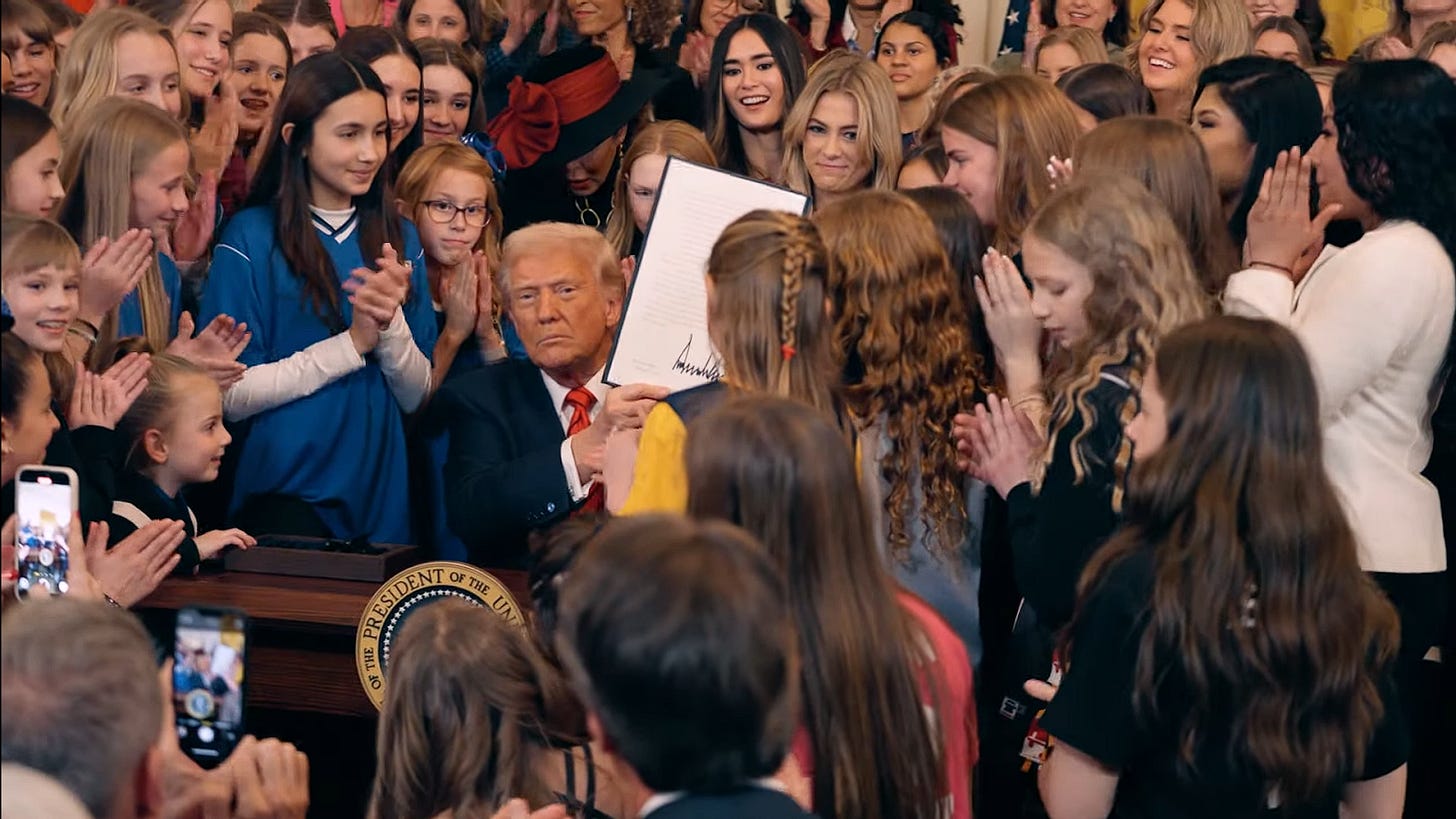
Trump signs an executive order calling for bans on trans women and girls from women’s sports. Photo by: The White House.
These bans have been successful in part because of a toxic and ruthless ecosystem of far-right influencers, like Riley Gaines, who have formed entire careers around attacking trans athletes by prioritizing hate and misinformation.
“So much of what we see … just seems like it’s wrapped up in really hateful and negative messages that aren’t good for anyone,” says Mary Fry, a professor of sport and exercise psychology at the University of Kansas. “We’re creating issues where maybe we don’t need to.”
Harassment and Mental Health
Grace McKenzie has been deeply affected by these hate campaigns. A lifelong athlete, McKenzie has stayed healthy by playing multiple sports where she’s met “amazing people.” Shortly after she transitioned in 2018, she was thrilled when she was invited to join a women’s rugby team at the afterparty of a Lesbians Who Tech conference.
Grace McKenzie. Photo courtesy of McKenzie.
“Rugby became my home, it was my first queer community, it was the space where I really discovered my own womanhood,” McKenzie told Uncloseted Media. “I could be the sometimes-masculine, soft-feminine person who play[s] rugby and loves sports.”
But that started to change in 2019, when McKenzie and others on her team started to hear rumors that World Rugby was considering a ban on trans athletes. Fearing the loss of her community, she started a petition that racked up 25,000 signatures—but it wasn’t enough, and the ban took effect in 2020.
As anti-trans rhetoric in sports has ramped up, McKenzie says she’s had soul-crushing breakdowns that have left her “sobbing uncontrollably and unconsolably.”
“It would be these waves of such intense despair and rage—it was like going through grief for five years,” she says. “I have to wake up every single day and read about another state or another group of people who say that they don’t want me to exist.”
While McKenzie says she’s found the strength to keep playing where she can, sports psychologist Erin Ayala has seen clients leave sports altogether due to the hate toward trans athletes.
“It can be really difficult when they feel like they’re doing everything right … and they still don’t belong,” says Ayala, the founder of the Minnesota-based Skadi Sport Psychology, a therapy clinic for competitive athletes. “Depression can be really high. They don’t have the strength to keep fighting to show up. And then that can further damage their mental health because they’re not getting the exercise and that sense of social support and community.”
That was the story of Andraya Yearwood, who made national headlines in high school when she and another trans girl placed first and second in Connecticut’s high school track competitions. The vitriol directed at her was intense: Parents circulated petitions to have her banned; crowds cheered for her disqualification; the anti-LGBTQ hate group Alliance Defending Freedom launched a lawsuit against the state for letting her play; and she faced a torrent of transphobic and racist harassment.
“It’s a very shitty experience,” Yearwood, now 23, told Uncloseted Media.
Fearing more harassment, she quit running in college.
“I understood that collegiate athletics is on a much larger and much more visible scale. … I just didn’t want to go through all that again for the next four years,” she says. “Track obviously meant a lot to me, and to have to let that go was difficult.”
It’s understandable that Yearwood and other trans athletes struggle when they have to ditch their favorite sport. A litany of research demonstrates that playing sports fosters camaraderie and teamwork and improves mental and physical health. Since trans people disproportionately struggle from poor mental health, social isolation and suicidality, these benefits can be especially crucial.
“In some of these cases, kids have been participating with a peer group for years, and then rules were made and all of a sudden they’re pulled away,” says Fry. “It’s a hard world to be a trans individual in, so it’d be easy to feel lonely and separated.”
Caught in the Crossfire
The anti-trans attacks in sports are also affecting cis women. Ayala, a competitive cyclist, remembers one race where she and her trans friend both made the podium. When photos of the event were posted on Facebook, people accused her of being trans, and she was added to a “list of males who have competed in female sports” maintained by Save Women’s Sports.
Ayala isn’t alone. Numerous cis female athletes have been “transvestigated,” or accused of being trans, including Serena Williams and Brittney Griner. During the 2024 Paris Olympics, Donald Trump and Elon Musk publicly accused Algerian boxer Imane Khelif of being trans after her gold medal win, as part of a wave of online hate against her. She would later file a cyberbullying complaint against Musk’s X.
While women of all races have been targeted, Black women have faced harsher scrutiny due to stereotypes that portray them as more masculine.
Yearwood remembers posts that would fixate on her muscle definition and compare her to LeBron James.
“I think that is attributed to the overall hyper-masculinization and de-feminization of Black women, and I know that’s a lot more prevalent for Black trans women,” she says. “It made it easier to come for us in the way that they did.”
Subscribe
A Big Distraction
Joanna Harper, a post-doctoral scholar at Oregon Health & Science University and one of the world’s leading researchers on the subject, says that the jury is still out on whether the differences in athletic performance between trans and cis women are significant enough to warrant policy changes.
“People want simple solutions, they want things to be black and white, they want good guys and bad guys,” Harper says, adding that the loudest voices against trans women’s participation do not actually care about what the science says.
“This idea that trans women are bigger than cis women, therefore it can’t be fair, is a very simple idea, and so it is definitely one that people who want to create trans people as villains have pushed.”
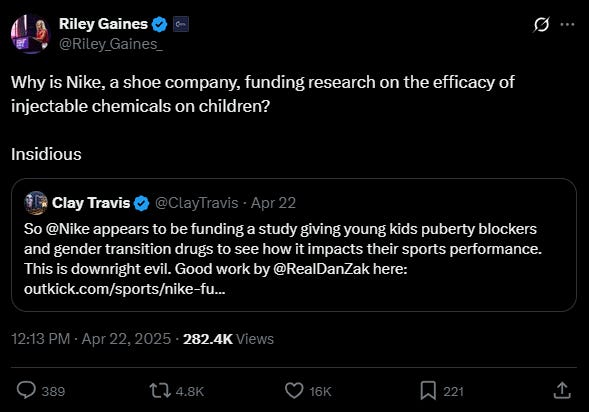
Even Harper herself has been the victim of the far-right’s anti-trans attacks. Earlier this year, she was featured in a New York Times article where she discussed a study she was working on with funding from Nike into the effects of hormone replacement therapy (HRT) on adolescents’ athletic performance.
Riley Gaines and OutKick founder Clay Travis attack Harper’s study on X.
“That Nike chose to fund a study on trans athletes doesn’t actually say that they’re supporting trans athletes. They’re merely supporting research looking into the capabilities of trans athletes,” Harper says. “You don’t know what the research will show until you get the data … but the haters don’t want any data coming out that doesn’t support what they want to say.”
Harper says this anti-trans fervor and HRT bans are making it more difficult to conduct studies in the first place.
And while the far-right argues that they are “protecting women’s sports” in their war on trans athletes, multiple athletes and experts told Uncloseted Media that this distracts from bigger issues in women’s sports, including sexualharassment by coaches and a lack of funding.
“If the real goal was to help women’s sports, they would try to increase funding [and] support for athletes,” says Harper, noting that women’s sports receive half as much money as men’s sports at the Division I collegiate level. “But that’s not what they’re doing, and it becomes pretty evident the real motivation behind these people.”
Since Trump’s reelection, Grace McKenzie has somewhat resigned herself to the likelihood of attacks on trans people getting worse. Despite this, she finds hope in building community with other trans athletes, such as the New York City-based trans basketball league Basketdolls.
“If that’s the legacy that [the anti-trans movement] wants to leave behind, good for them,” McKenzie says. “Our legacy is going to be one about hope, and collective solidarity, and mutual aid, and I would much rather be on that side of the fence.”
Meanwhile, Fry remains hopeful that conflicts can be resolved and that trans people may be able to find a place in sports over time.
“If we could all have more positive conversations and not create such a hateful environment around this issue, it would just benefit everyone.”
If objective, nonpartisan, rigorous, LGBTQ-focused journalism is important to you, please consider making a tax-deductible donation through our fiscal sponsor, Resource Impact, by clicking this button:
September 3, 1783 The Paris Peace Treaty between the U.S. and Great Britain — formally ending the American War for Independence — was signed by John Adams, Benjamin Franklin and John Jay. In addition to giving formal recognition to the U.S., the treaty established U.S. boundaries, specified certain fishing rights, allowed creditors of each country to be paid by citizens of the other, restored the rights and property of Loyalists, opened up the Mississippi River to citizens of both nations, and provided for evacuation of all British forces. The Treaty of Paris
September 3, 1957 Elizabeth Eckford was blocked from becoming the first black student at Little Rock’s Central High School in Arkansas.
September 3, 1970 Representatives from 27 African nations, the Caribbean nations, four South American countries, Australia, and the U.S. met in Atlanta, Georgia, for the first Congress of African People. Read more about CAP in historical context
September 3, 1997 The Musa Anter, or Kurdish Peace Train (named after an assassinated Kurdish writer) was organized by peace activists to call attention to the oppression of the Kurdish people in Turkey by their own government. At the time, the Turkish words for Kurd, Kurdish, guerilla and torture were banned, and it was illegal to speak the Kurdish language. The Peace Train was to leave London and travel through Europe to Diyarbakir in eastern Turkey to celebrate International Anti-War Day there. Germany disallowed passage of the Train through its territory (the Germans and Turks have strong military ties). The group then flew to Istanbul, intending to take a fleet of busses to the Kurdish region. Turkish troops stopped them from reaching Diyarbakir, forcing them back to the capital. On this day they tried to hold a press conference to discuss the Kurdish issue. The police arrested or beat all present, including foreign diplomats. The story of the Musa Anter Peace Train
Again this is about wiping first the trans out of public society and then the rest of the LGBTQ+ community. It is the Russian / Nazi playbook. It is part of their plan to return the country to a 1950s white straight cis ethnostate. We must not let it happen. Hugs
Teaching new Americans culinary skills…and beyond by José Andrés
At Emma’s Torch, refugees get the skills to work in kitchens and make a life for themselves Read on Substack
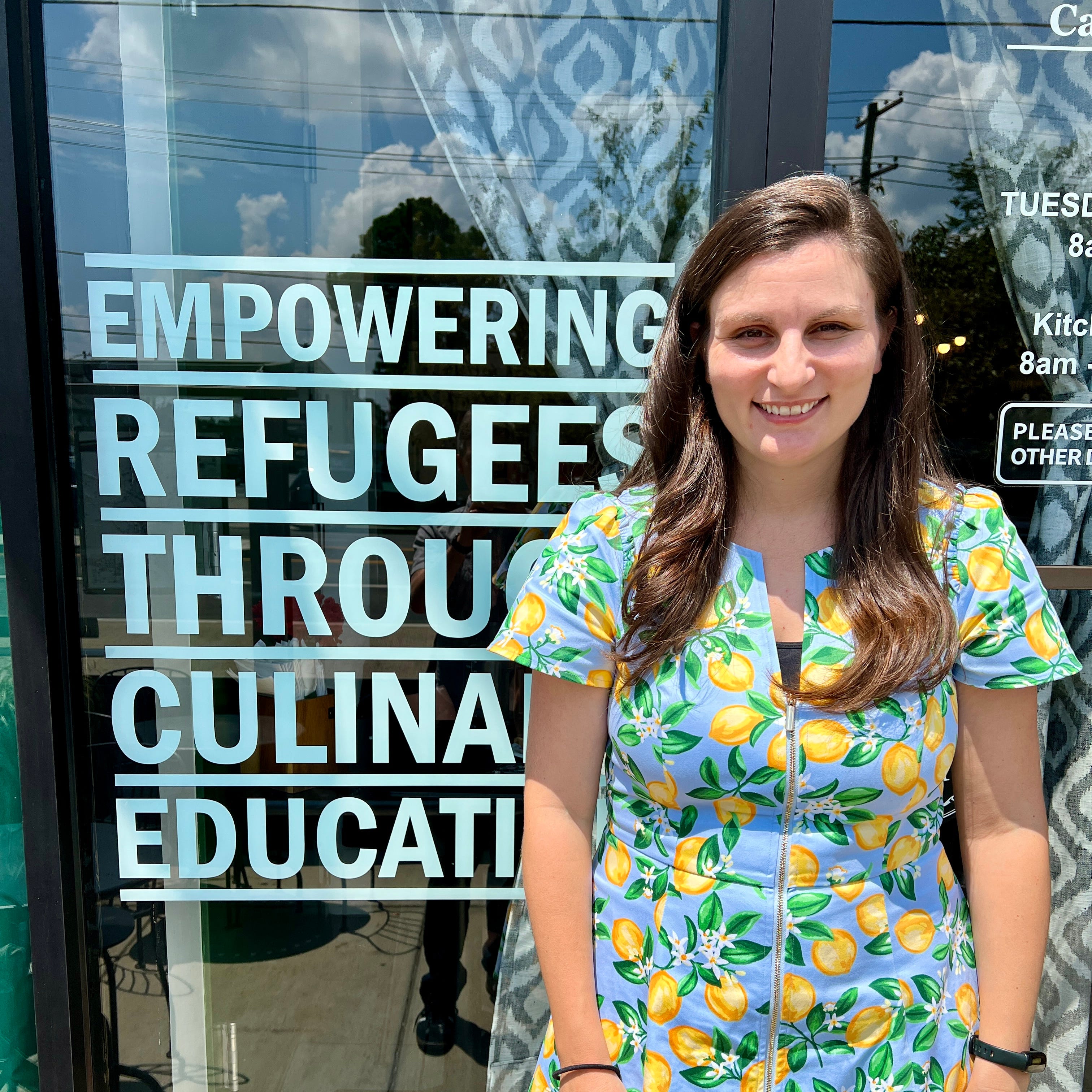
Hello friends, today I want to tell you about a really special organization here in Washington, DC as well as in Brooklyn, New York. It’s called Emma’s Torch, a non-profit organization that provides culinary training for refugees. Kerry Brodie, the founder of Emma’s Torch, named it after the famous poem written on the Statue of Liberty (“Give me your tired, your poor…”) by Emma Lazarus. The organization runs culinary programs for small groups of students to learn kitchen skills as well as life skills—and they have a network of partners to support students and graduates find housing, seek employment, connect with local communities, and find mental health support.
Soon, the DC program will be expanding to a much larger facility in Silver Spring, opening the door for even more students to be supported. My Longer Tables Fund has given a grant to Emma’s Torch to support this growth as a lead partner as they grow across the DC region, starting with the flagship Silver Spring hub in 2026…building a stronger future where more students can train for meaningful careers, more employers can connect with incredible talent, and more neighbors come together around the table. I’m excited to see the development of the new space and hopefully one day to attend a future graduation!
The Emma’s Torch culinary training program is 11 weeks total, and includes time in a classroom, in a teaching kitchen, in professional kitchens, and in a café that the organization runs. The Emma’s Torch team teaches culinary skills like knife skills, food safety, and recipe execution, as well as training outside the kitchen, like how to write a resume, how to interview, conflict resolution skills, coping methods, and language—mostly focused on culinary vocabulary and kitchen-specific language. Just imagine how important it is to be able to understand the difference between “you did cook that” and “you will cook that”…!
Emma’s Torch also has a relationship with José Andrés Group restaurants in Washington and New York—a program coordinated by our director of people, Eduardo Maia—and some of the program’s students work in our kitchens for a few days…as we say in kitchens, a “stage.” Students have worked at Zaytinya, Oyamel, Jaleo, China Chilcano, as well as minibar in DC, and Mercado Little Spain and Zaytinya in New York…and our teams have been so proud to work with them.
The organization partners with local nonprofits in DC and New York, organizations that support refugees like the International Rescue Committee, the Ethiopian Community Development Council, and other resettlement organizations…many of which have seen a decline in funding, so now more than ever, we need to be thinking about how to support people coming to our country. Today of all days, this week of all weeks, this year of all years, I think we should all be thinking about what longer tables means to us—and how the work of organizations like Emma’s Torch can make our communities, and our country, stronger.
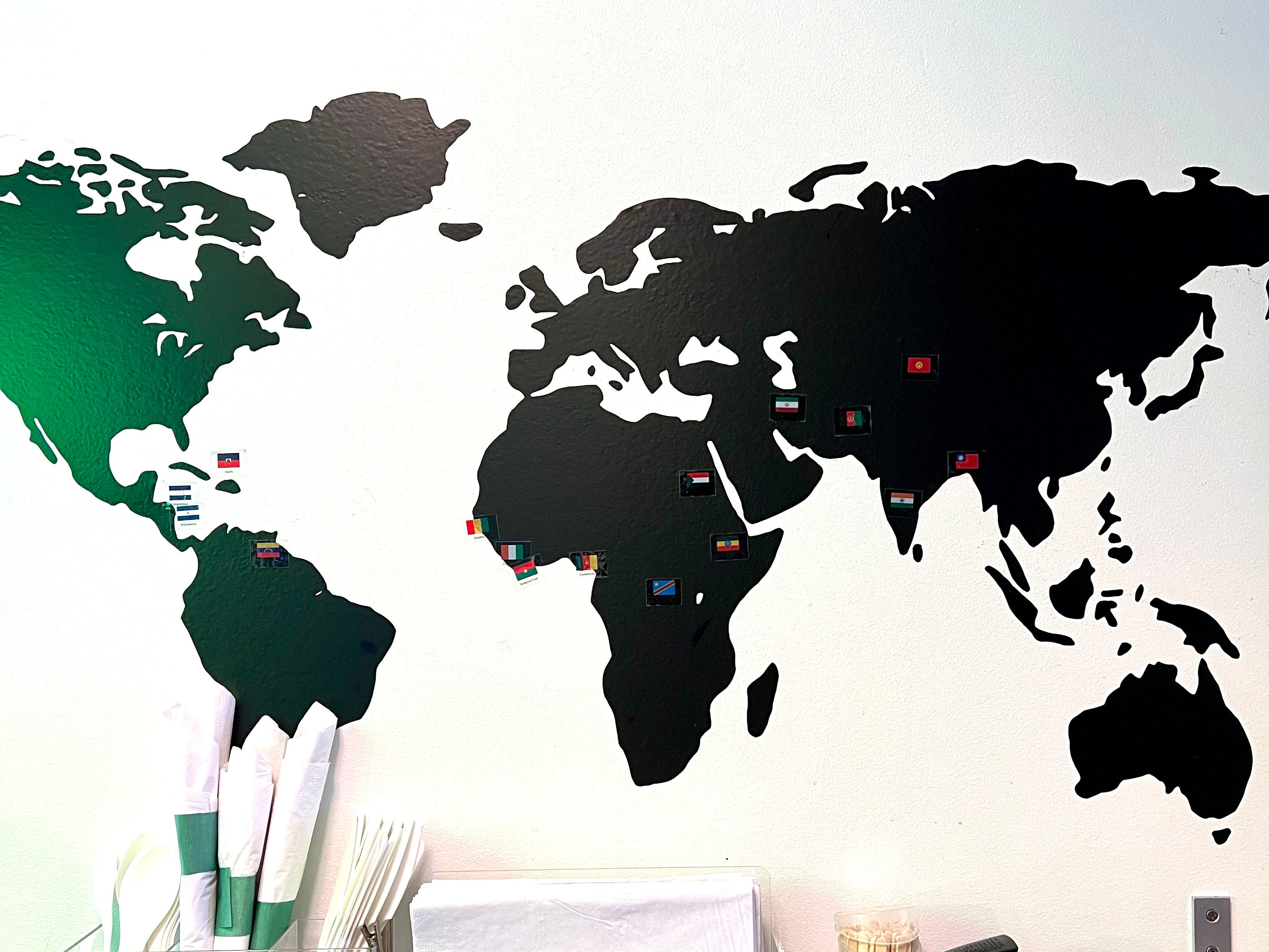
A map on the wall of the Emma’s Torch café in DC showing all the countries that graduates have come from.
My team had the opportunity to visit the DC cafe and meet some of the team members and students from Emma’s Torch (and had an amazing lunch at the café, of course!). Here are some thoughts from Kerry Brodie, the organization’s founder, Justin Edwards, the lead culinary trainer, and two recent graduates, Clara and Mamaissata.
Kerry Brodie is the founder of Emma’s Torch. She created the organization in 2016 after seeing the challenges of the day—a growing refugee crisis and increasingly hostile attitudes to new Americans, as well as restaurants struggling to find good workers. She’d had difficulty understanding how major change could happen through public policy—so instead, she decided to take matters into her own hands, and start a program training refugees to cook and to enter the workforce. Here’s more in Kerry’s own words.
Refugee resettlement is a long process because there’s the immediate trauma that a person might be escaping, but there’s also the trauma of building something entirely new—something that you didn’t plan for, that might not be plan B for you, but plan Z. Like, this is not where you thought you would be. And so many of our students have a shared experience of coming to terms with that, processing the loss as well as seeing the future with optimism, and working to build something.
And now, that trauma is paired with the constant harassment of headlines telling you that you’re not welcome here, and that you’re a drain on society, or that you are an other.
I think the loss of agency is something that becomes a huge problem because fundamentally, many people who leave their homes as refugees are taken from place to place and no longer given choices…Like, start here, go there, do this class. Instead, we like to frame everything as terms of a choice. We have our program and we’re clear with potential students about the parameters of it: this is what might be possible for you if you want to do it, but it is your choice to show up here, it is your choice to participate. It’s also your choice to accept or not to accept a job on the other end, at one of our employment partners.
We’ve seen more and more situations where families are separated, which leads to a lot of social isolation. It means we need to help people build a whole new social network for themselves, to establish a whole new social capital structure. So of course we’re teaching culinary skills, but we’re also teaching about employment. I like the phrase “knife skills and life skills”—but it’s not just language skills and how to write a resume, but also about equity and empowerment, how to speak up for yourself, to have agency over your life, despite the huge headwinds. (snip-There Is More-Please go read it!)
To win, Democrats must inspire the public in a fractured information age, engage meaningfully with the cultural shifts around race, gender, family, and migration, make democracy work despite obstructionists like Manchin and Sinema, and—most critically—deliver tangible results that improve people’s lives.
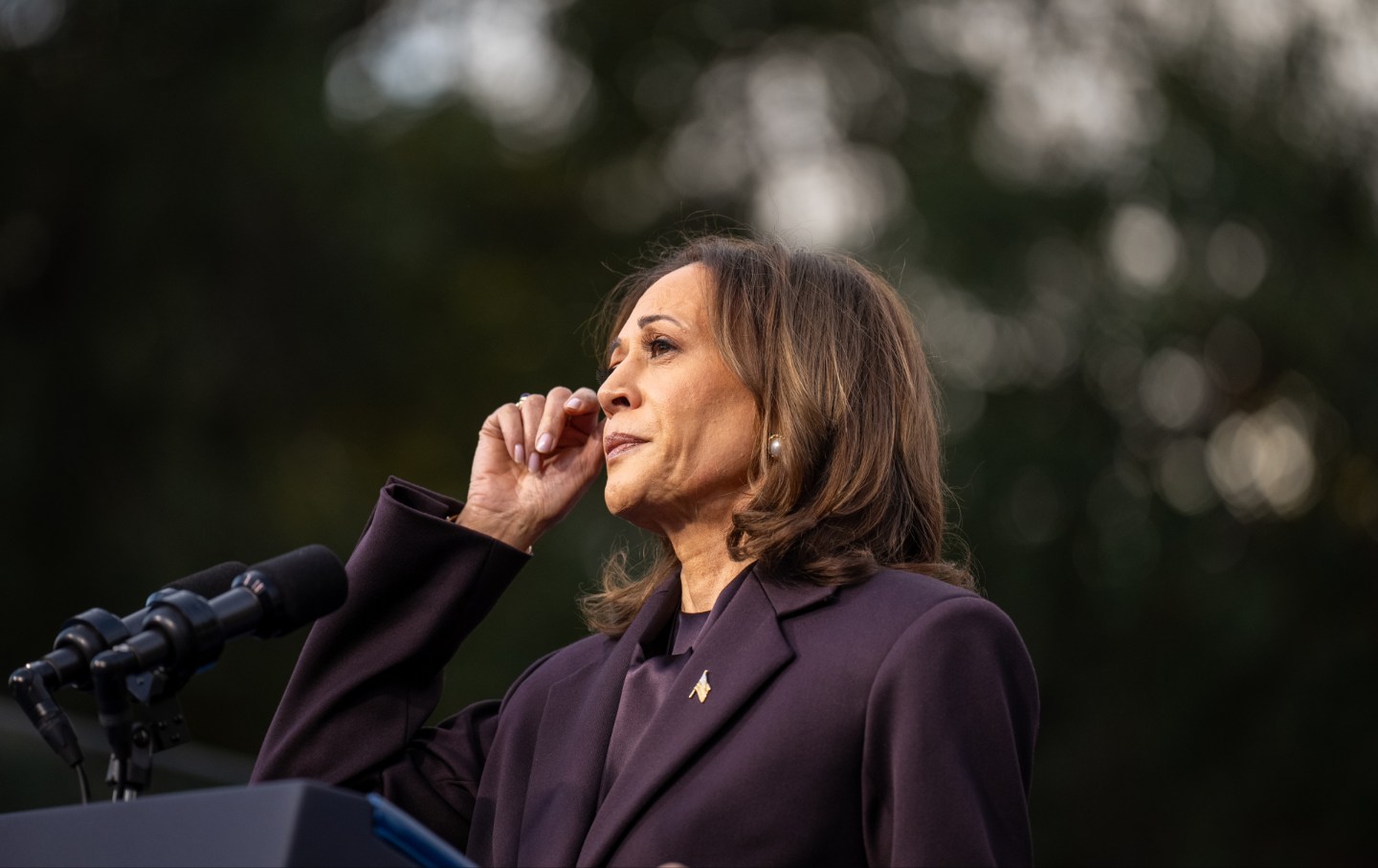
Kamala Harris pauses while speaking on stage as she concedes the election, at Howard University on November 6, 2024, in Washington, DC.
(Andrew Harnik / Getty Images)
In the aftermath of Kamala Harris’s loss, many pundits and politicians are turning to a familiar scapegoat. Critics like Adam Jentleson, a former aide to senators Harry Reid and John Fetterman, claim that “woke” advocacy groups made Democrats adopt extreme policies and drove voters away from the Democratic Party, sealing Donald Trump’s victory. But the truth is simpler—and more uncomfortable for the Democratic establishment. Despite the noise, voters didn’t reject Harris because of leftist rhetoric or activist slogans. They rejected her because she and her party failed to address the economic pain of working-class voters, who chose change over more of the same.
There’s a generation of Black and brown organizers, often the first in their families to step into positions of power, navigating institutions historically dominated by others. Alongside them are downwardly mobile white millennials, raised with expectations of stability but battered by an economy that delivers none. These activists, working within nonprofits and campaigns, fighting for causes once central to Democratic values, have somehow become scapegoats for the party’s electoral woes.
Why, after every electoral loss, is the left always the scapegoat? It’s easier to blame activists for pushing a progressive agenda than confront the real issue: the Democratic Party has long been shaped by far more powerful forces—corporate interests, lobbyists, and consultants—whose influence has neglected the real crises facing everyday Americans. We see this cycle again and again.
Contrary to establishment narratives, the Democratic leadership has often resisted advocacy organizations pushing for bold reforms on immigration, Big Tech, climate, debt, healthcare, rent, mass incarceration, Palestinian rights, and for policies like the Build Back Better agenda. This tension isn’t just about differing priorities—it reveals the actual balance of forces in the party. Corporate donors on Wall Street and Silicon Valley pour billions into campaigns, shaping agendas to suit their interests.A consultant class reaps millions from flawed strategies and failed candidates yet continues to fail upward, perpetuating a pattern of mediocrity. They, not progressives, are the roadblock preventing Democrats from becoming a populist force that could disrupt the status quo and win back voters of all stripes.
It was these elements within the party that kneecapped the Democrats’ most ambitious efforts to help ordinary Americans. The Biden administration entered with huge plans, notably Build Back Better, which would have delivered immediate relief: expanded child tax credits, free community college, universal child care and pre-K, paid leave, and more. Progressives pushed mightily for Build Back Better to pass. It was centrist obstruction—namely Senators Manchin and Sinema—that blocked those policies. The result was a patchwork of long-term measures like the Inflation Reduction Act and the Bipartisan Infrastructure Deal, whose benefits won’t be felt until 2025 at the earliest, if at all. By failing to pass Build Back Better, Democrats lost the chance to deliver easy-to-understand, tangible economic benefits and solidify their image as the party of working people.
And it was corporate Democrats—particularly lobbyists like Harris’s brother-in-law, former Uber executive Tony West, and David Plouffe—who held the most sway over Harris’s campaign. They advised her to cozy up to ultra-wealthy celebrities, Liz and Dick Cheney, and Mark Cuban, and avoid populist rhetoric that could have distanced her from the corporate elites who dominate the party. In 2024, the biggest spenders in Democratic Party politics weren’t progressives—it was AIPAC, cryptocurrency PACs, and corporate giants like Uber, all of whom poured millions into Democratic campaigns without regard for public opinion or the will of the people.
The Harris campaign’s messaging failed because, while populist economic appeals resonated with voters, the public face of the campaign was discouraged from embracing them. Instead, the focus was on issues like democracy and abortion, which, while important, couldn’t by themselves capture the priorities of working-class voters. In her public remarks and interviews, Harris, drawing on the advice of corporate leaders, frequently adopted a Wall Street–friendly tone that resonated with business interests, even if it alienated many of her core supporters.
It’s easy to forget that in 2020, Democrats saw historic turnout, driven largely by young voters who were energized by the largest left-wing and Black freedom protests since the 1960s. Biden won, and Democrats seemed to capture the nation’s hunger for justice and change, even as protesters marched with polarizing slogans like “Defund the Police.” Despite the controversy surrounding these messages, Biden triumphed decisively, calling for racial justice. The energy in the streets reflected a moment of possibility, a vision that real change was within reach. But by 2024, that grassroots energy had dissipated, and the Biden-Harris administration did little to revive it.
The loss of energy that Biden and Harris presided over showed up in youth turnout, which dropped to 42 percent in 2024, down from 50 percent in 2020 and closer to 2016 levels. However, battleground states saw higher youth turnout, around 50 percent. Young voters favored Harris over Trump by four points (51 percent to 47 percent), a sharp decline from Biden’s 25-point lead in 2020. The administration’s failure to offer a compelling narrative or deliver meaningful economic reforms alienated many young voters, especially on issues like unconditional weapons transfers to Israel.Trump capitalized on this vacuum with false promises and an anti-war message. Meanwhile, young workers, hit hardest by inflation and stagnant wages, saw little relief from the administration’s policies, leaving them feeling unseen and unmotivated. The simplest explanation may be the most accurate: after four years in opposition, Democrats under Biden had no plan for countering centrist obstruction from Manchin and Sinema. Nor did they have a clear strategy for transitioning to a new candidate, as Biden once suggested, or supporting a contested 2024 primary.
This disconnect was made worse by the administration’s lackluster communication strategy. Biden has avoided the media more than any modern president. In contrast, Mexico’s President Andrés Manuel López Obrador (AMLO) dominated the narrative with daily, three-hour, entertaining, and combative press conferences that have earned him one of the largest YouTube followings in Mexico. AMLO’s approach to the attention economy helped his party to secure another presidential term, defying global anti-incumbent trends.
Biden and Harris’s reluctance to embrace what some Democratic elites might view as “tasteless” or “uncouth” populist appeals allowed their opponents to seize the public’s attention, creating a void that ultimately drained the administration of the energy and momentum it once had. Trump’s simple, emotionally charged narrative about fixing the economy, winding down foreign wars, restoring order, and protecting “traditional” American values may have been filled with bigotry and lies. But it commanded the public discourse, pushing the Biden-Harris administration off center stage.
It’s true that some younger leftists embrace purity politics. But as Semafor’s Benjy Sarlin points out, the most polarizing moments in recent Democratic campaigns—like Beto O’Rourke’s “Hell yes” remark on gun confiscation or Julián Castro’s call to decriminalize border crossings during the 2020 primaries—were driven by the candidates themselves, not external activist pressure. Why did Kamala Harris take the positions she did in 2019? Because she was trying to distinguish herself in a crowded Democratic primary, where Bernie Sanders and Elizabeth Warren were surging and Biden seemed to have the center locked down. Ultimately, these moves were about gaining media attention in a competitive primary, not a direct result of pressure from advocacy groups—many of which, like Sunrise Movement, Working Families Party, and Justice Democrats, with which I was affiliated, have spent years working within the system to create lasting change and deliver real policy results that resonate with voters
The backlash against “wokeness” often rests on vague critiques, offering little more than cultural hand-wringing without any clear solutions. And when those solutions do emerge, they’re often morally indefensible. Jentleson’s criticism of progressive advocacy groups rings especially hollow when you consider the track record of his own political mentors. In 2010, his former boss, Harry Reid, publicly opposed the “Ground Zero mosque,” a proposed Islamic cultural center near the World Trade Center. While technically acknowledging the developers’ rights, Reid capitulated to Republican culture wars by suggesting Muslim Americans build the mosque elsewhere. This wasn’t a principled stance—it was a political maneuver that lent legitimacy to Islamophobia, feeding into narratives from figures like Sarah Palin and Newt Gingrich, who compared the center to a Nazi building next to the Holocaust Museum. In doing so, Reid allowed bigotry to flourish, leaving a vulnerable community to bear the brunt of political scapegoating.
From asylum seekers to transgender rights, today’s debates mirror the “Ground Zero mosque” controversy. From 2017 to 2020, Democrats, including Harris, were eager to condemn Trump’s cruel immigration policies. Now, however, they seem more focused on dodging the topic altogether. These are issues demanding a new approach, one that emphasizes year-round persuasion and agenda-setting over political convenience. Thermostatic public opinion might be a reality of politics, but voters appreciate when you stand for something with conviction and authenticity.
This is where movements and parties work best together: movements push the boundaries of what’s possible, creating the political space to reframe issues like transgender rights and immigration in majoritarian terms, and politicians follow when the political weather aligns with their self-interest. These two sides will clash, but it’s in that tension that progress lies.
Democrats can’t be scared of that process. They must stop ceding the narrative to far-right framing and instead invest in populist campaigns that aren’t afraid to antagonize villains, highlight the humanity of marginalized communities, and expose the Republican Party’s divide-and-conquer tactics. Only then can they build the political power necessary to shift the conversation and secure real change.
Anyone who knows me knows I’m critical of the academic jargon and misguided tactics that sometimes dominate activist circles. But to blame activists for the party’s struggles is to overlook the much larger battles they’re engaged in: 11 million undocumented Americans left in limbo, a prison system that incarcerates more people than any other in history, and an economy where three people hold more wealth than the bottom half of the country. These are the moral tests of our time—tests that any party claiming to stand for justice will be judged by. Scapegoating those pushing for change isn’t just unfair; it’s counterproductive, fracturing necessary coalitions and undermining the ability of the party to tackle the crises ahead.
Harris’s defeat should prompt serious introspection for Democrats—but not the narrow, one-sided critique Jentleson offers. Everyone, including progressive advocacy groups, has lessons to learn. The path forward isn’t about hippie-punching—it never has been. Time and again, the center-left’s response to electoral defeat has been to blame the unpopular and disruptive activists pushing for progress, whether abolitionists, suffragettes, labor unions, civil rights leaders, or environmentalists.
History reveals that oversimplified approaches often sidestep the harder questions. Success doesn’t come from rejecting the complexity of a diverse coalition but from learning to navigate it. To win, Democrats must inspire the public in a fractured information age, engage meaningfully with the cultural shifts around race, gender, family, and migration, make democracy work despite obstructionists like Manchin and Sinema, and—most critically—deliver tangible results that improve people’s lives.And if the corporate, status quo–loving forces within the party are standing in the way of that mission, they must be moved aside.
Success will come not by pointing fingers but by telling a story of transformation—with clear villains, bold vision, and conviction that democracy can, indeed, make a difference.