A U.S. Army veteran who was arrested during an immigration raid at a Southern California marijuana farm last week said Wednesday he was sprayed with tear gas and pepper spray before being dragged from his vehicle and pinned down by federal agents who arrested him.
George Retes, 25, who works as a security guard at Glass House Farms in Camarillo, said he was arriving at work on July 10 when several federal agents surrounded his car and — despite him identifying himself as a U.S. citizen — broke his window, peppered sprayed him and dragged him out.
In this image taken from video provided by United Farm Workers, George Retes speaks about being arrested at an immigration raid at a Southern California marijuana farm during a press conference held over Zoom in Oxnard, Calif., Wednesday, July 16, 2025. (United Farm Workers via AP)
“It took two officers to nail my back and then one on my neck to arrest me even though my hands were already behind my back,” Retes said.
Massive farm raids led to hundreds being detained
The Ventura City native was detained during chaotic raids at two Southern California farms where federal authorities arrested more than 360 people, one of the largest operations since President Donald Trump took office in January. Protesters faced off against federal agents in military-style gear, and one farmworker died after falling from a greenhouse roof.
The raids came more than a month into an extended immigration crackdown by the Trump administration across Southern California that was originally centered in Los Angeles, where local officials say the federal actions are spreading fear in immigrant communities.
California Gov. Gavin Newsom spoke on the raids at a news conference Wednesday, calling Trump a “chaos agent” who has incited violence and spread fear in communities.
“You got someone who dropped 30 feet because they were scared to death and lost their life,” he said, referring to the farmworker who died in the raids. “People are quite literally disappearing with no due process, no rights.”
Retes was taken to the Metropolitan Detention Center in downtown Los Angeles, where he said he was put in a special cell on suicide watch and checked on each day after he became emotionally distraught over his ordeal and missing his 3-year-old daughter’s birthday party Saturday.
Milk is poured on a protester’s face after federal immigration agents tossed tear gas at protesters during a raid in the agriculture area of Camarillo, Calif., Thursday, July 10, 2025. (AP Photo/Michael Owen Baker)
He said federal agents never told him why he was arrested or allowed him to contact a lawyer or his family during his three-day detention. Authorities never let him shower or change clothes despite being covered in tear gas and pepper spray, Retes said, adding that his hands burned throughout the first night he spent in custody.
On Sunday, an officer had him sign a paper and walked him out of the detention center. He said he was told he faced no charges.
Retes met with silence when seeking explanation
“They gave me nothing I could wrap my head around,” Retes said, explaining that he was met with silence on his way out when he asked about being “locked up for three days with no reason and no charges.”
Tricia McLaughlin, assistant secretary of the Department of Homeland Security, confirmed Retes’ arrest but didn’t say on what charges.
“George Retes was arrested and has been released,” she said. “He has not been charged. The U.S. Attorney’s Office is reviewing his case, along with dozens of others, for potential federal charges related to the execution of the federal search warrant in Camarillo.”
A federal judge on Friday ordered the Trump administration to halt indiscriminate immigration stops and arrests without warrants in seven California counties, including Los Angeles. Immigrant advocates accused federal agents of detaining people because they looked Latino. The Justice Department appealed on Monday and asked for the order to be stayed.
The Pentagon also said Tuesday it was ending the deployment of 2,000 National Guard troops in Los Angeles. That’s roughly half the number the administration sent to the city following protests over the immigration actions. Some of those troops have been accompanying federal agents during their immigration enforcement operations.
Retes said he joined the Army at 18 and served four years, including deploying to Iraq in 2019.
“I joined the service to help better myself,” he said. “I did it because I love this (expletive) country. We are one nation and no matter what, we should be together. All this separation and stuff between everyone is just the way it shouldn’t be.”
Veteran pledges to sue federal authorities for his ordeal
Retes said he plans to sue for wrongful detention.
“The way they’re going about this entire deportation process is completely wrong, chasing people who are just working, especially trying to feed everyone here in the U.S.,” he said. “No one deserves to be treated the way they treat people.”
Retes was detained along with California State University Channel Islands professor Jonathan Caravello, also a U.S. citizen, who was arrested for throwing a tear gas canister at law enforcement, U.S. Attorney Bill Essayli posted on X.
The California Faculty Association said Caravello was taken away by agents who did not identify themselves nor inform him of why he was being taken into custody. Like Retes, the association said the professor was then held without being allowed to contact his family or an attorney.
Caravello was attempting to dislodge a tear gas canister that was stuck underneath someone’s wheelchair, witnesses told KABC-TV, the ABC affiliate in Los Angeles.
A federal judge on Monday ordered Caravello to be released on $15,000 bond. He’s scheduled to be arraigned Aug. 1.
“I want everyone to know what happened. This doesn’t just affect one person,” Retes said. “It doesn’t matter if your skin is brown. It doesn’t matter if you’re white. It doesn’t matter if you’re a veteran or you serve this country. They don’t care. They’re just there to fill a quota.” ___ Associated Press writer Jamie Ding contributed from Los Angeles.
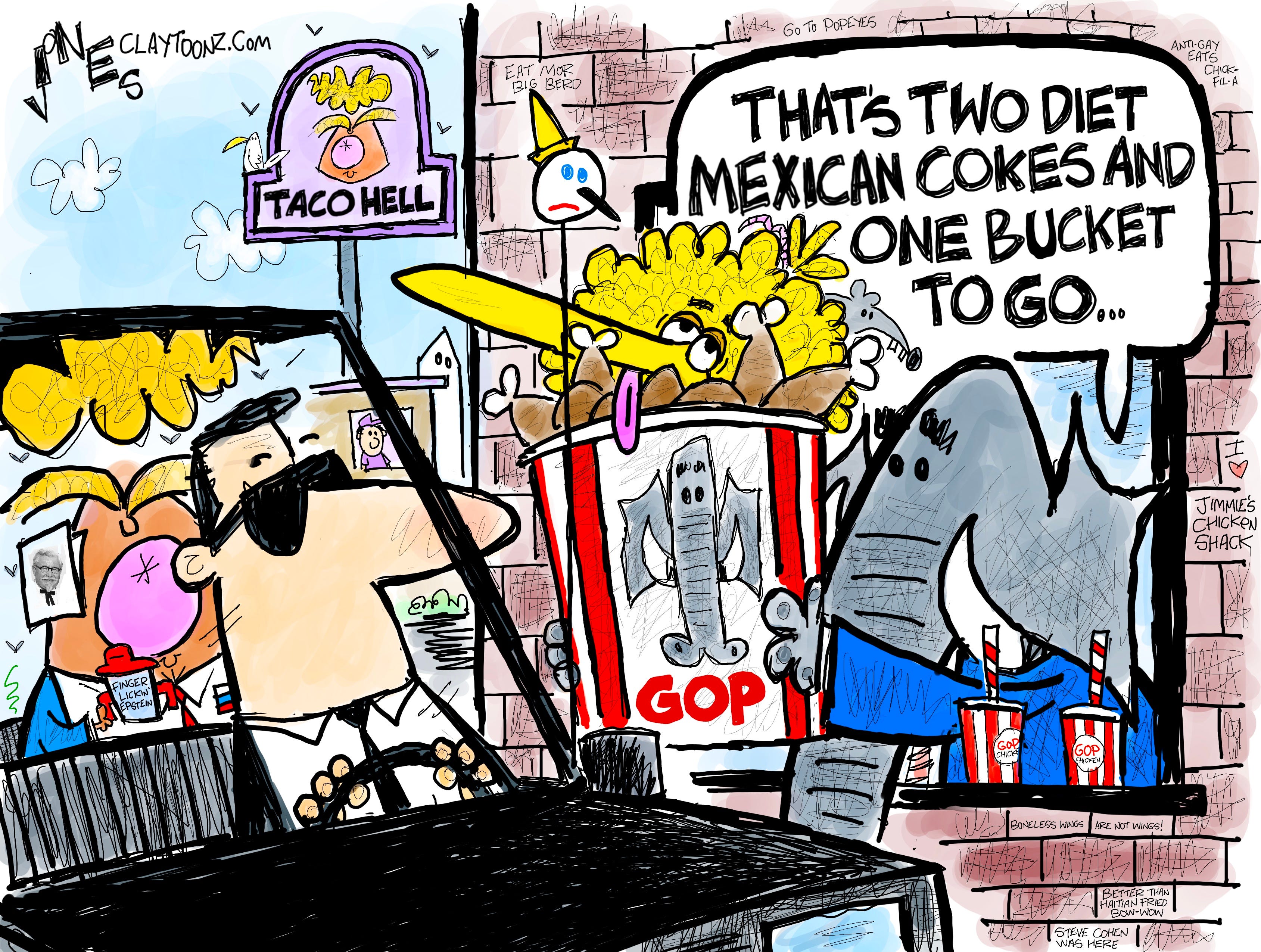
While asshole billionaires are enjoying the continuation of huge tax cuts, Donald Trump and Republicans realized, maybe, that this will actually increase our national debt. Why didn’t somebody say something? So in order to slow down the bleeding, the goons looked for where they could make some cuts and save. No, they did not cut the budgets for ICE, defense, bombs for Israel to drop on the kids in Gaza, Trump golf trips, or Trump birthday parades. Maybe they could sell the plane Qatar bribed Trump with, if anyone else actually wanted it.
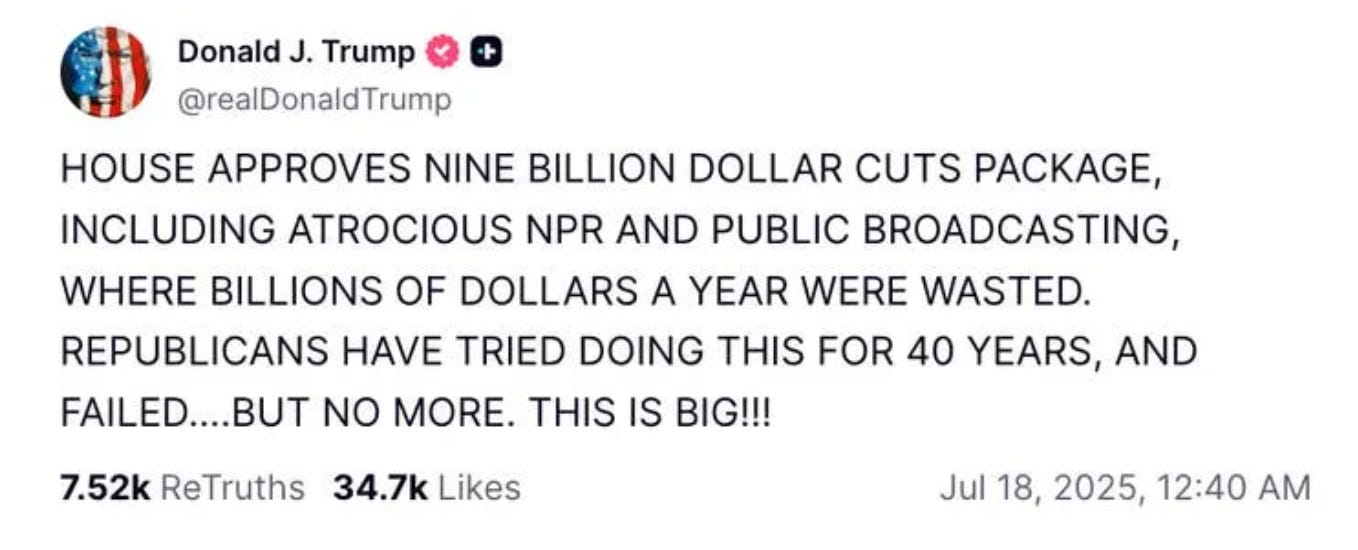
Trump and Republicans passed a bill that will cut $1.1 billion in federal funding for PBS and NPR. Trump is all giddy about this and posted to ShitSocial…
Of course, this impacts Sesame Street. What kind of asshole hates Sesame Street? Donald Trump is that kind of asshole. Donald Trump was an asshole millionaire by the time he was 8 years old. His allowance at 3 years old was around $200,000 a year. That explains why he doesn’t have any appreciation for Sesame Street. If nothing else, Sesame Street could have taught him how to count his money and maybe realize that if you spend more than you bring in, you will increase debt. Cookie Monster knows this. You can’t eat more cookies than you have. Maybe if Trump watched Sesame Street, he wouldn’t speak like a drugged-out crackhead and could talk the king’s English as well as the president of Liberia.
Sesame Street might have saved Trump from being the kind of asshole who sexually assaults and rapes women. It could have saved him from being a grifter and a thief. It could have saved him from growing up into a racist liar. Sesame Street could have saved Trump from turning into Trump.
As Matt Hooper said in Jaws while describing a Great White Shark as a machine, “All this machine does is swim and eat and make little sharks, and that’s all.” Trump is also a machine, and all that asshole machine does is grift, sexually assault women, and make little assholes.
By the way, have you seen a photo of Barron Trump lately? He’s cultivating the asshole look. He may be taking grooming tips from older brother, Don Jr. Fortunately, Barron hasn’t developed the coke-up dazed expression yet, so for now, he only has the Christian Bale serial killer look from American Psycho.
Anyhoosies, we’re supposed to be talking about Big Bird and not Big Turd, the serial killer of democracy. I wanted to avoid drawing Big Bird for a cartoon on this subject, as so many other cartoonists did this week. But after I got the bucket idea, how could I not?
That’s the blog for today, Peezeheads. One of my clients asked for a local cartoon this morning, and he asked about an hour ago if he could have it by 11 a.m. tomorrow. I haven’t even read the article yet, so I should do that. You’re also going to get a blog about Ozzy. Stay tooned. And no talking about Ozzy in the comments until the Ozzy blog. Pretend you’re a Republican and Ozzy is the Epstein Client List. (snip-MORE)
This is a fun half from an Emma Thursday 07-17-2025
This last one is from the Nazi authoritarian cult of tRump maga who I posted a meme of getting fired and asking for money because his boss felt his was not a good fit for the company. FAFO
Allison Gill reported on the newest money runaround the laws on campaign financing. Seems the island of Guam Republican Party got in prior years one donation of $10. This year they got 193 individual donations of $10,000 each. $10,000 is the maximum one person can give to the party. It turns out the donors were all very wealthy republicans many serving in the tRump administration. The island did not suddenly go hard right. No it turns out that the law doesn’t limit party transfers of money between party committees. After the money hit the Guam party coffers, it was transferred to the RNC. Turns out the 193 donors had already maxed out their allowed donations to the RNC. So this was a way to give the RNC an extra 1.93 million for the midterms. Put that with the other ways they plan to rig the election and it seems that the only way they figure they can stay in power is to cheat. Often and repeatedly. Hugs
Very informative and heart felt. Aron Ra is well known for his thought approach to atheism and science, delivering it in a way that a normal person can understand. The things he says at the end and the pictures he shows makes clear that as he says this is not about protecting anyone but about enforcing bigotry. Hugs
July 22, 1756 The “The Friendly Association for gaining and preserving Peace with the Indians by Pacific Measures.” was founded in Philadelphia. It was comprised primarily of Quakers (members of the Society of Friends who wished to pursue peaceful coexistence between the native peoples and the European immigrants to the Pennsylvania region. Quakers and Indians
July 22, 1877 A general strike, part of the railroad strike that had paralyzed the country, was called in St. Louis, where workers briefly seized control of the city. Within a week after it began in Martinsburg, West Virginia, the railroad strike reached East St. Louis, Illinois, where 500 members of the St. Louis Workingmen’s Party joined 1,000 railroad workers and residents. Strikers in St. Louis continued operation of non-freight trains themselves, collecting the fares, making it impossible for the railroads to blame the workers for loss of passenger rail service. More about the 1877 general strike
July 22, 1966 Federal Judge Claude Clayton issued an injunction ordering the police of Grenada, Mississippi, to stop interfering with lawful protest, ordering them instead to protect demonstrations, and requiring certain rules to be set down for the conduct of marches. This ruling followed weeks of arrests and beating of demonstrators who had been attempting to integrate all the businesses and other institutions in their town.
July 22, 1987 President Ronald Reagan signed into law the Stewart B. McKinney Homeless Assistance Act (named for a member of Congress from Connecticut) which provided emergency relief provisions for shelter, food, mobile health care, and transitional housing for homeless Americans. More about the act
Legacy media is very concerned with the ‘Gen Z Stare’
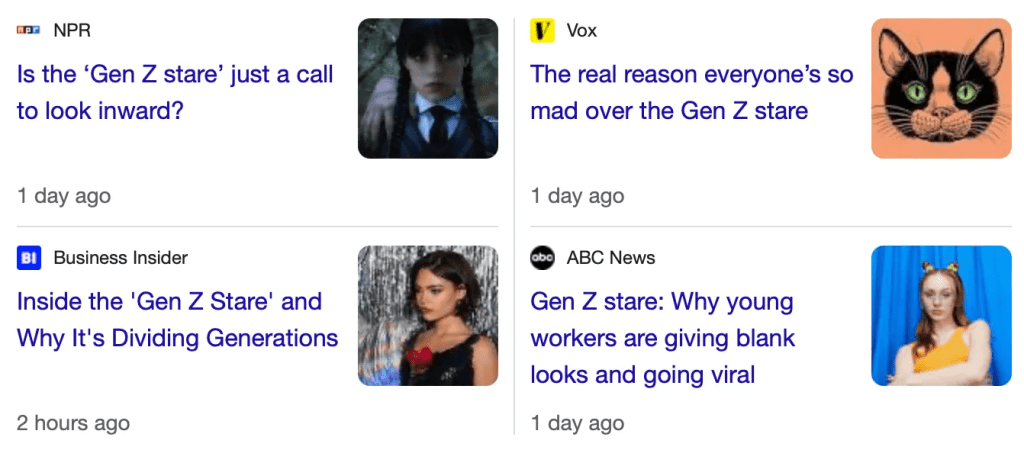
In the past week, there’s been robust discourse in legacy media about the so-called ‘Gen Z Stare’ and the bursts of generational conflict it reportedly captures.
It’s gotten write-ups by The New York Times, The Washington Post, USA Today, The Boston Globe, NBC News, ABC News, CNBC, Newsweek, Indy100, Axios, Fortune, Vox, Vice, Business Insider, The Independent, Forbes, Buzzfeed, Slate, HuffPost, Glamour, People, and Marie Claire, among others.
As a millennial, I am apparently urged to be concerned about this phenomenon of Gen Z folks supposedly failing to appropriately interact with me through sufficiently pleasant facial expressions, so I thought it might be helpful to offer my thoughts:
The sitting president of the United States is currently covering up a massive sex trafficking operation that targeted children and likely implicates a number of powerful people who are currently out in the world and free to continue preying on children.
The sitting president of the United States just successfully pressured Paramount and CBS to cancel the #1 late-night talk show on broadcast television as part of what appears to be a blatant bribery deal because the host has been critical of him.
The sitting president of the United States just got the extremist Republican majority in Congress to strip 11 million Americans of health care coverage by the end of 2026 and upwards of 17 million Americans when you account for new federal work requirements. (snip-MORE; it’s succinct and quick, and it’s all good facts for grocery/other places lines, for discussion.)
July 21, 1878 Publication of “Eight Hours,” written by Reverend Jesse H. Jones (music) and I.G. Blanchard (lyrics), the most popular labor song until “Solidarity Forever” was published by the IWW (Industrial Workers of the World) in 1915. “Eight hours for work, Eight hours for rest; Eight hours for what we will.” All the lyrics (The eight-hour was an established concept before the song.)
July 21, 1925 The so-called “Monkey Trial” ended in Dayton, Tennessee, with high school teacher John T. Scopes convicted of violating a state law against teaching Darwin’s theory of evolution. It was considered illegal to contradict the Bible’s description of God’s seven-day creation of the world in Genesis. The trial pitted two of America’s leading advocates as the opposing lawyers: William Jennings Bryan, thrice the Democratic presidential candidate (1896, 1900, 1908) and the state’s prosecutor; Clarence Darrow, a lawyer famous for representing the underdog, at the defense table. Referred to as “the trial of the century” even before it began, it was the first trial ever broadcast (on radio). Bryan became ill and died shortly after the trial’s end; the conviction was later overturned by Tennessee’s Supreme Court. The Defendant John T. Scopes The Attorneys: Darrow & Bryan/ The Verdict: Thou Shall Not Think Interest in the trial by the populace and the media (and the heat in the courtroom) prompted Judge John T. Raulston to move the trial outdoors to the courthouse lawn. Bryan himself was called as a witness on the literal interpretation of scripture. Attorney General Thomas Stewart, in response to Darrow’s questioning, asked, “What is the meaning of this harangue?” “To show up fundamentalism,” shouted Mr. Darrow, “to prevent bigots and ignoramuses from controlling the educational system of the United States.” Mr. Bryan sprang to his feet, his face purple, and shook his fist in Darrow’s face: “To protect the word of God from the greatest atheist and agnostic in the United States.” ACLU History: The Scopes ‘Monkey Trial’ More about the Monkey Trial
July 21, 1954 Major world powers, meeting in Geneva, Switzerland, reached agreement on the terms of a ceasefire for Indochina, ending nearly eight years of war. The war began in 1946 between nationalist forces of the Communist Viet Minh, under leader Ho Chi Minh, and France, the occupying colonial power after the Japanese lost control during World War II. The Geneva conference included France, the United Kingdom, the U.S., the U.S.S.R., People’s Republic of China, Cambodia, Laos, and both Vietnamese governments (North and South). The peace treaty called for independence for Vietnam and a 1956 election to unify the country. However, only France and Ho Chi Minh’s DRV (Democratic Republic of Vietnam (North)) signed the document. The United States did not approve of the agreement. Instead, they backed Emperor Boa Dai and Prime Minister Ngo Dinh Diem’s government in South Vietnam and refused to allow the elections, knowing, in President Eisenhower’s words, that “Ho Chi Minh will win.” The result was the Second Indochina War, more commonly known as the Vietnam War. The treaty is signed
July 21, 1976 Plaza de Mayo mother A military junta under General Jorge Rafael Videla took power in Argentina on March 24, disbanding parliament and taking over all labor unions. The military kidnapped hundreds of people from two villages of Jujuy province in northern Argentina, thirty of whom never returned from a clandestine detention center. Most of those disappeared worked for the Ledesma sugar refinery. Since 1983, on the Thursday closest to July 21, Madres de Plaza de Mayo (an organization of mothers and wives of the missing) are joined by others, and walk the 7 km (4.3 miles) from Calilegua to San Martin, demanding answers about their loved ones. Madres de Plaza de Mayo is supported by Amnesty International and the United Nations Human Rights Commission. Read more