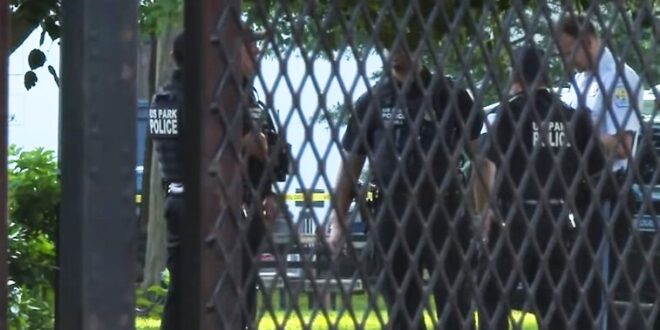
Mayor Muriel Bowser addressed the closure for the first time in a public radio appearance Friday afternoon. She called the closing an “unfortunate error” and said she would “continue to try to lean on” the National Park Service “for a different decision.” At the same time she appeared to defend the decision, saying police had “a lot of events to be responsible for” and that “unfortunately, the public safety issue rose to the top over the public celebration.”
A cyclist draped in a rainbow Equality flag chanted “shame” as she rode loops around the park. Passersby, turned away by police from entering the circle, shouted expletives. A man, driving top-down in a convertible through the snarled traffic around Dupont Circle, shouted, sarcastically: “Oh no! I’m a heterosexual man, and I must be protected from Pride!
The park has been a historic gathering place that has hosted celebrations following the first Pride events in the 1970s, AIDS protests in the ’80s and ’90s and vigils after violent attacks on the LGBTQ community, including a vigil for the victims of the 2016 Pulse nightclub shooting and a Black Trans Lives Matter rally.
Earlier this week, D.C. Council members Brooke Pinto and Zachary Parker announced that the Metropolitan Police Department had withdrawn its request to close the park following backlash from community members. But federal officials proceeded with the shutdown anyway and have not responded to requests for comment.
“I am extremely disappointed and frustrated that Dupont Circle Park will be closed this weekend despite MPD’s commitment to keep folks safe there,” Pinto said in a statement to The Advocate.
“This closure is disheartening to me and so many in our community who wanted to celebrate World Pride at this iconic symbol of our city’s historic LGBTQ+ community. I wish I had better news to share.”
Underscoring their desire to implement the closure, USPP highlighted criminal incidents that were initially pointed out in Smith’s April 22 letter. Those incidents, which took place during the District’s Pride celebration, included damages to the park’s historic fountain in 2023 that amounted to approximately $175,000.
In 2019, panic erupted at the park after loud popping sounds were perceived as gunshots being fired. However, it was later determined no firearm had been discharged. Seven people were transported to the hospital for non-life-threatening injuries prompted by the chaos that had initially broken out.
Police responded to recent incidents of vandalism to Pride decorations in D.C. The suspects tore down rainbow wraps from poles in the area, according to two incident reports from the Metropolitan Police Department (MPD). One incident is listed as a suspected hate crime. The suspects got away in both cases, according to MPD.
Chris De Anda said he wrapped himself around one of the poles to block the suspect from ripping off the rainbow wrap, thinking that would stop him. It didn’t.
“He starts to rip down the flag, rips my arms off trying to get into them to pull down the paper a little bit more, but the entire time I basically hold on to it,” de Anda described, saying the man scratched his arms a bit to get to the flag.
The lawless, corrupt occupation regime in DC is doing this on purpose as a way to inconvenience, snub and insult the lgbt community. Their long term goal is to silence, cancel and eradicate lgbt Americans, so expect increasing instances of these kinds of things, and worse.
So…a bunch of bigots have been vandalizing things in Dupont Circle, so they close it all off so the people who AREN’T the bigoted vandals can’t go there? Kinda sounds like they’re letting the bigots win here…
Childish petty thin skinned MAGA cultists in the White House just can’t let anyone celebrate anything that isn’t specifically a “Christian” event. I wonder what would happen in Thousands just show up to DuPont Circle enmass, what are they going to do, arrest them all???
First you know this man was threatened all the way back to the US that his family would be rounded up and tortured if he told of what happened to him in that prison. I wonder if they had to wait until injuries healed before they could let the public see him? Ron says they maybe starved him and had to feed him again to build up his weight and looks. Poor man I hope he is able to safely get his story out. It is clear the charges against him are fraudulent and made up. Just like the government kept saying he was an MS 13 gang member which two courts found he was not. Also he was living in Maryland and his court case is being heard in DC so why is the Justice department trying his new charges in Tennessee? Why not add the charges to the case being heard now in DC. Clearly they hope to get a much more conservative and racist court there than they would in the northern states. I am surprised they did not charge him in Texas. Hugs.
Mistakenly deported Salvadoran native Kilmar Abrego Garcia appeared in a Tennessee courtroom Friday, hours after he was brought back to the United States to face criminal charges for allegedly transporting undocumented migrants within the U.S.
More than two months after the Trump administration admitted it mistakenly deported Abrego Garcia from Maryland to his native El Salvador, a two-count indictment unsealed Friday alleges that he participated in a years long conspiracy to haul undocumented migrants from Texas to the interior of the country.
The return of Abrego Garcia from his native El Salvador follows a series of court battles in which the Trump administration repeatedly said it was unable to bring him back, drawing the country toward the brink of a constitutional crisis when the administration failed to heed the Supreme Court’s order to facilitate his return.
MORE: Justice Department investigating 2022 Abrego Garcia traffic stop: Sources
He made his initial court appearance Friday evening in the Middle District of Tennessee, answering “Yes, I understand” in Spanish when U.S. Magistrate Judge Barbara Holmes asked him if he understood the charges against him.
Judge Homes set a hearing for June 13, where Abrego Garcia will be arraigned on charges and the judge will take up the government’s motion to hold him in pre-trial detention on the grounds that he “poses a danger to the community and a serious risk of flight” He will remain in federal custody in Tennessee pending next week’s hearing.
“If convicted at trial, the defendant faces a maximum punishment of 10 years’ imprisonment for ‘each alien’ he transported,” said the government’s motion for detention, which also contained an allegation — not included in the indictment — that one of Abrego Garcia’s co-conspirators told authorities that Abrego Garcia participated in the murder of a rival gang member’s mother in El Salvador.
Abrego Garcia’s attorney, in an online press briefing, called the charges against his client “an abuse of power.”
Kilmar Abrego Garcia is placed in the back seat of a truck by ICE agents after arriving in Nashville, Tenn., June 6, 2025.
ABC News
“They’ll stop at nothing at all — even some of the most preposterous charges imaginable — just to avoid admitting that they made a mistake, which is what everyone knows happened in this case,” said attorney Simon Sandoval-Moshenberg.
“Mr. Garcia is going to be vigorously defending the charges against him,” the attorney said.
The decision to pursue the indictment against Abrego Garcia led to the abrupt departure of Ben Schrader, a high-ranking federal prosecutor in Tennessee, sources briefed on Schrader’s decision told ABC News. Schrader’s resignation was prompted by concerns that the case was being pursued for political reasons, the sources said.
Schrader, who spent 15 years in the U.S. Attorney’s Office in Nashville and was most recently the chief of the criminal division, declined to comment when contacted by ABC News.
The alleged conspiracy spanned nearly a decade and involved the domestic transport of thousands of noncitizens from Mexico and Central America, including some children, in exchange for thousands of dollars, according to the indictment.
Abrego Garcia is alleged to have participated in more than 100 such trips, according to the indictment. Among those allegedly transported were members of the Salvadoran gang MS-13, sources familiar with the investigation said.
MORE: Timeline: Wrongful deportation of Kilmar Abrego Garcia to El Salvador
Abrego Garcia is the only member of the alleged conspiracy charged in the indictment.
Attorney General Pam Bondi, at a Friday afternoon press conference, thanked Salvadoran President Nayib Bukele for “agreeing to return Abrego Garcia to the United States.”
“Our government presented El Salvador with an arrest warrant and they agreed to return him to our country,” Bondi said.
Bondi said that if Abrego Garcia is convicted of the charges, upon the completion of his sentence he will be deported back to his home country of El Salvador.
“The grand jury found that over the past nine years, Abrego Garcia has played a significant role in an alien smuggling ring,” Bondi said. “They found this was his full time job, not a contractor. He was a smuggler of humans and children and women. He made over 100 trips, the grand jury found, smuggling people throughout our country.”
Attorney General Pam Bondi speaks as Deputy Attorney General Todd Blanche listens during a news conference about Kilmar Abrego Garcia at the Justice Department, June 6, 2025, in Washington.
Julia Demaree Nikhinson/AP
In a statement to ABC News, Abrego Garcia’s attorney said that he’s going to keep fighting to ensure Abrego Garcia receives a fair trial.
“From the beginning, this case has made one thing painfully clear: The government had the power to bring him back at any time. Instead, they chose to play games with the court and with a man’s life,” Sandoval-Moshenberg said. “We’re not just fighting for Kilmar — we’re fighting to ensure due process rights are protected for everyone. Because tomorrow, this could be any one of us — if we let power go unchecked, if we ignore our Constitution.”
Abrego Garcia, a Salvadoran native who had been living with his wife and children in Maryland, was deported in March to El Salvador’s CECOT mega-prison — despite a 2019 court order barring his deportation to that country due to fear of persecution — after the Trump administration claimed he was a member of the criminal gang MS-13. His wife and attorneys deny that he is an MS-13 member.
The Trump administration has acknowledged in court filings that Abrego Garcia’s removal to El Salvador in March was in error, because it violated a U.S. immigration court order in 2019 that shielded Abrego Garcia from deportation to his native country, according to immigration court records. An immigration judge had determined that Abrego Garcia would likely face persecution there by local gangs that had allegedly terrorized him and his family.
The administration argued, however, that Abrego Garcia should not be returned to the U.S. because he is a member of the transnational Salvadoran gang MS-13, a claim his family and attorneys have denied. In recent weeks, Trump administration officials have been publicizing Abrego Garcia’s interactions with police over the years, despite a lack of corresponding criminal charges.
After Abrego Garcia’s family filed a lawsuit over his deportation, U.S. District Judge Paula Xinis in Maryland ordered the Trump administration to facilitate his return to the United States. The U.S. Supreme Court affirmed that ruling on April 10.
Abrego Garcia was initially sent to El Salvador’s notorious CECOT prison but was believed to have later been transferred to a different facility in the country.
The criminal investigation that led to the charges was launched in April as federal authorities began scrutinizing the circumstances of a 2022 traffic stop of Abrego Garcia by the Tennessee Highway Patrol, according to the sources. Abrego Garcia was pulled over for speeding in a vehicle with eight passengers and told police they had been working construction in Missouri.
According to body camera footage of the 2022 traffic stop, the Tennessee troopers — after questioning Abrego Garcia — discussed among themselves their suspicions that Abrego Garcia might be transporting people for money because nine people were traveling without luggage, but Abrego Garcia was not ticketed or charged.
The officers ultimately allowed Abrego Garcia to drive on with just a warning about an expired driver’s license, according to a report about the stop released last month by the U.S. Department of Homeland Security.
Asked what circumstances have changed since Abrego Garcia was not taken in custody during that traffic stop in Tennessee, Bondi replied, “What has changed is Donald Trump is now president of the United States, and our borders are again secure, and thanks to the bright light that has been shined on Abrego Garcia — this investigation continued with actually amazing police work, and we were able to track this case and stop this international smuggling ring from continuing.”
Asked by ABC News’ Pierre Thomas asked whether this should be seen as resolving the separate civil case in Maryland in which a federal judge ordered the government to facilitate Abrego Garcia’s return, Deputy Attorney General Todd Blanche said, “There’s a big difference between what the state of play was before the indictment and after the indictment. And so the reason why he is back and was returned was because an arrest warrant which was presented to the government and in El Salvador. So there’s, there’s a big difference there as far as whether it makes the ongoing litigation in Maryland moot. I would think so, but we don’t know about this. He just landed today.”
As ABC News first reported last month, the Justice Department had been quietly investigating the Tenessee traffic stop. As part of the probe, federal agents in late April visited a federal prison in Talladega, Alabama to question Jose Ramon Hernandez-Reyes, a convicted felon who was the registered owner of the vehicle Abrego Garcia was driving when stopped on Interstate 40 east of Nashville, sources previously told ABC News. Hernandez-Reyes was not present at the traffic stop.
MORE: Newly released video shows Abrego Garcia’s 2022 Tennessee traffic stop
Hernandez-Reyes, 38, is currently serving a 30-month sentence for illegally re-entering the U.S. after a prior felony conviction for illegal transportation of aliens.
After being granted limited immunity, Hernandez-Reyes allegedly told investigators that he previously operated a “taxi service” based in Baltimore. He claimed to have met Abrego Garcia around 2015 and claimed to have hired him on multiple occasions to transport undocumented migrants from Texas to various locations in the United States, sources told ABC News.
When details of the Tennessee traffic stop were first publicized, Abrego Garcia’s wife said her husband sometimes transported groups of fellow construction workers between job sites.
“Unfortunately, Kilmar is currently imprisoned without contact with the outside world, which means he cannot respond to the claims,” Jennifer Vasquez Sura said in mid-April.
Sen. Chris Van Hollen of Maryland, who flew to El Salvador and met with Abrego Garcia shortly after his deportation, said Friday that the Trump administration had “relented” regarding his return.
“After months of ignoring our Constitution, it seems the Trump Admin has relented to our demands for compliance with court orders and due process for Kilmar Abrego Garcia,” Van Hollen posted on X. “This has never been about the man — it’s about his constitutional rights & the rights of all.”
Abrego Garcia entered the U.S. illegally as a teenager in 2012, according to court records. He had been living in Maryland for the past 13 years, and married Vasquez Sura, a U.S. citizen, in 2019. The couple has one child together.
ABC News’ Laura Romero contributed to this report.
June 3, 1900 The International Ladies’ Garment Workers Union (ILGWU), a consolidation of seven smaller east coast needle trades unions, was founded. Read more Herman Grossman, ILGWU president
June 3, 1946 In Irene Morgan v. Virginia, the U.S. Supreme Court ruled that racial segregation in interstate travel was unconstitutional as “an undue burden on commerce.” The southern states refused to enforce it, however, and Jim Crow (the term for laws, local and state, that enforced segregation) continued as the way of life in the South. Eleven years before Rosa Parks refused to give up her seat on a city bus in Montgomery, Alabama, a young woman named Irene Morgan rejected that same demand on an interstate bus headed to Maryland from Gloucester, Virginia. Read more about Irene Morgan Recovering from surgery and already sitting far in the back, she defied the driver’s order to surrender her seat to a white couple. Like Parks, Morgan was arrested and jailed. But her action caught the attention of lawyers from the NAACP, led by (future Supreme Court justice) Thurgood Marshall, and two years later her case reached the Court. Headlines when Irene Morgan won out over Jim Crow (JC) segregation law
June 3, 1957 Thousands of scientists, led by Barry Commoner and Nobel laureate Linus Pauling, issued a call for banning nuclear weapons testing: “As scientists we have knowledge of the dangers involved and therefore a special responsibility to make those dangers known.” “…Then on May 15, 1957, with the help of some of the scientists in Washington University, St. Louis, I wrote the Scientists’ Bomb Test Appeal, which within two weeks was signed by over two thousand American scientists and within a few months by 11,021 scientists, of forty-nine countries….” –Linus Pauling Linus Pauling at a disarmament demonstration photo: Robert Carl Cohen
June 3, 1964 Conscientious objection, the refusal to bear arms in time of war on the grounds of moral or religious principles, became legally recognized in Belgium. A history of European conscientious objection