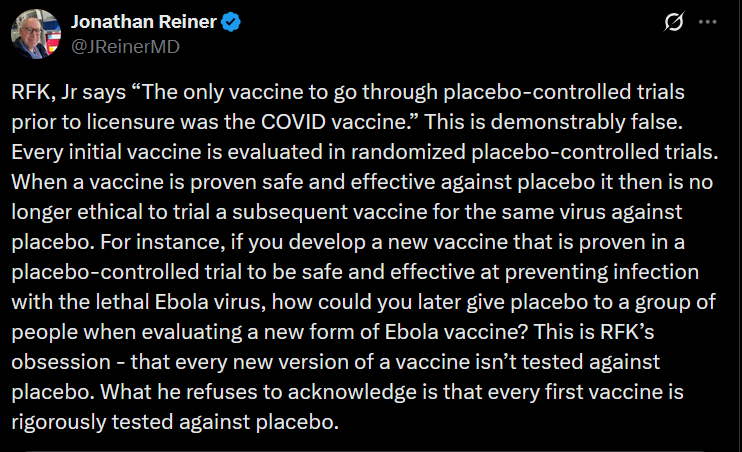
Kennedy, a longtime vaccine skeptic, ousted the 17-member Advisory Committee on Immunization Practices (ACIP) earlier this week in a stunning move that shocked medical experts. He defended his action in an interview with Fox News’ Martha MacCallum, claiming that “97% of the people on the committee had conflicts of interest.”
He repeated falsehoods about vaccines that were immediately fact checked by doctors on social media platform X. He falsely claimed there were between 69 and 92 mandatory vaccines in the U.S. today and that most of the vaccines, excluding the COVID-19 vaccine, had not gone through safety tests.
“So nobody has any idea what the risk profiles are on these products, and we don’t know whether they have anything to do with the epidemic of chronic disease,” Kennedy said, presenting no evidence for his claims.
Following records requests from The Post, officials paused the first known, widespread live facial recognition program used by police in the United States.
A Project NOLA security camera keeps watch over the corner of Conti and Burgundy streets in New Orleans on May 8. (Edmund D. Fountain/For The Washington Post)
NEW ORLEANS — For two years, New Orleans police secretly relied on facial recognition technology to scan city streets in search of suspects, a surveillance method without a known precedent in any major American city that may violate municipal guardrails around use of the technology, an investigation by The Washington Post has found.
Police increasingly use facial recognition software to identify unknown culprits from still images, usually taken by surveillance cameras at or near the scene of a crime. New Orleans police took this technology a step further, utilizing a private network of more than 200 facial recognition cameras to watch over the streets, constantly monitoring for wanted suspects and automatically pinging officers’ mobile phones through an app to convey the names and current locations of possible matches.
This appears out of step with a 2022 city council ordinance, which limited police to using facial recognition only for searches of specific suspects in their investigations of violent crimes and never as a more generalized “surveillance tool” for tracking people in public places. Each time police want to scan a face, the ordinance requires them to send a still image to trained examiners at a state facility and later provide details about these scans in reports to the city council — guardrails meant to protect the public’s privacy and prevent software errors from leading to wrongful arrests.
Since early 2023, the network of facial recognition cameras hasplayed a role in dozens of arrests, including at least four people who were only charged with nonviolent crimes, according to police reports, court records and social media postsby Project NOLA, a crime preventionnonprofit company that buys and manages many of the cameras. Officers did not disclose their reliance on facial recognition matches in police reports for most of the arrests for which the policeprovideddetailed records, and none of the cases were included in the department’s mandatory reports to the city council on its use of the technology. Project NOLA has no formal contract with the city, but has been working directly with police officers.
“This is the facial recognition technology nightmare scenario that we have been worried about,” said Nathan Freed Wessler, a deputy director with the ACLU’s Speech, Privacy, and Technology Project, who has closely tracked the use of AI technologies by police. “This is the government giving itself the power to track anyone — for that matter, everyone — as we go about our lives walking around in public.”
New Orleans Police Superintendent Anne Kirkpatrick during an interview this month. (Edmund D. Fountain/For The Washington Post)
Anne Kirkpatrick, who heads the New Orleans Police Department, paused the program in early April, she said in an interview, after a captain identified the alerts as a potential problem during a review. In an April 8 email reviewed by The Post, Kirkpatrick told Project NOLA that the automated alerts must be turned off until she is “sure that the use of the app meets all the requirements of the law and policies.” The Post began requesting public records about the alerts in February.
The police department “does not own, rely on, manage, or condone the use by members of the department of any artificial intelligence systems associated with the vast network of Project Nola crime cameras,” Reese Harper, a spokesman for the agency, said in an emailed statement.
Police across the country rely on facial recognition software, which uses artificial intelligence to quickly map the physical features of a face in one image and compare it to the faces in huge databases of images — usually drawn from mug shots, driver’s licenses or photos on social media — looking for possible matches. New Orleans’s use of automated facial recognition has not been previously reported and is the first known widespread effort by police in a major U.S. city to use AI to identify people in live camera feeds for the purpose of making immediate arrests, Wessler said.
The Post has reported that some police agencies use AI-powered facial recognition software in violation of local laws, discarding traditional investigative standards and putting innocent people at risk. Police at times arrested suspects based on AI matches without independent evidence connecting them to the crime, raising the chances of a false arrest. Often, police failed to inform defendants about their use of facial recognition software, denying them the opportunity to contest the results of a technology that has been shown to be less reliable for people of color, women and older people.
A facial recognition system deployed by police in London’s Oxford Circus on May 13. London is one of the few places where live facial recognition is known to be in wide use. (Leon Neal/Getty Images)
One of the few places where live facial recognition is known to be in wide use is London, where police park vans outside of high-traffic areas and use facial recognition-equipped cameras to scan the faces of passersby, and confront people deemed a match to those on a watch list. While the city says the program has never led to a false arrest since launching in 2016, Big Brother Watch, a London-based civil liberties group, argues that the practice treats everyone as a potential suspect, putting the onus on the people who were falsely matched to prove their innocence.
Real-time alerts
The surveillance program in New Orleans relied on Project NOLA, a private group run by a former police officer who assembled a network of cameras outside of businesses in crime-heavy areasincluding the city’s French Quarter district.
Project NOLA configured the cameras to search for people on a list of wanted suspects. When the software determined it had found a match, it sent real-time alerts via an app some officers installed on their mobile phones. The officers would then quickly research the subject, go to the location and attempt to make arrests.
Police did not set up the program nor can they directly search for specific people, or add or remove people from the camera system’s watch list,according to Bryan Lagarde, Project NOLA’s founder.
Little about this arrangement resembles the process described in the city council ordinance from three years ago, which imagined detectives using facial recognition software only as part of methodical investigations with careful oversight. Each time police want to scan a face, the ordinance requires them to send a still image to a state-run “fusion center” in Baton Rouge, where various law enforcement agencies collaborate on investigations. There, examiners trained in identifying faces use AI software to compare the image with a database of photos and only return a “match” if at least two examiners agree.
Investigators have complained that process takes too long and often doesn’t result in any matches, according to a federally mandated audit of the department in 2023. It has only proved useful in a single case that led to an arrest since October 2022, according to records police provided to the city council.
A surveillance camera mounted to the underside of a balcony on Bourbon Street in New Orleans. (Edmund D. Fountain/For The Washington Post)
Freddie King, a New Orleans council member who represents the district that includes the French Quarter, voted in support of a 2022 ordinance that authorized police to use facial recognition as long as they adhered to certain guardrails. (Edmund D. Fountain/For The Washington Post)
By contrast, Project NOLA claims its facial recognition cameras played a role in at least 34 arrests since they were activated in early 2023, according to the group’s Facebook posts — a number that cannot be verified because the city does not track such data and the nonprofit does not publish a full accounting of its cases. Without a list of the cases, it’s impossible to know whether any of the people were misidentified or what additional steps the officers took to confirm their involvement in the crimes.
Kirkpatrick said her agency has launched a formal review into how many officers used the real-time alerts, how many people were arrested as a result, how often the matches appear to have been wrong and whether these uses violated the city ordinance.
“We’re going to do what the ordinance says and the policies say, and if we find that we’re outside of those things, we’re going to stop it, correct it and get within the boundaries of the ordinance,” she said.
There are no federal regulations around the use of AI by local law enforcement. Four states — Maryland, Montana, Vermont and Virginia — as well as at least 19 cities in nine other states explicitly bar their own police from using facial recognition for live, automated or real-time identification or tracking, according to the Security Industry Association, a trade group.
Lawmakers in these places cited concerns in public meetings that the technology could infringe on people’s constitutional rights or lead police to make mistakes when they rush to arrest a potential suspect before taking steps to confirm their connection to the crime, as many people look alike. At least eight Americans have been wrongfully arrested due to facial recognition, The Post and others have reported.
The unsanctioned surveillance program in New Orleans highlights the challenge of regulating a technology that is widely available, at a time when some police see AI as an invaluable crime fighting tool. Even in some places where officials have banned facial recognition, including Austin and San Francisco, officers skirted the bans by covertly asking officers from neighboring towns to run AI searches on their behalf, The Post reported last year.
Violent crime rates in New Orleans, like much of the country, are at historic lows, according to Jeff Asher, a consultant who tracks crime statistics in the region. But city officials have seized on recent instances of violent crime to argue that police need the most powerful tools at their disposal.
Last month, an independent report commissioned after the New Year’s Day attack that left 14 people dead on Bourbon Street found the New Orleans police to be understaffed and underprepared. The report, overseen by former New York City police commissioner William Bratton, advised New Orleans to explore adopting several new tools, including drones, threat prediction systems and upgrades to the city’s real-time crime center — but did not recommend adding any form of facial recognition.
Kirkpatrick, the city’s top police official, and Jason Williams, its top prosecutor, both said they are in discussions with the city council to revise the facial recognition ordinance. Kirkpatrick says she supports the idea of the city legally operating its own live facial recognition program, without the involvement of Project NOLA and with certain boundaries, such as prohibiting use of the technology to identify people at a protest.
“Can you have the technology without violating and surveilling?” she asked. “Yes, you can. And that’s what we’re advocating for.”
5,000 cameras
Few people have as much visibility into the everyday lives of New Orleans residents as Lagarde, a former patrol officer and investigator who started his own video surveillance business in the late 1990s before launching Project NOLA in 2009.
Funded by donations and reliant on businesses that agree to host the cameras on their buildings or connect existing surveillance cameras toits centralized network,Lagarde saidProject NOLA has access to 5,000 crime cameras across New Orleans, most of which are not equipped with facial recognition. The cameras all feed into a single control room in a leased office space on the University of New Orleans campus, Lagarde said in an interview at the facility. Some camera feeds are also monitored by federal, state and local law enforcement agencies, he said.
Bryan Lagarde, who founded Project NOLA in 2009, in a real-time video monitoring room at the University of New Orleans in 2017. (Max Becherer/The Advocate)
Project NOLA made $806,724 in revenue in 2023, tax filings show. Much of it came from “cloud fees” the group charges local governments outside of New Orleans — from Monticello, Florida, to Frederick, Colorado — which install Project NOLA cameras across their own towns and rely onLagarde’s assistance monitoring crime. He’s experimented with facial recognition in Mississippi, he said, but his “first instance of doing citywide facial recognition is New Orleans.” New Orleans does not pay Project NOLA.
For more than a decade,Lagarde used standard cameras outside businesses to monitor crime and offer surveillance clips for officers to use in their investigations. Lagarde’s cameras became so widespread that police began calling him when they spotted a Project NOLA camera hovering near a crime scene they were investigating, according to police incident reports, interviews with police and emails obtained through a public records request.
Lagarde began adding facial recognition cameras to his network in early 2023, after an $87,000 bequest from a local woman. Lagarde used the money to buy a batch of cameras capable of detecting people from about 700 feet away and automatically matching them to the facial features, physical characteristics and even the clothing of people in a database of names and faces he has compiled.
Lagarde says he built his database partly from mug shots from local law enforcement agencies.It includes more than 30,000 “local suspected and known criminals,” Project NOLA wrote on Facebook in 2023. Lagarde can quickly identify anyone in the database the moment they step in front of a Project NOLA camera, he said. He can also enter a name or image to pull up all the video clips of that person Project NOLA captured within the last 30 days, after which Lagarde says videos get automatically deleted“for privacy reasons.”
Project NOLA found enthusiastic partners in local business owners, some of who were fed up with what they saw as the city’s inability to curb crime in the French Quarter — the engine of its tourism economy that’s also a hub for drug dealers and thieves who prey on tourists, said Tim Blake, the owner of Three Legged Dog, a bar that was one of the first places to host one of Project NOLA’s facial recognition cameras.
“Project NOLA would not exist if the government had done its job,” Blake said.
Tim Blake’s bar, the Three Legged Dog, was one of the first places to host a Project NOLA camera. (Edmund D. Fountain/For The Washington Post)
While Lagarde sometimes appears alongside city officials at news conferences announcing prominent arrests, he is not a New Orleans government employee or contractor. Therefore, Lagarde and the organization are not required to share information about facial recognition matches that could be critical evidence in the courtroom, said Danny Engelberg, the chief public defender for New Orleans.
“When you make this a private entity, all those guardrails that are supposed to be in place for law enforcement and prosecution are no longer there, and we don’t have the tools to do what we do, which is hold people accountable,” he said.
Lagarde says he tries to be transparent by posting about some of his successful matches on Facebook, though he acknowledges that he only posts a small fraction of them and says it would be “irresponsible” to post information about open investigations. Project NOLA, he added,is accountable to the businesses and private individuals who host the cameras and voluntarily opt to share their feeds with the network.
“It’s a system that can be turned off as easily as it’s been turned on,” he said. “Were we to ever violate public trust, people can individually turn these cameras off.”
Banned devices
Lagarde declined to say who makes the equipment he uses, saying he doesn’t want to endorse any company.
Several Project NOLA cameras in the French Quarter look nearly identical to ones on the website of Dahua, a Chinese camera maker, and product codes stamped on the backs of these devices correspond to an identical camera sold by Plainview, New York-based equipment retailer ENS Security, which has acknowledged reselling Dahua cameras in the past. Project NOLA’s website also contains a link to download an app where police officers can view and manage footage. The app, called DSS, is made by Dahua.
Congress banned federal agencies from using products or services made by Dahua and a list of other Chinese companies in 2018, citing concerns that the equipment could be used by President Xi Jinping’s government to spy on Americans. Since 2020, the law has barred any agency or contractor that receives federal funds from using those funds on the banned products.
“This technology requires accountability,” said Stella Cziment, a lawyer who heads a watchdog agency overseeing the practices of the New Orleans Police Department. “I am never going to be satisfied with the accountability it receives if it’s in a private entity’s hands.” (Edmund D. Fountain/For The Washington Post)
A Project NOLA security camera mounted to the Hotel Monteleone. (Edmund D. Fountain/For The Washington Post)
A Dahua spokesperson declined to comment on the New Orleans cameras and said the company stopped selling equipment in the U.S. last year.
The New Orleans Police Department has received tens of millions of dollars from the federal government in recent years and confirmed that someofficers have installed this DSS app on mobile phones and police workstations. Kirkpatrick said she was not aware of who made the app or cameras but would look into it.
Lagarde said Project NOLA uses “American-made, brand-name servers to operate our camera program.”
Some city officials argue that police are not violating the city’s facial recognition ordinance because they do not own the cameras or contract with Lagarde; they are merely receiving tips from an outside group that is performing facial recognition scans on its own.
“If Bryan Lagarde calls an officer and says ‘I think a crime is occurring on the 1800 Block of Bienville,’ that’s no different than Miss Johnson looking out of her window and saying ‘I think a crime is occurring on 1850 Bienville,’” Williams, the Orleans Parish district attorney, said in an interview.
But in many cases, police have gone to Lagarde to request footage or help identifying and locating suspects, according to police reports, Project NOLA social media posts and internal police emails.
Tracking a suspect
In one case last year, a police detective investigating a snatched cellphone relied on Project NOLA to identify the perpetrator and track him down using facial recognition alerts, according to accounts of the investigation drawn partly from the police incident report and partly from Project NOLA’s Facebook post.
The detective contacted Lagarde “to assist locating the perpetrator on Project NOLA cameras,” according to the police report, providing still shots taken from the city’s surveillance camera footage. Lagarde used Project NOLA’s clothing recognition tool to find previous video footage of a suspect. With the new, better images of his face, Project NOLA used facial recognition to learn his possible identity and share that with the detective.
The detective took that name and found photos of a man on social media whose appearance and tattoos matched the phone-snatcher. Police got a warrant for his arrest. Lagarde added that name and face to Project NOLA’s watch list, and a few days later, cameras automatically identified him in the French Quarter and alerted police, who found and arrested him. The man was charged with robbery but pleaded guilty to the lesser offense of theft, court records show.
The police report mentioned that Lagarde helped identify the suspect, but did not mention that he used facial recognition to do so or used live facial recognition and automated alerts to monitor for and locate him.
New Orleans Police Sgt. David Barnes. (Edmund D. Fountain/For The Washington Post)
David Barnes, a New Orleans police sergeant overseeing legal research and planning, said officers are trained toalways find probable cause before making an arrest. He said Lagarde sometimes overstates in Facebook posts the role his technology played in some of the cases. He said the detective investigating the phone-snatching case was only asking Lagarde to find videos of the suspect, not the location of the suspect.
On a rainy May morning outside the Three Legged Dog, a Project NOLA camera swiveled about, blinking red and blue lights, and twitching side to side as it followed cars and people based on an automated program. The camera is no longer pinging the police on an app — at Kirkpatrick’s request.
“Like you and everybody else, I do not want to lose any cases of violent criminals based on policy violations or violations of our ordinances,” Kirkpatrick said in her email last month to Lagarde.
But the alerts still go to Project NOLA staff, who Lagarde said convey the location of wanted suspects to the police via phone calls, texts and emails.
Schaffer reported from Washington. Nate Jones and Jeremy Merrill contributed to this report.
A representative of Seattle Sperm Bank admitted to selling unused sperm vials to the FBI during an industry conference, purportedly for the agency to research splat patterns, multiple sources told LGBTQ Nation.
The sources say the admission came from the representative – who one source identified as Seattle Sperm Bank General Supervisor Angelo Allard – during an October 2022 meeting at the California Cryobank campus in Los Angeles. Allard did not reply to LGBTQ Nation’s multiple requests for comment, nor did Seattle Sperm Bank CEO Fredrik Andreasson, nor the bank’s communication team.
For decades, commercial sperm banks (on which many LGBTQ+ people rely to build their families) have faced ardent criticism over a host of ethical issues fueled by a lack of industry regulations. Donor-conceived people, recipient parents, and donors themselves have long sounded the alarm on the industry’s shady practices – from failing to enforce reasonable family limits to outright lying about donor medical histories. These activists continue to fight for legislation that would keep the banks in check.
This ongoing tension is why the 2022 meeting occurred in the first place. Sources say sperm banks hosted the gathering as a sort of olive branch to the reform advocates, though some who attended felt the banks were not actually willing to listen. Reportedly in attendance were lawyers, medical experts, activists, and scholars.
Although these activists have long known about the unethical practices of the industry, many were still shocked at what they heard.
Anti-fertility fraud activist Eve Wiley called it a “nails on a chalkboard moment” and said that the admission brought “a collective gasp in the room.” It was “unlike any other procedure any of us had heard,” she said.
She said the comment was skated over pretty quickly and that the man next to the speaker “was kind of like, ‘Dude, stop,’ giving, you know, the death stare essentially.”
A fertility expert who was also present in the room confirmed the story to LGBTQ Nation, saying they are “not sure what precipitated it” but that a “gentleman who was involved at a sperm bank raised his hand and basically said they sent sperm to the FBI at the request of the FBI for training purposes.”
“On one level it makes sense, you know, that you would need sperm to train on or to do some analysis of,” they said, “but I guess none of us had ever considered that law enforcement might reach a sperm bank and do this, certainly without consent from the parties themselves who could be genetically identified and put into a database if this were done.”
They said the representative seemed completely taken aback that anyone found the information troubling.
“They just stated it so matter-of-factly, like, ‘Yeah, this is what we do.’ And it was almost as if they didn’t see any privacy protections that needed to be discussed, any issues with that, any hesitation about turning information over to law enforcement in that manner, even for training purposes.”
Another expert who attended the meeting also heard the admission. They told LGBTQ Nation in an emailed statement that they remembered the representative from Seattle Sperm Bank “telling the group that they… provided the FBI with unused sperm for them to use for ‘practice.”’ The source (the same one who identified the speaker as Allard) said they do not remember the representative saying the sperm was “sold,” though.
A transcript of a Zoom chat obtained by LGBTQ Nation shows those who attended virtually discussing the admission in the chat. Folks called the revelation “shocking” and “incredibly concerning,” with some questioning if the DNA was being added to a criminal database.
LGBTQ Nation reached out to the National FBI office and received the following response from Seattle Field Office public affairs specialist Steven Bernd: “Our policy prohibits us, except in rare circumstances, from disclosing investigative techniques of an FBI investigation. However, I can plainly state that I did not find any information to suggest that the FBI has been purchasing sperm from a sperm bank.”
It’s not clear, however, whether the sperm would have been sold to the local or national office. Additionally, Bernd took less than an hour to reply to our request for a statement, raising the question of how much digging he did before saying he “did not find any information.”
The queer connection
Also reportedly present at the meeting were several LGBTQ+ family-building organizations, though none have corroborated the FBI admission with LGBTQ Nation.
Ron Poole-Dayan, executive director of Men Having Babies, stated over email that he had “no specific recollection” of the admission being made. The representative who attended the meeting from Family Equality no longer works for the organization, and a spokesperson said, “No current staff members have additional information to share.” Representatives from Colage, an organization for the children of LGBTQ+ people, and GLAD, an LGBTQ+ legal advocacy organization, did not respond to a request for comment.
Wiley called it “shocking” and “disheartening” that no LGBTQ+ organizations have come forward.
Laura High, a donor-conceived person and activist who was not present at the meeting, expressed disappointment that these organizations have not taken action.
“Especially right now we need to be able to rely on these organizations to keep the queer community safe,” she told LGBTQ Nation over email. “And the fact that they stayed silent on this incredibly clear violation of rights that clearly puts the queer community in jeopardy, especially under this regime is terrifying.”
High said many people in the activist community have told her they do not want to contribute to this story going public for fear of not being invited to future meetings or losing a seat at the table, and she wonders if perhaps that’s why these organizations also have not spoken up.
“But why on earth would you want to be sitting at that kind of table that clearly has no problem putting the queer community or any marginalized group in utter danger?” she said.
What’s at stake
The prospect of a bank selling sperm to the FBI without informed consent raises a number of ethical concerns, though the legality of it all is murky.
Donor contracts from Seattle Sperm Bank obtained by LGBTQ Nation state, “I understand that once I agree to participate in the donor program and have been accepted into the program, I may not impose restrictions on the manner in which my donor sperm may be used.”
“Technically, people can buy sperm for any purpose… but sperm samples are not intended for that purpose,” explained the fertility expert. “They’re intended for people to buy to family build. That is the assumption.”
“I think there would be a lot of people who would object, for example, if law enforcement just started suddenly going through trash in search of hair or saliva or discarded toothbrushes or fingernail clippings to include people in databases for ‘training purposes.’”
They said the lack of informed consent is one of the biggest issues. “I’ve talked to sperm donors, and they were not informed that this was going on.” LGBTQ Nation independently received direct confirmation from one Seattle donor who said they were never told this was a possibility.
Wiley said she is most concerned with sperm being mishandled or planted as evidence in a crime.
“What if someone steals that sperm and then sells it on the black market, and they plant that?” she said. “And is DNA being extracted and then being used in a database to catch criminals?… It’s hard to say what can happen.”
As someone who has spent her life fighting fertility fraud, Wiley has witnessed firsthand the horrific ways gametes can be mishandled. “It’s unbelievable,” she said, adding that “in the absence of laws and that legal landscape being the wild wild west, it’s really frustrating.”
High said trans people also have specific safety concerns, since they often preserve their sperm or eggs at these banks before starting gender-affirming care.
“We know this administration is targeting the queer community,” High said, “Especially the trans community, who actively uses the fertility industry to store their DNA before they medically transition.”
She said there is also particular concern for people of color. “We are well aware that people of color are actively and heinously targeted by the police force,” she said. “Secretly handing over sperm from Black donors or any donor of color does not just affect that donor, but potentially their entire family. We have a long and terrible history in this country of people of color getting set up for a crime by the police force.”
“This industry who’s already very famous for excluding recipient parents and donors of color is demonstrating that they are also willing to put those donors at risk for severe injustice… Seattle has given the FBI the ability to have a genetic tracker.”
There is also the matter of the DNA of the children conceived from each donor being in the hands of a government agency. One recipient parent, Romy Razuri, who told LGBTQ Nation she became an activist in the space after she had reason to believe Seattle Sperm Bank failed to report critical pieces of her donor’s medical information, called it “creepy.”
“It just doesn’t sound right. I mean, no matter how you look at it and if you try to make sense of it… Whatever the reason is, it’s just not okay.”
Asked if the information made her feel worried about her kids, she replied: “I mean, anything at this point related to donor conception makes me feel scared for my kids.”
Subscribe to the LGBTQ Nation newsletter and be the first to know about the latest headlines shaping LGBTQ+ communities worldwide.
June 10, 1917 The Women’s Peace Crusade in Scotland launched a three-week campaign of street meetings and demonstrations in dozens of towns to build support for peace in the midst of what was then called The Great War (now known as World War I). More about the Womens’s Peace Crusade
June 10, 1937 The mayor of Monroe, Michigan, organized a citizens’ posse of some 1400 vigilantes, armed with baseball bats and tear gas, to combat the union organizing drive at local Newton Steel. The mob threw a dozen of the picketers’ cars into the River Raisin. Steelworkers’ cars were rolled into Monroe, Michigan’s River Raisin by strike breakers recruited by the mayor. The 120 striking steelworkers and their supporters were working to form unions in the “Little Steel” companies which, unlike U.S. Steel, continued to resist unionization. Newton had just been purchased by Republic Steel [see Chicago’s Memorial Day Massacre [May 30, 1937]. The whole story (Note from Ali: the link in the newsletter was no longer functional. Doing a search of cars going into the River Raisin is really interesting, even simply in modern times! I had to search the specific date to get this report. Seems like an “active” place, there in Monroe!)
June 10, 1963 The “Equal Pay Act of 1963” was passed and signed into law; it guaranteed women equal pay for equal work. The legislation was a result of the recommendations of President John F. Kennedy’s Commission on the Status of Women. The law itself
June 10, 1980 Nelson Mandela’s first writings, and those of other imprisoned anti-apartheid leaders, were smuggled out and made public while they were imprisoned on South Africa’s Robben Island. “ As I read these fascinating essays, I was struck so forcibly by the importance of memory, of history, for both the individual and the community. . . . I pray that our people and especially our children will, by reading this collection of essays, remember the very high price that has been paid to achieve our freedom.” – Desmond Tutu, from the foreword Nelson Mandela’s cell on Robben Island, where he spent 17 years Review of Reflections in Prison Portions of the book
So many old friends in Wichita deplore the conservatism, and yes, there are more voters voting Republican than Dem (though their Dem party is healthy.) Yet, Wichita loves everyone, and I love that! If you’re lucky the little video player on the page will work, and you can watch the broadcast. https://www.ksn.com/video/ict-big-gay-market-hosts-event-for-3rd-year/9749633
With DEI initiatives firmly in the crosshairs of the Trump administration, many large corporations that were once so quick to celebrate June as Pride month have quietly ditched their public support for LGBTQI+ rights even faster.
It used to be common for companies to emblazon their social media accounts with rainbow-themed versions of their logo, but in 2025, the same big businesses that were so vocal about supporting Pride initiatives have fallen silent.
The controversial post that sparked a social media backlash.
That’s certainly true for big international airlines in the United States, which were falling over themselves to show their support for Pride until very recently (critics might argue they were just chasing the so-called ‘Pink Dollar’).
In 2025, the social media accounts of American Airlines, Delta, and United make no mention or reference to Pride, even if these airlines do still support LGBTQ+ initiatives (Alaska and United are still sponsors of San Francisco’s Pride parade even as other big name corporations drop their support).
German flag carrier Lufthansa doesn’t seem too concerned that supporting LGBTQ+ rights is no longer fashionable… at least not in Trump’s America.
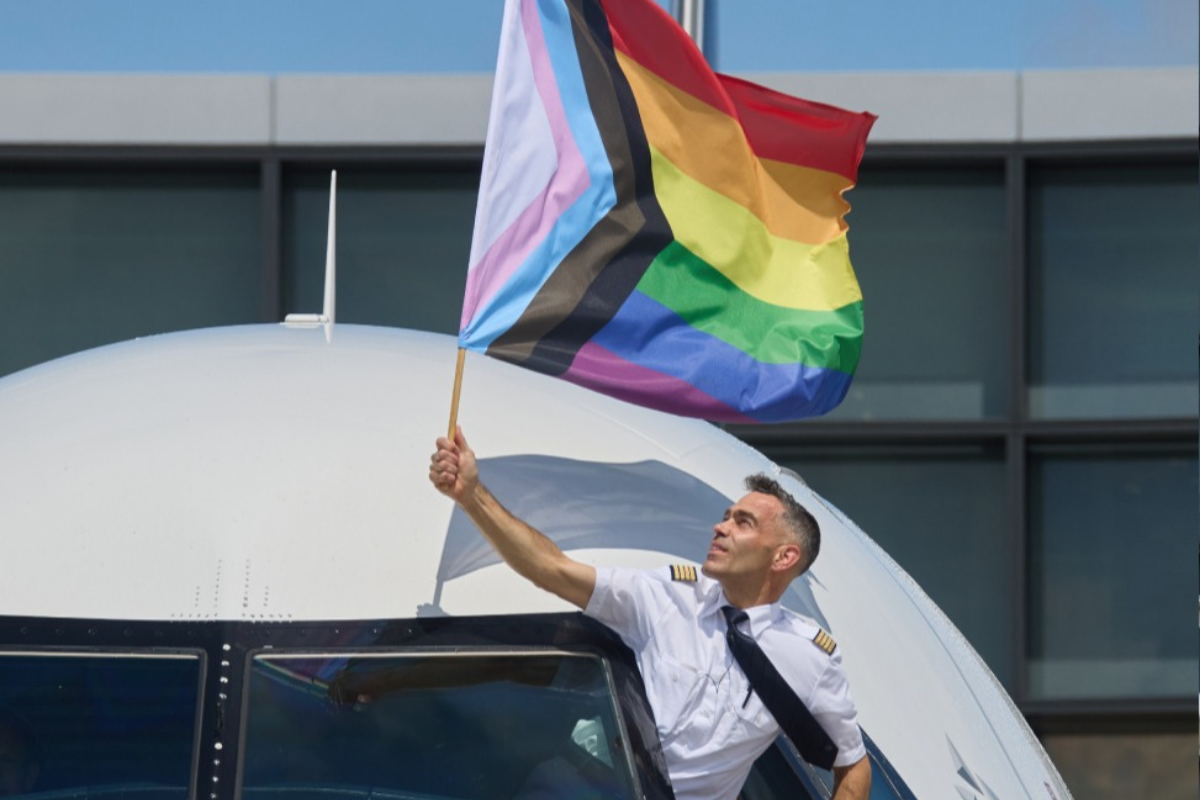
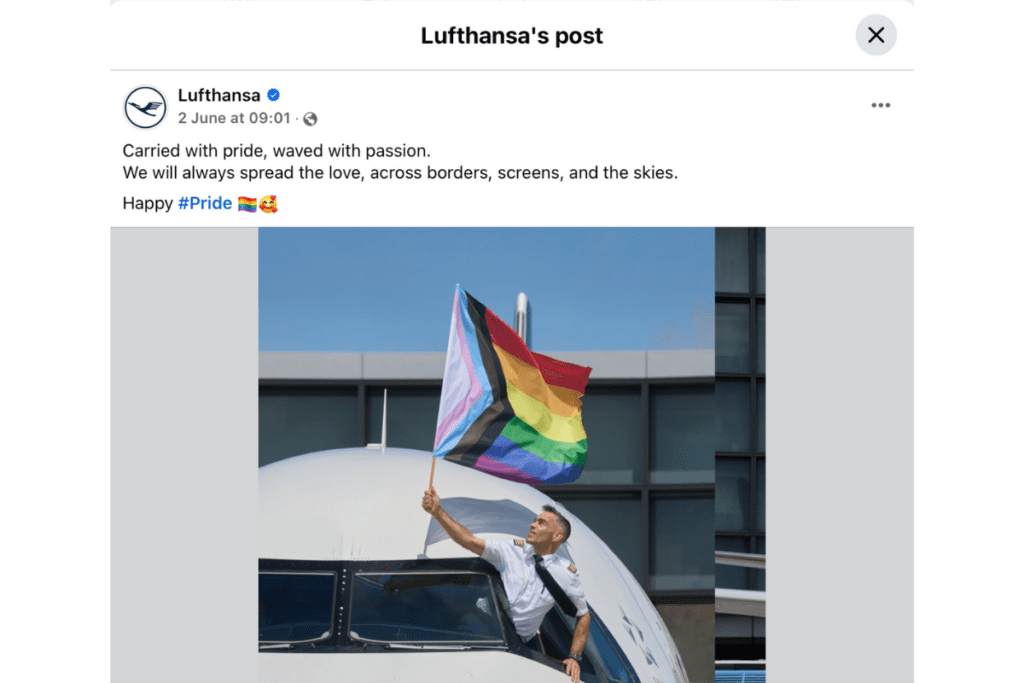
On June 2, the airline posted a photo of a pilot waving a Pride rainbow flag out the window of a cockpit, captioned with the words: “Carried with pride, waved with passion. We will always spread the love, across borders, screens, and the skies.”
Lufthansa has been quick to respond to critics.
It seemed like a pretty inoffensive and inspiring message that didn’t directly reference LGBTQ+ rights, but it didn’t take long for Lufthansa’s Facebook page to be deluged with homophobic comments.
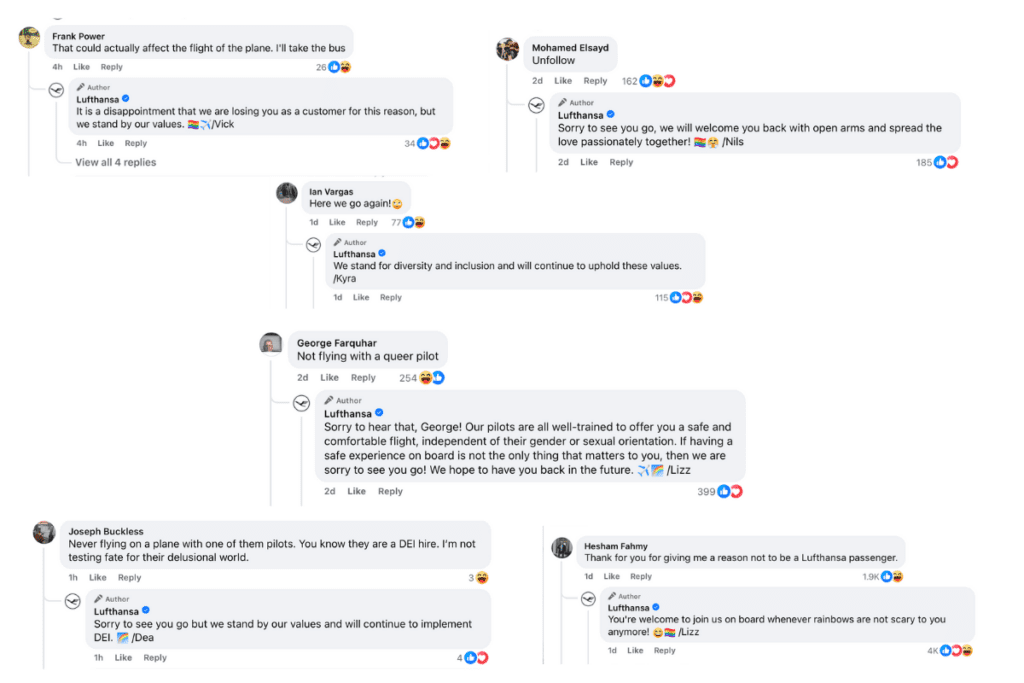
But it looks like Lufthansa knew exactly what it was getting itself into, and its social media team quickly fired back at critics with sassy replies that shut down the hateful comments without censoring them or turning off the comment feature altogether.
“Thank you for you for giving me a reason not to be a Lufthansa passenger,” one person wrote underneath the post. Lufthansa clapped back with: “You’re welcome to join us on board whenever rainbows are not scary to you anymore!”
While one person inferred that inclusivity was a safety issue, saying: “That could actually affect the flight of the plane. I’ll take the bus.”
Lufthansa was not having any of it, though, relying: “It is a disappointment that we are losing you as a customer for this reason, but we stand by our values.”
Another referenced DEI, saying: “Never flying on a plane with one of them pilots. You know they are a DEI hire. I’m not testing fate for their delusional world.”
Again, Lufthansa stood firm: “Sorry to see you go but we stand by our values and will continue to implement DEI.”
Many responses to the post have, however, been positive, and some fans have pointed out that the response has proved exactly why, even in 2025, Pride is still needed.
June has traditionally been recognized as Pride Month to mark the Stonewall riots that occurred in late June 1969. Since then, several US presidents have issued proclamations, declaring June as the month of Pride, but White House press secretary Karoline Leavitt said earlier this week that President Trump has no plans to issue a similar proclamation this year.
Trump was, however, the first Republican President to acknowledge LGBT Pride Month back in 2019 when he Tweeted a message in support of the commemoration.
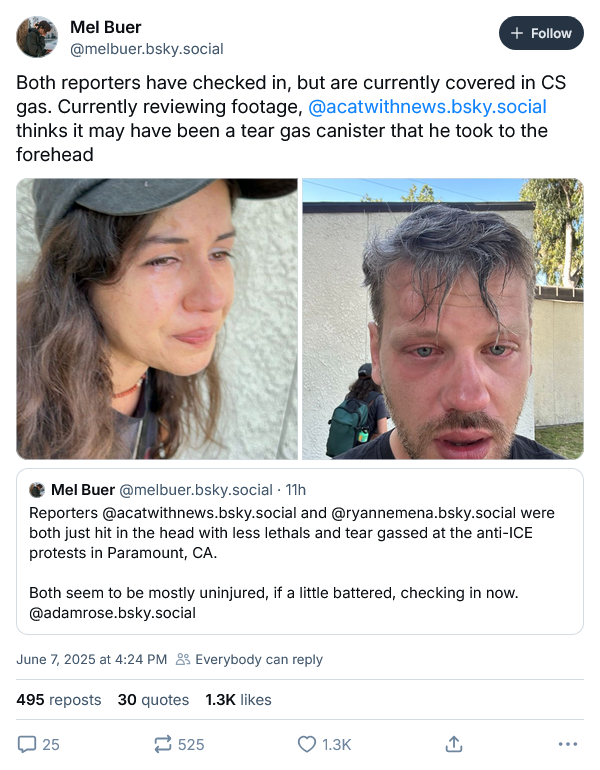
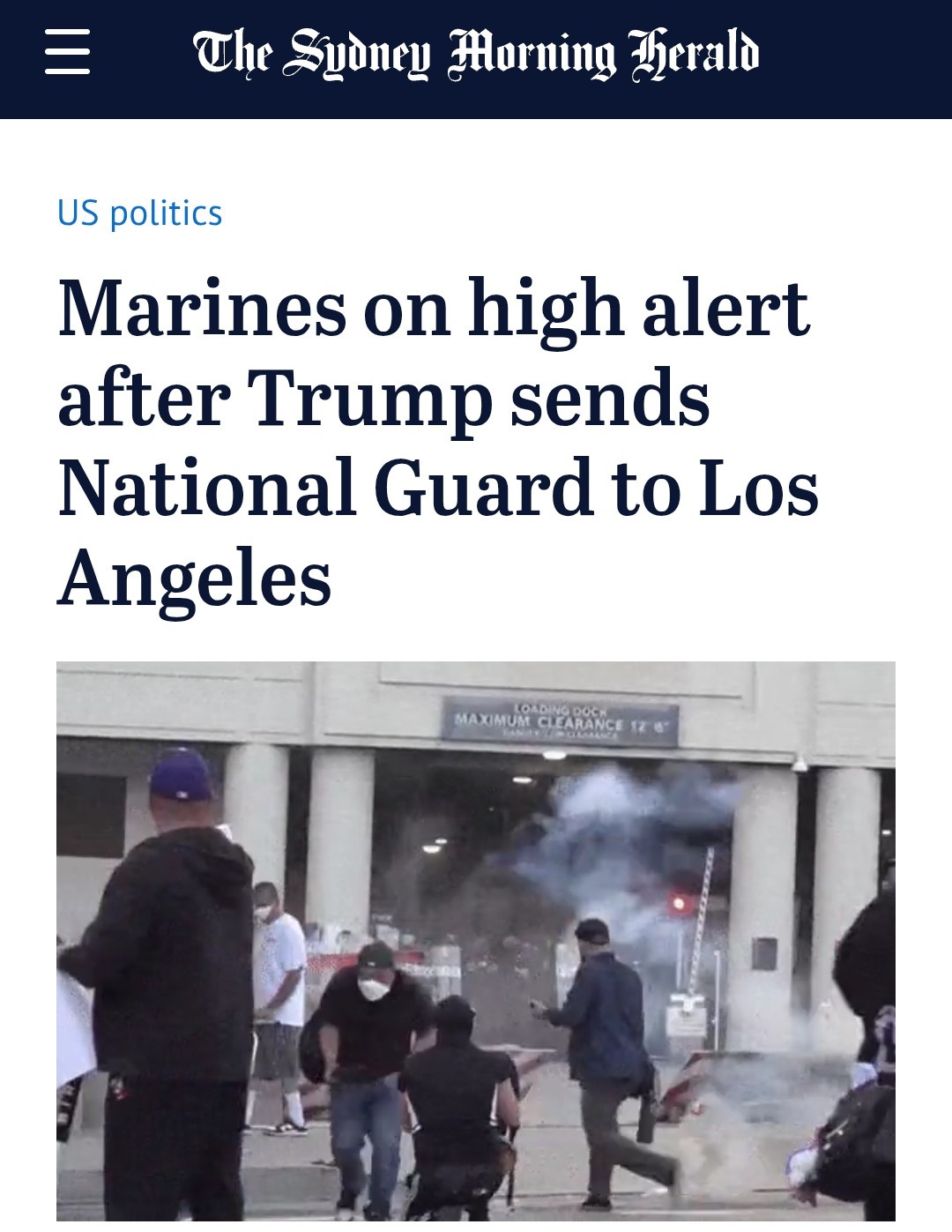
A third day of protests against immigration raids was expected to take place in the Los Angeles area on Sunday, hours after President Trump took the extraordinary action of ordering at least 2,000 National Guard members to assist immigration agents clashing with demonstrators.
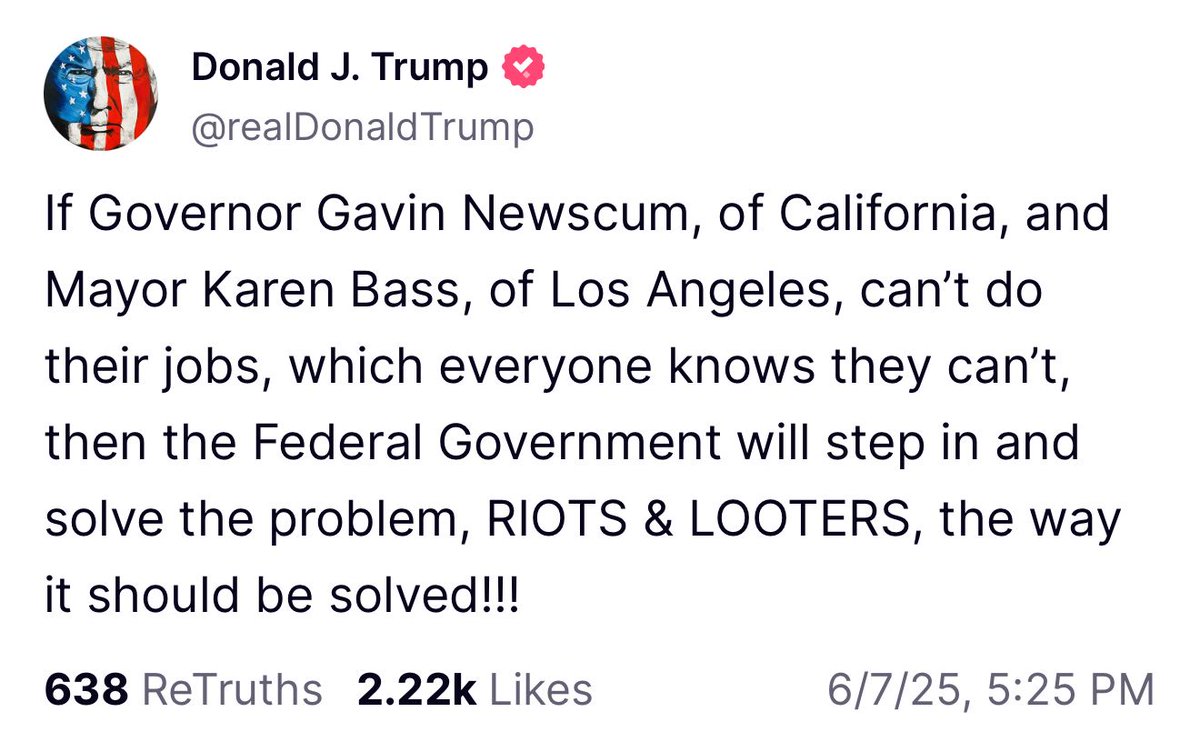
The announcement by Mr. Trump — who said that any protest or act of violence that impeded officials would be considered a “form of rebellion” — was an escalation that put Los Angeles squarely at the center of tensions over his administration’s immigration crackdown and made rare use of federal powers to bypass the authority of California’s governor, Gavin Newsom.
Mr. Trump issued the order on Saturday as law enforcement officers faced off with hundreds of protesters for a second consecutive day in the Los Angeles area, in some cases using rubber bullets and flash-bang grenades. Mr. Newsom described Mr. Trump’s order as “purposefully inflammatory,” saying that the federal government was mobilizing the National Guard “not because there is a shortage of law enforcement, but because they want a spectacle.”
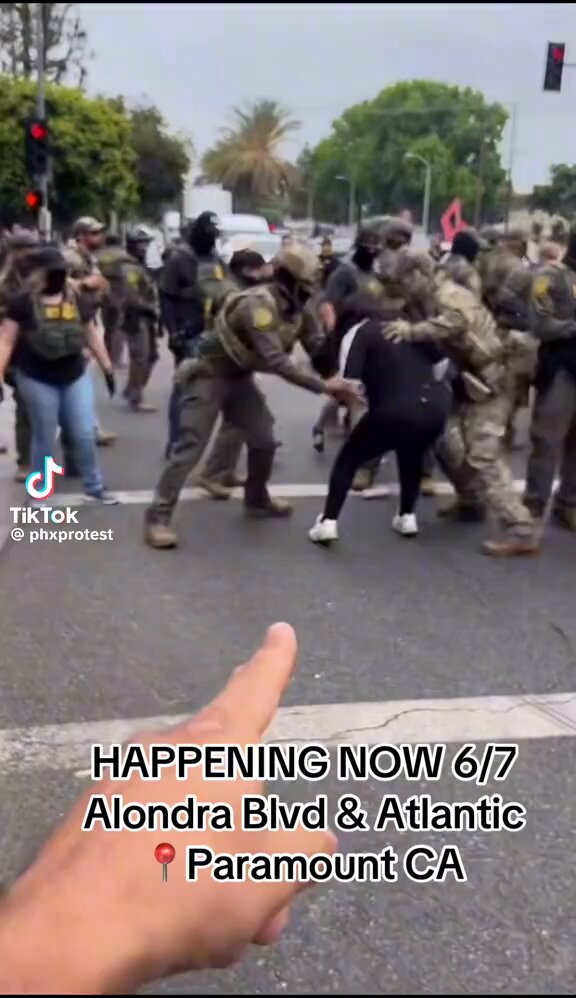
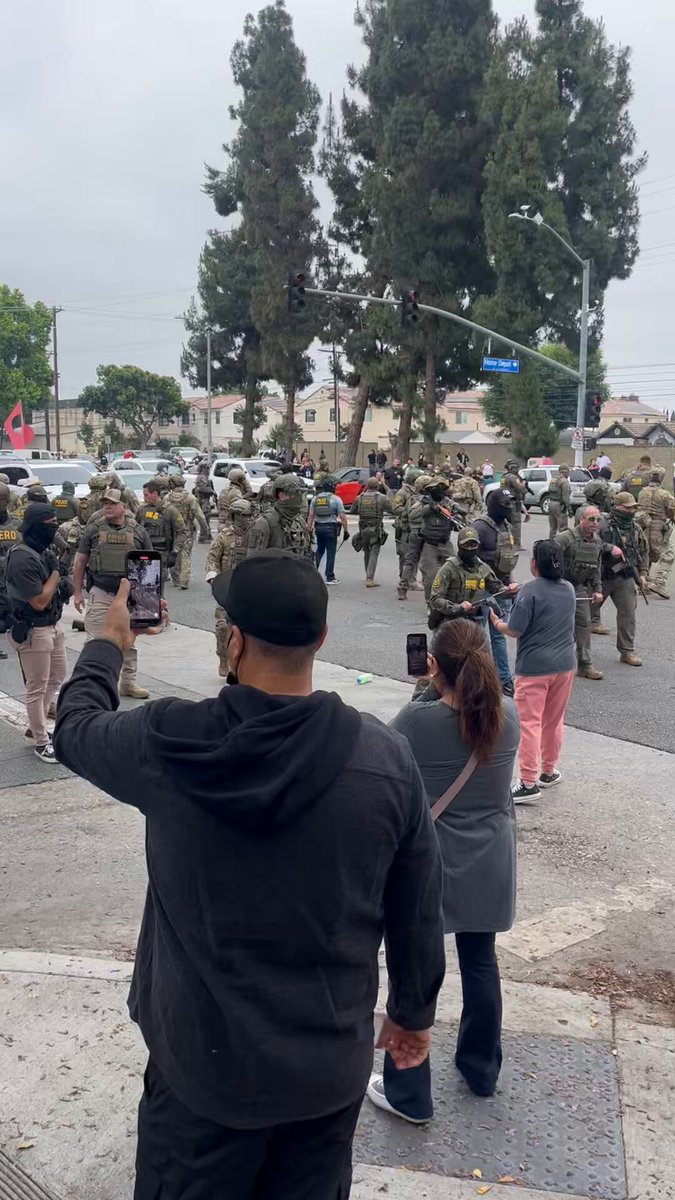
Confrontations broke out on Saturday near a Home Depot in the heavily Latino city of Paramount, south of Los Angeles, where federal agents were staging at a Department of Homeland Security office nearby.
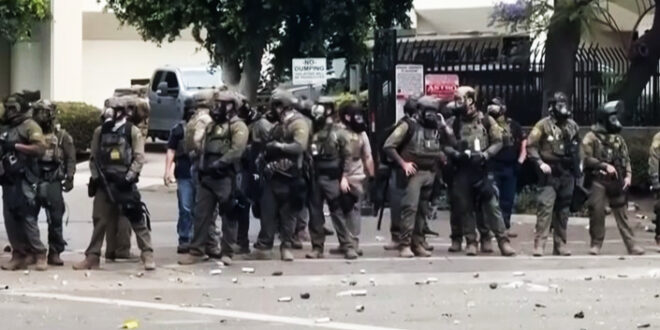
Agents unleashed tear gas, flash-bang explosives and pepper balls, and protesters hurled rocks and cement at Border Patrol vehicles. Smoke wafted from small piles of burning refuse in the streets.
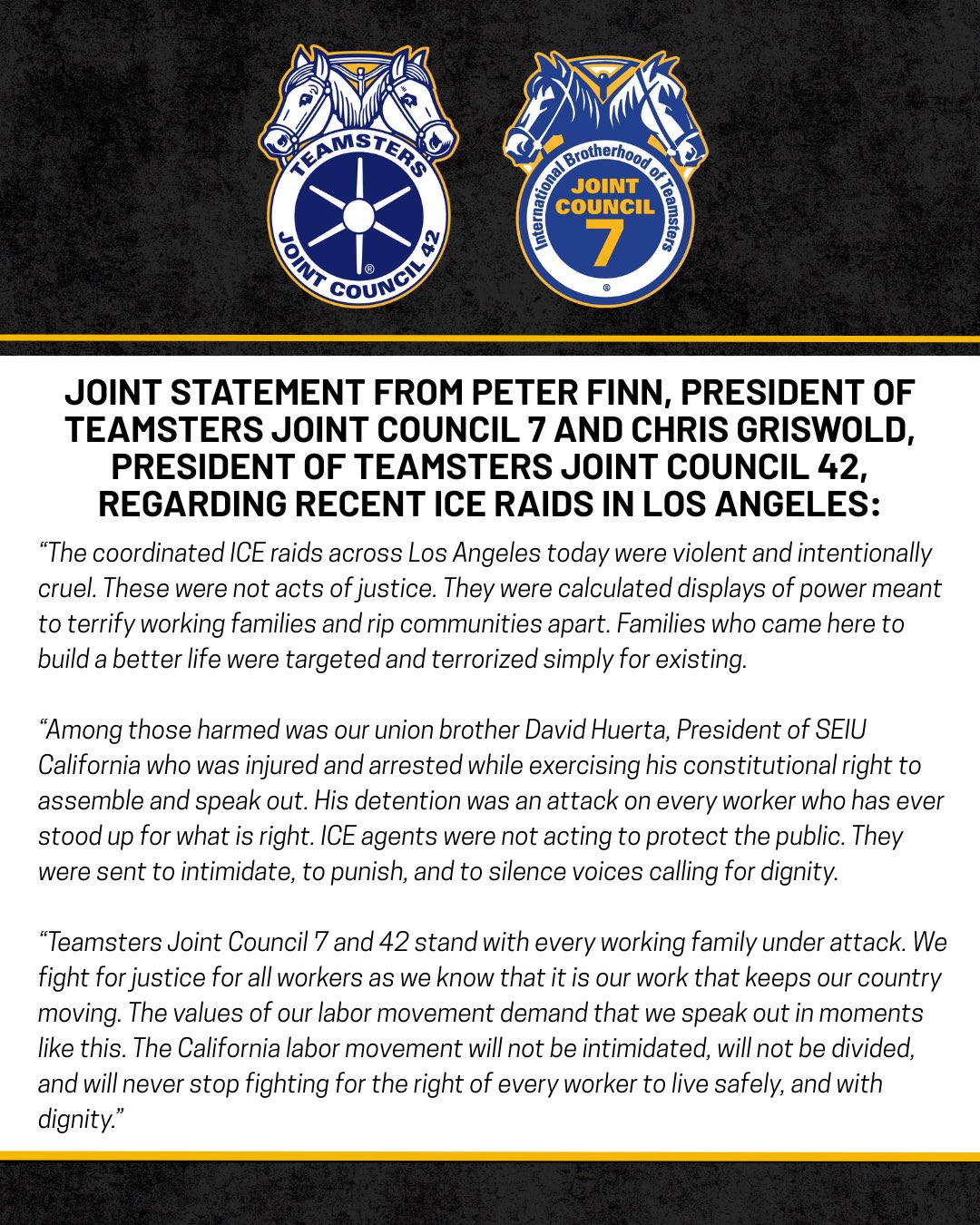
Tensions were high after a series of sweeps by immigration authorities the previous day, including in LA’s fashion district and at a Home Depot, as the weeklong tally of immigrant arrests in the city climbed past 100. A prominent union leader was arrested while protesting and accused of impeding law enforcement.
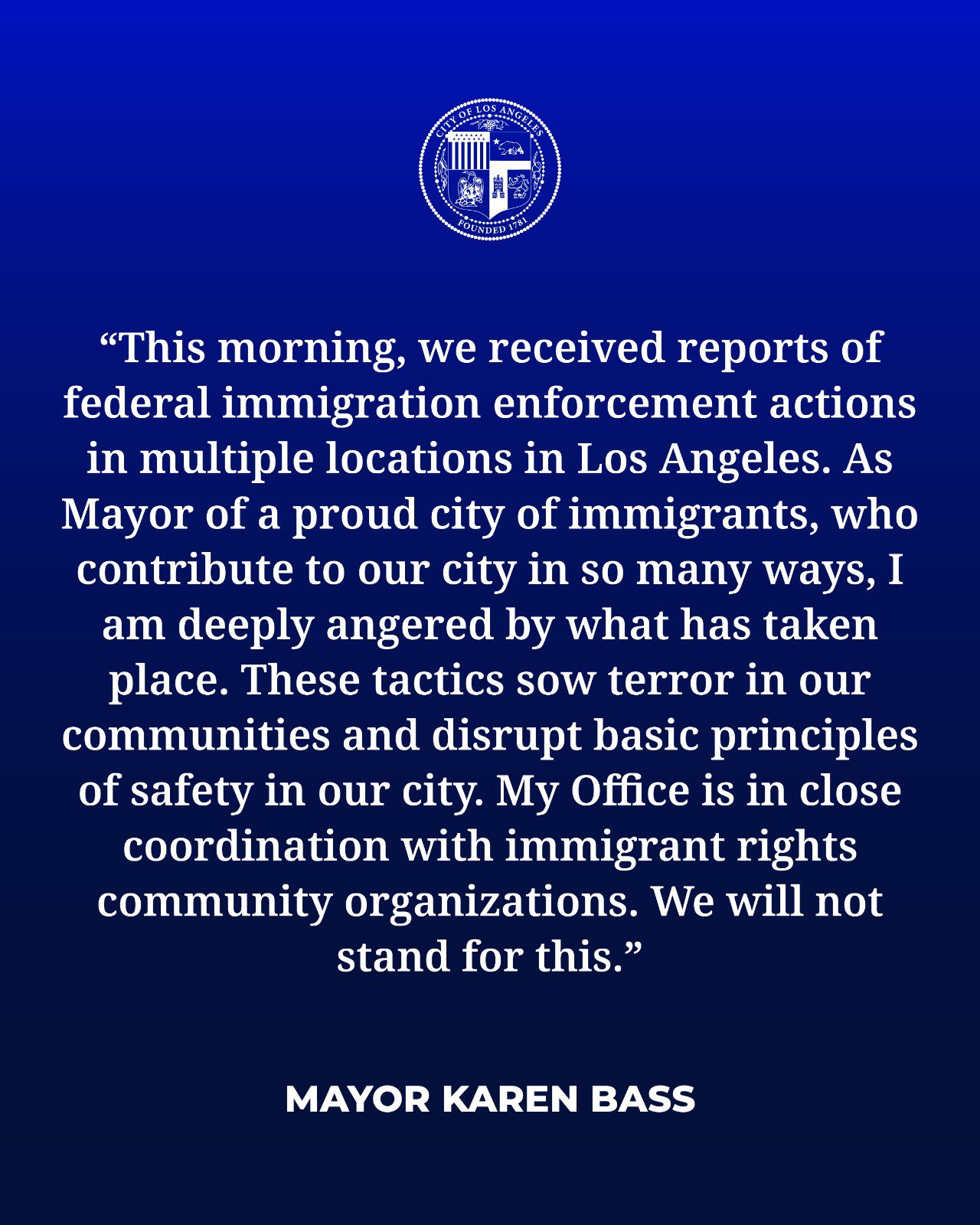
The National Guard has not yet been deployed to the sites of any protests in Los Angeles County, according to its sheriff’s department. “We were told that the National Guard had been deployed, however they are not on the scene or the ground yet,” Deputy Sheriff Tracy Koerner said around 1:45 a.m. local time. Earlier Sunday, Mayor Karen Bass said the National Guard had not been deployed in the city limits.
The Los Angeles Police Department said at midnight that it detained “multiple” people who breached an area near the city’s Metropolitan Detention Center where the agency had declared an “unlawful assembly.” “Those detained will be arrested and booked for failing to disperse,” the force said on social media. Earlier, police said a section of Alameda Street was closed to all vehicle and pedestrian traffic.
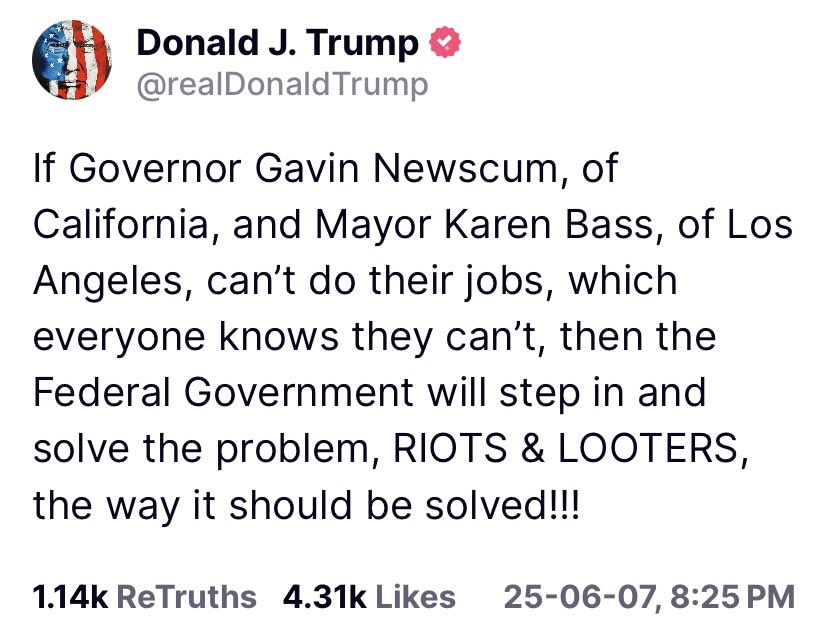
The cult is celebrating on X, with some calling for the use of “live rounds” on protesters. Trump’s post below came at 2:41am, presumably upon his return from a UFC match where he was seated with Mike Tyson.
Post
See new posts
Conversation
emptywheel (check)
@emptywheel
SEIU CA President David Huerta was assaulted and arrested for peaceful protest. The injuries the assault caused required hospital care.
Quote
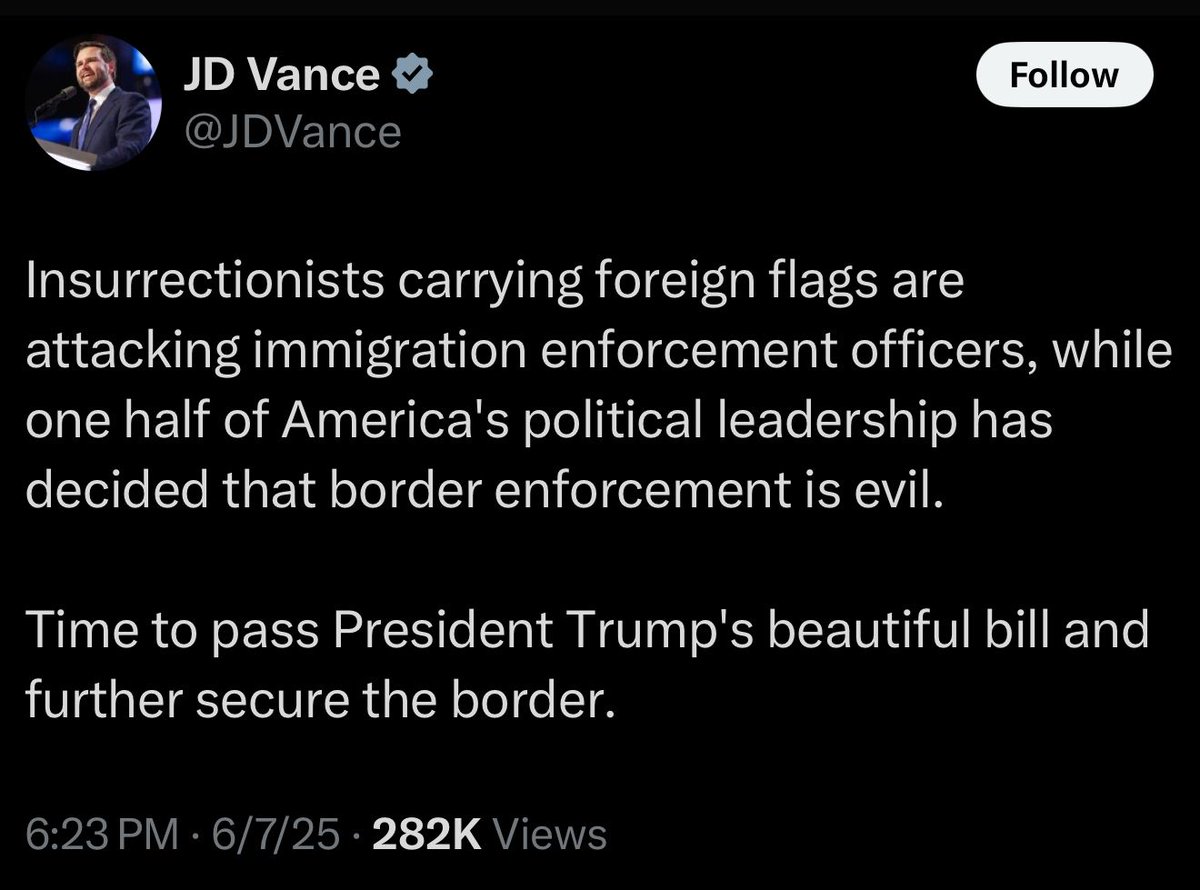
JD Vance
@JDVance
·
Replying to @JDVance
For the far left rioters, some helpful advice; peaceful protest is good. Rioting and obstructing justice is not.
Deploying troops to communities already under pressure is not leadership—it’s provocation. The Trump Administration is weaponizing fear to divide and destabilize. We will not be silent. We stand with those targeted and terrorized. We fight for justice. Always.
Quote
Gavin Newsom
@GavinNewsom
·
The federal government is taking over the California National Guard and deploying 2,000 soldiers in Los Angeles — not because there is a shortage of law enforcement, but because they want a spectacle. Don’t give them one.
Brian Allen
@allenanalysis
Subscribe
In case you were wondering what sparked the LA standoff between protesters and federal agents, this is it. Immigrants showed up for routine ICE check-ins and were detained on the spot. Hauled into the basement. Held overnight like fugitives. No warning. No due process. Just snatched. “Land of the free,” right?
Republicans against Trump
@RpsAgainstTrump
Subscribe
During his first term, Trump asked Defense Secretary Mark Esper to shoot protesters. Esper refused. Now he has Pete Hegseth. God help us all
JD Vance now wants to use the chaos ICE is causing in Los Angeles as pretext to pressure politicians to pass the Republican budget bill that will saddle Americans with trillions of dollars of debt, skyrocket the deficit, take away people’s healthcare, and give massive tax breaks to the wealthy.
Jo
@JoJoFromJerz
Subscribe
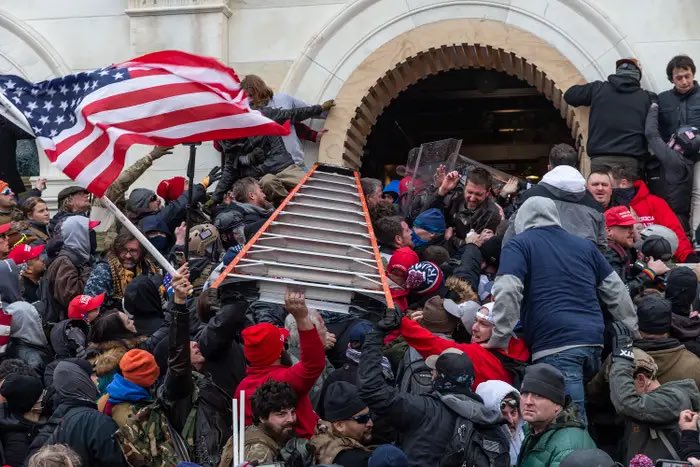
Weird how he didn’t call up the National Guard on January 6th.
Post
See new posts
Conversation
Crooks and Liars
@crooksandliars
Trump sends in his brown shirts to cause disruption so he can use the insurrection act or whatever fucked rational he comes up with to send in the the National G. Mussolini gives a thumbs up in his grave.
Quote
MeidasTouch
@MeidasTouch
·
Trump lit the match, poured the gasoline, and now wants to use the blaze he is creating as pretext to burn it all down.
A powder keg is about to explode: With masks to hide their identity, this is what a Nazi takeover of the streets of Los Angeles looks like. Trump’s cosplaying ICE Gestapo is carrying out a lawless assault against one of the most diverse cities in America.
I was told ICE was going to arrest gangsters and mobsters. But all I see is fat white guys in cosplay doin jobsite raids, school raids, and arresting mothers with kids who are applying for citizenship.
Ask yourself why ICE is conducting raids in cities like LA and Chicago, where they face strong opposition, while massive agribusinesses in places like Kristi Noem’s South Dakota remain untouched.
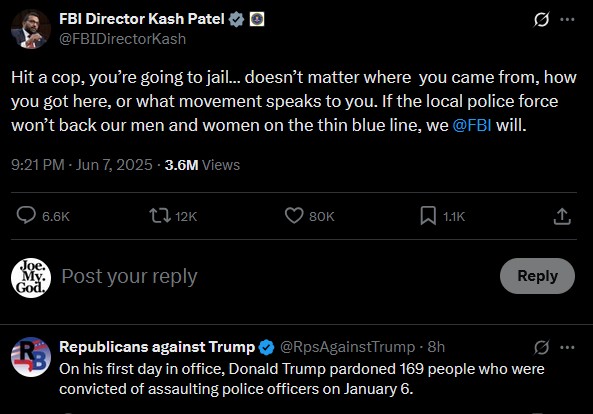
Your boss pardoned cop beaters at the January 6th riot
CBP
@CBP
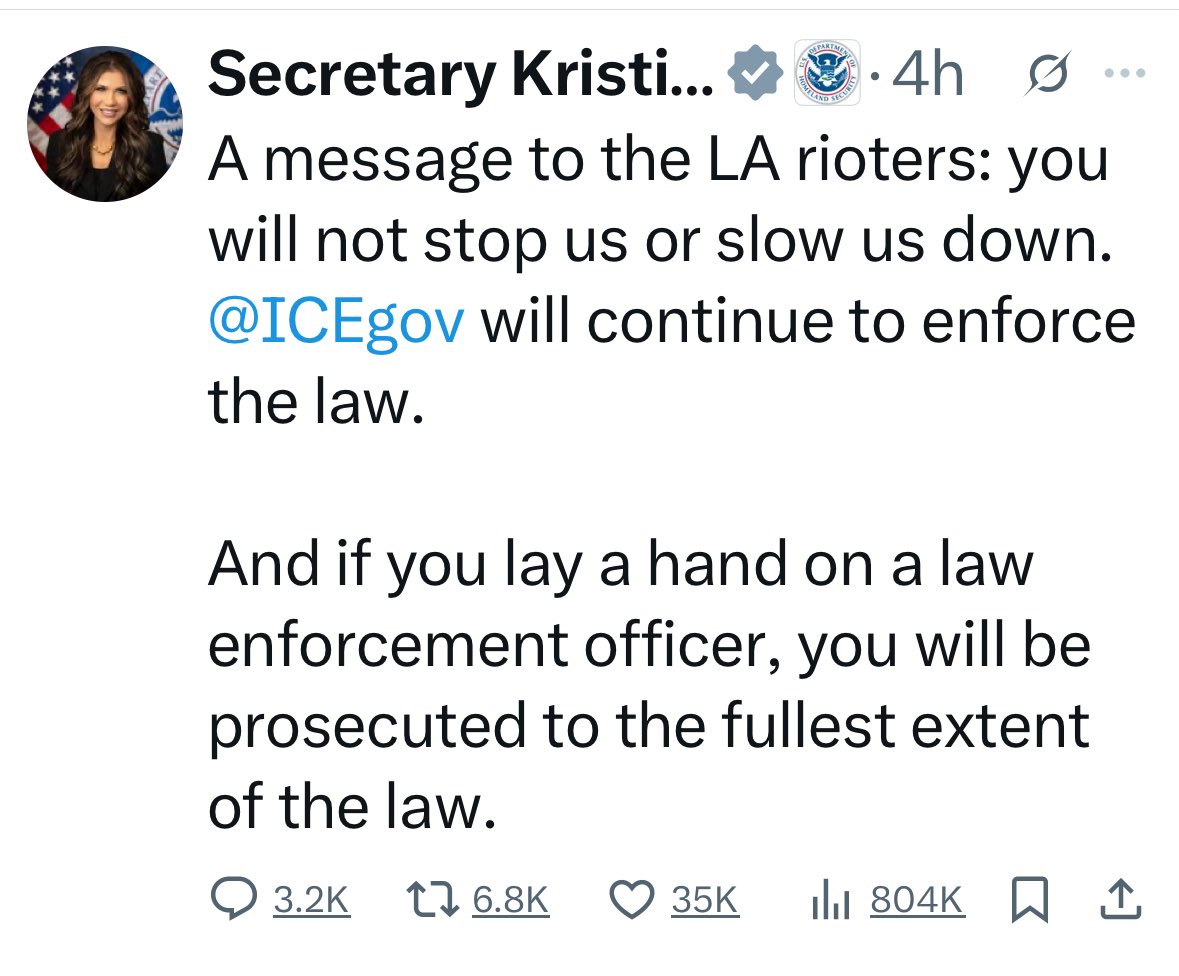
Let this be clear: Anyone who assaults or impedes a federal law enforcement officer or agent in the performance of their duties will be arrested and swiftly prosecuted to the fullest extent of the law. Attack a cop, and life long consequences will follow!
This guy is living out his camo fantasy right now like it’s a game. Disgusting.
Acyn
@Acyn
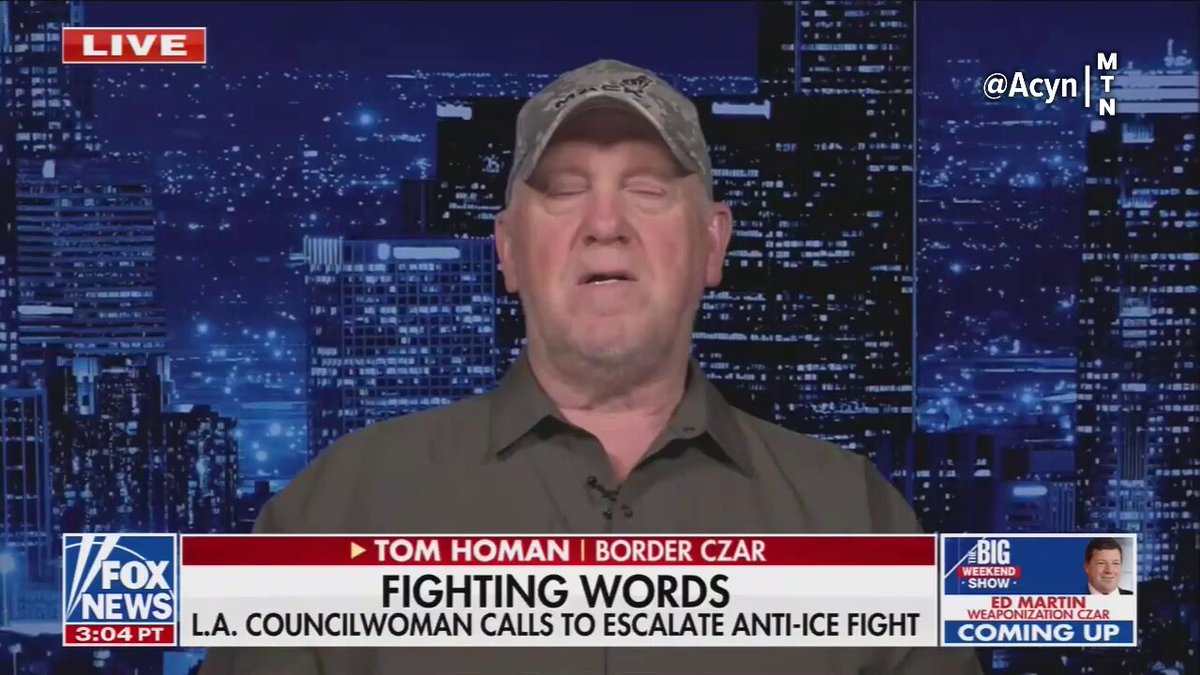
Tom Homan: We are making Los Angeles safer. Mayor Bass should be thanking us. She says they are going to mobilize—guess what? We are already mobilizing. We are going to bring the National Guard in tonight
President Obama deported 3 million people and managed to do so without using stormtroopers and the National Guard. Like everything else, Obama was better at that too.
Trump is sending in highly visible and armored ICE agents to LA and other big cities. He’s deliberately creating conflict so he can federalize the National Guard to go in and start hurting American citizens. That’s the end game.
The person most responsible for the chaos and violence in southern California right now is @StephenM – who screamed at and fired ICE officials for not making 3,000 arrests per day Now he’s put ICE agents, police officers, protesters, immigrants, and innocent bystanders at riskShow more
It’s even worse than just “capturing them at court dates”…they are dropping charges against the people for the sole purpose of arresting and deporting them as they are leaving the courthouse, It’s underhanded bullshit.
TACO will declare a national emergency and then suspend Habeas Corpus and initiate mass arrests. The captured true American Patriots protesting the Dear TACO will be sent to concentration camps. Who will stop him? More court orders.
Legal or not, it’s going to take an escalation by the Mayor or Governor, telling their officers to arrest and detain ICE members for trespassing and kidnapping, to attempt to end this. Governor could just tell the National Guard to disobey. It’s going to take open defiance by those with the power to smack down these fascists who think they have all the power.


 Molly Sprayregen (She/Her )May 21, 2025, 12:00 pm EDT
Kyle Neal


 “

 With DEI initiatives firmly in the crosshairs of the Trump administration, many large corporations that were once so quick to celebrate June as Pride month have quietly ditched their public support for LGBTQI+ rights even faster.