Some Bluesky posts. I recommend reading the links to the anti-trans stories.

Yesterday, 37 Democratic Senators voted to pass the anti-trans NDAA.Those same Dems refused to allow Senator Baldwin to advance an amendment to remove anti-trans provisions from the bill.EITM has released an easy to read list of Senators who voted for it.Subscribe to support our journalism.

— Erin Reed (@erininthemorning.com) 2024-12-19T15:34:29.396Z

This follows the Queensland and French reviews into care that found care to be safe and effective. The Cass Review was a political hatchet job. Guarantee the NYT and US media doesn't cover this.

— Alejandra Caraballo (@esqueer.net) 2024-12-19T13:18:58.565Z

In 2024, several New Hampshire Democrats, afraid that anti-trans attacks would work, voted in favor of a trans surgery ban and bathroom bill.They lost more seats than most other states. Now the R majority is ramping up targeting us.Capitulation didn't work.National Dems, take note.

— Erin Reed (@erininthemorning.com) 2024-12-19T05:05:53.670Z

There is no joy in taking health insurance coverage away from any of our constituents, including trans children of active duty service members here in Virginia.You can’t support our troops by making it harder for families to afford medically necessary health care prescribed by their doctors.

— Sen. Danica Roem (@pwcdanica.bsky.social) 2024-12-18T19:09:58.939Z

This is the trans athletic scare that has half the nation in a tizzy. It’s manufactured fear, playing off of ignorance and bigotry.

— George Takei (@georgetakei.bsky.social) 2024-12-19T17:38:11.087Z

The result of puberty blocker bans means trans youth are just skipping to grey market hormones, not managed by a healthcare provider. So the result of bans is care that is not managed and worse for everyone involved. This is why gatekeeping doesn't work. People will get access anyways.

— Alejandra Caraballo (@esqueer.net) 2024-12-19T16:47:29.073Z

The only thing you do is make it less safe for trans people. Trans teens taking grey market hormones has been a thing for decades and had been declining until bans started kicking in. You'd think these idiots would learn that prohibitions never actually stops anything, you just make it less visible.

— Alejandra Caraballo (@esqueer.net) 2024-12-19T16:47:29.074Z

Rand Paul becomes the first to call for Elon Musk to replace Mike Johnson as Speaker. Which, if you listened to my podcast Uncovered yesterday, you already knew was going to happen before it just happened.

— Ron Filipkowski (@ronfilipkowski.bsky.social) 2024-12-19T13:06:10.248Z

Mitch McConnell ran a playbook of total opposition after the 2008 election and it resulted in Republicans flipping 6 senate seats and 63 house seats two years after the biggest Dem victory since LBJwhat the fuck are you people doing

— Micah (@rincewind.run) 2024-12-18T16:16:00.341Z

The government is going to get shut down because this oligarch dipshit believes blatant lies from the dumbest person on Twitter.

— Alejandra Caraballo (@esqueer.net) 2024-12-19T04:16:58.141Z

I don't think we're prepared for just how stupid things are about to get. The dumbest people on earth high on conspiracy theories will be making policy decisions like pandemic response based on disinformation from twitter.

— Alejandra Caraballo (@esqueer.net) 2024-12-19T04:21:54.369Z

We’re all going to have to continue to push back on this lie from Trump that he won a “mandate” of historic proportions.

— George Takei (@georgetakei.bsky.social) 2024-12-19T18:30:01.228Z

"2025 Will Be the Year of Trump's Crackdown on Islam"What Trump’s hawkish anti-Muslim appointees mean for the Middle East – and beyond, writes @attackerman.bsky.social for @zeteo.com

— Mehdi Hasan (@mehdirhasan.bsky.social) 2024-12-19T18:16:23.849Z

Jeffries: That bipartisan agreement has now been detonated because House Republicans have been ordered to shut down the government and hurt the very working-class Americans that many of them pretend to want to help

— Acyn (@acyn.bsky.social) 2024-12-19T16:53:20.945Z

The police exist to protect property, not people.

— Alejandra Caraballo (@esqueer.net) 2024-12-19T16:06:02.492Z

This is why police unions are not real unions and no one should view them as such. They exist to protect power and property. That's it. There's no solidarity to be found there.

— Alejandra Caraballo (@esqueer.net) 2024-12-19T16:14:35.755Z
The Chaos Monkeys Have Already Taken Over the Zoo by Paul Krugman

The peddlers of misinformation are high on their own supply Read on Substack

(Thanks to BruceDesertRat who comments here, for linking this really useful Substack!)

Well, I was going to post about proposals for bank deregulation, but I think that can wait for a bit. The news of the moment is the looming prospect that the federal government will shut down over the weekend.

We’ll have to see how much damage this does, but it’s already clear that assuming the worst happens — and it’s hard to see how it won’t — this will be the dumbest shutdown ever. I’d say that the incoming Musk administration (so far Musk, not Trump, appears to be calling the shots) is trying to hold itself up for ransom, but it doesn’t even rise to that level. This isn’t like 1995, when Newt Gingrich shut down the government in an attempt to extract cuts in Medicare and Medicaid — a move that seemed (and was) a foolish act of petulance, but at least had a ghost of motivation.

No, Musk is demanding — apparently successfully — that Republicans in Congress renege on a deal they had already agreed to, a continuing resolution that would keep the federal government going for the next few months. Why? Because, Musk says, of the outrageous provisions in that CR.

Except none of the items Musk is complaining about are actually in the bill. No, Congress isn’t giving itself a 40 percent raise. No, the bill doesn’t fund a $3 billion stadium in Washington. No, it doesn’t block future investigations into the Jan. 6 committee. No, it doesn’t fund bioweapons labs.

I have an embarrassing admission to make. I thought that Muskaswamy’s obvious problems with getting DOGE going would have inspired, not humility — never that — but at least a bit of caution. That is, I imagined that Musk would by now have at least an inkling of two things.

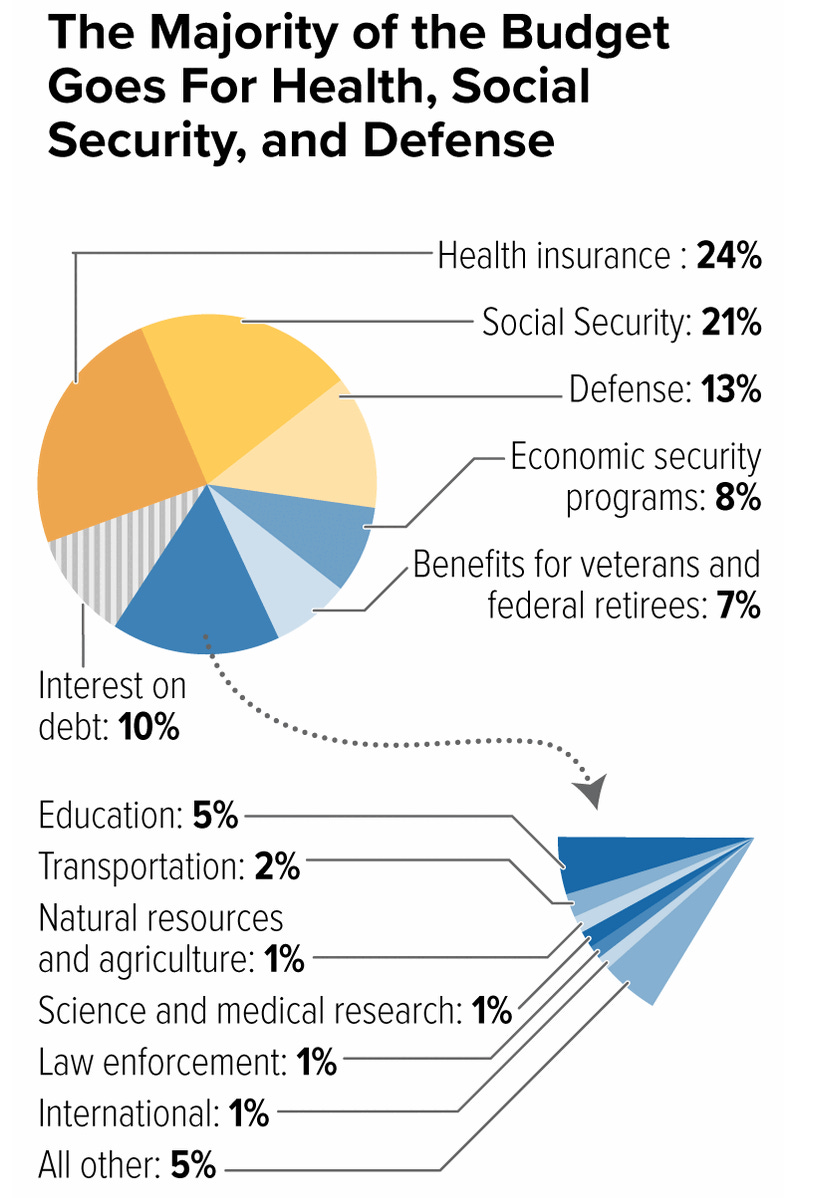
First, finding big-ticket examples of government waste is hard, because the government mostly spends money on things people want. Here’s a nice chart from the Center on Budget and Policy Priorities, showing where the money goes:

Yes, the federal government is an insurance company with an army.

Second, you shouldn’t trust claims about the budget coming from Some Guy on the Internet. You might have imagined that the world’s richest man could have a couple of fact-checkers on retainer to help ensure that he isn’t making clearly stupid assertions. But nooo.

In a barrage of posts on X Musk pushed misinformation about a more or less routine, place-holding bill that was basically a way to keep the ship of state afloat until Trump takes charge. Maybe this was in part a power play, an attempt to make Republicans in Congress show fealty to a man who clearly imagines that he’s the real president — and Trump, by meekly endorsing Musk’s position, did in fact convey the impression that Musk is leading the guy who is supposed to be in charge by the nose. But this political theater will have real consequences, for America, for Trump, and for Musk himself.

Musk has asserted that shutting the government down for a month would do no harm. And it’s true that Social Security, Medicare and Medicaid funding — which is where the bulk of the money goes — will continue. But many services people rely on will be disrupted, especially if the shutdown goes on for more than a month, which seems all too likely given Republicans’ razor-thin House majority and the dominance of misinformation in many members’ thinking.

Maybe Musk himself doesn’t expect to experience any hardship, but put it this way: I’m glad that I won’t need to renew my passport any time soon, that I don’t expect to be trying to get through airport security for a while, and especially glad that I don’t rely either on food stamps or on small business loans. For all of these things have been disrupted in past government shutdowns.

Do Musk and Trump know any of this? Almost surely not.

Beyond the specifics, my guess is that antics like the potential shutdown will do much more damage to the Musk/Trump administration than they realize. (There’s also this other guy — JV Dance or something? — but he clearly doesn’t matter.)

First, since the election financial markets have clearly been betting that Trump will do very little of what he promised during the campaign — that we won’t really have a trade war, just some minor trade skirmishes, that we’ll have symbolic deportations rather than a mass roundup of immigrants, and so on. Markets have, in effect, discounted the disastrous consequences that would follow if Trump honored his own promises.

But a government shutdown in response to completely false claims about what’s in an innocuous short-term funding measure suggests that the peddlers of misinformation are high on their own supply. Trump may really believe that foreigners will pay tariffs, that U.S. trade deficits subsidize the rest of the world, that there’s a reserve army of American workers available to fill the gaps deportation would create. I don’t want to put too much weight on the latest market fluctuations, but it is starting to look as if investors are questioning their own complacency.

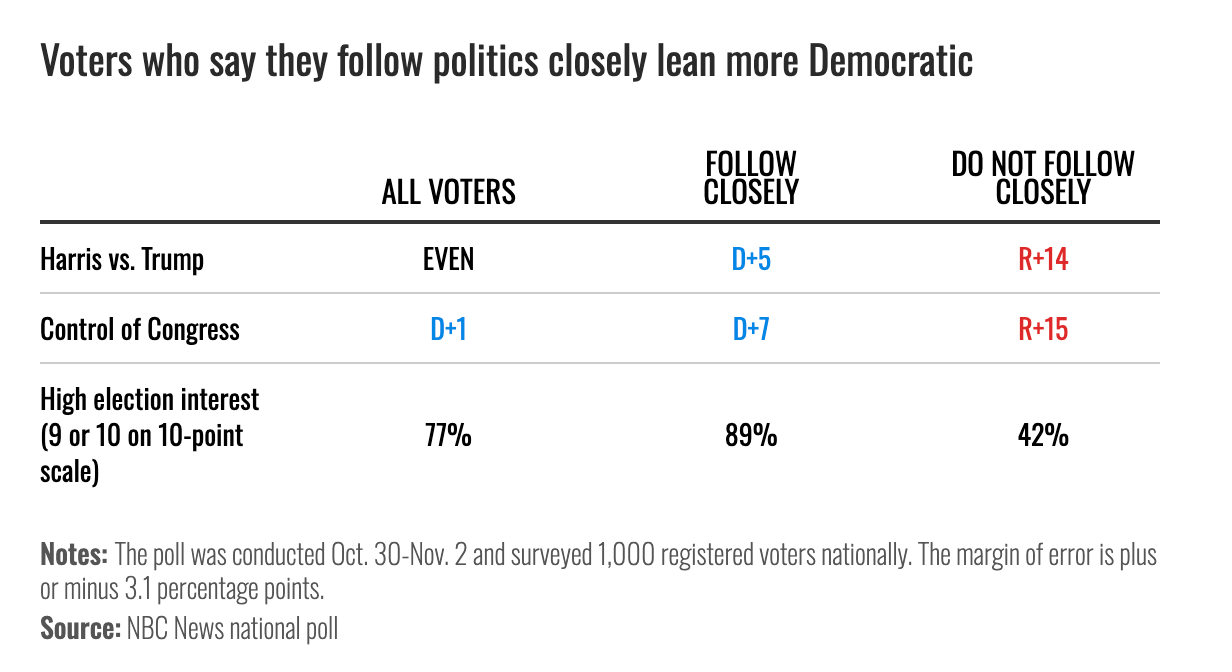
Second, many, probably most people who voted for Trump believed that he really is the character he played on The Apprentice — a highly competent manager. The other day I said that Trump was elected by low-information voters; this wasn’t a slur on Americans’ intelligence, it was a reference to survey results showing that Trump’s edge depended entirely on support from voters who don’t pay much attention to politics:

How will these voters react if, as seems all too likely, the second Trump administration is instead marked by rolling chaos?

Anyway, it’s pretty remarkable. Inauguration Day is still a month away, yet the chaos monkeys have already taken over. (snip)

Yesterday’s News Today

but it’s vital timely stuff that is still fresh today-

I love The Majority Report and the progressive factual style they have. Enjoy some clips on different subjects.

Hitting the Debt Limit: 3 Things to Know

December 17, 2024 By Joel Friedman and Richard Kogan

On January 1, 2025, the federal government will reach the debt limit, the maximum amount it is allowed to borrow. Accordingly, Congress will need to act to raise or suspend the limit in the coming months to cover existing commitments. Raising or suspending the debt limit does not authorize new spending or tax cuts; it merely acknowledges past budgetary decisions — that is, current budget law — and so allows the federal government to meet its existing legal obligations. The government must suspend or raise the limit to prevent default, which would be deeply damaging and disruptive for people across the U.S., financial markets, and the economy.

The debt limit has been suspended since the enactment of the bipartisan 2023 Fiscal Responsibility Act, allowing the federal government to borrow as needed. But under that law, the suspension expires at the start of 2025, and the new limit will be set at the level of debt outstanding on that day.

The Congressional Budget Office estimates that the deficit is currently running a bit below $2 trillion per year, which is therefore a reasonable approximation of the amount the federal government will need to borrow in 2025 to pay its bills in full, even if policymakers enact no further deficit-increasing measures.

Here are three key things to know about the debt limit:

1. January 1st is not a hard deadline.

When the U.S. reaches the debt limit, Treasury cannot increase borrowing to finance spending. But it will be several more months before the federal government lacks the resources to meet its legal obligations. That hard deadline, sometimes called the “X-date,” will likely not occur until the spring or summer, but it is difficult to estimate precisely at this point.

What allows the Treasury to spend when it cannot borrow more? First, it will have a buffer of cash on hand, which stood at around $700 billion on December 12. Second, Treasury will continue to collect revenues. Even though total revenues are less than total spending over the year, in certain months revenues exceed spending, generating a surplus. (See Figure 1 on the page; won’t embed.) This is particularly the case in April, around the tax filing deadline.

Finally, the Treasury Department can use certain accounting maneuvers, known as “extraordinary measures,” that let it finance expenditures without additional borrowing that counts against the limit. Both Democratic and Republican administrations have used these measures in recent decades after reaching the debt limit, allowing them to meet the federal government’s obligations while waiting for Congress to act. But these accounting maneuvers are not open-ended. In past years, they have given the Treasury several months of cushion before reaching the X-date. In 2023, for instance, Treasury relied on them for 135 days before Congress suspended the debt limit.

2. Prioritizing payments isn’t the answer to the debt ceiling.

If Congress does not raise or suspend the debt limit by the time Treasury has exhausted its cash balances and extraordinary measures, it would be unable to increase borrowing. It could not meet all the government’s legal obligations; it could pay only as much as it collects in revenues — on a day-to-day basis. Given that revenue is insufficient to cover spending, payments would need to be delayed and spending eventually cut — all of which would be illegal, because that would violate existing spending law. Default would not only hurt people who depend on timely government payments, but it would also shake financial markets and damage the economy.[1]

A number of Republican members of Congress have introduced legislation over the past dozen years that would authorize Treasury to prioritize certain payments if the federal government reached the debt limit. But that is not a way around the debt limit. The many budget statutes authorizing government’s various spending programs provide no legal authority to prioritize one payment over another. As a result, the government’s current payment system is designed to pay bills in the order in which they come due. And it relies on quite old technology that cannot be easily or quickly updated.

Even if prioritizing were legalized, many experts believe it is a practical impossibility under current technology and systems, particularly given that Treasury makes hundreds of millions of separate payments each month. And even if it were possible to administer on a large scale, prioritization is little more than picking winners and losers. Proposing to prioritize certain payments is merely an attempt to lessen some of the harm to some of the people. But it would increase the harm even further to those not favored — harms that would grow every month, as delays cumulated — while still failing to provide protection from default’s widespread fallout.[2]

3. The debt limit is not a way to control deficits.

In the past, some lawmakers have refused to support raising or suspending the debt limit without accompanying deep spending cuts — including to programs that help people afford health care and groceries — as a way to link the debt limit to deficit reduction. But the debt limit is neither an effective nor appropriate mechanism to limit federal deficits and borrowing.

By the time the debt limit is reached, virtually all of the spending and tax policies that determine the federal government’s near-term borrowing needs have already been enacted. Therefore, raising or suspending the limit merely enables the government to pay the bills that it has already incurred through previous tax and spending policies that created deficits in the first place; it does not create more spending or larger deficits, as reports from the Congressional Research Service and the Government Accountability Office agree.[3]

Additionally, the Congressional Budget Office has written, “By itself, setting a limit on the debt cannot control deficits because the decisions that trigger borrowing are made through other legislative actions that occur largely before the debt ceiling is reached. By the time an increase is needed, it is too late to curtail federal spending or to avoid paying pending obligations without incurring negative consequences.”[4]

While policymakers should consider the risks associated with a federal debt that’s growing faster than the economy and is projected to continue doing so, they should not hold the debt limit hostage to their policy preferences, creating uncertainty and risking a government default. A more appropriate place to debate the long-term fiscal outlook would be when policymakers are considering the revenue and spending effects of specific legislation.

Moreover, a focus on tying the debt limit to spending cuts mistakenly implies that growing spending is the cause of our fiscal challenges. While total spending is projected to rise faster than revenue, this is almost exclusively due to rising interest costs. Program costs (which exclude interest) and revenue are growing at roughly the same rate. Rising interest costs are the result of the large underlying mismatch between revenues and program spending, which is due primarily to tax cuts enacted over the last 25 years that have resulted in revenues lagging behind the cost of public services, like Social Security, Medicare, Medicaid, that are broadly supported by the public. This mismatch has necessitated greater borrowing, and higher interest rates have increased the cost of that borrowing.[5] Rising interest costs associated with tax cuts should not be understood as “higher spending” but rather the additional cost of enacting those tax cuts.

The United States is the only major industrialized nation that sets a binding legal limit on the total debt of its central government — a limit that, in its current form, dates back to World War I.[6] Policymakers should consider eliminating the debt limit because it serves no useful purpose and only seems to provide opportunities for political mischief while putting the nation’s financial standing at risk. But, at the very least, they should suspend or raise the debt limit in a timely way and for an extended period so that the government does not default or risk illegally defaulting on its obligations, which would cause a host of serious problems.

https://www.cbpp.org/research/federal-budget/hitting-the-debt-limit-3-things-to-know

And It’s a More Important Reason than that they’re better than UPS and FedEx …

A threat to the community?

Peace & Justice History for 12/17

The first entry may be a clue as to why Musk is supporting the Don; he could wish to turn the US into S. Africa. As hard as we worked when we were young until now, progress doesn’t seem to have stuck, here.

December 17, 1982
The U.N. passed a series of 4 resolutions attacking apartheid in South Africa: To organize an international conference of trade unions on sanctions against South Africa (approved 129 to 2); To encourage various international actions against South Africa (126 to 2); Support of sanctions and other measures against South Africa including international sporting events (139 to 1); Cessation of further foreign investments and loans for South Africa (138 to 1). The U.S. was the only country to have voted against all 4 resolutions (joined only by the United Kingdom on two).
December 17, 1990

Jean-Bertrand Aristide
Jean-Bertrand Aristide, a radical Roman Catholic priest and opponent of the dictatorship of Jean-Claude Duvalier who had been deposed in 1986, was elected president in the first free election in Haiti’s history. He was overthrown in 1991 in a military coup led by Brigadier-General Raoul Cedra.

More about Jean-Bertrand Aristide
Jean-Bertrand Aristide Fast Facts
December 17, 2010
In Tunesia jobless graduate Mohmad Bouazizi starts selling vegetables. When police seize his cart, he sets fire to himself and later dies.
This event believed to be the ignition of Arab Spring
.
A UK Guardian interactive timeline 

https://www.peacebuttons.info/E-News/peacehistorydecember.htm#december17

States and Localities Can Use Guaranteed Income to Support People Experiencing Homelessness or Housing Instability While Promoting Dignity and Racial Equity

Victoria Bowden , Research Associate

Urvi Patel, Policy Analyst and Intern Coordinator

Everyone should have an affordable place to live.

In the face of the persistent housing affordability crisis, rising eviction rates in many parts of the country, and ongoing threats against unhoused communities, including the U.S. Supreme Court’s decision in City of Grants Pass, Oregon v. Johnson, some states and localities — often working with philanthropic partners — are taking innovative approaches to provide unconditional cash to people experiencing housing instability or homelessness through guaranteed income pilot programs.

It’s more important than ever that state and local leaders choose strategies that help people with low incomes meet their housing needs with dignity, rather than punishing people experiencing homelessness through fining and, in some cases, arresting and incarcerating them for sleeping outside when they have nowhere safe to go, which evidence shows are ineffective, costly, and racially discriminatory strategies.

Guaranteed income (GI) is emerging as one strategy for helping people afford housing and other expenses like food, clothing, and transportation. Unlike universal basic income, which proposes giving a standard periodic cash payment to all individuals, guaranteed income provides cash assistance to people based on a determined need — such as experiencing housing instability or having income below a certain level — with assistance typically ranging between $500 and $1000 a month. Over 150 programs across the country have begun providing direct cash assistance, with several localities and states having one or more programs that prioritize people and families who are unhoused or at risk of homelessness. Promising findings from individual pilot programs support broader research demonstrating that GI programs can be a mechanism for helping people meet their needs. Ongoing research is helping us understand the ways that unrestricted cash supports can be designed to be most beneficial to the people who need them, including those experiencing housing insecurity and homelessness.

Today’s wave of the guaranteed income movement isn’t new. In the 1960s and 70s, leaders within the National Welfare Rights Organization, racial justice advocates in the Civil Rights and Black Power movements, and feminist thought leaders within the Wages for Housework Movement began advancing GI in response to historical inequities rooted in enslavement, discrimination, and exclusionary policy choices. While GI initiatives alone don’t address the root causes of these inequities, they provide more possibilities for repairing harms caused by deep-seated prejudice in our institutions.

GI is a compelling step forward as policymakers look for innovative ways to:

  • ensure that people can make decisions about how to best meet their needs;
  • improve accessibility and reduce administrative burdens in existing economic security programs;
  • reduce the discrimination people can face when they participate in assistance programs, which is often rooted in racism and stigma against people with low incomes; and
  • guarantee that everyone who needs assistance receives it.

The rise of GI programs responds to the reality that many people don’t have enough money, even with work or public benefits, to afford basic needs due to reasons not entirely within their control. For example, systemic and structural racism embedded in the housing market and criminal legal system result in people of color, particularly Black, Indigenous, and Latine communities, being disproportionately harmed by a cycle of homelessness and incarceration. The same is true for the labor market, in which people of color are overrepresented in jobs with the lowest pay because of racism in hiring practices and frequent government underinvestment in communities of color — which leads to low-performing schools, chronic health conditions, and other negative outcomes that hurt employment opportunities. The impacts of low pay are also felt disproportionately by other communities that face discrimination, such as people with disabilities and LGBTQ+ people.

A Sample of Guaranteed Income Programs Prioritizing People Experiencing or At Risk of Homelessness in the United States Copy link

Hover over blue states for a list of programs Copy link

(embedded graphic on the page; click on the “Copy link”s to see. There are quite a few.)

Center on Budget and Policy Priorities | cbpp.org

Several GI pilots were implemented in 2024. In California, a five-year pilot called It All Adds Up provides 225 families that recently experienced homelessness and are exiting rapid re-housing programs with $1,000 a month for one year. In Massachusetts, through the Somerville GI Pilot, 200 families that are struggling with high housing costs receive $750 a month for a year. And a New York City program supports 100 families that are living in shelters through monthly cash payments of $1,400 for two years to help them meet their needs.

Federal and state policymakers can take the lessons of GI pilot programs and apply them to other economic security policies. For example, reforming cash assistance programs like TANF and SSI to be more accessible and provide higher benefit levels would go a long way in helping older adults, people with disabilities, and low-income families with children meet their needs. Similarly, expanding access to tenant-based rental assistance, which rigorous research has shown can greatly reduce homelessness and housing insecurity, and testing new ways to deliver it — like through direct rental assistance, which is provided directly to tenants instead of landlords — can make it easier for families to find a place to live.

Expanding cash income supports, increasing access to rental assistance, and making these kinds of assistance simpler to access through processes that respect people’s dignity are the right path forward to improve well-being, promote racial equity, and help people stay stably housed.

https://www.cbpp.org/blog/states-and-localities-can-use-guaranteed-income-to-support-people-experiencing-homelessness-or

This Is Nice-

via The Bee.