Transgender Adults Being Cut From Care After Florida Court Ruling by Erin Reed

by Erin Reed

After a court ruling from the 11th Circuit Court of Appeals allowed an anti-trans law in Florida targeting youth and adults go back into effect, many providers were forced to end care. Read on Substack

*With thanks to Janet.*

Several transgender youth and adults are being told their care will be terminated following a ruling from the 11th Circuit Court of Appeals by a majority-Trump appointed panel. The court ruled that a 2023 law, which restricts transgender care at any age, can go back into effect after being permanently blocked in June 2024.

The ruling, released late Monday, stated that transgender people are not a “quasi-suspect class,” meaning they do not receive the same level of equal protection under the Constitution as other categories such as race, ethnicity, religion, or sex. This decision implies that laws discriminating against transgender people are likely to be considered valid and constitutional by the 11th Circuit Court.

One such law, SB254, was passed in 2023. The law banned gender-affirming care for transgender youth but went further than similar legislation passed in several Republican-led states that year by also restricting care for transgender adults. The bill mandated that care for transgender adults could only be provided by physicians and required that patients receive forms outlining the “risks” of gender transition. Many proposed versions of these forms are filled with disinformation about transgender care.

The physician requirement has proven especially burdensome for transgender adults, as the majority of their care is provided by nurse practitioners. This is because the number of transgender adults far exceeds the capacity of physicians who offer gender-affirming care. Planned Parenthood, the largest hormone therapy provider in the United States, explains, “Most gender-affirming hormone care is provided at PPSP by advanced practice providers (physician assistants, certified nurse midwives, and nurse practitioners) in our health centers or over telemedicine.”

Now, with the law fully in effect, transgender adults who previously had access to care are being notified that their care will no longer be provided.

One anonymous patient shared an email from their provider, QueerMed, which stated, “Unfortunately, Florida has reinstated the ban on care for minors and the restrictions for adults… We can no longer see any patient of any age who is located in Florida.”

See that email here:
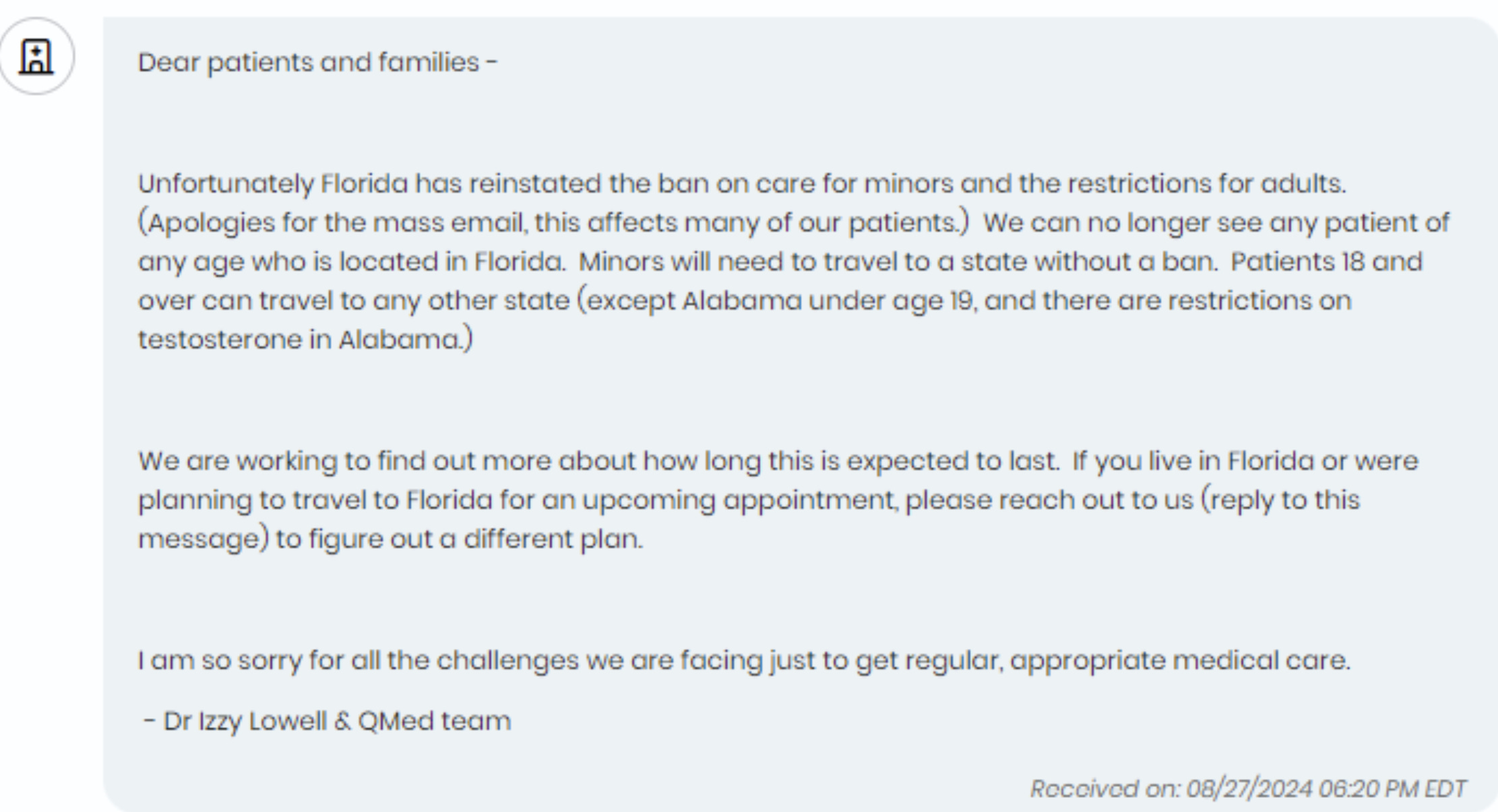
Email provided from a QueerMed Patient

Spektrum, a major provider in Florida, was also forced to terminate care and cancel new patient appointments. However, during the period when the law was blocked, the organization reportedly took steps to ensure patients were well-supplied with medication in case the law went back into effect:

“During this little freedom period as I call it … we made good use of that time to make sure all of our patients were well supplied with medication. Although I had hoped that it wouldn’t have been necessary, at least now we can say, I’m glad we did all the things that we did,” said Joseph Knoll, a nurse practitioner at the clinic, as reported by the Associated Press.

Healthcare bans are currently a contentious issue in courts across the United States, with some courts blocking bans on transgender healthcare coverage or provision. A major point of contention is whether discrimination against transgender people qualifies as sex discrimination, which would subject these laws to higher scrutiny regarding their constitutionality.

The Supreme Court is poised to rule on such questions later this year in a case stemming from Tennessee’s trans care ban. If the Supreme Court were to rule that transgender people are not entitled to equal protection under the law, many forms of discrimination against transgender youth and adults could be deemed fully legal.

For trans people in Florida, many cannot afford to wait for such a decision, and many have already fled the state. For those unable to leave, disruptions to their care will likely have significant impacts on their mental and physical health.

“We are deeply disappointed by this decision and the panel’s disregard for the district court’s careful findings and adherence to the Eleventh Circuit’s recent precedent. Allowing these discriminatory restrictions to go back into effect will deny transgender adults and adolescents lifesaving care, and prevent Florida parents from making medical decisions that are right for their children. As the district court found based on voluminous evidence, the record shows that these extraordinary restrictions were based on disapproval of transgender people and serve no purpose other than to harm transgender Floridians. The plaintiffs in this case are considering their options and will take every step possible to protect their right to equal treatment under Florida’s laws, which these restrictions egregiously violate. We will continue fighting for transgender Floridians and their families, and for everyone’s right to make healthcare decisions without government interference,” said the organizations representing the plaintiffs in the case.

News Headlines and My Thoughts 4

I read news headlines and discuss the articles. This one was about tRump’s lies that the military has no ammo, DeathSantis wants to sell state parks to developers to put up hotels and golf courses, OK removes the teaching license of a teacher who fought the book bans, Kennedy may be on the tRump transition team, and lastly a judge blocks a Biden plan to help undocumented immigrants spouses gain citizenship.

DNC Convention: DEMolish HATE! | Christopher Titus | Armageddon Update

Peace & Justice History 8/28

August 28, 1833
The Abolition of Slavery Act was passed by the British Parliament. As early as 1787, members of the Society of Friends (Quakers), particularly Thomas Clarkson and Granville Sharp, organized to end the slave trade.Since Quakers were barred from serving in the House of Commons, the cause was led by a member of the Evangelical Party, William Wilberforce, ending the international trade in slaves in 1807. By 1827 slaving was considered piracy and punishable by death. The complete ban on slavery itself through the British Empire didn’t happen until this day; Wilberforce was informed of the Act’s passage on his death-bed.

William Wilberforce
August 28, 1963
Reverend Martin Luther King, Jr. delivered his “I Have a Dream” speech from the steps of the Lincoln Memorial to a crowd of half a million gathered on the Mall in Washington, D.C. They gathered there for jobs and freedom.
The speech: https://www.npr.org/2010/01/18/122701268/i-have-a-dream-speech-in-its-entirety

  organizing to build the march
Film of the March and the speech: https://vimeo.com/2158959

1983:
Three hundred thousand marched in Washington on the 20th anniversary of MLK’s “I Have A Dream” speech for the second “March on Washington for Jobs, Peace and Freedom.”

August 28, 1976
60,000 joined the Community of Peace People demonstrations in Belfast and Dublin, Ireland. Peace People was founded by two women, Betty Williams and Mairead Corrigan to decry the painful violence between Catholics and Protestants, between unionists and republicans, and to move the peace process forward in Northern Ireland.
Betty Williams
Mairead Corrigan
They jointly won the Nobel Peace Prize for 1976.
More about Betty Williams and Mairead Corrigan
 
From the Declaration of the Peace People:
“ . . . We want to live and love and build a just and peaceful society.
We want for our children, as we want for ourselves, our lives at home, at work and at play, to be lives of joy and peace.
We recognize that to build such a life demands of all of us, dedication, hard work and courage . . .
We dedicate ourselves to working with our neighbors, near and far, day in and day out, to building that peaceful society in which the tragedies we have known are a bad memory and a continuing warning.”

The Peace People’s website: https://www.peacepeople.com/

https://www.peacebuttons.info/E-News/peacehistoryaugust.htm#august28

News Headlines and My Thoughts 2

tRump is a racist and Nazi supporter. tRump stealing money, money disappearing and not traceable. Fox Host claims Democrats are the real authoritarians.

Reblog from MPS

“Proving them wrong”: After raising minimum wage, California has more fast-food jobs than ever

In April, California fast-food workers went from earning $15.50 per hour to $20 per hour

By Ashlie D. Stevens

Last year, California Governor Gavin Newsom signed the state’s fast-food minimum wage increase into law, which meant that employees at fast-food restaurants in the state went from making $15.50 per hour to $20 per hour. While the decision was lauded by many labor activists as part of broader efforts to improve working conditions and address wage disparities, some economists and fast-food industry members expressed concern over how the law would impact restaurants’ operating costs, which could result in reduced hours for workers or even job cuts. 

However, according to new state and federal employment data, California’s fast-food industry has added jobs every month this year — including 11,000 new jobs since the wage increase officially went into effect in April. For instance, in May of 2023, there were 742,600 fast-food workers in the state; a year later, there were 743,300 workers. 

According to a release from Newsom’s office last week, since raising worker wages, every month this year has seen consistent fast food job gains, and nearly each month has seen more jobs than the same month last year.

“What’s good for workers is good for business, and as California’s fast food industry continues booming every single month our workers are finally getting the pay they deserve,” Newsom said in a written statement. “Despite those who pedaled [sic] lies about how this would doom the industry, California’s economy and workers are again proving them wrong.”

CO2 pipeline setback: South Dakota Supreme Court rules in landowners’ favor


by Skylar Tallal Fri, August 23rd 2024 at 10:30 PM

DES MOINES, Iowa — Summit Carbon Solutions is facing a set back in its proposed CO2 pipeline project, as the South Dakota Supreme Court ruled in favor of landowners who sued to keep Summit from surveying their land.

It’s a reversal of a lower court decision, with the state’s high court now claiming it’s premature to categorize Summit as a ‘common carrier’ for public utility. It’s something Summit needs to be able to prove before it can use eminent domain.

“One of our main arguments is that Summit’s not a common carrier,” Jess Mazour the conservation program coordinator with the Sierra Club Iowa Chapter said. “So it really does change the game here in Iowa as well.”

Summit can’t start building its pipelines in Iowa until it gets approval in North and South Dakota.

The Sierra Club Iowa Chapter calls the decision a victory for landowners. Even though the Iowa Utilities Commission isn’t taking up the club’s reconsideration request, the club is moving forward with its plan to take the fight to court.

“We now have precedent on our side and we’re going to have a strong base for when we file our appeal in district court,” Mazour said.

A similar court case is already on the books in Iowa, with Iowa’s highest court set to hear oral arguments October 8 at the state capitol.

“A landowner in Hardin County, Kent, he was sued for denying Summit access to his land and we are fighting that and also challenging Iowa’s survey law,” Mazour said.

Eminent Domain has been a major issue in Iowa over the last few years. Some Iowa lawmakers joined the pipeline opposition but haven’t been successful in their efforts to change state laws.

The topic is also coming up on the campaign trail, specifically in Iowa’s congressional races.

Congressional Rep. Mariannette Miller-Meeks (R) Iowa said carbon capture pipelines make sense for Iowa.

“So the carbon capture pipeline is only meant to lower the carbon intensity score of ethanol which makes it competitive globally,” Rep. Miller-Meeks said.

She said while eminent domain is a state issue, she hopes there will only be a limited number of landowners who don’t sign on voluntarily.

“Farmers and property owners need to look at the why the rationale and then determine if it’s in their best interest,” Rep. Miller-Meeks said. “Companies that are acquiring easements are looking at how do you make the land whole. How do you ensure farmers that you can grow crops in the near future?”

Iowa’s News Now did reach out to Summit for comment didn’t hear back.

https://cbs2iowa.com/news/local/south-dakota-supreme-court-rules-in-landowners-favor-set-back-for-co2-pipelines

Vance’s Trumped-Up Economics

Robert Reich Aug 25, 2024 (Posting Monday AM)

Friends,

Sorry to interrupt your Sunday but I think it useful in these final weeks before the election to give you the truth on important matters of public policy.

Today, Republican vice-presidential nominee JD Vance told NBC News that the tariffs Trump imposed during his term in office had not raised prices for Americans but had brought a significant number of jobs back to the United States.

Wrong on both counts.

In a careful analysis, researchers found the cost of Trump’s tariffs were “almost entirely borne by U.S. firms and consumers.”

That’s not surprising; tariffs function like taxes by raising the costs of imported goods. Trump’s proposal to raise tariffs on all imports as a means of raising revenue to offset a tax cut is obviously absurd.

Vance is also wrong about employment. Research clearly shows that the Trump tariffs did not bring jobs back to the United States.

Tariffs may be necessary for national security to protect critical industries such as semiconductors. But no one should be fooled into thinking they’re costless for consumers, or good for workers. The 1930 Smoot-Hawley tariff made the Great Depression far worse than it already was.

That Vance would make these claims — which have been so convincingly debunked — should cause all of us some concern. He seems as unreliable as the person who named him his running-mate.

https://robertreich.substack.com/p/vances-trumped-up-economics

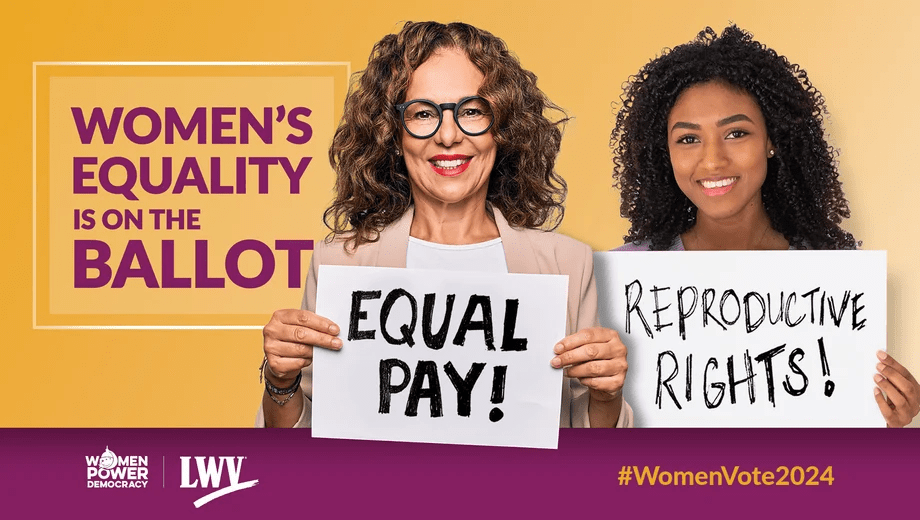
Women’s Equality Day!

(Some references, and resources for the day, and every day to come!

Thanks and h/t to Women for Kansas -A)

August 26, otherwise known as Women’s Equality Day, marks the anniversary of the certification of the 19th Amendment, which granted some women the right to vote.

Yet today, women have fewer rights than they’d had in decades. To recognize this, we acknowledge Women’s Inequality Day.

Empowering Women Voters in 2024

Women still aren’t equal under the law. 

2024 Social Toolkit

Inequality impacts our health: although women pay $15 million more each year for health care than men, we spend more of our lives in poor health. Those who may experience pregnancy no longer have reproductive freedom; and when we do give birth, we (particularly women of color) face high rates of maternal mortality. 

It impacts our work: we’re paid less than our male counterparts and are underrepresented in leadership roles. We also deal with workplace harassment, insufficient maternal leave, and disproportionate caretaking responsibilities that affect our ability to work. 

It impacts our representation: women are severely underrepresented in politics, making up only 25% of the Senate, 29% of the House, and 31.9% of statewide elective executives.  

How can we make policies that protect and serve women without more women in office? And in an age where our basic freedoms and bodily autonomy are under fire, how can we ensure our rights aren’t degraded further? 

The 2024 federal election is a critical moment in the fight for our equality. 

The people we elect in November will be in charge of our rights – including the right to reproductive freedom – for the next four years. 

So when you cast your vote in 2024, will you vote for someone who defends those rights? Or someone who wants to take them away? 

Our 2024 campaign centers around empowering women to make their voices heard at the ballot box by equipping them with essential voter information. We’re highlighting our free, bilingual one-stop-shop for nonpartisan election information, VOTE411.org.

This year’s Women’s Inequality “Day” campaign will take place from August 26-30, with unique calls to action engaging voters every day! Get involved by sharing content via our social toolkit.

https://www.lwv.org/WID

=====

International Women’s Day 2024 campaign theme is ‘Inspire Inclusion’

The campaign theme for International Women’s Day 2024 was Inspire Inclusion.

When we inspire others to understand and value women’s inclusion, we forge a better world.

And when women themselves are inspired to be included, there’s a sense of belonging, relevance, and empowerment.

Collectively, let’s forge a more inclusive world for women.

Read more about a definition of what it means to inspire inclusion here.

https://www.internationalwomensday.com/Theme

=====

BAD ROMANCE: WOMEN’S SUFFRAGE

Soomo, youtube.com

“Bad Romance: Women’s Suffrage is a parody music video paying homage to Alice Paul and the generations of brave women who joined together in the fight to pass the 19th Amendment, giving women the right to vote in 1920.” Watch here.

=====

WOMEN’S PROGRESS THROUGH THE YEARS…
Prior to 1918
Doctor’s weren’t allowed to advise married patients about birth control.
Prior to 1920
Women couldn’t vote in all elections until 19th Amendment was ratified.
Prior to WWII
Female teachers couldn’t be married.
During 1950’s
Domestic abuse was not considered a crime but a’family matter’.
Prior to 1963
Equitable wages for the same work, regardless of race, color, religion, national origin, or sex of the workers were not promised until passage of Equal Pay Act.
Prior to 1964
Discrimination on the basis of race, color, religion, national origin, or sex was not prohibited until passage ofthe Civil Rights Act.
Prior to 1965
State laws could prohibit the prescription or use of contraceptives by married couples. In some states, the woman needed her husband’s permission to purchase contraceptives.
Prior to 1969
Yale and Princeton didn’t accept female students.
Prior to 1969
Women couldn’t work at jobs that had been for men only.
Prior to 1971
Women with a law degree could be denied the right to plead a client’s case in court.
Prior to 1971
Private employers could refuse to hire women with pre-school children.
Prior to 1972
The Boston Marathon was an all-male event. There was no Women’s Division.
Prior to 1972
The right to privacy didn’t encompass an unmarried person’s right to use contraceptives.
Prior to 1972
Title IX of the Education Amendment didn’t exist. Schools that received Federal support didn’t need to provide the same programs to women as they did men.
Prior to 1973
Abortions weren’t legal in the entire U.S. until Roe v. Wade decision by Supreme Court declared the U.S. Constitution protected a woman’s right to terminate an early pregnancy.
Prior to 1974
Housing discrimination on the basis of sex and credit discrimination against women existed.
Prior to 1974
It was legal to force pregnant women to take maternity leave on the assumption they were incapable of working in their physical condition.
Prior to 1974
Single, widowed, or divorced women had to bring a man along to open a bank account or to cosign any credit application. Married women couldn’t open a bank account without their husband’s permission.
Prior to 1975
Women were excluded from serving on juries.
Prior to 1976
West Point Academy didn’t admit female students.
Prior to 1977
Harvard didn’t admit female students.
Prior to 1978
There was no ban on discrimination against women on the basis of pregnancy, childbirth, or related medical issues.
Prior to 1984
Women were not allowed to join all-male organizations (Jaycees, Kiwanis, Rotary, Lions)
Prior to 1994
There were no funded services for victims of rape or domestic violence.
Prior to 2013
Women in the military were banned from combat positions.
Prior to 2022
Since the 1973 Supreme Court decision (Roe v. Wade), a woman’s right to terminate a pregnancy was protected by the U.S. Constitution. This decision was reverse by the current U.S. Supreme Court in 2022.
Information provided by Soroptimist site. Learn more about Soroptimist’s by visiting their site here.

LEARN MORE ABOUT THE HISTORY OF WOMEN’S EQUALITY DAY

National Women’s History Alliance

Read more here.