If Donald Trump returns to the presidency, he’ll have another shot at achieving a goal that eluded him last time: Changing the colors of Air Force One to his beloved red, white and dark blue.
And he’ll likely do it — even though replacing the traditional light-blue-and-white design with Trump’s preferred scheme would be complicated and expensive.
A former senior Trump White House official who remains close to him says it would be totally in character for the former president to insist on using his preferred colors on the planes.
“Absolutely. 100 percent,” said the former official, granted anonymity to discuss Trump’s thinking.
The Air Force is still modifying two Boeing 747-8s to replace the existing aircraft, and the two planes are on track to be delivered in 2026 and 2027, years late and well over budget. When they arrive, they’ll be sporting the traditional white-and-light-blue livery that has adorned presidential aircraft since the Kennedy administration.
But according to three people familiar with the program, there’s still time for Trump to order the color scheme back to his favored palette, similar to the pattern already on his private plane. In 2019, the then-president told ABC host George Stephanopoulos that he wanted to shake up the traditional pattern with a design he made himself.
“There’s your new Air Force One,” Trump said at the time, holding up mock-ups of the aircraft that at the time was supposed to be delivered by this year. “I’m doing that for other presidents, not for me.”
After POLITICO reported in 2022 that Trump’s preferred colors would lead to expensive design fixes, the Biden White House scrapped the plan and brought back the traditional palette.
The person familiar with Trump’s thinking said he expects him to change the colors back because of how proud the former president was of the design change.
“The model was on the coffee table in the Oval Office and he pointed it out many times to foreign and domestic visitors,” the person said. “He thought it represented America more and represented strength, the red, white and blue.”
Yet the cost of bringing back Trump’s favored shade hasn’t gone away.
At some point after Trump announced he was changing the colors in 2019, Boeing determined that the dark blue paint on the underside of the plane and its engines would likely contribute to excessive temperatures, a problem that Boeing would likely have to pay out-of-pocket to fix.
Specifically, the dark color would require modifications to cool some of its components, the three people familiar with the changes said. The people were granted anonymity to speak freely about the sensitive program.
The people said changing the color scheme this far in the process may require more engineering work, millions of dollars in cost overruns, and further delays.
“For example, Boeing would need to ensure antennas work with the new livery and that there is no interference,” one person said.
Boeing referred to the Air Force for comment. An Air Force spokesperson said the service does not speculate on hypotheticals. Asked for comment, Trump campaign spokesperson Steven Cheung said “Sounds like Joe Biden hates the Red, White, and Blue.” He did not specifically answer whether Trump would change the color.
As president, Trump took pride in personally getting involved in the negotiations for the replacement aircraft once he learned of the cost. In February 2017, he said the Air Force was “close to signing a $4.2 billion deal” and “we got that price down by over $1 billion.”
The Air Force awarded Boeing a $3.9 billion contract in 2018 for the two modified 747-8s to replace the existing Air Force One aircraft, based on the 747-200B model that has been flying since the 1990s.
The company consented to a fixed-price contract with the Air Force, meaning any changes made to the airplane are at Boeing’s cost, not the government’s. The program is already more than $2 billion over budget.
Boeing CEO Dave Calhoun told investors in 2022 that company executives should never have agreed to Trump’s terms for the Air Force contract six years ago.
The program faced major problems when a subcontractor hired to furnish the cabin interior went bankrupt, and Boeing had to switch to a new supplier. The program also faced hurdles due to labor shortages and a lack of employees with the proper clearances to work on the sensitive program.
During Trump’s presidency, Democrats registered their opposition to his decision to change Air Force One’s paint scheme. After winning control of the House in 2019, Democrats pushed to limit changes to the paint job or interior decorations on the program.
Defense legislation that passed the House that year included language limiting changes to the aircraft’s livery and interior design to what was included in the contract.
Rep. Joe Courtney (D-Conn.), who sponsored the proposal, said at the time that Congress needed to rein in “less essential aspects” of the new planes and close a potential “backdoor for the program to hemorrhage” money.
“The president will have an opportunity to make some suggestions and changes to the plane,” Courtney said during the 2019 House Armed Services Committee deliberations on the defense bill. “But we do want to keep this within the parameters of the existing contract process so that, again, we’re not creating additional costs for the operation of the plane.”
“Additional paint can add weight to the plane,” he noted.
Republicans, however, accused Democrats of using the program to take a swipe at Trump. Then-Rep. Bradley Byrne (R-Ala.) criticized the effort as “an attempt to just poke at the president.”
“Prior to 2017, I don’t recall attempts to block things like paint colors,” he said.
The measure passed the House, but not the Senate. Lawmakers ultimately approved a compromise bill that required the Air Force to notify Congress before it undertook any “over and above” work on the aircraft.
Bright future for medicines and farming after fluorine discovery
July 30, 2024 Ellen Phiddian
US researchers have figured out an environmentally friendly way to mix fluorine into carbon molecules using enzymes and light.
The discovery illuminates a path for safer and more ecologically sound materials, particularly pharmaceuticals and agricultural chemicals.
“This work could pave the way for new, greener technologies in chemical production,” says senior researcher Professor Huimin Zhao, from the University of Illinois at Urbana-Champaign.
Fluorine atoms can be very powerful additions to bioactive materials. They can make medicines easier to absorb, more stable in biological systems, and better at interacting with other proteins. About 20% of pharmaceuticals on the market contain fluorine.
But these organic (carbon-containing) molecules all typically need a bond between a fluorine atom and a carbon atom to work.
This bond is rare in nature, and difficult to make in a lab. At the moment, most fluorine-containing substances are made using super-toxic hydrogen fluoride, which can be fatal with just a small splash to the skin.
This has spurred chemists to hunt for other ways to fluorinate molecules.
In this research, the scientists used a protein that responds to light, called a photoenzyme.
Using this enzyme, they were able to add fluorine to a class of molecules called olefins. These carbon-containing molecules are widely used as a feedstock in the chemical industry, because they’re easy to turn into a range of other molecules.
The reaction is also “stereoselective”: it can differentiate between molecules that are chemically identical, but optically different. This is a difficult property to achieve in a lab, but crucial to the pharmaceutical and agricultural market because biological organisms can react differently to optically different molecules.
Maolin Li (seated) and Huimin Zhao in the lab. Credit: Center for Advanced Bioenergy and Bioproducts Innovation (CABBI)
“Our research opens up fascinating possibilities for the future of pharmaceutical and agrochemical development,” says Dr Maolin Li, a postdoctoral researcher at the University of Illinois at Urbana-Champaign.
“By integrating fluorine into organic molecules through a photoenzymatic process, we are not only enhancing the beneficial properties of these compounds but also doing so in a manner that’s more environmentally responsible.
“It’s thrilling to think about the potential applications of our work in creating more effective and sustainable products for everyday use.”
Newsweek observed that the White Dudes for Harris X account had been suspended after the group held a star-studded virtual call on Monday night that raised more than $4 million.
The automated message when the account was suspended read: “X suspends accounts which violate the X rules.” Mike Nellis, who is involved in the organization, shared an update on Tuesday explaining that while the X account is live again, it still remains suspended.
He said the account is “permanently in read-only mode,” meaning it cannot post. When contacted by Newsweek for comment, X’s press office responded: “Busy now, please check back later.”
Classic. @elonmusk puts false video smearing VP Harris with lies in an AI generated audio/video of statements never made. He violates his own rules but because he’s on the wrong side of history now is reduced to muzzling honest support for #Kamala4President2024 . https://t.co/VTCxKDixLL
Technically not GOP, but definitely a platform for white racist bigots, Nazis, and other hate-filled bigots. Which, I suppose, is pretty much the same thing nowadays.
I like to combine the old name into the new: Xitter, with the X pronounced as /sh/, because that is exactly what it has become since Musk took over. In a similar fashion, the messages are now xits, with x pronounced the same way
A priest is suing the gay dating and “hookup” app Grindr after the company reportedly failed to protect his data, leading to his resignation from a top position at the U.S. Conference of Catholic Bishops (USCCB).
In July 2021, Monsignor Jeffrey Burrill resigned from his post as the general secretary of the USCCB ahead of a report by The Pillar alleging that he had engaged in inappropriate behavior and frequent use of Grindr.
The app advertises itself as “the largest social networking app for gay, bi, trans, and queer people.” Its geolocation feature is popularly known to facilitate sex hookups between gay men.
The Pillar said its report on Burrill was based on “commercially available records” correlated to the priest’s mobile device. But a lawsuit filed this week claims that Grindr hadn’t taken steps to protect the data from third-party acquisition.
The suit, filed in the Superior Court of California, claims the group Catholic Laity and Clergy for Renewal (CLCR) purchased the priest’s data from the app and sent it to The Pillar.
The gay hookup app “assures customers” that it “takes steps” to protect data from unauthorized access, use, or disclosure, the suit says. But Grindr allegedly “knew they were failing to protect sensitive personal data of its customers” yet failed to take steps to protect it, the filing says.
Public reports “reveal a stunning pattern of [Grindr’s] intentional and reckless failure to protect private data of its customers,” the priest argues in the suit.
The company allegedly “fraudulently conceals and fails to disclose that it provides and/or sells its users’ personal data to ad networks, data vendors, and/or or other third parties that sell the data or otherwise make it commercially available to others.”
The suit requests damages, lawyer’s fees, and “injunctive relief.” It also asks the court to forbid Grindr “from committing such unlawful, unfair, and fraudulent business practices.”
In 2022 Burrill returned to active ministry as a priest in his home diocese of La Crosse, Wisconsin, with then-Bishop William Callahan stating that the priest had “engaged in a sincere and prayerful effort to strengthen his priestly vows” and had “favorably responded to every request” made by the bishop and the diocese.
The priest was appointed to St. Teresa of Kolkata Parish in West Salem, where he serves as pastor.
In his lawsuit, Burrill said his reputation had been “destroyed” by the data leak.
In addition to losing his position at the USCCB, he was “subjected to significant financial damages and emotional and psychological devastation,” the suit says.
Daniel Payne is a senior editor at Catholic News Agency. He previously worked at the College Fix and Just the News. He lives in Virginia with his family.
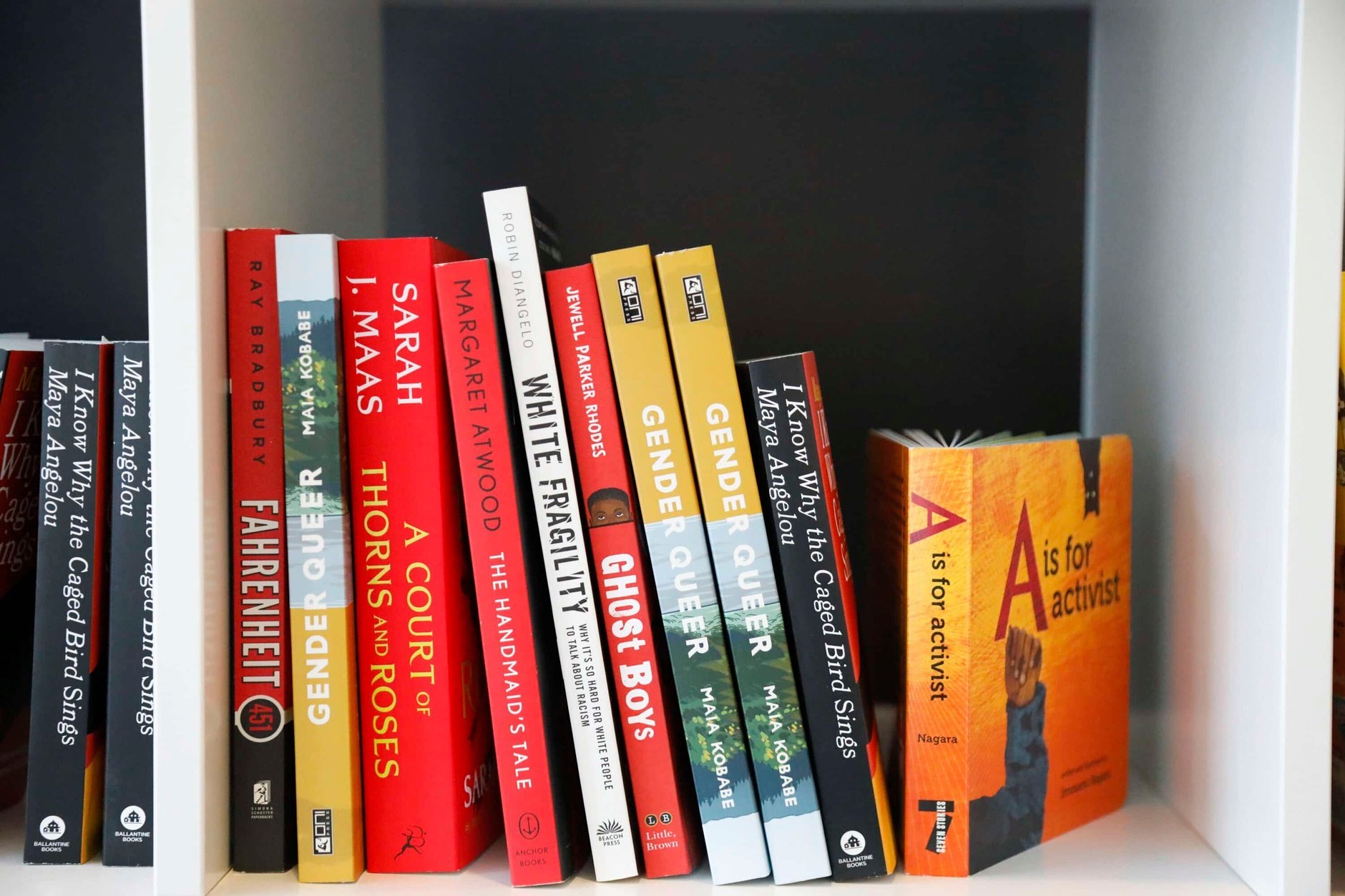
Idaho’s recently enacted bill encourages parents and children to bring legal action against schools and libraries that refuse to move certain material into “adult only” sections.
Books are displayed at the Banned Book Library at American Stage in St. Petersburg, Fla., on Feb. 18, 2023. (Jefferee Woo/Tampa Bay Times via AP)
A recently enacted law requiring Idaho schools and libraries to remove materials that are “harmful” to minors infringes on the First Amendment rights of private entities, a group of private schools, privately-funded libraries, parents and schoolchildren say in a Thursday lawsuit.
House Bill 710 — which took effect July 1 after Governor Brad Little signed it into law in April — allows citizens and the government to file a lawsuit against any school or library that doesn’t move certain material into designated “adult only” sections within 60 days of a complaint.
“H.B. 710 is the product of a social climate in Idaho (and elsewhere) in which schools and libraries have been inaccurately and unfairly castigated and villainized for using and making available constitutionally protected materials with content that the state and some Idahoans disapprove of,” the plaintiffs say in the 57-page complaint.
The suit was brought by private schools Sun Valley Community School and Foothills School of Arts and Sciences, along with the Community Library Association, a privately funded public library, and Collister United Methodist Church, which operates a lending library.
The groups are also joined by a set of parents and two high school-age students, who say that they want access to these reportedly “harmful” books and other materials to further their education.
The plaintiffs say the law violates their First Amendment free speech rights and their Fourteenth Amendment rights to due process. They ask the court to block enforcement of the law and to declare HB 710 unconstitutional.
“The act’s vague and overbroad definition of ‘harmful to minors’ conflicts with decades of settled constitutional law and extends well beyond the state’s limited authority to restrict the materials that private parties, like the private entity plaintiffs, may provide to minors,” they write.
Under the act’s definitions, the plaintiffs say, materials like health and sex education textbooks, literary works like Maya Angelou’s “I Know Why the Caged Bird Sings” and artworks like Michelangelo’s David would all be subject to removal, possibly based on arbitrary and subjective reasons.
“Even the Bible, if a defendant or citizen complainant subjectively believes members of their community would find them offensive,” could be targeted, the plaintiffs note.
The plaintiffs also take specific aim with a clause of the act that restricts materials that depict or represent “sexual conduct” — a definition that includes “any act of … homosexuality.”
Beyond the “vague and overbroad” definition of what constitutes “harmful for minors,” the plaintiffs also take issue with what they called the “incoherent” enforcement provisions outlined in HB 710. The act “fails to provide constitutionally meaningful guardrails on enforcement,” plaintiffs say.
“If a private entity plaintiff disagrees with the content-based assessment of the parent or minor and declines to segregate the challenged material, the parent or minor is authorized to file a civil suit against the private entity plaintiff and incentivized to do so by a cash reward and the availability of ‘actual damages,’” the plaintiffs write, referring to a provision in HB 710 that allows for a possible recovery of $250 and statutory and actual damages, if the complainant prevails in the case.
The government itself is also permitted under HB 710 to seek an injunction against any of the plaintiffs, who say this could lead to financial and reputational harm.
The plaintiffs name Idaho Attorney General Raúl Labrador as a defendant, alongside Jan Bennetts, prosecuting attorney for Ada County, and Matt Fredrick, prosecuting attorney for Blaine County.
HB 710 is not the first attempt Idaho legislators have made to restrict library access in the state. A version of the measure made it through the 2023 session but was rejected by Little.
In a letter after he signed HB 710, the governor commended the 2024 bill for having tighter definitions for restricted material and for lowering the recovery from $2,500.
“I share the co-sponsors’ desire to keep truly inappropriate materials out of the hands of minors,” Little wrote in April.
Libraries initially pushed back on the bill, citing free speech concerns and the financial burden it could levy, particularly on smaller libraries, but legislators stood by the measure.
“I can assure you that there is no book banning and there’s no book burning and there’s no book removal anywhere in this legislation. What we have to look at when you look at these libraries is that you have differing viewpoints and different opinions from taxpayers,” Representative Jaron Crane, a Nampa Republican and bill co-sponsor, said in committee, the Idaho Capital Sun reported in March.
I have followed Gronda for a long time, before she took her long break. But she is back and her writtings while in debth and a bit long are so very interesting and well researched that they are more than worth the time to read. I love them. I hope everyone here will. Hugs. Scottie
A complete Christian take over if the US and an attempt to turn society back to 1850s mentality with a 1950s society. And if tRump wins, we all well have to start attending the hate church nearest us. The women in the back, on one side, black people in the back on the other, and white men in front to show their privilege. After church while the men relax the women and girls will be cooking meals. The gays will be converted in camps and if they still have the demon gays, the LGBTQ+, they will be removed from society. Hugs. Scottie
Heritage Foundation leader has long received spiritual guidance from group and his policy goals align with its teachings
Kevin Roberts, the Heritage Foundation president and the architect of Project 2025, the conservative thinktank’s road map for a second Trump presidency, has close ties and receives regular spiritual guidance from an Opus Dei-led center in Washington DC, a hub of activity for the radical and secretive Catholic group.
Roberts acknowledged in a speech last September that – for years – he has visited the Catholic Information Center, a K Street institution headed by an Opus Dei priest and incorporated by the archdiocese of Washington, on a weekly basis for mass and “formation”, or religious guidance. Opus Dei also organizes monthly retreats at the CIC.
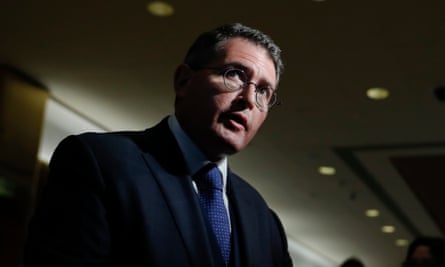
Kevin Roberts, president of the Heritage Foundation, speaks at an event on 12 April 2023. Photograph: J Scott Applewhite/AP
In the speech – which he delivered at the CIC and was recorded and is available online – Roberts spoke candidly about his strategy for achieving extreme policy goals that he supports but are out of step with the views of a majority of Americans.
Outlawing birth control is the “hardest” political battle facing conservatives in the future, the 50-year-old political strategist said, but he urged conservatives to pursue even small legislative victories – what he called “radical incrementalism” – to advance their most rightwing policy objectives.
Kevin Roberts explains ‘radical incrementalism’ to advance rightwing policy objectives – video
Roberts gained notoriety this year as the leading force behind Project 2025, a foundation plan backed by more than 100 conservative groups that seeks to radically upend a broad range of policies if Trump gets elected again, from limiting abortion access and LGBTQ+ rights and dismantling the Department of Education, to ending diversity programs and increasing government support for “fertility awareness” programs, like ovulation tracking and practicing periodic abstinence, instead of more reliable contraception.
But Roberts’ personal ties to Opus Dei and the significance of his affiliation, have received far less attention.
Gareth Gore, the author of a forthcoming book on Opus Dei, called the Catholic organization “a political project shrouded in a veil of spirituality”. The group’s founder, Saint Josemaría Escrivá, saw his followers as part of a “rising militia”, Gore said, who were seeking to “enter battle against the enemies of Christ”.
“Like Project 2025, Opus Dei at its core is a reactionary stand against the progressive drift of society,” Gore said. “For decades now, the organization has thrown its resources at penetrating Washington’s political and legal elite – and finally seems to have succeeded through its close association with men like Kevin Roberts and Leonard Leo.”
Leonard Leo, the Federalist Society executive vice-president, speaks to the media at Trump Tower on 16 November 2016. Photograph: Carolyn Kaster/AP
Leo is a conservative activist who has led the Republican mission to install the rightwing majority in the supreme court and finances many of the groups signed on to Project 2025.
Like Roberts, Leo also has links to the Opus Dei-linked CIC. In a 2022 speech accepting the CIC’s highest honor, the John Paul II New Evangelization award, Leo praised the center while also referring to his political opponents as “vile and amoral current day barbarians, secularists and bigots” who were under the influence of the devil.
Democrats, including Kamala Harris, have been sounding the alarm on Project 2025 to warn voters of what a second Trump administration could do.
“[Trump] and his extreme Project 2025 agenda will weaken the middle class. We know we have to take this thing seriously. And can you believe they put that thing in writing?” Harris said this week in her first presidential campaign rally, to laughter. “Read it. It’s 900 pages.”
Trump, for his part, has sought to distance himself from the project, though the people behind it have close ties to the former president, and the policies it envisions often align with Trump’s ideas. Roberts has said he is “good friends” with JD Vance, Trump’s running mate, and Vance has praised Project 2025 as having “some good ideas”. Vance, who converted to Catholicism in 2019, also wrote the foreword for Roberts’ forthcoming book, praising the author for articulating a “genuinely new future for conservatism”.
“We are now all realizing that it’s time to circle the wagons and load the muskets. In the fights that lay ahead, these ideas are an essential weapon,” Vance wrote.
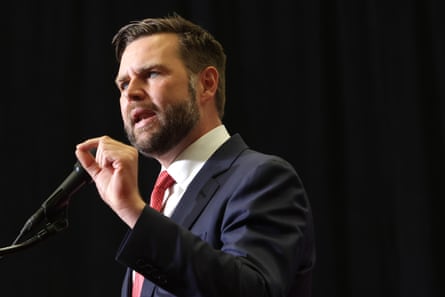
JD Vance, Trump’s running mate, speaks at a campaign rally at Radford University on 22 July 2024 in Radford, Virginia. Photograph: Alex Wong/Getty Images
Opus Dei does not disclose the names of its members. The group’s roots date back to a century ago, when the group was established in Spain in response to a clash between conservative Catholics and anti-Catholic socialism and communism in Spain. Decades later, the group was granted special status by the conservative pope John Paul II, who supported Opus Dei and saw it as a response to the rise of liberation theology in Latin America, a progressive church movement.
Some of Opus Dei’s special rights were revoked in recent years by Pope Francis, who is seen as a more progressive pontiff.
One of the core tenets of Opus Dei is that it does not believe in the traditional separation of church and state. Instead, said Massimo Faggioli, a professor of theology and religious studies at Villanova University, it believes the two ought to have a symbiotic relationship.
“They are secretive, so while they are not [outwardly] part of this [Project 2025] per se, it is not surprising at all that some of their members are part of it. They see this moment in politics – and the possibility of allowing ‘woke ideology’ to win – as fundamentally changing the nature of America, western civilization and Christianity,” Faggioli said.
He added: “Opus Dei is part of [a movement of] US conservative and traditionalist Catholicism that holds a view that the United States is the last bastion of Christendom, so that if the United States goes a certain way, so goes Christianity, and Catholicism.”
Indeed Roberts made it clear earlier this month that he believes the US is at a crossroads, and“in the process of the second American Revolution, which will remain bloodless if the left allows it to be”.
Asked whether it had a view on Roberts’ remarks or Project 2025, a spokesperson for Opus Dei told the Guardian in a statement: “Opus Dei is an institution of the Catholic Church that tries to help people come closer to God in their work and everyday lives. Opus Dei’s aims are purely spiritual and it does not endorse or have any opinion on any political project of any kind.”
Opus Dei is controversial not only in the US. Dozens of women from Argentina and Paraguay filed a complaint to the Vatican over labor exploitation and abuses of power they say they experienced after joining the group at sites in multiple countries. And reporting in Australia gave insight into schools run by Opus Dei, where former students allege their education left them with “psychological damage”.
Roberts’ personal background suggests his ties to Opus Dei are not just limited to the CIC. A school founded by Roberts in Louisiana, called John Paul the Great Academy, considers Opus Dei-founder Escrivá its “patron”.
Josemaría Escrivá, founder of the Catholic group named Opus Dei. Photograph: REUTERS
Roberts was also involved in an Opus Dei-affiliated high school leadership program in Austin, Texas. A website that tracks Opus Dei men’s activities called Where You Are included a profile of the high school program in Austin where Roberts appears to volunteer and “contributes significantly “ to the school’s career and leadership program.
Roberts was featured as a guest at another Opus Dei-linked school, the Camino Schools, in 2023. In introductory remarks before Roberts spoke, the school’s chairman, Bob Rose, praised schools that teach boys and girls they are “different”, they learn differently and are inspired by different things, and where boys are taught by “manly men” who serve as role models.
Roberts’ critics said concerns about his ties to Opus Dei were not connected to his identity or beliefs as a Roman Catholic.
“Kevin Roberts, like all Americans, has a guaranteed freedom to worship or not under our constitution,” said Lisa Graves, co-founder of Court Accountability, a non-partisan group that seeks to combat judicial corruption.” That is not at issue. What is of concern is how some powerful elites, like Roberts, who have failed to persuade the American people to embrace their agenda, seem eager to use the power of the executive branch to impose their personal religious views as binding law on other Americans – by barring abortion, using the government to endorse the rhythm method of contraception, even banning mention of ‘condoms’ in women’s preventative health, as well as assailing the rights of LGBTQ+ Americans.”
Heritage did not respond to a request for comment. The CIC did not respond to a request for comment.
During Roberts’ September 2023 speech, which received little notice at the time but is posted on the center’s YouTube page, Roberts detailed how conservative Catholics and their allies could advance US policy to end access to abortion, same-sex marriage and contraception.
Knowing the unpopularity of banning birth control – a harder political battle to wage than advancing anti-abortion and anti-gay marriage policies – he encouraged an incremental approach to pursuing this long-term goal.
“Even in a politically conservative setting, that can be a very difficult thing to advance,” Roberts told attendees at the CIC event. “A majority of Roman Catholics don’t believe in that teaching, if public opinion surveys are the case. And so it makes it very difficult to advocate for that.”
The faithful should practice the “gift of discernment” to know when to bring it up: “Sometimes the right thing at the right time to the right person isn’t the full teaching of humanity, right? It isn’t the full teaching of contraception. And recognizing that that’s not the time is no way turning into Judas. In fact, it’s being apostolic. And the very definition of the word, which is in modern common parlance, meeting someone where they are.”
In espousing his theory of “radical incrementalism”, or what he called the “enchilada theory”, he said it was critical for conservatives to work first to achieve a small part of a larger policy goal based on what’s politically possible at the moment. Sometimes, he said, having even half an enchilada could be a victory.
On abortion, he noted that Roman Catholics believe “no abortion can be morally justified”, but that even in conservative circles in the US, this is not a majority opinion, and it’s an “even more difficult position to hold” after the Dobbs decision. Using the “same vocabulary of our faith” in the policy arena has a negative effect on electoral outcomes, he said.
Roberts advised listeners not to accept the “narrative framing of the other side” on these issues. He said conservatives who are anti-abortion should stop talking about it the way the left wants them to and instead “talk about the fact that many of them want abortion to be legal until birth”.
Strategies of incrementalism and narrative framing don’t always apply, he added, because sometimes you just have to fight.
“Right now, we have to fight on religious liberty and, in particular, religious liberty as it relates to protecting institutions of faith,” he said. “And that’s not a time for strategic retreat. It’s not a time to be savvy, it’s not a time to be sweet. It’s not a time to develop friendships with the other side. It is a time to take our fist – figuratively, Father Charles – and bust them in the nose because they hate what you and I believe.”


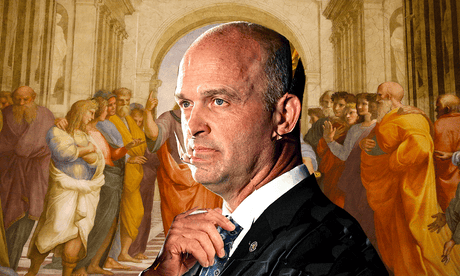
Msgr. Jeffrey Burrill | U.S. Conference of Catholic Bishops