The View from Rural Missouri by Jess Piper

The Vibes Have Changed… by Jess Piper

Hope.

Read on Substack

My husband and I have five kids. Four are now adults and we have one still at home. We have raised wrestlers, football players, basketball players, and a softball player. We’ve had a cheerleader and two homecoming kings, but we never expected our last to hate sports and love theater. Let me tell you…it’s a breath of fresh air and I don’t have to take out special insurance riders for concussions and broken collar bones.

Our last kiddo is a theater kid and I love it.

I walked into my daughter’s yearly play performance a couple of days ago and saw a woman smiling at me as I passed. You have to remember that I am in a small town and if people know me, they also know my loud-mouth brand of politics, so I can be polarizing in person. If they know me, they like me or hate me. There’s no in-between.

So when I saw her smiling at me, I smiled back. Whew! She must be friendly. She said “Kamala” as I walked past. I turned back and said, “Kamala?” She responded with, “Yes, we Kam,” and her smile grew even bigger. I couldn’t believe what I had just heard.

Kamala.

That was the Friday night performance. My daughter also had a Saturday matinee. My husband and I sat closer to the stage for this one since we knew where to better see our kid as she sang and danced. As we sat down, a woman behind me said, “Jess!” I turned and she told me how much she appreciated me speaking out on rural issues. She held my hand as she told me how excited she was to hear Kamala would be the nominee. We talked for just a minute and I then turned back to see my husband scrolling Facebook marketplace as we waited for the play to begin…he’s always looking for a deal on an old car or a lawnmower. We need neither.

A couple of minutes passed when a former student (I adore her and her entire family) got my attention. Mrs. Piper! She introduced me to yet another woman who lives in my community and sat next to me nearly breathless in her excitement for the upcoming election. She asked how we could start organizing for 2024. How can we work to elect Crystal Quade as the first woman Governor of Missouri? How can we make sure abortion rights win on Missouri ballots? How can we organize in tiny Northwest Missouri to elect Kamala Harris?

Her eyes were clear and bright. She also held my hand while speaking. She and the other women were exhibiting something I had not seen in a long time…it looked like hope.

Adams County, Illinois.

I was asked to speak to a group of Democrats in Quincy, Illinois this week and I happily accepted. Quincy is a town just over the Mississippi River from Missouri. The landscape looks exactly like the corn and bean fields of Missouri, and it is just across the river, but I was suddenly bestowed with bodily autonomy and the rights of a first-class citizen as soon as I drove east across that muddy river.

“States’ Rights.”
The problem with driving several hours with only minutes to dress for an event? I am consistently dressing next to a toilet — changing out of my leggings or shorts and into a dress. I always hope for a stall with a hook to hang my things so I don’t have to drop my clothes onto a public bathroom floor. And, don’t even ask how I apply makeup while sitting on a toilet. I live a glamorous life, friend 😉

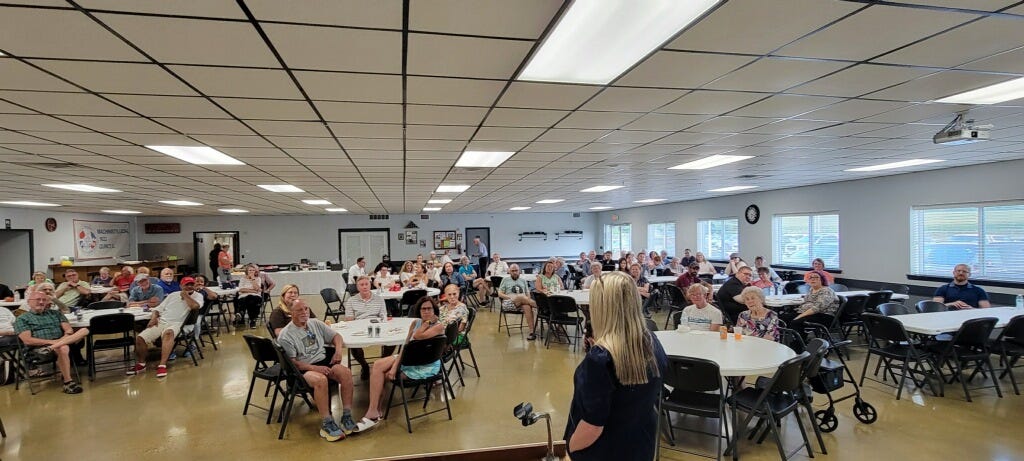
Anyway, I managed the toilet two-step and walked out ready to speak to a few people. The event organizer told me there are usually 50-60 people who attend.

As soon as folks started arriving for the event, I noticed it would be a bigger crowd than they had anticipated. The Adams County Dems had prepared enough food for 90 people — over and above what they hoped to host. They had over 100 show up. The organizer told me it was the biggest event they have had in years. I’d like to say it’s because people were there to hear me, but I know that’s not the case. People showed up because they were excited. They wanted to be around like-minded friends who are excited. They wanted to smile broadly and talk loudly. They wanted to hear others affirm what they felt.

They have hope.

I noticed a woman in a Kamala shirt…it had only been three days since Joe said he was stepping aside. I asked her if she had a Cricut machine in her basement. These folks are moving fast. Excitement.

I sat down at a table to eat my pulled pork sandwich before my talk and organizers from an abortion rights group were at the table already discussing the Plan B kits they send across the border to Missouri. One woman said they put together over 100 kits and sent them to bars in Missouri with a no-pay policy. If you need the kit, just walk in and ask. I was amazed at the work they are doing to help women in another state. My state. The first state to completely ban abortion after Roe fell.

Bless them.

The first speaker was a first-generation Mexican American who also served in the Army. He was fiery. He blew us away with his love of country and patriotism for a country that has not lived up to its potential. He reminded the audience that Democrats are patriots. That we are trying to live up to ideals that will pave the way for all to live freely in our country. He stands in the way of a Trump dictatorship.

I love to hear Dems remind us that the Republicans do not own patriotism or the flag. In fact, the leader of the Republican party is a shameful man who does not stand for American values. The audience came to their feet as he closed his message.

The next speaker was a young woman from rural Missouri. She is only 16, but she came with a speech that made me remember why Republicans want to ban books and ban the teaching of accurate history. She spoke of being a woman in a red state with an abortion ban. “Oh, to be a Woman.” She spoke of women activists and the suffrage movement. She is a woman of color and she spoke of the civil rights movement. She spoke of second-class citizenship and of her ability to see why politicians would want to oppress generations of women. Fear of our vote.

Republicans push fear while we move forward in hope.

And, this is where I should say something. Reader, you know I was in favor of Joe staying in the race, and this was the reason: Every time pundits and consultants spoke of Biden dropping out, they never named Kamala Harris. Her name did not appear on the lists for nomination, and I am not sure they would have ceded the nomination if Biden had not endorsed her as he did. If tens of thousands of us would not have immediately started donating and picking up the torch Joe had passed.

If we had not rallied behind the woman we hope to nominate for the presidency, I think we may have had another nominee and many Democrats would have felt the fracture in our party.

There is no fracture now. There is palpable hope and joy. Eyes are wide and clear and smiles abound. Folks hold my hand to tell me how excited they are to see where the party is going.

I am telling you the story of rural spaces.

The vibes have changed.

~Jess

From The Root magazine:

Don’t Get it Twisted…Black Folks Are Unified Behind Kamala Harris. Here’s What We Know

Despite what polls say, Black people have always been politically united and that’s not changing anytime soon

By Nigel Roberts Published11 hours ago

All the negative predictions and chatter about disgruntled Black voters abandoning the Democratic Party are nonsense.

Admittedly, there’s a lot of frustration over the Biden administration’s failure to deliver on issues like police reform, voting rights legislation and student loan debt relief. But venting frustration doesn’t equate to disunity.

Over the years, there’s always been a fear that we won’t unite, but in the end, we do. That’s what makes Black America a powerful voting bloc.

A New York Times/Sienna College poll released last November set off alarm bells, finding that 22 percent of Black voters in six battleground states said they would support Trump. However, polls taken in June, before President Biden dropped out of the race, found that Black voters overwhelmingly disapproved of Trump and backed Biden.

And now that Vice President Kamala Harris is poised to become the Democratic nominee, Black voters are elated and even more united. Trump’s small gains with Black voters have declined with Harris as the presumptive nominee.

A narrative about Democrats losing Black men encouraged Trump’s team to do its damnedest to exploit a perceived weakness in our unity. One GOP ploy involved dispatching two Black Republicans, U.S. Reps. Wesley Hunt of Texas and Florida’s Byron Donalds, to persuade Black men at cigar and cognac events to vote for Trump.

However, Black men, even those who were leaning toward Trump, support Harris, as evidenced by scores of brothers who recently voted for her with their wallets. On Monday, more than 53,000 Black men joined a virtual event hosted by the collective group Win With Black Men and raised $1.3 million in four hours for Harris’ campaign. (snip-More)

For our community, the choice on Election Day is clear. We’re unified and standing behind Harris. (end)

https://www.theroot.com/dont-get-it-twisted-black-folks-are-unified-behind-ka-1851605966

It is a thing:

Nebraska’s $1.85 Billion Math Problem

JULY 24, 2024, 1:49 PM

Same as in every state that tries this.

=====

Nebraska Gov. Jim Pillen is calling legislators back into session this week, assigning them the impossible task of finding $1.85 billion to redirect toward local property tax cuts. Policymakers can run the numbers as many times as they want, but the problem remains that the state will either face deep budget cuts or must raise taxes elsewhere to fund Pillen’s latest plan — or both.

Last year, Nebraska used the cover of temporary budget surpluses to pass sweeping income tax cuts that primarily benefitted wealthy people and out-of-state corporations. These cuts will cost more than $900 million each year once fully phased in. That leaves legislators bent on cutting local property taxes with three options: abandon the income tax cuts, embrace massive spending cuts, or expand regressive fees and sales taxes on everything from vet services to car repairs to home maintenance.

Nebraska families with the lowest incomes — those making about $50,000 a year or less — would bear the brunt of a sales tax expansion. They already pay five times more in sales taxes as a share of income than families with the top 1 percent of incomes, and relying more heavily on the sales tax would only make things worse.

A sweeping property tax cut would also jeopardize hundreds of millions of dollars in funding for the state’s K-12 education system, which has been weakened by a new private school voucher program that siphons money away from public schools. Property taxes are the primary revenue stream for public education in Nebraska and nationally, accounting for more than one in three dollars spent by schools. They pay for classroom books, vocational and technical programs, mental health counseling, and teachers’ salaries, among many other things.

Research suggests that property tax cuts result in disproportionately less funding for districts that serve large numbers of students of color and low-income students. In Nebraska, districts serving the most students of color receive roughly $3,500 less in funding per student than districts serving the fewest students of color. The governor’s proposal could worsen this divide. 

Collectively, these changes are a recipe for weaker schools, greater inequality, and higher taxes for working people. Creating a fairer tax system — one that generates enough revenue to fund public education and many services Nebraska families rely on — requires a balanced approach, not a wholesale shift to the state’s most regressive tax.

If policymakers really want to help Nebraskans stay in their homes, they should explore “circuit breaker” policies, which guarantee that people’s property tax bills don’t exceed their ability to pay. And longer term, the state should grapple with how to adequately fund K-12 education, lessening local school districts’ reliance on property taxes to keep the lights on and increasing the amount of funding going to schools overall. But a special session is not the right mechanism for such a massive undertaking, which must balance the needs of students and all Nebraskans.

https://www.cbpp.org/blog/nebraskas-185-billion-math-problem

Adidas apologises to Bella Hadid after she appeared in campaign criticised by Israel

Sportswear company issues statement after accusations it was conflating Palestinian identity with terrorism

Ellie Violet Bramley Wed 24 Jul 2024 10.38 EDT

Adidas has apologised to the model Bella Hadid after pulling adverts in which she was promoting a sport shoe first launched to coincide with the 1972 Munich Olympics.

Adidas last week said it was “revising” its campaign after criticism from Israel over Hadid’s involvement in the campaign for the retro SL72 trainers. Hadid is an American whose family has roots in Palestine.

The apology, issued on Instagram, said: “Connections continue to be made to the terrible tragedy that occurred at the Munich Olympics due to our recent SL72 campaign,” referring to the 1972 Munich Olympics massacre when Israeli athletes were taken hostage by the Black September Organization, a Palestinian militant group. Eleven Israelis, a German police officer and five of the attackers died.

The statement continued: “These connections are not meant, and we apologise for any upset or distress caused to communities around the world. We made an unintentional mistake. We also apologise to our partners, Bella Hadid, ASAP Nast, Jules Koundé, and others, for any negative impact on them and we are revising the campaign.”

On Friday, the German-based company had said in a statement it was “revising the remainder of the campaign” after criticism over Hadid’s involvement by Israel on X. “Guess who the face of their campaign is?” read a post on Israel’s official account. “Bella Hadid, a model who has a history of spreading antisemitism and calling for violence against Israelis and Jews.”

Hadid had previously been criticised by Israel for allegedly chanting: “From the river to the sea, Palestine will be free,” on a march in 2021.

Adidas was condemned by some Jewish organisations, with the American Jewish Committee labelling its decision as either a “massive oversight or intentionally inflammatory”. Others came out in support of Hadid. One fellow Adidas ambassador, the Palestinian-American author and activist Amani al-Khatahtbeh, posted an email she sent to Adidas on X, in which she said: “Bella Hadid is a model of Palestinian origin that has been a much-needed outspoken advocate for human right.” She added: “Adidas’s disappointing response conflates our Palestinian identity with terrorism.”

Hadid, 27, whose father is the Palestinian businessman Mohamed Hadid, has been vocal in her support for Palestine. In May she expressed her solidarity by wearing a dress crafted out of red and white keffiyehs during the film festival in Cannes. In 2023 she denounced the far-right Israeli national security minister Itamar Ben-Gvir for saying Jewish settlers had more rights than Palestinians in occupied territories.

When she appeared on the cover of Vogue magazine in 2021, she said on Instagram: “A Palestinian girl on the cover of Vogue. The joy it brings me to say that … I won’t stop talking about the systematic oppression, pain and humility that Palestinians face on a regular basis.”

Hadid, who recently launched her own wellness brand, has faced death threats for her outspoken support.

The apology to Hadid and her fellow Adidas partners comes amid reports that she is speaking to lawyers about her options.

A trend-setter across fashion, Hadid is perhaps particularly influential in the trainer space – she was a driver of the widespread popularity of the Adidas It-trainer, the Samba, which has been ubiquitous in recent years. She started wearing the SL72s, which are part of a campaign by Adidas to revive a series of its classic trainer models, earlier this year.

https://www.theguardian.com/fashion/article/2024/jul/24/adidas-apologises-bella-hadid-campaign-criticism-israel

Let’s talk about the most important election of your life….

From Janet-

I love this it is everything I feel and more.

How Brazilian Women Challenged Slavery and Patriarchy Through Food

Hope I’m not pushing the feminism too hard. But seriously! Feminism, food, successful resistance, with food, what’s not to love? Enjoy the article.

BEATRIZ MIRANDA AND ÍRIA BORGES

LAST UPDATED JULY 24, 2024, 9:18 AM

n the quaint district of Milho Verde, it’s impossible to go without hearing about Geralda Francisca dos Santos and her biscoito de polvilho (a cassava flour and cheese puff). At 81, Dona Geralda is one of the region’s traditional cooks of quitanda, pastries typical of Brazil’s food culture, especially in the state of Minas Gerais.

Ahead of festivities like the Three Kings’ Day and the Feast of Our Lady of the Rosary, her daughters and granddaughters — even those living in other districts — join her in the kitchen, surrounding the termite mound, clay, and tile shard oven that Dona Geralda built. They aim to help the matriarch meet the extraordinary demand, but these gatherings always mean something else. 

“When my mother and I cook around her oven, she tells me stories of Milho Verde and our family that I didn’t know about,” Silvana Aparecida Santos, 38, who learned the quitanda alchemy from a very young age by watching and listening to her mother, tells Refinery29 Somos. “When we cook quitanda together, we shorten distances between us.” 

“Quitanda goes beyond the kitchen. Before the dish became a local culinary symbol, it helped fuel a resistance movement.”

BEATRIZ MIRANDA

For many women like Aparecida Santos and Dona Geralda, quitanda goes beyond the kitchen. Before the dish became a local culinary symbol, it helped fuel a resistance movement. The tradition of cooking these pastries has crossed generations of women workers (predominantly in Minas Gerais), with the food continuing to represent the means to a better living. Quitanda is the technology through which artisanal cooks build their self-esteem, identity, community belonging, financial autonomy, and female networks of mutual support.

According to scholar Juliana Bonomo, quitanda originated in the 18th century when lords sent women enslaved workers to the nearest urban centers to generate complementary income. The word “quitanda” derives from the Kimbundu language, alluding to the tray where one sells food. But back in those days, it referred, as Bonomo explains, “to everything from haberdashery items to snacks.”

Mariana Gontijo

PHOTO: NEREU JR.

To this day, despite industrialization, most quintandeiras use no artificial ingredients. These snacks blended local ingredients (such as coconut, corn, peanuts, and cassava) with Portuguese recipes (cakes, biscuits, and pastries) and African techniques, rites, and beliefs. “Quitanda is a multicultural food,” Bonomo adds. “Pastry would often be prepared in silence. One couldn’t hit the pan with the spoon because it would bring bad luck.” 

But it’s this move from the private to the public sphere that transformed this slave lord-run business into something revolutionary.

“As these women left their lords’ houses to work on the streets, they started learning and sharing ideas about freedom with other quitandeiras and their own customers — many of them also enslaved workers,” the researcher says, pointing to Luiza Mahin, a quitandeira from Bahia State who played a pivotal role in the Revolta dos Malês (1835), the biggest uprising of enslaved workers in Brazil. Once authorities perceived them as a threat to the slavery system, the first quitandeiras faced persecution. 

“As these women left their lords’ houses to work on the streets, they started learning and sharing ideas about freedom with other quitandeiras and their own customers — many of them also enslaved workers.”

JULIANA BONOMO

However, quitandas ultimately emancipated many women. “By finding a way to sell quitanda, they were able to buy manumission for themselves and their relatives,” Bonomo says. The food ensured dignity for women in the 18th and 19th centuries, something that resonates in the lives of quitandeiras even today. 

“The selling of quitanda helped me raise my 10 children,” says Dona Geralda, who grew up in the Ausente quilombo, a community that descends from enslaved workers who fought the system. Even though Aparecida Santos runs a bar in Milho Verde, she cites quitanda as a major source of income.

Quitanda spread made by Angela Resende

PHOTO: MARCELO RAMOS.

In the historical village of Congonhas (home to Minas Gerais’s biggest quitanda festival), Raquel Ramalho tenderly recalls her first memories with the pastries. “When I close my eyes, I can visualize my grandmother making biscoito de polvilho for us in the wood-burning stove before we went to school,” she says. 

While quitanda has always been intrinsic to her identity, Ramalho’s life changed 15 years ago when she established herself as a professional quitandeira. “I used to be a housewife and felt excluded from social life. As I started working with quitanda, I started traveling to promote my work in other places, meeting new people, and conquering my own space,” she says. “It raised my self-esteem and gave me autonomy.” The 47-year-old now has a dedicated YouTube channel to share her quitanda knowledge with the world.“

“By finding a way to sell quitanda, they were able to buy manumission for themselves and their relatives.”

JULIANA BONOMO

Quitanda is also a protagonist in the life of 60-year-old Angela Resende, who wakes up every day at 4 a.m. to cook. In the last 20 years, she has spent many of her mornings preparing quitanda in the Minas Gerais city of Paracatu, where she serves customers a homemade breakfast in her yard. In spite of the hard work, Resende asserts she wouldn’t choose any other profession.

“People used to think that we were quitandeiras because we had no option because we didn’t go to university,” she says. “There used to be this prejudice.”

For Bonomo, this misunderstanding of quitandeiras stems from the patriarchal work division that prevails in society. “Professions that have historically been connected to domestic work (like cooking) are still seen as not real work,” she says, pointing out how empowering the role is. “[With her income], the quitandeira is responsible for buying her son’s school uniform, for example, or helping pay the family’s food expenses.”

Angela Resende

PHOTO: MARCELO RAMOS.

Being a quitandeira can also be a lifeline. “When my grandfather became physically disabled, my grandmother became the breadwinner,” says Mariana Gontijo, 40, a culinary school professor born in Moema. “By selling quitanda and washing and ironing clothes, she provided for a family of seven people.” 

After years of working as a lawyer, Gontijo returned to her roots. “My first source of research was my mother’s cookbook, where I reconnected to recipes that have accompanied me through my whole life,” Gontijo says. An advocate of local traditional cooking, she now runs O Tacho, a food consultancy company, and Roça Grande, a restaurant in the capital of Minas Gerais that celebrates the food of her land.

For Gontijo, quitanda is a tradition that has long represented a means of survival and emancipation for many women. Or simply put, “quitanda is an act of resistance.” 

“Quitanda is an act of resistance.”

MARIANA GONTIJO

It also requires a profound knowledge of nature and themselves. “By using corn flour, banana tree leaves, and even their own arms to measure the temperature of the wood-burning stove, they ensure the food preparation is on point,” she says. “These are purely empirical and poetic techniques that shouldn’t be taken for granted.

Gontijo continues: “Before we look to international cuisine, we need to understand, respect, and value what we have here — like the quitanda culture. If you don’t know where you come from, you don’t know where to go.”

https://www.refinery29.com/en-us/black-women-resistence-brazil-quitanda

As a College Student, I Hope the Presidential Election Is a Wake-Up Call for Our Country

JUL 25, 2024, 10:00AM

LORIEN TYNE

I’ve become cynical in the last decade, but I am holding out hope that Vice President Kamala Harris can lead the country into a new chapter.

This piece first appeared in our weekly newsletter, The Fallout.

By now you’ve heard President Joe Biden dropped out of the presidential race on Sunday and endorsed Vice President Kamala Harris, which either puts the nation on a path to more progressive reform and the first woman president or catapults Donald Trump back into the White House.

As a college student, I am excited for the possibility of Harris winning the nomination at the Democratic National Convention, and I’m eager to see who she chooses as her running mate. However, I am also terrified by the chaos because it has made the results of this presidential election so unclear, and the impact of the outcome will last longer than a four-year term.

This turn of events has to be a resounding wake-up call for our country. I was worried that choosing Biden to beat Trump in 2020 was putting a placeholder president in the White House, and one that wouldn’t offer much change. But I was wrong. And with Harris as the presumptive nominee, the country gets an even stronger advocate for reproductive rights.

Just look at her recent record:

By Monday evening, Harris had already amassed the endorsements of enough delegates to clinch the nomination. Delegates from more than half the states—including California, Florida, New Hampshire, North Carolina, South Carolina, Tennessee, and Texas—have already pledged their support. The rest are expected by the end of the week.

I’ve become very cynical in the past decade, but I am holding out hope that Harris can lead us into a new chapter. I am tired of choosing the best of the worst options when I stare down a ballot, and if she wins, a little of my faith in our country will be restored.

Harris would not only be the first woman president and the first Black and Asian woman president, but would open doors for more radical change. I’ve decided that we cannot be complacent with blind trust in the Democratic Party, nor paralyzed with fear of what another four years under Trump would bring. For the first time in my lifetime, the Harris nomination presents a real choice to move forward, and I hope the country takes it.