Farm data shows [sic] holiday meal staples are collectively at their cheapest, after adjusting for inflation, in nearly 40 years — not including the Covid-hit year of 2020.
You may not know it by looking at sticker prices in grocery aisles, but Thanksgiving dinner is more affordable than it has been in years.
The costs of this year’s holiday feast — estimated at $58.08 for a 10-person gathering, or $5.81 a head — dropped 5% since last year, the lowest level since 2021, according to a nationwide survey of grocery prices by the American Farm Bureau Federation, which represents millions of U.S. farmers. But the picture improves further when adjusted for inflation. (snip)
A defining feature of the post-pandemic recovery, and the 2024 election, is the divergence between Americans’ sour views of the economy and its underlying strength. Many shoppers understandably focus on price levels — the dollar value of the things they buy — rather than those purchases’ inflation-adjusted, or “real,” costs. The latter is the true test of affordability, since it reflects an often underappreciated piece of the inflation puzzle: wage inflation.
And indeed, while Thanksgiving food prices are up 19% since 2019, according to the AFBF, federal data shows median household wages growing by about 25% during the same period.
What’s more, “the average American also has to work fewer hours to buy the same meal than in previous years,” the report added. “Wages continued to grow faster following the COVID-19 pandemic, even as inflation cooled. Because average wages rose 4% from 2023 to 2024, it took 9% less work time for us to pay for this year’s Thanksgiving dinner.” (Emph. mine -A)
Snip-there is more, and being a mainstream news outlet, they are both siding the economy by including people’s feelings about it as opposed to the facts, but still. They could have been saying these things for the past year and a half, because I don’t know about where everyone else here lives, but our prices in S. Central KS have been lower again for at least a year and a half now. Prices went through the roof after DJT and Republicans allowed suppliers to do what they needed to to solve the supply chain crisis they made during COVID, and so suppliers raised prices so severely.
But maybe that’s not true where everyone lives, either.
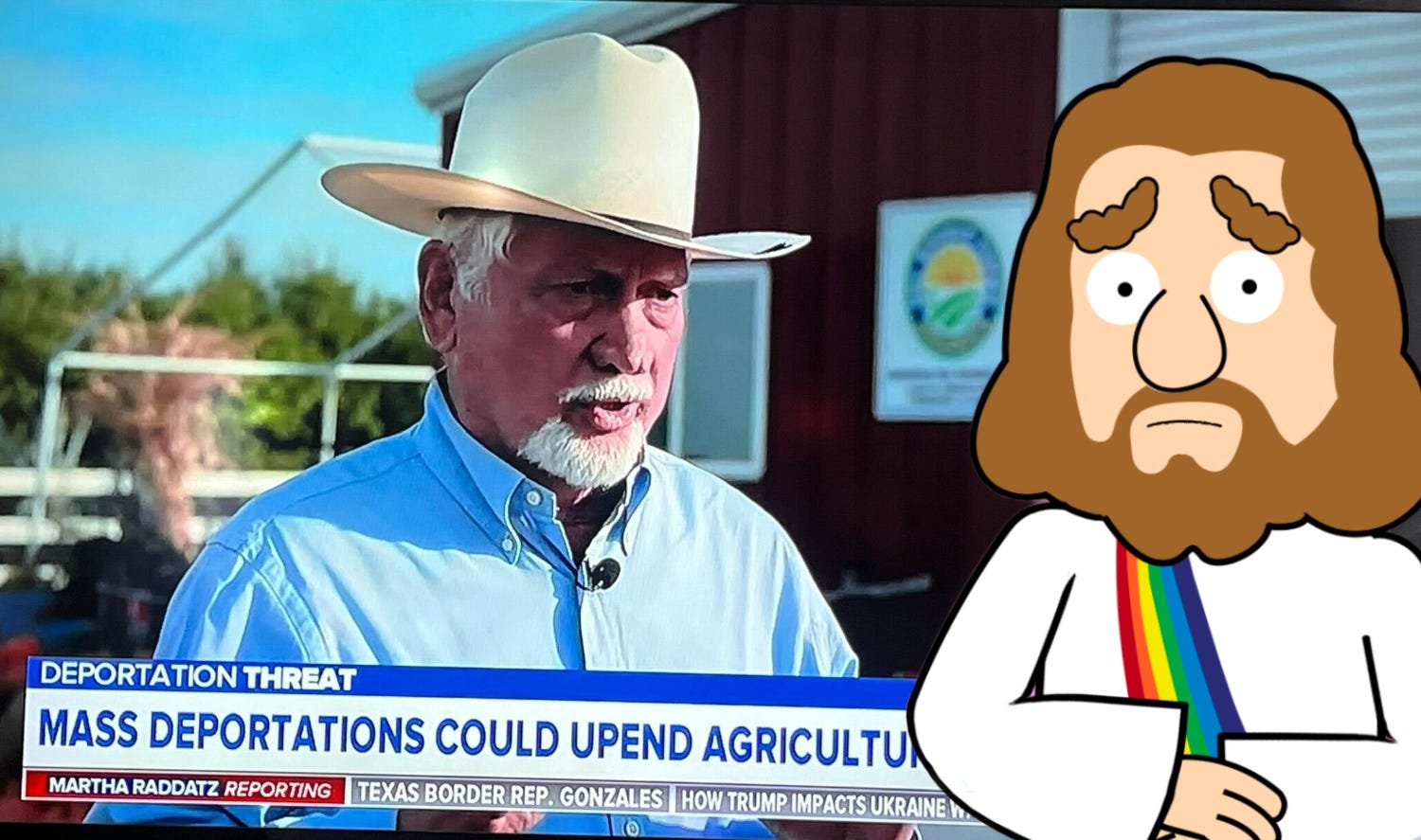
As someone who has always taught inclusion, loving thy neighbor, and supporting marginalized groups, I’ve been deeply concerned about Trump’s mass deportation proposals that he spoke frequently about during his Presidential campaign.
To many in his uninformed and racist voter base, they hear about the proposal and think it’s a great idea.
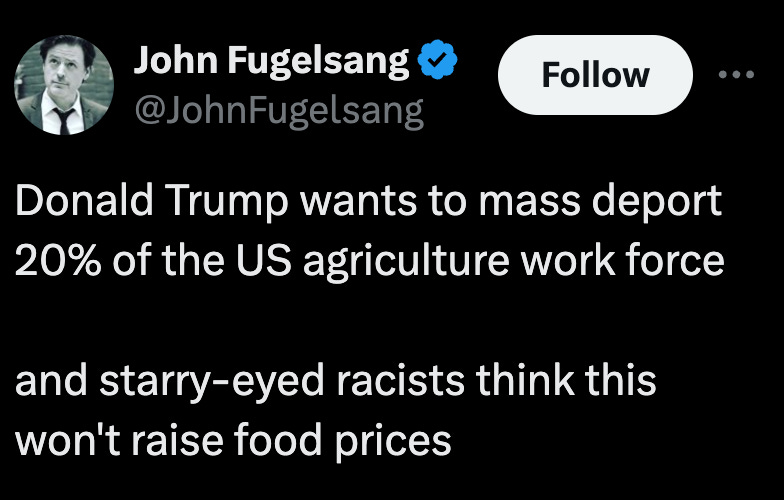
What they don’t realize is how it’ll affect – among many things – their food supply.
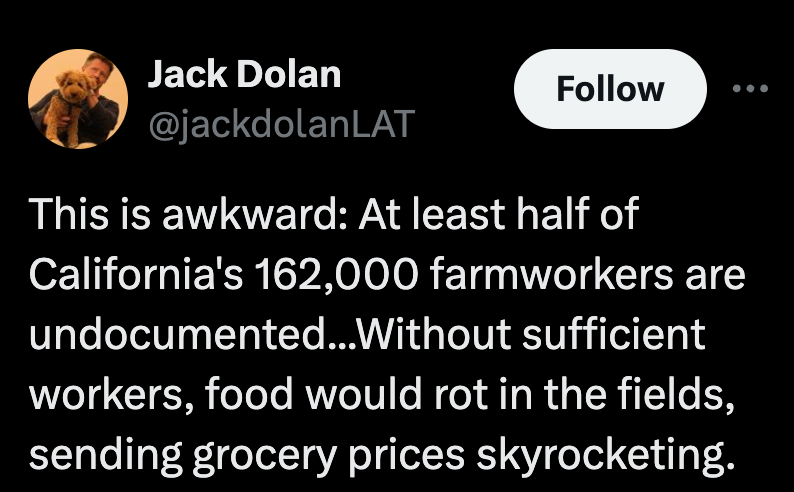
You see, farmers depend on undocumented immigrants to manage their crops, because it’s a grueling job that most Americans don’t want to take. Immigrants, however, are looking for any life they can start in America and are willing to take on the job.
They’re also freakin’ tough-as-nails types of people!
We’re still nearly two months away from Trump returning to office (Sigh), and already, key U.S. agricultural organizations are advocating for the exclusion of farmworkers from mass deportation attempts.
Reuters spoke to numerous farm groups who said they are already working to ensure their workers are exempt from any deportations.
Should Trump’s ‘mass deportation’ idea go through (And let’s be clear: It would be a VERY difficult task – it’s basically his new ‘Build the Wall’ proposal), that would mean that about HALF of the two million farmworkers in the United States would be deported.
It’d be like a Thanos snap – it would have HUGE implications for the American food supply.
When all those workers disappear, the food would disappear too. And if you thought eggs were costly now, just wait until you lose half of your workers who are employed on farms and meat processing plants.
A More Jesus-y Plan
What Trump’s incoming administration should be doing instead of instilling fear in the American people is giving these undocumented migrants a path to citizenship. These people who live in America not only work tough jobs, but they also contribute to the American economy by supporting businesses that they visit. That in turn generates tax revenue for America.
EVERYONE benefits from having immigrants in their country.
In The Parable of the Good Samaritan, I taught that your “neighbor” is not limited to those within the same community or background but extends to anyone in need. I encourage Humans to cross cultural boundaries to show kindness and mercy. (snip)
This is an incredible video on lies and truth, not because he tells us to call out the lies, but look to the real serious needs below the lies. I finally after several hours of fighting got the finial very large big program installed on my main computer. Hugs.
Incredible. I never heard a religious leader say that the Christian lifestyle is not for everyone and that if you feel you can not follow Jesus’s command to love and care for others, help those that need help, care for the stranger, then it clearly is not for you. He tells the story that a man came up to his pastor and said that leftist stuff doesn’t work, when the pastor points out those are Jesus’s words the man responds well it may have worked in his day but not today. Wonderful video. Hugs
All the links are worthy; today I’m partial to both the one about a Trump-proof climate action Pres. Biden could take that would benefit the entire world, and the story about the “Indian peach”.
On Friday, Secretary of Commerce Gina Raimondo locked in a $6.6 billion deal with the Taiwan Semiconductor Manufacturing Company for it to invest $65 billion in three state-of-the-art fabrication plants in Arizona. This will bring thousands of jobs to the state. The money comes from the CHIPS and Science Act, about which Trump told podcaster Joe Rogan on October 25: “That CHIPS deal is so bad.” House speaker Mike Johnson (R-LA) said he would work to repeal the law, although he backed off that statement when Republicans noted the jobs the law has brought to their states.
Also on Friday, a Trump-appointed federal judge struck down a Biden administration rule that would have made 4 million workers eligible for overtime pay. The rule raised the salary level below which an employer has to pay overtime from $35,568 to $43,888 this year and up to $58,656 in 2025. The decision by Texas judge Sean D. Jordan kills the measure nationally.
On Sunday, speaking from the Amazon rainforest in Brazil, President Joe Biden said that it would not be possible to reverse America’s “clean energy revolution,” which has now provided jobs across the country, primarily in Republican-dominated states. Biden noted that the U.S. would spend $11 billion on financing international responses to climate change in 2024, an increase of six times from when he began his term.
But President-elect Trump has called climate change a hoax and has vowed to claw back money from the Inflation Reduction Act appropriated to mitigate it, and to turn the U.S. back to fossil fuels. What Trump will have a harder time disrupting, according to Nicolás Rivero of the Washington Post, is the new efficiency standards the Biden administration put in place for appliances. He can, though, refuse to advance those standards.
Meanwhile Trump and his team are announcing a complete reworking of the American government. They claim a mandate, although as final vote tallies are coming in, it turns out that Trump did not win 50% of the vote, and CNN statistician Harry Enten notes that his margin comes in at 44th out of the 51 elections that have been held since 1824. He also had very short coattails—four Democrats won in states Trump carried—and the Republicans have the smallest House majority since there have been 50 states, despite the help their numbers have had from the extreme gerrymandering in states like North Carolina.
More Americans voted for someone other than Trump than voted for him. (Emphases mine- A.)
Although Trump ran on lowering the cost of consumer goods, Trump and his sidekick Elon Musk, along with pharmaceutical entrepreneur Vivek Ramaswamy, have vowed to slash the U.S. government, apparently taking their cue from Argentina’s self-described anarcho-capitalist president Javier Milei, who was the first foreign leader to visit Trump after the election. Milei’s “shock therapy” to his country threw the nation into a deep recession, just as Musk says his plans will create “hardship” for Americans before enabling the country to rebuild with security.
Ramaswamy today posted on social media, “A reasonable formula to fix the U.S. government: Milei-style cuts, on steroids.” He has suggested that cuts are easier than people think. The Washington Post’s Philip Bump noted that on a podcast in September, Ramaswamy said as an example: “If your Social Security number ends in an odd number, you’re out. If it ends in an even number, you’re in. There’s a 50 percent cut right there. Of those who remain, if your Social Security number starts in an even number, you’re in, and if it starts with an odd number, you’re out. Boom. That’s a 75 percent reduction done.”
But, as Bump notes, this reveals Ramaswamy’s lack of understanding of how the government actually works. Social Security numbers aren’t random; the first digit refers to where the number was obtained. So this seemingly random system would target certain areas of the country.
Today, both Jacob Bogage, Jeff Stein, and Dan Diamond of the Washington Post and Robert Tait of The Guardian reported that Trump’s economic advisors are talking with Republicans in Congress about cuts to Medicaid, the Supplemental Nutrition Assistance Program (SNAP) formerly known as food stamps, and other welfare programs, in order to cover the enormous costs of extending tax cuts for the wealthy and corporations. Medicaid is the nation’s health insurance for low-income Americans and long-term care. It covers more than 90 million Americans, one in five of us. Rural populations, which tend to vote Republican, use supplemental nutrition programs more than urban dwellers do.
The Washington Post reporters note that Republicans deny that they are trying to reduce benefits for the poor. They are, they say, trying to reduce wasteful and unnecessary spending. “We know there’s tremendous waste,” said House Budget Committee chairman Jodey Arrington (R-TX). “What we don’t seem to have in the hour of action, like when we have the trifecta and unified Republican leadership, is the political courage to do it for the love of country. [Trump] does.”
Those cuts will likely not sit well with the Republicans whose constituents think Trump promised there would be no cuts to the programs on which they depend.
Trump’s planned nominations of unqualified extremists have also run into trouble. Senate Republicans are so far refusing to abandon their constitutional powers in order to act as a rubber stamp to enable Trump’s worst instincts. Former representative Matt Gaetz (R-FL), a Trump bomb thrower, was unqualified to be the nation’s attorney general in any case, but as more information comes out about his alleged participation in drug fueled orgies, including the news that a woman allegedly told the House Ethics Committee that she saw him engage in sex with a minor, those problems have gotten worse.
Legal analyst Marcy Wheeler notes that the lawyers representing the witnesses for the committee are pushing for the release of the ethics committee’s report at least in part out of concern that if he becomes attorney general, Gaetz will retaliate against them.
According to Vanity Fair’s Gabriel Sherman, fear of the MAGA Republican colleagues who are already trying to bully them into becoming Trump loyalists is infecting congress members, too. When asked if Gaetz was qualified for the attorney general post, Representative Mike Simpson (R-ID) answered: “Are you sh*tting me, that you just asked that question? No. But hell, you’ll print that and now I’m going to be investigated.”
The many fringe medical ideas of Trump’s pick for secretary of health and human services, Robert F. Kennedy Jr., earned him the right-wing New York Post editorial board’s denigration as “nuts on a lot of fronts.” The board called his views “a head-scratching spaghetti of what we can only call warped conspiracy theories, and not just on vaccines.” Kennedy is a well-known opponent of vaccines—he called Covid-19 vaccines a “crime against humanity”—and has called for the National Institutes of Health to “take a break” of about eight years from studying infectious diseases, insisting that they should focus on chronic diseases instead.
Writing in the New York Times yesterday, Peter Baker noted that Trump “has rolled a giant grenade into the middle of the nation’s capital and watched with mischievous glee to see who runs away and who throws themselves on it.” Mischievous glee is one way to put it; another is that he is trying to destroy the foundations of the American government.
Baker notes that none of Trump’s selections would have been anything but laughable in the pre-Trump era when, for example, Democratic cabinet nominations were sunk for a failure to pay employment taxes for a nanny, or for a donor-provided car. Nor would a president-elect in the past have presumed to tap three of his own defense lawyers for top positions in the Department of Justice, effectively guaranteeing that he will be protected from scrutiny.
A former deputy White House press secretary during Trump’s first term, Sarah Matthews, said Trump is “drunk on power right now because he feels like he was given a mandate by winning the popular vote.”
Today Trump confirmed that he intends to bypass normal legal constraints on his actions by declaring a national emergency on his first day in office in order to launch his mass deportation of undocumented migrants. While the Congressional Budget Office estimates this mass deportation will cost at least $88 billion a year, another cost that is rarely mentioned is that according to Bloomberg, undocumented immigrants currently pay about $100 billion a year in taxes. Losing that income, too, will likely have to be made up with cuts from elsewhere.
Finally, today, CNBC’s economic analyst Carl Quintanilla noted today that average gasoline prices are expected to fall below $3.00 a gallon before the Thanksgiving holiday.





 Scottie's Playtime