Homeland Security Secretary Kristi Noem | Steven Spearie/The State Journal-Register / USA TODAY NETWORK
Rep. Robert Garcia (D-CA) confronted Homeland Security Secretary Kristi Noem about the administration sending a gay man to a prison camp in El Salvador and not even knowing if he’s still alive. Noem said that it wasn’t her problem.
Noem, who has bragged in the past about shooting her dog to death, appeared before the House Homeland Security Committee for a hearing yesterday, where Garcia asked her about Andry Hernandez Romero, a gay hair dresser from Venezuela who came to the U.S. legally to escape anti-LGBTQ+ violence and who was sent to the CECOT camp in El Salvador, which is known for torturing inmates, earlier this year.
The administration, which sent immigrants to the CECOT without letting courts determine if they were in the country illegally or if they had committed any crimes, has refused to try to bring anyone back from the camp.
“Would you commit to just letting his mother know – as a mother-to-mother – if Andry is alive?” Garcia asked Noem. “He was given an asylum appointment by the United States government. We gave him an appointment, we said, Andry, come to the border at this time and claim asylum, he was taken to a foreign prison in El Salvador.”
“His mother just wants to know if he’s alive. Can we check and do a wellness check on him?”
Noem said she doesn’t “know the specifics” of Hernandez Romero’s case but said that since he’s in El Salvador, Garcia should be asking El Salvador’s government about him.
“This isn’t under my jurisdiction,” Noem said.
Garcia reminded her that she said that the Salvadoran prison is a “tool in our toolkit” for fighting crime.
“You and the president have the ability to check that Andry is alive and not being harmed,” he said. “Would you commit into at least looking and asking El Salvador if he is alive?”
“This is a question that is best asked to the president and the government of El Salvador,” Noem responded drily.
Garcia to Noem: "Can you commit to just letting his mother know mother to mother if Andry is alive? He was given an asylum appointment by the United States government."(Noem wouldn't commit to it.)
Hernandez Romero is a Venezuelan immigrant who trekked to the U.S. and entered legally last year at San Diego. There, he asked for asylum, saying that he was being targeted in Venezuela for being gay and due to his political beliefs. He was held in a CoreCivic detention center, where he was screened by Charles Cross Jr.
“The government had found that his threats against him were credible and that he had a real probability of winning an asylum claim,” his lawyer, Lindsay Toczylowski, said.
In March, he, along with over 200 other immigrants, was taken in shackles to the CECOT camp in El Salvador. Even his lawyer said she didn’t know what happened to him until he was gone and missed a hearing in his immigration case.
In a video from the CECOT, Hernandez Romero could be heard saying, “I’m not a gang member. I’m gay. I’m a stylist,” as he was slapped and had his head shaved.
It was later revealed that the evidence Immigration and Customs Enforcement (ICE) had against Hernandez Romero was his tattoos, which came from a report from the contractor CoreCivic, specifically from former police officer Charles Cross Jr., who lost his job with the Milwaukee police after he drunkenly crashed into a house and allegedly committed fraud. His name was subsequently added to the Brady List, a list of police officers who are considered non-credible for providing legal testimony in Milwaukee County.
Cross claimed that Hernandez Romero had crown tattoos associated with a gang. The tattoos are labeled “Mom” and “Dad” and are common symbols associated with his hometown of Capacho, Venezuela. Capacho is known for its elaborate festival for Three Kings Day, and a childhood friend, Reina Cardenas, told NBC News that it was that festival that awakened Hernandez Romero’s desire to be an artist.
“Andry dedicated his life to arts and culture, and he worked hard to better his craft,” Cardenas said.
Subscribe to the LGBTQ Nation newsletter and be the first to know about the latest headlines shaping LGBTQ+ communities worldwide.
No one forced these people to read the book. But just having the book there in open view enraged them. How dare this librarian admit that trans kids exist, that they are real. They wouldn’t have an issue with a book on child angels or mythical creatures, but humans that are different from the majority straight cis must be denied and destroyed. Forbidden knowledge seems big in the Christian extremest world. They seem to live for and delight in harming anyone or thing different from the way they want the world to be. They seem to think it fine for them to force their views on others but requiring factual teaching about science, biology, geology, race history is oppressing them. Imposing the idea that some people dress up in costumes to read books to children on them is a violation of their rights, but a kid’s desire to see themselves represented in media they feel they have a right to prevent. Hugs
The cover of the offending book, When Aidan Became a Brother by transgender male author Kyle Lukoff. | Lee & Low Books
Lavonnia Moore, a 45-year-old library manager, had worked at the Pierce County Library in Blackshear, Georgia, for 15 years. She was ultimately let go when a Christian extremist group filed a complaint to the library after Moore approved the display of a children’s book about a transgender boy.
According to Moore, the display (entitled “Color Our World”) included the book When Aidan Became a Brother (by trans male author Kyle Lukoff), a story about a family accepting a trans child named Aiden while also preparing for the birth of Aiden’s sibling. Library volunteers created the display as a part of a regional-wide summer theme featuring books that celebrate diversity.
“I simply supported community involvement, just as I have for other volunteer-led displays. That’s what librarians do — we create space for everybody… I did not tell the parents and children what they could or could not add to the display, just as I do not tell them what they can or cannot read,” she wrote in a statement.
However, the book caught the attention of a group calling themselves the Alliance for Faith and Family (AFF), not to be confused with the anti-LGBTQ+ legal group Alliance Defending Freedom. The AFF had previously been in the public eye for demanding the removal of a mural in the Waycross-Ware County Public Library, which included a Pride theme declaring, “Libraries Are For Everyone.”
The AFF campaigned on Facebook, urging their followers to pray and take a few moments out of their day to email the Three Rivers Library System and Pierce County Commissioners to “put a stop to this and show them the community supports them in taking a stand against promoting transgenderism at our local library,”
In an update post, the group wrote, “The display has been removed, and LaVonnia is no longer the Pierce County Library Manager. Please thank the Pierce County Commissioners and Three Rivers Regional Library System for quickly addressing our concerns.”
Moore and her sister Alicia confirmed that LaVonnia Moore had been fired. A statement to The Blackshear Times from the Three Rivers Library System Director Jeremy Snell explained that the library board leadership decided to move to new leadership for the Pierce County Library. He specifically cited the display of an “inappropriate” book as his reasoning.
“The library holds transparency and community trust in the highest regard,” Snell said.
“Instead of investigating, talking to me or my team, or exploring any kind of fair process, they used the ‘at-will’ clause in my contract to terminate me on the spot. No warning. No meeting. No due diligence. Just the words ‘poor decision making’ on a piece of paper after 15 years of service,” Moore claimed.
“I am just heartbroken,” she said of her dismissal.
According to Moore’s sister Alicia, “She messaged the family group and said ‘I was just fired.’”
“I don’t think she’s doing emotionally good, because imagine having to pack up 15 years in two days,” Alicia Moore told First Coast News.
“She’s heartbroken that a place she gave so much of herself to turned its back on her so quickly. And yes, she’s still in disbelief. She didn’t expect to be punished for doing her job with integrity and love for all patrons — especially children.” the sister explained.
The sisters are currently seeking legal counsel, and Alicia is urging people to reach out to the library board and county commissioners.
“I’m hoping the same method will be useful to get her justice,” Alicia said.
Subscribe to the LGBTQ Nation newsletter and be the first to know about the latest headlines shaping LGBTQ+ communities worldwide.
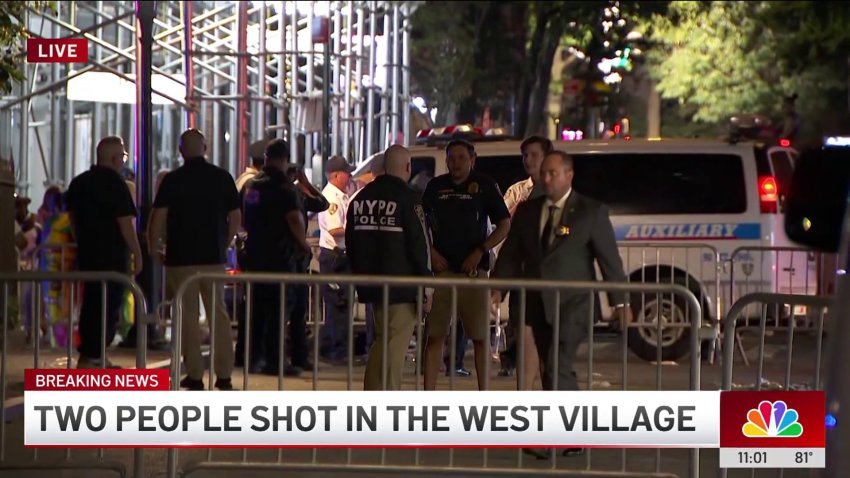
Two teenage girls were shot late Sunday night near Manhattan’s Stonewall Inn hours after the annual Pride March passed through the neighborhood.
The NYPD said the two people, a 16-year-old and a 17-year-old, were shot around 10:15 p.m. in the West Village, busy with revelers celebrating the end of Pride celebrations.
One of the shooting victims was struck in the head, according to police sources. That girl, 16, was last said to be in critical condition. The other victim was said to be stable.
Police had not confirmed any arrests as of early Monday.
The shooting occurred in Sheridan Square, a few steps away from the historic Stonewall Inn, a landmarked site. The neighborhood attracted tens of thousands on Sunday for the annual parade and end to Pride Month celebrations.
Police did not share a possible motive or any suspect descriptions.
Police said at least two people were shot on Sunday, as Pride celebrations came to a close in New York City. NBC New York’s Charles Watson reports.
A High Court in India has ruled that trans women are women. (Getty)
A court in India has decreed that trans women are women.
In a landmark ruling for the country, after rejecting claims that womanhood was preserved only for those who can bear children, the High Court of Andhra Pradesh ruled that trans women were “legally entitled” to recognition as women.
Presiding over the case, justice Venkata Jyothirmai Pratapa decided that tying the definition of women to pregnancy was “legally unsustainable” and contradicted India’s constitution, which emphasises equality before the law.
Quoting a Supreme Court decision from 2014, which legally recognised the rights of “third gender” individuals, Pratapa said that prohibiting trans women’s right to identify as women “amounted to discrimination”.
The case was brought to the high court in 2022 after transgender woman Pokala Shabana looked to use a section of the Indian penal code to seek protection from her in-laws, whom, she said, had been abusive towards her.
The court sided with trans women. (Getty)
Her husband’s parents petitioned the court to deny her use of Section 498A, which protects women from cruelty by a husband or relatives, arguing that it only applied to cisgender women. They claimed that trans women don’t meet the legal definition of women under Indian law because they cannot get pregnant and said Shabana’s allegations of harassment lacked evidence.
However, the judge said that articles 14, 15 and 21 of the constitution, which guarantee a variety of discrimination protections, including the right to life and personal liberty, meant trans women’s rights to be recognised as women superseded the law.
“A trans woman, born male and later transitioning to female, is legally entitled to recognition as a woman,” he wrote in his ruling. “Denying such protection by questioning their womanhood amounts to discrimination.”
Trans activist and artist Kalki Subramaniam told the Washington Blade that she was relieved and delighted to see the court “upholding our basic human right to be identified as what we want.” She went on to say: “For [the] transgender community, especially trans women, this verdict means a lot.”
The Indian government has been under mounting pressure to modernise its laws and policies on LGBTQ+ rights. Same-sex marriage is still illegal, despite growing support for its legalisation.
Prime minister Narendra Modi’s government have previously labelled same-sex marriage an “elitist” viewpoint that “seriously affects the interests of every citizen”.
An affidavit establishing the government’s views on same-sex unions, in 2023, proclaimed that marriage was valid only between “biological males and females [and that] this definition [was] socially, culturally and legally ingrained into the very idea and concept of marriage and ought not to be disturbed or diluted by judicial interpretation”.
Share your thoughts! Let us know in the comments below, and remember to keep the conversation respectful.
Crackdown on Pride is part of effort to curb democratic freedoms ahead of a hotly-contested election next year
Tens of thousands march against Hungary’s government for LGBT rights – video
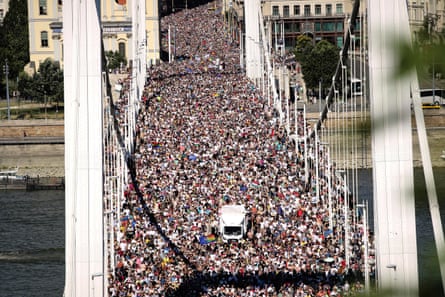
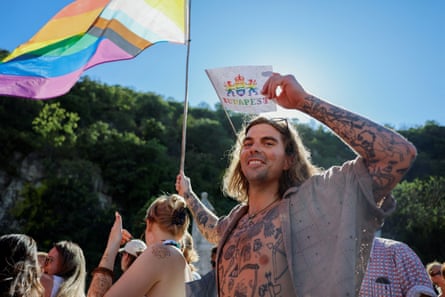
Tens of thousands of people have taken to the streets of Budapest in defiance of the Hungarian government’s ban on Pride, heeding a call by the city’s mayor to “come calmly and boldly to stand together for freedom, dignity and equal rights”.
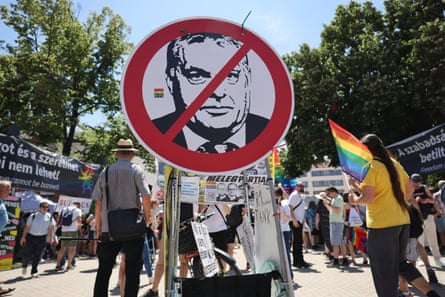
Jubilant crowds packed into the city’s streets on Saturday, waving Pride flags and signs that mocked the country’s prime minister, Viktor Orbán, as their peaceful procession inched forward at a snail’s pace.
Organisers estimated that a record number of people turned up, far outstripping the expected turnout of 35,000-40,000 people.
“We believe there are 180,000 to 200,000 people attending,” the president of Pride, Viktória Radványi told AFP. “It is hard to estimate because there have never been so many people at Budapest Pride.”
The mass demonstration against the government was a bittersweet marking of Budapest Pride’s 30th anniversary; while the turnout on Saturday was expected to reach record levels, it had come after the government had doubled down on its targeting of the country’s LGBTQ+ community.
Hungary Pride participants in the march cross the Elisabeth Bridge in Budapest, Hungary. Photograph: Rudolf Karancsi/AP
“We came because they tried to ban it,” said Timi, 49. The Hungarian national was marching with her daughter, Zsófi, 23, who had travelled from her home in Barcelona to join the rally.
After the ruling Fidesz party, led by the rightwing populist Orbán, fast-tracked a law that made it an offence to hold or attend events that involve the “depiction or promotion” of homosexuality to minors, many Hungarians vowed to show their disapproval by attending Pride for the first time.
Viki Márton was among those who had made good on the promise, turning up with her nine-year-old daughter.
The pair had come equipped with hats, water spray, and a swimsuit, more worried about heat than rightwing protesters. “I want her to see the reality,” said Márton. “And I’m so excited to be here!”
Tens of thousands of Hungarians took to the streets on Saturday, despite Orbán’s warning on Friday that those who attend or organise the march will face ‘legal consequences’. Photograph: János Kummer/Getty Images
Earlier this month, police announced they would follow the government’s orders and ban the march. The progressive mayor of Budapest, Gergely Karácsony, was swift to respond, saying that the march would instead go ahead as a separate municipal event, with Karácsony describing it as a way to circumvent the need for official authorisation.
On Saturday, the mayor reiterated why the city had decided to host the event, hinting at how the march had become a symbol of discontent against a government that has long faced criticism for weakening democratic institutions and gradually undermining the rule of law.
“The government is always fighting against an enemy against which they have to protect Hungarian people,” said Karácsony.
“This time, it is sexual minorities that are the target … we believe there should be no first and second class citizens, so we decided to stand by this event.”
Akos Horvath, 18, who had travelled two hours from his city in southern Hungary to take part in the march, described it as an event of “symbolic importance”.
Speaking to news agency AFP, he added: “It’s not just about representing gay people, but about standing up for the rights of the Hungarian people.”
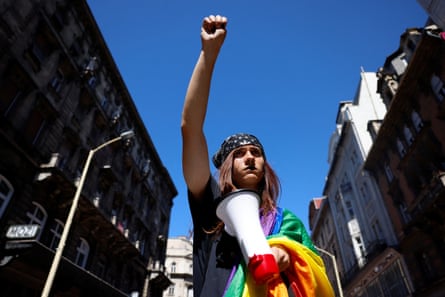
The sentiment was echoed by fellow marcher Eszter Rein-Bódi. “This is about much more, not just about homosexuality,” Rein-Bódi told Reuters “This is the last moment to stand up for our rights.”
‘This is about much more, not just about homosexuality,’ one participant told Reuters. Photograph: Lisa Leutner/Reuters
Tens of thousands of Hungarians, including senior citizens and parents with their children, plus politicians and campaigners from 30 countries, took to the streets on Saturday, despite Orbán’s warning on Friday that those who attend or organise the march will face “legal consequences”.
The Hungarian prime minister sought to minimise concerns over violence, however, saying that Hungary was a “civilised country” and police would not “break it up … It cannot reach the level of physical abuse”.
Still, in a video posted to social media this week, the country’s justice minister, Bence Tuzson, warned the Budapest mayor that organising a banned event or encouraging people to attend is punishable by up to a year in prison.
Speaking to reporters on Friday, the mayor brushed off the threat and downplayed concerns that police would later impose heavy fines on attende s. “Police have only one task tomorrow: to guarantee the safety and security of those gathered at the event,” said Karácsony.
The potential for violence had been amplified after three groups with ties to the extreme right said they were planning counter-marches. As the Pride march got under way, local news site Telex reported that the route of the march had to be changed after one of these groups blocked off a bridge.
Analysts had described the government’s bid to crackdown on Pride as part of a wider effort to curb democratic freedoms ahead of a hotly contested national election next year.
Orbán is facing an unprecedented challenge from a former member of the Fidesz party’s elite, Péter Magyar, leading Pride organisers to suggest they are being scapegoated as Orbán scrambles to shore up support among conservative voters.
Orbán’s government had also prompted concerns across Hungary and beyond after it said it would use facial recognition software to identify people attending any banned events, potentially fining them up to €500 (£425).
Ahead of the march, as campaigners scrambled for clarity on whether or how this technology would be used, AFP reported that newly installed cameras had appeared on the lamp-posts that dotted the planned route.
The threat had been enough to rattle some. Elton, 30, a Brazilian living in Hungary wore a hat and sunglasses as he took part on Saturday, explaining that he had been worried about jeopardising his job and immigration status, but that his Hungarian boyfriend had persuaded him to attend.
“This is my second time at Pride, but the first time I feel insecure about it,” he said.
Orbán’s government had also prompted concerns across Hungary and beyond after it said it would use facial recognition software to identify people attending any banned events. Photograph: Lisa Leutner/Reuters
Mici, a 21-year-old Budapest resident, said she had attended Pride marches in the past but this time had weighed whether to join in after she was spooked by reports of the facial recognition system.
“At first, I was scared to come out because of the news, but I feel safe with so many people.”
She hoped that the massive turnout for the march would be enough to push the Orbán government to change its stance.
“I think the crowd that has come from across Europe, the record numbers, will make Hungarian people see that this cause is well-supported.”
BREAKING: The three liberal Supreme Court justices release a scathing dissent after the Republican-controlled judges issue an anti-LGBTQ ruling that “ushers in a new reality” that will deny children the “opportunity to practice living in our multicultural society.”
This is only the third time that Sonia Sotomayor has read her dissent from the bench, indicating strong disapproval…
“Exposing students to the ‘message’ that LGBTQ people exist, and that their loved ones may celebrate their marriages and life events, the majority says, is enough to trigger the most demanding form of judicial scrutiny,” Justice Sonia Sotomayor wrote, supported by justices Elena Kagan and Ketanji Brown Jackson.
The ruling was made in favor of a group of parents who want to opt their children out of elementary school lessons that include LGBTQ storybooks. The case will now go back to a lower court for final decision on whether schools must provide such an opt-out option.
Thanks to the Republican justices, school districts must now inform parents in advance of the books being read in class and allow them to pull their children if they choose. For underfunded schools, this additional burden will be too much to bear. It adds administrative costs and distracts teachers who are already struggling to teach overcrowded classrooms. Taken in tandem with the Trump administration’s efforts to completely eliminate the Department of Education, it’s a grim omen of things to come.
Crucially, the decision is a blatant handout to the religious radicals who helped put Donald Trump in power, which in turn tilted the court even more conservative. Such people want to pretend that LGBTQ people don’t even exist.
“Given the great diversity of religious beliefs in this country, countless interactions that occur every day in public schools might expose children to messages that conflict with a parent’s religious beliefs. If that is sufficient to trigger strict scrutiny, then little is not,” Sotomayor continued.
She predicted that the decision will cause “chaos for this Nation’s public schools.”
“Requiring schools to provide advance notice and the chance to opt out of every lesson plan or story time that might implicate a parent’s religious beliefs will impose impossible administrative burdens on schools,” she continued. “The harm will not be borne by educators alone: Children will suffer too. Classroom disruptions and absences may well inflict long-lasting harm on students’ learning and development.”
“Worse yet, the majority closes its eyes to the inevitable chilling effects of its ruling,” she went on. “Many school districts, and particularly the most resource strapped, cannot afford to engage in costly litigation over opt-out rights or to divert resources to tracking and managing student absences. Schools may instead censor their curricula, stripping material that risks generating religious objections.”
“The Court’s ruling, in effect, thus hands a subset of parents the right to veto curricular choices long left to locally elected school boards,” she added. “Because I cannot countenance the Court’s contortion of our precedent and the untold harms that will follow, I dissent.”
Allendale United Methodist Church in St. Petersburg, Florida. | Screenshot: Google Maps
A church in Florida has sent the local sheriff’s office an invoice after law enforcement officials parked their vehicles in its parking lot against the pastor’s wishes as they sought to carry out an unspecified investigation.
Allendale United Methodist Church in St. Petersburg, Florida, posted a photograph to Facebook on June 17 showing an invoice addressed to the Pinellas County Sheriff’s Office. The invoice requests a payment of $10,000 for “unauthorized use of [the] private church parking lot beginning at 6:00 AM.”
The invoice maintained that the presence of “13 vehicles occupying 17 parking spots” resulted in a “disruption to community access, operations, and congregational use of property.”
The document stressed that “continued use without coordination or consent may result in legal action or additional penalties,” vowing that the church will use payment received from the law enforcement agency to pay for “legal services for immigrants.”
Andy Oliver, the pastor of Allendale, who has been outspoken in his advocacy against U.S. Immigration and Customs Enforcement, posted a video to Facebook on June 17 documenting the presence of law enforcement vehicles in the church parking lot.
The video shows Oliver asking law enforcement officials if he could help them. One of them responded by telling Oliver, “We’re just waiting for an operation.”
“Is this involving ICE?” Oliver asked. Multiple law enforcement officials denied that the operation in question involved ICE but declined to provide further details other than stating, “It’s a Sheriff’s Office investigation.” After the official informed Oliver that the investigation did not involve anything on his property, the pastor asked the law enforcement officials to leave: “I don’t want policing to be staged here. Definitely, ICE is not welcome here.”
The officers agreed to leave, and a subsequent video posted to Facebook shows a dozen vehicles, both marked and unmarked, exiting the property.
Oliver’s Facebook page makes the dislike of ICE at his church clear. The cover photo features an image of the church taken at night with the words “Abolish ICE” displayed on the side of the building.
The most recent public post on Oliver’s Facebook page links to a TikTok video showing the pastor speaking at an anti-ICE protest outside the Pinellas County Jail while wearing an “Abolish ICE” shirt on June 14, three days before law enforcement officials showed up on his property.
During his remarks, Oliver denounced ICE as a “weapon” that is “soaked in white supremacy.”
“It is the child of manifest destiny and Jim Crow, the bastard cousin of slave patrols and Indian removal,” he added. “ICE is the cold breath of empire whispering ‘You don’t belong.'”
Oliver referred to the Bible as he attempted to make the case against ICE.
“Jesus fled to Egypt as a refugee. Jesus knew what it meant to hear soldiers marching with orders signed in the blood of empire and Jesus, he was executed by the state, hung between thieves as a warning to the masses. His death was legal.”
“So, don’t you dare tell me that the Gospel is neutral. Don’t you dare sanitize the cross while ICE cages children under fluorescent lights. I believe in resurrection, but too many are still hanging on crosses of barbed wire borders, prison buses, ankle monitors and courtroom numbers that decide who gets to stay and who gets disappeared. ICE disappears people. And if your theology doesn’t scream for abolition, then your theology is frozen,” he proclaimed.
Oliver shared his belief that “this nation has built its wealth on stolen land and stolen labor, and ICE is just the newest name for the oldest sin.” He described ICE as “white supremacy in a windbreaker, colonialism with a clipboard” and “hatred with a hollowed-out smile.”
“Our God does not deport, our God delivers,” he said. “Our God does not separate families, our God sets captives free.”
“ICE is sin, borders are a lie, cages are the devil’s architecture and silence is complicity. We won’t be silent. We won’t be complicit. We won’t stop until every child is reunited, every detainee is released and every system built on hate melts into history,” he vowed.
Oliver’s advocacy against ICE is not the only example of the pastor’s progressive activism.
In 2023, after the Florida Department of Education rejected an Advanced Placement African-American Studies course over concerns it promoted critical theory, Oliver offered the class at his church.
Since returning to the White House in January, President Donald Trump and his administration have ramped up enforcement of immigration law, which has seen waves of ICE raids seeking to detain immigrants who are in the U.S illegally.
While some have defended the measure as a bid to enforce the country’s immigration laws, as millions of immigrants are in the country illegally, some Christian leaders have voiced their displeasure with church properties being used in immigration raids.
In a January directive, the Trump administration rescinded the U.S. Department of Homeland Security’s policy limiting the deportation of illegal immigrants in so-called “sensitive areas.”
The Roman Catholic Diocese of San Bernardino in San Bernardino, California, issued a statement this week criticizing the “change and increase in immigration enforcement in our region and specifically our diocese.”
“We have experienced at least one case of [Immigration and Customs Enforcement] agents entering a parish property and seizing several people,” Bishop Alberto Rojas wrote.
“While we surely respect and appreciate the right of law enforcement to keep our communities safe from violent criminals, we are now seeing agents detain people as they leave their homes, in their places of work and other randomly chosen public settings.”
The Allendale United Methodist Church of St. Petersburg just ran a full page ad in the Tampa Bay Times in which it apologized to the LGBTQIA community for the harm that was done to it by the UMC. The add is a wonderful expression of love for all. Please find it and read it.
LGBTQ+ affirming Allendale United Methodist Church, located in St. Petersburg, FL, hosts drag queen-led worship services. In one service, drag queens perform and lip-sync to Dolly Parton’s version of “Go Tell It on the Mountain.” Allendale’s most recent Instagram post reads,… pic.twitter.com/h9omwmnhSE
Rev. Andy Oliver (he/him/his), pastor of Allendale United Methodist Church in St Petersburg, Florida, lights a candle wrapped in barbed wire in honor of alleged wife beater Kilmar Abrego Garcia—during his EASTER church service.
Jermaine Thomas, who says he was deported to Jamaica without a passport though he’s never been to the country (Provided by Jermaine Thomas)
Ten years ago, Jermaine Thomas was at the center of a case brought before the U.S. Supreme Court: Should a baby born to a U.S. citizen father deployed to a U.S. Army base in Germany have U.S. citizenship?
Last week, Thomas was escorted onto a plane with his wrists and ankles shackled, he says. He arrived in Jamaica, a country he’d never been to, a stateless man.
“I’m looking out the window on the plane,” Thomas told the Chronicle, “and I’m hoping the plane crashes and I die.”
Thomas has no citizenship, according to court documents. He is not a citizen of Germany (where he was born in 1986) or of the United States (where his father served in the military for nearly two decades) or of his father’s birth country of Jamaica (a place he’d never been).
Thomas doesn’t remember Germany. He says he thinks his first memory is in Washington state, but he moved around so much in his military family that it was hard to keep track.
He spent most of his life in Texas, much of it homeless and in and out of jail, he says. His parents divorced when he was too little to remember. His mother, a nurse, remarried to another man in the Army. They moved a lot, and as she and the stepfather had their own kids, Thomas says he struggled in the new family setup.
So at about about 11 years old, he went to stay with his biological father in Florida. By then, his dad was retired from an 18-year career in the U.S. military, he says. His dad died from kidney failure not long after, in 2010.
“If you’re in the U.S. Army, and the Army deploys you somewhere, and you’ve gotta have your child over there, and your child makes a mistake after you pass away, and you put your life on the line for this country, are you going to be okay with them just kicking your child out of the country?” Jermaine says, phoning the Chronicle from a hotel in Kingston, Jamaica. “It was just Memorial Day. Y’all are disrespecting his service and his legacy.”
From Killeen to Kingston
Thomas says it all began with an eviction in Killeen, Texas, which is about an hour north of Austin. Thomas didn’t know where he’d go next, so to get things out of the apartment quickly, he says he moved all of the stuff into the front yard.
While he was gathering things up in the yard, he was joined by his rottweiler, Miss Sassy Pants, whose leash he had tied to a pole.
Then Killeen police showed up. Thomas says they asked for his ID without telling him what he was in trouble for. He says he responded: I haven’t committed a crime and I don’t want to talk to you. They told him that they’d gotten a call about a dog being tied up. Next, they asked if he had the dog’s immunization records or chip number. He said they checked her chip and didn’t see Sassy’s name, so they told Thomas they’d be taking her to the pound.
The dog was loaded into a truck, and Thomas says at this point, he was arrested. Killeen police confirmed that he was arrested for suspected trespassing with no other charges. That’s a misdemeanor in Texas. He went to the Bell County Jail, where he says a court-appointed lawyer told him he could be sitting in a cell for eight months if he wanted to take the case to trial.
After about 30 days in jail, which resulted in losing his job as a janitor, Thomas says he signed paperwork to be released with conditions. But instead of being released, he was transferred to an Immigration and Customs Enforcement detention center in Waco. He was there only a few hours before being transferred again to an ICE detention camp in Conroe, Texas, just north of Houston.
He says he spent two and half months incarcerated in Conroe, and it seemed like no one knew the status of his case. According to Thomas, a deportation officer told him repeatedly that he had a very unique case, and that it was out of their hands in Texas, and now in the hands of “Washington, D.C.”
“You keep explaining to me that I’m being detained in suspended custody, in detention, but if I don’t have a release day and I don’t get to see a judge, that’s pretty much a life sentence,” Thomas says.
Feeling frustrated with his indefinite imprisonment, Thomas says he called the Department of Homeland Security and the Office of the Inspector General to file a report about what he thought was unlawful detention.
His case only got more confusing after that, he says. After a guard told him he would soon be released, Thomas was allowed a mesh bag to put his property in. He says all he had was some paperwork from his citizenship case and a phone. The phone didn’t have service – naturally, as he hadn’t been able to pay his phone bill since being incarcerated.
Officers brought Thomas to a room full of Spanish speakers. Thomas says he found one man who spoke “broken English” who said they were all being deported to Nicaragua. “So I get to banging on the door, and I’m like: Hey, why am I in here with them?”
Jermaine Thomas in Kingston (Provided by Jermaine Thomas)
Thomas says he decided then that if officers asked him to put his hands behind his back, he just wouldn’t. “I thought, I’m not gonna do it,” he says. “I’m gonna refuse to do it: Respectfully, I don’t mean to be a problem or anything like that, but you’re not gonna just kidnap me and traffic me across the lands and international lines and deport me like I’ve been seeing y’all do on the news.”
The Back of the Airbus
At least they sent him to Jamaica, says Thomas’ new friend and fellow deportee Tanya Campbell. It may be a country he’s never stepped foot in, and it may be he’s only there because of his “appearance,” as she puts it, but at least the language is English. Campbell, who actually grew up in Jamaica, was imprisoned for manslaughter more than a decade ago in New York. Upon her release from prison a few weeks ago, ICE picked her up. On May 29, she says she was one of roughly 100 people brought to a plane on a tarmac in Miami, bound for Kingston.
At the airport, as she exited a van and was being shackled, she noticed a man surrounded by between eight and 10 officers. That’s how she describes first seeing Jermaine. He was the last to board the plane, “And it was like a walk of shame,” she says. He was seated at the back with officers on either side. She assumed he was a fugitive.
Thomas says he sat in the 31st row. Landing was “bizarre, too real,” he says. “It was like a stampede. Everybody just got up and got off the plane.”
Thomas waited in the last row.He says an ICE officer got on the plane and said: “I don’t have records for more than half of these people. There’s something wrong.”
ICE and DHS did not respond to our questions.
Thomas says he doesn’t know what to do in Jamaica. He finds people difficult to understand, plus many speak Patois, and he doesn’t. He doesn’t know how to get a job. He doesn’t know if it’s the Jamaican or U.S. government paying for his hotel room, and for how long that will last. He’s not sure if it’s even legal for him to be there.
Editor’s Note Friday, June 6, 4:44pm: This story has been updated to correct the year of Thomas’ father’s death. The Chronicle regrets the error.

 Alex Bollinger (He/Him)May 15, 2025, 9:14 am EDT
Homeland Security Secretary Kristi Noem | Steven Spearie/The State Journal-Register / USA TODAY NETWORK

 Arin Waller (She/They)June 24, 2025, 4:00 pm EDT
The cover of the offending book, When Aidan Became a Brother by transgender male author Kyle Lukoff. | Lee & Low Books




Allendale United Methodist Church in St. Petersburg, Florida. | Screenshot: Google Maps
 Jermaine Thomas in Kingston (Provided by Jermaine Thomas)


