
The man in the MAGA cap and the “Size Matters” T-shirt allowed me to take his picture. The “size” in question had to do with bullets, represented on the shirt in a line from pistol- to bazooka-grade. Not far from us stood a man in a T-shirt that read “MAKE MEN MEN AGAIN.” Women walked past in red-white-and-blue outfits. Many had Bible verse numbers or slogans on their T-shirts, though quite a few sported images of guns, some of which were aimed at “RINOs.” At a booth nearby, a group of women was raising money for the “patriots” of January 6 incarcerated in “the DC gulag.”
It was a hot summer day in 2023, and there was little new for me at this gathering of right-wing activists in Las Vegas. Yet as I took in the January 6 memorabilia, I couldn’t help thinking back on another, very different event four years earlier. In 2019, I found myself in a seventeenth-century palazzo in Verona, Italy, for a gathering of the World Congress of Families, where I sat in on speeches and discussions with American, Russian, and European political activists on “the LGBT totalitarians” and the evils of “global liberalism.” The message was in some sense the same as the one in Las Vegas, but it’s safe to say that among the well-heeled, stylishly-dressed, highly-educated, and well-traveled participants there, members of the Nevada T-shirt crowd would have stuck out like a platter of corn dogs at a fine Italian trattoria.
The last of the speakers in Verona was a diminutive white-haired academic in a nondescript jacket and tie, the dean of a small law school in California, whose brief tirade about “gender confusion” among the “radical Left” didn’t leave much of an impression on me. I did, however, take note of his name: John Eastman. The same Eastman would later show up at the podium on the White House lawn on the morning of January 6 and he would subsequently turn up as “Co-Conspirator 2” in the federal indictment of Donald Trump for conspiring to overturn the 2020 election. He himself would be indicted in Georgia for the same conspiracy and disbarred in his home state of California. (He’s pled “not guilty” to conspiracy fraud and forgery charges.)
It’s a long way from the palazzo populists of Verona to the RINO hunters of Las Vegas, but they’re clearly part of the same story—the rise of an antidemocratic political movement in the United States. Though diverse and complicated, the movement is united in its rejection of the Enlightenment ideals on which the republic was founded and represents the most serious threat to American democracy since the Civil War.
They don’t want a seat at the table—they want to burn down the house
The American idea, as Abraham Lincoln saw it, is the familiar one articulated in the preamble to the Declaration of Independence. It says that all people are created equal; that a free people in a pluralistic society may govern themselves; that they do so through laws deliberated in public, grounded in appeals to reason, and applied equally to all; and that they establish these laws through democratic representation in government. While the American republic has often fallen short of this idea, many people rightly insist that we should, at the very least, try to live up to it. And in its better moments, the United States and its revolutionary creed have inspired freedom movements around the world.
But in recent years a political movement has emerged that fundamentally does not believe in the American idea. It claims that America is dedicated not to a proposition but to a particular religion and culture. It asserts that an insidious and alien elite has betrayed and abandoned the nation’s sacred heritage. It proposes to “redeem” America, and it acts on the extreme conviction that any means are justified in such a momentous project. It takes for granted that certain kinds of Americans have a right to rule, and that the rest have a duty to obey.
No longer casting the United States as a beacon of freedom, it exports this counterrevolutionary creed through alliances with leaders and activists who are themselves hostile to democracy. This movement has captured one of the nation’s two major political parties, and now controls the Presidency, Congress, and the Supreme Court. It claims to be “patriotic,” and yet its leading thinkers explicitly model their ambitions on corrupt and illiberal regimes abroad that render education, the media, and the corporate sector subservient to a one-party authoritarian state.
How did such an anti-American movement take root in America?
The antidemocratic movement isn’t the province of any single demographic, or even ideology. The real story of the authoritarian Right features a rowdy mix of personalities, often working at odds with one another: “apostles” of Jesus; atheistic billionaires; reactionary Catholic theologians; pseudo-Platonic intellectuals; woman-hating opponents of “the gynocracy”; high-powered evangelical networkers; Jewish devotees of Ayn Rand; pronatalists preoccupied with a dearth of (White) babies; COVID truthers; and battalions of “spirit warriors” who appear to be inventing a new style of religion even as they set about undermining democracy at its foundations.
To repeat the obvious: this movement represents a serious threat to the survival of American democracy. Today’s political conflicts aren’t simply the result of incivility, tribalism, “affective partisanship,” or some other unfortunate trend in manners. All will be well, the thinking goes, if the red people and the blue people would just sit down for some talk therapy and give a little to the other side. In earlier times this may have been sage advice. Today it’s a delusion.
American democracy is failing because it’s under direct attack, and the attack isn’t coming equally from both sides. The authoritarian movement isn’t looking for a seat at the noisy table of American democracy; it wants to burn down the house. It isn’t the product of misunderstandings; it advances its antidemocratic agenda by actively promoting division and disinformation. In my book, Money, Lies and God, I bring the receipts to support these uncomfortable facts.
The fall has been swift, but it was decades in the making
When did the crisis begin? It can sometimes seem that the antidemocratic reaction snuck up on us and suddenly exploded in our living rooms when Donald Trump descended on the escalator and announced his candidacy. Looking back over the decade and a half I’ve spent reporting on the subject, the escalation of the threat is breathtaking. In 2009, I was reporting on an antidemocratic ideology focused on hostility to public education that appeared to be gaining influence on the Right. By 2021, I was writing about an antidemocratic movement whose members had stormed the Capitol—and about a Republican Party whose leadership disgracefully acquiesced in the attempted overthrow of American democracy. Yet the swiftness of the fall should not distract from the long duration of the underlying causes.
The present crisis is deeply rooted in material changes in American life over the past half century. The antidemocratic movement came together long before the 2016 election, and the forces hurling against American democracy will long outlive the current political moment. Their various elements have emerged along the fissures in American society, and they continue to thrive on our growing educational, cultural, regional, racial, religious, and informational divides.
This antidemocratic reaction draws much of its energy from the massive increase in economic inequality and resulting economic dislocations over the past five decades. In the middle of the twentieth century, capitalist America was home to the most powerful and prosperous middle class the world had hitherto seen. By the second decade of the twenty-first century, capitalism had yielded in many respects to a form of oligarchy, and the nation had been divided into very different strata. At the very top of the wealth distribution arose a sector whose aggregate net worth makes the rich men of earlier decades look like amateurs. Between 1970 and 2020, the top 0.1 percent doubled its share of the nation’s wealth. The bottom 90 percent, meanwhile, lost a corresponding share.
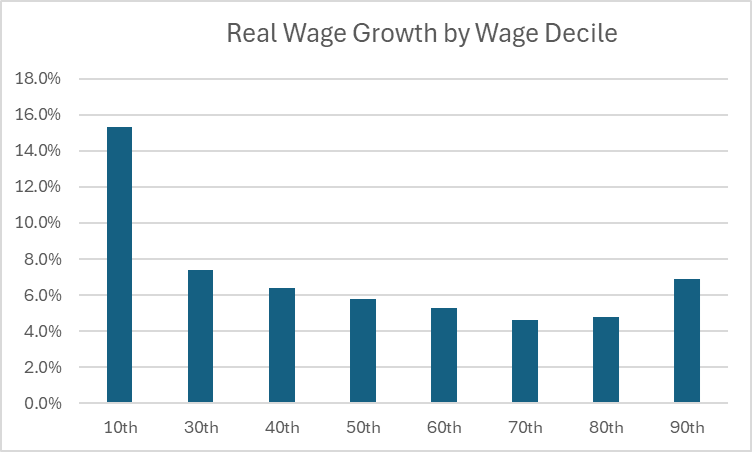
For the large majority of Americans, the new era brought wage stagnation and even, within certain groups in recent years, declining life expectancy. In the happy handful of percentiles located just beneath the 0.1 percent, on the other hand, a hyper-competitive group has managed to hold on to its share of the pie even as it remains fearful of falling behind.
While the political conflicts of the present cannot be reduced to economic conflicts, the great disparity in wealth distribution is a significant contributor. It has fractured our faith in the common good, unleashed an epidemic of status anxiety, and made a significant subset of the population susceptible to conspiracism and disinformation.
Different groups, of course, have responded differently. The antidemocratic movement isn’t the work of any one social group but of several working together. It relies in part on the narcissism and paranoia of a subset of the super-rich who invest their fortunes in the destruction of democracy. They appear to operate on the cynical belief that manipulation of the masses through disinformation will enhance their own prosperity. The movement also draws in a sector of the professional class that has largely abdicated its social responsibility. Much of the energy of the movement, too, comes from below, from the anger and resentment of those who perceive that they’re falling behind.
As these groups jockey for status in a fast-changing world, they give rise to a politics of rage and grievance. The reaction may be understandable. But it’s not, on that account, reasonable or constructive. Although the antidemocratic movement emerged, in part, out of massive structural conflicts in the American political economy, it does not represent a genuine attempt to address the problems from which it arose. This new politics aims for results that few people want and that ultimately harm everybody.
The rocket fuel of the new American authoritarianism
What are the main features of this new American fascism grounded in resentment? In America, just as in unstable political economies of the past, the grievances to which the daily injustices of an unequal system give rise inevitably vent on some putatively alien “other” supposedly responsible for all our ills. America’s demagogues, however, have a special advantage. They can draw on the nation’s barbarous history of racism and the fear that the “American way of life” is slipping away, abetted by an out-of-touch elite.
The story of this movement cannot be told apart from the racial and ethnic divisions that it continuously exploits and exacerbates. The psychic payoff that the new, antidemocratic religious and right-wing nationalism offers its adherents is the promise of membership in a privileged “in-group” previously associated with being a White Christian conservative—a supposed “real American”—with the twist that those privileges may now be claimed even by those who aren’t White, provided they worship and vote the “right” way. At the same time, the movement is the result of the concerted cultivation of a range of anxieties that draw from deep and wide roots.
Anxiety about traditional gender roles and hierarchies is the rocket fuel of the new American authoritarianism. Among the bearded young men of the New Right, it shows up in social media feeds bursting with rank misogyny. In the theocratic wing of the movement, it puts on the tattered robes of patriarchy, with calls for “male headship” and female subordination, and relentlessly demonizes LGBT people. On the political stage, it has centered around the long-running effort to strip women of their reproductive health rights and, in essence, make their bodies the property of the state. That effort has had significant consequences at the ballot box—which is why a sector of movement leadership is starting to speak openly about stripping women of the right to vote. The tragedy of American politics is that the same forces that have damaged so many personal lives have been weaponized and enlisted in the service of a political movement that’s sure to make the situation worse.
Expressions of pain, not plans for the future
The bulk of this movement is best understood in terms of what it wishes to destroy, rather than what it proposes to create. Fear and grievance, not hope, are the moving parts of its story. Its members resemble the revolutionaries of the past in their drive to overthrow “the regime”—but many are revolutionaries without a cause.
To be sure, movement leaders do float visions of what they take to be a better future, which typically aims for a fictitious version of the past: a nation united under “biblical law”; a people liberated from the tyranny of the “administrative state”; or just a place somehow made “great again.” But in conversations with movement participants, I have found, these visions quickly dissipate into insubstantial generalizations or unrealizable fantasy. There is no world in which America will become the “Christian nation” that it never actually was; there’s only a world in which a theocratic oligarchy imposes a corrupt and despotic order in the name of sectarian values.
These visions turn out to be thin cover for an unfocused rage against the diverse and unequal America that actually exists. They’re the means whereby one type of underclass can be falsely convinced that its disempowerment is the work of another kind of underclass. They’re expressions of pain, not plans for the future. This phenomenon is what I call “reactionary nihilism.” It’s reactionary in the sense that it expresses itself as mortal opposition to a perceived catastrophic change in the political order; and it’s nihilistic because its deepest premise is that the actual world is devoid of value, impervious to reason, and governable only through brutal acts of will. It stands for a kind of unraveling of the American political mind that now afflicts one side of nearly every political debate.
Yet there is method in this phenomenon. The direction and success of the antidemocratic movement depends on its access to immense resources, a powerful web of organizations, and a highly self-interested group of movers and backers. It has bank accounts that are always thirsty for more money, networks that hunger for ever more connections, religious demagogues intent on exploiting the faithful, communicators eager to spread propaganda and disinformation, and powerful leaders who want more power. It takes time, organizational energy, and above all, money to weaponize grievances and hurl them against an established democracy—and this movement has it all.
To be clear, there’s no single headquarters for the antidemocratic reaction. There are, however, powerful networks of leaders, strategists, and donors, as well as interlocking organizations, fellow travelers, and affirmative action programs for the ideologically pure. That matrix is far more densely connected, well-financed, and influential at all levels of government and society than most Americans appreciate.
History shows, however, that better organization does not always flatten the contradictions. On the contrary, it can sometimes amplify the conflicts. This is perhaps the most difficult to appreciate aspect of the antidemocratic movement—and the source of both its weakness and its strength. This movement is at war with itself even as it wages war on the rest of us. It consists of a variety of groups and organizations, each pursuing its own agendas, each in thrall to a distinct set of assumptions.
Viewed as a whole, it seems to want things that cannot go together—like “small government” and a government big enough to control the most private acts in which people engage; like the total deregulation of corporate monopolies and a better deal for the workforce; like “the rule of law” and the lawlessness of a dictator and his cronies who may pilfer the public treasury; like a “Christian nation” that excludes many American Christians from the ranks of the supposedly righteous. It pursues this bundle of contradictions not merely out of hypocrisy and cynicism but because the task of tearing down the status quo brings together groups that want very different things and are even at odds with one another.
Hope despite—and because of—the chaos
While a survey of the antidemocratic reaction in the United States is bound to provoke alarm and perhaps even a feeling of hopelessness, the self-contradictory nature of this reaction should be a source of hope for those who want to defend American democracy. MAGA is in many regards a weak movement, not a strong one. It draws on multiple factions, including oligarchic funders, the Christian Right, the New Right, libertarians, Q-Anoners, White nativists, “parent activists” radicalized by disinformation, health skeptics, a small segment of the Left, and others, all of whom worked together to bring slim majorities of voters to their side. These groups don’t really belong together, and they probably won’t stay together indefinitely.
In spite of their differences, for now these groups are rowing in the same boat. They told us ahead of the 2024 election that they were going to smash the federal bureaucracy, which they view for ideological reasons as interfering with their agenda. Trump said in no uncertain terms that he would turn the Department of Justice into his personal vendetta machine, and that’s what he’s attempting to do. He promised trade wars and let everybody know he would trash vital international alliances, and that’s what he’s doing.
So this is no time to retreat under the covers. Now is the time for moral courage. There are more Americans who would prefer to live in a democracy than a kleptocratic, Christian nationalist autocracy. We need to come together in broad coalitions and stay focused on organizing—from developing pro-democracy strategies and infrastructure to taking local action to improving voter turnout operations—now and in the long term.
When they lost in 2020, the MAGA movement didn’t roll over. They simply resolved to organize better and fight harder. Above all, they found new populations to evangelize with untruths. We wouldn’t wish to emulate their most craven tactics, of course, but we can learn something from their strategic resolve.













 Scottie's Playtime