Project 2025, assuming it still needs to be explained at this point, is an infamous proposed manifesto for the ultra-conservative faction of the Republican Party and, many believe, Donald Trump’s second term.
And with many LGBTQ+ Americans waking up on 6 November to the bleak and shocking reality of a second Trump presidency, it feels like a particularly good time to unpick what the document could signify for queer peoples’ rights in the US over the next four years.
Unsurprisingly, while Project 2025 promises to “take down the ‘Deep State’ and return the government to the people”, it also threatens to shred the rights and advancements of the LGBTQ+ community in the US.
The handbook’s authors claim that one of the biggest problems facing the US today is the “toxic normalization of transgenderism with drag queens and pornography invading school libraries.”
Project 2025 goes on to say that “transgender ideology” is one form of “pornography” linked to the “sexualization of children”. In total, “gender” is mentioned 111 times, and “LGBT” or “LGBTQ” 18 times, in the handbook.
LGBTQ+ rights would all but disappear if Project 2025 came to fruition. (Getty)
Viewed as a sort of right-wing wish-list, Project 2025 pledges to strip away anti-discrimination policies, making it easier to target and discriminate against LGBTQ+ people.
Published by the hard-line right-wing Heritage Foundation, the document calls for the removal of terms such as “sexual orientation” and “gender identity” from federal rules and legislation, and the revoking of regulations prohibiting discrimination based on sexual orientation, gender identity, transgender status and sex characteristics.
Project 2025 set out plans to restrict the application of the Supreme Court’s decision in Bostock vs. Clayton County, which extended workplace protections against sex discrimination to LGBTQ+ employees.
In addition, it plans to restrict access to healthcare for transgender people, something it refers to as a form of “child abuse”. Its authors also want to see trans healthcare no longer being covered by insurance schemes Medicare and Medicaid, and an end to anti-discrimination rules based on gender identity and sexual orientation.
In addition, there are plans to reverse policies allowing transgender people to serve in the military, a ban that was initially brought in under the Trump administration but reversed by president Joe Biden. If enacted, Project 2025 would expel transgender servicemen and women as well as those living with HIV.
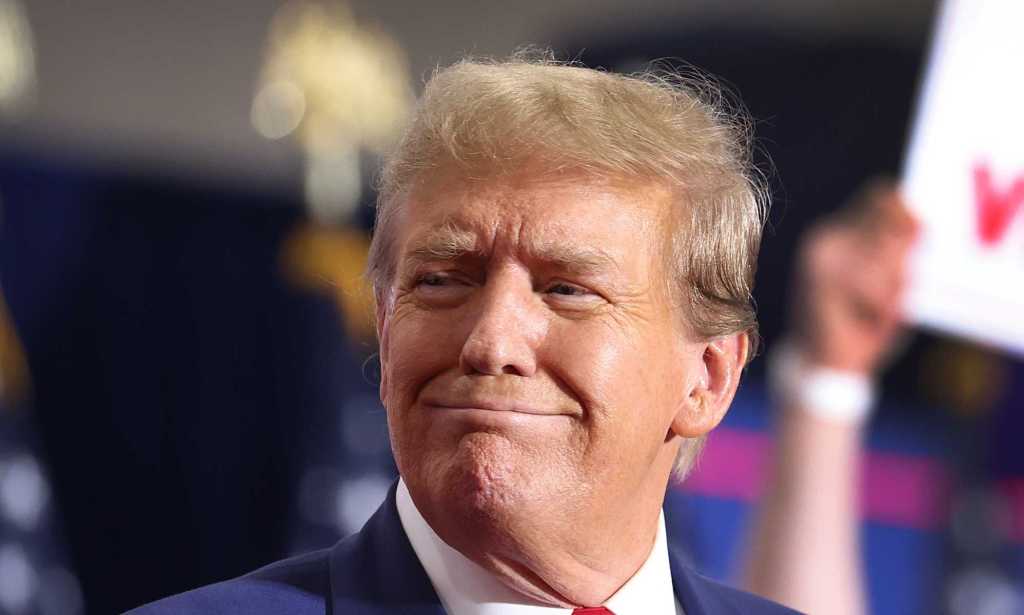
Donald Trump has tried to distance himself from the hard-line right-wing document. (Getty)
The State Department’s LGBTQ+ equality initiatives in Africa would also be axed. In other words, there would be no effort to stop draconian anti-queer laws being passed in countries such as Uganda.
In terms of education, the conservative blueprint is even more staunchly anti-LGBTQ+. It calls for a ban on students using names or pronouns that don’t match the sex on their birth certificate, and no school employee would be “forced” to use a pupil’s chosen pronouns.
It document outlines ideas to remove LGBTQ+-inclusive curriculums and policies from schools, claiming that “critical race theory and gender ideology” are “poisoning and indoctrinating children with leftist ideologies”. Instead, families “comprised of a married mother, father and their children” would be prioritized.
Despite many of its authors being one-time Trump administration advisors, the former president claims to know “nothing about Project 2025” or who is behind it, saying: “I disagree with some of the things they’re saying and some of the things they’re saying are absolutely ridiculous and abysmal.”
And two of his campaign advisors insisted: “President Trump’s campaign has been very clear that Project 2025 had nothing to do with the campaign, did not speak for the campaign, and should not be associated with the campaign in any way.”
A spokesperson for Project 2025 has even told CNN that it “does not speak for any candidate or campaign.”
However, Democrats have continued to point to links between the 922-page document and Trump. As he’s now won the election, will Trump finally admit to having any involvement with Project 2025? Only time will tell.
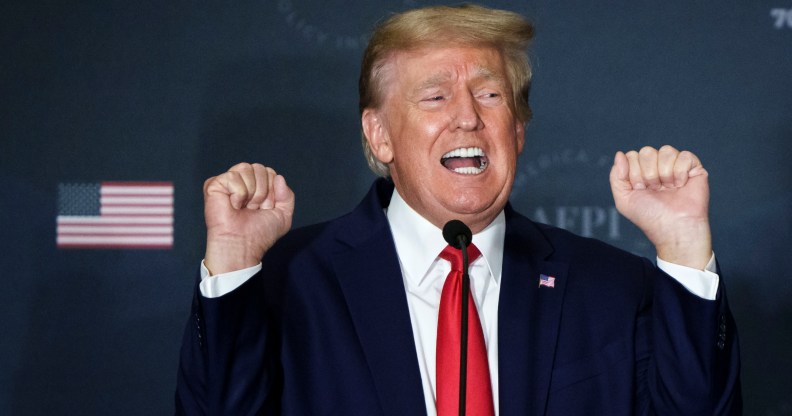
Donald Trump has been outspoken against the LGBTQ+ community. (Getty)
At the time of writing, it seems almost inevitable that Donald Trump will become the 47th President of the United States, meaning LGBTQ+ rights are under serious threat.
The election was one of the closest in history according to voting polls over the past few weeks, with polling group FiveThirtyEight reporting that Harris just barely reached a 1.2 per cent lead on Trump a day before the results were counted.
The last Trump presidency led to a roll-back of protections and anti-discrimination laws for LGBTQ+ people, and it doesn’t look as if a second term would be any different if he is re-elected, based on campaign promises and the detailed policy proposals outlined in Project 2025 – although Trump has tried to distance himself from the right-wing proposals.
In anticipation of a Trump win, the American Civil Liberties Union (ACLU) suggested a new Trump administration would “reinstate and significantly escalate the removal of anti-discrimination policies… proactively require discrimination by the federal government [and] weaponize federal law against transgender people across the country”.
So, what are Trump’s views about LGBTQ+ rights, and what exactly might he do?
Erase federal non-discrimination protections for LGBTQ+ people
Trump’s first term was extremely detrimental to the rights and protections of LGBTQ+ people, and a second term could roll back protections once again.
LGBTQ+ people might no longer be guaranteed to be free of discrimination across several federal government programs, such as Social Security, Medicare, housing and employment.
Exclude openly transgender people from the military
The first Trump administration reversed policies allowing trans people to serve in the military, and it is not difficult to foresee the president doing so again.
Another ban on trans people in the military would force out active-duty transgender service personnel as well as prevent trans people enlisting in the future.
This is despite a report in 2016 revealing that trans-inclusive policies have “little or no impact on unit cohesion, operational effectiveness, or readiness”.
In fact, trans-inclusive military policies could benefit all active service members by “creating a more inclusive and diverse force.”
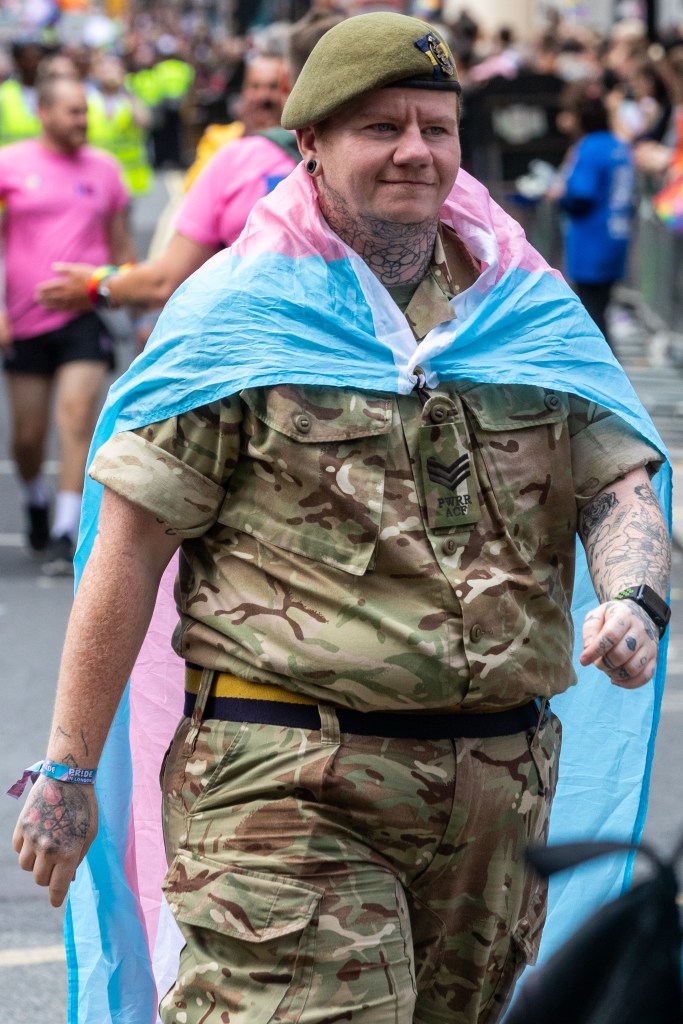
Trans people could once again be banned from serving. (Getty)
Withhold federal funding if school officials affirm transgender students
Trump has said he would act to stop any school district introducing or maintaining trans-inclusive policies and practices.
This would include withholding federal funding that allow trans students to use toilets and changing rooms that align with their gender identity, or even acknowledging that they are trans, as well as arguing that trans-inclusive policies violate the rights of cisgender pupils.
Discrimination against trans students, causing significant harm to the community as a whole, would be the likely result of such a move.
During a recent campaign rally, Trump said he was not going to “let” trans women compete in sporting events at all if he becomes president again.
He said invoking the ban would “not [be] a big deal”, citing recent sporting events in which trans women competed against cisgender women, claiming that the trans athlete had a competitive edge over their opponent.
“Physically, from a muscular standpoint… look at what’s happened in swimming. Look at the records that are being broken,” he said.
Prohibit gender-affirming care in federal healthcare programmes
His website also promises that on his first day in the Oval Office, he would issue an executive order “instructing every federal agency to cease all programs that promote the concept of sex and gender transition, at any age”.
The administration would also probably deny Medicaid funding for hospitals that provide gender-affirming care, forcing medics to deny trans people the care they require.
Access to healthcare for more than 100,000 transgender youngsters in 24 states has already been halted in the past three years.
Allow employers to discriminate against LGBTQ+ staff
A second Trump administration could bring in provisions to allow employers to discriminate against LGBTQ+ members of staff based on the boss’ stated religious beliefs, a reversal of existing non-discrimination laws.
This would not require congress or bipartisan support, and could be pushed through using an executive order from the president.
The administration could go one step further to prevent state and local governments enforcing non-discrimination laws if the defendant says the discrimination was based on religious belief.
Laws protecting LGBTQ+ people and other minorities from discrimination based on protected characteristics might also disappear.
Donald Trump has continued to target the LGBTQ+ community. (Getty)
Criminalize gender-non-conformity in public life
Project 2025 – a hard-line right-wing blueprint for a future Republican president – suggests the use of criminal laws to punish gender-non-conformity in public life, with pornography being the crux of the issue.
The authors of the plan, the Heritage Foundation, inexplicably link pornography with “transgender ideology” and argue that neither has a “claim to First Amendment protection” and therefore should be outlawed.
“The people who produce and distribute it should be imprisoned,” they demand. “Educators and public librarians who purvey it should be classed as registered sex offenders, and telecommunications and technology firms that facilitate its spread should be [closed down].”
That means any discussion of transgender people in schools and libraries could be criminalized, and trans people might face jail time for being themselves.
Trump would only be able to put this into practice with congress’ approval and there is unlikely to be bipartisan support for such a law, but even the slim possibility is terrifying.
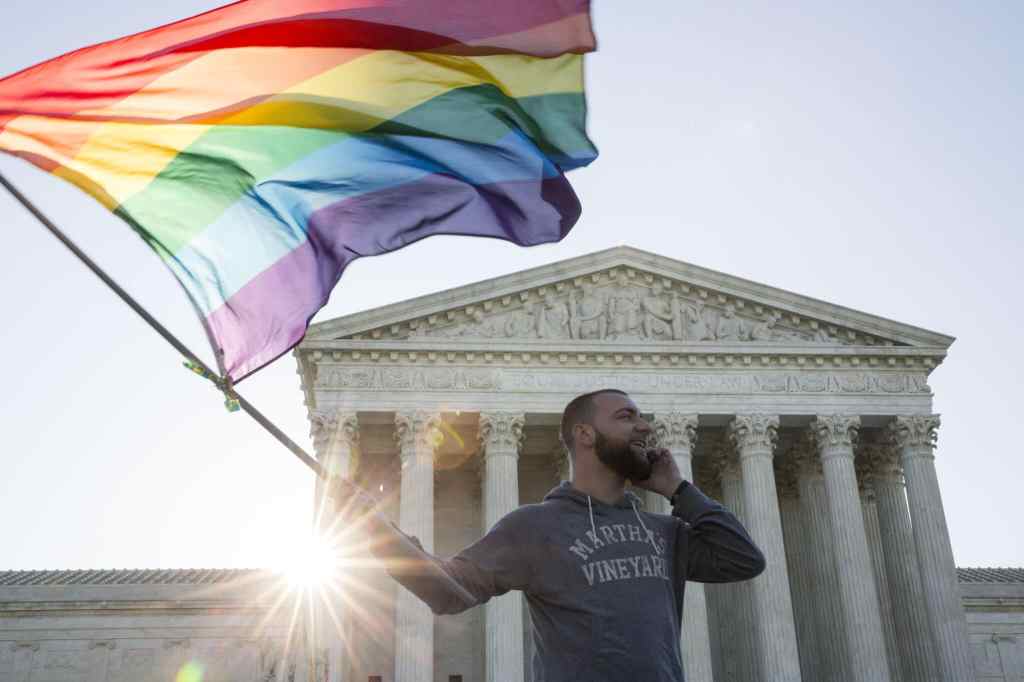
Finally – could gay marriage be reversed?
Same-sex marriage supporter Vin Testa, of Washington DC, waves a rainbow pride flag near the Supreme Court. (Drew Angerer/Getty Images)
Unfortunately, yes, it could.
After crucial abortion legislation Roe v. Wade was overturned by the Supreme Court, many people said that next, they would be coming for Windsor and Obergefell and Lawrence – three rulings that unlocked a national right to same-sex marriage.
Whether a same-sex couple could marry varied by state before 2015. With its 5-4 decision in Obergefell v. Hodges, the Supreme Court extended the full federal right to marry to all same-sex couples.
So would – or could it be taken away? Many people think that the Supreme Court wouldn’t dare. Same-sex marriage is now too accepted in American society, they argue. It would cause “legal chaos.”
However, it remains the case that some justices, particularly Samuel Alito and Clarence Thomas, appear to be itching to overturn Obergefell. In 2022, Justice Thomas said the Supreme Court “should reconsider” its past rulings codifying rights to contraception access, same-sex relationships and same-sex marriage.
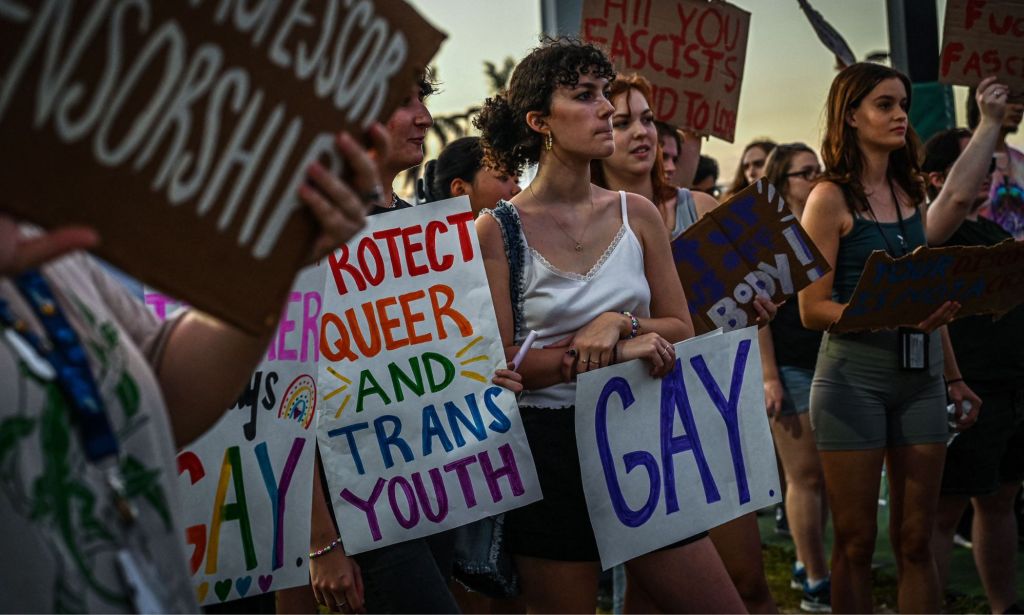
It’s important to remember in all of this Pride is a protest, and it continues to be. We can fight any and all of these attacks by standing up, speaking out and refusing to stay silent.
What We Know About How Trump Will Approach LGBTQ+ Rights, Abortion, and Other Issues
Much is still unknown about how Trump will carry out some of his big promises on issues like the economy and immigration, or how he may curb abortion access and LGBTQ+ rights. Project 2025 and what he’s said so far offer some clues.
Sign up for The Agenda— Them’s news and politics newsletter, delivered to your inbox every Thursday.
Throughout his campaign, President-elect Donald Trump has made big promises on issues of enormous consequence to Americans, from the economy to reproductive health care — but offered few details on how he would see those promises through.
What he’s said in his campaign and what he did during his first term offer some clues, as does Project 2025, the blueprint for a second Trump term written by the conservative Heritage Foundation. Though Trump has distanced himself from Project 2025, saying he has “no idea who is behind it” and that he has not read it, six of his former cabinet secretaries contributed to it in some form and much of what is in the 920-page document aligns directly with statements Trump has made this year.
Though there are still many unknowns, here is what we know so far about how a second Trump term will approach reproductive rights, LGBTQ+ rights, the economy, education, immigration and aging and disability care.
Abortion
Throughout his campaign, Trump has repeatedly taken credit for the fall of Roe v. Wade. He appointed three of the Supreme Court justices who helped overturn the decades-old case protecting federal abortion rights. His stance on abortion access has wobbled over time between a national ban and state-by-state laws.
Though Trump has said he would not support a federal abortion ban and he’s called restrictive abortion laws like Florida’s six-week ban “a terrible mistake,” it’s unclear how much he will stick to those statements: A day after he said people needed “more time” than six weeks, he said he would vote to uphold the ban in Florida, where he lives. About 57 percent of Floridians voted in favor of an amendment to undo the six-week regulation, but it fell short of the 60 percent threshold it needed to pass.
The biggest question mark heading into the election was his support of a federal ban. During the presidential debate in September, Trump said “there’s no reason to sign a ban, because we’ve gotten what everybody wanted, Democrats, Republicans and everybody else, and every legal scholar wanted it to be brought back into the states,” meaning the issue had been returned to the states. A majority of Americans disapproved of the Supreme Court decision that led to a patchwork of abortion decisions, according to polling from the nonpartisan Pew Research Center.
What Trump will ultimately do will likely come down to who he appoints — and listens to — in his administration. Some of his closest supporters, including Vice President-elect JD Vance, have said they support a national ban on abortion, though during the vice presidential debate in October, Vance acknowledged that his position is not popular with “a lot of Americans.”
Trump has also said he’s open to limiting whether mifepristone, one of the pills used in medication abortions, can be sent by mail.
Economy
Much of Trump’s win Tuesday was likely due to Americans’ view on how he could improve the economy — and particularly their own personal finances. Early exit polls show that the economy was a lead motivator for many after record inflation during the Biden administration brought on by a confluence of factors, including supply chain issues, Russia’s war in Ukraine and coronavirus stimulus checks.
In the end, the reason for the inflation — and how much of it was Biden’s doing — didn’t matter. Trump presented himself as the person to “fix” the economic troubles that have plagued Americans over the past four years, and it appears to have been a salient message.
Trump inherits an economy in repair: Inflation is back down to 2.1 percent from 9 percent, hovering at the Federal Reserve’s 2 percent goal. And the country has been adding jobs consistently for months, though the most recent report shows fewer jobs added in October than expected. Still, the unemployment rate is down to about 4.1 percent from 6.3 percent when Trump left office in January 2021.
The biggest economic showdown of a second Trump term will likely come next year, when parts of Trump’s 2017 tax bill expire. Among those provisions is the child tax credit, which was expanded in 2017 to $2,000 per child. Trump has expressed support for the credit, but has not said what he’d do with it in 2025. Vance has floated increasing the credit further to $5,000 per child. Trump has also called for further lowering the corporate tax rate, which he brought down from 35 to 21 percent in 2017, to 15 percent.
The president-elect has also proposed several tax breaks — on tips, Social Security and overtime pay — but it’s unclear how he would pursue those aims.
Cutting taxes on tips would impact the women who make up the majority of tipped workers directly, but only those who earn enough to be taxed in the first place. Nearly 40 percent of tipped workers already don’t earn enough to pay federal income taxes.
If Trump also eliminates payroll taxes on tips, most workers would see some impact, but could also see their Social Security benefits diminish (payroll taxes fund Social Security and Medicare). The same would happen if taxes are cut on overtime pay, though it’s also unclear what the impact of that would be. Trump has offered no details on how he would approach the policy.
Trump has also called for eliminating taxes on Social Security benefits, a proposal that would impact about half of recipients, most of them higher income, who currently pay taxes. But that proposal alone could make Social Security insolvent three years earlier than predicted, by fiscal year 2031, rather than 2034, according to the Committee for a Responsible Federal Budget, a nonpartisan nonprofit organization.
It is likely that the second Trump administration will vigorously pursue curbing the rights of trans Americans. Trump’s campaign has proposed terminating Medicare and Medicaid funding for hospitals that provide gender-affirming care to trans youth, attempting to charge teachers with sex discrimination for affirming students’ gender identities and ordering federal agencies to “cease all programs that promote the concept of sex and gender transition at any age.” Trump has also pledged to ask Congress to halt the use of federal funds to promote or pay for gender-affirming care, without distinguishing between care for adults or minors.
Leading up to the election, Trump falsely claimed that schools were performing gender-affirming surgeries on children without parental knowledge or consent — a claim divorced from reality that marked a particularly bizarre moment in a campaign littered with anti-trans misinformation. At an October 28 rally, as Trump did at multiple rallies on the tail end of his campaign, he doubled down on framing anti-trans policies as key to his vision for the Republican party, saying: “We’re the party of common sense. That means no open borders, and no transgender operations.”
In October, about 41 percent of the campaign’s ad spending was focused on messaging around trans people, particularly trans athletes and children receiving gender-affirming care.
When polled, most Americans do not rank trans issues highly compared to issues like the economy or abortion rights. It is currently unclear if these ads motivated Trump voters to turn out in 2024 or if they were incidental to issues that voters rank more highly.
Education
Trump has called repeatedly for an end to the Department of Education and presented himself as a champion for school choice, a position that will likely take center stage in a second term.
That stance aligns with details in Project 2025, which also supports eliminating the agency, as well as gutting protections for LGBTQ+ students and what he sees as progressive curriculum. Trump has vowed to cut federal funding for schools that teach lessons related to race or that teach “gender ideology.” Much of the impact will be on trans students, especially in sports.
Under his previous administration, then-Education Secretary Betsy DeVos worked to limit trans women’s participation in women’s sports, arguing it violated the anti-discrimination law Title IX.
DeVos also sparked outrage by revising Title IX regulations to make it harder for sexual misconduct survivors on college campuses to hold perpetrators accountable.
Earlier this year, the Biden administration reversed these controversial DeVos-era regulations and offered protections for LGBTQ+ students in schools, but the incoming Trump administration will almost certainly introduce their own updates to this federal law. Specifically, Trump is expected to go further by defining “sex” to exclude transgender students from playing on teams or experiencing school generally in ways that align with their gender identity.
Gutting the Department of Education would also have a major negative impact on disabled students, who rely on federal enforcement of civil rights laws to protect them from discrimination, lack of access to appropriate education, unnecessary segregation and abuse.
Immigration
Some of Trump’s most divisive rhetoric during his campaign was toward Latinx people and immigrants, who he blamed as the reason for many of the country’s challenges, from safety to job loss to affordable housing. In the final days of his campaign, at a Trump rally in Madison Square Garden, comedian Tony Hinchcliffe called Puerto Rico “a floating island of garbage.”
Throughout his campaign, Trump has called immigrants “the enemy from within,” saying undocumented immigrants are “poisoning the blood of our country.”
His response as president, he said, would be to mount the “largest deportation in the history of our country,” but he has offered very little information on how that would happen, who would be targeted and with what resources.
Much of what Project 2025 has to say about immigration overlaps with Trump’s campaign promises. The document discusses reinstating “every rule related to immigration that was issued” during Trump’s first term, and the president-elect has specifically called for putting back into place his “Remain in Mexico” policy, by which some asylum seekers had to wait out the outcomes of their U.S. immigration cases in Mexico.
Plans laid out in Project 2025 would also make it even more difficult for undocumented students to attend college. It calls for the Department of Education to deny loan access to students who aren’t in the country with authorization and for loan access to be denied to students at schools that offer in-state tuition to the undocumented population. Nearly 20 states, including California, Texas and New York, offer in-state tuition to undocumented students.
Disability and aging
During the presidential debate in September, Trump indicated that he had “concepts of a plan” for replacing the Affordable Care Act, which protects disabled, chronically ill and older Americans from being excluded from standard health insurance coverage.
Opposition to the Affordable Care Act was a centerpiece of Trump’s 2016 campaign, and his first year in office was characterized by a failed, widely unpopular attempt to repeal and replace it, in addition to cutting Medicaid funding. Medicaid, a federal poverty program, funds the majority of long-term care for disabled and older adults in the United States.
Republican House Speaker Mike Johnson has indicated that he is willing to commit to dismantling the Affordable Care Act during a Trump presidency. While Trump promises on his website not to cut Medicare, which provides health insurance for Americans over 65, he has made no such promises about Medicaid.
Affordable drug pricing may also take a hit during a second Trump term. The Biden administration vigorously pursued Medicare price negotiation to lower the cost of some particularly expensive prescription drugs for older adults. While Trump promised to pursue a similar policy during the 2016 race, he never implemented that promise.
Both Vance and Trump have promised a tax credit for family caregivers of older and disabled adults between $5,000 to $6,000 per year. The average cost of home care in the United States, per the most recent data from the Federal Long Term Care Insurance Program, is $42,120 per year. The average cost of a shared room in a nursing home is $100,740 per year.
Nadra Nittle and Orion Rummler contributed to this reporting.
GOP candidate for NC schools chief has spread conspiracy theories, ‘groomer’ rhetoric – Michele Morrow has a track record of falsehoods – for example, saying Islam is a cult and that the plus in LGTBTQ+ stands for pedophilia. via NPR https://t.co/nItjI0LE6r
Lovable policy dork and new US Congresswoman Sarah McBride gives a hug to the kid who stole my pink unicorn dress. Yes, I will sue.
How do you do, fellow Wonks! It is I, your friendly neighborhood trans woman who is happy about a thing!
What? What is with those faces? Did something bad happen? No matter! For it is my job to give you the good news, with a spring in my step and a song in my heart and I am going to fucking do that because it is my job, melonfuckers, and I will not neglect my professional duty to be happy about a happy thing. Or three!
Yesterday, for those not in the know, the United States had an election. And during this election the transgenders worked their genderqueer asses off, not only running for election to the local sixth-grade softball team but also to at least 35 political positions around the country. And while we here at Wonkette salute every single one of those eager beavers, a couple stand out for their prominence and their victories.
No trans star shines brighter in, lo, these early morning hours as I write you this, than Sarah McBride. While McBride was not the first trans person to be elected to any ol’ thing, she was not elected to any ol’ thing. She was elected to the actual Congress of the US America. That’s right! We’re talking about the very same federal legislature made famous in Schoolhouse Rock’s song “I’m Just A Bill.”
This is not particularly surprising, as like some San Franciscans we could name, she was very well qualified for the position she sought. Before coming out or even turning 20 years old she worked as a junior staffer for Delaware Governor Jack Markell’s campaign in 2008 and Attorney General Beau Biden’s campaign in 2010. Next she lobbied for adding gender identity to Delaware’s equal protection law and interned at the White House in 2012 before graduating from college. She was on this shit young, I tell ya. And after she came out that year, her story was featured on American University Radio (later rebroadcast on NPR) including an anecdote about Beau telling her that after coming out she “was still part of the Biden family.”
After graduating she went to work as an activist with Equality Delaware and used her relationships to help pass positive bills before she became the first ever out trans speaker at a major party political convention in 2016 — something she’s sure as hell going to do again now. She then went on to write a book (foreword by some dude named “Joe Biden”), work for the Human Rights Campaign as their spokesperson, and then spend the most recent four years representing 50,000 Delawareaniteishers in the state Senate.
With her resumé and the Blue-leaning makeup of the state electorate, she had this. And it showed both during her campaign and in her 57/42 victory. (Which won me five bucks.) And now she’s going to Congress to make sure that Republican dickweasel bigots have to look a trans person in the eye as they ban driving through McDonalds while trans or whatever evil-ass bill they’re proposing next January. She lists her top two priorities as universal healthcare and reproductive rights, with other big ticket items like the John Lewis Voting Rights Act, the union-friendly PRO Act, curbing climate change, ending mass incarceration and more. She sounds too good to be true, but she’s real and she’s going to be kicking Matt Gaetz ass in just eight weeks.
Still convinced there’s a catch? Like maybe she’s great but replaced someone greater? Worry not: The woman she’s replacing is now your new US Senator from Delaware Lisa Blunt Rochester, making all kinds of demographic firsts from a state previously obsessed with sending only white men to the Senate but which has now elected a Black woman 56/39/4.
Yeah, we could use a lot more Delawares right now.
But if you’ll excuse Hawaii for not being Delaware, there’s also some good shit doing down on the islands. Over the last few decades indigenous Hawaiians have become homeless at a horrible rate — yes, this started long before Lahaina burned to the ground. The primary culprit is a tourism-first legislature full of corporate Democrats who never met a bit of housing they couldn’t rezone for rental to visiting mainlanders. Along with other forces making housing expensive even on the continent, this has made trying to find a place to live in the state a genuine crisis, especially for the people working those low-paying service jobs catering to tourists.
While Kim Coco Iwamoto isn’t the only Hawaiian to notice the problem, she made it her mission to knock off the incumbent Speaker of the Hawaiian state House in the Democratic primary. It took three tries, but this year she managed it and put the game away in the general last night. She only takes over the district of Scott Saiki, not his speakership, and the still pro-corporate Dem majority is certain to elect another tourism-pleasing Speaker, but Iwamoto becomes a trans voice against homelessness and for affordable housing. Iwamoto didn’t start off in politics going straight after Saiki. She was actually the first out trans person ever to hold statewide office anywhere in the US as she was elected to an at-large position on the Hawaii Board of Education and then later appointed to the state Civil Rights Commission. She is experienced and determined, she knows Hawaii politics, and she’s going to get things done.
Our third and final Trans Nice Times! for this morning comes to you from Los Angeles, where for the first time ever a trans-centric non-profit was designated a voting center. You may be used to voting in gymnasiums and churches, but yesterday in West Hollywood if you wanted to drop off your ballot (or fill one out if you hadn’t had a chance to vote from home as is the norm in California these days), your home precinct was The Connie Norman Transgender Empowerment Center where instead of having to to look at posters saying, “Jesus dies a little every time you touch your cooter! Don’t be chewed bubblegum!” as you walk through the lobby to cast your vote, you instead got to see signs saying, “Trans joy **is** resistance!” Won’t that just be a hoot for the two conservatives who still live in West Hollywood?
In summary and conclusion, there is still joy in this world, like trans people who kick ass and golden retrievers who know just a little too much English.
Now ain’t that some nice times?
Send this post to a friend who needs to read it! (I thought we all needed this here. -A)
Thanks to Ten Bears for the reminder that others faced a harder struggle and stood their ground in order to create a more perfect union. I will give myself today to absorb it, to be stunned at how we were so misled. How with all the support, money, and him being him, how did Harris lose. Misogyny comes to mind. But we fought for our rights before. We started at the ground, the grassroots and changed minds along with changing who was in charge. The other side learned our lessons and turned them against us. So tomorrow we go back to doing what we must to change the direction the country is going in, to make sure school boards are filled with people who want kids to learn science, learn to treat those different from them with respect and dynasty. We were on the way to a better world, those that did not want that fought back. Now the shoe is back on our feet. We have to make sure it starts at every level and every state. Make sure we are in the community and seen. Make sure we let people know we will not return to the 1850s or even the 1950s. We remember, let’s make sure everyone else does also. Hugs
it’s too cold here for butterflies. As it should be, in November.
Oooookay. I’ve got little to offer right now. We lost, we seem to have lost by not much numbers-wise, but big as to our government. So there are likely to be changes coming. I’ve got very little because while most of the ones who won lie constantly, sometimes they don’t lie. It’s easy to take all the very bad things they’ve said and decide they weren’t telling lies then, but they were otherwise. But, one could choose to take the opposite outlook, as well, deciding that they said the very bad stuff to get the ugly vote, but didn’t mean it. Or, we can just take care of ourselves now and for the future instead of worrying about changes that aren’t here yet. I hope we decide to retain our power to put ourselves in good positions to withstand any adversities that might be on the way.
FILE – Texas Gov. Greg Abbott speaks at a news conference in Austin, Texas on June 8, 2021. (AP Photo/Eric Gay, File)
By THE ASSOCIATED PRESS
Updated 7:10 AM EST, November 1, 2024
Texas hospitals must ask patients starting Friday whether they are in the U.S. legally and track the cost of treating people without legal status following an order by Republican Gov. Greg Abbott that expands the state’s clash with the Biden administration over immigration.
Critics fear the change could scare people away from hospitals in Texas, even though patients are not required to answer the questions to receive medical care. The mandate is similar to a policy that debuted last year in Florida, where Republican Gov. Ron DeSantis is also a frequent critic of the federal government’s handling of illegal crossings along the U.S.-Mexico border.
Texas hospitals have spent months preparing for the change and have sought to reassure patients that it won’t affect their level of care.
Here’s what to know:
Required to ask, not required to answer
Under the executive order announced by Abbott in August, hospitals must ask patients if they are citizens in the U.S. and whether they are lawfully present in the country.
Patients have the right to withhold the information and hospital workers must tell them their responses will not affect their care, as required by federal law.
Tracking hospital costs and patient data
Hospitals are not required to begin submitting reports to the state until March. An early draft of a spreadsheet made by state health officials to track data does not include fields to submit patient names or personal information.
Providers will fill out a breakdown of visits by inpatient and emergency care patients and document whether they are lawfully present in the country, citizens or not lawfully present in the U.S.
The reports will also add up costs for those covered by Medicaid or the Children’s Health Insurance Program, known as CHIP; and the cost for patients without it.
“Texans should not have to shoulder the burden of financially supporting medical care for illegal immigrants,” Abbott said when he announced the policy.
Texas is following Florida’s lead
Florida enacted a similar law last year. Health care advocates contend the law has made immigrants who need of emergency medical care fearful and led to fewer people seeking help, even from facilities not subject to the law.
Florida’s early data is — by the state’s own admission — limited. The data is self-reported. Anyone can decline to answer, an option chosen by nearly 8% of people admitted to the hospital and about 7% of people who went to the emergency room from June to December 2023, according to Florida’s state report. Fewer than 1% of people who went to the emergency room or were admitted to the hospital reported being in the U.S. “illegally.”
Texas hospitals have been preparing
Immigrant and health care advocates have sought to educate the Texas public about their rights. In Florida, groups used text messages, posters and emails to get the word out. But advocates there have said they didn’t see fears subside for about a year.
Health care providers received directives from the state and guidance from the Texas Hospital Association.
“The bottom line for patients is that this doesn’t change hospital care. Texas hospitals continue to be a safe place for needed care,” said Carrie Williams, spokesperson for the hospital association.
November 5, 1872 Susan B. Anthony and a few other women in Rochester, New York, voted in the presidential election, all of them for the first time. Susan B. Anthony She wrote later that day to her fellow suffragist Elizabeth Cady Stanton, “If only now—all the women would work to this end of enforcing the existing constitution—supremacy of national law over state law—what strides we might make . . . .” Anthony’s vote went to U. S. Grant and other Republicans, based on that party’s promise to consider the legitimacy of women’s suffrage. Elizabeth Cady Stanton Read Susan B. Anthony’s speech On Women’s Right to Vote
November 5, 1949 The Peace Pledge Union in Great Britain set up the Non-Violence Commission to study nonviolent resistance and how the ideas of Gandhi could be used to reach the Union’s goals of getting U.S. troops out of Britain and to end production of nuclear weapons there.
November 5, 1969 Bobby Seale Bobby Seale, a founder of the Black Panther Party, was sentenced to four years in prison on sixteen counts of contempt of court during the federal Chicago Eight trial in Chicago; he was charged for his insistent claims to the right to choose his own lawyer, or to represent himself. After the Chicago Eight verdict, the contempt charges were withdrawn.
November 5, 1982 36 were arrested in a demonstration at Honeywell, Minnesota’s largest defense contractor. The “Honeywell Project,” a local campaign against the arms maker, dogged the company for over three decades, at times with success. It continues today, targeting Alliant Technologies, the arms-making branch of Honeywell that was spun off in the 1990s. Protests at Alliant continue today. Alliant is the manufacturer for the Pentagon of artillery shells made with depleted uranium (DU or U-238, a by-product of uranium enrichment) which have been used extensively in Iraq and Kosovo. The Defense Department denies any health effects from use of DU (though army manuals warn soldiers of its toxicity), and contests accusations of DU’s role in Gulf War Syndrome. More about the Honeywell project from War Resisters’ international
November 5, 1987 Govan Mbeki, an early leader of the African National Congress, was released from South Africa’s Robben Island prison after serving twenty-four years (for treason). He served his sentence alongside Nelson Mandela, Walter Sisulu and many others who fought apartheid. Govan Mbeki His son, Thabo Mbeki, was elected in 1998 (and force to resign in 2008) to succeed Mandela, who was the first president elected following a new constitution which granted the right to vote to the entire non-white population, comprising 85% of the country’s population. Read more about Govan Mbeki





 Susan B. Anthony
 Elizabeth Cady Stanton
 Bobby Seale
 Protests at Alliant continue today.
 Govan Mbeki
 Scottie's Playtime