August 5, 1963 The U.S., U.S.S.R. and U.K. signed the Limited Test Ban Treaty in Moscow, banning nuclear testing in the atmosphere, in space or underwater. Underground testing, however, was not prohibited. It has since been signed by more than 100 countries. Text of the treaty, background and signatories
August 5, 1964 President Lyndon Johnson asked Congress ”for a resolution expressing the unity and determination of the United States in supporting freedom and in protecting peace in southeast Asia.” The president had already used the alleged incidents in the Gulf of Tonkin [see August 4, 1964 above] to mount major air strikes on the North Vietnamese navy. The resulting Congressional Resolution authorizing military force in Vietnam was the legal basis for the war there that lasted until 1975. Only two members of the senate voted against the resolution: Ernest Greuning of Alaska and Wayne Morse of Oregon. …
“Let’s go back to the war in Vietnam. I was here. I was one of the Senators who voted for the Gulf of Tonkin resolution. Yes, I voted for the Gulf of Tonkin resolution. I am sorry for that. I am guilty of doing that. I should have been one of the two, or at least I should have made it three, Senators who voted against that Gulf of Tonkin resolution. But I am not wanting to commit that sin twice, and that is exactly what we are doing here. This is another Gulf of Tonkin resolution.” Senator Robert Byrd (D-WV) in debate on the resolution to authorize use of military force on Iraq, October 4, 2002
August 5, 1981 President Ronald Reagan, having ordered striking air traffic controllers back to work within 48 hours, fired 11,359 (more than 70%) who ignored the order, and permanently banned them from federal service (a ban later lifted by President Bill Clinton). The controllers, seeking a shorter workweek among other things, were concerned the long hours they were required to work performing their high-stress jobs were a danger to both their health and the public safety. Lessons from When Reagan Crushed PATCO Union
This one’s about trouble for all coastal states, coming from Louisianans.
Louisiana Fights Against Becoming Another Not There No More Statistic by Jerileewei
Terrebonne Parish: Where the Rivers Meets the Sea Read on Substack
CCJC Audio Podcast Episode 00086, Season 2
“It’s not just the land we’re losing. It’s the stories. The way we talk. The smell of the air before a big storm.” — Emile Navarre
Cajun Chronicles Audio Podcast – Bringing you the heart of Louisiana. Artwork generated with Google Docs Image Maker.
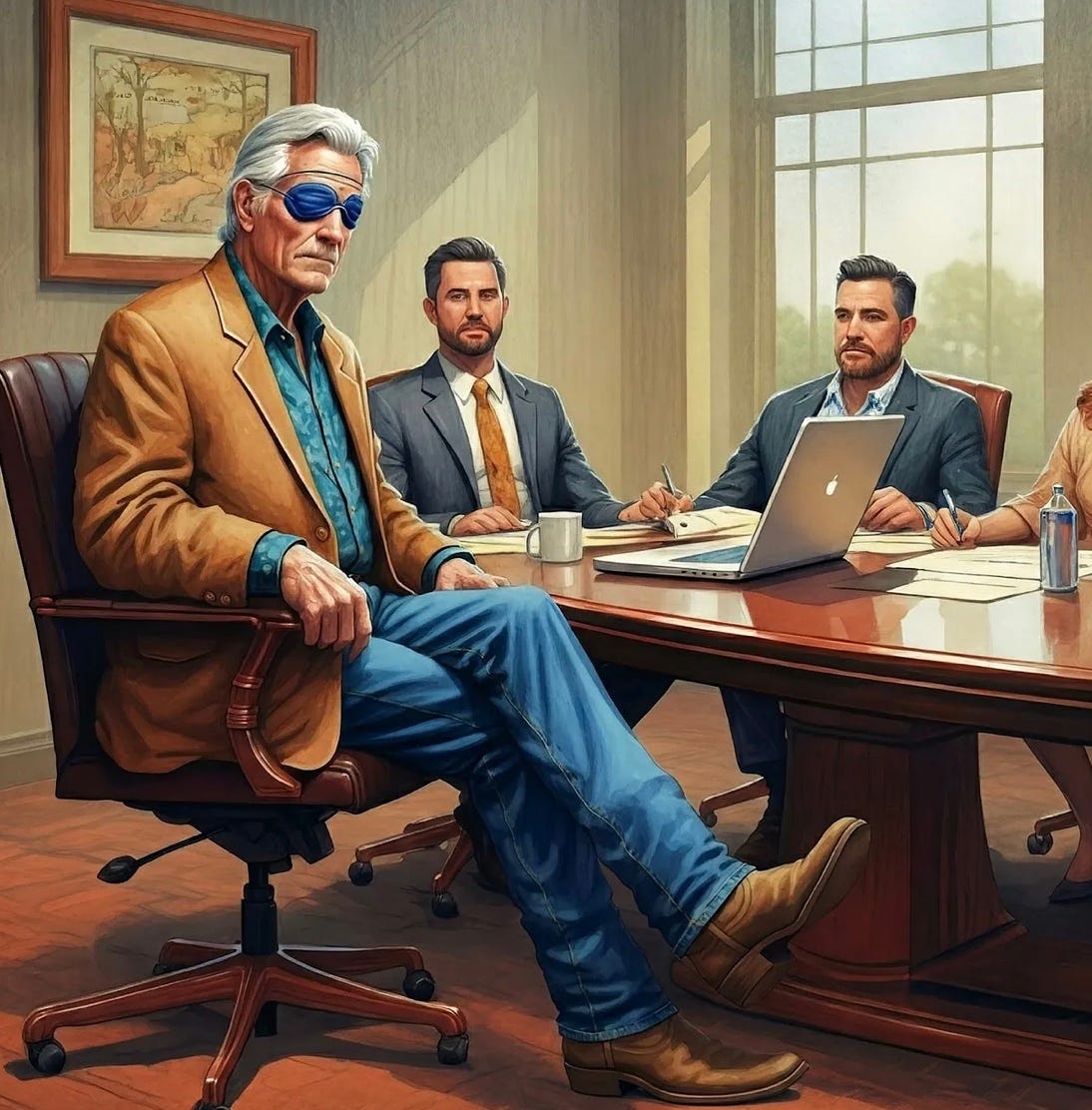
Back from his month long vacation in Chacahoula, Louisiana, Cajun Chronicle Podcast, Writer/Editor, Emile Navarre arrived for our first staff meeting armed with fresh material for a future episode, as soon as Marie Lirette, our Outreach Coordinator can reach out to potential experts on the topic of “Ain’t There No More” – a nation wide trending group talk everywhere these days, as our world changes in ways none of us could have imagined.
Here is his recount of his lifelong story telling to his family’s youngest children:
Cajun Chronicles Audio Podcast – Bringing you the heart of Louisiana. Artwork generated with Google Docs Image Maker
“Come closer, chérs,” he said, his voice a low rumble like the last Lafitte skiff shrimping boat of the day heading down the Bayou Lafourche over Galliano or Golden Meadow way. His cane bottom rocking chair seat creaked a steady rhythm against the worn Cedar floorboards as he said that.
The sun, a too warm blanket he could feel, but not see, was sinking somewhere behind the great oak in the yard he will always remember. He ran a hand over the cane of his chair, then rested it on the knee of a boy sitting on the steps below him. He lifted his walking stick and pointed off to the right side. “You see that big fence, hein?
“Or that levee your mamans and pépère have to climb to get home from work at the Bollinger Shipyard, just to get up to the house? We didn’t have such a thing when I was a boy. Back then, my feet knew every dip and bump in this land”.
“From our porch right down that oyster shell road to the bayou where the shrimp jumped so high, you’d swear you could catch them in your mouth, if you were quick.” A ripple of giggles ran through the children.
“Ah, oui,” he chuckled, “I lost a good tooth catching shrimp that way. But the land, it was different. We were like a river family. She’d bring us a big muddy hug every spring, and we’d be happy for it.”
“The floods, they were always a part of life. We’d move our things up high, sing songs, and wait for the water to go down. When it did, Mother Nature would leave behind a gift, a rich, dark mud that made our gardens burst with life. You could feel it in your toes, a soft, giving sponge of sandy soil that told you everything was going to be alright.”
He paused, and the laughter faded, replaced by the chirping of crickets.
“My pépère, he’d sit right here on the back porch with a fishing line tied to his toe, but in his mind, Gaia was always busy with the water. He’d talk about how the Lafourche river was a living thing, always moving, always changing. ‘She builds, and she takes away,‘ he’d say.”
“We knew that. A little bit here, a little bit there. It was a fair trade. But then came the men with the big ideas. They came from places where the land didn’t move so much. They told us we could stop the river’s big hugs. They said we could make a straight line and build high walls, so the water would stay in its place.”
Emile’s voice dropped to a conspiratorial whisper. “The young people, they thought it was wonderful. No more floods! No more moving furniture to the attic! But my pépère, he just shook his head. ‘You can’t trap a wild woman, not for long,’ he said. ‘She will find her way, and she will be angry for it.'”
“And she was,” he said, his hand now clutching his walking stick. “For years, the river was quiet, but our land, she was not. I can’t see it anymore with my eyes, but I felt it with my feet. The soil grew tired, no longer receiving her yearly gift.”
“The ground began to sag, and the bad marsh saltwater, it came closer in to say hello, not from a storm, but like a thief in the night, creeping up through the channels les Américains dug for the oil. They were for the big machines, the big money, but they were also a wound. A wound in the land that never healed.”
He turned his head toward the silent children, his milky blind blue eyes fixed on something only he could see. “Now, this levee you have, it protects you from the river, oui? But it holds the land in a box. It cannot breathe. The land is sick, and the ocean is hungry, taking a football field from our home every hour, the experts say.”
“I hear it in the wind now, not just the storms, but also in the sad whispers of the marsh, of the birds that have no place to land anymore. The land is leaving us, and we are left behind. We traded our river’s muddy hugs for a straight line and some high walls, and now we pay for it. Now, it’s not just the water that takes. It’s the land that gives itself away.”
The porch was silent, a stillness that was heavier than the humid air. The children looked at each other, not understanding all the words, but feeling the weight of them. One of the little girls, her braids tied with pink ribbons, quietly moved her hand to rest on the Emile’s knee as she headed inside for bed.
Emile smiled, his face creasing with a thousand invisible memories. Talking to the breeze, he raised his fist and threatened, “But you know what else my pépère said? He said, ‘As long as we tell the stories, the land is not truly gone.’ So listen, chérs, listen closely to my bedtime stories. Because now, it is your turn to remember.”
Cajun Chronicles Audio Podcast – Bringing you the heart of Louisiana. Artwork generated with Google Docs Image Maker
He had felt the last of the children’s light footsteps fade into the dusk, and the porch was still again except for his rocking chair. His head turned to the quiet rustling of the adults lingering on the porch. “You hear my stories, oui?” he said, his voice now lower, rougher.
“You too remember what I said about the river’s gift of mud? We didn’t know it, but we were like a family that had a big, generous table. Rivers brought food, and our land ate it. Every year, she’d get fat and happy. We thought we were so smart, so clever, when we built those high walls.”
“We told Gaia to stop eating for a while, believing for a while that she didn’t need the mud. ‘Don’t worry,’ we said, ‘We’ll protect you from the floods.’ But what we really did was put the food in a box and send it out to sea. Now, the land is starving. You cannot see it in a day, or a year. But that’s happening rapidly.”
“But I feel it in every part of my mind and body. Every year, she gets thinner, weaker. And like a sick old person who can’t stand anymore, Mother Earth’s starting to melt away. The medicine to save her is that very food we cut her off from. But the walls of levees and the canals the Corps of Engineers built? They are so high.”
“How will we get the food back to Louisiana’s coast before she’s gone entirely? That is the story my heart tells me now. And that is the story for you all to worry about. Time’s running out. I’m 75 years young this month. In another 75 years I won’t be here to see that my beloved Louisiane will be added to that dreaded list, “Ain’t Here No More.“
Cajun Chronicles Note: Sediment Starvation: The settlers’ levees and later government agencies built, while protecting their land from floods, also had an unintended consequence that would become a major factor in today’s coastal crisis. By containing the rivers, they prevented the natural flooding that would have deposited sediment into the wetlands.
This sediment was the building block of the delta. Without it, the land began to sink (subsidence) and slowly disappear. The settlers since the 1800s and later colonists were unaware of this long-term process and the vital role of the Mississippi’s and other rivers’ sediment in sustaining the land.
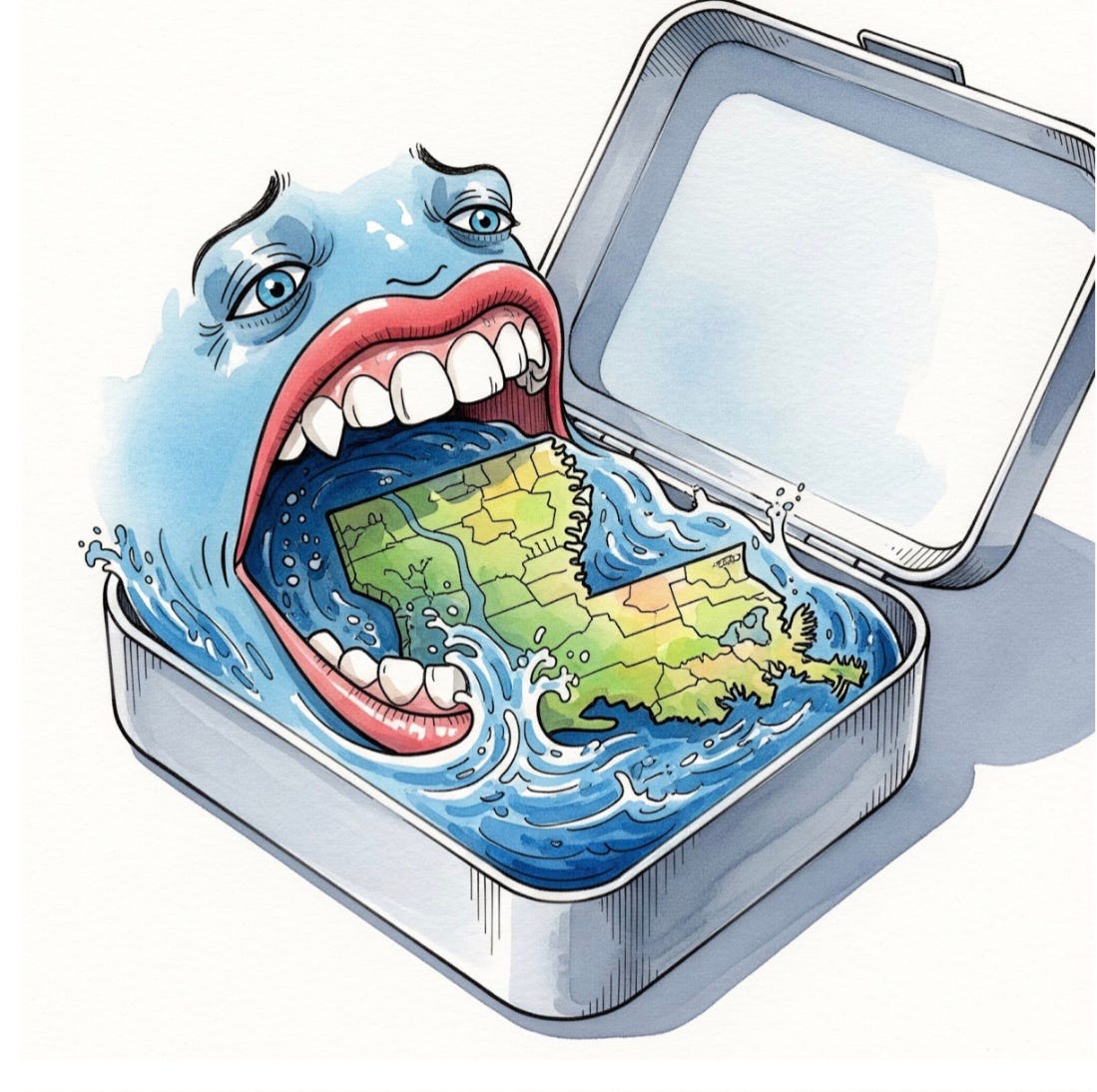
Water’s Takin’ Our Land, Gulf’s Hungry & She Ain’t Slowin’ Down
Cajun Chronicles Audio Podcast – Bringing you the heart of Louisiana. Artwork generated with Google Docs Image Maker
Louisiana has the highest coastal land loss rate in the United States. Since the 1930s, the state has lost about 2,000 square miles of land. This is a significant amount, roughly the size of the state of Delaware.
Without major intervention, the state of Louisiana is projected to lose an additional 700 to 1,000 square miles of land by the year 2050. This is an area roughly the size of the greater Washington D.C.-Baltimore area.
By the year 2100, the projections are even more dire, with some worst-case scenarios suggesting that up to 3,000 square miles of land could be lost. Some scientists have even warned that the entire remaining 5,800 square miles of Louisiana’s coastal wetlands in the Mississippi River delta could eventually disappear.
A Word of Wisdom:
Our fictional and non-fictional tales are inspired by real Louisiana and New Orleans history, but some details may have been spiced up for a good story. While we’ve respected the truth, a bit of creative license could have been used. Please note that all characters may be based on real people, but their identities in some cases have been Avatar masked for privacy. Others are fictional characters with connections to Louisiana.
As you read, remember history and real life is a complex mix of joy, sorrow, triumph, and tragedy. While we may have (or not) added a bit of fiction, the core message remains, the human spirit’s power to endure, adapt, and overcome.
August 4, 1964 The Pentagon reported a second attack on U.S. Navy ships in Vietnam’s Gulf of Tonkin [see August 2, 1964]. But there was no such activity reported at the time by the task force commander in the Gulf, Captain John J. Herrick. One of the Navy pilots flying overhead that night was squadron commander James Stockdale, who was later captured and held as a POW by the North Vietnamese for more than seven years, and became Ross Perot’s vice-presidential candidate in 1992: ” I had the best seat in the house to watch that event and our destroyers were just shooting at phantom targets — there were no PT boats there . . . There was nothing there but black water and American firepower.” Nearly three decades later during the Gulf War, Pulitzer Prize-winning columnist Sydney Schanberg warned journalists not to forget “our unquestioning chorus of agreeability when Lyndon Johnson bamboozled us with his fabrication of the Gulf of Tonkin incident.”
August 4, 1964 FBI agents discovered the bodies of three missing civil rights workers buried deep in an earthen dam near Philadelphia, Mississippi. James Chaney was a local African-American man who had joined the Congress of Racial Equality (CORE). Andrew Goodman and Michael Schwerner had traveled from New York to heavily segregated Mississippi that year to help register voters with the support of CORE. Schwerner, Chaney and Goodman At the time, fewer than 10% of eligible black Mississippians were registered to vote. The three young men and many others were part of Freedom Summer, a massive voter registration and education project organized by the Council of Federated organizations (COFO), an umbrella group of major civil rights organizations. Watch a video Here is a transcription of what was written on the chalkboard (photo below) this August day in 1964: Yesterday – Negro woman arrested in Hattiesburg for refusing to give her bus seat to a white woman. • 400 attended mass meeting in Marks. • Tallahatchie Co. – 24 people tried to register to vote in Charleston; at least one man told he would lose his job as a result. Today – 6 youths arrested in Greenwood while singing in front of a store. One boy reported beaten. • Local girl missing since Sunday in Natchez • $200 each bond paid by 2 SNCC workers arrested in Anguilla (Sharkey Co.) yesterday for passing out vote leaflets. This is a close-up of the chalk-board beside the front door of the COFO headquarters building in Jackson, Mississippi. (Transcript just above.) Read more
August 4, 1985 Peace Ribbons made by thousands of women were wrapped around the U.S. Pentagon, the White House and the Capitol. Twenty thousand people participated, and the 27,000 panels making up the ribbon stretched for 15 miles.
August 3, 1882 Congress passed the first U.S. law to restrict immigration of a particular ethnic group into the United States, the Chinese Exclusion Act. It stopped all further Chinese immigration for ten years, and denied citizenship to those already in the country, most of whom had been recruited by American railroad and mining companies. The law remained in effect until 1943. Chinese rail workers Very cool site from the National Archives and Records Administration
August 3, 1913 Four died and many others were injured in the Wheatland Hop Riot when police fired into a crowd of California hop pickers trying to organize (with the help of the IWW, or Industrial Workers of the World). At the Durst Ranch in Wheatland, the state’s largest single agricultural employer, hundreds of workers—whites, Mexicans, and Filipinos—had put down their tools because of terrible working conditions, low wages, and an almost complete lack of sanitation and decent housing. It was one of the first attempts to organize agricultural workers. The story of the Wheatland Hop Riot
August 3, 1981 Nearly 13,000 of the nation’s 17,500 air traffic controllers, members of the Professional Air Traffic Controllers Organization (PATCO), went on strike.After six months of negotiations with PATCO President Robert Poli, the Federal Aviation Administration (FAA) had offered less than 10% of what the union had sought. Due to the stressful nature of their jobs, managing the nation’s ever-increasing volume of airport landings and take-offs without up-to-date equipment, they had asked for a shorter workweek, an increase in pay and retirement after 20 years. 95% of PATCO members rejected the FAA’s final offer. The union had endorsed Ronald Reagan for president in 1980 (one of very few to do so), but President Reagan said they were violating U.S. law banning strikes by federal workers, and would all be terminated unless they returned to work within 48 hours. A Reagan Letter to Robert Poli, PATCO (October. 20, 1980) Dear Mr. Poli: I have been briefed by members of my staff as to the deplorable state of our nation’s air traffic control system. They have told me that too few people working unreasonable hours with obsolete equipment has placed the nation’s air travellers in unwarranted danger. In an area so clearly related to public safety the Carter administration has failed to act responsibly. You can rest assured that if I am elected President, I will take whatever steps are necessary to provide our air traffic controllers with the most modern equipment available and to adjust staff levels and work days so that they are commensurate with achieving a maximum degree of public safety…. I pledge to you that my administration will work very closely with you to bring about a spirit of cooperation between the President and the air traffic controllers. Sincerely, Ronald Reagan More about the strike
August 3, 1986 Laurie McBride and seven other Motherpeace members of the Nanoose Conversion Campaign were arrested for picnicking on Winchelsea Island, east of British Columbia’s Vancouver Island. They, along with dozens of volunteer witnesses and supporters who had set off by boat from the town of Nanoose Bay, were protesting the ten-year extension of free use by the U.S. of the Canadian Forces Maritime Experimental Test Range (CFMETR). It is a joint Canadian-American facility for torpedos, other maritime warfare and detection equipment; the island held the command and control center. The Campaign advocated conversion of the area back to peaceful purposes. Laurie McBride’s story
August 3, 1988 One hundred forty-three white English and Afrikaans conscripts from four cities in South Africa announced their refusal to serve in the South African Defense Force. The SADF was engaged in actions to preserve apartheid, the social and economic system of racial separatism, in South Africa, and to occupy and thwart independence for South Africa’s neighbors, Angola and Namibia [see July 31, 1986]. 24-year-old David Bruce had just been sentenced to six years in prison for refusing to serve; he was released after two. He works today with The Centre for the Study of Violence and Reconciliation on issues of integrity, conduct and accountability in democratic policing. David BruceThe Police That We Want .pdf
August 2, 1931 Albert Einstein urged all scientists to refuse military work. “I know not with what weapons World War III will be fought, but World War IV will be fought with sticks and stones.” – Albert Einstein (April-May 1949) Book review of Einstein on Politics Other Einstein thoughts on the military
August 1, 1914 As World War I began, Harry Hodgkin, a British Quaker, and Friedrich Siegmund-Schulte, a German Lutheran pastor, attending a conference in Germany, pledged to continue sowing the “seeds of peace and love, no matter what the future might bring,” germinating the idea for the Fellowship of Reconciliation (FOR).
FOR’s Mission: FOR seeks to replace violence, war, racism, and economic injustice with nonviolence, peace, and justice. We are an interfaith organization committed to active nonviolence as a transforming way of life and as a means of radical change. We educate, train, build coalitions, and engage in nonviolent and compassionate actions locally, nationally, and globally. History of the Fellowship of Reconciliation
August 1, 1920 Mohandas Gandhi began the movement of “non-violent non-cooperation” with the British Raj (ruling colonial authority) in India. The strategy was to bring the British administrative machine to a halt by the total withdrawal of Indian popular support, both Hindu and Muslim. British-made goods were boycotted, as were schools, courts of law, and elective offices. More on the Non-Cooperation Movement
August 1, 1944 The Polish underground army began its battle to liberate Warsaw, the first European city to have fallen to the Germans in World War II. The heroic effort to rout the Germans
August 1, 1975 The U.S. and the U.S.S.R, represented by President Gerald Ford and General Secretary Leonid Brezhnev, along with 33 other nations, signed the Helsinki Accords at the close of the Finland meeting of the Conference on Security and Cooperation in Europe. The agreement recognized the inherent relationship between respect for human rights and fundamental freedoms, and the attainment of genuine peace and security. All signatories agreed to respect freedom of thought, freedom of conscience, as well as freedom of religion and belief, and to facilitate the free movement of people, ideas, and information between nations.
August 1, 1976 200 people, organized by the Clamshell Alliance, occupied the site of a new nuclear power plant in Seabrook, New Hampshire. They were attempting to halt construction the same day the United States Nuclear Regulatory Commission had issued a construction license. Eighteen were arrested. Eventually, only one of two planned reactors was built. Clamshell Alliance history
July 31, 1896 The National Association of Colored Women (NACW) was established in Washington, D.C. Its two leading members were Josephine Ruffin and Mary Church Terrell. Founders also included some of the most renowned African-American women educators, community leaders, and civil-rights activists in America, including Harriet Tubman, Frances E.W. Harper, Margaret Murray Washington, and Ida B. Wells-Barnett. Mary Church Terrell The original intention of the organization was “to furnish evidence of the moral, mental and material progress made by people of colour through the efforts of our women.” However, over the next ten years the NACW became involved in campaigns favoring women’s suffrage and opposing lynching and Jim Crow laws. By the time the United States entered the First World War, membership had reached 300,000. The NACW and its founders
July 31, 1986 25,000 people rallied in Namibia for freedom from South African colonial rule. In June, 1971 the International Court of Justice had ruled the South African presence in Namibia to be illegal. Eventually, open elections for a 72-member Constituent Assembly were held under U.N. supervision in November, 1989. Three months later Namibia gained its independence, and maintains it today. More on Namibia’s independence Namibian flag
July 31, 1991 The United States and the Soviet Union, represented by President George H.W. Bush and General Secretary Mikhail Gorbachev, signed the Strategic Arms Reduction Treaty, known as START I. It was the first agreement to actually reduce (by 25-35%) and verify both countries’ stockpiles of nuclear weapons at equal aggregate levels in strategic offensive arms. The Soviet Union dissolved several months later, but Russia and the U.S. met their goals by December, 2001. Three other former republics of the U.S.S.R., Kazakhstan, Belarus and Ukraine, have eliminated these weapons from their territory altogether. Comprehensive info from the Federation of American Scientists:
July 30, 1492 The same month Christopher Columbus set sail from Spain for his “expedition of discovery to the Indies” [actually the Western Hemisphere], was the deadline for all “Jews and Jewesses of our kingdoms to depart and never to return . . .” lest they be executed. Under the influence of Fr. Tomas de Torquemada, the leader of the Spanish Inquisition, King Ferdinand and Queen Isabella had ordered the expulsion of the entire Jewish community of 200,000 from Spain within four months. Spain’s Muslims, or Moors, were forced out as well within ten years. The edict of expulsion from Spain signed by King Ferdinand and Queen Isabella All were forced to sell off their houses, businesses and possessions, were pressured to convert to Christianity, and to find a new country to live in. Those who left were known as Sephardim (Hebrew for Spain), settling in North Africa, Italy, and elsewhere in Europe and the Arab world. Most went to Portugal, were allowed to stay just six months, and then were enslaved under orders of King John. Those who made it to Turkey were welcomed by Sultan Bajazet who asked,“How can you call Ferdinand of Aragon a wise king, the same Ferdinand who impoverished his own land and enriched ours?”
July 30, 1996 Four Ploughshares activists in Liverpool, England, were acquitted of all charges (illegal entry and criminal damage) on the basis of their having prevented a greater crime, after having extensively damaged an F-16 Hawk fighter jet to be sold to the Indonesian government for use in its genocidal occupation of East Timor. Seeds of Hope-East Timor Ploughshares: the action and the aftermath
Mehdi moderates a panel with YouTube star Brian Tyler Cohen, LA city council member Nithya Raman, and podcaster Van Lathan, LIVE in Los Angeles!
Mehdi and Zeteo concluded our one-year anniversary tour last week, with a final stop in the city that has made headlines in recent days and weeks, after the Trump administration deployed the National Guard against protesters.
Yes, Los Angeles. Political commentator and YouTuber Brian Tyler Cohen: “If it was happening in another country… We would not hesitate for a single second to call it autocracy, authoritarianism, or a dictatorship”
In this special live recording, Mehdi sits down with Cohen, as well as LA City Council member Nithya Raman and “Higher Learning” co-host Van Lathan for a conversation on President Donald Trump’s targeting of LA protesters and immigrants, Democrats’ response, and the media’s handling of Trump 2.0.
LA Councilmember Nithya Raman: “There is an incredible amount of fear right now,” Raman tells Mehdi. “They’re [ICE] showing up at workplaces. They’re showing on street corners. They’re showing up taking street vendors who are selling outside of a Home Depot…
They showed up outside of an elder care facility in Santa Monica and took workers from there. I mean these are kidnappings.” Mehdi asks Lathan, who frequently appears on CNN, about whether he believes the media is meeting the moment right now when it comes to covering Trump’s second term.
Van Lathan: “The legacy media right now is made to serve a commercial break ‘I’m mad on the left,’ ‘I’m on the right,’ ‘I am the host, you two stop fighting! We’ll be right back,’ ‘Proctor & Gamble.’” Did you like this video? It was published on zeteo.com several days ago.
If you would like early access to more exclusive content like this, then do consider becoming a paid subscriber. It costs as much as a single coffee a month, gives you early access to all our fearless, independent reporting, and goes a long way in supporting our mission of bringing the best of journalism to YOU our subscribers. So what are you waiting for?
I wasn’t an adult in 1972, but it was a relief to me, that there was no more death penalty! Four years later, it was back, and I cannot explain how that happened. My town had a death penalty trial almost immediately. A teacher had access to an execution film; the state was required to keep that on record for a while, whenever anyone sat on Ol’ Sparky; we viewed it before the trial (no one present was on the jury, of course.) It was medieval. And, here we still are in 2025, killing people in the names of everybody who lives here. There are ways to work against it; let me know if there is interest in comments.
July 29, 1970 Signing the contract After a five-year strike, the United Farm Workers (UFW) signed a contract with the table grape growers in California, ending the first grape boycott. Exploring the United Farm Workers’ History
July 29, 1972 The U.S. Supreme Court ruled the death penalty to be cruel and unusual punishment by a 5-4 vote. The Court called the wide discretion in application of capital punishment, including the appearance of racial bias against black defendants, “arbitrary and capricious” and thus in violation of due process guarantees in the 14th Amendment [see July 28, 1868]. Influence of race on imposition of the death penalty






 Scottie's Playtime