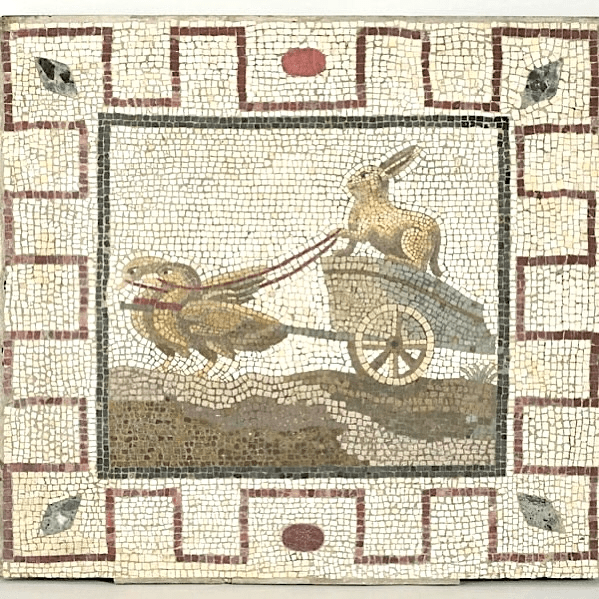
If you head to the Louvre, make sure you visit the Mona Lisa, Venus de Milo, and Liberty Leading the People. But then swing by the Department of Greek, Etruscan, and Roman Antiquities. There you might find (no guarantee!) a Roman mosaic featuring a rabbit riding a chariot pulled by geese. Discovered at Hadrian’s villa in Tivoli, Italy, the mosaic dates back to the 2nd century. About the mosaic, the History Cool Kidswrites:
This kind of humorous scene is an example of asária, a type of ancient visual joke where animals behave like humans (anthropomorphism). Such mosaics were popular in Roman domestic decoration, often as floor or wall panels in villas and bathhouses.
This particular mosaic is part of the Louvre’s extensive collection of Greek, Etruscan, and Roman Antiquities. It illustrates how Roman artists loved playful or satirical imagery alongside more serious mythological and realistic scenes. The rabbit, a symbol often associated with fertility and speed, paired with the absurdity of it driving a chariot of geese, reflects both Roman wit and their fondness for decorative exuberance.
Some scholars believe the mosaic plays on a line in Ovid’s Metamorphoses: “Cytherea [Aphrodite] was riding in her dainty chariot, winged by her swans, across the middle air making for Cyprus, when she heard afar Adonis’ dying groans, and thither turned her snowy birds.” But it’s hard to know for sure.
That pesky thing called the US CONSTITUTION says that the people have a right to protest the government. The last ten or more years the federal government has been trying to restrain the rights of the people to protest or have their voices heard. This is another example. Hugs
DHS is urging law enforcement to treat even skateboarding and livestreaming as signs of violent intent during a protest, turning everyday behavior into a pretext for police action.
The Department of Homeland Security is urging local police to consider a wide range of protest activity as violent tactics, including mundane acts like riding a bike or livestreaming a police encounter, WIRED has learned.
Threat bulletins issued during last month’s “No Kings” protests warn that the US government’s aggressive immigration raids are almost certain to accelerate domestic unrest, with DHS saying there’s a “high likeliness” more Americans will soon turn against the agency, which could trigger confrontations near federal sites.
Blaming intense media coverage and backlash to the US military deployment in Los Angeles, DHS expects the demonstrations to “continue and grow across the nation” as protesters focused on other issues shift to immigration, following a broad “embracement of anti-ICE messaging.”
The bulletins—first obtained by the national security nonprofit Property of the People through public records requests—warn that officers could face assaults with fireworks and improvised weapons: paint-filled fire extinguishers, smoke grenades, and projectiles like bottles and rocks.
At the same time, the guidance urges officers to consider a range of nonviolent behavior and common protest gear—like masks, flashlights, and cameras—as potential precursors to violence, telling officers to prepare “from the point of view of an adversary.”
Protesters on bicycles, skateboards, or even “on foot” are framed as potential “scouts” conducting reconnaissance or searching for “items to be used as weapons.” Livestreaming is listed alongside “doxxing” as a “tactic” for “threatening” police. Online posters are cast as ideological recruiters—or as participants in “surveillance sharing.”
One list of “violent tactics” shared by the Los Angeles–based Joint Regional Intelligence Center—part of a post-9/11 fusion network—includes both protesters’ attempts to avoid identification and efforts to identify police. The memo also alleges that face recognition, normally a tool of law enforcement, was used against officers.
Vera Eidelman, a senior staff attorney with the American Civil Liberties Union, says the government has no business treating constitutionally protected activities—like observing or documenting police—as threats.
DHS did not respond to a request for comment.
“Exercising those rights shouldn’t be justification for adverse action or suspicion by the government,” Eidelman says. Labeling something as harmless as skateboarding at a protest as a violent threat is “disturbing and dangerous,” she adds, and could “easily lead to excessive force against people who are simply exercising their First Amendment rights.”
“The DHS report repeatedly conflates basic protest, organizing, and journalism with terroristic violence, thereby justifying ever more authoritarian measures by law enforcement,” says Ryan Shapiro, executive director of Property of the People. “It should be sobering, if unsurprising, that the Trump regime’s response to mass criticism of its police state tactics is to escalate those tactics.”
Fusion centers like JRIC play a central role in how police understand protest movements. The intelligence they produce is rapidly disseminated and draws heavily on open-source data. It often reflects broad, risk-averse assumptions and includes fragmentary and unverified information. In the absence of concrete threats, bulletins often turn to ideological language and social media activity as evidence of emerging risks, even when tied to lawful expression.
DHS’s risk-based approach reflects a broader shift in US law enforcement shaped by post-9/11 security priorities—one that elevates perceived intent over demonstrable wrongdoing and uses behavior cues, affiliations, and other potentially predictive indicators to justify early intervention and expanded surveillance.
A year ago, DHS warned that immigration-related grievances were driving a spike in threats against judges, migrants, and law enforcement, predicting that new laws and high-profile crackdowns would further radicalize individuals. In February, another fusion center reported renewed calls for violence against police and government officials, citing backlash to perceived federal overreach and identifying then-upcoming protests and court rulings as likely triggers.
At times, the sprawling predictions may appear prescient, echoing real-world flashpoints: In Alvarado, Texas, an alleged coordinated ambush at a detention center this week drew ICE agents out with fireworks before gunfire erupted on July 4, leaving a police officer shot in the neck. (Nearly a dozen arrests have been made, at least 10 on charges of attempted murder.)
In advance of protests, agencies increasingly rely on intelligence forecasting to identify groups seen as ideologically subversive or tactically unpredictable. Demonstrators labeled “transgressive” may be monitored, detained without charges, or met with force.
Social movement scholars widely recognize the introduction of preemptive protest policing as a departure from late-20th century approaches that prioritized de-escalation, communication, and facilitation. In its place, authorities have increasingly emphasized control of demonstrations through early intervention, surveillance, and disruption—monitoring organizers, restricting public space, and responding proactively based on perceived risks rather than actual conduct.
Infrastructure initially designed to combat terrorism now often serves to monitor street-level protests, with virtual investigations units targeting demonstrators for scrutiny based on online expression. Fusion centers, funded through DHS grants, have increasingly issued bulletins flagging protest slogans, references to police brutality, and solidarity events as signs of possible violence—disseminating these assessments to law enforcement absent clear evidence of criminal intent.
Surveillance of protesters has included the construction of dossiers (known as “baseball cards”) with analysts using high-tech tools to compile subjects’ social media posts, affiliations, personal networks, and public statements critical of government policy.
Obtained exclusively by WIRED, a DHS dossier on Mahmoud Khalil, the former Columbia graduate student and anti-war activist, shows that analysts drew information from Canary Mission, a shadowy blacklist that anonymously profiles critics of Israeli military action and supporters of Palestinian rights.
In federal court Wednesday, a senior DHS official acknowledged that material from Canary Mission had been used to compile more than 100 dossiers on students and scholars, despite the site’s ideological slant, mysterious funding, and unverifiable sourcing.
Threat bulletins can also prime officers to anticipate conflict, shaping their posture and decisions on the ground. In the wake of violent 2020 protests, the San Jose Police Department in California cited the “numerous intelligence bulletins” it received from its local regional fusion center, DHS, and the FBI, among others, as central to understanding “the mindset of the officers in the days leading up to and throughout the civil unrest.”
Specific bulletins cited by the SJPD—whose protest response prompted a $620,000 settlement this month—framed the demonstrations as possible cover for “domestic terrorists,” warned of opportunistic attacks on law enforcement and promoted an “unconfirmed report” of U-Haul vans purportedly being used to ferry weapons and explosives.
Subsequent reporting in the wake of BlueLeaks—a 269-gigabyte dump of internal police documents obtained by a source identifying as the hacktivist group Anonymous and published by transparency group Distributed Denial of Secrets—found federal bulletins riddled with unverified claims, vague threat language, and outright misinformation, including alerts about a parody website that supposedly paid protesters and accepted bitcoin to set cars on fire, despite a clear banner labeling the site “FAKE.”
Threat alerts—unclassified and routinely accessible to the press—can help law enforcement shape public perception of protests before they begin, laying the groundwork to legitimize aggressive police responses. Unverified DHS warnings about domestic terrorists infiltrating demonstrations in 2020, publicly echoed by the agency’s acting secretary on Twitter, were widely circulated and amplified in media coverage.
Americans are generally opposed to aggressive protest crackdowns, but when they do support them, fear is often the driving force. Experimental research suggests that support for the use of coercive tactics hinges less on what protesters actually do than on how they’re portrayed—by officials, the media, and through racial and ideological frames.
Dell Cameron is an investigative reporter from Texas covering privacy and national security. He’s the recipient of multiple Society of Professional Journalists awards and is co-recipient of an Edward R. Murrow Award for Investigative Reporting. Previously, he was a senior reporter at Gizmodo and a staff writer for the Daily … Read More
Or, whenever you read this. There are 4 snippets, all important to maintaining visibility of people through representation in history. Language alert, in case you’re at work.
Queer History 847: Sarah Orne Jewett – The Defiant Pen That Refused to Bow by Wendy🏳️⚧️🏳️🌈🌈 Read on Substack
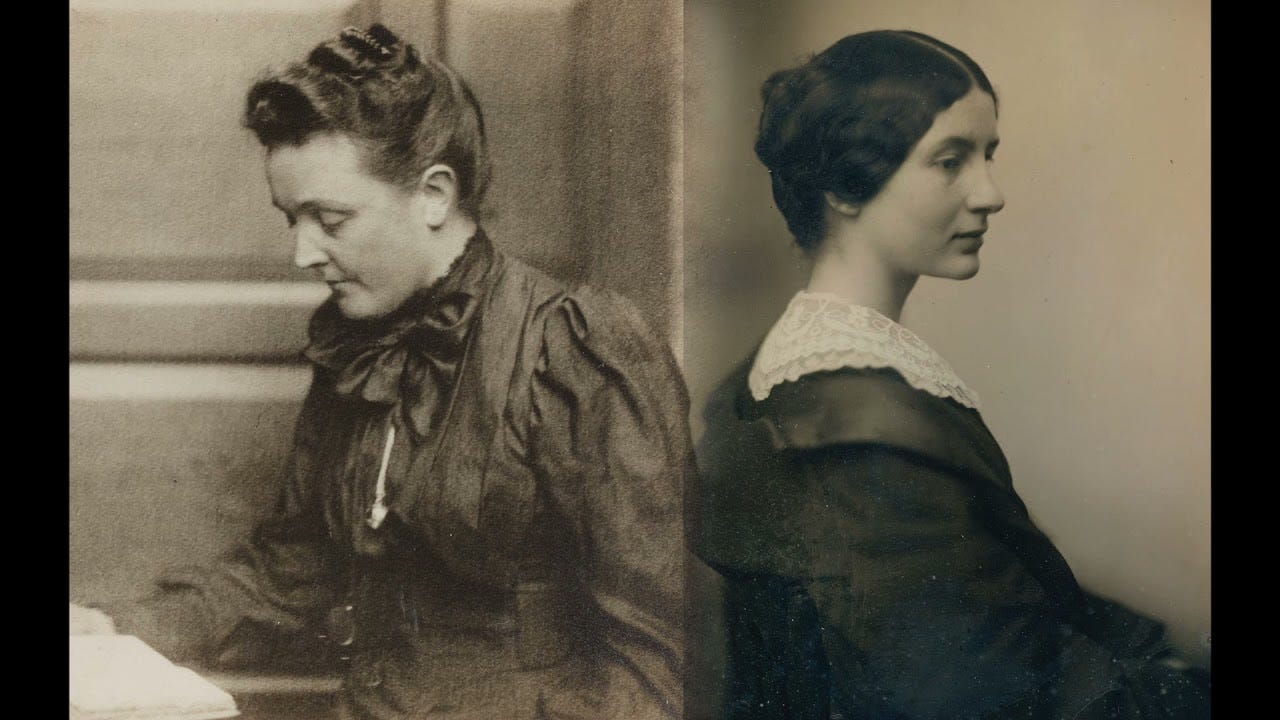
Sarah Orne Jewett wasn’t just a writer—she was a goddamn literary revolutionary who told the world to fuck off while she lived her truth in broad daylight. Born in 1849 in South Berwick, Maine, this fierce woman carved out a life that would make modern queer folk weep with recognition and rage at how little has changed. Her “Boston marriage” with Annie Adams Fields wasn’t just a relationship; it was a middle finger raised high to a society that demanded women choose between intellectual fulfillment and emotional intimacy.
The term “Boston marriage” itself is a sanitized piece of historical bullshit that literary scholars use to avoid saying what everyone with half a brain knows: these women were lovers, partners, and soulmates who built lives together while the world pretended they were just “very close friends.” Jewett and Fields lived this reality for nearly three decades, creating a partnership that was more authentic and enduring than most heterosexual marriages of their era—or ours, for that matter.
The Making of a Literary Badass
Sarah Orne Jewett emerged from a world that wanted to stuff women into corsets and drawing rooms, but she said “fuck that noise” and became one of America’s most celebrated regional writers. Her father, Theodore Herman Jewett, was a country doctor who took his daughter on his rounds through rural Maine, exposing her to the harsh realities of working-class life that would later infuse her writing with a authenticity that urban literary elites couldn’t fake if they tried.
This early exposure to real people living real lives—not the sanitized version of existence that polite society preferred—shaped Jewett’s understanding that truth was more important than propriety. She watched women struggle to survive in a world that offered them shit options: marriage to men who might abuse them, spinsterhood that meant poverty and social isolation, or the kind of life she would eventually choose—one that required courage, defiance, and the willingness to let people think whatever the hell they wanted. (snip-MORE)
Queer History 594: Alexander Hamilton – The Founding Father Who Loved Hard and Wrote Gay as Fuck Letters by Wendy🏳️⚧️🏳️🌈🌈 Read on Substack
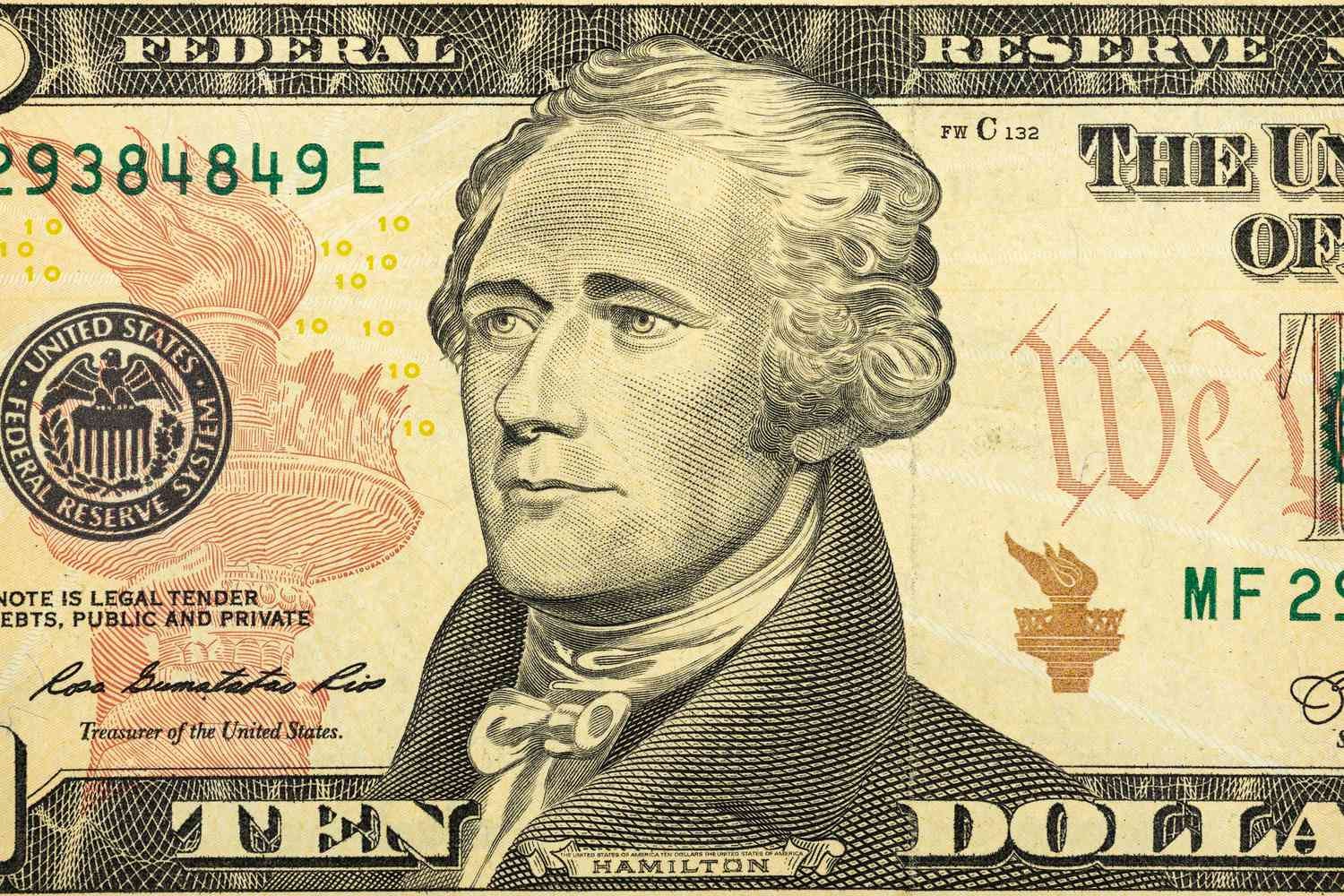
In the pantheon of American mythology, Alexander Hamilton has been sanitized, straightened, and scrubbed clean of anything that might challenge the heteronormative fairy tale we tell ourselves about our founding fathers. But here’s the thing about historical whitewashing—it can’t erase the actual fucking words these men wrote to each other. And Alexander Hamilton, that brilliant, passionate, self-destructive bastard who helped birth a nation, wrote letters to John Laurens that were so goddamn romantic, so emotionally intimate, so clearly beyond the bounds of “normal” male friendship that historians have been performing Olympic-level mental gymnastics for centuries to explain them away.
Born in 1755 on the Caribbean island of Nevis, Hamilton clawed his way from bastard orphan to the right hand of George Washington through sheer intellectual brilliance and an intensity that burned like a fucking supernova. But it was his relationship with fellow revolutionary John Laurens that revealed the depth of his capacity for love, passion, and the kind of emotional vulnerability that straight male mythology pretends doesn’t exist. Their correspondence reads like a love affair conducted through the medium of revolutionary politics, and anyone who thinks these men were just “very good friends” has clearly never read a love letter in their goddamn life.
The Making of a Revolutionary Heart
Alexander Hamilton’s early life was a masterclass in how trauma and abandonment can forge either a monster or a revolutionary—and sometimes both. His father abandoned the family when Alexander was ten. His mother died when he was thirteen, leaving him and his brother orphaned and destitute in a world that had no fucking patience for bastard children with no connections.
The psychological impact of this early abandonment cannot be overstated. Hamilton developed the kind of intense, desperate need for connection that would characterize all his relationships—romantic, political, and personal. He threw himself into every relationship with the fervor of someone who had learned early that love was scarce and could disappear without warning. (snip-MORE)
Queer History 673: Renée Vivien – The Sapphic Rebel Who Burned Bright and Fucking Died for Love by Wendy🏳️⚧️🏳️🌈🌈 Read on Substack
In the suffocating, corseted world of turn-of-the-century Europe, where women were expected to be seen and not heard, to marry well and breed often, and to suppress any hint of sexual desire that didn’t serve patriarchal ends, Renée Vivien said “fuck that” with every passionate verse she penned. Born Pauline Mary Tarn in 1877, this British-American poet didn’t just write love poetry to women—she set the goddamn literary world on fire with verses so erotically charged, so unapologetically sapphic, that they made Victorian sensibilities spontaneously combust.
Vivien wasn’t just a poet; she was a fucking revolutionary who wielded language like a sword against the heteronormative assumptions of her time. She lived fast, loved hard, and died young at 32, leaving behind a body of work that would make contemporary lesbian poets weep with envy and recognition. Her life was a middle finger to every social convention that tried to cage women’s desires, a testament to the power of living authentically even when the world wants to crush you for it.
The Making of a Sapphic Goddess
Pauline Mary Tarn was born into privilege in London on June 11, 1877, but privilege couldn’t protect her from the psychological warfare that society wages against women who dare to love other women. Her father died when she was eleven, and her mother, perhaps recognizing something unconventional in her daughter, shipped her off to boarding school in Paris. It was there, in the City of Light, that Pauline would transform herself into Renée Vivien—a name that literally means “reborn” and “living,” because sometimes you have to kill your old self to become who you’re meant to be. (snip-MORE)
Queer History 847: Mary Glasspool – Holy Shit, She Actually Did It by Wendy🏳️⚧️🏳️🌈🌈 Read on Substack
In the grand fucking theater of religious hypocrisy, where LGBTQIA+ people have been told for millennia that they’re damned, broken, and unwelcome at the altar of God’s love, Mary Glasspool stood up in 2010 and said, “Bullshit.” Not with those exact words, mind you—she’s a bishop, after all—but with something far more powerful: her entire goddamn life.
Born in 1954 in New York, Mary Douglas Glasspool didn’t just break the stained-glass ceiling of the Episcopal Church; she obliterated it with the force of a woman who refused to let anyone else define her relationship with the divine. When she was consecrated as the first openly lesbian bishop in the history of Christianity, she didn’t just make history—she rewrote the fucking rulebook on what it means to serve God while being authentically, unapologetically queer.
The Holy Shit Moment That Changed Everything
Picture this: It’s January 15, 2010, and the religious establishment is losing its collective mind. Conservative bishops are clutching their pearls, traditionalists are having actual conniptions, and somewhere in the background, you can practically hear the sound of centuries-old prejudices cracking like ice on a frozen pond. Mary Glasspool, a 55-year-old woman who had been serving her church and community with distinction for decades, was about to be consecrated as a bishop in the Episcopal Church—and she wasn’t hiding who she was or who she loved.
The consecration ceremony at Christ Cathedral in Los Angeles was a watershed moment that sent shockwaves through the Anglican Communion worldwide. Here was a woman who had spent her life in service to others, who had demonstrated exceptional leadership, theological acumen, and pastoral care, and the fact that she happened to love women was somehow supposed to disqualify her from serving God? Fuck that noise. (snip-MORE)
July 13, 1863 Massive New York City protests decrying the first-ever wartime draft lottery led to bloody rioting over five days as a mob of 50,000 burned buildings (including looting and torching the Colored Orphan Asylum on Fifth Avenue, though the 200+ children were unharmed), stores and draft offices, and attacked police. Some clubbed, lynched, and shot large numbers of blacks, whom they blamed for the war.By the time troops returning from the Battle of Gettysburg finally restored order, 1200 had died over five days. New Yorkers, spurred on by the Democratic leadership of Tammany Hall and tired of the seemingly endless war, had been angered by President Abraham Lincoln’s recent call for 300,000 more troops. In the Shadow of Slavery: African Americans in New York City, 1626-1863 by Leslie M. Harris They especially resented the legal provision allowing a cash payment ($300 commutation fee) as a way for those with the means to avoid military service in the Union Army. Read more about the 1863 draft riots
July 13, 1905 A Declaration of Principles was issued by the Niagara Movement (the precursor to the National Association for the Advancement of Colored People) following their conference in Buffalo, New York. Matters of concern included: realization of suffrage for all black men, as well as other civil liberties; economic opportunities for black Americans, especially in the South; access to education, especially high schools, trade and technical schools, and colleges; fair treatment in the courts and an end to the convict-lease system; fair treatment in employment wherein employers brought in black workers temporarily to keep down wages, and labor unions refused membership to blacks; an end to the color line, particularly in public transporation; fair treatment for black soldiers and access to military training schools; enforcement of the 13th, 14th and 15th amendments to the U.S. Constitution passed in the wake of the Civil War. “The Negro race in America, stolen, ravished and degraded, struggling up through difficulties and oppression, needs sympathy and receives criticism; needs help and is given hindrance, needs protection and is given mob-violence, needs justice and is given charity, needs leadership and is given cowardice and apology, needs bread and is given a stone. This nation will never stand justified before God until these things are changed.” Additionally, they urged upon the African-American community: The duty to vote. The duty to respect the rights of others. The duty to work. The duty to obey the laws. The duty to be clean and orderly. The duty to send our children to school. The duty to respect ourselves, even as we respect others.
July 13, 1985 The first Live Aid concert raised $75 million for agricultural and technical assistance to Africa, many times what was expected. Described as the Woodstock of the ‘80s, the world’s biggest rock festival (in London, Philadelphia, Moscow and Sydney, Australia, simultaneously and linked by satellite) was organized by Boomtown Rats singer Bob Geldof to raise money for famine relief in Ethiopia. Bob Geldof The Republic of Ireland (Éire) gave the most donations per capita, despite being in the throes of a serious economic depression at the time. The single largest donation (£1m) came from the ruling family of Dubai (Al Maktoum). More about Live Aid ’85 Watch a video about the concert
John Ehrlichman, former top aide to President Richard Nixon, and three others were convicted of conspiring to violate a citizen’s civil rights. Ehrlichman had approved a recommendation for a covert investigation of Daniel Ellsberg in 1971 by writing on a memo: “If done under your assurance that it is not traceable.” Looking for information to discredit Ellsberg, agents of President Nixon’s re-election campaign broke into the office of his psychiatrist.
John Ehrlichman
Ellsberg, a former Defense Department analyst, had been responsible for public release of The Pentagon Papers, a collection of documents outlining the U.S. history and strategy in Vietnam, that had been classified as secret to avoid public scrutiny.The world’s most famous filing cabinet
I see that our recycling center has closed until further notice. International Paper, downsizing, has closed its recycling plant in Wichita, laying off all those employees, I saw on the newscast from the station I linked. Their story links a release from IP about all their closures and their plans for the year. The release is dated Feb. 13, of 2025. There’s another release from the Wichita Business Journal about the Wichita plant, but it says little to nothing. (No link from them; they’re mostly Kansans and Americans For Prosperity, anyway.)
Earlier, I got the idea to search if IP’s downsizing is due to recission of tax cuts and to tariffs. Gemini (who always volunteers though I never ask, preferring to find a link to a known source) says that while it cannot state that those things cause the downsizing in full, it also cannot state that those aren’t in the mix. (Because I do skim Gemini’s stuff.)
So, this hurts a bit: the closing of our recycling facility, as well as the Wichita one. During the first Trump admin, when POTUS began that trade war with China, China reciprocated by, possibly among other things, refusing anymore plastic recycling from the US. Our facility couldn’t find a place that did the recycling; no one else does it. China does it very economically though of course there is the question of what it’s really doing with the plastic, but another story for another time.
Anyway, in those days, I was an active BPW member. One of the things we worked hard on was getting a recycling collection facility here in town. We lobbied hard, both the public and the council, for use of an unused building (the former firehouse,) and possibly the use of a big truck for hauling the recycling collected to the recycler. We asked for no funding, we had willing volunteers; all the civic organizations set up volunteer schedules. We just needed the facility and a way to haul. Before the facility came about, I became a member of the city Planning Commission, so I couldn’t continue in that effort until after it was decided by the council. But, it was a happy circumstance that there was a plan for recycling in the existing Strategic Plan, even then! That’s always a big help, when something’s in the Strat Plan.
So, this was not a thing that came before the Planning Commission. I was not on Zoning Appeals at that time, so I have no idea if they got it, but as it came to reality, that wouldn’t have been necessary. It was decided that that firehouse building would become the collection facility, it would be staffed with volunteers but with a city worker or two there because it’s city property and insurance insists on that, and a city worker would do the hauling. Yay! It was open each Saturday from 9 until noon, and people needed to bring their recycling, preferably sorted, to the facility where volunteers then helped getting things where they went.
Eventually it grew, and there weren’t enough volunteers every Saturday to keep the lines moving reasonably. It went before the council to staff another one or two. There would still be volunteers there to keep things moving without too much staff. (People here in town like nice things, but don’t like paying for them.) The council approved, and the facility also opened on Mondays from 11 AM to 1 PM. That way, downtown business, who go through a lot of corrugated cardboard and bubble wrap, could get theirs done without as many of the public. Also, the staffers could actually get the stuff loaded in time for it to go to the recycler.
I just went there last week to drop recycling. We usually accrue enough corrugated cardboard and chipboard to unload at least once per month. We’ve cut paper back a lot, and again, plastic hasn’t been accepted since Trump p.o.’d China last term, so that’s not so much. Even so, where we usually have a single trash bag to go out for pickup, I think we’re going to have more that now has to go to the landfill.
I may be taking it too seriously, but I feel the way I did when the SCOTUS overturned their own decision in Roe v. Wade. We worked hard for it, we had it, it was good for all, and now it’s gone.
I hope this hasn’t bored anyone very much. It’s more sentimental than I usually am when posting such stuff. Still, our recycling collection facilities closing, or really, any big companies downsizing, is happening everywhere, and is affecting many, many people. I feel for all the Wichita workers who will have no jobs just in time for school shopping. So, I thought I’d post, because we all have to keep our eyes open for this happening around us everywhere. Thanks for your time! 🌞
July 11, 1905 The Niagara Movement, precursor of the National Association for the Advancement of Colored People (NAACP), was formed in Buffalo, New York. Meeting at the home of Mary Burnett Talbert were W.E.B. DuBois, John Hope and 30 others who rejected the accommodationist approach of Booker T. Washington (“The wisest among my race understand that the agitation of questions of social equality is the extremest folly . . . .”) Founders of The Niagara Movement at Niagara Falls The Niagara Movement’s manifesto was, in the words of DuBois, “We want full manhood suffrage and we want it now . . . We are men! We want to be treated as men. And we shall win.“ The Niagara Movement and its founding principles
July 11, 1968 The American Indian Movement (AIM) was founded in Minneapolis, Minnesota, by George Mitchell, Dennis Banks, Clyde Bellecourt and 200 others. They gathered to organize in order to deal with widespread and persistent poverty among native Americans, and unjust treatment from all levels of government. American Indian Movement background
July 11, 1969 The federal appeals court in Boston reversed the convictions of Dr. Benjamin Spock and Michael Ferber who had been found guilty of conspiring to counsel evasion of the military draft in 1968. The judges considered their activities opposing the Vietnam War covered under the 1st Amendment right to free speech. Dr. Benjamin Spock and Dr. Martin Luther King Jr. Read “A Call to Resist Illegitimate Authority” co-authored by Dr. Spock (1967)