July 6, 1892 In one of the worst cases of violent union-busting, a fierce battle broke out between the striking employees (members of the Amalgamated Association of Iron and Steel Workers) of Andrew Carnegie’s Homestead Steel Company and a Pinkerton Detective Agency private army brought on barges down the Monongahela River in the dead of night. Twelve were killed. Henry C. Frick, general manager of the plant in Homestead, near Pittsburgh, Pennsylvania, had been given free rein by Carnegie to quash the strike. At Frick’s request, Pennsylvania Governor Robert E. Pattison then sent 8,500 troops to intervene on behalf of the company. Read more (2 links)
July 6, 1942 In Nazi-occupied Holland, thirteen-year-old Jewish diarist Anne Frank and her family were forced to take refuge in a secret sealed-off area of an Amsterdam warehouse under threat of arrest and deportation to a concentration camp by the Einsatzgruppen (Task Force), a part of the German Gestapo. The Anne Frank Center for Mutual Respect
July 6, 1944 Irene Morgan, a 28-year-old black woman, was arrested for refusing to move to the back of the bus eleven years before Rosa Parks did so. Her legal appeal, after her conviction for breaking a Virginia law (known as a Jim Crow law) forbidding integrated seating, resulted in a 7-1 Supreme Court decision barring segregation in interstate commerce. Irene Morgan More about Irene Morgan June 3, 1946: Morgan v. Commonwealth of Virginia Zinn Ed Project
July 6, 1965 As many as 500 students in Berkeley, California, attempted to block trains carrying troops destined for Vietnam along the Santa Fe Railroad tracks; there were no casualties. Organized by the Vietnam Day Committee, this was the first civil disobedience at UC-Berkeley against the Vietnam War.
I have long liked this young YouTuber. I started following him when he was more into debunking stuff while also producing atheist content. I felt he understood what a lot of people were going through in that he was trying hard to hide being an atheist from his parents and family which gave him an idea what many in the LGBTQ+ community were going through with their families. He himself noted that similarity. One of the things I like about him is his calm quiet fact filled delivery. If others have not noticed I don’t like aggressive angry yelling videos, they are too close to what I grew up with and suffered in my childhood. Drew is not a fervent anti-Christian like so many atheists are. Instead he simply is against the bad stuff some people do in the name of religion / Christianity. I like that. At the end of this video he again says if you are getting something good from your faith, don’t leave it, just change it to make it better. I agree. He explains how Christianity was abused by corporations and wealthy people to get people to do things against their own interest they otherwise wouldn’t do. In the name of god work more at a lower cost to make money for your employer type stuff. Hugs
July 5, 1827 The newly freed African-American population of New York, led by men on horseback, marched in an Emancipation Day Parade from the Battery at the foot of Manhattan to City Hall. Follow the route of the parade
July 5, 1894 Buildings erected for the 1892 Columbian Exposition in Chicago’s Jackson Park were set ablaze, seven reduced to ashes. The fire was part of the chaos in reaction to President Grover Cleveland’s calling out federal troops to end the Pullman Strike. The Pullman Palace Car Company produced the sleeping cars used by most of the railroads. The contingent of federal, state and local forces equalled the number of striking workers.The Pullman employees, who lived in company-owned housing in Pullman, Illinois, had suffered massive layoffs and pay cuts averaging 25%. The company refused to cut the rent on the housing its employees were required to occupy, nor would it bargain with workers’ representatives. Federal troops guarding the Arcade Building in Pullman, Illinois. The Pullman workers’ cause had been taken up by Eugene V. Debs, the leader of the American Railway Union, who helped organize a nationwide boycott of any train that included a Pullman car. The Pullman Strikers’ Statement More on the Great Pullman Strike
July 5, 1934 Bloody Thursday, July 5, 1934, near Rincon Hill. On “Bloody Thursday,” police armed with machine guns opened fire against striking longshoremen and their supporters, killing two, wounding 32 more by gunfire, and injuring 75 others at Rincon Hill in San Francisco.
July 5, 1935 The National Labor Relations or Wagner Act (named for New York’s Senator Robert Wagner) became law, recognizing workers’ rights to organize and bargain collectively. It was signed into law by President Franklin D. Roosevelt. Read more about the act
July 5, 1989 Former National Security Council aide Oliver North received a $150,000 fine and a suspended prison term for his part in the Iran-Contra scandal. The scandal was a secret arrangement directed from the Reagan White House that provided funds to the Nicaraguan Contra rebels (despite specific congressional prohibition) from profits gained by selling arms to Iran (at war with Iraq at the time) in hopes of their releasing hostages, despite President Reagan’s claim that he would never negotiate with hostage-takers. North’s conviction was later overturned because evidence revealed in the congressional Iran-Contra hearings had compromised his right to a fair trial. The real details on Ollie North’s activities (It’s still up! -A.)
There are videos at the link below. I don’t know where we are a species right now. It seems more and more people are willing to give in to the lowest of our natures while mocking those who try to live up to the best we could be. The Christians trying to keep books that have LGBTQ+ characters out of schools can’t be bothered by the shooting of starving people including kids trying desperately to get something to eat. They are not doing anything to help, just everything they can to lash out bashing a minority group just for existing using their god to do it. Yet did not their god say to feed the hungry? To help the immigrants among you? They are so desperate to control others sexuality but they don’t care about those acting cruelty to the ones most needing help. Hypocrites, which side of god do they get to sit on? Hugs
American contractors guarding aid distribution sites in Gaza are using live ammunition and stun grenades as hungry Palestinians scramble for food, according to accounts and videos obtained by The Associated Press.
Two U.S. contractors, speaking to the AP on condition of anonymity because they were revealing their employers’ internal operations, said they were coming forward because they were disturbed by what they considered dangerous and irresponsible practices. They said the security staff hired were often unqualified, unvetted, heavily armed and seemed to have an open license to do whatever they wished.
They said their colleagues regularly lobbed stun grenades and pepper spray in the direction of the Palestinians. One contractor said bullets were fired in all directions — in the air, into the ground and at times toward the Palestinians, recalling at least one instance where he thought someone had been hit.
“There are innocent people being hurt. Badly. Needlessly,” the contractor said.
He said American staff on the sites monitor those coming to seek food and document anyone considered “suspicious.” He said they share such information with the Israeli military.
Videos provided by one of the contractors and taken at the sites show hundreds of Palestinians crowded between metal gates, jostling for aid amid the sound of bullets, stun grenades and the sting of pepper spray. Other videos include conversation between English-speaking men discussing how to disperse crowds and encouraging each other after bursts of gunfire.
The testimonies from the contractors — combined with the videos, internal reports and text messages obtained by the AP — offer a rare glimpse inside the Gaza Humanitarian Foundation, the newly created, secretive American organization backed by Israel to feed the Gaza Strip’s population. Last month, the U.S. government pledged $30 million for the group to continue operations — the first known U.S. donation to the group, whose other funding sources remain opaque.
A spokesperson for Safe Reach Solutions, the logistics company subcontracted by GHF, told the AP that there have been no serious injuries at any of their sites to date. In scattered incidents, security professionals fired live rounds into the ground and away from civilians to get their attention. That happened in the early days at the “the height of desperation where crowd control measures were necessary for the safety and security of civilians,” the spokesperson said.
Aid operation is controversial
Gaza’s more than 2 million Palestinians are living through a catastrophic humanitarian crisis. Since Hamas attacked Israel on Oct. 7, 2023, setting off the 21-month war, Israel has bombarded and laid siege to the strip, leaving many teetering on the edge of famine, according to food security experts.
For 2 1/2 months before GHF’s opening in May, Israel blocked all food, water and medicine from entering Gaza, claiming Hamas was stealing the aid being transported under a preexisting system coordinated by the United Nations. It now wants GHF to replace that U.N. system. The U.N. says its Gaza aid operations do not involve armed guards.
Over 57,000 Palestinians in Gaza have been killed since the war erupted, according to the territory’s Health Ministry, which does not distinguish between civilians and militants.
GHF is an American organization, registered in Delaware and established in February to distribute humanitarian aid during the ongoing Gaza humanitarian crisis. Since the GHF sites began operating more than a month ago, Palestinians say Israeli troops open fire almost every day toward crowds on roads heading to the distribution points, through Israeli military zones. Several hundred people have been killed and hundreds more wounded, according to Gaza’s Health Ministry and witnesses.
In response, Israel’s military says it fires only warning shots and is investigating reports of civilian harm. It denies deliberately shooting at any innocent civilians and says it’s examining how to reduce “friction with the population” in the areas surrounding the distribution centers.
AP’s reporting for this article focuses on what is happening at the sites themselves. Palestinians arriving at the sites say they are caught between Israeli and American fire, said the contractor who shared videos with the AP.
“We have come here to get food for our families. We have nothing,” he recounted Palestinians telling him. “Why does the (Israeli) army shoot at us? Why do you shoot at us?”
A spokesperson for the GHF said there are people with a “vested interest” in seeing it fail and are willing to do or say almost anything to make that happen. The spokesperson said the team is composed of seasoned humanitarian, logistics and security professionals with deep experience on the ground. The group says it has distributed the equivalent of more than 50 million meals in Gaza in its food boxes of staples.
GHF says that it has consistently shown compassionate engagement with the people of Gaza.
Throughout the war, aid distribution has been marred by chaos. Gangs have looted trucks of aid traveling to distribution centers and mobs of desperate people have also offloaded trucks before they’ve reached their destination. Earlier this month, at least 51 Palestinians were killed and more than 200 wounded while waiting for the U.N. and commercial trucks to enter the territory, according to Gaza’s Health Ministry and a local hospital. Israel’s military acknowledged several casualties as soldiers opened fire on the approaching crowd and said authorities would investigate.
Videos, texts, internal reports document havoc at food sites
AP spoke to the two contractors for UG Solutions, an American outfit subcontracted to hire security personnel for the distribution sites. They said bullets, stun grenades and pepper spray were used at nearly every distribution, even if there was no threat.
Videos of aid being dispensed at the sites seen by the AP appear to back up the frenetic scenes the contractors described. The footage was taken within the first two weeks of its distributions — about halfway into the operations.
In one video, what appear to be heavily armed American security contractors at one of the sites in Gaza discuss how to disperse Palestinians nearby. One is heard saying he has arranged for a “show of force” by Israeli tanks.
“I don’t want this to be too aggressive,” he adds, “because this is calming down.”
At that moment, bursts of gunfire erupt close by, at least 15 shots. “Whoo! Whoo!” one contractor yelps.
“I think you hit one,” one says.
Then comes a shout: “Hell, yeah, boy!”
The camera’s view is obscured by a large dirt mound.
The contractor who took the video told AP that he saw other contractors shooting in the direction of Palestinians who had just collected their food and were departing. The men shot both from a tower above the site and from atop the mound, he said. The shooting began because contractors wanted to disperse the crowd, he said, but it was unclear why they continued shooting as people were walking away.
The camera does not show who was shooting or what was being shot at. But the contractor who filmed it said he watched another contractor fire at the Palestinians and then saw a man about 60 yards (meters) away — in the same direction where the bullets were fired — drop to the ground.
This happened at the same time the men were heard talking — effectively egging each other on, he said.
In other videos furnished by the contractor, men in grey uniforms — colleagues, he said — can be seen trying to clear Palestinians who are squeezed into a narrow, fenced-in passage leading to one of the centers. The men fire pepper spray and throw stun grenades that detonate amid the crowd. The sound of gunfire can be heard. The contractor who took the video said the security personnel usually fire at the ground near the crowds or from nearby towers over their heads.
During a single distribution in June, contractors used 37 stun grenades, 27 rubber-and-smoke “scat shell” projectiles and 60 cans of pepper spray, according to internal text communications shared with the AP.
That count does not include live ammunition, the contractor who provided the videos said.
One photo shared by that contractor shows a woman lying in a donkey cart after he said she was hit in the head with part of a stun grenade.
This photo, provided by an American contractor on condition of anonymity because they were revealing their employers’ internal operations, shows a woman slumped over in a donkey cart after the contractor said she was hit in the head with part of a stun grenade at a food distribution site in Gaza run by the Gaza Humanitarian Foundation in June 2025. (AP Photo)
An internal report by Safe Reach Solutions, the logistics company subcontracted by GHF to run the sites, found that aid seekers were injured during 31% of the distributions that took place in a two-week period in June. The report did not specify the number of injuries or the cause. SRS told the AP the report refers to non-serious injuries.
More videos show frenzied scenes of Palestinians running to collect leftover food boxes at one site. Hundreds of young men crowd near low metal barriers, transferring food from boxes to bags while contractors on the other side of the barriers tell them to stay back.
Some Palestinians wince and cough from pepper spray. “You tasting that pepper spray? Yuck,” one man close to the camera can be heard saying in English.
SRS acknowledged that it’s dealing with large, hungry populations, but said the environment is secure, controlled, and ensures people can get the aid they need safely.
Verifying the videos with audio analysis
To confirm the footage is from the sites, AP geolocated the videos using aerial imagery. The AP also had the videos analyzed by two audio forensic experts who said they could identify live ammunition — including machine-gun fire — coming from the sites, in most cases within 50 to 60 meters of the camera’s microphone.
In the video where the men are heard egging each other on, the echo and acoustics of the shots indicate they’re fired from a position close to the microphone, said Rob Maher, a professor of electrical and computer engineering at Montana State University and an author and research expert in audio forensic analysis. Maher and the other analyst, Steven Beck, owner of Beck Audio Forensics, said there was no indication that the videos’ audio had been tampered with.
The analysts said that the bursts of gunfire and the pop sequences in some of the videos indicated that guns were panning in different directions and were not repeatedly aimed at a single target. They could not pinpoint exactly where the shots were coming from nor who was shooting.
GHF says the Israeli military is not deployed at the aid distribution sites. Lt. Col. Nadav Shoshani, an army spokesman, said the army is not stationed at the sites or within their immediate proximity, especially during operating hours. He said they’re run by an American company and have their own security.
One of the contractors who had been on the sites said he’d never felt a real or perceived threat by Hamas there.
SRS says that Hamas has openly threatened its aid workers and civilians receiving aid. It did not specify where people were threatened.
Palestinians carry boxes containing food and humanitarian aid packages delivered by the Gaza Humanitarian Foundation, a U.S.-backed organization approved by Israel, in Rafah, southern Gaza Strip, Tuesday, May 27, 2025. (AP Photo/Abdel Kareem Hana,File)
American analysts and Israeli soldiers work side by side, contractors say
According to the contractor who took the videos, the Israeli army is leveraging the distribution system to access information.
Both contractors said that cameras monitor distributions at each site and that American analysts and Israeli soldiers sit in a control room where the footage is screened in real time. The control room, they said, is housed in a shipping container on the Israeli side of the Kerem Shalom crossing into Gaza.
The contractor who took the videos said some cameras are equipped with facial recognition software. In live shots of the sites seen by the AP, some videos streams are labeled “analytics” — those were the ones that had the facial recognition software, said the contractor.
If a person of interest is seen on camera — and their information is already in the system — their name and age pops up on the computer screen, said the contractor. Israeli soldiers watching the screens take notes and cross-check the analysts’ information with their own drone footage from the sites, he said.
The contractor said he did not know the source of the data in the facial recognition system. The AP could not independently verify his information.
An internal SRS report from June seen by the AP said that its intel team would circulate to staff a “POI Mugs Card,” that showed photos of Palestinians taken at the sites who were deemed persons of interest.
The contractor said he and other staff were told by SRS to photograph anyone who looked “out of place.” But the criteria were not specified, he said. The contractor said the photos were also added to the facial recognition database. He did not know what was done with the information.
SRS said accusations that it gathers intelligence are false and that it has never used biometrics. It said it coordinates movements with Israeli authorities, a requirement for any aid group in Gaza.
An Israeli security official who was not named in line with the army’s protocol, said there are no security screening systems developed or operated by the army within the aid sites.
July 3, 1835 Children employed in the silk mills at Paterson, New Jersey, went on strike for an eleven-hour workday and a six-day workweek rather than 12-14 hour days. With the help of adults, they won a compromise settlement of a 69-hour week. More on the Baby Strikers
July 3, 1966 4000 Britons chanting, “Hands off Vietnam,” demonstrated in London against escalation of the Vietnam War. U.S. warplanes had recently bombed the North Vietnamese capital of Hanoi as well as the port city of Haiphong. Police moved in after scuffles broke out at the demonstration outside the U.S. Embassy in Grosvenor Square; 31 were arrested. Actress Vanessa Redgrave joins 25,000 two years later at Anti-Vietnam war protest, Grosvenor Square. Read more
July 3, 1974 At the Moscow Summit talks between President Richard Nixon and President Leonid Brezhnev, the United States and the Soviet Union agreed to hold bilateral talks on the prohibition of chemical weapons.
July 4, 1776 The United States declared its independence from King George III and Great Britain, thus beginning the first successful anti-imperial revolution in world history. Signed in Philadelphia by 56 British subjects who lived and owned property in thirteen of the American colonies, the document asserted the right of a people to create its own form of government. The signers of the Declaration of Independence were members of the 2nd Continental Congress which had voted two days earlier to separate from the British crown. Read the Declaration see some quotes on nationalism and patriotism
July 4, 1827 Slavery was outlawed in New York State as the result of the Gradual Emancipation law passed ten years earlier. This freedom applied only to those who had been 18 at the time of its passage. Enslaved children born during the subsequent ten-year period were not be freed until they reached the age of 21. At the urging of Reverend William Hamilton, a freedman and carpenter, and others, the end of slavery was celebrated in churches. The Fourth of July had in the past been marred by young white men attacking black Americans. More on William Hamilton and others
July 4, 1829 Speaking at Boston’s Park Street Church, newspaper editor and abolitionist William Lloyd Garrison gave a seminal speech on “Dangers to the Nation.” Though Massachusetts had banned slavery in 1781 and there was strong anti-slavery sentiment, most understood that a national ban of slavery would threaten the union of the states. Compensation to slaveholders and return of the enslaved to Africa was considered the best solution. Garrison, on the other hand, called attention to the hypocrisy of celebrating the the day the document was signed declaring, “All men are created equal” while two million were in bondage. He proposed four propositions that day to guide the abolitionist movement: 1. Above all others, slaves in America deserve “the prayers, and sympathies, and charities of the American people.” 2. Non-slave-holding states are “constitutionally involved in the guilt of slavery,” and are obligated “to assist in its overthrow.” 3. There is no valid legal or religious justification for the preservation of slavery. 4. The “colored population” of America should be freed, given an education, and accepted as equal citizens with whites. William Lloyd Garrison
July 4, 1894 The Republic of Hawaii was proclaimed with Sanford B. Dole as president. It was recognized immediately by the United States government under President Grover Cleveland. This was the result of the successful overthrow of the Hawaiian monarchy, then held by Queen Lydia Liliuokalani, and the support by white Americans involved in the sugar trade on the islands for annexation by the United States. Shortly after she had come to office, she had promulgated a new constitution which increased the power of the monarchy and that of native Hawaiians.
July 4, 1965 Barbara Gittings at the Philadelphia picket The first of an annual picket in front of Philadelphia’s Independence Hall was held by gay and Lesbian Americans. Jack Nichols and Frank Kameny and members of the New York and Washington Mattachine Society and the Daughters of Bilitis had earlier demonstrated in Washington, and wished to change the general perception that homosexuals were perverted or sick.
“By those protesters coming out publicly, and placing themselves very strategically in front of the building that evoked the Declaration of Independence and the idea that all men are created equal, it suggested it [gay rights] was no longer a moral or national security or psychiatric issue … it was a civil-rights issues,” David K. Johnson wrote in The Lavender Scare: The Cold War Persecution of Gays and Lesbians in the Federal Government.
July 4, 1966 The Freedom of Information Act, P.L. 89-487, became law. It established the right of Americans to know what their government is doing by outlining procedures for getting access to internal documents.
July 4, 1969 “Give Peace a Chance” by the Plastic Ono Band was released in the United Kingdom. The song was recorded May 31, 1969, during the “Bed-In” John Lennon and Yoko Ono staged at the Queen Elizabeth Hotel in Montreal as part of their honeymoon. John and Yoko stayed in bed for 8 days, beginning May 26, in an effort to promote world peace. Some of the people in the hotel room who sang on this were Tommy Smothers, Timothy Leary, Allen Ginsberg, and Petula Clark. Smothers also played guitar. This event promoting peace received a great deal of media attention.“All we are saying . . .” watch & listen – give it a chance
July 4, 1969 A national anti-war conference in Cleveland, Ohio, mapped out activities against the Vietnam War and resulted in the founding of New Mobe (mobilization). More about the Mobes
July 4, 1983 The Women’s Encampment for a Future of Peace and Justice began an eight week stay on a farm just outside the Seneca Army Depot near Romulus, New York. The purpose of the gathering was for the women to learn about and together protest the escalation of militarism and the weapons build-up being led at the time by the Reagan administration. visit PeaCe eNCaMPeNT HeRSToRy PRoJeCT
July 4, 2007 The first of several Peace Caravans (Caravanes de Paix) set out from South Kivu and traveled across Africa’s Great Lakes region, including the Democratic Republic of the Congo, Burundi and Rwanda. The Scout Associations of the countries in the violence-ridden area trained hundreds of young people in conflict resolution through their focus on education for peace. Members of the Caravan for Peace in Burundi The classes and the caravans included hundreds of young people in Scouts and Girl Guides from many ethnic groups (often with a history of mutual hostility) who act as community mediators.
July 2, 1776 New Jersey became the first British colony in America to grant partial women’s suffrage. The new constitution (temporary if there were a reconciliation with Great Britain) granted the vote to all those “of full age, who are worth fifty pounds proclamation money,” including non-whites and widows; married women were not able to own property under common law.
July 2, 1777 Vermont became the first of the United States to abolish slavery.
July 2, 1809 Alarmed by the growing encroachment of whites squatting on Native American lands, the Shawnee Chief Tecumseh called on all Indians to unite and resist. By 1810, he had organized the Ohio Valley Confederacy, which united Indians from the Shawnee, Potawatomi, Kickapoo, Winnebago, Menominee, Ottawa, and Wyandotte nations. For several years, Tecumseh’s Indian Confederacy successfully delayed further white settlement in the region. Chief Tecumseh Tecumseh’s efforts
July 2, 1839 Slave ship Early in the morning, captive Africans on the Cuban slave ship Amistad, led by Joseph Cinquè (a Mende from what is now Sierra Leone), mutinied against their captors, killing the captain and the cook, and seized control of the schooner. Jose Ruiz, a Spaniard and planter from Puerto Principe, Cuba, had bought the 49 adult males on the ship, paying $450 each, as slaves for his sugar plantation. More about Amistad Joseph Cinquè
July 2, 1964 Jobs and Freedom march April 28, 1963, Washington DC U.S. President Lyndon B. Johnson signed the Civil Rights Act of 1964 into law, thus barring discrimination in public accommodations (restaurants, stores, theatres, etc.), employment, and voting. The law had survived an 83-day filibuster in the U.S. Senate by 21 members from southern states. “I think we just delivered the South to the Republican party for a long time to come,” said President Johnson to his press secretary, Bill Moyers later that day. He anticipated a shift in white southern voting from the Democratic to the Republican party in response to the law. Massive demonstrations a year earlier ensured passage of the Act.
July 2, 1992 President George H.W. Bush (the elder) announced that the United States had completed the worldwide withdrawals of all its ground- and sea-launched tactical nuclear weapons [see September 27, 1991].
CINCINNATI — The Ohio Lesbian Archives in Cincinnati’s Over-the-Rhine neighborhood started with a friendship.
Phebe Beiser said that when she and co-founder Victoria “Vic” Ramstetter met in the 1970s, they bonded over being “hidden, secret, teenage lesbians,” growing up in what was then a conservative city and region where there were few gay role models. For a time in their 20s, they shared group houses in Clifton, where they now joke that they “survived the lesbian commune together.” They were young and idealistic. They wanted to “turn being an activist lesbian into something fun and interesting, and maybe help change the world.” Beiser, now in her mid 70s, told The 19th that they had a mantra: “We never wanted to be invisible again.”
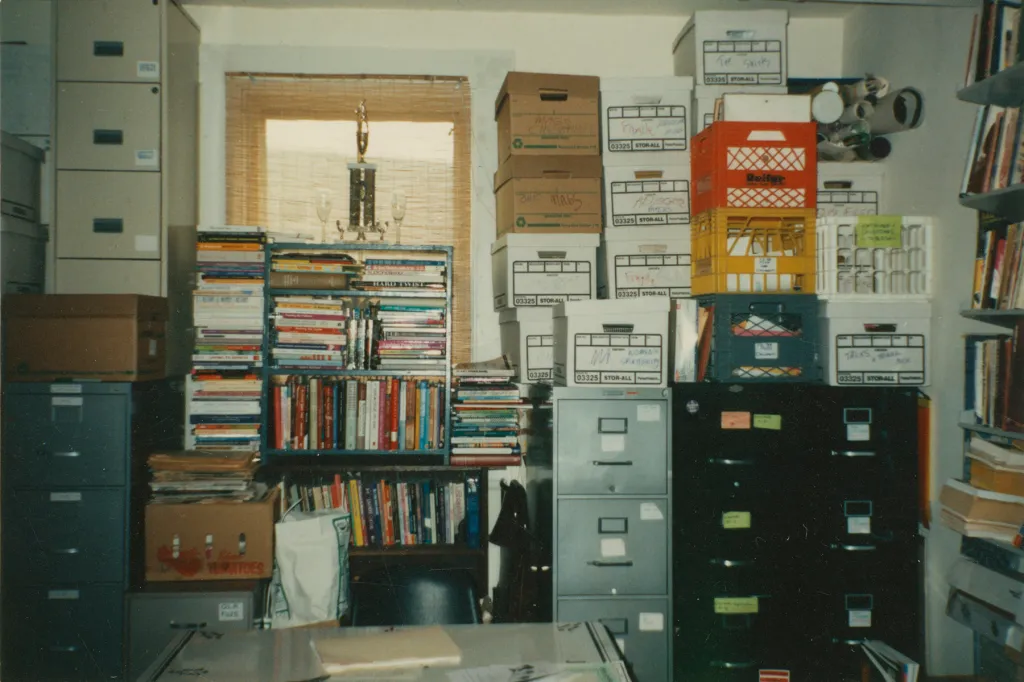
When the Crazy Ladies Bookstore, named for the women who history brushed off as “crazy,” opened in Northside in 1979, it became the center of gravity in the Cincinnati lesbian community of which Beiser and Ramstetter were a part. Women bought homes in the neighborhood, gathering at the feminist bookstore for coffee, tea and conversation about being women, and about being gay. In 1989, the Archives opened on an upper floor.
It seemed that the visibility of the Crazy Ladies Bookstore and the Ohio Lesbian Archives — and of the women who made them happen — would be cemented in history in 2023, when the Ohio History Connection, the state’s nonprofit historical society, “embarked on a three-year project to diversify Ohio’s historical markers to include ten new stories of LGBTQ+ Ohioans” via its Gay Ohio History Initiative, or GOHI. At the time, there were roughly 1,800 historical markers in Ohio’s program, but only two commemorated places, events or people from the state’s queer history. A third, recognizing Summit Station, a lesbian bar in Columbus that operated from 1970 to 2008, was dedicated during Pride Month that year. The Archives and bookstore were selected for joint recognition.
That long-overdue acknowledgement has been derailed by the Trump administration’s sweeping war on DEI, which extends beyond diversity, equity and inclusion programs to seemingly include anything that acknowledges the country’s diversity of experience. But the archives — and the volunteers who sustain it — are undeterred, carrying on as the queer community has throughout history, documenting their existence.
We never wanted to be invisible again.” Phebe Beiser
The Ohio Lesbian Archives first began in 1989 in a small room on the third floor above the Crazy Ladies Bookstore in Cincinnati, Ohio. (Cincinnati & Hamilton County Public Library)
The Marking Diverse Ohio program was financed by a $250,000 grant from the Institute of Museum and Library Services, an independent agency created by a Republican-led Congress in 1996 that is the main source of federal funding for libraries and museums. Beiser and Branstetter were interviewed for an oral history. Ohio History Connection researchers visited the Archives to peruse the collection. A location was secured in a city park near where the since-shuttered Crazy Ladies Bookstore once was. By early this year, preparations to forever commemorate the Archives and bookstore with a plaque were all but complete. Its installation was expected in June, Pride Month.
Then, in late March, President Donald Trump issued an executive order regarding “The Continuing Reduction of the Federal Bureaucracy,” singling out seven agencies for elimination — including the Institute of Museum and Library Services, or IMLS. Nearly all of its employees were put on leave and their emails were disconnected. Days later, his administration’s Department of Government Efficiency, or DOGE, canceled $25 million worth of already-awarded IMLS grants, including the $250,000 for Ohio History Connection’s Marking Diverse Ohio program. The federal agency’s seemingly final Instagram post stated: “The era of using your taxpayer dollars to fund DEI grants is OVER.” The last photo listed erecting “LGBTQIA+ historical markers across Ohio” among the alleged government excesses that would be cut.
Svetlana Harlan, a former project coordinator for Marking Diverse Ohio, recalled that when she looked at the list, and saw the program with other projects she admired, “it almost seemed like a positive thing, I was like, ‘Oh yeah, these are nice initiatives!’”
“And it turns out that [DOGE] was just taking over the account. So then I was like, ‘Oh, they’re cutting those. Oh, our name is on the list,’” she said.
DOGE’s cancellation of the $250,000 IMLS grant to Ohio History Connection threw into question the future of the markers that were supposed to ensure that Ohio’s public displays of its history include LGBTQ+ people. Along with the Ohio Lesbian Archives and the Crazy Ladies Bookstore, there were markers in the works for an LGBTQ+ district in Akron; the first professor of gay and lesbian studies at Kent State University; 19th-century sculptor Edmonia “Wildfire” Lewis; LGBTQ+ journalism in Ohio; Toledo’s first LGBTQ+ member of city council; a Columbus hospice care center for HIV and AIDs patients; an open lesbian pastor in Athens; the screen-printing company Nightsweats and T-Cells in Lakewood; and the Rubi Girls, a Dayton-area drag group that has raised more than $3 million for HIV/AIDs and LGBTQ+ causes since the 1980s.
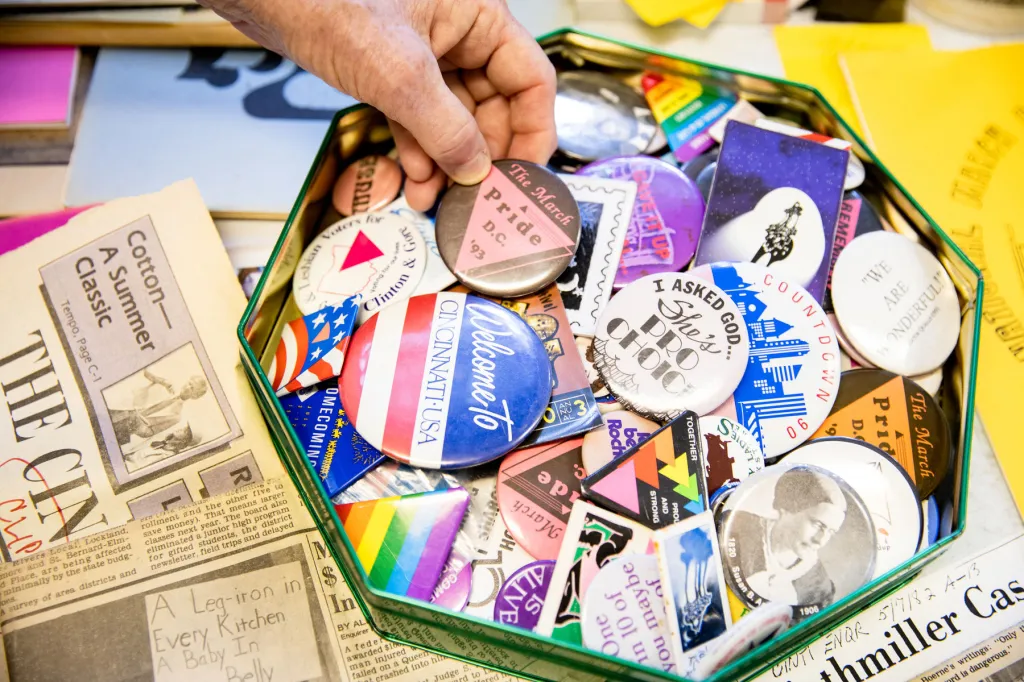
Ephemera collected at the Ohio Lesbian Archives include buttons from past Pride marches, political campaigns and other symbols of lesbian life. (Courtesy Ohio Lesbian Archives)
Preservation on hold
Marking Diverse Ohio and other programs recognizing specific communities weren’t the only programs impacted in the state when DOGE cut IMLS grants and the federal agency essentially shuttered. And, given that more than $250 million is granted annually to libraries and museums nationally, the economic chaos at the country’s museums, libraries and historical institutions wasn’t confined to Ohio.
In Ohio, other entities that received recent IMLS funding include the Frank Lloyd Wright-designed Westcott House in Springfield, for post-pandemic, on-site programming; the Cincinnati Zoo for a big cat breeding program; Dayton Metro Library programs that helped low-income Ohioans secure Internet access; and Cincinnati’s Contemporary Arts Center, which lost $175,000 slated for programming aimed at the 3,000 or more teens it serves each year.
Institutions in Pennsylvania warned the economic upheaval could scuttle the digitization of The Rosenbach museum’s collection of rare books and manuscripts; the Woodmere Art Museum was mid renovation on a building to house its collection and expected to be reimbursed. In Wisconsin, small-town libraries said without the $3 million from the IMLS they’d received the year before they would have to reduce staff and therefore services. The American Library Association, or ALA, and the American Federation of State, County and Municipal Employees, or AFSCME, the labor union representing government workers, sued the Trump administration. ALA President Cindy Hohl said at the time that, “Libraries play an important role in our democracy, from preserving history to … offering access to a variety of perspectives.” AFSCME President Lee Saunders added: “Libraries and museums contain our collective history and knowledge.”
Earlier this month, a federal judge ruled that the Trump administration could continue dismantling the Institute of Museum and Library Services as the case continues.
For now, Ohioans who want LGBTQ+ history represented among the 1,800 markers in the state will not get the federal funding that was granted and must search for alternative resources in their communities. A couple of the markers look poised to move forward with outside funding from community foundations and other organizations. Others, like the Ohio Lesbian Archives and the Crazy Ladies Bookstore, are still waiting. The remaining cost to install the marker would likely be $3,000-$5,000.
When The 19th reached out to Ohio History Connection to ask if any alternative funding sources were being explored to install the Archives’ marker, spokesperson Neil Thompson said that he was “not able to provide any additional information for an Ohio Historical Marker application that is not in the public domain” and that it is only considered in the public domain once “the markers are finalized, cast and ready to be installed and dedicated.”
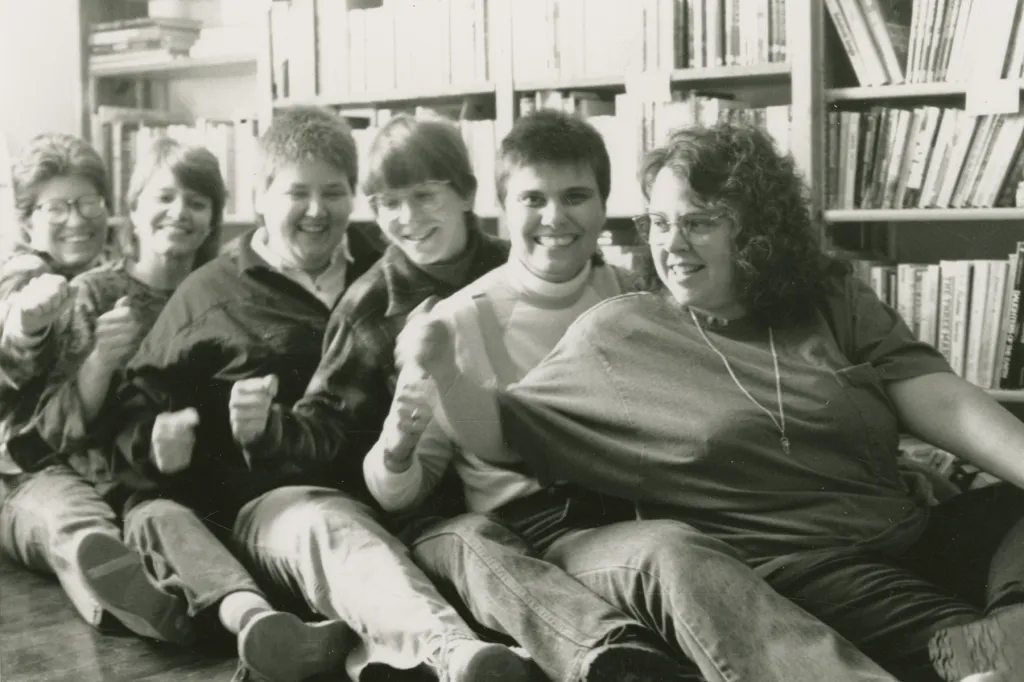
Phebe Beiser (far left), who co-founded the Ohio Lesbian Archives with her longtime friend Victoria ‘Vic’ Ramstetter, with Janice Uhlman, Elizabeth Van Dyke, Cathy McEneny, Morgan Kronenberger, and Ruth Rowan (left to right) at the Ohio Lesbian Archives in 1989. (Cincinnati & Hamilton County Public Library)
‘A reflection of themselves’
The Ohio Lesbian Archives has always been a DIY endeavor, powered by a group of passionate volunteers. When the Crazy Ladies Bookstore’s founder, Carolyn Dellenbach, moved out of the area, she handed it over to its patrons to be run as a feminist collective. A lesbian newsletter called Dinah operated out of the upper floor — they referred to the National Organization for Women’s Task Force on Sexuality and Lesbianism, established in 1973, as FOSAL, or fossil, and Dinah was a play on dinosaur. Beiser laughed explaining the name: It was the 1970s; maybe there were drugs involved. For a time she wrote for Dinah and loved interviewing famous arrivals from the “women’s music circuit” when they came to town.
At some point, the women working shifts at the bookstore, writing for Dinah and organizing talks and other events related to feminist and lesbian issues, realized that the community they had built, and the ephemera they were collecting and creating, were an important part of history — theirs, lesbians,’ Ohioans,’ and women’s.
“We held on to them because we knew they could not be replaced,” Beiser said of the collection. “It’s proof of our existence … so we held on to these things to never be invisible again.”
We held on to them because we knew they could not be replaced. It’s proof of our existence.” Phebe Beiser
Books on lesbian history line the shelves of the Ohio Lesbian Archives. (Courtesy Ohio Lesbian Archives)
In a 1991 issue of Dinah, letters to the editor included one from “Ma” who updated the “wimmin” in the community — they often spelled variations of their gender in ways that did not include “man” — that she was homesteading outside the city with her partner and building a log cabin. Another was from a woman who said she was “shocked” to find out that her being fired for being a lesbian was not a violation of civil rights laws and she was disappointed that the LGBTQ+ community did not come out to support her recent picket, writing: “I hope that in my lifetime I will see the gay and lesbian community get off their asses and together start fighting for their rights.”
Across from the metal filing cabinet at the Archives that houses the Dinah issues, a modern-looking poster from before the Supreme Court decided Bostock v. Clayton County in 2020, which extended employment protections to LGBTQ+ Americans, reminded Ohioans that it was still legal for them to be fired for their sexual orientation or gender identity. Today, Trump’s Equal Employment Opportunity Commission is aiming to curtail those hard-won workplace protections established by Bostock.
Lüdi Rich, a 27-year-old librarian, was working a recent Sunday afternoon at the Archives’ twice-weekly open hours, organizing books and research materials while the space was open to members of the community to drop in.
When Rich moved to Cincinnati nearly two years ago, she didn’t know anyone in the area, so she looked online for queer spaces so she could start building her community. When she attended a panel on local queer history, one of the speakers was Beiser, a longtime librarian herself in the country’s second-largest public library system.
Beiser mentioned at the panel that the Ohio Lesbian Archives would be having an open house that night at its new location next to Over-the-Rhine’s Washington Square Park, where Beiser was among those who met to march in Cincinnati’s first Pride Parade in April 1973. Rich asked Beiser how she could volunteer.
A couple months later, Rich showed up for her first shift, “And I’ve been here working ever since,” she said.
Nancy Yerian, the 34-year-old president of the Archives’ board, said that when she graduated from college in Massachusetts, she didn’t know if she could return to Cincinnati, where she grew up — until she discovered the Archives. “I thought that to live the kind of life I wanted to lead, I had to get out of what I thought was a very conservative place,” said Yerian, who has been volunteering at the Archives in some capacity since shortly after she finished school.
“Finding the Archives and the people I’ve met through the organization and the community we’re creating, as well as the history we’re preserving — it gave me a lot of hope that I could create a life for myself here,” she added.
It really is just us, preserving our history.”Lüdi Rich
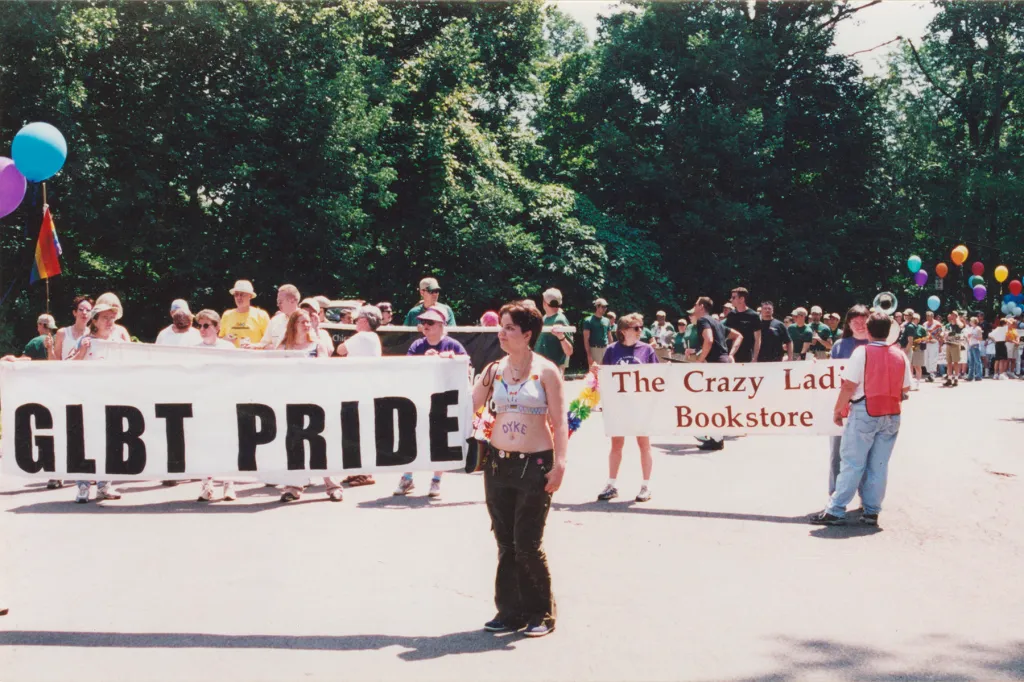
The Crazy Ladies Bookstore marched in a Cincinnati, Ohio Pride parade. (Cincinnati & Hamilton County Public Library)
The Archives’ volunteers have helped digitize old photos, some of which are now in a collection at the Cincinnati Public Library. They organize the books, arranged by first names instead of last, since so many women, especially in those early years, published works after taking on their husbands’ surnames. There are filing folders of Dinah newsletters. A cabinet holds multiple VHS and DVD copies of the early aughts television drama “The L Word.” A collection of buttons includes those from past Pride marches; supporting Hillary Clinton’s presidential campaigns; and one with “REMEMBER” and an inverted pink triangle, the Nazi symbol that Adolf Hitler used to identify gay and trans people. There is also one with the logo of the Crazy Ladies Bookstore, the silhouette of a woman reading while reclined in a chair, a cat by her side.
“Many people who are coming to the archives are looking for a reflection of themselves and in many ways that’s why Vic and Phebe started it. It shows models of ways to be in the world and a feeling of not being alone and not being the first queer person or lesbian,” Yerian said.
The Ohio Lesbian Archives, marker or not, is and will keep doing what it always has: making sure that lesbian Americans are visible in the country’s historical record.
“It really is just us, preserving our history,” Rich said.
Feeling overwhelmed by the news? The 19th is considering new ways to keep you informed. But we need your input! Fill out this quick survey to share your thoughts.




 At the urging of Reverend William Hamilton, a freedman and carpenter, and others, the end of slavery was celebrated in churches. The Fourth of July had in the past been marred by young white men attacking black Americans.