Letters From An American

March 15, 2025 by Heather Cox Richardson Read on Substack

March 15 is a crucially important day in U.S. history As the man who taught me to use a chainsaw said, it is immortalized by Shakespeare’s famous warning: “Cedar! Beware the adze of March!”

He put it that way because the importance of March 15 is, of course, that it is the day in 1820 that Maine, the Pine Tree State, joined the Union.

Maine statehood had national repercussions. The inhabitants of this northern part of Massachusetts had asked for statehood in 1819, but their petition was stopped dead by southerners who refused to permit a free state—one that did not permit human enslavement—to enter the Union without a corresponding “slave state.” The explosive growth of the northern states had already given free states control of the House of Representatives, but the South held its own in the Senate, where each state got two votes. The admission of Maine would give the North the advantage, and southerners insisted that Maine’s admission be balanced with the admission of a southern slave state lest those opposed to slavery use their power in the federal government to restrict enslavement in the South.

They demanded the admission of Missouri to counteract Maine’s two “free” Senate votes.

But this “Missouri Compromise” infuriated northerners, especially those who lived in Maine. They swamped Congress with petitions against admitting Missouri as a slave state, resenting that slave owners in the Senate could hold the state of Maine hostage until they got their way. Tempers rose high enough that Thomas Jefferson wrote to Massachusetts—and later Maine—senator John Holmes that he had for a long time been content with the direction of the country, but that the Missouri question “like a fire bell in the night, awakened and filled me with terror. I considered it at once as the knell of the Union. It is hushed indeed for the moment, but this is a reprieve only, not a final sentence.”

Congress passed the Missouri Compromise, but Jefferson was right to see it as nothing more than a reprieve.

The petition drive that had begun as an effort to keep the admission of Maine from being tied to the admission of Missouri continued as a movement to get Congress to whittle away at slavery where it could—by, for example, outlawing slave sales in the nation’s capital—and would become a key point of friction between the North and the South.

There was also another powerful way in which the conditions of the state’s entry into the Union would affect American history. Mainers were angry that their statehood had been tied to the demands of far distant slave owners, and that anger worked its way into the state’s popular culture. The opening of the Erie Canal in 1825 meant that Maine men, who grew up steeped in that anger, could spread west.

And so they did.

In 1837, Elijah P. Lovejoy, who had moved to Alton, Illinois, from Albion, Maine, to begin a newspaper dedicated to the abolition of human enslavement, was murdered by a pro-slavery mob, who threw his printing press into the Mississippi River.

Elijah Lovejoy’s younger brother, Owen, had also moved west from Maine. Owen saw Elijah shot and swore his allegiance to the cause of abolition. “I shall never forsake the cause that has been sprinkled with my brother’s blood,” he declared. He turned to politics, and in 1854 he was elected to the Illinois state legislature. His increasing prominence brought him political friends, including an up-and-coming lawyer who had arrived in Illinois from Kentucky, Abraham Lincoln.

Lovejoy and Lincoln were also friends with another Maine man gone to Illinois. Elihu Washburne had been born in Livermore, Maine, in 1816, when Maine was still part of Massachusetts. He was one of seven brothers, and one by one, his brothers had all left home, most of them to move west. Israel Washburn Jr., the oldest, stayed in Maine, but Cadwallader moved to Wisconsin, and William Drew would follow, going to Minnesota. (Elihu was the only brother who spelled his last name with an e).

Israel and Elihu were both serving in Congress in 1854 when Congress passed the Kansas-Nebraska Act, overturning the Missouri Compromise and permitting the spread of slavery to the West. Furious, Israel called a meeting of 30 congressmen in May to figure out how they could come together to stand against the Slave Power that had commandeered the government to spread the South’s system of human enslavement. They met in the rooms of Representative Edward Dickinson, of Massachusetts—whose talented daughter Emily was already writing poems—and while they came to the meeting from all different political parties, they left with one sole principle: to stop the Slave Power that was turning the government into an oligarchy.

The men scattered for the summer back to their homes across the North, sharing their conviction that a new party must rise to stand against the Slave Power. In the fall, those calling themselves “anti-Nebraska” candidates were sweeping into office—Cadwallader Washburn would be elected from Wisconsin in 1854 and Owen Lovejoy from Illinois in 1856—and they would, indeed, create a new political party: the Republicans. The new party took deep root in Maine, flipping the state from Democratic to Republican in 1856, the first time it fielded a presidential candidate.

In 1859, Abraham Lincoln would articulate an ideology for the party, defining it as the party of ordinary Americans standing together against the oligarchs of slavery, and when he ran for president in 1860, he knew it was imperative that he get the momentum of Maine men on his side. In those days Maine voted for state and local offices in September, rather than November, so a party’s win in Maine could start a wave. “As Maine goes, so goes the nation,” the saying went.

So Lincoln turned for his vice president to Hannibal Hamlin, who represented Maine in the Senate (and whose father had built the house in which the Washburns grew up). Lincoln won 62% of the vote in Maine in 1860, taking all eight of the state’s electoral votes, and went on to win the election. When he arrived in Washington quietly in late February to take office the following March, Elihu Washburne was at the railroad station to greet him.

I was not a great student in college. I liked learning, but not on someone else’s timetable. It was this story that woke me up and made me a scholar. I found it fascinating that a group of ordinary people from country towns who shared a fear that they were losing their democracy could figure out how to work together to reclaim it.

Happy Birthday, Maine.

[Photo by Buddy Poland.]

(snip)

Peace & Justice History for 3/16

March 16, 1190
The entire Jewish community of York, England, perished while observing Shabbat ha-Gadol, the last sabbath before Passover. Gathered together inside Clifford’s Tower, the keep of York’s medieval castle, for protection from the violent mob outside, many of the Jews took their own lives; others died in the flames they had lit, and those who finally surrendered were massacred and murdered.

Clifford’s Tower
This occurred just after the beginning of the Third Crusade. “Before attempting to revenge ourselves upon the Moslem unbelievers, let us first revenge ourselves upon the ‘killers of Christ’ living in our midst!”
March 16, 1827
The first newspaper owned and edited by and for African-Americans, Freedom’s Journal, was published in New York City.
It appeared the same year slavery was abolished in New York state.
 

two of the early founders of Freedom’s Journal
March 16, 1921
The War Resisters International was founded with sections set up in Great Britain, the Netherlands, Germany and Austria. By 1939 there were 54 WRI Sections in 24 countries, including the U.S..

WRI No More War demonstration in Berlin 1922

Their symbol: a broken gun.
Their slogan: “The right to refuse to kill.”
Their founding statement 
WRI today 
March 16, 1968
U.S. troops in South Vietnam killed 504 Vietnamese civilians at My Lai, a pair of hamlets in the coastal lowlands of Quang Ngai Province. The victims were from 247 families, completely eliminating 24 of them, three generations with no survivors. Among the dead were 182 women, 17 of them pregnant, and 173 children, including 56 infants,
and 60 older men.


Young girls sheltering behind their mother during My Lai
Lt. William L. Calley, Jr. commanded the men of Charlie Company, First Battalion, Americal Division, and was the only one tried out of 80 involved in what is called the My Lai Massacre. The Army, including a young Major Colin Powell, at first tried to cover it up and the media resisted reporting it.
Some of Calley’s soldiers refused to participate, but only 24-year-old helicopter pilot Hugh Thompson and his crew stopped it by putting themselves between the villagers and the troops pursuing them.

Chief My Lai prosecutor William Eckhardt described how Thompson responded to what he found when he put his helicopter down: “[Thompson] put his guns on Americans, said he would shoot them if they shot another Vietnamese, had his people wade in the ditch in gore to their knees, to their hips, took out children, took them to the hospital…flew back [to headquarters], standing in front of people, tears rolling down his cheeks, pounding on the table saying, ‘Notice, notice, notice’…then had the courage to testify time after time after time.”

Lt. William L. Calley
Some of Calley’s soldiers refused to participate, but only 24-year-old helicopter pilot Hugh Thompson and his crew stopped it by putting themselves between the villagers and the troops pursuing them.

Warrant Officer Hugh Thompson

Hugh Thompson’s story 
More on My Lai 
New article by Seymour Hersh who broke the original story: 
March 16, 1972
Reference librarian Zoia Horn refused to testify against the Harrisburg Seven who were on trial for an alleged conspiracy to kidnap then-National Security Adviser Henry Kissinger. Five of the seven were current or former Catholic priests or nuns.
Horn had been implicated by an ex-convict informer placed in the Bucknell University library by the FBI.


Reference librarian Zoia Horn
Though given immunity from self-incrimination, Zoia objected to the idea that libraries could become places of infiltration and spying. Charged with contempt of court, she was sent to jail for 20 days until a mistrial was declared.

Judith Krug, longtime director of the American Library Association’s Office of Intellectual Freedom, said that Horn was “the first librarian who spent time in jail for a value of our profession.”

At the trial she asked to read a statement of explanation, but was led away in handcuffs before she had begun her third sentence:
“Your Honor, it is because I respect the function of this court to protect the rights of the individual, that I must refuse to testify. I cannot in my conscience lend myself to this black charade. I love and respect this country too much to see a farce made of the tenets upon which it stands. To me it stands on freedom of thought—but government spying in homes, in libraries and universities inhibits and destroys this freedom. It stands on freedom of association—yet in this case gatherings of friends, picnics and parties have been given sinister implications, and made suspect. It stands on freedom of speech—yet general discussions have been interpreted by the government as advocacies of conspiracies.”
Zoia Horn in the California Library Hall of Fame 
March 16, 1988
Iraqi forces acting under orders from President Saddam Hussein attacked the Kurdish village of Halabja with a variety of poison gasses including mustard gas and the nerve agents sarin, tabun, and VX. About 5,000 non-combatant men, but mostly women and children, died from the chemical weapons.This was part of Saddam’s al-Anfal campaign, a slow genocide of the Kurds in Iraq. About 2000 villages were emptied and leveled as well as a dozen larger towns and cities, tens of thousands were killed.

Kurdish father Omar Osman and his infant son, victims of Saddam Hussein’s poison gas attack on Halabja, Kurdistan (Iraq)
The Human Rights Watch full report on the al-Anfal Campaign
March 16, 2003
Rachel Corrie, an American college student in Gaza to protest Israeli military and security operations, was killed when run over by a bulldozer while trying to stop Israeli troops from demolishing a Palestinian home.

The 23-year-old from Olympia, Washington, was a member of International Solidarity Movement and was the first nonviolent western protester to die in the occupied territories.
In Memoriam Rachel Corrie 1979-2003 
March 16, 2003
Over 5000 coordinated candlelight vigils and demonstrations took place, in more than 125 countries, in an eleventh-hour protest against the U.S. invasion of Iraq.

Knoxville, Tennessee Trafalgar Square, London

https://www.peacebuttons.info/E-News/peacehistorymarch.htm#march16

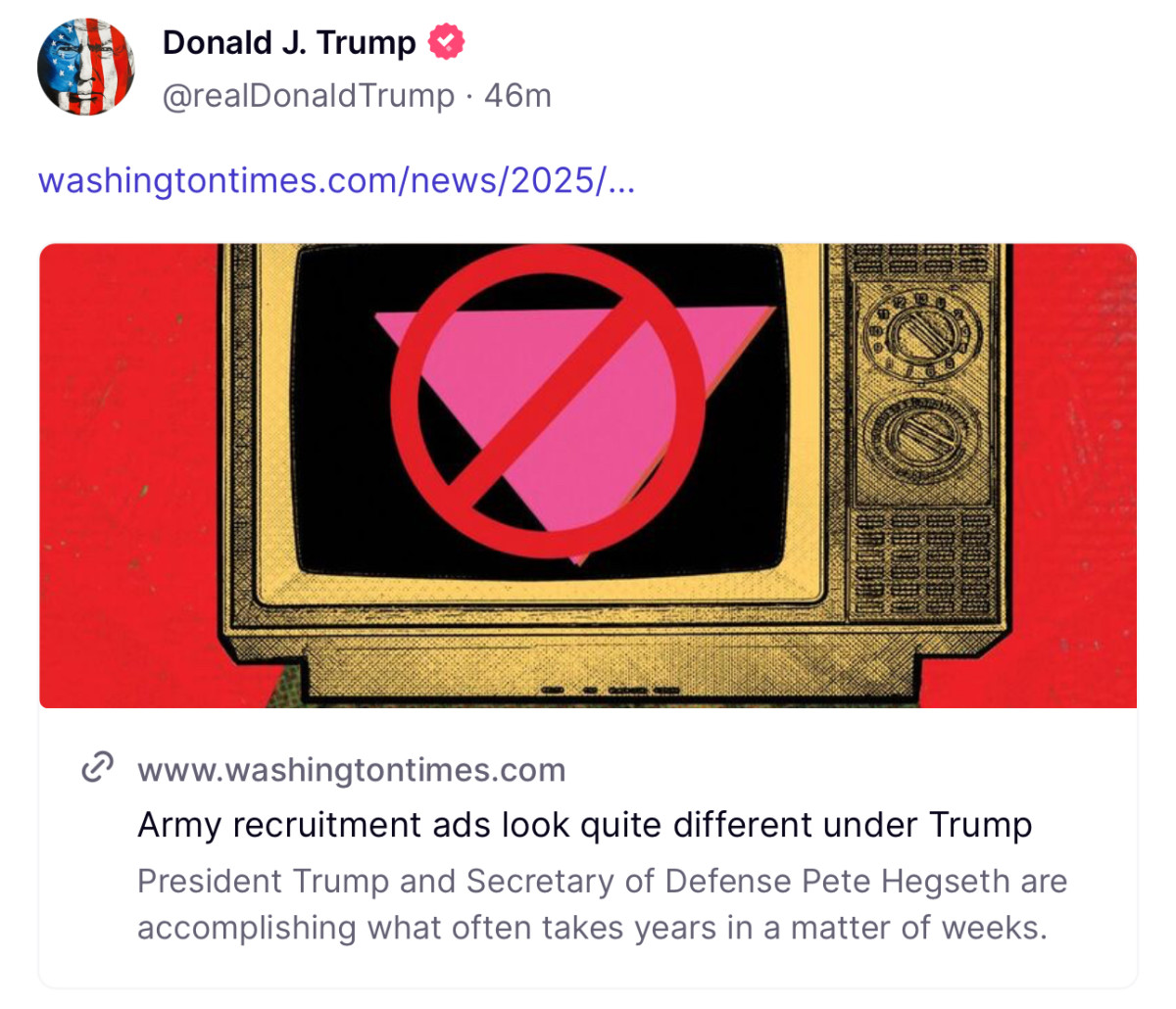
Trump Amplifies “No LGBTQ” Symbol Using Nazi-Era Imagery in Military Ad Post

https://meidasnews.com/news/trump-amplifies-no-lgbtq-symbol-using-nazi-era-imagery-in-military-ad-post


Trump’s Truth Social post has a pink triangle overlayed with a prohibition symbol

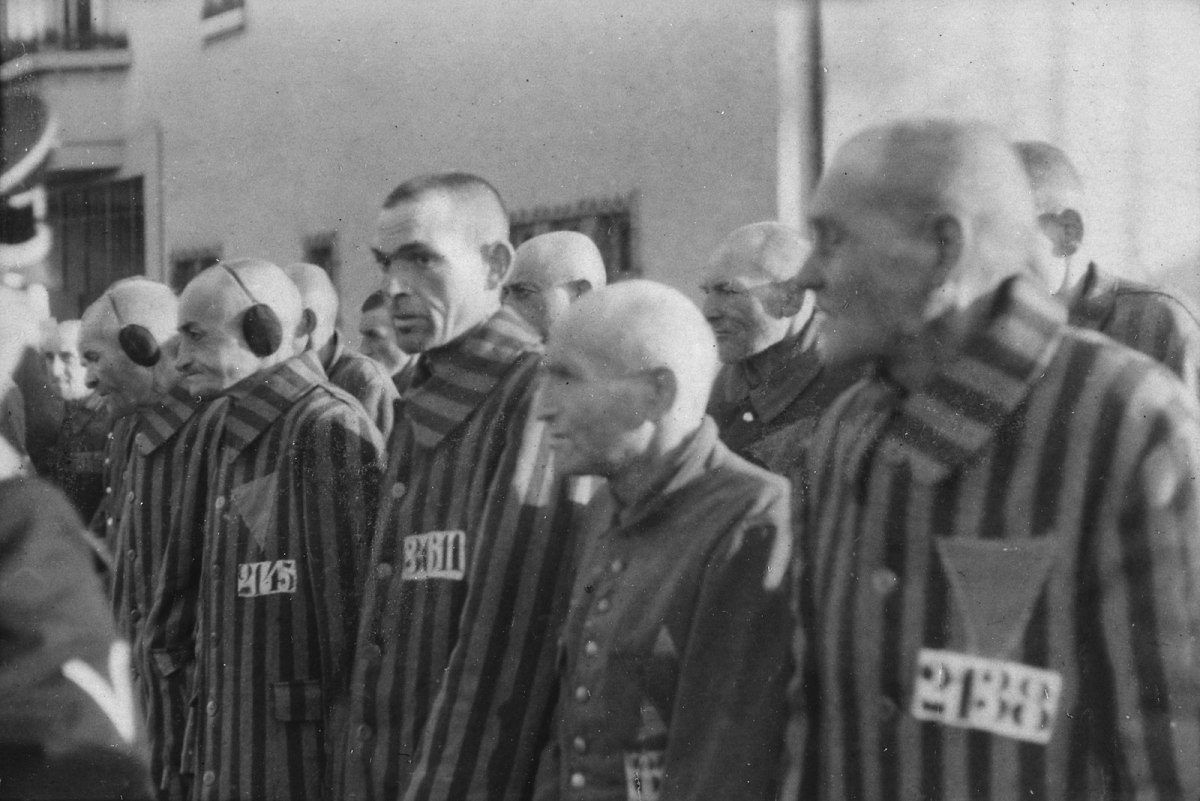
Trump posted an article to his Truth Social account this weekend featuring a deeply troubling image: a pink triangle—the Nazi-era symbol used to identify and persecute gay men in concentration camps—covered with a red prohibited sign. Historically, the LGBTQ+ rights movement reclaimed the pink triangle as a symbol of resistance, pride, and remembrance.

Trump

Trump

Truth Social

The article itself titled, “Army recruitment ads look quite different under Trump,” published by the Washington Times praises Trump and Defense Secretary Pete Hegseth for refocusing the military on “lethality” and reversing Biden-era policies that embraced diversity, including ads featuring LGBTQ+ soldiers.

Holocaust Museum Exhibit of Nazi concentration camp badges

Holocaust Museum Exhibit of Nazi concentration camp badges

Max, Wikipedia Commons

The image, placed in the context of military recruitment, strongly suggests a rejection of LGBTQ+ service members, at least in the terms of recruitment, under Trump’s leadership.

Military ads recruitment illustration

Military ads recruitment illustration

Washington Times

Trump’s choice to amplify such an image is particularly alarming given Hegseth’s past statements.

Prisoners wearing triangles in the concentration camp at Sachsenhausen, Germany, December 19, 1938

Prisoners wearing triangles in the concentration camp at Sachsenhausen, Germany, December 19, 1938

Heinrich Hoffman Collection / NARA

He has long opposed LGBTQ+ inclusion in the military, previously criticizing the repeal of Don’t Ask, Don’t Tell.

Hegseth 2

Pete Hegseth Lamented Don’t Ask Don’t Tell Change, Women in the Military

Now, under his leadership, Trump appears to be reinforcing the idea that LGBTQ+ individuals are unwelcome in the armed forces—not just through policy but through amplifying symbolic messaging with disturbing historical roots.

Pete for Senate

Pete Hegseth Campaigned to “Uphold Traditional Marriage” During 2012 Senate Run

Trump’s amplification of a Nazi-era symbol to promote this shift sends a message signaling a return to exclusionary policies that many believed were left in the past.

Peace & Justice History for 3/15

March 15, 1869
The first proposed amendment to the constitution guaranteeing women’s suffrage was introduced in the U.S. Congress.
March 15, 1942
Over 1300 Norwegian teachers were arrested by the German Nazi-installed government run by Vidkun Quisling after 12,000 of 14,000 nationwide had refused to join the new teachers’ association and resisted nazification of the curriculum. Half were held in a concentration camp outside the capital of Oslo. The rest were shipped to the Arctic for forced labor alongside Russian prisoners of war.
The loss of the arrested teachers forced a school shutdown for several weeks. Each day the imprisoned teachers were marched to their job of unloading supply ships, citizens stood respectfully by as they passed. When the teachers returned home later in the year, they were treated as heroes.

Hitler and Quisling
Following Germany’s defeat, Quisling was tried for treason, convicted and sentenced to death. Quisling is now considered a synonym for traitor.
Vidkun Quisling – ‘The Hitler of Norway’ 
March 15, 1963
Students from South Carolina State and Claflin College organized to integrate the lunch counter at Kresge 5&10 in Orangeburg, South Carolina. Though their efforts were disciplined and peaceful, 400 were attacked by police then herded behind fences in the largest mass arrest of the civil rights movement.

More than a 1000 students marched peacefully to integrate lunch counters in Orangeburg, South Carolina.
Convicted of “Breach of the Peace,” the U.S. Supreme Court later overturned those convictions because those arrested were petitioning for redress of grievances within the protection of the 1st Amendment.
More on the Orangeburg action 
March 15, 1965
Less than a week after the Bloody Sunday police attacks on peaceful marchers at the Edmund Pettus Bridge in Selma, Alabama, President Lyndon Johnson addressed the American people before a televised Joint Session of Congress. He said, “There is no issue of States rights or national rights. There is only the struggle for human rights . . . We have already waited a hundred years and more, and the time for waiting is gone . . . .”
Watch video or read the text of his speech 
March 15, 1993
The United Nations Commission on the Truth for El Salvador concluded that most of the murder and human rights abuses during its civil war had been committed by the U.S.-backed Salvadoran government through its various military, security and allied paramilitary organizations.
Truth Commission: El Salvador, U.S. Institute of Peace

https://www.peacebuttons.info/E-News/peacehistorymarch.htm#march15

Peace & Justice History for 3/14

March 14, 1879

Physicist and peace activist Albert Einstein was born in Ulm, Germany. The Nobel Prize winner opposed militarism and became a champion of nuclear disarmament. Though he supported the development of the atomic bomb out of fear that Germany would develop it first, he warned in a 1944 letter to the Manhattan Project’s Niels Bohr: “When the war is over, then there will be in all countries a pursuit of secret war preparations with technological means which will lead inevitably to preventative wars and to destruction even more terrible than the present destruction of life.”
Read more 
March 14, 1934
The National Civil Liberties Council was founded in England, principally to monitor the policing of protests. Renamed Liberty in 1989, it has campaigned to protect and promote rights and freedoms for over 75 years.  

About Liberty’s history 
The organization today 
March 14, 1970
During a second attempt by Native American activists to claim Fort Lawton (about 50 miles south of Seattle, Washington), 78 were arrested for entering the site.United Indians for All Tribes was demanding the city give the unused facility to Native Americans for use as a cultural center. One week earlier about the same number had been arrested for occupying what had been declared federal surplus property. The Daybreak Star Cultural Center is now operating on the site.

Indians demonstrating at Fort Lawton
Background 
The Daybreak Star Cultural Center
Recent pictures of the center 
March 14, 2004
Opposition Socialists scored an upset win in Spain’s general election three days following the Madrid train bombings. The conservative government had joined the U.S.-led coalition that invaded Iraq the previous year though Spanish public opinion was overwhelmingly opposed to it. José Luis Rodríguez Zapatero and his party, Partido Socialista Obrero Español (PSOE), had opposed the Iraq War and Spain’s involvement.
The coordinated bombings, which left 191 dead and 1600 injured, were the worst terrorist attack in Europe aside from the downing of Pan Am flight 103 over Lockerbie, Scotland.

Thoughtful article on the bombings and the political situation in Spain 

https://www.peacebuttons.info/E-News/peacehistorymarch.htm#march14

Peace & Justice History for 3/13

March 13, 1830
The term “rat,” referring to a worker who betrays the interests of fellow workers, first appeared in print. The New York Daily Sentinel reported on replacement workers who had agreed to work for two-thirds of the going rate.
“ . . . [many printers are out of work, others are being paid about 2/3 the regular pay; they should join in cooperative associations, ‘as we have done’]
“ [While] the master printers [fill] their offices with boys and two-thirds men, alias ‘rats,’ it will be difficult to find a remedy.”
March 13, 1864
The first contingent of 14,030 Navajo reached Fort Sumner, New Mexico. Men, women and children had been forced to march almost 400 miles from northeastern Arizona and northwestern New Mexico to Bosque Redondo, a desolate tract on the Pecos River in eastern New Mexico. Traveling in harsh winter conditions for almost two months, about 200 Navajo died of cold and starvation along the way.  More died after they arrived at the barren reservation.  The forced march, led by Kit Carson, an Indian agent and military leader in both the Mexican and Civil Wars, became known by the Navajos as the “Long Walk.” 
A grueling 400-mile march to imprisonment in a sterile land.
More on The Long Walk 
March 13, 1945
Pax Christi, an international Catholic peace organization, was founded in France. From their website: “Pax Christi is a ground up organization – it began with a few committed people who spoke out, prayed and worked for reconciliation at the end of the second world war, and is now active in more than 60 countries and five continents, with more than 60,000 members worldwide.”
Pax Christi history

March 13, 1968
Clouds of nerve gas drifted outside the Army’s Dugway Proving Grounds in Utah, poisoning 6,400 sheep in nearby Skull Valley.

Sign near Dugway: Warning Hazardous Area: This area may contain Chemical, Biological and Radiological contaminated material and explosives . . .
Read more about Dugway – the home of Amerian WMD

https://www.peacebuttons.info/E-News/peacehistorymarch.htm#march13

2 More From Clay Jones

MAGA Fire In The Sky by Clay Jones

Oops, there goes another one of Elon’s rockets Read on Substack

A second SpaceX rocket has blown up this year. And remember, the year is less than three months old. Debris from the explosion shut down air traffic in the state of Florida, or it was because they found a trans flight attendant in Orlando.

MSNBC’s Rachel Maddow had some snark about the explosion, using a metaphor for Elon Musk’s and DOGE’s dismantling of federal government agencies, Maddow said, “Rapid unscheduled disassembly is kind of Elon Musk’s specialty these days, especially in a way that really messes with other people through no fault of their own.”

Just think of all those inconvenienced by Elon’s rocket explosion delaying flights. Florida alligators are waiting to eat those people, Elon!

MSNBC’s Michael Steele said, “For Elon, his response to all of this was, ‘Rockets are hard.’ And Mr. Musk, if they’re so hard, why don’t you go back to your day job and work that out and leave those of us who do government to do government because you can’t do both. Clearly, you’re failing right now at both. Your rockets are blowing up, and the government is blowing up.”

Poor Kayleigh Menaney flipped her blonde wig over at Fox News, saying to the liberal media, “Don’t you dare root against SpaceX.” You would think they had put a shit-covered flag into a blender to serve as smoothies to World War II veterans, but then again…Elon’s making cuts at the Veteran’s Administration. It’s getting harder and harder to use analogies with these bastards.

There was a lot of wig flipping over on Trump TV. (snip-MORE)

=====

BRAAAAAAINS by Clay Jones

Where are the brains in the Trump/Elon Administration? Read on Substack

During Trump’s address to Congress last week, he repeated Elon Musk’s lie that 150-year-olds are collecting Social Security. The lie is even more malicious than originally thought because Trump repeated and enhanced it after it’s been debunked.

It’s a lie.

Elon previously posted on X in February, when it was working, that DOGE found beneficiaries in their 100s, 200s, and even 300s who were still receiving Social Security payments.

Nobody’s actually against the government rooting out waste and fraud. What we’re against is the lack of transparency by a Trump-appointed, corrupt, lying unelected bureaucrat with huge conflicts of interest and a lack of any qualifications to make decisions on government spending without any input from the three branches of government. Why is this so hard to understand?

We know there’s waste and fraud in government, but you don’t elect lying swamp creatures to drain the swamp.

In his address, Trump said, “We are also identifying shocking levels of incompetence and probable fraud in the Social Security program for our seniors and that our seniors and people that we love rely on. He then went on to list the number of people who are past the age of 100. “Money is being paid to many of them, and we are searching right now,” King Grifter said.

At one point during the speech, he criticized “unelected bureaucrats,” which made the Democrats laugh. (snip-MORE)

Peace & Justice History for 3/12

The very first execution of a Conscientious Objector, and more in today’s items.

March 12, 295
Maximilian of Thebeste (near Carthage in North Africa) was beheaded by Romans after refusing military service because he said his Christian beliefs did not permit him to become a soldier.
March 12, 1912
Workers led by the Industrial Workers of the World (IWW) won the Lawrence, Massachusetts, “Bread & Roses” textile strike after 32,000 workers (mostly young female immigrants who spoke 25 different languages, half between the ages of 14 and 18) stayed out for nine weeks. They were striking for a wage increase, double time for overtime and safer working conditions: the equipment was dangerous and the air quality caused lung disease in about one-third of the workers before the age of twenty-five.

IWW organizer Elizabeth Gurley Flynn addresses a strike rally
Background 
“Bread and Roses” became the strikers slogan and inspired a poem by by the same name.
 
Bread & Roses victory parade
March 12, 1930
Gandhi’s Salt March began from Ahmadabad, India, with 76 followers to protest the salt tax. Great Britain’s Salt Acts prohibited Indians from collecting or selling salt, a staple of the Indian diet.

Gandhi leading the Salt March
Citizens were forced to buy it from the British, who, in addition to exercising a monopoly over the manufacture and sale of salt, also exerted a heavy salt tax. Defying the Salt Acts, Gandhi reasoned, would be a simple way for many Indians to break an unjust law nonviolently (civil disobedience), increasing the pressure for independence from the British Empire.
By the time Gandhi had covered the 241 miles to the coastal city of Dandi on the Arabian Sea, the number of marchers had grown into the thousands.

More on the Salt March 
March 12, 1978
150,000 demonstrated against construction of a nuclear power plant in Lemoniz, Spain, part of the Basque region. No fewer than a dozen plants were planned in a relatively small, densely populated area, Lemoniz being only 12 km (5 miles) from Bilbao, a city of a million.
The opposition was concerned about the possibility of accidents.

Lemoniz protest
March 12, 1990
Sixteen disability-rights activists from ADAPT (American Disabled for Accessible Public Transit)were arrested at the U.S. Capitol demanding passage of what would become the Americans With Disabilities Act.

The Capitol Crawl

More on the status of the disabled
The Capitol Crawl Zinn project

https://www.peacebuttons.info/E-News/peacehistorymarch.htm#march12

Peace & Justice History for 3/11

March 11, 1988

Ten days of protest and direct action ensued demanding an end to nuclear testing at the Nevada Test Site. The site, larger than the state of Rhode Island, is an outdoor laboratory and national experimental center for testing nuclear weapons. The actions resulted in over 2,200 arrests, the largest number of arrests in U.S. history for a political protest outside Washington, D.C.
March 11, 2011
More than 85,000 Wisconsin citizens rallied outside the Capitol in Madison to welcome the return to the state of fourteen Democratic state senators. Known as the Wisconsin 14, they had left the state to deny the senate a quorum, thus delaying passage of legislation which took away public employees right to collectively bargain and restricting other rights of union members.
State Senate Minority Leader Mark Miller remarked about the gathering, “This is what democracy looks like!”

The Wisconsin 14

https://www.peacebuttons.info/E-News/peacehistorymarch.htm#march11

Rev. Barber Still Out Here Working

Bishop William Barber: GOP Tax Cuts “Mathematically Impossible” Without Gutting Medicaid and More

Story March 07, 2025 (Watch and/or listen on the page, linked just above.)

Republicans in Congress are pushing forward budget plans that would cut trillions in federal spending and give trillions more in tax cuts that disproportionately benefit corporations and the ultra-rich. This week, hundreds of faith leaders gathered on the Christian holy day of Ash Wednesday on Capitol Hill to voice their opposition. “There’s no way you can do the kinds of cuts they’re talking about — it’s mathematically impossible — without touching Social Security, Medicare and Medicaid,” says Bishop William Barber, one of the participants. Barber also reflects on the 60th anniversary of Bloody Sunday, when civil rights marchers were brutalized in Selma, Alabama, and stresses that economic justice was always at the heart of the movement alongside ending segregation and winning voting rights.

Transcript

This is a rush transcript. Copy may not be in its final form.

AMY GOODMAN: This is Democracy Now!, democracynow.org, The War and Peace Report. I’m Amy Goodman.

House Republicans narrowly adopted a budget proposal last week to cut as much as $2 trillion in spending over a 10-year period, in part to fund Trump’s tax cuts. A new analysis by the Congressional Budget Office shows the proposed budget would require massive cuts to Medicaid spending. Meanwhile, Elon Musk, the richest man in the world, has warned the U.S. government will go bankrupt without his Department of Government Efficiency, DOGE, which is working to slash a trillion dollars from the deficit.

This week, hundreds of faith leaders gathered to mark the Christian holy day of Ash Wednesday on Capitol Hill and to protest the impact the proposed cuts could have on the poor and the vulnerable. This is Bishop William Barber speaking at the protest Wednesday.

BISHOP WILLIAM BARBER II: If an unelected technocrat can delete the financial commitments of a government established for the people and by the people, and we don’t say anything, we betray our moral commitments to liberty.

AMY GOODMAN: Faith leaders also shared findings of a new report Wednesday called “The High Moral Stake: Our Budget, Our Future,” which details how President Trump and the Republican Party are taking more essential services and money away from working people while cutting taxes for the wealthiest. It was authored by Institute for Policy Studies, the Economic Policy Institute and Repairers of the Breach.

For more, we’re joined from North Carolina by Bishop William Barber, president and senior lecturer at Repairers of the Breach, national co-chair of the Poor People’s Campaign, founding director of the Center for Public Theology and Public Policy at Yale Divinity School. He’s co-author of the new book White Poverty: How Exposing Myths About Race and Class Can Reconstruct American Democracy.

Bishop Barber, welcome back to Democracy Now! on this 60th anniversary of Bloody Sunday, when voting rights activists marched — tried to march over the Edmund Pettus Bridge, led by John Lewis, and were beaten down by Alabama state troopers. Five months later, the Voting Rights Act would be signed by President Johnson. Your thoughts on putting history and this moment together, and what you were demanding on Wednesday?

BISHOP WILLIAM BARBER II: Well, thank you so much, Amy.

As I was listening to that song, “We Shall Overcome,” there’s another line that says, “We are not afraid.” And I want to thank Representative Green for his courage and showing the way of courage. He’s a dear friend of mine. He’s exactly right: You cannot wait until a dictator is in charge. You must challenge the way toward that dictatorship.

And we must remember, on this day 60 years ago, we did see that Bloody Sunday, but for nearly 40 years, Amelia Boynton, who was also beaten that day, a woman that John Lewis held in his arms, they have been working against voter suppression in that particular city. They also connected the issues of voter suppression and voter denial to economic injustice. Remember, the voting piece was supposed to be a part of the Civil Rights Act of ’64 along with raising the minimum wage to a living wage, and those things were gutted out of the ’64 Civil Rights Act, which made the ’65 march and the ’65 Voting Rights Act necessary.

At the end of that march, when they finally did reach Montgomery, Dr. King gave an amazing sermon. And he chose not to just talk about voting rights, but he chose to connect voting rights to economic injustice. And in that sermon, he said that the greatest fear of the greedy oligarchs in this country was for the masses of Black people and poor white people to join together and form a voting bloc that could fundamentally shift the economic architecture of the nation, and that every time this possibility becomes possible, the forces of extremism and the forces of division sow that division to keep it from happening.

I think we see that here today, what’s going on with this Congress. And it’s amazing to me, for instance, that they would censure Representative Green. They didn’t censure our sister out of Georgia. They didn’t censure the man who called Obama a liar on the floor. It’s a strange time that — the cheering, the applauding. But I think we are in a crisis of civilization, really, not just a crisis of democracy. It’s going to call people to have to stand, regardless of where they are.

So, what we’re dealing with right now, Amy, before I even talk about the specific policy, is this immoral philosophy that’s at work. Number one, they are operating off of the deliberate attempt to use executive orders as a way of intentionally violating the Constitution, thereby creating enough confusion to distract people from what’s going on in the Congress, because what happens in the Congress has the weight of the law, and EO doesn’t have the weight of law.

Number two, we are seeing the tyranny of technology and the dehumanization of people.

Number three, we’re seeing the attempt to make people justify their existence, which has its roots in racism, apartheid and Nazism.

Number four, we’re seeing the denial of equality on every front.

Five, we’re seeing the outright violation of freedom of speech, due to the process — due process and equal protection under the law for all persons, and an attempt to end birthright citizenship.

Number six, we are seeing the outright betrayal of liberty.

Number seven, we are seeing the idolatry of the certainty of white supremacy, that some people can decide who’s in, who’s out, who’s right, who’s wrong.

And number eight, we’re seeing the misuse of religious Christian nationalism in an attempt to falsely claim that their immoral actions are moral.

This is what is underneath, if you will, what we see going on. It is dangerous. It leads us to dictatorships and worse. And we must be courageous in this moment. I think that what you saw happen with Representative Green is just the tip of the kind of pushback we’re going to see as the weather gets warmer and as people see more and more the kind of damage that’s being suggested by this current budget and this current Congress. (snip-MORE; watch/listen on the page)