
Category: History
Let’s talk about how Trump, Bragg, names, and what’s next….
More About Erasing People, + Action for Fighting
‘We Will Not Surrender’: How to Stand Up to Trump Administration Attacks on LGBTQ+ Health Research
PUBLISHED 2/14/2025 by Wendy Bostwick
The Trump’s administration’s unprecedented war on LGBTQ+ health research—erasing data, censoring science and threatening lives—demands urgent resistance from the medical and research communities.
For the first time in a long time, I was scared. Two weeks after the election, I gave a lecture I’ve delivered countless times, on the critical need to measure sexual orientation and gender identity in health research. Such measures are necessary to identify the unique health needs of lesbian, gay, bisexual and transgender (LGBT) people. In my 25 years of doing research in and with LGBT communities, this is a topic that has shaped my career.
Yet this time, I began my lecture with a caveat: I was uncertain—and afraid—of what the new administration might mean for the hard-won progress we’ve made in LGBT health research, to say nothing of the civil rights gained for my community in the past 30 years.
Not only was my fear justified. It was understated.
Within the first three weeks of Donald Trump’s presidency, an avalanche of executive orders and questionably legal actions have validated my fears, leaving me unsteady and reeling. The Trump administration has aimed to disrupt—if not destroy—research and the scientific process … most especially research focused on LGBT populations, with transgender and non-binary people expressly targeted.
The administration’s actions have been swift and ruthless. (snip)
The American Public Health Association filed a lawsuit to challenge federal funding freezes. The American College of Obstetricians and Gynecologists has publicly condemned censorship and used their website to post some of the purged data. Organizations that rely on federal data should publicly take a stand, much like the American Association for Public Opinion Research just did. These aren’t just commendable actions; they’re blueprints for what every medical and scientific organization should do immediately.
Academic publishers and journal editors can no longer remain neutral. They have an ethical imperative to actively resist censorship and protect academic freedom. Their platforms, influence and resources need to be deployed in this fight—now, not after more damage is done.
A commentary by editors of the British Medical Journal is an excellent example. In it, they forcefully decry the Trump administration’s ludicrous order for CDC scientists to withdraw or retract scientific articles containing the aforementioned forbidden words, plainly explaining, “This is not how it works.” Article retractions, they note, do not happen on demand. They happen when there is evidence of data fabrication or manipulation, not because of political pressure.
Some may imagine that silence in the face of injustice will shield them from harm, particularly if their work is seemingly unrelated to issues of sexual orientation, gender or gender identity. But when healthcare data and related research about LGBT groups are suppressed, it is not just scientific integrity that is undermined. We’re actively worsening health outcomes and costing lives. And this is a cost we all will bear.
Strengthening our cross-issue collaborations and advocacy efforts is imperative. This crisis demands unprecedented coalition-building across scientific disciplines, civil rights organizations and public health institutions. The administration’s assault on LGBT people and health research, as well as science writ large, may seem overwhelming. They are counting on our paralysis and division. We should not—must not—fall prey to this tactic.
It the midst of this deliberately wrought chaos, we must also take care of each other and ourselves. We cannot let these actions crush our spirit and obliterate our hope. I have found comfort in the work of Rebecca Solnit, author of Hope in the Dark, who reminds us that hope is itself an act of resistance. “They want you to feel powerless and surrender and let them trample everything, and you are not going to let them,” she posted on her site, “Meditations in an Emergency,” recently. “The fact that we cannot save everything does not mean we cannot save anything, and everything we can save is worth saving.”
Science is worth saving. Speak up. Push back. Build coalitions. File lawsuits. Protect data. Continue research. The future of science and countless lives hang in the balance. We cannot wait another day. We will not surrender.
They Cannot Erase People!
Peace & Justice History for 2/15

| February 15, 1898 The man-of-war (battleship) USS Maine was sunk in Cuba’s Havana Harbor as the result of an explosion, 260 American naval personnel dying as a result, another 58 wounded. An insurrection against Spanish colonial rule in Cuba had persisted for years, and brutal Spanish tactics had engendered strong American reaction. That is why Consul General Fitzhugh Lee had asked President William McKinley to send the Maine “for the moral effect it might have.” Spain’s Governor-General Weyler had forced 300,000 Cubans into towns and cities to insulate them from the insurgents but had made no preparations for their food, housing or health care. Half of the reconcentrados, as they were called, died as a result. Pres. McKinley had tried since coming into office to reach a settlement through negotiation but Spain rejected his efforts. Following the sinking of the Maine, popular opinion in the U.S. moved toward war with Spain, partially in response to inflammatory press coverage. Congress then voted McKinley $50,000,000 to be used for the national defense at his discretion, and provided for a contingent increase of the army to 100,000 men. The cause of the explosion ??? |
| February 15, 1998 About 2,000 people – including a tractor convoy consisting of over 100 farmers – staged a demonstration in the north German town of Ahaus in protest against the planned shipment of nuclear waste to a storage facility in the town. A consignment of full CASTOR (Casks for Storage and Transport of Radioactive Material) containers was expected at the Ahaus interim nuclear storage site within the next two weeks. |
| February 15, 2002 President George W. Bush approved Nevada’s Yucca Mountain as the site for long-term disposal of 70,000 metric tons (77,000 tons) of highly radioactive nuclear power plant waste. 12 years and $6.8 billion worth of study and construction had gone into the site 90 miles from Las Vegas.  It is officially estimated that, by the time it is completed in 2017, the total construction cost will be $23 billion. 2000 additional metric tons of such waste are generated by U.S. nuclear power plants each year, leading to concerns that the facility would be full shortly after its opening. All such waste is currently stored onsite at individual nuclear power plants.  Problems with the Yucca Mountain site What are the alternatives FAQs on Yucca Mountain |
| February 15, 2003 The world said NO to war… In the single largest day of protest in world history, millions on 6 continents demonstrated against the U.S./U.K. plans to invade Iraq. Reported totals included 1 to 2 million in London and Rome; 1.3 million in Barcelona, Spain (a city of 1.5 million); 500,000 each in Berlin, Paris, Madrid, and New York. Smaller demonstrations were held in over 600 cities and towns across the U.S., including tens of thousands in several cities, and 150,000 the following day in San Francisco. Total participation is estimated at 25 million in more than 100 countries.  |
https://www.peacebuttons.info/E-News/peacehistoryfebruary.htm#february15
Peace & Justice History for 2/14
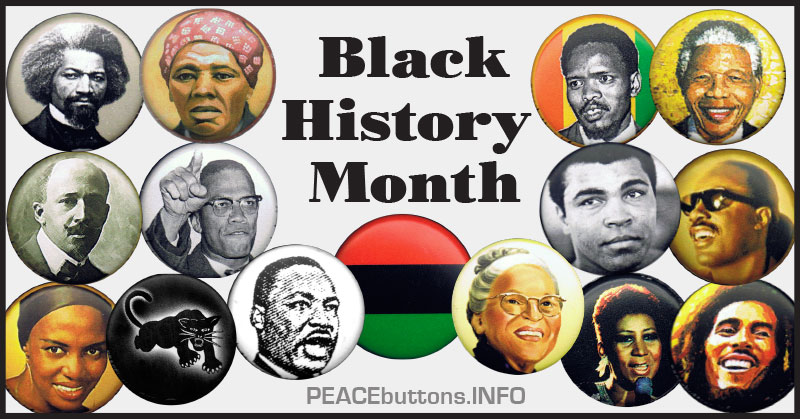
| February 14, 1957 The organization that would shortly be called the Southern Christian Leadership Conference (SCLC) chose its leadership at a meeting in New Orleans. Reverend Martin Luther King, Jr. and Reverend Ralph David Abernathy led the group which sought to coordinate civil rights protests throughout the South. Organizers of bus boycotts, inspired by the one in Montgomery, Alabama, had met in Atlanta a month earlier. During that meeting, Dr. Abernathy’s home and church were bombed.  Reverend Ralph David Abernathy and Rev. Martin Luther King, Jr. Southern Christian Leadership Conference history |
February 14, 1971 President Richard Nixon ordered a secret taping system to be installed for his offices in the White House. Listen in on the presidents |
| February 14, 1989 At a meeting of the presidents of Nicaragua, Honduras, Guatemala, Costa Rica, and El Salvador, the Sandinista government of Nicaragua agreed to release a number of political prisoners and hold free elections within a year. In return, Honduras promised to close bases established by the U.S. for and used by the anti-Sandinista Contra rebels. Just over one year later, elections were held (with international observers including former President Jimmy Carter) though the nation was threatened with a continuing U.S. economic boycott, and was experiencing ongoing Contra violence. The Sandanista Front candidate was defeated 55% to 41%. |
Peace & Justice History for 12/13
| February 13, 1912 Labor leader Mary Harris “Mother” Jones was placed under house arrest at Pratt (Kanawha Co.), West Virginia, for inciting to riot. An organizer for the United Mine Workers, she had come to the Paint Creek and Cabin Creek mines where a long and nasty struggle had escalated.  Jones was known for her fiery (and often obscene) verbal attacks on coal operators and politicians. A native of Ireland, she had been organizing for more than 15 years.The coal operators had hired mine guards to intimidate the workers and discourage formation of a union. Besides asking to be paid what other area miners were making, the union demanded • the right to organize • recognition of their rights to free speech and assembly • an end to blacklisting of union organizers • alternatives to company stores • an end to the practice of using mine guards • prohibition of cribbing • installation of scales at all mines for accurately weighing coal unions be allowed to hire their own checkweighmen to make sure the companies’ checkweighmen were not cheating the miners who were not paid hourly, but by the ton. 68 years old (though claiming to be over 80) and suffering from pneumonia, Jones was never charged with a crime (martial law had been declared). A few weeks later, the new governor, Henry Hatfield, was sworn in and examined Mother Jones (he was also a doctor) but refused to release her from house arrest for two months. Mother Jones biography Mother Jones magazine (They have a great free newsletter!) |
| February 13, 1960 France became the world’s fourth nuclear power, conducting its first plutonium bomb test at the Reggane base in the Sahara Desert in what was then French Algeria. “Gerboise Bleue” was detonated from a 330-foot tower and had a yield of 60-70 kilotons (equivalent to nearly 70,000 tons of TNT).  |
| February 13, 1967 Carrying huge photos of Vietnamese children who had been victims of Napalm (a flammable defoliant used extensively in the war there), 2,500 members of the group Women Strike for Peace stormed the Pentagon, demanding to see “the generals who send our sons to Vietnam.” When Pentagon guards locked the main entrance doors, the women took off their shoes and banged on the doors with their heels.   They were eventually allowed inside, but Defense Secretary Robert McNamara would not meet with them. Senator Jacob Javits (R-New York) agreed to meet a few hundred of the women, but he was booed by the women when he denied the U.S. was using toxic gas in Vietnam. |
| February 13, 1968 Five soldiers were arrested at a pray-in for peace in Vietnam at Fort Jackson, South Carolina. Two were court-martialed for refusing to stop praying. The pray-in was repeated a year later. |
| February 13, 1991 Two precision-guided missiles destroyed the Amiriyah subterranean bunker in Baghdad while being used as an air-raid shelter by 408 Iraqi civilians during the first Gulf War. The resulting deaths of all inside made it the single most lethal incident for non-combatants in modern air warfare. The U.S. had detected signals coming from the bunker and considered it a military command and control center.  There was an antenna atop the bunker but it was connected by cable to the actual command center 300 yards away, which was not hit by the 2000 lb. bombs which landed precisely on their intended target, penetrating ten feet of hardened concrete. Only 3% of the 250,000 bombs and missiles fired during that conflict were considered such “smart bombs.”  Visitors tour the Amiriyah Bunker. The Iraqi government has preserved the bunker as a public memorial. |
https://www.peacebuttons.info/E-News/peacehistoryfebruary.htm#february13
Peace & Justice History for 2/12
Feb. 12th always reminds me of the time we were sitting in a Wendy’s eating on the way to/from a karate tournament. Someone in the restaurant sneezed (it wasn’t crowded,) and I automatically said “God bless you!” then the kid said, “Science could have prevented that.” It was pretty awesome. Happy Darwin Day!

 | Charles Robert Darwin, who first described the process of evolution of species in the plant and animal kingdoms through natural selection, was born. It is now celebrated as Darwin Day, when the common language of science, bridging language and culture, is recognized and appreciated. |  |
| Darwin Day ideas ================================================ February 12, 1909 The National Association for the Advancement of Colored People (NAACP) was founded by sixty Americans, both black and white, in a call to safeguard civil, legal, economic, human, and political rights of black Americans.  The call was partly in reaction to a race riot in 1908 in Springfield, Illinois, home of Abraham Lincoln. The call was issued on the centennial of his birth, and principally written by Oswald Garrison Villard, president of the N.Y. Evening Post Company: “If Mr. Lincoln could revisit this country in the flesh, he would be disheartened and discouraged.”  Oswald Garrison Villard NAACP’s beginnings ================================================== February 12, 1947 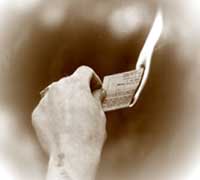 An estimated 400-500 veterans and conscientious objectors from World Wars I and II burned their draft cards during two demonstrations, in front of the White House and at New York City’s Labor Temple, in protest of a proposed universal conscription law. This was the first peacetime draft-card burning. ================================================== February 12, 1993 About 5,000 demonstrators marched on Atlanta’s State Capitol to protest the Georgia state flag (on left) because its principal element was the Confederate battle flag. That flag was adopted in 1956 by the state legislature in reaction to the Supreme Court decision of Brown v. Board of Education ordering the racial integration of public schools. Several newspaper editorials opposed the flag as well as 18 local patriotic organizations, including the United Daughters of the Confederacy, stating the flag “would cause strife.”   In 2001 the Georgia state flag was redesigned, shown above. ==================================================== February 12, 1997  In “Prince of Peace Plowshares,” six activists poured blood and symbolically disarmed U.S.S. The Sullivans, a nuclear-capable Arleigh Burke-class destroyer, at the Bath Iron Works in Bath, Maine. All were eventually convicted of destruction of government property and conspiracy. Read more about this action |
https://www.peacebuttons.info/E-News/peacehistoryfebruary.htm#february12
Peace & Justice History for 2/11
February 11, 1790 The Pennsylvania Society for Promoting the Abolition of Slavery, composed mostly of Quakers and Mennonites, petitioned Congress for emancipation of all slaves. Benjamin Franklin had become vocal as an abolitionist and in 1787 began to serve as President of the Society which not only advocated the abolition of slavery, but made efforts to integrate freed slaves into American society. The proposed resolution was immediately denounced by pro-slavery congressmen and sparked a heated debate in both the House and the Senate. More on early Abolitionist and Anti-Slavery Movements |
| February 11, 1916 Emma Goldman was arrested for lecturing on birth control, presumed a violation of the 1873 Comstock Law which prohibited distribution of literature on birth control, considered obscene under the act. Goldman considered such knowledge essential to women’s reproductive and economic freedom; she had worked as a nurse and midwife among poor immigrant workers on New York’s Lower East Side in the 1890s. She also organized for womens’ suffrage, later opposed U.S. involvement in World War I, and was imprisoned for allegedly obstructing military conscription.  Emma Goldman speaking on Birth Control -Union Square, New York City May 20, 1916 “. . . those like myself who are disseminating knowledge [of birth control] are not doing so because of personal gain or because we consider it obscene or lewd. We do it because we know the desperate condition among the masses of workers and even professional people, when they cannot meet the demands of numerous children.” – Goldman letter to the press following her arrest  Emma Goldman’s courageous efforts ————————————————————————————– February 11, 1937 Forty-eight thousand General Motors workers won their 44-day sit-down strike in Flint, Michigan. On December 30 workers at Fisher Plants 1 & 2 sat down and refused to leave, forcing workers around them to stop work and preventing the next shift from starting.  The sit-down strike ended when the company agreed to recognize the United Automobile Workers union as the representative bargaining agent for the striking hourly employees. Other automakers gradually accepted the legitimacy of the union. The success of the sit-down was an inspiration to workers in other industries to organize their own unions. Nearly 100 images on the Flint sit-down from Detroit’s Wayne State University Walter Reuther Archive —————————————————————————————- February 11, 1978 Native Americans began The Longest Walk, a march from Alcatraz Island in San Francisco Bay to Washington, D.C. Native American Activism: 1960s to Present A Brief History of the American Indian Movement  photo Ilka Hartmann The Walk was intended to be a reminder of the forced removal of American Indians from their homelands across the continent, and drew attention to the continuing problems plaguing the Indian community, particularly joblessness, lack of health care, education and adequate housing. —————————————————————————————– February 11, 1979 Poet John Trudell, a former national chairman of the American Indian Movement (AIM), burned an upside-down flag and spoke from the steps of the FBI building in Washington, D.C. during a vigil for Leonard Peltier. Peltier, also a leader of AIM, was imprisoned (and is still today after 30 years,) and is considered a political prisoner by Amnesty International. (NOTE: Leonard Peltier’s sentence was commuted to home confinement in 2025.) Twelve hours later Trudell’s wife Tina, her mother, and their three children died in an arsonist’s attack of their home on the Duck Valley Reservation in Nevada. The FBI did not investigate even though the crime fell under its jurisdiction. Learn about Leonard Peltier Remembering John Trudell ———————————————————————————————- February 11, 1990  Nelson Mandela was freed after 27 years in a South African prison following months of secret negotiations with South African President F.W. (Frederik Willem) de Klerk. In 1952, Mandela became deputy national president of the African National Congress (ANC), the oldest black political organization in South Africa, having joined as a young lawyer in 1944. He advocated nonviolent resistance to apartheid – South Africa’s institutionalized system of white supremacy, black disenfranchisement and rigid racial segregation. However, after the massacre of peaceful black demonstrators at Sharpeville in 1960, Mandela helped organize a paramilitary branch of the ANC to engage in guerrilla warfare against the white minority government.  He and de Klerk were jointly awarded the Nobel Peace prize in 1993 “for their work for the peaceful termination of the apartheid regime, and for laying the foundations for a new democratic South Africa.” Read more: http://news.bbc.co.uk/onthisday/hi/dates/stories/february/11/newsid_2539000/2539947.stm |
https://www.peacebuttons.info/E-News/peacehistoryfebruary.htm#february11
I Really Like This.
I think you will, too.
 Scottie's Playtime