Understanding the critical role of the sovereign powers of the states as a redoubt beyond the reach of Trump’s increasingly autocratic power is really the entire game right now, at least for the next 18 months and, in various measures, almost certainly through the beginning of 2029. People can march, advocate, campaign, donate to candidates, all the stuff. But in many ways the most important thing right now is both communicating to and demanding of state officials that they act on this latent power.
There are key areas where Democrats in Congress may have moments of power, the ability to slow a few things down. But to a great degree, the battle is already lost within the federal government until the next election. It’s only in the states where opponents of Donald Trump hold executive power outside the reach of and the hierarchies of the federal government. That’s where the whole game is. It is strategic depth not in extent or remoteness of territory but in the structure of government and the state. And states have vast amounts of power, far more than we tend to realize because we’ve never been in a position where the mundane daily activities of state and local government have become so critical — its taxing powers, its policing powers, the ways in which the federal government actually struggles to effectively extend its powers to the local level at scale without the active participation of local government.
Something Jason Sattler wrote yesterday needs repeating this morning:
Everything we do makes it easier for our neighbors to stand up or sit down for this regime. We all know there’s a crisis coming that will force all who pay attention to make a choice that could define the rest of their lives.
Will people do it? In most cases, it depends on what they see us doing next.
SEE us doing. That’s the key.
How the less-engaged make up their minds about political matters, Anand Giridharadas observed (based on Anat’s work), is more akin to how they decide to buy pants: What’s everyone else wearing this year? What are normal people like me doing? Not in one-and-done big rallies but every day. Your resistance must be visible and persistent for that to work and give the less engaged permission to join the resistance movement. Calling your senator five days a week is fine, but which of your neighbors sees that?
Plus, if you want people to join your party, throw a better party. We’re out in the streets multiple times a week now. I bring dance music.
A friend pointed to this TikTok by someone going by @logicnliberty. She advocates a unified front by blue-state governors with trifectas. It’s not that they are not already unified, coordinating, and suing. They are. Govs. Gavin Newsom, JB Pritzker, Kathy Hochul are speaking out and holding press conferences. (State AGs too.) But not necessarily as a team. Are they leveraging their trifectas proactively to erect firewalls in their states against Trump’s gutting of the Constitution? They should.
(snip-TikTok video embedded on the page)
Would the press cover it if they did? We are already in the slow civil war Jeff Sharlet described. The blue and the gray meets the blue and the red. Run with it. The press loves controversy. Generate more, blue state governors.
There are key areas where Democrats in Congress may have moments of power, the ability to slow a few things down. But to a great degree, the battle is already lost within the federal government until the next election. It’s only in the states where opponents of Donald Trump hold executive power outside the reach of and the hierarchies of the federal government. That’s where the whole game is. It is strategic depth not in extent or remoteness of territory but in the structure of government and the state. And states have vast amounts of power, far more than we tend to realize because we’ve never been in a position where the mundane daily activities of state and local government have become so critical — its taxing powers, its policing powers, the ways in which the federal government actually struggles to effectively extend its powers to the local level at scale without the active participation of local government.
Understanding the critical role of the sovereign powers of the states as a redoubt beyond the reach of Trump’s increasingly autocratic power is really the entire game right now, at least for the next 18 months and, in various measures, almost certainly through the beginning of 2029. People can march, advocate, campaign, donate to candidates, all the stuff. But in many ways the most important thing right now is both communicating to and demanding of state officials that they act on this latent power.
And those actions must be not only public, but in-your-face public. Their actions and yours.
The human heart hangs on to hope until there’s no other choice. People will not fight back in the ways that will work, until they realize there is no other choice, until the only other choice is their own imprisonment or death, or that of someone they love. For many of us, that moment is already here. But for most of us, it’s not.
Bio: Richard Francis Hogan is a Canadian writer, Poet and advocate on several levels based in Ottawa. His work explores hope, resilience, identity, faith, and the quiet power of public spaces.
Subject: Op-Ed Submission: When the Parade Stops, the Silence Speaks Louder
Dear Editor,
I am submitting the attached op-ed for consideration in the Ottawa Citizen. It reflects on the recent cancellation of the Ottawa Gay Pride Parade and the deeper cultural and spiritual implications of that absence. As a longtime resident and advocate for inclusive public spaces, I believe this piece speaks to a moment of reflection for our city and its commitment to visibility, dignity, and belonging. Thank you for your time and consideration.
Sincerely,
Richard Hogan
(snip-personal contact info)
Full Narrative
When the Parade Stops, the Silence Speaks Louder
By Richard Francis Hogan
The cancellation of the Ottawa Gay Pride Parade due to protests is more than a logistical decision. It is a cultural silence, a civic absence, a spiritual pause that demands reflection.
For decades, Pride has been more than a celebration. It has been a procession of courage, a public hymn of identity, a communal act of love. It has been where the marginalized found visibility, where joy became resistance, and where the city itself remembered its promise to all its people.
To cancel such a gathering is not merely to postpone an event. It is to interrupt a ritual of belonging.
As a Christian, I believe in the sacredness of every human soul. As a Buddhist, I recognize the impermanence of all things—but also the importance of showing up, again and again, with compassion. And as someone with Irish blood, I know that humor and heartache often walk hand in hand. We laugh because we’ve cried. We march because we’ve been still for too long.
This year, there will be no rainbow flags waving down Bank Street. No music echoing through Centretown. No cheers from sidewalks lined with families, allies, and elders who remember when Pride was a protest, not a party.
But let us not confuse absence with apathy.
Let us write, speak, gather, and remember. Let us honor those who came before, and those who still wait to be seen. Let us make sure that when the parade returns, it does so not just with glitter—but with grit.
Because Pride is not a date on the calendar. It is a declaration of dignity.
And dignity, like love, does not disappear. It waits. It endures. It marches on.
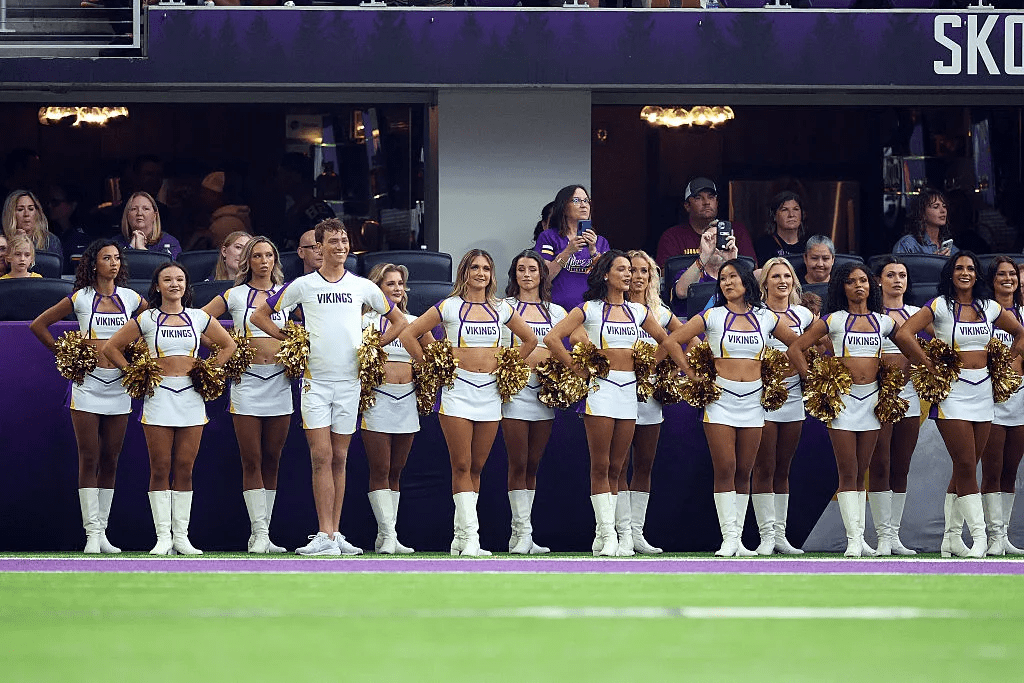
The excellent Minnesota Vikings cheer squad. Image credit: David Berding // Getty Images)
The American economy has become sluggish, Trump’s foreign policy has been abysmal, and we still don’t have the Epstein files that likely implicate Trump’s role in a massive sex operation that targeted children.
Thus, the distractions keep on comin’, and the latest culture war fiasco being trial-ballooned by rightwing media is… male cheerleaders in the NFL.
If you’ve spent any time on social media over the past few weeks, you’ve probably seen the predictable, manufactured outrage over the Minnesota Vikings adding two men to their cheer squad this season.
Fox News, conservative influencers, and even Republican elected officials are getting in the mix, desperate to find any damn distraction they can to keep folks from paying attention to the massive failures and glaring scandals of the Trump administration and Republican Party across-the-board this year.
But this ain’t a new thing. There have been male cheerleaders in the NFL since 2018, when the Los Angeles Rams and New Orleans Saints became the first franchises to add men to their cheer squads.
Since then, the Carolina Panthers, Seattle Seahawks, Philadelphia Eagles, San Francisco 49ers, New England Patriots, Kansas City Chiefs, Indianapolis Colts, Tampa Bay Buccaneers, Tennessee Titans and Baltimore Ravens have selected male cheerleaders.
This season, a full third of NFL teams have men on their cheerleading squads, but what I find truly hilarious is that the past eight winners of the Super Bowl have male cheerleaders.
In fact, the past eight Super Bowls have only featured teams with male cheerleaders.
Yesterday, Senator Tommy Tuberville of Alabama—a former college coach—weakly attempted to fear-monger over the issue with one of the more bizarre claims he’s made in a while:
But if you’re going to be woke and you’re gonna try to take the men out of men’s sports, which is what you’re doing. They’re trying to take gender and say, ‘OK, we’re going to make it more about gender than we are about masculinity.’ Then, you’re going to have a huge problem. It’s coming.
I don’t know what the hell he’s talking about, either. I caught the oblique reference to trans women in women’s sports, but good lord, what an awkward way of framing the argument.
This is all the more amusing when you consider the long history of Republican politicians who were male cheerleaders.
That includes four Republican presidents in their college years: both George W. Bush and his father George H. W. Bush at Yale, Ronald Reagan at Eureka, and Dwight D. Eisenhower at West Point.
Former Texas Governor Rick Perry was a cheerleader at Texas A&M. So was Senator Trent Lott at Ole Miss. So was Mitt Romney at Stanford.
The Republican Party has a long and proud history of producing the nation’s finest male cheerleaders. In the past 50 years, more Republican presidents have been male cheerleaders than seen combat.
So, what’s the play here? We all know it’s a distraction, but why are Republicans and conservative media hoping this’ll stick?
Some rightwing men are angry over male cheerleaders because male cheerleaders distract from their open lusting toward women cheerleaders.
They see male cheerleaders as a distraction because they might “accidentally” objectify a male cheerleader amidst all the pretty ladies and that puts them on edge.
Yet they’re openly lusting for women cheerleaders at a public venue in front of kids.
These are the same dudes who claim any LGBTQ content in any public context is harmful to kids because from the warped and sad perspective of these dudes, merely the presence of LGBTQ visibility is always sexual in nature.
But they’re actually very pleased to ogle sexy women and see no problem doing so in front of kids. Sexual performance is never a problem when it caters to straight men.
As always, this goes back to the male gaze and some straight men being entirely incapable of reconciling their own sexuality and religious hypocrisy and using the “safety of kids” to alleviate their own discomfort.
The problem isn’t the presence of sexy cheerleaders, regardless of gender. It isn’t the presence of children. It isn’t even supposed religious teachings.
The problem, as always, are some straight, conservative men needing the entire world to cater to all their whims and all their discomforts and holding up a Bible to cover for that, which immediately gets set back down the moment there are sexy ladies to ogle.
It’s pathetic, but what would you expect from a political party that’s doing everything it can to distract from its leader, Donald Trump, being connected to a massive sex trafficking operation?
The Republican Party is in desperate need of better crowd chants. Maybe they should ask their own male cheerleaders to help them out.
Exclusive: largest data analysis of its kind counters Trump’s aggressive efforts to deny trans minors’ existence
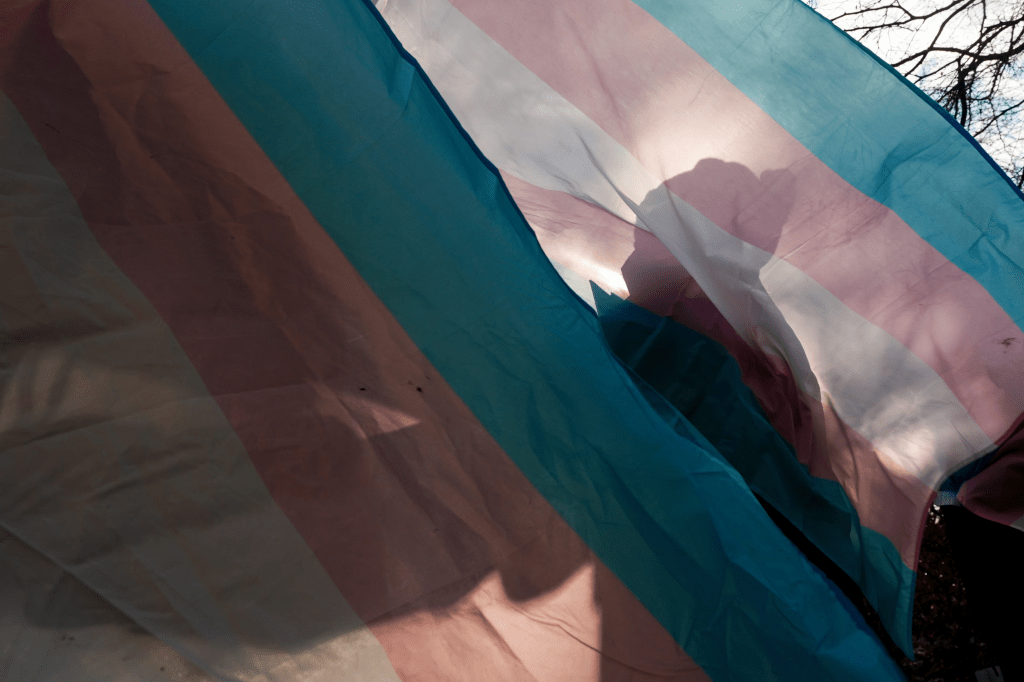
View image in fullscreen A protester is silhouetted against a trans pride flag during a pro-transgender rights protest outside of Seattle children’s hospital on 9 February. Photograph: Lindsey Wasson/AP
More than 2.8 million people now identify as transgender in the US, including an estimated 724,000 youth, according to a new data analysis that is the largest of its kind to date.
Researchers from the University of California, Los Angeles (UCLA) Williams Institute used federal surveys and data from state health agencies to identify the size and demographics of the trans population in each state.
The analysis, shared with the Guardian and released on Wednesday, documented thousands of trans youth living in all 50 states and the District of Columbia. The findings counter Donald Trump’s aggressive efforts to deny the existence of trans minors, as his administration removes references to trans people across federal agencies and widely erodes protections and programs for LGBTQ+ communities.
The report builds on federal data collection efforts that the White House is now eliminating. The authors warn their study could be the last comprehensive portrait of the nation’s trans population for a decade or more as trans people are erased from vital US surveys, including health reports and crime data analyses.
The Williams Institute primarily relied on data from 2021 to 2023 from Centers for Disease Control and Prevention (CDC) surveys and records disclosed by state health agencies. Some of the key findings include:
1% of the total US population ages 13 and older identifies as trans, including 0.8% of adults (more than 2.1 million people) and 3.3% of youth ages 13 to 17 (roughly 724,000 people).
Young adults ages 18 to 24 are significantly more likely to identify as trans (2.72%) than those 35 to 64 (0.42%) and those 65 and older (0.26%).
Of the 2.1 million trans adults, 32.7% (698,500) are trans women, 34.2% (730,500) are trans men and 33.1% (707,100) are trans non-binary people.
The trans populations are fairly consistent across regions, with 0.9% of adults in the west, midwest and north-east identifying as trans, compared with 0.7% of adults in the south.
Minnesota had the highest rate of adults who identify as trans (1.2%), and Hawaii had the highest rate of trans youth (3.6%), though the ranges were similar across states.
“Trans people live everywhere and are represented in every state,” said Dr Jody Herman, senior scholar of public policy at the Williams Institute and co-author of the report, noting the total US trans population was greater than the individual populations of more than a dozen states. “This is a substantial population that has unique concerns and barriers to getting their needs met, and lawmakers need to keep that in mind.”
The Williams Institute, a leading LGBTQ+ policy research center, has published national trans population counts since its 2011 report, which was the first of its kind as state-level data on gender identity became available. The estimates are considered the best available data and were cited by the US supreme court in its recent majority opinion upholding Tennessee’s ban on trans youth healthcare.
The quality and sources of the researchers’ data have improved from one report to the next, the researchers said, making it difficult to assess changes over time. But the researchers noted that the overall estimates of trans adults have remained relatively steady, while the latest data shows how younger people are now significantly more likely to identify as trans than older groups.
There are many factors contributing to youth identifying as trans at higher rates, including that younger people are more likely to answer these kinds of survey questions, said Dr Andrew Flores, Williams Institute distinguished visiting scholar and associate professor of government at American University.
“Younger people are growing up among other younger people who already hold more accepting attitudes toward LGBT and transgender people more broadly,” said Flores, a report co-author, citing increasingly visible signs of support, such as student walkouts in Florida in protest of anti-trans policies. “In this generation, they might be more willing and safe to identify that they are transgender, because they don’t see as much of a harm or threat as older generations.”
While some conservatives and anti-trans advocates have presented a reported rise in trans youth as a “social contagion”, suggesting youth are copying their peers, “the growth comes as people are now in an environment that allows them to fully express who they are,” Flores said.
Shifting language also affects generational differences, he said, noting how older groups were more likely to identify as lesbian or gay while younger people are more likely to identify as bisexual or pansexual. And while older trans people are more likely to identify as men or women, younger trans people more frequently identify as non-binary.
The report also found that the race and ethnicity of trans people was largely similar to broader US demographics, with Indigenous, Latino and multiracial adults slightly more likely to identify as trans than other groups.
The Trump administration, which has widely attacked data collection efforts across government, has moved to remove trans identity questions from two critical CDC behavioral health surveys and from Department of Justice surveys on crime victimization and sexual violence. The US Census Bureau has also taken steps to exclude gender identity from multiple surveys, according to the former director who resigned in February.
Those efforts followed Trump’s day-one executive order “restoring biological truth” to the government, which suggested that trans identity was “false” and directed the state department to deny trans people accurate passports.
The data loss will make it impossible for the Williams Institute to continue its analyses in their current form, and even if the next administration restored the surveys, the public would still be losing up to 10 years of data, which would be a devastating erosion of knowledge, the researchers said.
“We didn’t really have decent national data until around 10 years ago, so we just very recently got a grasp on how many people identify as trans in the US and what their characteristics are,” said Herman. “For these data sources to just suddenly disappear, it is a major setback. The population is not going to go away; we’re just not going to know more about them than what we have from our current sources.”
The data has frequently been cited by journalists, school boards, public health experts, civil rights lawyers, advocates fighting discriminatory legislation and lawmakers expanding trans rights. The researchers had hoped federal data could help illuminate how trans people were moving within the US as some have fled red states due to anti-trans laws, but that will be hard to track without national surveys, they said.
“In some policy circles, they say if you can’t be counted, you don’t count,” Flores added. “And for members of the LGBTQ+ community, to be able to see numbers that reflect their lived experiences is quite important.”
Imara Jones, founder of news organization TransLash Media, said there was no easy fix for the loss of national data backed by federal resources.
“It is meant to erase, and that erasure is meant to have real-world impacts, making it harder for people to be who they are,” Jones said.
Flores said the institute and others were discussing ways to fill the gaps and continue data collection without the federal government: “We’re not just going to close up shop. We’re going to try to find a way to keep telling these stories and be persistent.”
I have been waiting for the show to clip this interview. I watched it live when he was interviewed. I was blown away by Frost. He is the kind of Democratic elected members we need and the kind of candidates we should vote for. Please give the interview a watch. Hugs
Henry Stout runs the neo-Nazi Aryan Freedom Network with his partner. REUTERS/Jim Urquhart
HOCHATOWN, Oklahoma – Wearing cargo shorts, flip-flops and a baseball cap shading his eyes from the sun, Dalton Henry Stout blends in easily in rural America.
Except for the insignia on his hat. It bears the skull and crossbones of the infamous “Death’s Head” SS units that oversaw Nazi Germany’s concentration camps – and the initials “AFN,” short for Aryan Freedom Network, the neo-Nazi group Stout leads with his partner.
From a modest ranch house in Texas, the couple oversee a network they say has been turbocharged by President Donald Trump’s return to the White House. They point to Trump’s rhetoric – his attacks on diversity initiatives, his hardline stance on immigration and his invocation of “Western values” – as driving a surge in interest and recruitment.
Trump “awakened a lot of people to the issues we’ve been raising for years,” Stout told Reuters. “He’s the best thing that’s happened to us.”
While the Aryan Freedom Network and other neo-Nazi groups remain on the outermost edges of American politics, broadly regarded as toxic by conservatives and mainstream America, they are increasingly at the center of far-right public demonstrations and acts of violence, according to interviews with a dozen members of extremist groups, nine experts on political extremism and a review of data on far-right violence.
Several trends have converged since Trump’s re-election, Reuters found. Trump’s rhetoric has galvanized a new wave of far-right activists, fueling growth in white supremacist ranks. Trump’s pardons of January 6 rioters and a shift in federal law enforcement’s focus toward immigration have also led many on the far right to believe that federal investigations into white nationalists are no longer a priority.
[Trump] awakened a lot of people to the issues we’ve been raising for years. He’s the best thing that’s happened to us.
Henry Stout, a leader of the white nationalist group Aryan Freedom Network
And the boundaries of the far right itself are shifting. Ideas once confined to fringe groups like the Proud Boys – who helped lead the January 6 siege – are now more visible in Republican politics, from election denialism to rhetoric portraying immigrants as “invaders.” Trump’s public support and pardons for far-right figures helped normalize those views, the researchers said. As the Make America Great Again movement has come to define the party’s identity, the line separating the far right from mainstream conservatism has grown increasingly difficult to draw, they added.
What was once extreme now blends more easily into the broader far-right, not because those extreme groups have changed, but because the terrain around them has, said Heidi Beirich, co-founder of the Global Project Against Hate and Extremism, a nonprofit that tracks hate speech and extremism. “A Proud Boy doesn’t even seem that scary anymore because of the normalization process,” she said.
That shift has coincided with a surge in white nationalist activity. White extremists are committing a growing proportion of U.S. political violence, according to the Armed Conflict Location & Event Data project, a nonprofit research outfit that tracks global conflicts. In 2020, such groups were linked to 13% of all U.S. extremist-related demonstrations and acts of political violence, or 57 of the events ACLED tracked. By 2024, they accounted for nearly 80%, or 154 events.
Ideas once confined to fringe groups like the Proud Boys are now more visible in mainstream Republican politics. REUTERS/Jim Urquhart
Trump has denied that he supports white extremism, and the White House rejects the notion that his rhetoric promotes racism.
“President Trump is a president for all Americans and hate has no place in our country,” White House spokesperson Harrison Fields said in response to questions for this story. “President Trump is focused on uniting our country, improving our economy, securing our borders, and establishing peace across the globe.” Fields also pointed to a significant rise in support for Trump among Black voters. In last year’s election, his share of the Black vote nearly doubled from 2020 to about 15%.
Trump has batted away accusations of racism. At a campaign rally last year, he declared, “I’m not a Nazi. I’m the opposite of a Nazi.” A few months earlier, he told an interviewer that he can’t be racist because he has “so many Black friends.”
Even as he has made inroads with non-white voters, Trump has consistently drawn support from white nationalist and extremist groups while using racially divisive rhetoric. He promoted the false claim that Barack Obama, the nation’s first Black president, was not born in the U.S. In his 2024 campaign, he suggested immigrants commit violent crimes because “it’s in their genes,” a remark condemned by many as racist.
Stout said his group opposes violence. Yet the Aryan Freedom Network openly advocates preparing for a “Racial Holy War.” It promotes white superiority ideology, seeks to unify elements of the broader white nationalist movement and actively recruits former members of other extremist groups.
The Trump administration has scaled back efforts to counter domestic extremism, redirecting resources toward immigration enforcement and citing the southern border as the top security threat. The Federal Bureau of Investigation has reduced staffing in its Domestic Terrorism Operations Section. The Department of Homeland Security has cut personnel in its violence prevention office.
Some specialists in domestic terrorism say these moves could embolden extremists by weakening U.S. capacity to detect and disrupt threats. The DHS and FBI have defended the cuts, saying they remain committed to fighting domestic terrorism. The FBI said in a statement it allocates resources based on threat analysis and “the investigative needs of the Bureau,” and that it remains committed to investigating domestic terrorism.
“RACIST ROYALTY”
In his first interview with any news organization, Stout met Reuters journalists in April at a restaurant in Hochatown, Oklahoma, a quiet town known for its hiking and fishing about an hour’s drive north of their Texas home. He was joined by his partner, who goes by the name Daisy Barr.
Stout says AFN is focused on staying within the law. “We got to watch our Ps and Qs,” he said. Then his tone turned apocalyptic: “And when the day comes, that will be the day – that’s when violence will solve everything.” While he offered no timeline, researchers who study domestic extremism say the comment reflects a strategy among some far-right groups: operate within the law while openly predicting a moment of upheaval.
The Aryan Freedom Network first drew national attention in 2021 after organizing a “White Unity” conference in Longview, Texas. By the following year, it was distributing flyers in cities across the country. One in Texas featured racist caricatures of Black Americans – one swinging from a street lamp amid rubble and an overturned car – alongside the caption: “At the current rate of decline what will America’s major cities look like in ten years?”
An AFN flyer found in West Bend, Wisconsin, in a plastic bag. Photo via West Bend Police Department. Image was redacted by Reuters to remove group’s website address.
Another AFN flyer, targeting immigrants. The plastic bags were weighted with wood pellets to make them easier for canvassers to toss into people’s yards. Photo via West Bend Police Department.
AFN also began staging protests, often targeting drag events and LGBTQ+ gatherings. Stout says the demonstrations were designed to attract recruits. Its conferences and annual “Aryan Fests” have become networking hubs for the far right, drawing attendees from groups such as the Ku Klux Klan and other white nationalist organizations, according to two individuals affiliated with those movements. Reuters was unable to independently verify the claim.
The pseudoscientific notion of a superior white Aryan race – essentially Germanic – was a core tenet of Hitler’s Nazi regime. AFN gatherings brim with Nazi memes: Swastikas are ritually set ablaze and chants of “white power” echo through the woods. AFN’s website pays specific tribute to violent white supremacist groups of the past, including The Order, whose members killed a Jewish radio host in 1984. Two key members responsible for the killing were sentenced to lengthy prison terms and are now deceased.
Stout’s beliefs are rooted in the Christian Identity movement, which claims that white Europeans, not Jews, are the true Israelites of biblical scripture and therefore God’s chosen people. Stout and Barr also claim that Black Americans, under Jewish influence, are leading a Communist revolution – an ideology that fuses racial supremacy with far-right conspiracy theories.
Stout, 34, and Barr, 48, were born into self-avowed white supremacist families with deep ties to the Ku Klux Klan, infamous for its white robes, burning crosses and long history of racist violence, including decades of lynchings and terrorist campaigns against Black Americans.
As a child, Stout said he attended Klan ceremonies and white nationalist youth camps. He recalls reading translations of SS training manuals from Nazi-era Germany. And while other girls were playing video games, Barr said she was wrapping torches in burlap strips, for secret KKK cross-burning ceremonies.
Though they now identify as American Nazis, their ideology is anchored in the KKK and other white extremist groups. Their families are well known to historians of the movement. Stout’s father, George Stout, was a “grand dragon” in the White Knights of Texas, a KKK offshoot. He declined to comment for this story.
Barr’s late father was a KKK “grand wizard” from Indiana who was sentenced to seven years in prison for holding two journalists at gunpoint. AFN requires members to use aliases; she chose “Daisy Barr” after the name of a female Klan leader of the 1920s who sold Klan robes and died in a car crash.
AFN leaders have links to the Ku Klux Klan. Here, a KKK member attends a gathering marking the 160th anniversary of the of the Klan’s founding, outside Maysville, Kentucky, in May. REUTERS/Jim Urquhart
One person familiar with the couple described their 2020 marriage as a union of “racist royalty.”
They filed for divorce two years later, but Stout said the split was in name only – a legal move to shield their assets in case they faced civil rights lawsuits like those that once bankrupted the Klan and Aryan Nations, a neo-Nazi group held liable in a 1999 civil suit for inciting violence.
Stout and Barr declined to share membership numbers but said AFN now has nearly twice as many chapters as the 23 it claimed in early 2023.
The Terrorism Research and Analysis Consortium, a private research group that monitors extremist movements, estimates AFN’s members have grown to between 1,000 and 1,500. “We collect and record every event of theirs,” said TRAC researcher Muskan Sangwan. Some of the earliest chapters, including those in Texas, likely began with around 100 members each, Sangwan said, suggesting the group may have had roughly 200 members in its initial stages.
Chris Magyarics, a senior researcher at the Anti-Defamation League, a Jewish advocacy organization that monitors antisemitic harassment, said he was skeptical AFN was so big but said he had no independent data on its size. “The previous largest neo-Nazi group only had a couple of hundred,” he said, referring to the National Socialist Movement, which has been in steady decline.
Reuters was unable to independently establish the extent of AFN’s membership.
Despite the uncertainty over its numbers, AFN is on the radar screens of independent researchers. Jon Lewis, a research fellow specializing in domestic extremism at George Washington University’s Program on Extremism, said the group has been “really popular” among far-right “accelerationists,” a term used by white supremacists who advocate violence to hasten a race war.
Stout said his group has benefited from the decline of the Proud Boys following the Capitol attack. Once prominent for street clashes during the Trump administration, the Proud Boys have faced legal setbacks and public scrutiny since many of its members were convicted – and later pardoned by Trump – for their roles in the January 6 Capitol riots. The group describes its ideology as “Western chauvinism.” Critics say the group uses the term “Western” rather than “white” to veil its racism, a charge the Proud Boys’ defenders deny.
Stout described groups like the Proud Boys as “civic nationalists” – movements that draw in followers with patriotic rhetoric, then serve as stepping stones toward more overtly racist organizations like AFN or the Klan.
“A lot of newbies, new people to the movement, join that type of movement before they join us,” Stout said.
Reuters was unable to reach a Proud Boy representative for comment.
Members of the Ku Klux Klan take part in a cross-burning to mark the group’s 160th anniversary, outside Maysville, Kentucky, in May. REUTERS/Jim Urquhart
WEAPONS AND RACE WAR
Although Stout said the Aryan Freedom Network rejects violence, firearms and tactical training remain central to its identity and feature prominently in its gatherings and recruitment efforts, according to a review of federal court records.
One former member, Andrew Munsinger, built and traded semi-automatic AR-15 rifles and other weapons, using a machine shop to fabricate untraceable parts, according to an FBI affidavit filed in federal court. He boasted to other AFN members of stockpiling ammunition and constructing explosive devices, and claimed to have pointed a shotgun at a sleeping prosecutor, the affidavit said.
Munsinger, who went by the alias “Thor,” was arrested last year in Minneapolis on federal charges of illegally possessing firearms. As a convicted felon, he was barred under federal law from owning weapons. He attended at least five AFN events in one year, the FBI said. Agents described him as an adherent of accelerationism, which seeks to provoke a race war through violence.
An excerpt from the federal arrest affidavit for Andrew Munsinger.
AFN is “an umbrella organization for other white-supremacist organizations,” the affidavit said. Documents relating to Munsinger’s case, including testimony from an FBI informant who infiltrated the group, offer a glimpse inside its operations: firearms training across several states, encrypted communications focused on weapons, a recruitment event at a lakeside bar in Ohio, and new members building timber swastikas in a ritualistic initiation.
Stout said he disavowed Munsinger, who was convicted by a federal jury in April of illegally possessing firearms and ammunition, as well as trafficking marijuana. He is awaiting sentencing. Munsinger and his attorney did not respond to requests for comment.
Stout said his network has links to the Klan, which has splintered and shrunk dramatically since its peak a century ago.
In May, Reuters attended a modern-day Klan ceremony held in a clearing deep within the woods on private land in northeastern Kentucky. William Bader, leader of the Trinity Knights, a small Klan faction, donned a purple silk robe and conical hood as he presided over the swearing in of about half a dozen heavily tattooed new members.
Item 1 of 5 New initiates are blindfolded and walked along a trail as part of an induction ceremony during a gathering and cross-burning marking the Klan’s anniversary outside Maysville, Kentucky, in May. REUTERS/Jim Urquhart
[1/5]New initiates are blindfolded and walked along a trail as part of an induction ceremony during a gathering and cross-burning marking the Klan’s anniversary outside Maysville, Kentucky, in May. REUTERS/Jim Urquhart
In an interview, Bader said Trump has energized the white nationalist movement. “White people,” he said, “are finally seeing something going their way for once.” Bader said he had previously attended an AFN event without elaborating.
Steve Bowers, another Klan official at the ceremony, which didn’t involve AFN, said he isn’t a fan of Trump because of his administration’s close ties with Israel. But he said many white nationalists are fully behind the president. “People think he’s going to save the white race in America,” said Bowers, dressed in a white KKK robe and hood, decorated with two blood crosses on the chest.
The Klan once claimed as many as six million members in the 1920s. It had dwindled to an estimated 2,000 to 3,000 members across 72 chapters by 2015, according to the Southern Poverty Law Center, a nonprofit that tracks extremist groups. More recent figures are unavailable, a research analyst at the center said.
AFN has adopted certain tactics and rituals of the Klan, including widespread distribution of racist flyers.
AFN’s flyers have appeared in multiple cities and towns, from Florida to Washington state, according to police reports. Stout and Barr said they view them as a recruitment tool. Police in West Bend, Wisconsin, said hundreds of flyers targeting immigrants were distributed in May. One flyer found in the Wisconsin village of Mukwonago read, “Tired of being discriminated against because you’re white? Join.”
Stout said members are instructed to distribute flyers at night – what he calls “night rides,” echoing the Klan’s term for its historic terrorism campaigns against Black people.
In another echo of the Klan, its signature cross burnings, swastikas are set alight at AFN gatherings. In an AFN video posted online, Stout stands on the bed of a pickup truck, masked and flanked by armed guards, arm raised in a Nazi salute.
Still image from AFN video shows Stout on the bed of a pickup truck, arm raised in a Nazi salute. AFN website.
Still image from AFN video found on their website
“White power!” he shouts in a hoarse Texas drawl, wearing a chest rig for rifle magazines. His audience returns the Nazi salute. “White Power!” they call out.
At the restaurant in Oklahoma, asked why he believes his group is gaining momentum, Stout offered a simple explanation.
This is more of the rights push to erase the LGBTQ+ from society. They are trying to return to the past when people could be fired simply for being gay. These people really carve the society of the 1950s when the LGBTQ+ were not in public society and the normal was considered straight and cis with any divergence considered an illness. I think it is because they can’t imagine something if they don’t feel it or understand it. They are straight so straight should be what everyone feels, to feel differently is weird and yucky to them. They view same sex acts as yucky because it doesn’t appeal to them, but they don’t stop to think that is how gay people feel about mixed sex relationships. Hugs
The 2-term School Board member just took over as Executive Director of Project Pride SRQ.
Sarasota County School Board member Tom Edwards just joined a nonprofit promoting diversity programs. Now, local Republicans say he should resign his public office, but the incumbent brushed that off as a desperate attempt to distract from other bad news for the GOP.
Project Pride SRQ last week announced that Edwards, a second-term School Board member, had taken over as Executive Director of the Sarasota organization.
“Project Pride envisions a silo-free community that is proud, resilient, and unified by shared values, not tribal policies,” Edwards said last week. “I am so excited that Project Pride has given me this platform to do this important work.”
But the Republican Party of Sarasota (RPOS) immediately called out Edwards’ new job as a conflict.
“In his new role, Tom Edwards will have overt conflicts of interest. The press release announcing this new job said Edwards will work to establish multiple programs in the schools and after school to further this radical ideology rejected by the vast majority of Americans,” reads a statement from the party.
“Tom Edwards can do whatever that he wants in his private life. But this position leverages him as a School Board member to push programs in the public, taxpayer-funded schools of which he has enormous influence. He cannot hold this position and look out for the well-being of all students. He clearly is incentivized to prioritize a small minority.”
Edwards made clear he has no intention of stepping away from his new work.
“Mr. Brill, is this a political ploy created as another distraction from the (Jeffrey) Epstein files? Or perhaps, with the upcoming School Board elections, you are concerned about two of your previously-endorsed School Board members’ reputations spoiling the chances of election for their replacements? If that’s the case, is it the one who was embroiled in the ‘Throuplegate’ scandal along with her husband, who was terminated as the State Republican Party chair because of rape allegations? Or is it the one who behaved like a spoiled child, refusing to return to her post and complete her term after losing her election? I must have missed it when you called for their resignations,” Edwards said in a statement.
“Only you can answer what keeps you up at night. In the meantime, I will continue to do the good School Board work that the community – from both sides of the aisle – overwhelmingly reelected me to do. Additionally, I will use my new position at Project Pride SRQ to build a stronger, kinder, more resilient community that can respond to the bullying tactics frequently deployed on members of the LGTBQ+ community. I remain steadfast in building coalitions that foster inclusivity and stand against the elimination of human rights for any element of the population.”
Edwards, who is openly gay, has faced criticism since his election to the School Board in 2020, when he defeated incumbent School Board member Eric Robinson. Gov. Ron DeSantis listed the School Board member as a top target in the last election cycle, but Edwards won re-election regardless.
Edwards walked out of a School Board meeting in 2023 after members of the public hurled homophobic slurs at him. A few months later, he was among those members calling for fellow School Board member Bridget Ziegler to resign amid her own sex scandal; she remains on the board.
Now, Republicans want Edwards to step down, and labeled his agenda as extreme.
“School Board Member Tom Edwards is a supporter of radical LGBTQ beliefs and has pushed them as a School Board member — completely out of touch with what the Sarasota County community of parents want,” reads a statement sent out by RPOS Chair Jack Brill. “But now he has been named Executive Director of Project Pride SRQ, which consistently pushes ideas far outside the mainstream.”
Project Pride SRQ leaders had a different take on Edwards’ record.
“We’re thrilled to welcome Tom as our new executive director,” said Justyn Hunter-Ceruti, Project Pride SRQ Board President. “His leadership, experience, and deep ties to the community will be invaluable as we step into this next chapter. I look forward to working with Tom to advance our mission and ensure that Project Pride continues to be a powerful force for inclusion, connection, and resilience in Sarasota and beyond.”
Added Harry Cicchetti, Vice President of the organization’s board: “Tom brings a passion for our mission, a wealth of experience, and a dedication to advancing equity, justice and inclusion not only for LGBTQ+ people but for all who face barriers, which our organization is committed to addressing at this pivotal time in our culture. The board looks forward to working with Tom as he leads our organization into our next chapter of growth and impact.”
Regardless, the fact that the organization also said Edwards will work on issues like a peer-to-peer Support Squad of students to identify bullying and mobilize around victims has GOP leaders concerned.
“We call on Tom Edwards to resign his School Board seat if he wants to be Executive Director of this organization,” reads the RPOS statement. “Holding both positions is antithetical to ethical behavior and harmful to public school students.”
Jacob Ogles
Jacob Ogles has covered politics in Florida since 2000 for regional outlets including SRQ Magazine in Sarasota, The News-Press in Fort Myers and The Daily Commercial in Leesburg. His work has appeared nationally in The Advocate, Wired and other publications. Events like SRQ’s Where The Votes Are workshops made Ogles one of Southwest Florida’s most respected political analysts, and outlets like WWSB ABC 7 and WSRQ Sarasota have featured his insights. He can be reached at jacobogles@hotmail.com.
Forget “100 points to Gryffindor,” 100% of profits going to trans charities sounds even better.
Czech Games Edition, the publisher behind the new board game Codenames: Back to Hogwarts, has announced that the total sum of profits made by the game will go to trans charities following consumer backlash against the Harry Potter tie-in product.
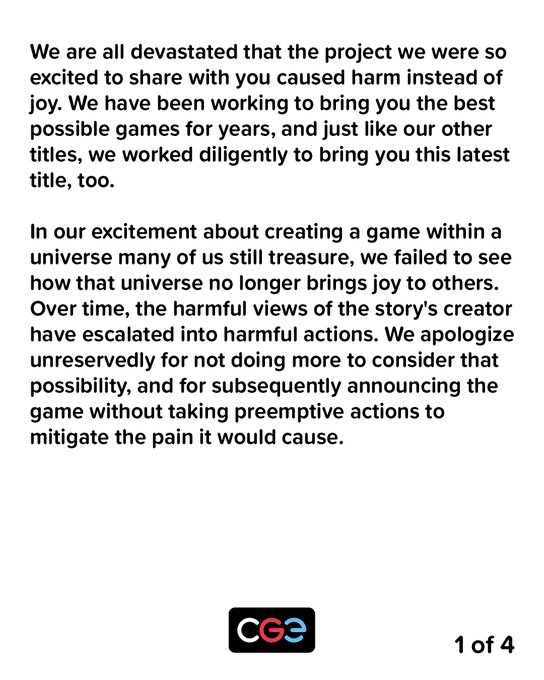
The gaming publisher announced the decision in a social media post issued on Friday. “We are all devastated that the project we were so excited to share with you caused harm instead of joy,” the August 8 statement reads. “Over time, the harmful views of the story’s creator have escalated into harmful actions. We apologize unreservedly for not doing more to consider that possibility, and for subsequently announcing the game without taking preemptive actions to mitigate the pain it would cause.”
Codenames is an award-winning word-based board game that has sold over 15 million units since its launch in 2015, per The Guardian. Czech Games Edition announced its first Harry Potter board game tie-in, Codenames: Harry Potter, in 2019, months before Rowling started making public anti-trans proclamations.
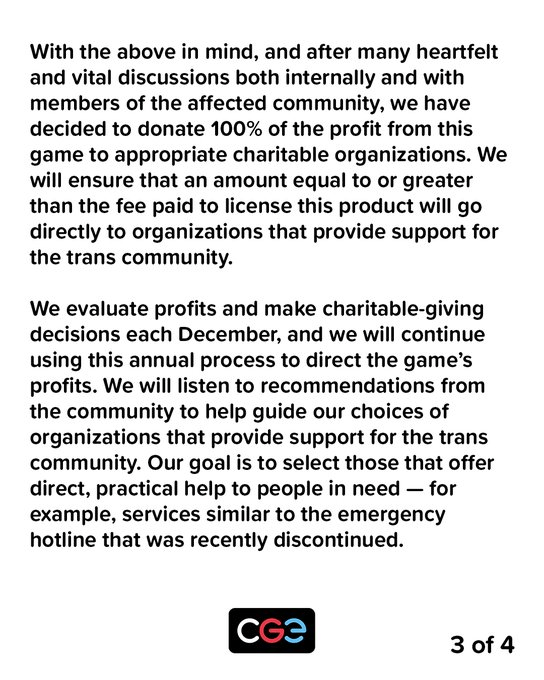
The company went on to say in its August 8 statement that it was “not prepared for the volume of the response” to Back to Hogwarts and that, aside from donating profits, it will ensure that “an amount equal to or greater than the fee paid to license this product” will go toward organizations that support the trans community. The company will determine which organizations receive the money based on community feedback, per the apology statement, prioritizing “those that offer direct, practical help to people in need.”
Czech Games Edition first announced Back to Hogwarts on July 23, per board game news website Wargamer. After two days of consumers pointing out the issues with licensing the J.K. Rowling-owned property, the company issued a statement saying that “we fully respect and understand those who do not wish to engage with this game,” and requesting an “ongoing conversation” characterized by “care, empathy and respect — both online and in person.”
On July 30, after continuing backlash, the company issued a follow-up statement saying that “our aim was never to cause harm,” and that it was working toward a “concrete solution” at the time.
Rowling’s anti-trans politics are well-known by now, as are her own monetary contributions to the movement, including her legal fund, which is hoping to push trans people out of public life. As Rowling’s views have grown louder and more vitriolic, actors attached to projects in the still-growing Harry Potter universe have made several statements condemning her views. One San Francisco bookstore has even announced that it would stop selling books about the Boy Wizard on its shelves, encouraging people who want to read them to seek out used copies instead.




Jacob OglesAugust 13, 20258min



 Scottie's Playtime