The FCC is seeking comment on whether the TV Parental Guidelines rating system needs to be changed to penalize shows for transgender or nonbinary content.
Today, FCC Chairman Brendan Carr announced that the FCC would be seeking comment on whether the TV Parental Guidelines rating system needs to be changed to address shows with transgender or nonbinary characters. The public notice, which Carr posted on twitter this morning, seeks to weaponize the TV ratings system to restrict shows that include such characters—asking whether programs that contain “the discussion or promotion of gender identity themes” should “be rated differently or contain relevant descriptions.” Though the FCC’s direct authority over the TV ratings system is limited—the system is voluntary and industry-run, and streaming platforms like Netflix and Disney+ can maintain their own standards—the FCC retains enormous coercive power over broadcast networks and their parent companies, many of which also operate streaming platforms. The move comes after a series of attacks on network television weaponizing the FCC for political purposes, including Carr’s threats to revoke broadcast licenses over news coverage of the Iran war and his targeting of ABC over late-night host Jimmy Kimmel. It appears to be an attempt to extend “Don’t Say Gay”-style policies—which have restricted discussion of LGBTQ+ people in classrooms across red states—to national television ratings.
“Years ago, Congress passed a law that empowers parents to decide the types of TV programs that are appropriate for their kids by standing up a TV show ratings system. But recently, parents have raised concerns with the industry’s approach—including with ratings creep. Specifically, they argue that New York & Hollywood programmers are promoting controversial issues in kids programming without providing any transparency or disclosures to parents. This undermines the whole point of the law and the ratings system parents rely on. The FCC is now seeking comment on whether the industry’s approach provides parents with the types of information and disclosures relevant to them today,” Carr wrote on twitter. However, the actual document posted alongside his statement tells a more specific story—it primarily centers on gender identity. (snip-MORE on the page)
This video explains what everyone on the real left already knew instead of forgetting the trans / woke culture wars and moving right, the center left keeps demanding which is simply code speak for leaning right. While all the same democratic strategists since the Bill Clinton days demand candidates move to the right to “triangulate” to capture republican voters these polls show what we already knew. The culture wars are losing for the republicans. After republicans spent nearly 3 million dollars in ads against trans people the polls showed almost no one felt those adverts influenced their vote. Even as red states rail against higher education, acceptance, and tolerance of people who are different it is losing them votes. Some thing the Christian nationalists who are in the height of their influence now in political circles don’t understand is that people who grew up with LGBTQ+ classmates, friends, and even dated some do not find them the evil that these hate religions preach they are.
*** Personal note. I explained to Ali in an email that I am not functioning. For what ever reason wheither it be anemia or something worse I am desperately tired from the time I manage to get up. I often get up only to a few hours later go back to bed for four or more hours. I have started taking vitamin B-12 and a woman’s one-a-day vitamin. That with more red meat which was recommended to me in the past every time I go into anemia. How ever I get up, I have coffee and stuff with Ron then I need to go back to bed for normally 4 hours, get up and do dishes while watching The Majority Report. How ever some days like yesterday I did not even get that far, going to back to bed by 2 pm only to have Ron wake me and beg me to eat.
I have done better today only going back to bed for 3 hours later in the morning. I wanted to go to bed two hours ago, but Ron was all upset he couldn’t sleep due to the neighbors having new skirting put around their home outside our bedroom. So I got him in his recliner and moved his CPAP out to his chair. Still he was not tracking. Good news as I was falling asleep at my desk he woke up and is fixing supper. At this point I am so tired I don’t really care whether I eat or not.
I tried to reply to comments, but I couldn’t. I even started to move old saved open tabs out by making a new cartoon / memes post but I simply couldn’t do it. Right now the best I can do to function is make doctors appointments and watch videos that don’t take too much thought to understand. That means most political videos are outside my ability. I am sorry but right now I am functioning at the level of a confused grandpa. Sorry. I hope to get better soon. Ron says if I don’t clear up by next week we will demand the primary care see me and deal with it. I’m not sure if I want that as my last visit he was insisting I think about getting a colonoscopy. Anyway. This is a good video and one I watched several hours ago when I was much sharper than I feel now. *** Hugs
stuff here on Playtime, day to day; lots of material from which to listen, choose, skim, read in full, watch. Today is Sunday. I frequently take the day to get my emails cleared and read the stuff I haven’t gotten to through the week. Sunday is the day a new Lit Hub email comes, and today I indulged myself by opening it before many other things, including last week’s Lit Hub. I did that because I admire Mae West; also I tend to use the F-word a lot inside my home and inside my head. Today’s Lit Hub covers each of these subjects along with its usual variety. If you likeand/or use the F-word, and/or are interested in the etymology of the F-word, you should read the Lit Hub story you can see by clicking this sentence. And now, here is the bit of info of interest about Mae West. We may all be aware that she was so much more than the caricature we tend to receive; she was an ally of LGBTQ+, a playwright, and more. This short bit has some links to her work. Enjoy!
Monstrosity Plucked From Garbage Can: On Mae West’s early career as a controversial playwright.
Mae West is an icon: literally, a representative symbol. In the popular imagination, Mae West stands in for a certain type of seduction—blonde, campy, one-liner-heavy. But though West is best known for her distinctive performances, she was also a controversial playwright; before West established the acting persona that would stick in the public’s minds for a century, she was offending critics and facing jail time for shows that she called “comedy-dramas of life,” illuminating elements of life yet to be popularized onstage.
West’s plays The Dragand The Pleasure Manbrought a type of communal gay camp onstage that at turns scandalized and excited a largely straight audience. And back in 1926, before Diamond Lil, her play-turned-movie about a good-natured prostitute, launched West to bona fide stardom, she wrote and performed another play—SEX—which would lay the groundwork for the plot of Diamond Lil but polarized audiences in a way Diamond Lil never did.
In SEX, West starred as a prostitute named Margy Lamont. The plot is winding, complicated, and not the point; viewer response was created by the first two acts, where the audience saw Margy working in a brothel and then in a nightclub. Critics were universally horrified by SEX. TheNew Yorker described the script as “street sweepings”; the New York Herald Tribune said that “never in a long experience of theatre-going have we met with a set of characters so depraved”; the slightly more provocative New York Daily Mirror titled their review “SEX an Offensive Play, Monstrosity Plucked From Garbage Can, Destined to Sewer.”
It wasn’t that there had never been sex or representations of sex workers on Broadway before; but critics found SEX reminiscent of burlesque (stigmatized at the time), as well as uncomfortably realistic in its treatment of sex work and class. As Marybeth Hamilton puts it in “SEX, The Drag, and 1920s Broadway,” “Margy was . . . an ill-paid sex-worker who traded her body on the streets. West made that fact unmistakable. As West embodied her, Margy was palpably from the lower orders . . . Margy is bitterly conscious of herself as a member of the oppressed class, and the grimness and harshness of her manner are reflected in the world she inhabits.” Imagine Mae West’s characteristic delivery without the irony: that was Margy Lamont. Understandably (though not correctly), people were scandalized.
As usually happens when people freak out about a piece of art, ticket sales went up. Then, on February 9, 1927, SEX was raided by the acting mayor, and West spent $14,000 to bail herself and her fellow actors out of jail. As she refused to shut down the show, West was sentenced to ten days in jail for “corrupting the morals of youth.” She was released two days early for good behavior, and the jail time essentially operated as a publicity stunt, launching her in the media as a “bad girl” of theater.
West capitalized on the publicity of SEX and took it as an opportunity to retool her persona, creating Diamond Lil. West plays a sex worker in Diamond Lil as well, but this time, it was funny. Lil was constantly making jokes, and West played her with a veil of irony, so an audience could interpret all of the raunchiness as satire. Plus, the specter of class was never mentioned, making it easier to swallow for middle-class audiences. West called Lil “a little spicy, but not too raw”; this was the beginning of the West performances we know today. I’m grateful for West’s fame, and her later work; but I’m glad we know what was lost in translation.
On Monday, the Montana Supreme Court issued a landmark 5-2 ruling declaring that “transgender discrimination is, by its very nature, sex discrimination,” and that transgender people constitute a suspect class under the state’s equal protection clause. The ruling in Kalarchik v. State of Montana blocks a definition-of-sex law and related state policies that stripped all legal recognition from transgender people and barred them from obtaining accurate birth certificates and driver’s licenses. The decision rests on Montana’s constitution, whose Equal Protection and Individual Dignity clause has been repeatedly interpreted to protect transgender people—and which the court made clear provides far greater protection than the federal constitution. Justices have now issued the clearest declaration ever that transgender people in the state will have enhanced protections of their rights, grounding the ruling in equal protection, sex discrimination, and privacy—principles with broad applicability in a state that has become a major battleground for anti-trans legislation and resistance to it. (snip-MORE)
Several justices seemed to support the families of trans youth on the question of whether to force Colorado Children’s Hospital to discontinue capitulating to the Trump administration.
On Tuesday, the Colorado Supreme Court heard oral arguments over whether Children’s Hospital Colorado can be forced to resume gender-affirming care for transgender youth. The hospital was one of roughly 40 across the country that capitulated to Trump administration threats and shuttered their trans youth care programs. However, the hospital’s position has grown increasingly untenable, as hospitals in states like Minnesota and California have begun reversing course and as the Trump administration has suffered mounting losses in federal courts—including an Oregon ruling that vacated the very declaration the hospital cited as justification for halting care. Hearing arguments on Tuesday, several justices appeared skeptical of the hospital’s rationale, questioning whether Colorado’s civil rights protections for transgender people—among the strongest in the nation—can simply be overridden by federal threats that do not constitute law. (snip-MORE)
They served their prison time. Then came deportation.
After being released from prison in 2022, he completed an 18-month job training program with the Los Angeles-based organization Homeboy Industries and began working as a cook for the group’s onsite cafe. He enrolled in two different community college programs to study business administration and culinary arts. He volunteered with groups to help other trans Latinx and formerly incarcerated people get back on their feet. By the time he reached the five-year anniversary of his release date, JJ hoped he would have saved enough to buy a house with his sister.
He also wanted to travel more, and last April, JJ went to Thailand with his mom, sister and a friend. It was his first time outside the United States since he and his parents entered the country without legal documentation when he was a toddler. They later obtained permanent resident status, and his sister was born in the United States.
“I always told myself, the moment I was able to come home, and if God permitted me to get my life together, that I would like to travel with my family,” JJ told The 19th. “Being able to give that to both my sister and my mom — even if I knew that this would be the end result, for me to get deported — I would do it all over again, just to see them happy.”
JJ, who asked for The 19th to withhold his last name for privacy, was not particularly concerned when returning to Los Angeles International Airport (LAX) and going through the standard post-flight motions. He waited in line for customs, showed his passport and green card, and got his fingerprints taken. But then, the customs officer made a phone call and escorted JJ away from his loved ones.
The weeks that followed felt like a different kind of prison: five days in LAX sleeping on the floor and living off of vending machine food, he said. Then it was five months in Eloy Detention Center in Arizona, where it came down to two options: JJ could do a “voluntary” departure to Mexico, or he could challenge his case in court and risk staying in the custody of Immigration and Customs Enforcement (ICE) indefinitely. The Department of Homeland Security did not respond to The 19th’s request for comment by the time of publication.
The choice was clear for JJ, he said, even if that meant returning to a country he hasn’t known since age 2. “I’ve been here since September, and I’m barely learning how to maneuver around. My Spanish is horrible,” he said recently from Mexico. “People notice that I’m not from here because of the way I speak.”
In the second Trump administration, people with JJ’s background — a formerly incarcerated trans immigrant — have three targets on their backs, and the power of the federal government aimed at them. Trump has repeatedly stated that ICE, under his administration, will detain and deport “the worst of the worst,” particularly people who have committed crimes. A combination of anti-trans, anti-immigrant and tough-on-crime messaging by the White House depicts a country under siege.
To carry out its mass deportation mission, the administration has ramped up partnerships with local law enforcement and correctional facilities that allow the federal government to take custody of people held in prisons who have already served their sentences. Even in states like California, which limit local law enforcement partnerships with ICE, federal law defines a broad list of criminal offenses that can make a noncitizen deportable, even if that person secured legal status like JJ.
The result is a system of “double punishment,” a prison-to-ICE pipeline that advocates told The 19th can be particularly detrimental for trans people.
We just see trauma compounded on trauma compounded on trauma.”Lynly Egyes
Trans migrants often face rejection from family, abuse, job insecurity or homelessness as a result of their identity, which increases their risk of criminalization, advocates say. In ICE custody, they may be denied health care access, face sexual violence and be deported to countries that are hostile to their identity. Even for those who attempt to rebuild their lives after serving prison terms, “ICE could use that years later to target them, pull them into immigration detention and have them deported,” said Lynly Egyes, the legal director at the Transgender Law Center.
“We just see trauma compounded on trauma compounded on trauma,” Egyes said. “When trans people are shuffled between systems such as prison into ICE custody, it completely strips them of any opportunity for freedom and connection with their loved ones and community.”
It took three attempts for Nataly Marinero to secure parole from the California Department of Corrections and Rehabilitation. It ultimately happened in 2023, and he was released after nearly 18 years of incarceration. The state’s parole approval rate was about 34 percent at the time.
During this process, the parole board assesses an incarcerated person’s behavior and activities while in custody and considers whether they will be a threat to the general public. The board considers a range of factors, including signs of remorse, past criminal history, age and plans for the future, according to the California department of corrections website. While in prison, Marinero took substance abuse courses, worked on getting his high school diploma, had a job as a clerk in the prison kitchen. He had not received a write up, an infraction in prison, in years, he said. Each of these factors help to build a stronger case for release.
Immediately after leaving prison, Marinero joined a reentry program in Los Angeles called A New Way of Life, where he received housing, a job and connections to other opportunities to help him transition to life outside.
Life felt good.
“Freedom — just to think about it makes me want to cry,” the 40-year-old told The 19th. “That’s the best thing that ever happened to me.”
Marinero, who came to the United States without authorization at 17, was aware that ICE had put a “hold” on him at the beginning of his incarceration more than a decade ago. ICE “holds” are requests asking jails or prisons to hold someone after incarceration so that they can be transferred to immigration custody.
“When you get to prison, your counselor would tell you when you have an ICE hold,” said Laura Hernandez, executive director of the California-based advocacy group Freedom for Immigrants.
“If you have an inkling that you may have an ICE hold, you tend to check every so often,” she added. “But sometimes ICE holds aren’t placed on anyone until right before they’re getting ready to be released. So people have to check like the entire time they’re inside.”
Whether the agency follows through on picking up immigrants with ICE holds on their accounts is largely a toss up. In Marinero’s case, he was allowed to be released from prison; he was allowed to join a reentry program and to live his life for two years without being arrested by ICE.
In January 2025, he received a call from a woman who said she was his parole officer. This struck Marinero as odd, because this was a different officer from the man he had previously spoken with. The woman demanded Marinero come to the front of his reentry home, he said. When he obeyed, ICE agents were waiting outside and took Marinero into custody.
His legal advocates at the California Coalition of Women Prisoners, who also serve trans people, moved quickly to assess whether Marinero could make an asylum claim as he was moved from an ICE holding facility to detention centers in California and Louisiana over the course of two months. Ultimately, his legal team was unable to file an asylum claim before his deportation. In April 2025, Marinero was placed in handcuffs and loaded onto a plane. He was back in El Salvador, a place he fled as a teenager and one of the most dangerous countries for trans people in Latin America.
Partnerships between federal immigration authorities, local law enforcement and state prisons have existed for three decades.
In 1996, fears about crime led to a wave of laws — including the 1994 crime bill — with more severe punishments and a historic expansion of law enforcement. President Bill Clinton signed into law two bills that created pathways to speed up the deportation of noncitizens with criminal records and broadened the list of crimes considered aggravated felonies. These crimes could range from murder and sexual assault to shoplifting and forgery. As a result, any noncitizens, including green card holders, with an aggravated felony record became eligible for deportation.
“It especially hit lawful permanent residents,” said Juliet Stumpf, the Edmund O. Belsheim professor of law chair at Lewis & Clark Law School, whose research centers on what’s referred to as “crimmigration.”
“We used to see lawful permanent residents as being able to remain in the country if they committed a crime,” she added. “But now, we’ve added a whole other level of penalty, for lawful permanent residents especially, because they’re the ones that are going to be most vulnerable to deportation based on those grounds.”
One of the 1996 laws also laid the groundwork for the 287(g) program, which can essentially turn local and state law enforcement into an arm of immigration enforcement. These 287(g) agreements fall into one of three categories, one being the “Jail Enforcement Model,” designed to identify noncitizens held in local jails or state prisons who can be transferred to immigration custody.
At the time of Trump’s first term, his administration ushered in a high — at that time — of about 150 active 287(g) agreements of all types. In the last 15 months, that figure has increased tenfold. As of April 10, ICE has signed 1,645 agreements across 39 states and two U.S. territories, according to data from the Department of Homeland Security. That dataset indicates that 10 percent of these agreements, 171 total, fall under the Jail Enforcement Model.
One contributor to this growth is likely financial incentives built into Trump’s expansive 2025 so-called One Big Beautiful tax bill, said Karen Pita Loor, director of the criminal law clinical program at Boston University.
“Historically, 287(g) agreements were not financially profitable for these counties, localities, whatever jurisdictions. They weren’t making them money,” Loor said. “The bill created really attractive financial incentives that make 287(g) agreements much more profitable.” These benefits to local law enforcement agencies can include salary reimbursements, $7,500 for equipment and $100,000 for new vehicles.
Some states, like California, where JJ and Marinero lived, have laws limiting collaborations between local and federal law enforcement. But even in those jurisdictions, the more forgiving immigration policies often do not extend to migrants with criminal records.
Prior to Trump’s return to office, JJ and Marinero, who served their prison time and were on a path to rehabilitation, might have gone unnoticed by ICE, advocates said.
Now, for Marinero, “I feel like going back to the same time when I was younger,” he said. “I can’t dress the way I want to dress. I can’t be who I want to be. It’s kind of killing my self-esteem.”
I just want to be free.”Nataly Marinero
Growing up in El Salvador, Marinero did not have a specific word to describe how he felt about his gender. He just knew that people called him a girl, but he felt like a boy and preferred loose fitting shirts and pants rather than dresses. Marinero’s religious family treated his self-expression like a curse that needed to be healed, he said. They told him he would go to hell if he didn’t change. People called him a “marimacha,” a slur for a lesbian or masculine girl. He was also repeatedly targeted for sexual violence.
“It was so bad that I wanted to try to kill myself so many times,” Marinero said. “I just want to be free.” When his uncle offered to connect him with a group who could get him into the United States, Marinero jumped at the chance.
Being back in El Salvador 23 years later, Marinero mostly works and stays at home. He doesn’t have friends, he said, though he recently found a boxing gym that is helping to relieve stress. In Mexico, JJ said he also keeps to himself and isn’t open with people about his trans identity. He said it helps that he “blends in” as a man and doesn’t get many questions or weird looks.
Next March will mark five years since JJ left prison. The five-year plan he mapped out for himself has changed quite a bit, but he hasn’t lost all hope.
“I feel like I just came out of being in prison all over again, and I have to start all over again,” he said. “Just getting back on my feet; that’s really my fifth-year goal now.”
I did some reviews on the Cass report because it was supported by so many anti-trans bigots. Turns out there were so many lies and errors in the report that it became clear the purpose was to discredit the clinic and get it shut down. The report was driven by anti-trans people and even Cass herself was well known to be anti-trans. But what is so irksome is the lies still get told and circulated repeatedly even when they are pointed out. The idea of social contagion was found to be entirely made up by people desperate to keep their child from transitioning. The idea came from a website set up for parents that had kids transitioning and they hated it. The Cass report used lies from that site as if they were medical facts saying that parents were not told and children were being rushed to transition, when even the parents admitted they had all the information in writing that they had to sign and the biggest complaint was how long it took to get seen by the clinic with many kids going through puberty before they got gender affirming care. The idea of large amounts of detransitioners is totally made up as real studies have found it is less than 2% and the regret levels are well below any other medical procedure. I wish haters and bigots would understand if they have to make up stuff and lie to prove their point then they have no point to make. They just hate the idea of people not accepting they are the gender / sex assigned at birth and don’t want to accept new medical data. Hugs
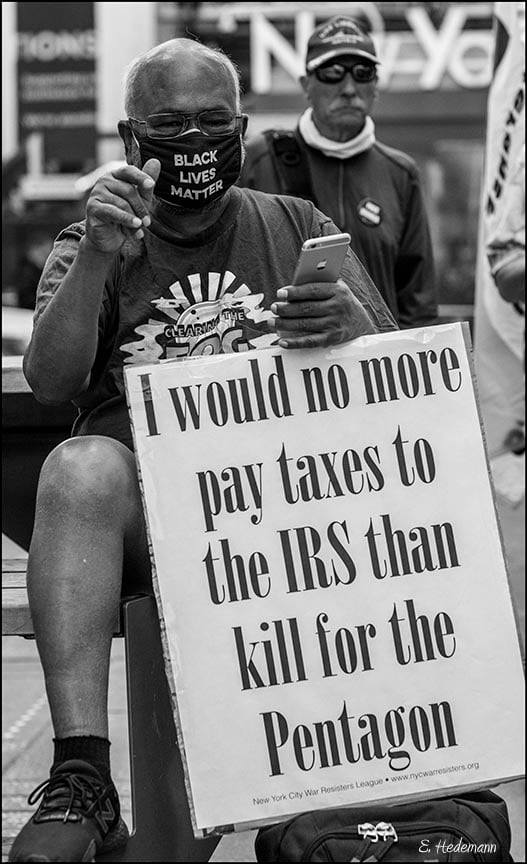
April, 16, 1971 The Internal Revenue Service (IRS) estimated over 2,000 people openly refused to pay part or all of their income tax. “If a thousand [people] were not to pay their tax bills this year, that would not be a violent and bloody measure, as it would be to pay them and enable the state to commit violence and shed innocent blood.” – Henry David Thoreau on the Mexican War
April 16, 2000 Between 10,000 and 20,000 activists blockaded meetings of the World Bank and International Monetary Fund in Washington, D.C. Sitting down at intersections and locking arms to form human chains, the protesters were opposed to Bank and IMF policies that increased third-world indebtedness and did little to directly benefit the poor in those countries. “The World Bank is subjugating our economic and social independence,” Vineeta Gupta, a doctor from the Punjab in India, said in a letter he delivered to World Bank President James Wolfensohn at his home. “It is time that we shut the bank down, and this boycott is a great start.”
More from National War Tax Resistance Coordinating Committee:
War tax resistance means refusing to pay some or all of the federal taxes that pay for war. While you can refuse income tax legally by lowering your taxable income, for many people war tax resistance involves civil disobedience.
In the U.S. war tax resisters refuse to pay some or all of their federal income tax and/or other taxes, like the federal excise tax on local telephone service. Income taxes and excise taxes are destined for the government’s general fund and about half of that money goes for military spending, including weapons of war and weapons of mass destruction.
People take many roads to war tax resistance. Most are motivated by a combination of reasons and actively work for peace in many other ways too. If you consider your motivations this will help you determine your method of resistance.
Refusing to pay federal income taxes is an act of civil disobedience with a long history in the U.S. America’s most well-known war tax resister was Henry David Thoreau, whose refusal to pay his poll tax because of the Mexican-American War earned him an night in jail and the experience that led him to write his influential essay, Civil Disobedience. While those of us who refuse to pay war taxes believe our refusal is just and imperative — and some of us cite international law to back up this belief — the government considers the refusal to pay these taxes to be illegal, and there are potential repercussions through the IRS collection system. For most of us who resist, the dire consequences of voluntarily paying for war are far worse that what the IRS and government can do to us. (snip-MORE)
April 17, 1959 22 were arrested in New York City for refusing to take shelter during a civil defense drill.
April 17, 1960 Inspired by the Greensboro sit-in of four black college students at an all-white lunch counter, nearly 150 black students from nine states formed the Student Nonviolent Coordinating Committee (SNCC). Meeting in Raleigh, North Carolina, with Ella Baker, James Lawson and Martin Luther King, Jr., the founders set SNCC’s initial goals as overturning segregation in the South. They also considered it important to give young blacks a stronger voice in the civil rights movement, as many had participated in sit-ins that had proliferated to dozens of cities over the previous three months. At the Raleigh conference Guy Carawan sang a new version of “We Shall Overcome,” an adaptation of an old labor song. This song would become the national anthem of the civil rights movement.People joined hands and gently swayed in time singing “black and white together,” repeating over and over, “Deep in my heart, I do believe, we shall overcome some day.” What SNCC did to make change happen
April 17, 1961 Cuban leader Fidel Castro during the Bay of Pigs invasion. An army of 1500 anti-Castro Cuban exiles, mercenaries equipped and trained at a secret Guatemala base by the CIA, landed at Bahia de Cochinos (Bay of Pigs) in an attempt to “liberate” Cuba from Communist rule. Within three days, the invasion proved disastrous with nearly 1200 members of Brigade 2506 (who had been trained in the U.S.) taken prisoner.
Known as Operation Zapata, it was conceived by Vice President Nixon, planned and approved by the Eisenhower administration, and executed shortly after President John Kennedy’s inauguration. President Kennedy receives the Brigade 2506 flag in Miami in 1962 and declares: “I promise to return this flag in a free Havana.”
Soviet General Secretary Nikita Kruschev sent a telegram to President Kennedy: “Mr. President, I send you this message in an hour of alarm, fraught with danger for the peace of the whole world. Armed aggression has begun against Cuba. It is a secret to no one that the armed bands invading this country were trained, equipped and armed in the United States of America. The planes which are bombing Cuban cities belong to the United States of America, the bombs they are dropping are being supplied by the American Government . . . .” What actually happened
April 17, 1965 The first national demonstration against the Vietnam War took place in the nation’s capital. Students for a Democratic Society (SDS), the organizers, had expected about 2000 marchers; the actual count was 15,000–25,000. This was the largest anti-war protest ever to have been held in Washington, D.C. up to that time. The number of marchers approximately equaled the number of U.S. soldiers in Vietnam. Several hundred students in the protest broke away from the main march and conducted a brief sit-in at the U.S. Capitol’s door. An exam prepared by SDS about the Vietnam War (answers available)
April 17, 1965 Gay rights advocate Jack Nichols The first demonstration promoting equal treatment of homosexuals, Jack Nichols, Barbara Gittings and others picketed in front of the White House. There were no media present. Read more (Go-it’s interesting!)
April 17, 1986 Reverend Jesse Jackson, future congresswoman Maxine Waters and others co-founded the Rainbow Coalition, initially intended as a progressive public-policy think tank within the Democratic Party.
Representative Maxine Waters, Harry Belafonte, John Sweeney, President of the AFL-CIO, Reverend Jesse Jackson, and Willie Nelson August 6, 2005-Atlanta, Georgia.
April 17, 1992 On Good Friday morning, about 50 people accompanied Fr. Carl Kabat and Carol Carson to Missile Silo Site N5 at Whiteman Air Force Base in Missouri, the same silo that Carl and other members of the Silo Pruning Hooks (see below) disarmed in 1984. They cut through a fence and, once inside, Carol used a sledgehammer on the concrete lid of the silo while Carl performed a rite of exorcism. Eventually, the police arrived and arrested Carl and Carol. They were jailed and held until their court appearance. At that time, they made a preliminary agreement with federal prosecutors wherein they would plead “no contest” to trespass in exchange for the property destruction charge being dropped; they were sentenced to six and three months, respectively, in a halfway house. Carl Kabat A History of Direct Disarmament Actions About the Silo Pruning Hooks action
This is what working for the people, working for the public means. This is what representing the will of the people / public looks like. This is what is attracting the people / public voters to the democrats, yet Chuck Schumer as yet to endorse Mamdani. Why? Because the two are the opposite sides of the political coin. One wants to serve and represent the people / public and the other is a corporate democrat beholden to big money donors and major lobbyist groups. Same with Hakeem Jerofies who only endorsed Mamdani when on election night it became clear he would be the winner. Hugs





 Carl Kabat
