Barbara Gittings was a lover of books. She realized, from a young age, that she also loved girls. So when, in 1949, she left Wilmington, Delaware to attend Northwestern University, she did what any bookish young lesbian would do: research homosexuality in the school’s library. What Gittings found was not comforting. The vast majority of sources were written by medical professionals and described homosexuality as an illness or a perversion. She became so consumed with spending time in various Chicago libraries that she neglected her coursework and flunked out of school. But as a result of the discouraging information she found, an activist was born. With passion, determination, and what she would come to refer to as “gay gumption,” Gittings would spend the rest of her life working, in various ways, to correct those lies she found in the pages of books and scientific journals on the library shelves.
Gittings moved to Philadelphia in 1950 and supported herself with part-time clerical work. She continued to read everything she could find on homosexuality and, as part of her search, discovered Donald Webster Cory’s The Homosexual in America: A Subjective Approach, originally published in 1951. Gittings was particularly impressed with Cory’s arguments that gays and lesbians constituted a large unrecognized minority who deserved civil rights and his attempts to cultivate empathy in his readers by outlining the difficulties faced by American homosexuals. She wrote to Cory’s publisher and discovered he lived in New York City. The two met on several occasions, and Cory informed Gittings of a newly-formed gay organization in Los Angeles: the Mattachine Society, founded in 1950 by Harry Hay.
In the summer of 1956, when she was on vacation from her office job, Gittings boarded a plane to Los Angeles and visited the office of ONE, Inc., a homophile organization who had amicably split from the Mattachine Society in 1952. The members of ONE, Inc. informed her of the existence of a San Francisco-based organization for lesbians, the Daughters of Bilitis (DOB), founded in 1955 by lesbian partners Del Martin and Phyllis Lyon.
Gittings once again boarded a plane, this time bound for San Francisco. The DOB were, fatefully, having a meeting that very evening in a member’s apartment. The meeting was the first time in her life Gittings would interact with a group of lesbians outside of a bar setting. Two years later, in 1958, Gittings officially joined the DOB and was tapped by Martin and Lyon to start an East Coast chapter of the organization based in New York City. With her co-founder, Marion Glass, Gittings built the chapter into the largest in the country.
In 1963, Gittings, whose enthusiasm and knowledge of literature left an impression on Martin and Lyon, was tapped to be the editor of The Ladder, the DOB’s national magazine for gay women. Gittings transformed The Ladder from what was essentially a newsletter to a national magazine respected within gay circles. With the help of her partner, Kay “Tobin” Lahusen, whom she met in 1961 at a DOB picnic in Rhode Island, Gittings replaced the amateurish illustrations that typically adorned the cover of The Ladder with photographs taken by Lahusen of actual lesbians who appeared confident and happy.
Gittings began to take The Ladder in an increasingly militant direction, reporting on protests, questioning the merits of various activist strategies such as picketing, and engaging in debates with so-called “experts,” arguing that homosexuality was a social and cultural problem, not a psychological problem. The activist bent of The Ladder under Gittings’ editorship alarmed the West Coast leadership of the DOB. When Gittings, amidst her many activities on behalf of gay rights, was late with the August 1966 issue, Martin and Lyon used her tardiness as an excuse to oust her as editor.
Gittings would also find a kindred spirit in Frank Kameny, who she credited as the first person to articulate a fully coherent philosophy of gay rights. She and Lahusen partnered with Mattachine Washington, of which Kameny was a co-founder, working alongside other lesbians and gay men to directly challenge the federal government. Gittings participated in the first picket of the White House for homosexual rights on April 17th of 1965.
Gittings worked with Kameny and other activists to lobby the American Psychiatric Association (APA) to remove homosexuality as a diagnostic category from the Diagnostic and Statistical Manual (DSM). At the APA’s 1972 conference, held in Dallas, Texas, Gittings, Kameny, and Lahusen created a display entitled “Gay, Proud, and Healthy: The Homosexual Community Speaks.” The exhibit, which featured photographs of gay couples taken by Lahusen, was adorned with the word “LOVE” in bold letters and portrayed gay people as healthy and happy, not as patients who were tormented and in need of a cure. In December of 1973, the APA board of trustees voted to pass a resolution to remove homosexuality from the DSM, effectively declassifying it as a mental illness.
Gittings was a lifelong bibliophile, and though she recognized the importance of taking on the federal government and institutions such as the APA, she never lost sight of the “lies in the libraries” she discovered as a college freshman and the importance of gay representation. In 1970, she joined the American Library Association’s (ALA) newly-formed Task Force on Gay Liberation (TFGL). The TFGL, whose mission was to provide support for gay librarians within the profession and increase gay representation in libraries, was glad to have a veteran activist like Gittings join their ranks.
With the help of Israel Fishman, the first coordinator of the TFGL, Gittings organized a gay kissing booth — titled “Hug-a-Homosexual: Free Kisses” — for the 1971 ALA conference in Dallas, Texas. While the group could have created a nice display featuring gay books, periodicals, and their bibliography, they instead decided to make their presence known by showing gay love live. The publicity was better than Gittings and the TFGL could have imagined, and continued to spark discussions within the ALA over the next year.
In 1999, in honor of her contributions to create more visibility for gays and lesbians in libraries and in the profession, Gittings was awarded a lifetime membership at the annual ALA conference, held that year in New Orleans, Louisiana. The ALA also named an award after Gittings as part of their Stonewall Book Awards, sponsored by the Gay, Lesbian, Bisexual, and Transgender Round Table (GLBTRT), the contemporary iteration of the TFGL. The Stonewall Book Award-Barbara Gittings Literature Award is given annually for works of fiction that exhibit “exceptional merit relating to the LGBT experience.”
Barbara Gittings died on February 18th, 2007 at the age of 74 after a long battle with breast cancer. In a 1999 interview with American Libraries magazine, she summarized her career as a gay activist with the wit and wisdom she was known for:
“As a teenager, I had to struggle alone to learn about myself and what it meant to be gay. Now for 48 years I’ve had the satisfaction of working with other gay people all across the country to get the bigots off our backs, to oil the closet door hinges, to change prejudiced hearts and minds, and to show that gay love is good for us and for the rest of the world too. It’s hard work — but it’s vital, and it’s gratifying, and it’s often fun!”
September 7, 1948 3,000 attended a rally to publicly launch the Peace Council in Melbourne, Australia.
September 7, 1957 Barbara Gittings leading a picket in the ’60s Barbara Gittings organized the first New York meeting held for the Daughters of Bilitis, a pioneer lesbian organization. The group was founded two years earlier in San Francisco. Barbara Gittings: Mother of the Gay Rights Movement (This link requires a sign-in on Medium, so I’m going to post it in another entry on its own.)
Cover from their magazine “The Ladder”, October,1968
September 7, 1990 Two British peace activists, Stephen Hancock and Mike Hutchinson known as the Upper Heyford Plowshares were sentenced to 15 months in prison for disabling an F-111 bomber in Oxford, England. A brief History of Direct Disarmament Actions
September 7, 1992 South African troops killed at least 24 people and injured 150 more at an African National Congress (ANC) rally on the border of Ciskei, in South Africa. 50,000 ANC supporters had turned out to demand Ciskei’s re-absorption into South Africa. Ciskei was one of ten black “homelands,” so designated to keep blacks from claiming citizenship in South Africa itself. They were a legal fiction, not recognized by any other country, that was part of the racially separatist apartheid regime. News at the time BBC
September 7, 1996 Two women were arrested for trespass at the Norfolk (Virginia) Naval Base after walking into the base with a banner reading, “Love Your Enemies.”
This man understands, this person gets it! Those of us not center, those of us not maga, those of us paying attention to what is happening and see what red states are doing to the LGBTQ+ and how hard they are trying to keep anyone not fully supporting them from voting … Yes we are scared. We feel all the movement to the future acceptance of people who are different from the main stream, all the rights for black people, all the rights for minorities, all the rights for the disabled, all the rights for the poor, and all the rights that have been gained for the LGBTQ+ are being wiped away with the goal being removing us from public society so that we have no voice in the very country we live. Welcome to the 1950s white cis straight men in charge society. Hugs. Scottie
This is what the fundamentalist religious / maga right want to do in the US notice the reason why they feel they need to pass this law. Because it is changing tradition. Tradition is peer pressure from dead people. The right wing straight cis people like the way things are and don’t want to include other ideas or ways. Just a warning. Hugs. Scottie
The legislation would ban LGBTQ+ rights on multiple fronts, including adoption, marriage, and civil IDs.
TBILISI, GEORGIA – MAY 17, 2018: Family day. People attend a rally marking the Day of Family Purity and opposing the International Day Against Homophobia and TransphobiaPhoto: Shutterstock
Georgia’s parliament on Thursday pushed ahead a sweeping package of bills that would effectively outlaw LGBTQ+ identity in the former Soviet republic.
The set of bills proposed by the ruling pro-Putin Georgian Dream party bans depictions of same-sex relationships in the media, outlaws gender-affirming surgery, and will make Pride events and the public display of the Pride flag in Georgia a thing of the past.
Parliamentary speaker Shalva Papuashvili describes the bills as necessary to control “LGBT propaganda,” which he said was “altering traditional relations.”
The first reading of the bill titled “On the Protection of Family Values and Minors,” which draws heavily from Russia’s anti-LGBTQ+ “propaganda” law passed last year, drew widespread support among Georgia Parliament deputies. The bill is scheduled for second and third readings in the fall.
In addition to outlawing public gatherings “promoting” same-sex relationships, the legislation would also limit adoption to heterosexuals, ban gender changes on official identification, and outlaw “LGBT propaganda” in education.
Georgian Dream MPs have also proposed introducing “genetic” requirements in establishing legal marriage, whereby marriage would be a union of a “genetic woman” and a “genetic man.”
The Constitution already bans same-sex marriage in Georgia, where the deeply conservative Orthodox Church holds outsized influence in the government and public sphere.
Georgia enjoyed decades of progress on human and LGBTQ+ rights following the Rose Revolution in 2003, as a majority of citizens supported a pro-Western turn and integration into the European Union and NATO.
The rise of the Georgian Dream party in the last ten years, however, has seen the government reorienting toward Russia, with the Church encouraging the rapprochement.
Georgia’s version of Putin’s draconian “LGBT propaganda” law seems designed not only to roll back progress on LGBTQ+ rights but to scuttle any hope of Georgia entering the European Union, with its strict requirements upholding civil liberties and personal freedoms.
The introduction of the anti-LGBTQ+ legislation follows the Georgia Parliament’s passage of another Russian-inspired law to label Western NGOs “foreign agents,” teeing up a harassment campaign aimed at expelling human rights and other groups that far-right conservatives and the Orthodox Church have accused of infecting Georgia and other countries with “degeneracy.”
Speaking of opponents of the nascent legislation in March, Mamuka Mdinaradze, leader of the Georgian Dream parliamentary majority, said, “Even if they brand the law against LGBT ‘propaganda’ not Russian, but Soviet, we will follow it through, given that it is the biggest challenge of modern times.”
Anti-LGBTQ+ sentiment runs high among extremists in the onetime Soviet vassal. In 2021 and 2023, violent mobs shut down Pride marches in the capital Tbilisi.
Organizers say foreign agents, delivered by Russian President Vladimir Putin, joined far-right fascist political gangs and members of the Georgian Orthodox church to sabotage the peaceful demonstration. Hundreds were injured in the two incidents.
Rights groups and supporters described the attacks as “pogroms.”
From David Beckham’s poreless skin to the tastes of Queer Eye’s original Fab Five, metrosexuality marked an essential step toward a more open masculinity.
(This came from a magazine Janet linked a few days ago. I’m sitting and reading around in it today, and this struck me, especially in light of certain dark comments made over the past few years by the Republican VP nom. So I’m posting for juju. Or mojo. Mostly humorous spite, on my part. NVM me and enjoy the story.)
2004 Was So Gay is Them’s look back at a pivotal year for queer history and pop culture. Read more from the series here.
“Precise, smooth, and powerful:” the sexual energy rippling through Gillette’s 2004 ad campaign nearly leaps from the page — not because razors were suddenly sexy, but because its star, David Beckham, was known at the time as “the biggest metrosexual in Britain.” With a freshly shaved head, glistening muscles, and a green-tipped razor in hand, the image cemented what the world already knew, by way of a £40 million global ad campaign. This British soccer star — this man who wore pink nail polish and, occasionally, his wife’s panties — was seen as the peak of masculinity that year, and nobody else came close. As Gillette’s tagline went, Beckham was “the best a man can get.”
Beckham may have been the gold standard for The Metrosexual, a “type” of man that entered the popular consciousness in the mid-2000s, but really the inspiration for the movement looked more like Stefon from Saturday Night Live. The character, played by Bill Hader, stopped by Weekend Update with highlights in his side-swept hair and Ed Hardy’s rhinestone regalia covering his body to let viewers in on the hottest new spots in nightlife. Stefon’s outfits were modeled after 2000s nightlife looks, a fitting visual metaphor for the chaotic, homoerotic overtones of the early 2000s.
Much like the fictitious clubs Stefon gushed over, metrosexuality had everything. There were the menswear bibles you had to subscribe to (Details, Esquire, and GQ); must-have fashion labels (from Paul Smith and Hugo Boss to Dolce & Gabbana); and, of course, grooming brands like Axe body spray, which launched in the U.S. in 2002. On TV, the metrosexual movement was dominated by the likes of Queer Eye’s “Fab Five,” who burst into straight men’s homes like a glitterati SWAT team, and by Stacy London and Clinton Kelly on What Not to Wear, the more composed (but equally bitchy) spiritual sister in the makeover reality show genre.
Men had been Yassified, remade in His image; “His” being, if it weren’t clear by now, a fashion-conscious, grooming-obsessed gay man. Yes, the homoerotic undertones of metrosexuality weren’t exactly subtle, but it was the 2000s, damnit, and men were allowed to be a little fruity and high maintenance as a treat. For those caught in the metrosexualmania, the fad might’ve felt like a flash of lightning: suddenly there, lighting up every follicle and pore. Google search results for the phrase exploded from 25,000 in mid-2002 to nearly a million by the end of 2005. But the term had roots far beyond its early 2000s heyday, first entering the cultural lexicon via the self-proclaimed “daddy” of metrosexuality, Mark Simpson, and his seminal 1994 essay, “Here Come the Mirror Men: Why the Future is Metrosexual.”
Written as a taxonomy on fascinating, capitalist animals who’d just discovered oil-free moisturizer and form-fitting pants, Simpson’s essay announced the arrival of the “[m]etrosexual man, the single young man with a high disposable income, living or working in the city (because that’s where all the best shops are), is perhaps the most promising consumer market of the decade […] he’s everywhere, and he’s going shopping.” Or put more succinctly: “Metrosexual man is a commodity fetishist: a collector of fantasies about the male sold to him by advertising.”
The notion that you should spend more time and money on clothes, grooming, and fitness wasn’t exactly reinventing the wheel. What made metrosexuality unique wasn’t its deep roots in capitalism, but rather its flirtation with queering masculinity in a way that felt fundamentally new. This was a tectonic vibe shift that democratized desire, cracking open the door for straight men to edge into femininity. Metrosexuality’s origin was also fundamentally shaped by the HIV pandemic, which spawned its own obsession with self-image. LGBTQ+ people — and particularly gay men — idolized gym-hardened bodies and obsessed over looking affluent and “healthy.”
The rise of the “metrosexual” may have been a straight thing, but the through lines of these two movements ran concurrently, separated more by who you wanted to sleep with and less by what designer brand you went shopping for. We may feel trapped today in a timeline that’s more metro than ever, but the newness and, frankly, the edginess of metrosexuality 20 years ago was historic — especially as it grew from that tiny 1994-era seedling into a blossoming flower.
Like Simpson’s read of heterosexuality in 90s menswear magazines being “so self-conscious, so studied, that it’s actually rather camp,” it was the self-serious, studied, and camp character of Patrick Bateman in 2000’s American Psycho that finally put the nail in the coffin of the 1990s’ dominant, grungy aesthetic. The film about full-time Wall Street hotshot and part-time murderer, played perfectly by a svelte and smug Christian Bale, rewrote the codes of the New Man for a new decade within its first 10 minutes. In an opening monologue that feels created in a lab for future metrosexuals to studiously replicate, Bateman walks through a morning routine that includes ice-pack facials, a thousand stomach crunches, deep pore cleanser lotion, water-activated gel cleanser, honey almond body scrub, exfoliating gel scrub, herb-mint facial masque (leave on for 10 minutes), moisturizer, anti-aging eye balm, and aftershave lotion with no alcohol (“because alcohol dries your face out and makes you look older.”) By the time the film shows him studying himself in a mirror, flexing his muscles as he mindlessly fucks a woman, the codes of this new kind of man were crystallized.
By 2004, “metrosexual” had been crowned “Word of the Year” by the American Dialect Society. Naturally, culture was flooded with glistening bodies, clouds of cologne, hardened hair gel, and at least five pairs of queer eyes regularly dissecting and rebuilding straight guys. These habits and inclinations toward presenting health and wealth have hardened with the passing of time, like a particularly sculpted torso. To put this in more Shakespearean terms: Metrosexuality by any other name (say, a looksmaxxing alpha male, or muscle gay) smells just as strongly of whatever scent we’re being marketed that day. Just like in 2004, turn on the TV or open a fashion publication’s homepage, and you’ll be knocked on your ass by capitalism’s consumptive frenzy; the major difference now is the somehow more relentless push to sculpt, shop and spend, driven into hyperdrive by our social media feeds. No matter if you’re gay, straight, femme, or them, we’re bombarded by messaging that tells us to work out, dress better, and start an 84-step skincare routine. My algorithm seems to hit me with a barrage of perfectly toned, sexually ambiguous guys every time I doomscroll.
It doesn’t take an armchair anthropologist to tell you that every trend, no matter how culturally ingrained it seems, will fade out over time. See “demure,”“Brat,” and whatever microtrend TikTok’s algorithms push today. As culture shifted and economics crashed, so did the desire to spend exorbitantly on grooming. The word “metrosexual” now feels as dated as Carson Kressley and the other original Fab Five members I simply cannot remember, but its cultural impact has lived on; every subsequent movement owes a debt to the metrosexual — from hipsters and their gallons of beard oil all the way to streetwear bros with sneaker collections rivaling even Carrie Bradshaw.
Metrosexuality’s chokehold on the 2000s taught men to be more comfortable in their femininity, but in the 20 years that have passed, our cultural understanding of manhood has splintered. There is the darker side, filtering metrosexuality’s obsessive grooming into a toxic, warped worldview dominated by obsessively coiffed, overly buff, and deeply insecure influencers. This is the side where young men are breaking their legs to be taller and smashing their jaws to be more “alpha.”
But luckily, it’s not all broken bones and toxic trauma. There’s a more healthy, nuanced exploration of modern masculinity that leans into the queerer side of our metrosexual forefathers. One that has allowed rockstars like Harry Styles to grace magazine covers in womenswear, release a gender-neutral beauty brand (Pleasing), and say, “I think there’s so much masculinity in being vulnerable and allowing yourself to be feminine” in a 2018 interview with fellow softboy Timothée Chalamet. You can see it during a night out as you spot straight men with painted nails and crop tops dancing with their girlfriends. You can see it in the celebrity role models of Steve Lacy, Paul Mescal, and Josh O’Connor — the latter helping launch both the “rat boy” and “fruity boy” micro-trends. This particular flavor of New Man is united in an embrace of and comfort with the duality of their feminine and masculine sides — and, notably, not separated by sexuality. Omar Apollo, Steve Lacy, Frank Ocean, and Tyler, the Creator meld effortlessly with the likes of Jaden Smith and the airbrushed perfection of K-pop supergroup BTS.
It has been thirty years since the “metrosexual” emerged and twenty years since its cultural reign. As we continue to navigate this modern era, redefining what it means to be a man, we’d do well to remember just how many boundaries metrosexuality broke down. Sure, it may be responsible for the poisonous clouds of Axe body spray we endured and ushered in a new era of hyper-commodification, but it also brought newfound sexual confidence and liberation to masculinity that taught us that it’s okay to be a little gay. Had it not been for our metrosexual forefathers (and the queers that guided them), who knows what rigid sartorial hellscape we’d all be living in today.
In Kansas, lawyers for the American Civil Liberties Union have drafted a letter reminding election workers that a gender marker on a person’s identification does not need to match or correspond to a voter’s gender expression. Staff for the organization have also held clinics elsewhere to prepare trans Americans for the identification requirements they will have to navigate.
In eight battleground states, the nonprofit VoteRiders is on the ground helping voters get the identification they need to cast ballots in the November election — and one that reflects who they are.
Equality Florida, the state’s leading LGBTQ+ advocacy group, is holding “know your rights” trainings in the wake of new regulations barring many transgender voters from obtaining photo identification that reflects their gender.
As Republican politicians push anti-transgender rhetoric ahead of a historic election, transgender and nonbinary Americans are facing new laws and rules that effectively prohibit them and others from obtaining documentation like birth certificates and driver’s licenses that align with their gender identities.
Advocates are fighting back. They’ve been mobilizing communities and organizing resources to help transgender Americans, an effort aimed at safeguarding their civic rights. Some trans voters have expressed confusion and fear of discrimination at the ballot box that could discourage them from participating in public life.
“There is a chilling effect,” said Lauren Kunis, CEO and executive director of VoteRiders, which helps voters obtain identification. “There is an unsafe and intimidating environment around existing as trans in society, and definitely in being able to go to the polls safely and cast a ballot.”
The ripple effect could extend beyond trans people, these advocates warn. Regulations around gender impact cisgender people, particularly women and women of color. America’s decentralized elections system relies on a temporary workforce tasked with enforcing varying policies around identification rules. In states that require voters to “reasonably resemble” the picture on their ID, like North Carolina and Wisconsin, the results could ensnare anyone at the ballot box who doesn’t fit the binary concept of masculinity and femininity traits.
“A lot is falling on poll workers to correctly enforce the law,” Kunis added. “And I would argue that is less of a solid protection in states where anti-trans rhetoric is skyrocketing.”
The measures often focus on sex classification that narrowly defines an individual’s sex as either male or female at birth. They’re among a broad scope of anti-trans legislation that have popped up in Republican-led statehouses in recent years and served as breeding ground for the binary vision of the country embraced by former President Donald Trump and U.S. Sen. JD Vance, his running mate on the Republican ticket. At least nine states in the past two years have explicitly regulated gender in this way, according to a tally by the Movement Advancement Project (MAP), which tracks LGBTQ+ policy.
Anti-transgender rhetoric was front and center at the Republican National Convention in July, and Trump has taken to verbally targeting transgender people in his campaign. He described Democratic vice presidential nominee Tim Walz recently as “very heavy into the transgender world.”
The verbal attacks are against a group that is highly invested in electoral politics. An analysis released in August of respondents to the 2022 U.S. Transgender Survey, widely seen as the most comprehensive study of binary and nonbinary transgender Americans, found that voting-eligible trans people had cast ballots in the last presidential election at a higher rate than the U.S. population. The study included more than 92,000 respondents, including more than 84,000 adults who were 18 and older.
“Trans votes count,” said Ankit Rastogi, director of research for the National Center for Transgender Equality, which conducted the survey and will soon be known as Advocates for Trans Equality Education Fund. “I think the big takeaway is that our community is really trying to come out and make a difference through the democratic process.”
The new laws and rules around sex classification vary widely. Those that intentionally target government identification that people use in everyday life, like driver’s licenses, are particularly challenging. Forcing a person to show identification that does not align with their gender identity could out them to people in their community, as Lucas Cameron-Vaughn, an attorney for the ACLU of Tennessee, explained.
“Trans people, just like everyone else, want to be able to travel, start new jobs, open bank accounts, enroll in school, vote — all of those things require some form of ID. And so when a state goes out of its way to enforce its message about its belief about sex and gender on a license, and transgender people then have to publicize that when they show other people, it creates a dangerous environment,” he said.
Last year, Tennessee Gov. Bill Lee, a Republican, signed a bill into law that defines sex as “determined by anatomy and genetics existing at the time of birth.” The state’s Department of Safety and Homeland Security then created a rule banning transgender people from changing gender markers on their driver’s licenses. The ACLU sued the agency for discrimination, claiming the rule was adopted illegally because it didn’t follow proper administrative procedure.
“It’s a tactic that’s designed to splinter support for trans rights and suggest sort of who is harmed by protecting trans people — to frame that as cisgender women being the people harmed by protections for trans people,” said Rose Saxe, who is deputy project director for the ACLU’s LGBT & HIV Project.
Nearly 21 million voting-eligible U.S. citizens do not have a current driver’s license, according to the Center for Democracy and Civic Engagement at the University of Maryland, whose research was partially supported by VoteRiders. Black and Hispanic people are among those most likely not to have a current license, so the requirement harms them too, regardless of their gender identity.
In the 2024 election, 38 states will require voters to show some form of identification at the polls, including 17 states that have new or stricter ID laws passed since 2020.
The full impact of these laws amid new and evolving voter identification laws is not yet clear, in part because of how recent they are — and that, experts say, could mask their harm. The Williams Institute at the University of California, Los Angeles School of Law, estimated ahead of the 2022 midterm election that more than 200,000 voting-eligible transgender Americans may find it difficult to vote at the time because of voter ID laws.
But these don’t just affect transgender people. In many red states, Republican-led attacks on transgender people are going hand-in-hand with new identification requirements and other laws that pose barriers to the ballot that reach beyond gender lines.
“The states with the anti-trans laws are also the ones that are more likely to be passing anti-voter laws, full stop,” Kunis said.
In Florida, which has emerged as a national epicenter of policies targeting LGBTQ+ people in recent years, the state’s Department of Highway Safety and Motor Vehicles issued a new regulation barring residents from updating their gender identity on their drivers’ license.
To Quinn Diaz, a public policy associate at advocacy group Equality Florida, the failure of most anti-LGBTQ+ bills introduced in this year’s legislative session showed that the tide in Florida is turning. But the new gender marker regulation signals yet another way that state agencies in Florida have overstepped their bounds and been “weaponized” to target transgender Floridians, they argued.
“We saw it as a move to inflict maximum chaos and misunderstanding,” Diaz said. “And really to scare trans folks from even participating and getting the license if they needed to update it.”
For transgender people, lacking identification that reflects their gender identity and appearance can make them vulnerable to discrimination in everyday situations at a bar or liquor store, for example, and in interactions with law enforcement and at the polls.
“With these laws in Florida, you’re forced to choose between living authentically and just not really participating in public life,” Diaz said.
Diaz, who is transgender, moved to Florida from Massachusetts, where they had an “X” gender marker on their driver’s license. Because they didn’t have all the necessary documentation and weren’t established yet with a local provider when they transferred their license to Florida, they forfeited that marker and defaulted to a license with their sex assigned at birth.
Diaz said they didn’t have any problems voting in person in the 2022 midterms, but they plan to vote by mail this November.
“I can imagine that a lot of trans folks in Florida who might not have access … to an accurate and affirming ID might not want to engage in that process at all, especially in such a heightened political environment,” Diaz said.
Such rhetoric could also be most dangerous in states where far-right groups are trying to recruit poll watchers. Since 2020, many Republican-controlled states have passed laws expanding the authority of those temporary election observers who work elections under certain rules and may feel compelled to stop someone from voting under the guise of stopping widespread election fraud, which has been repeatedly debunked.
“Gender nonconforming people are already under such public scrutiny nationwide,” Diaz said. “That’s when you’re gonna see the convergence of those two elements. It really seems like it would only result in more discrimination, more discomfort for trans people, more interrogation and potentially just being turned away.”
Hazel Krebs, a 42-year-old transgender woman living in Kansas, one of the states with a new anti-trans law, felt the weight of that increased scrutiny as she cast her ballot in March. Krebs wondered whether her identification — one that for weeks no longer reflected her gender identity — might impact her ability to vote.
She chatted with the election workers in the mostly empty precinct, then showed her ID. She did her homework, learned that gender is not required information to vote and showed up ready to explain it.
But no one questioned her. Krebs voted and was out of the polling site within minutes. Still, she worries that, under the same circumstances, another trans person might have stayed home.
“They won’t stop me, but I can see how it would stop others,” she said. “It is almost certainly stopping some people from showing up at the polls.”
The ACLU, which is tracking some of these laws and rules, has tried to prepare election workers on how to process trans voters who come into their polling sites. VoteRiders is conducting year-round voter education. While the driver’s license is the most ubiquitous form of identification in the United States’ car-centric society, Kunis wants to dispel the “common misconception” that it’s the only form of ID people can use to vote.
Trans voters can obtain a U.S. passport or passport card that reflects their gender identity without needing to provide underlying documentation. However, that option may not be accessible to people who struggle to pay the related fees or may not have the time or knowledge required to fill out the forms and request the passport.
It’s also a temporary solution if a future presidential administration rescinds the ability for people to self-attest their gender on their passports. Some advocacy groups and lawmakers in Florida also argue the state’s new regulations conflict with the federal Real ID Act, but that question is unlikely to be resolved before November.
In addition to using passports as identification, Diaz said that Florida voters have the option to vote by mail, vote early in person and bring a friend or family member to the polls.
“Our ability to participate in this democracy in Florida, it’s been on the line for a while,” Diaz said. Transgender people, they said, are being “forced to choose between participating in our greatest civic right or just sitting out because the state doesn’t see us for who we are.”
It’s still unclear how many trans people will be denied affirming identification — and how many will choose not to vote — as a result of these new regulations. Several of the new laws are written with no clear penalties.
“Something that’s very frustrating for us at VoteRiders is you will never be able to capture the number of people who do not feel safe voting, and who therefore stay home. And you also won’t be able to capture the people who are trans and show up to try and vote and are turned away.” Kunis said. “And we know that is happening, but it is difficult to quantify.”
Cameron-Vaughn said he also worries about a scenario where a trans person is stopped at a polling place because of mismatching information on their identification and must fill out a provisional ballot — a voting option that often requires a person to return at a later date with more documentation to ensure their vote is counted.
“There are definitely the physical dangers, the dangers for harassment, discrimination — but also ultimately, voter suppression,” he said.
Josie Caballero, director of voting and elections for the group that conducted the 2022 U.S. Transgender Survey, said it’s important to remember that barriers to voting existed for trans people before the latest slate of laws and rules targeting sex classification, particularly around voter ID rules. Trans people turned out to vote despite those policy roadblocks.
“It really shows the resiliency of the trans community to ensure that our voices are heard and we have visibility at the ballot box,” she said.
Krebs, who plans to vote in November, is worried about how the dynamics of a crowded polling site might impact her ability to vote. But she is determined to access the ballot, and to stay in Kansas despite the heightened scrutiny.
“There’s nothing these laws will do to stop me from living my best life,” she said. “It just puts my energy and passion towards making this place better for me and other trans people.”
A few months ago, Substack generously invited thirty or so of their writers to NYC for the opportunity to create some ads for our blogs. I really didn’t know what to expect, but the experience itself with Cash Studios (cashstudios.co) was delightful.
For about an hour, I worked with the staff in their studio on various ideas they had, all of which I found interesting. Moreover, I was quite impressed with their creativity and professionalism. They were kind, curious about my work, and really wanted to bring out my authenticity.
A few days ago, the ads were sent out to all of us, and I was quite blown away by the care and thoughtfulness put into creating them. I feel that Cash Studios did an exceptional job in capturing what I try to do with Charlotte’s Web Thoughts, and I’m thankful to the folks at Substack for this level of investment in my work.
They cut four ads, and I want to share them with all my subscribers, with a humble request: if you have friends, family, colleagues, or whomever you think might connect with my writing, send them one of these ads. Tell them that it’s free to subscribe to the blog, that all they need is an email, and that I don’t spam.
After a court ruling from the 11th Circuit Court of Appeals allowed an anti-trans law in Florida targeting youth and adults go back into effect, many providers were forced to end care. Read on Substack
*With thanks to Janet.*
Several transgender youth and adults are being told their care will be terminated following a ruling from the 11th Circuit Court of Appeals by a majority-Trump appointed panel. The court ruled that a 2023 law, which restricts transgender care at any age, can go back into effect after being permanently blocked in June 2024.
The ruling, released late Monday, stated that transgender people are not a “quasi-suspect class,” meaning they do not receive the same level of equal protection under the Constitution as other categories such as race, ethnicity, religion, or sex. This decision implies that laws discriminating against transgender people are likely to be considered valid and constitutional by the 11th Circuit Court.
One such law, SB254, was passed in 2023. The law banned gender-affirming care for transgender youth but went further than similar legislation passed in several Republican-led states that year by also restricting care for transgender adults. The bill mandated that care for transgender adults could only be provided by physicians and required that patients receive forms outlining the “risks” of gender transition. Many proposed versions of these forms are filled with disinformation about transgender care.
The physician requirement has proven especially burdensome for transgender adults, as the majority of their care is provided by nurse practitioners. This is because the number of transgender adults far exceeds the capacity of physicians who offer gender-affirming care. Planned Parenthood, the largest hormone therapy provider in the United States, explains, “Most gender-affirming hormone care is provided at PPSP by advanced practice providers (physician assistants, certified nurse midwives, and nurse practitioners) in our health centers or over telemedicine.”
Now, with the law fully in effect, transgender adults who previously had access to care are being notified that their care will no longer be provided.
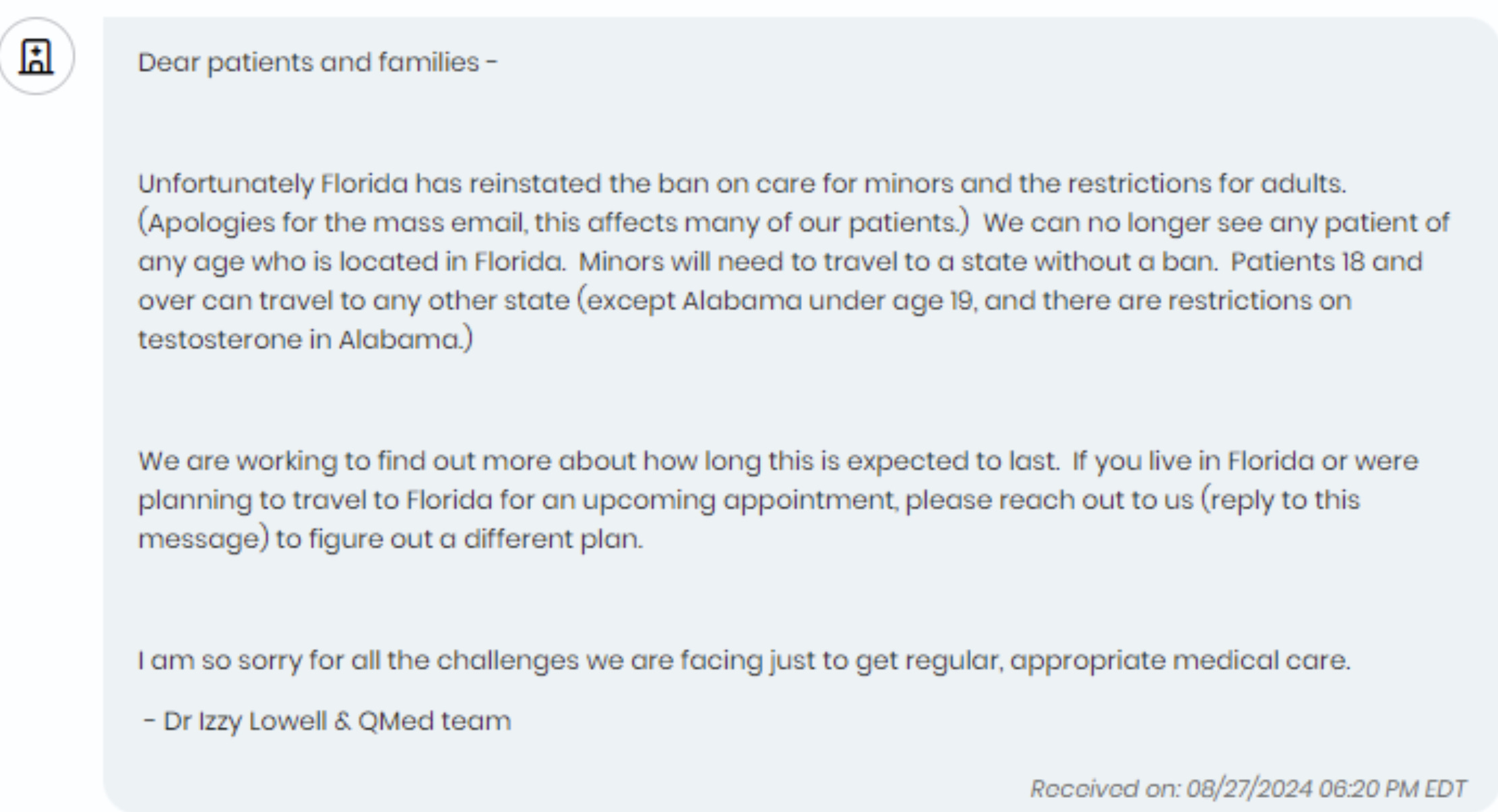
One anonymous patient shared an email from their provider, QueerMed, which stated, “Unfortunately, Florida has reinstated the ban on care for minors and the restrictions for adults… We can no longer see any patient of any age who is located in Florida.”
See that email here:
Email provided from a QueerMed Patient
Spektrum, a major provider in Florida, was also forced to terminate care and cancel new patient appointments. However, during the period when the law was blocked, the organization reportedly took steps to ensure patients were well-supplied with medication in case the law went back into effect:
“During this little freedom period as I call it … we made good use of that time to make sure all of our patients were well supplied with medication. Although I had hoped that it wouldn’t have been necessary, at least now we can say, I’m glad we did all the things that we did,” said Joseph Knoll, a nurse practitioner at the clinic, as reported by the Associated Press.
Healthcare bans are currently a contentious issue in courts across the United States, with some courts blocking bans on transgender healthcare coverage or provision. A major point of contention is whether discrimination against transgender people qualifies as sex discrimination, which would subject these laws to higher scrutiny regarding their constitutionality.
The Supreme Court is poised to rule on such questions later this year in a case stemming from Tennessee’s trans care ban. If the Supreme Court were to rule that transgender people are not entitled to equal protection under the law, many forms of discrimination against transgender youth and adults could be deemed fully legal.
For trans people in Florida, many cannot afford to wait for such a decision, and many have already fled the state. For those unable to leave, disruptions to their care will likely have significant impacts on their mental and physical health.
“We are deeply disappointed by this decision and the panel’s disregard for the district court’s careful findings and adherence to the Eleventh Circuit’s recent precedent. Allowing these discriminatory restrictions to go back into effect will deny transgender adults and adolescents lifesaving care, and prevent Florida parents from making medical decisions that are right for their children. As the district court found based on voluminous evidence, the record shows that these extraordinary restrictions were based on disapproval of transgender people and serve no purpose other than to harm transgender Floridians. The plaintiffs in this case are considering their options and will take every step possible to protect their right to equal treatment under Florida’s laws, which these restrictions egregiously violate. We will continue fighting for transgender Floridians and their families, and for everyone’s right to make healthcare decisions without government interference,” said the organizations representing the plaintiffs in the case.

 Barbara Gittings leading a picket in the ’60s