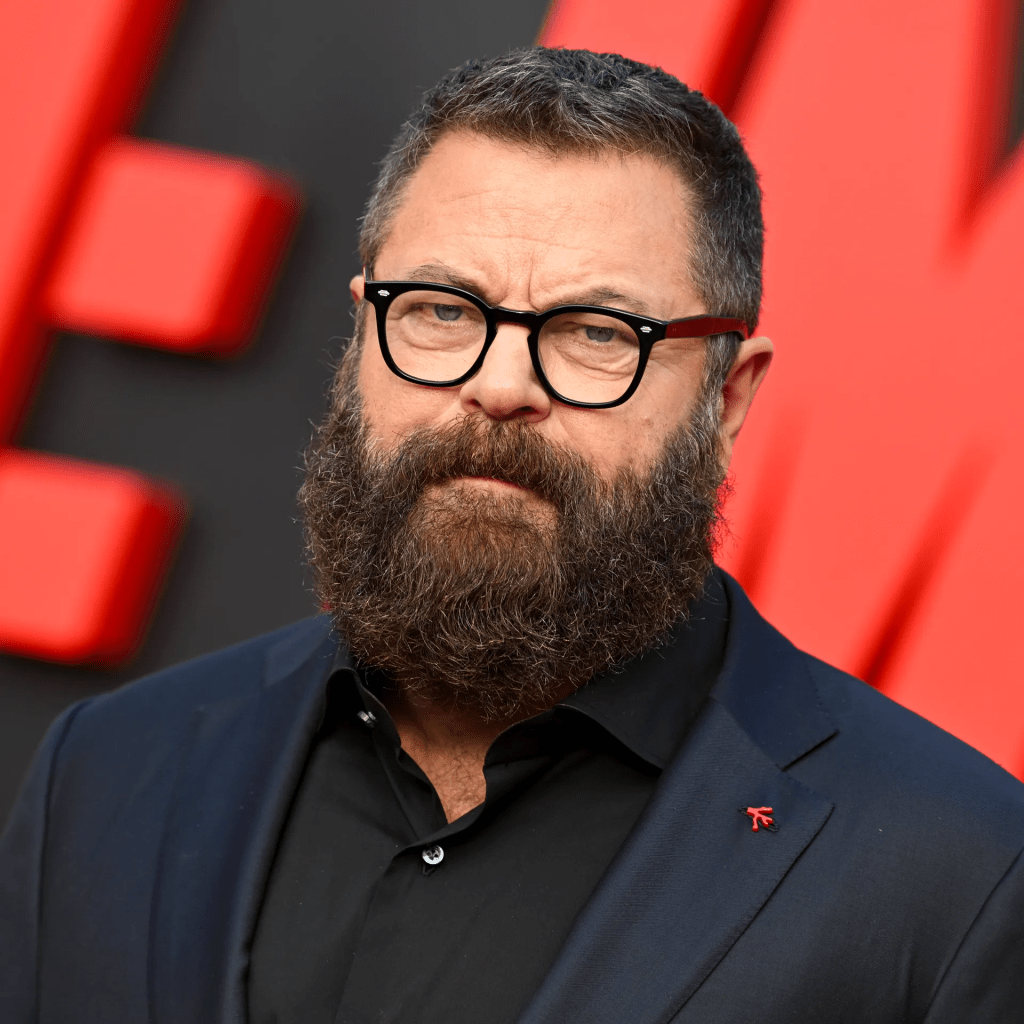
Homophobia during Pride Month? Not on Nick Offerman’s watch.
In what would prove to be a woefully misguided attempt to dunk on LGBTQ+ people, Michael Flynn Jr. (who, according to his X bio is the son of General Michael Flynn, President Donald Trump’s national security advisor for 22 days in 2017) posted to X to share a GIF from the NBC sitcom Parks and Recreation. The moment, taken from the episode “The Trial of Leslie Knope,” shows Offerman’s character Ron Swanson throwing his computer into a dumpster. However, the GIF Flynn shared had been edited to show Swanson tossing a rainbow Pride flag into the dumpster. (snip-embedded tweet on the page)
“Just wanted to show how I feel about pride month,” Flynn Jr. wrote.
Offerman, who also recently starred as half of a gay couple in the first season of The Last of Us, was not willing to let this mischaracterization of Swanson stand. (snip-see embedded tweet on the page)
“Ron was best man at a gay wedding you dumb fuck,” Offerman wrote in a tweet that quoted Flynn’s original. He added a “#HappyPride” hashtag. At the time of writing, more than 429,000 people have faved the post.
Offerman’s Swanson played best man during a same-sex wedding in the series finale, which saw Swanson’s hairdresser Typhoon marry Craig, a member of the Parks and Recreation staff.
Several X users also clapped back at Flynn’s post. (snip-embedded tweet, see it on the page)
“The man in this gif is currently mourning the murder of his co-star Jonathan Joss, who was harassed for months, had his house burned down and his dog killed and before being shot by a homophobic freak like you,” wrote Hamish Steele, creator of the animated show Dead End: Paranormal Park. “You find pride annoying? Big deal. We get killed by your lot.”
Just one day after defending the existence of Pride Month, Offerman issued a statement to People about the death of his Parks and Rec co-star Jonathan Joss, who was killed in what his husband says was a homophobic attack following years of anti-LGBTQ+ harassment and threats. (San Antonio police say they have found “no evidence to indicate that Mr. Joss’s murder was related to his sexual orientation.”)
“The cast has been texting together about it all day and we’re just heartbroken,” Offerman said. “Jonathan was such a sweet guy and we loved having him as our Chief Ken Hotate. A terrible tragedy.”
As maddening as it is to have to defend Pride during Pride, it’s always nice when a straight ally is willing to take homophobia right to the dumpster.
from Heather Cox Richardson. Though our current president has little respect for U.S. veterans, that is not true of anybody I know. Even anti-war I believe our current service people and our veterans are deserving of all benefits of their citizenship and especially added benefits of their service to the U.S. Many readers here are military veterans. My mother’s brother-in-law, my (favorite!) Uncle Jack, served as a U.S. Marine in WWII. My father served in the U.S. Army during the Korean conflict. All of us know and love someone who’s served us in this honorable and unique fashion. While our president doesn’t think to respect that, or even think about it at all, the rest of us do. I know we are thankful. And now, from Heather Cox Richardson, history expert,
Today the U.S. political world was consumed today by a public fight between President Donald J. Trump and his former sidekick, billionaire Elon Musk. Musk invested about $290 million into the 2024 election, vowing to elect Trump in order to get rid of government investigations into his businesses he worried would “take [him] down.”
When Trump took office, Musk became a fixture in the White House, attending Cabinet meetings and heading the “Department of Government Efficiency.” That group set out to kill government programs by withholding congressionally approved funds at the same time that its staff sucked up information on Americans that could feed the training of artificial intelligence and killed the investigations into his businesses Musk had worried about.
In February, Musk posted on social media: “I love [Donald Trump] as much as a straight man can love another man.”
But Musk overstepped boundaries and overstayed his welcome even as his antics hurt sales of his signature car, the Tesla, inspiring Trump to do a car commercial for him on the White House grounds. Just a week ago, Musk officially left the White House on the same day that an article in the New York Times documented his heavy drug use on the campaign.
Then, on Tuesday, June 3, he took a public stand against the omnibus bill Trump desperately wants Congress to pass, posting on X: “I’m sorry, but I just can’t stand it anymore. This massive, outrageous, pork-filled Congressional spending bill is a disgusting abomination. Shame on those who voted for it: you know you did wrong. You know it.”
And with that, the falling out began.
This morning, Trump told reporters he was “disappointed” in Musk. Ron Filipkowski of Meidas followed the saga from there.
“Without me, Trump would have lost the election, Dems would control the House, and the Republicans would be 51–49 in the Senate,” Musk wrote. “Such ingratitude.”
Trump then suggested that “The easiest way to save money in our Budget, Billions and Billions of Dollars, is to terminate Elon’s Governmental Subsidies and Contracts. I was always surprised that Biden didn’t do it!”
Musk promptly said he would begin decommissioning SpaceX’s spacecraft, which supply the International Space Station.
The two men continued to go back and forth, with Musk saying that “Donald Trump is in the Epstein files,” a reference to the records compiled by convicted sex offender Jeffrey Epstein, with whom Trump was friendly. Musk also said Trump’s tariffs will cause a recession, and agreed with another poster who suggested that Trump should be impeached and replaced with Vice President J.D. Vance.
Trump responded to that attack far more weakly than one would have expected, simply turning back to the omnibus bill and insisting it “is one of the Greatest Bills ever presented to Congress.”
Musk’s behavior is erratic in its own right, but if there is anything but pique behind it, it appears he is threatening Trump by making a play to control the Republican Party. In response to a post by conspiracy theorist Laura Loomer suggesting that Republican lawmakers are unsure if they should side with Trump or Musk, Musk wrote: “Oh and some food for thought as they ponder that question: Trump has 3.5 years left as President, but I will be around for 40+ years.”
It’s quite a gamble, since Trump controls the government contracts on which Musk’s fortune was built and on which he still relies. Some MAGA loyalists appear to see the fight as a victory for Trump and are thrilled to see Musk’s star fall. MAGA influencer Steve Bannon told Tyler Pager of the New York Times that he has advised Trump to cancel all of Musk’s federal contracts and launch a formal investigation of his drug use and his immigration status.
Kylie Robison and Aarian Marshall of Wired noted that TrumpCoin lost more than $100 million in value during the fight. Tesla stock lost $152 billion of value from its market capitalization, prompting Filipkowski to note that the total came to about $9 billion per tweet.
Economist Robert Reich had perhaps the best summary of the fight today when he noted, “That any of us have to care about the messy breakup of these two massive narcissists—and that they both individually wield such massive power—is an indictment of our political system and further proves the poisonous influence of Big Money on our democracy.”
Indeed, today’s White House and today’s America are very different from what they were eighty-one years ago.
President Franklin Delano Roosevelt gave his twenty-ninth Fireside Chat on June 5, 1944, and had good news for the American people. The day before, on June 4, Rome had fallen to Allied troops. “The first of the Axis capitals is now in our hands,” Roosevelt said.
The president pointed out that it was “significant that Rome has been liberated by the armed forces of many nations. The American and British armies—who bore the chief burdens of battle—found at their sides our own North American neighbors, the gallant Canadians. The fighting New Zealanders from the far South Pacific, the courageous French and the French Moroccans, the South Africans, the Poles and the East Indians—all of them fought with us on the bloody approaches to the city of Rome. The Italians, too, forswearing a partnership in the Axis which they never desired, have sent their troops to join us in our battles against the German trespassers on their soil.”
This group of ordinary men from many different countries had worked together to defeat the forces of fascism.
But FDR warned Americans that the fall of Rome was only the beginning. “We shall have to push through a long period of greater effort and fiercer fighting before we get into Germany itself,” he said. [T]he victory still lies some distance ahead. That distance will be covered in due time—have no fear of that. But it will be tough and it will be costly.”
FDR knew something his audience did not. On the other side of the Atlantic, paratroopers, their faces darkened with cocoa, were already dropping into France, and the soldiers, sailors, and airmen of the Allies were on their way across the English channel.
The order of the day from their commander Dwight D. Eisenhower that day had read: “You are about to embark upon the Great Crusade, toward which we have striven these many months. The eyes of the world are upon you. The hopes and prayers of liberty-loving people everywhere march with you. In company with our brave Allies and brothers-in-arms on other Fronts, you will bring about the destruction of the German war machine, the elimination of Nazi tyranny over the oppressed people of Europe, and security for ourselves in a free world.
“Your task will not be an easy one,” it read, but it assured the troops that the Germans had suffered great defeats and Allied bombing had reduced German strength, while “[o]ur Home Fronts have given us an overwhelming superiority in weapons and munitions of war, and placed at our disposal great reserves of trained fighting men. The tide has turned! The free men of the world are marching together to Victory!”
Eisenhower’s public confidence did not reflect his understanding that the largest amphibious invasion in military history was a gamble. On June 5, in pencil on a sheet of paper, he had written a message to be communicated in case the invasion failed.
“Our landings in the Cherbourg-Havre area have failed to gain a satisfactory foothold and I have withdrawn the troops,” it read. “My decision to attack at this time and place was based upon the best information available. The troops, the air and the Navy did all that bravery and dedication to duty could do. If any blame or fault attaches to the attempt it is mine alone.”
On the morning of June 6, 1944, five naval assault divisions stormed the beaches of Normandy. Seven thousand ships and landing craft operated by more than 195,000 naval personnel from eight countries brought almost 133,000 troops to beaches given the code names UTAH, OMAHA, GOLD, JUNO, and SWORD. By the end of the day, more than 10,000 Allied troops were wounded or killed, but the Allies had established a foothold in France that would permit them to flood troops, vehicles, and supplies into Europe. When FDR held a press conference later that day, officials and press alike were jubilant.
“Queer” is not about who you’re having sex with (that can be a dimension of it), but “queer” as being about the self that is at odds with everything around it and has to invent and create and find a place to speak and to thrive and to live.” —bell hooks
I’ve always been queer, but it took me a while to realize it. Even after coming out as gay, I still struggled with the language of “queer” because I grew up hearing it used as a slur. In many places, it still is. I remember the shocked look on the faces of a lecture audience in rural England when I said “queer” — as if I had uttered a curse word.
This is how the word sits with many people — even within the LGBTQIA+ community. But over the years, as I’ve wrestled with my identity, learned the history of LGBTQIA+ liberation, and developed my beliefs, I’ve come to resonate deeply with being queer, just as much as with being Christian.
In fact, for me, to be an authentic Christian — one who seeks to follow the life and teachings of Jesus — is to be queer. Let me explain.
To be queer generally means one of two things. First, it’s a catch-all phrase for the LGBTQIA+ community — those who embrace a non-heterosexual orientation and/or non-cisgender identity. Second, queer also means to disrupt arbitrary norms, making space for diverse, often marginalized, expressions to flourish.
To be queer means resisting the repression of our true selves and the forces that demand we conform to others’ ideas of who we should be. It’s a declaration of our commitment to live authentically — who God created us to be — not who society or religion says we must become.
In this sense, queerness is holy. It affirms that God doesn’t make mistakes — that our unique expression reflects God’s creativity — and refuses to blaspheme the Creator by suppressing that divine image. When seen this way, queerness is a calling every person should aspire to.
To follow Jesus is to refuse conformity, as Paul wrote: “[to] be transformed by the renewing of your mind” (Romans 12:2). This means shifting how we see ourselves and others — removing the masks we were taught to wear, the roles we were conditioned to play. In this way, queerness is deeply aligned with the way of Jesus.
bell hooks defines queerness as “being at odds with everything around it.” That feels exactly right. We live in a world shaped by systems built to benefit particular people. What’s considered “normal” is often an invention — crafted to maintain control and marginalize difference. Nothing has always been the way it is, and it shouldn’t remain the same.
Today, there’s a rising awareness of the value of diversity and pluralism by many in society (while diversity is also demonized by many). More people are becoming suspicious of those who demonize difference and cling to the status quo. The past century has shown us that the status quo is often built on lies that lead to oppression.
Our society was set up by people who established norms to benefit themselves. But as the world grows more connected and aware of diverse ways of being, movements of resistance have chipped away at this conformity and demanded a new, inclusive path. These movements are “queering” society — questioning and resisting what’s been called normal — and they’ve made the world more just and diverse.
One of the most resistant institutions to queering has been Christianity. This isn’t surprising. Religion resists change, and Christian institutions have fought nearly every cultural shift from desegregation to women’s voting rights to rock music. Those willing to reform are often labeled heretics and excluded from church power. But every so often, resistance sparks reform in the church. The Protestant Reformation, the abolitionist movement, and the fight for women’s rights have all queered Christianity by disrupting norms and pushing forward new expressions of faith.
The inclusion of queer people in Christianity is another such movement. Today, nearly every mainline Protestant denomination in the U.S. officially affirms queer people. We can serve as clergy, marry, and be fully embraced. While there are many local congregations in each denomination that resist these changes, the movement for inclusion is well underway. This is a remarkable shift.
Just last year, Pope Francis announced that Catholic priests may bless same-sex couples. A few months before, he said transgender people could be baptized and serve as godparents. Though these don’t change Catholic doctrine, they marked major steps forward that made many lay queer Catholics feel more included in their churches.
Still, there is much work to do. The truth remains that most Christians worldwide still uphold anti-queer theology. Many still preach that homosexuality is an abomination. Many still teach that women must submit to men and cannot lead.
Progressive Christians sometimes believe the church is rapidly changing, but that’s often just the view from our bubble. Most Christians still cling to rigid, patriarchal theology. And I’ve come to believe that the only way to challenge that resistance is through queering.
Not every LGBTQIA+ Christian agrees with this strategy. There are many queer Christians who would prefer to simply shift the church’s understanding of the six clobber passages and be accepted into the traditional Christian institution with its traditional sexual ethics, understanding of relationships, and devotion to conservative theology otherwise. I understand that desire; I once had it too. But I’ve come to believe it’s actually counterproductive to our flourishing as queer people.
The more I’ve studied Scripture and listened to queer stories, the more convinced I’ve become: The issue isn’t a few misinterpreted Bible verses — it’s that Christianity was institutionalized. A few hundred years after Jesus, his radical movement was merged with the Roman Empire and transformed into rules, dogma, and rigid orthodoxy.
Other perspectives were labeled heresy, punished, and driven underground. What remained became dominant: a version of Christianity that, frankly, looks nothing like Jesus.
When I became a Christian, it was because I wanted to follow Jesus — not an institution. But I was quickly taught that faithfulness to Jesus meant faithfulness to the church. I learned the doctrines and ethics of my church and saw that the more I conformed, the more I was accepted — and even celebrated.
From adopting the politics of my pastors to unquestioningly espousing conservative theology, to even dressing in ways that mirrored the evangelical subculture, I learned that through conforming and contorting myself to look, believe, vote, and act like what was seen as normative for evangelical Christians, my inclusion would be solidified.
I gained status and privilege. I was affirmed by my church and I believed that this meant I was close to God. But I felt uneasy, even early on. As I read Scripture, I struggled to see our theology or ethics reflected in Jesus’ life. Jesus lived on the margins of religious and political power. He constantly challenged the status quo and resisted exclusionary doctrine.
I came to see that neither I nor my church looked like Jesus. That realization was unsettling. Eventually, it led me to believe that queering Christianity wasn’t just permissible — it was necessary. Not only for LGBTQIA+ inclusion, but for everything and everyone.
Rather than blindly accepting church authority, I began to pursue truth wherever it led and invited others to do the same. My ministry became about queering Christianity, not just including queer people in the traditional frameworks of the church.
That meant challenging every theology and ethic that doesn’t reflect Jesus’ ethic of love. It meant reimagining how we follow Jesus — beyond traditional Christianity.
This is, I believe, the most faithful path. But it’s also the hardest. It requires us to stop seeking the affirmation of and inclusion in the old structures and instead focus on building subversive, queerly spiritual communities that reflect the Spirit of Christ.
It means being open to truth from everywhere and everyone — because all truth is God’s truth — and letting it shape our spiritual journeys.
It means getting used to being called heretics. Excluded even from some so-called affirming churches that find our vision too radical. But our goal isn’t to be welcomed because we conform — it’s to create a community that welcomes all expressions and beliefs, grounded in the love and example of Jesus in whatever form that takes.
Our goal isn’t even to be “Christians,” really. Jesus never used that word. Never spoke a Christian doctrine. Never stepped inside a Christian church. So inclusion in the traditional institutions of Christianity isn’t the point.
The point is a truly queer revolution of faith that liberates us all to show up authentically, that remains open to the voice of our still-speaking God in the most unlikely people and places, and that understands that the Kingdom of God that Jesus preached and embodied can never be contained in the rigid boundaries of any institution, but is found among the diversity, complexity, and beauty of all of our human experiences.
Editor’s note: This essay is an adaptation from Queer & Christian: Reclaiming the Bible, Our Faith, and Our Place at the Table. It has been adapted with the permission of St. Martin’s Essentials.
It’s been stormy/flooding/messy all day long, Ollie is not happy with the weather so I’ve been busy keeping him busy, we’ve still got about an hour to go with the weather, and now I can’t recall where, this morning over breakfast, I read this about Compass Group promoting PRIDE. But, the tab is still up there, so here it is at not quite suppertime!
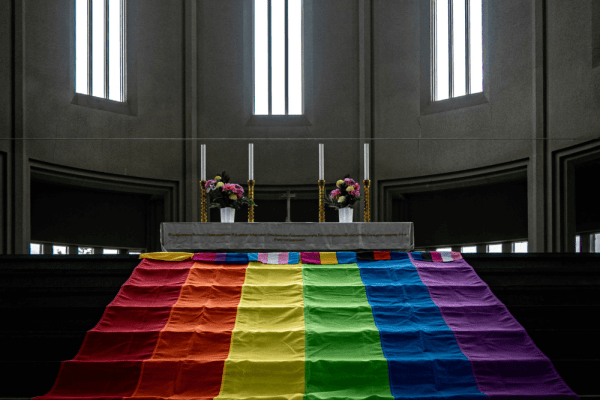
June is here, and with it comes Pride Month – a powerful celebration of love and authenticity. It’s a time to recognize the rich history of the LGBTQ+ community while embracing the voices that make our workplace stronger, more inclusive, and deeply connected.
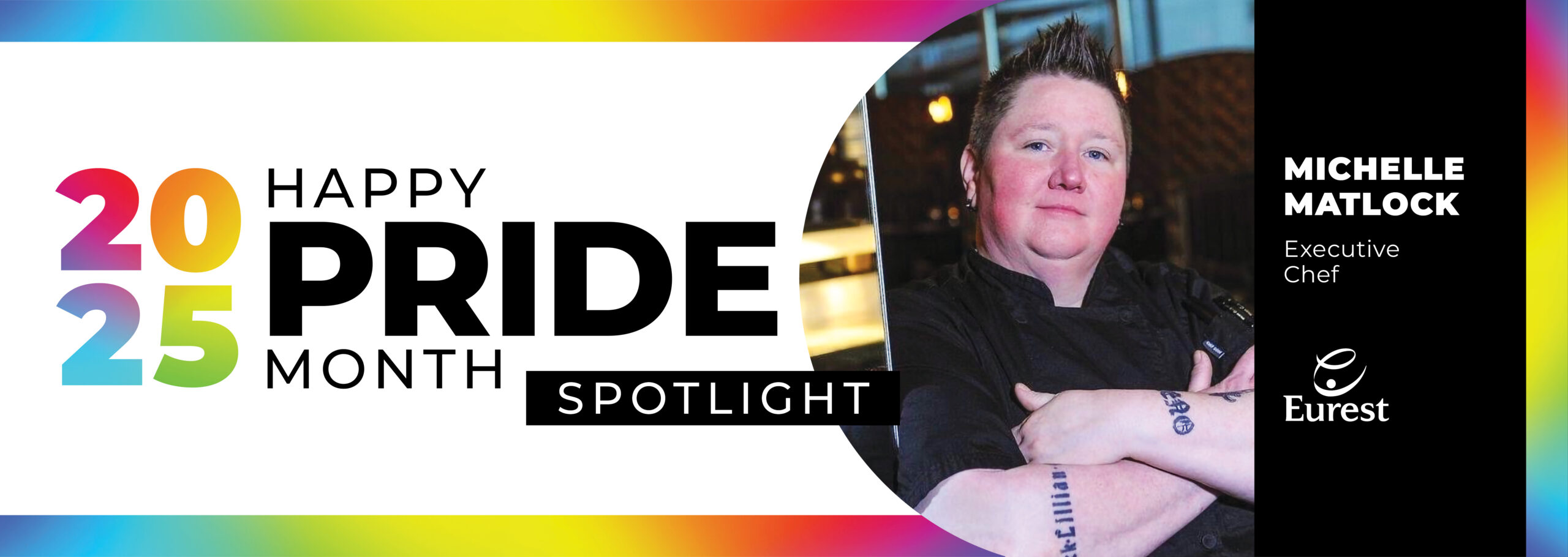
Meet three inspiring associates from across Compass Group’s family of businesses – Elise, Greg, and Chef Michelle – whose journeys of inclusion and belonging enrich our organization in meaningful ways. Through their work, passion, and personal experiences, they continue to cultivate spaces where everyone can thrive.
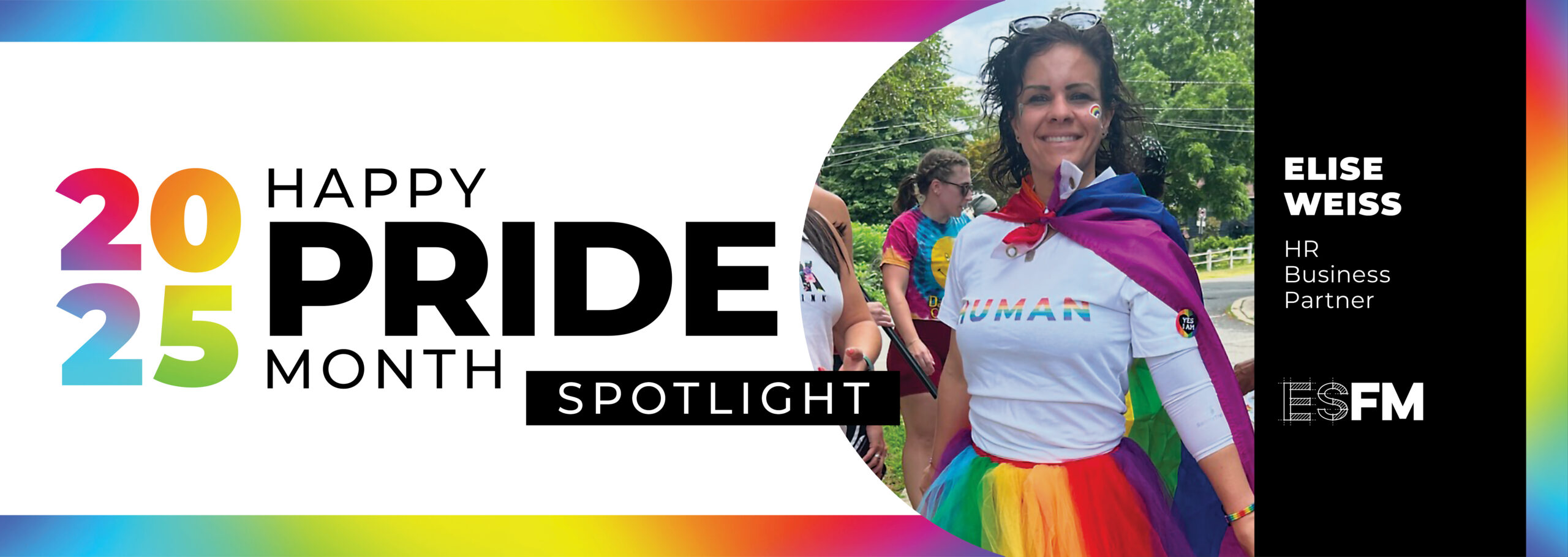
Elise Weiss has been with ESFM for seven years. The best part of her job as an HR business partner is building relationships, fostering strong team dynamics, and simplifying tough situations. Education and empowerment drive her. Leading ESFM’s Global University of Lifelong Learning (GULL) program as well as serving as co-chair of its Diversity & Inclusion Action Council (DIAC) make her work deeply fulfilling.
“Pride Month means LOVE is LOVE! Accepting everyone as they are so that no one fears loving who they truly love,” Elise says.
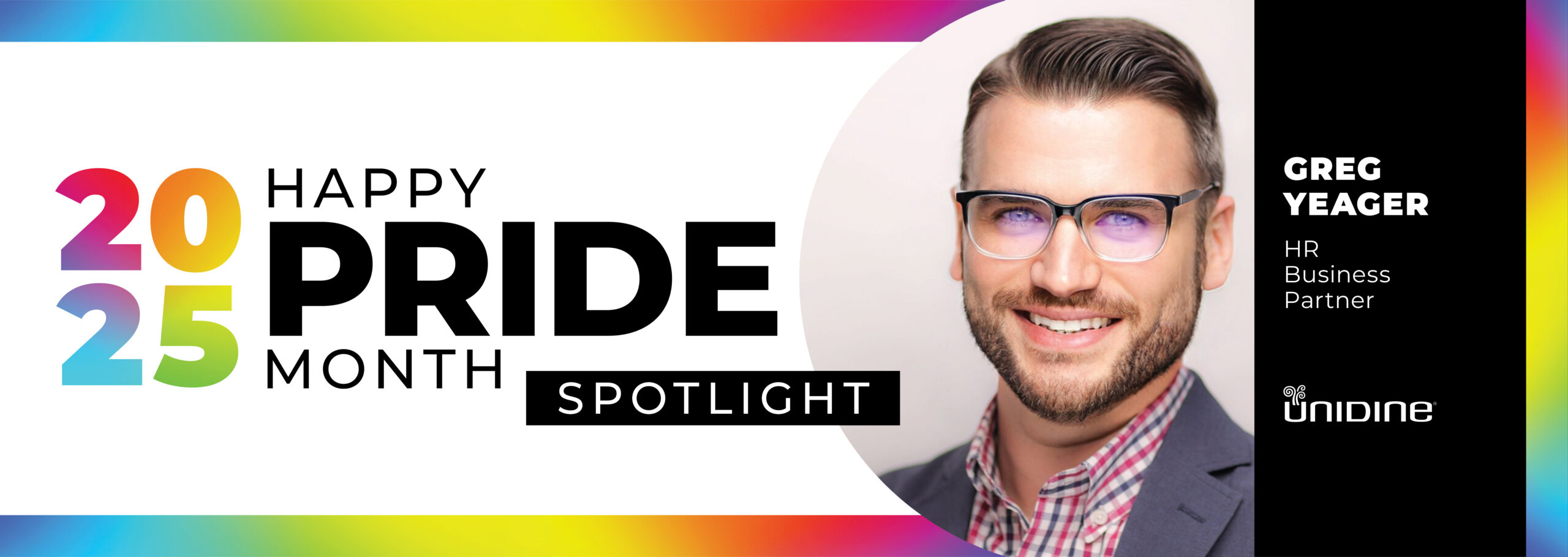
Greg Yeager has been with Unidine for eight years and currently serves in strategic dining services and national accounts as the HR business partner. Making a difference in people’s lives – with the support of his incredible team – is what he loves most about his position
“Pride is a reminder of both the progress made and the work still needed to ensure equal rights and respect for everyone,” Greg adds. “It’s also a deeply personal time when I acknowledge and celebrate my own growth, embracing who I am unapologetically.”
Chef Michelle M. Matlock CEC has been with Compass for three years, and for the past year has been an Executive Chef in Atlanta with Eurest.
“What I love most about my job is spending my life’s energy within a group that supports diversity, equality and inclusion,” Chef Michelle declares. “I love being able to mentor our young chefs and leaders. I adore my leadership and believe in their life’s work so much, find our corporate goals so similar, it keeps me going.”
Greg, Chef Michelle, and Elise’s respective journeys have been shaped by many people, and their experiences within the LGBTQ+ community have influenced their careers.
“I often wonder if I’ve done enough, because just living openly doesn’t always feel like enough,” Greg notes. “Getting into HR grounded me, showing me that I could be the person I had always needed – a representative living openly.” Greg hopes to be that person for future generations entering the hospitality industry.
A pivotal figure in Chef Michelle’s life was Charlene Schneider, who opened the first LGBTQ+ tavern in New Orleans in the 1950s. She was a “Den Mother” to many LGBTQ+ youth, offering acceptance, guidance, and life skills. She once told Michelle, “People walk through this world every day, just hoping someone will smile their way. BE THAT PERSON.” She taught Michelle honor, ethics, never to hide, and to BE SEEN.
Elise’s path has also been influenced by people who embody authenticity, strength, acceptance, empathy and love – qualities she strives for. Her most life-changing discovery, however, is yoga. “The inward journey transformed me, replacing fear with acceptance and love,” she says.
Each has precious advice to share with colleagues striving to be more inclusive.
Chef Michelle considers herself an “Elder” in the LGBTQ+ community and shares this impassioned message: “TO OUR BEAUTIFUL LGBTQ+ YOUTH – TO ‘B’ – Sometimes the world swings ugly and sometimes it swings back to beauty. In all these times, you are loved, you are important, you are beautiful EXACTLY as you are, and you MATTER. Know your history, get involved, define our community for US so that others can’t define it for YOU.”
Elise advises her teams to lead with vulnerability and humility. “Show up, listen, and be present. People feel that, and it matters,” she says. “In the photo, my shirt says ‘HUMAN,’ because kindness is what matters, not labels. Live in the energy of love, and never forget our shared humanity – we are all equal.”
And Greg encourages open and honest conversations. “Understanding comes from curiosity and the willingness to learn; I always tell friends and family to ask me anything,” he adds. “If it helps bridge the gap in understanding that our lives aren’t so different, then that’s one more educated mind shaping a better future.”
As Pride Month unfolds, let’s celebrate the progress made while recommitting to the work still ahead. Elise, Greg, and Chef Michelle remind us that inclusion is about people, actions, and creating spaces where everyone feels seen, valued, and empowered to be their authentic selves. Their stories illuminate the power of representation, resilience, and genuine connection. As we honor Pride, let’s continue building a workplace – and a world – where acceptance isn’t just a celebration for one month, but a commitment we carry every day.
“This is your month to celebrate the strength and courage it takes to be your authentic self. But this month is not just about celebrating, it’s also about commemorating and remembering AND creating safer spaces for people to feel Pride about being their authentic selves!
“These quotes from activists, artists, politicians, entertainers, and more emphasize what it means to be an LGBTQ+ person. I hope they inspire and encourage you along your journey of being LGBTQ+ or celebrating those who are.
1. “Love is too beautiful to be hidden in the closet.” – Anonymous
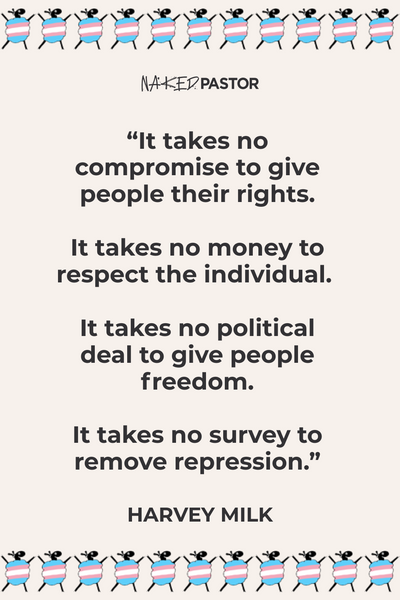
2. “It takes no compromise to give people their rights … it takes no money to respect the individual. It takes no political deal to give people freedom. It takes no survey to remove repression.” – Harvey Milk
3. “So let me be clear: I’m proud to be gay, and I consider being gay among the greatest gifts God has given me.” – Tim Cook
At the end of the video the Reverend says our only job is to love god by loving others. The only question is … how much will you love. Good thoughts in this video. Had the church been like this when I was a teen, had the church been inclusive like this when I was a little boy being molested by the Pastor I would have stayed in the faith, in the church. I might not have believed in the magic parts of the bible and I might have quibbled over the facts, but I would have stayed for the community. The environment of people who enjoyed each other’s company and loved the comradery of fellowship. Sadly the churches I saw as a child, as a teen, and as an adult lost people because rather than love, they clung to hate. The joy of feeling better than some other group, of being able to look down on them, to revel in negative emotions meant more to them than hugging those different that maybe they did not understand. They set themselves up as god judging others. Not as a loving flock, but as deciders over who was worthy to be in the flock. They were not the sheep, they wanted to be the Sheppard. Hugs







 Scottie's Playtime